Moderating Effects of Muscle Fitness on the Associations Between Work Stress, Burnout, and Well-Being Among White-Collar Workers

 ,
,
Abstract
1. Introduction
2. Materials and Methods
2.1. Study Design and Participants
2.2. Data Collection Procedures
2.2.1. Assessment of Work Stress
2.2.2. Assessment of Burnout
2.2.3. Assessment of Well-Being
2.2.4. Body Mass Index (BMI)
2.2.5. Muscle Fitness Measurements
2.3. Statistical Analysis
3. Results
4. Discussion
5. Conclusions
Author Contributions
Funding
Institutional Review Board Statement
Informed Consent Statement
Data Availability Statement
Acknowledgments
Conflicts of Interest
References
- Ganster, D.C.; Rosen, C.C. Work stress and employee health: A multidisciplinary review. J. Manag. 2013, 39, 1085–1122. [Google Scholar] [CrossRef]
- Eurofound. Working Conditions and Workers’ Health; Publications Office of the European Union: Luxembourg, 2018. [Google Scholar]
- Maslach, C.; Schaufeli, W.B.; Leiter, M.P. Job burnout. Annu. Rev. Psychol. 2001, 52, 397–422. [Google Scholar] [CrossRef]
- Schaufeli, W.B.; Bakker, A.B. Job demands, job resources, and their relationship with burnout and engagement. J. Organ. Behav. 2004, 25, 293–315. [Google Scholar] [CrossRef]
- Maslach, C.; Leiter, M.P. Understanding the burnout experience: Recent research and its implications for psychiatry. World Psychiatry 2016, 15, 103–111. [Google Scholar] [CrossRef]
- Ryff, C.D. Happiness is everything, or is it? Explorations on the meaning of psychological well-being. J. Pers. Soc. Psychol. 1989, 57, 1069–1081. [Google Scholar] [CrossRef]
- Keyes, C.L.M. Mental illness and/or mental health? Investigating axioms of the complete state model of health. J. Consult. Clin. Psychol. 2005, 73, 539–548. [Google Scholar] [CrossRef]
- World Health Organization. The World Health Organization-Five Well-Being Index (WHO-5); World Health Organization: Geneva, Switzerland, 2024. [Google Scholar]
- Topp, C.W.; Østergaard, S.D.; Søndergaard, S.; Bech, P. The WHO-5 Well-Being Index: A systematic review of the literature. Psychother. Psychosom. 2015, 84, 167–176. [Google Scholar] [CrossRef] [PubMed]
- Keyes, C.L.M. The mental health continuum: From languishing to flourishing in life. J. Health Soc. Behav. 2002, 43, 207–222. [Google Scholar] [CrossRef] [PubMed]
- Nielsen, K.; Nielsen, M.B.; Ogbonnaya, C.; Känsälä, M.; Saari, E.; Isaksson, K. Workplace resources to improve both employee well-being and performance: A systematic review and meta-analysis. Work Stress 2017, 31, 82–99. [Google Scholar] [CrossRef]
- Cheng, Y.; Chen, I.-S.; Burr, H.; Chen, C.-J.; Chiang, T.-L. Changes in psychosocial work conditions in Taiwanese employees by gender and age from 2001 to 2010. J. Occup. Health 2013, 55, 323–332. [Google Scholar] [CrossRef]
- Amore, M.; Alfarano, A.; Sorgente, V.; Panconi, G.; Guarducci, S.; Bravi, R.; Minciacchi, D. Single-bout strength: Acute mental health responses to resistance training in active adults. Sports 2025, 13, 221. [Google Scholar] [CrossRef]
- Landrigan, J.-F.; Bell, T.; Crowe, M.; Clay, O.J.; Mirman, D. Lifting cognition: A meta-analysis of effects of resistance exercise on cognition. Psychol. Res. 2019, 83, 928–949. [Google Scholar] [CrossRef]
- Blair, S.N.; Kohl, H.W.; Paffenbarger, R.S., Jr.; Clark, D.G.; Cooper, K.H.; Gibbons, L.W. Physical fitness and all-cause mortality: A prospective study of healthy men and women. JAMA 1989, 262, 2395–2401. [Google Scholar] [CrossRef]
- Warburton, D.E.R.; Nicol, C.W.; Bredin, S.S.D. Health benefits of physical activity: The evidence. CMAJ 2006, 174, 801–809. [Google Scholar] [CrossRef] [PubMed]
- Lee, I.-M.; Shiroma, E.J.; Lobelo, F.; Puska, P.; Blair, S.N.; Katzmarzyk, P.T. Effect of physical inactivity on major non-communicable diseases worldwide: An analysis of burden of disease and life expectancy. Lancet 2012, 380, 219–229. [Google Scholar] [CrossRef] [PubMed]
- Jackson, E.M.; Dishman, R.K. Cardiorespiratory fitness and stress reactivity. Psychophysiology 2006, 43, 57–72. [Google Scholar] [CrossRef] [PubMed]
- Gerber, M.; Pühse, U. Do exercise and fitness protect against stress-induced health complaints? A review of the literature. Scand. J. Med. Sci. Sports 2009, 19, 801–819. [Google Scholar] [CrossRef]
- Tang, F.C.; Wang, W.H.; Chen, H.Y.; Li, R.H.; Huang, S.L. Exploring the moderating effect of cardiorespiratory fitness on the association between work stress and burnout. Workplace Health Saf. 2025; submitted. [Google Scholar]
- Bohannon, R.W. Hand-grip dynamometry predicts future outcomes in aging adults. J. Geriatr. Phys. Ther. 2008, 31, 3–10. [Google Scholar] [CrossRef]
- Leong, D.P.; Teo, K.K.; Rangarajan, S.; Lopez-Jaramillo, P.; Avezum, A.; Orlandini, A.; Seron, P.; Ahmed, S.H.; Rosengren, A.; Kelishadi, R.; et al. Prognostic value of grip strength: Findings from the Prospective Urban Rural Epidemiology (PURE) study. Lancet 2015, 386, 266–273. [Google Scholar] [CrossRef]
- Naczenski, L.M.; de Vries, J.D.; van Hooff, M.L.M.; Kompier, M.A.J. Systematic review of the association between physical activity and burnout. J. Occup. Health 2017, 59, 477–494. [Google Scholar] [CrossRef]
- McGill, S.M. Low Back Disorders: Evidence-Based Prevention and Rehabilitation; Human Kinetics: Champaign, IL, USA, 2002. [Google Scholar]
- Granata, K.P.; Marras, W.S. Cost–benefit of muscle cocontraction in protecting against spinal instability. Spine 2000, 25, 1398–1404. [Google Scholar] [CrossRef] [PubMed]
- Lis, A.M.; Black, K.M.; Korn, H.; Nordin, M. Association between sitting and occupational LBP. Eur. Spine J. 2007, 16, 283–298. [Google Scholar] [CrossRef]
- Biering-Sørensen, F. Physical measurements as risk indicators for low-back trouble over a one-year period. Spine 1984, 9, 106–119. [Google Scholar] [CrossRef]
- McGill, S.M.; Childs, A.; Liebenson, C. Endurance times for low back stabilization exercises: Clinical targets for testing and training from a normal database. Arch. Phys. Med. Rehabil. 1999, 80, 941–944. [Google Scholar] [CrossRef]
- Honkonen, T.; Ahola, K.; Pertovaara, M.; Isometsä, E.; Kalimo, R.; Nykyri, E.; Aromaa, A.; Lönnqvist, J. The association between burnout and physical illness in the general population. J. Psychosom. Res. 2006, 61, 59–66. [Google Scholar] [CrossRef]
- Melamed, S.; Shirom, A.; Toker, S.; Berliner, S.; Shapira, I. Burnout and risk of cardiovascular disease: Evidence, possible causal paths, and promising research directions. Psychol. Bull. 2006, 132, 327–353. [Google Scholar] [CrossRef]
- Karasek, R.A. Job demands, job decision latitude, and mental strain: Implications for job redesign. Adm. Sci. Q. 1979, 24, 285–308. [Google Scholar] [CrossRef]
- Bakker, A.B.; Demerouti, E. The Job Demands–Resources model: State of the art. J. Manag. Psychol. 2007, 22, 309–328. [Google Scholar] [CrossRef]
- Karasek, R.; Theorell, T. Healthy Work: Stress, Productivity, and the Reconstruction of Working Life; Basic Books: New York, NY, USA, 1990. [Google Scholar]
- Kivimäki, M.; Kawachi, I. Work stress and risk of cardiovascular disease. Curr. Cardiol. Rep. 2015, 17, 630. [Google Scholar] [CrossRef] [PubMed]
- Cheng, Y.; Luh, W.M.; Guo, Y.L. Reliability and validity of the Chinese version of the Job Content Questionnaire in Taiwanese workers. Int. J. Behav. Med. 2003, 10, 15–30. [Google Scholar] [CrossRef] [PubMed]
- Karasek, R.; Brisson, C.; Kawakami, N.; Houtman, I.; Bongers, P.; Amick, B. The Job Content Questionnaire (JCQ): An instrument for internationally comparative assessments of psychosocial job characteristics. J. Occup. Health Psychol. 1998, 3, 322–355. [Google Scholar] [CrossRef]
- Yeh, W.Y.; Cheng, Y.; Chen, C.J.; Hu, P.Y.; Kristensen, T.S. Psychometric properties of the Chinese version of the Copenhagen Burnout Inventory. Int. J. Behav. Med. 2007, 14, 126–133. [Google Scholar] [CrossRef]
- Kristensen, T.S.; Borritz, M.; Villadsen, E.; Christensen, K.B. The Copenhagen Burnout Inventory: A new tool for the assessment of burnout. Work Stress 2005, 19, 192–207. [Google Scholar] [CrossRef]
- Primack, B.A. The WHO-5 Well-Being Index performed the best in screening for depression in primary care. Evid. Based Med. 2003, 8, 155. [Google Scholar] [CrossRef]
- Health Promotion Administration, Ministry of Health and Welfare. Body Mass Index (BMI) Measurement Standards; Ministry of Health and Welfare: Taipei, Taiwan, 2025. [Google Scholar]
- Chen, J.J.; Tsai, M.W.; Lee, H.C.; Wei, S.H. Investigating Fitness Promotion Strategies for Aging Workers in Taiwan; Occupational Safety and Health Administration, Ministry of Labor: Taipei, Taiwan, 1999.
- Spector, P.E. A control theory of the job stress process. In Theories of the Job Stress Process; Cooper, C.L., Ed.; Oxford University Press: Oxford, UK, 1998; pp. 153–169. [Google Scholar]
- Schaufeli, W.B.; Taris, T.W. A critical review of the Job Demand–Control–Support model: Implications for physical and mental health. In Bridging Occupational, Organizational and Public Health; Bauer, G.F., Hämmig, O., Eds.; Springer: Dordrecht, The Netherlands, 2014; pp. 17–42. [Google Scholar]
- Rimmele, U.; Seiler, R.; Marti, B.; Wirtz, P.H.; Ehlert, U.; Heinrichs, M. The level of physical activity affects adrenal and cardiovascular reactivity to psychosocial stress. Psychoneuroendocrinology 2009, 34, 190–198. [Google Scholar] [CrossRef]
- Häusser, J.A.; Mojzisch, A.; Niesel, M.; Schulz-Hardt, S. Ten years on: A review of recent theoretical and empirical development of the Job Demand–Control (–Support) model and psychological well-being. Work Stress 2010, 24, 1–35. [Google Scholar] [CrossRef]
- van der Windt, D.A.; van der Beek, A.J.; Blatter, B.M.; Bongers, P.M. Occupational risk factors for shoulder pain: A systematic review. Occup. Environ. Med. 2000, 57, 433–442. [Google Scholar] [CrossRef]
- Chaffin, D.B.; Andersson, G.B.J.; Martin, B.J. Occupational Biomechanics, 4th ed.; Wiley-Interscience: New York, NY, USA, 2006. [Google Scholar]
- Demoulin, C.; Crielaard, J.M.; Vanderthommen, M. Spinal muscle evaluation in healthy individuals and low-back-pain patients: A literature review. Jt. Bone Spine 2007, 74, 9–13. [Google Scholar] [CrossRef] [PubMed]
- de Jonge, J.; Dormann, C. Stressors, resources, and strain at work: A longitudinal test of the triple-match principle. J. Appl. Psychol. 2006, 91, 1359–1374. [Google Scholar] [CrossRef] [PubMed]
- Herzberg, F. Work and the Nature of Man; World Publishing Company: Cleveland, OH, USA, 1966. [Google Scholar]
- Magomedova, A.; Fatima, G. Mental health and well-being in the modern era: A comprehensive review of challenges and interventions. Cureus 2025, 17, e77683. [Google Scholar] [CrossRef] [PubMed]
- Wong, K.; Chan, A.H.S.; Ngan, S.C. The effect of long working hours and overtime on occupational health: A meta-analysis of evidence from 1998 to 2018. Int. J. Environ. Res. Public Health 2019, 16, 2102. [Google Scholar] [CrossRef] [PubMed]
- Lu, L. Oriental capitalism: Occupational psychology in Chinese societies. In The Internationalizing of Organizational Psychology; Alexander, S., Griffith, R.L., Eds.; Routledge: New York, NY, USA, 2011. [Google Scholar]
- Cheng, Y.; Yeh, W.-Y.; Lin, Y.-P. Social aspects of the work-related burnout problems in Taiwan. Taiwan J. Public Health 2007, 26, 251–253. [Google Scholar]
- Directorate-General of Budget, Accounting and Statistics (DGBAS). Yearbook of Manpower Survey Statistics 2019; Executive Yuan, Republic of China (Taiwan): Taipei, Taiwan, 2020; p. 153. [Google Scholar]


| Variables | Burnout | Well-Being | |||
|---|---|---|---|---|---|
| n (%) | Mean (SD) | t/F (ES) | Mean (SD) | t/F (ES) | |
| Gender | 1.055 (d = 0.176) | −0.894 (d = 0.150) | |||
| Female | 41 (12.8) | 38.8 (12.6) | 54.9 (19.3) | ||
| Male | 280 (87.2) | 41.4 (15.1) | 52.0 (19.7) | ||
| Marital status | −2.612 ** (d = 0.311) | 3.534 *** (d = 0.553) | |||
| Not married | 105 (32.7) | 44.1 (16.2) | 46.9 (20.3) | ||
| Married | 216 (67.3) | 39.6 (13.9) | 55.0 (18.8) | ||
| Educational level | 0.377 (η2 = 0.008) | 1.713 (η2 = 0.009) | |||
| Senior high | 41 (12.8) | 42. 9 (15.8) | 47.1 (21.6) | ||
| College/university | 251 (78.2) | 40.7 (14.8) | 53.1 (19.4) | ||
| Postgraduate | 29 (9.0) | 41.4 (13.6) | 54.1 (18.8) | ||
| Economic status | 4.331 * (η2 = 0.016) | 5.971 ** (η2 = 0.010) | |||
| Poor | 15 (4.7) | 51.7 (14.9) | 38.1 (18.8) | ||
| Ordinary | 289 (90.6) | 40.6 (14.9) | 52.6 (19.6) | ||
| Good | 15 (4.7) | 38.3 (8.7) | 62.1 (15.0) | ||
| BMI | 0.956 (η2 = 0.010) | 0.497 (η2 = 0.011) | |||
| Underweight | 5 (1.6) | 47.9 (14.2) | 52.5 (19.4) | ||
| Ideal weight | 116 (36.1) | 40.5 (16.1) | 44.0 (14.1) | ||
| Overweight | 105 (32.7) | 39.9 (13.5) | 53.5 (18.4) | ||
| Obesity | 95 (29.6) | 42.6 (14.7) | 51.4 (21.6) | ||
| Shift work | −0.433 (d = 0.058) | 0.748 (d = 0.100) | |||
| Without | 249 (77.6) | 41.2 (14.1) | 51.9 (19.0) | ||
| With | 72 (22.4) | 40.4 (17.1) | 53.9 (21.9) | ||
| Variables (Possible Range) | Mean | SD |
|---|---|---|
| Age (20–65) | 37.8 | 6.2 |
| Weekly work hours (30–60) | 44.0 | 4.2 |
| Job control (24–96) | 64.2 | 9.0 |
| Job demand (12–48) | 31.4 | 4.6 |
| Grip strength (1–5) | 3.63 | 0.98 |
| Abdominal muscle endurance (1–5) | 3.95 | 0.90 |
| Back muscle endurance (1–5) | 2.97 | 0.96 |
| Burnout (0–100) | 41.0 | 14.8 |
| Well-being (0–100) | 52.4 | 19.7 |
| Variables | 1. | 2 | 3 | 4 | 5 | 6 | 7 | 8 |
|---|---|---|---|---|---|---|---|---|
| 1. Age | -- | |||||||
| 2. Weekly work hours | 0.110 * | -- | ||||||
| 3. Job control | 0.072 | 0.230 ** | -- | |||||
| 4. Job demand | −0.031 | 0.300 ** | −0.026 | -- | ||||
| 5. Grip strength | 0.149 ** | −0.003 | −0.049 | 0.020 | -- | |||
| 6. Abdominal muscle endurance | −0.046 | −00.062 | −0.052 | −0.017 | 0.184 ** | -- | ||
| 7. Back muscle endurance | 0.220 ** | 0.023 | 0.120 * | −0.040 | 0.072 | 0.378 ** | -- | |
| 8. Burnout | −0.081 | 0.142 * | −0.165 ** | 0.480 ** | 0.021 | 0.022 | −0.064 | -- |
| 9. Well-being | 0.051 | −0.088 | 0.245 ** | −0.332 ** | −0.045 | −0.043 | 0.077 | −0.532 ** |
| Model 1 | Model 2 | Model 3 | |||||||
|---|---|---|---|---|---|---|---|---|---|
| Variables | B | SE B | β | B | SE B | β | B | SE B | β |
| Constant | 10.772 | 10.272 | 13.041 | 10.524 | 17.991 | 9.871 | |||
| Marital status | −4.201 | 1.552 | −0.133 ** | −4.393 | 1.537 | −0.141 ** | −4.225 | 1.531 | −0.135 ** |
| Economic status | −3.748 | 2.398 | −0.078 | −3.839 | 2.409 | −0.080 | −3.913 | 2.361 | −0.082 |
| Weekly work hours | 0.164 | 0.187 | 0.046 | 0.147 | 0.187 | 0.042 | 0.133 | 0.185 | 0.038 |
| Job control | −0.215 | 0.084 | −0.130 * | −0.227 | 0.085 | −0.138 ** | −0.244 | 0.084 | −0.148 ** |
| Job demand | 1.477 | 0.165 | 0.458 *** | 1.439 | 0.166 | 0.453 *** | 1.437 | 0.164 | 0.452 *** |
| Grip strength | 0.234 | 0.736 | 0.015 | ||||||
| Job control × grip strength | −0.098 | 0.085 | −0.057 | ||||||
| Job demand × grip strength | −0.042 | 0.154 | −0.013 | ||||||
| Abdominal muscle endurance | 0.446 | 0.806 | 0.027 | ||||||
| Job control × abdominal endurance | −0.013 | 0.086 | −0.008 | ||||||
| Job demand × abdominal endurance | −0.159 | 0.169 | −0.047 | ||||||
| Back muscle endurance | −0.518 | 0.760 | −0.034 | ||||||
| Job control × back endurance | 0.111 | 0.077 | 0.071 | ||||||
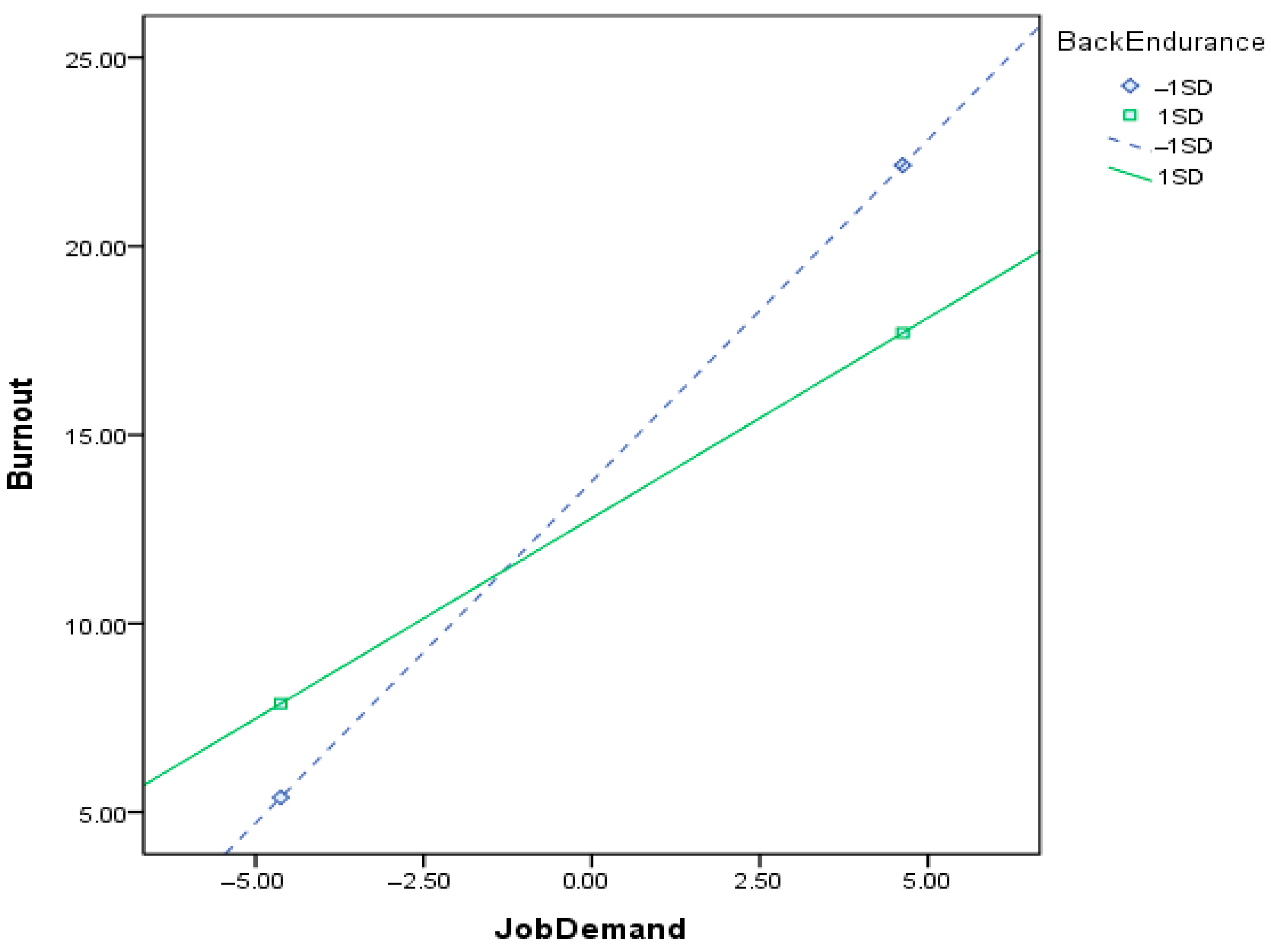
| Job demand × back endurance | −0.390 | 0.159 | −0.121 * | ||||||
| Adjusted R2 | 0.264 | 0.262 | 0.278 | ||||||
| F | 15.202 *** | 14.698 *** | 15.837 *** | ||||||
| Model 1 | Model 2 | Model 3 | |||||||
|---|---|---|---|---|---|---|---|---|---|
| Variables | B | SE B | β | B | SE B | β | B | SE B | β |
| Constant | 50.087 | 12.374 | 48.584 | 12.773 | 41.540 | 11.997 | |||
| Marital status | 7.119 | 2.145 | 0.170 ** | 7.359 | 2.137 | 0.178 ** | 6.929 | 2.152 | 0.167 ** |
| Economic status | 8.491 | 3.311 | 0.133 * | 7.936 | 3.344 | 0.124 * | 7.832 | 3.312 | 0.123 * |
| Job control | 0.415 | 0.113 | 0.190 *** | 0.432 | 0.115 | 0.197 *** | 0.456 | 0.115 | 0.208 *** |
| Job demand | −1.357 | 0.216 | −0.318 *** | −1.305 | 0.219 | −0.309 *** | −1.295 | 0.218 | −0.306 *** |
| Grip Strength | −1.027 | 1.017 | −0.051 | ||||||
| Job control × grip strength | 0.000 | 0.117 | 0.000 | ||||||
| Job demand × grip strength | 0.244 | 0.213 | 0.058 | ||||||
| Abdominal muscle endurance | −1.045 | 1.119 | −0.048 | ||||||
| Job control × abdominal endurance | 0.030 | 0.120 | 0.013 | ||||||
| Job demand × abdominal endurance | 0.258 | 0.235 | 0.058 | ||||||
| Back muscle endurance | 0.532 | 1.068 | 0.026 | ||||||
| Job control × back endurance | 0.006 | 0.109 | 0.003 | ||||||
| Job demand × back endurance | 0.349 | 0.223 | 0.082 | ||||||
| Adjusted R2 | 0.200 | 0.194 | 0.196 | ||||||
| F | 12.317 *** | 11.612 *** | 11.726 *** | ||||||
Disclaimer/Publisher’s Note: The statements, opinions and data contained in all publications are solely those of the individual author(s) and contributor(s) and not of MDPI and/or the editor(s). MDPI and/or the editor(s) disclaim responsibility for any injury to people or property resulting from any ideas, methods, instructions or products referred to in the content. |
© 2026 by the authors. Licensee MDPI, Basel, Switzerland. This article is an open access article distributed under the terms and conditions of the Creative Commons Attribution (CC BY) license.
Share and Cite
Huang, S.-L.; Wang, W.-H.; Li, R.-H.; Chen, H.-Y.; Tang, F.-C. Moderating Effects of Muscle Fitness on the Associations Between Work Stress, Burnout, and Well-Being Among White-Collar Workers. Healthcare 2026, 14, 468. https://doi.org/10.3390/healthcare14040468
Huang S-L, Wang W-H, Li R-H, Chen H-Y, Tang F-C. Moderating Effects of Muscle Fitness on the Associations Between Work Stress, Burnout, and Well-Being Among White-Collar Workers. Healthcare. 2026; 14(4):468. https://doi.org/10.3390/healthcare14040468
Chicago/Turabian StyleHuang, Shu-Ling, Wei-Hsun Wang, Ren-Hau Li, Hsuan-Yu Chen, and Feng-Cheng Tang. 2026. "Moderating Effects of Muscle Fitness on the Associations Between Work Stress, Burnout, and Well-Being Among White-Collar Workers" Healthcare 14, no. 4: 468. https://doi.org/10.3390/healthcare14040468
APA StyleHuang, S.-L., Wang, W.-H., Li, R.-H., Chen, H.-Y., & Tang, F.-C. (2026). Moderating Effects of Muscle Fitness on the Associations Between Work Stress, Burnout, and Well-Being Among White-Collar Workers. Healthcare, 14(4), 468. https://doi.org/10.3390/healthcare14040468