Time Burden of Electronic Medical Records on Nurses and Physicians in Saudi Arabia: Occurrence, Predictors, and Challenges—A Mixed-Methods Study


Abstract
1. Introduction
2. Materials and Methods
2.1. Study Design, Setting and Duration
2.2. Study Population and Eligibility Criteria
2.3. Sampling Technique
2.4. Sample Size Calculation
2.5. Data Collection Tool
2.5.1. Quantitative Tool
2.5.2. Qualitative Tool
2.6. Data Collection Procedure
2.7. Data Analysis
2.7.1. Quantitative Data Analysis
2.7.2. Qualitative Data Analysis
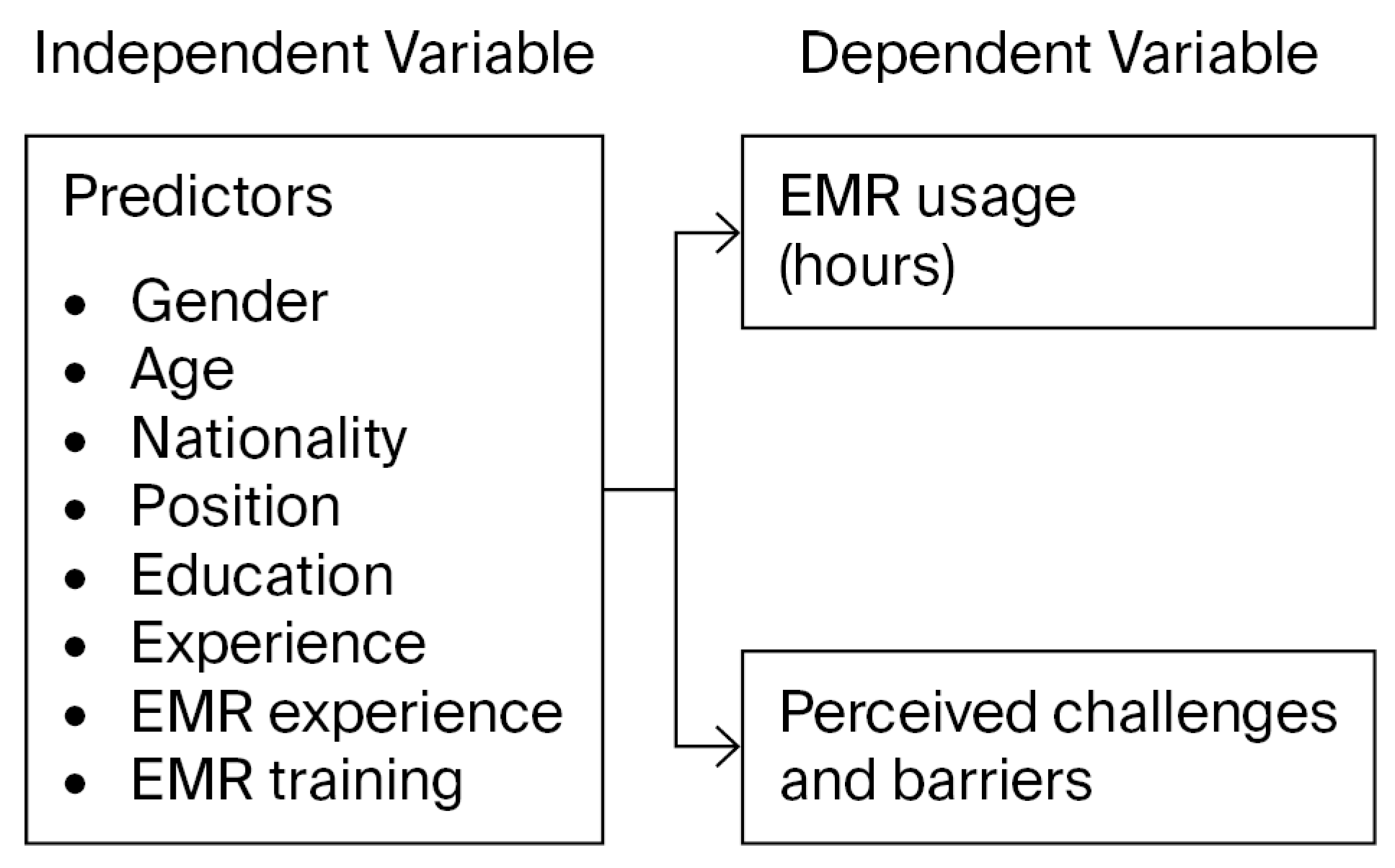
2.8. Conceptual Framework
2.9. Ethical Consideration
3. Results
3.1. Quantitative Data Results
3.2. Qualitative Data Results
3.2.1. Demographic Profile
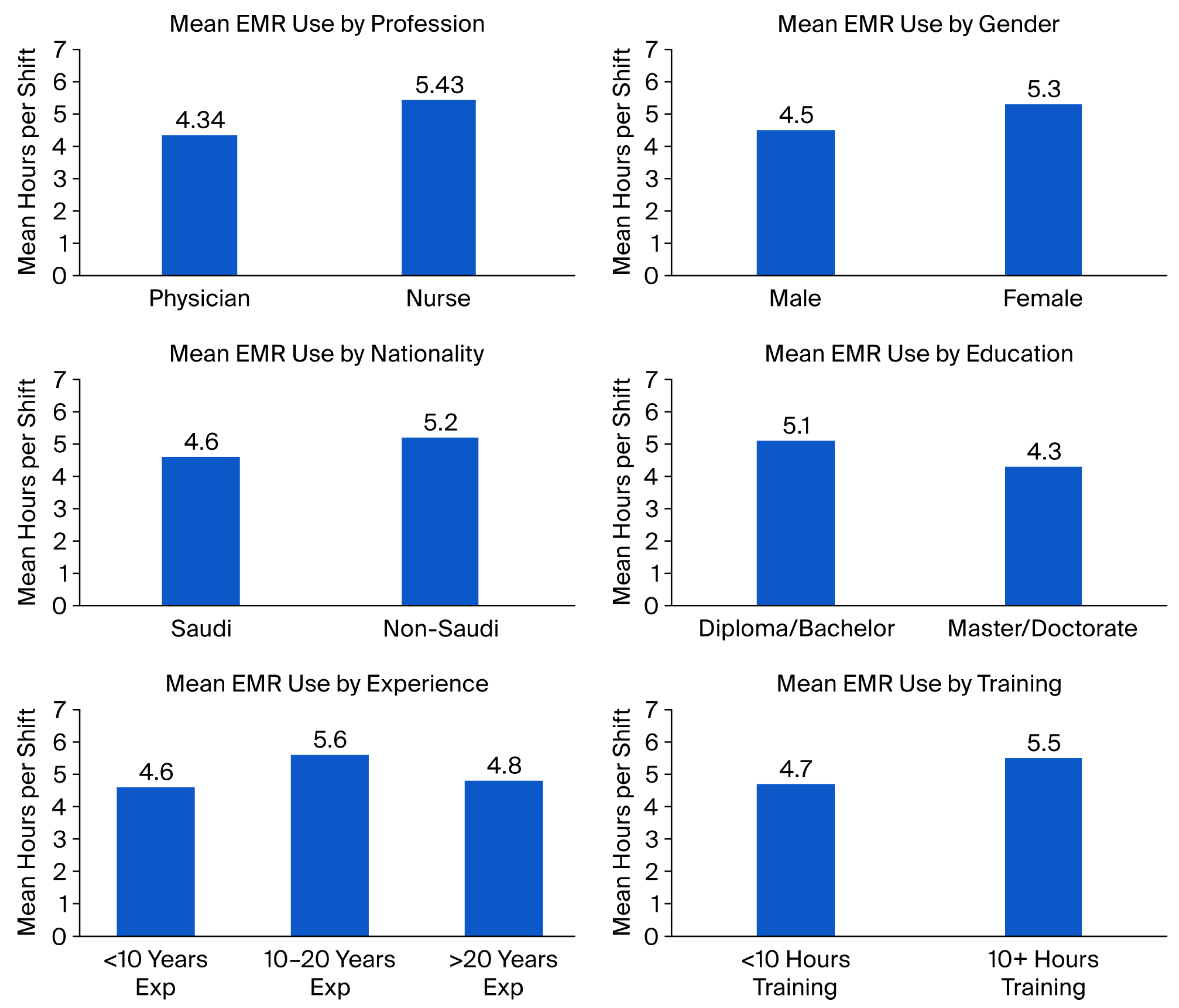
3.2.2. Hours of EMR Use
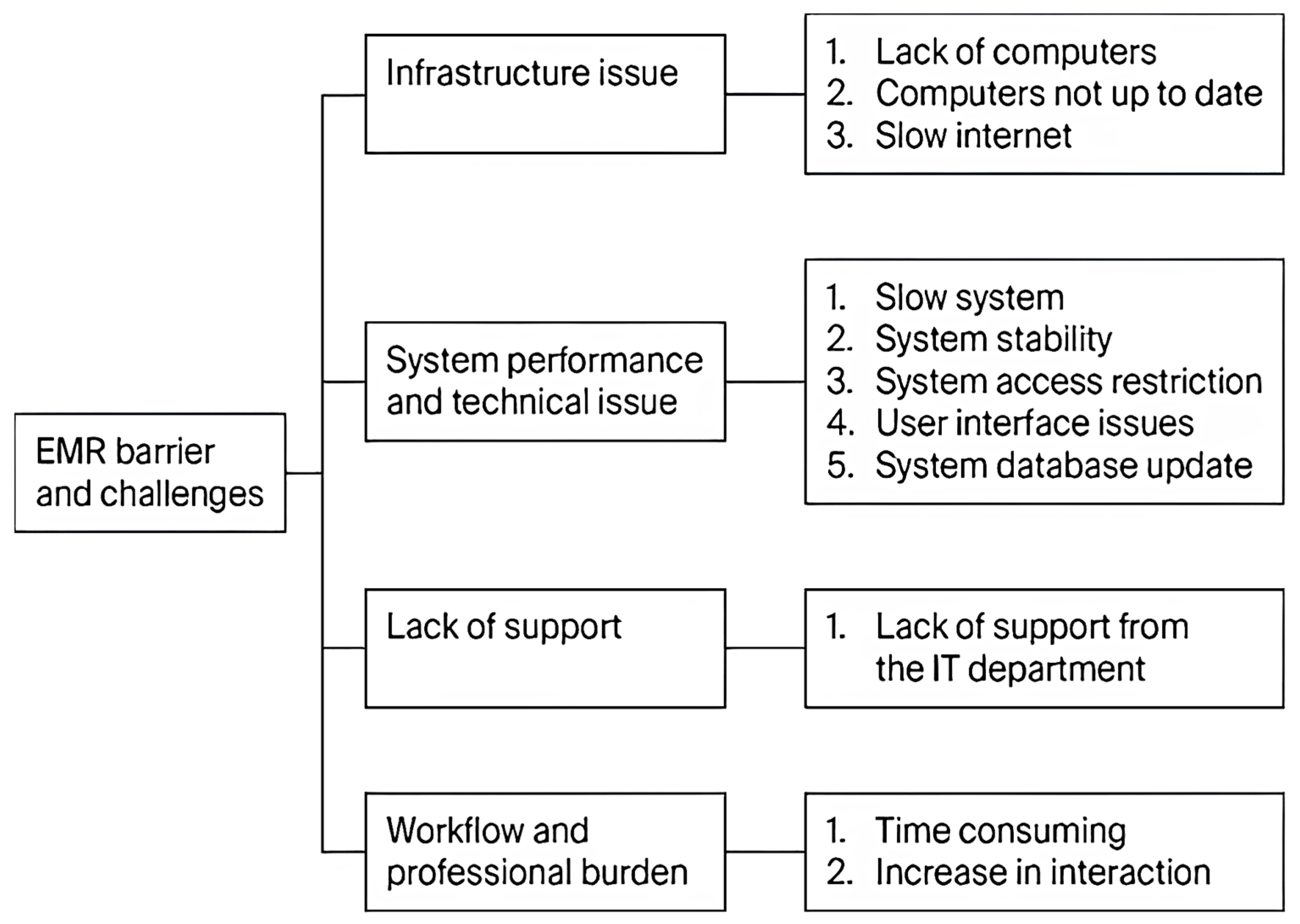
3.2.3. Challenges and Barriers Related to EMRs
Infrastructure Issues
System Performance and Technical Issues
Lack of Support
Workflow and Professional Burden
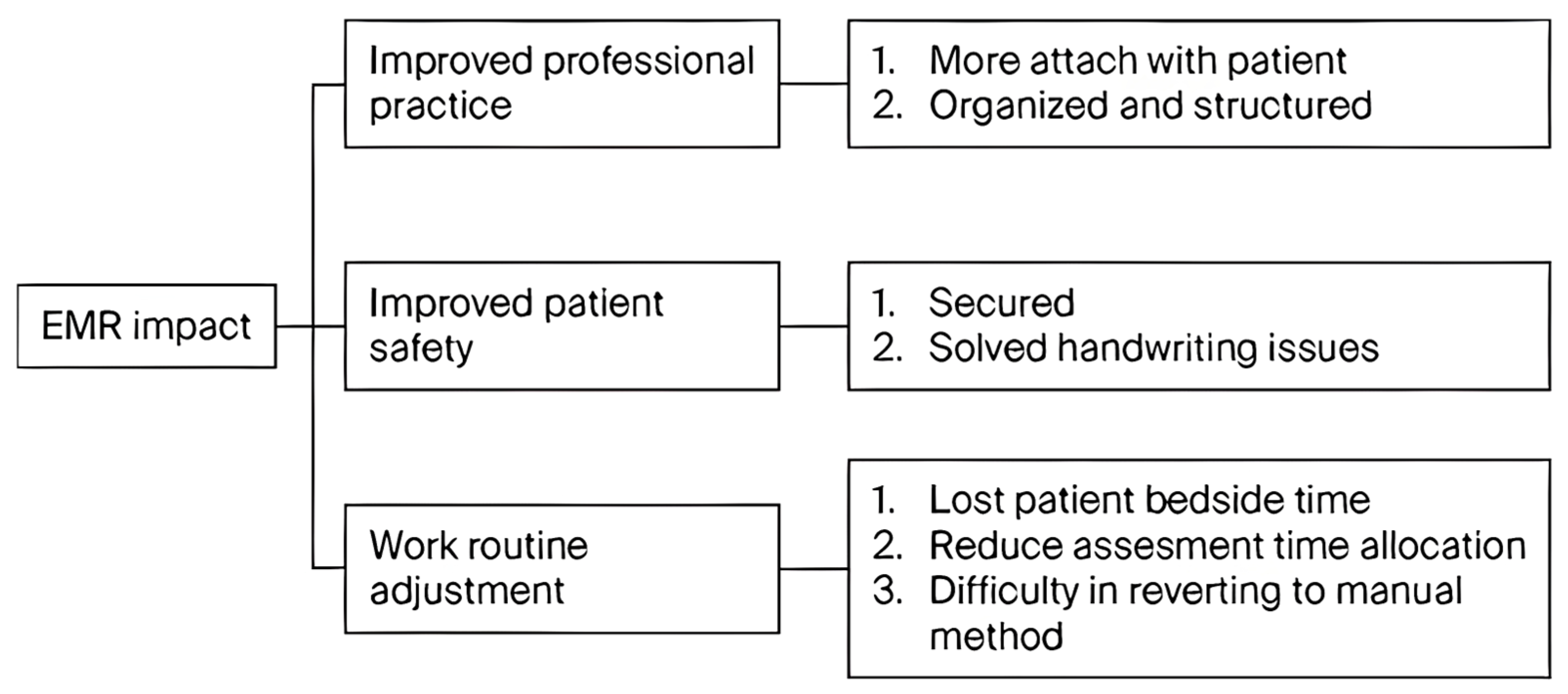
3.2.4. Impact of EMR Usage
Improved Professional Practice
Improved Patient Safety
Work Routine Adjustment
4. Discussion
4.1. Mean EMR Use Hours for Physicians and Nurses
4.2. Differences Between EMR Use Among Physicians and Nurses
4.3. Predictors of Extended EMR Use
4.4. Challenges and Barriers Related to EMR
4.5. Synthesis of Patterns Within the Saudi Context
4.6. Research and Practical Implications
4.7. Study Limitations, Strengths, and Future Research
- ➢
- First, this study involved several sites; however, all of them were Security Forces Hospitals. This restriction limits extrapolation to other healthcare organizations in Saudi Arabia, especially non-military or private hospitals with different EMR systems, administrative organizations, or resources.
- ➢
- Second, the quantitative data were self-reported, which may introduce recall bias or social desirability bias despite anonymity measures [63].
- ➢
- Third, the cross-sectional design does not allow for determining causality [64]. The qualitative element relied on short interviews with a small sample of participants, which prevented the attainment of more in-depth insights into the psychological, cultural, or organizational processes that affect EMR use [65]. Inconsistencies in EMR usage measurement across departments, patient loads, and staff roles may have also affected self-reported time, as no objective system-recorded data were used [66].
- ➢
- Finally, a lack of time and available resources restricted the extent of data collection and data analysis, preventing the examination of other variables such as job satisfaction, burnout, or patient outcomes.
- ➢
- Another major limitation of this research is the reliance on self-reported data to measure EMR usage duration, which may introduce recall and perception bias. Participants might overestimate their time spent on digital tasks due to the high cognitive load and professional frustration associated with documentation, leading to an inflation of the perceived administrative burden. While self-reporting is a common and practical approach in largescale clinical studies, it remains a subjective measure compared to objective audit log data. To mitigate this limitation, future research should integrate system-generated timestamps with survey data to provide a more precise calculation of active engagement time. Despite this potential for bias, the current findings offer valuable insights into professional experience of EMR burden and reflect the subjective reality of the healthcare workforce, which is a critical component of professional satisfaction and system acceptance.
- ➢
- In addition, the relatively small sample size for the qualitative phase is a concerning limitation. Although the research team determined that data saturation had been reached as no new themes emerged during the final interviews, the results may not fully capture the diverse perspectives of the entire healthcare workforce in Saudi Arabia. Future research involving a larger and more varied group of participants across different regions could further validate these findings and offer additional insights into EMR-related challenges.
- ➢
- Moreover, this research’s focus on a specific public hospital system may limit the generalizability of the results to the broader Saudi national context. The resource levels and technical support structures at Security Forces Hospitals might differ from those in the private sector or smaller community clinics. Therefore, the findings should be viewed as a representative case study of a major public health system rather than a comprehensive national survey.
5. Conclusions
Supplementary Materials
Author Contributions
Funding
Institutional Review Board Statement
Informed Consent Statement
Data Availability Statement
Acknowledgments
Conflicts of Interest
References
- Ibrahim, A.A.; Zamzuri, M.A.I.A.; Ismail, R.; Ariffin, A.H.; Ismail, A.; Hasani, M.H.M.; Manaf, M.R.A. The Role of Electronic Medical Records in Improving Health Care Quality: A Quasi-Experimental Study. Medicine 2022, 101, e29627. [Google Scholar] [CrossRef]
- Jabali, K.; Jarrar, M. Electronic Health Records Functionalities in Saudi Arabia: Obstacles and Major Challenges. Glob. J. Health Sci. 2018, 10, 50. [Google Scholar] [CrossRef]
- Akwaowo, C.D.; Sabi, H.M.; Ekpenyong, N.; Isiguzo, C.M.; Andem, N.F.; Maduka, O.; Dan, E.; Umoh, E.; Ekpin, V.; Uzoka, F.M. Adoption of electronic medical records in developing countries-A multi-state study of the Nigerian healthcare system. Front. Digit. Health 2022, 4, 1017231. [Google Scholar] [CrossRef]
- Alotaibi, Y.K.; Federico, F. The impact of health information technology on patient safety. Saudi Med. J. 2017, 38, 1173–1180. [Google Scholar] [CrossRef]
- De Benedictis, A.; Lettieri, E.; Gastaldi, L.; Masella, C.; Urgu, A.; Tartaglini, D. Electronic Medical Records implementation in hospital: An empirical investigation of individual and organizational determinants. PLoS ONE 2020, 15, e0234108. [Google Scholar] [CrossRef]
- Abdullah Alharbi, R. Adoption of electronic health records in Saudi Arabia hospitals: Knowledge and usage. J. King Saud Univ.-Sci. 2023, 35, 102470. [Google Scholar] [CrossRef]
- National E-Health Strategy. Available online: https://www.moh.gov.sa/en/Ministry/nehs/Pages/Ehealth.aspx (accessed on 25 November 2024).
- Nilsen, P.; Fernemark, H.; Seing, I.; Schildmeijer, K.; Ericsson, C.; Skagerström, J. Working Conditions in Primary Care: A Qualitative Interview Study with Physicians in Sweden Informed by the Effort-Reward-Imbalance Model. BMC Fam. Pract. 2021, 22, 149. [Google Scholar] [CrossRef] [PubMed]
- Murad, M.H.; Vaa Stelling, B.E.; West, C.P.; Hasan, B.; Simha, S.; Saadi, S.; Firwana, M.; Viola, K.E.; Prokop, L.J.; Nayfeh, T.; et al. Measuring Documentation Burden in Healthcare. J. Gen. Intern. Med. 2024, 39, 2837–2848. [Google Scholar] [CrossRef] [PubMed]
- Harris, D.A.; Haskell, J.; Cooper, E.; Crouse, N.; Gardner, R. Estimating the association between burnout and electronic health record-related stress among advanced practice registered nurses. Appl. Nurs. Res. 2018, 43, 36–41. [Google Scholar] [CrossRef]
- Ehrenfeld, J.M.; Wanderer, J.P. Technology as friend or foe? Do electronic health records increase burnout? Curr. Opin. Anesthesiol. 2018, 31, 357–360. [Google Scholar] [CrossRef]
- Alhur, A. Overcoming Electronic Medical Records Adoption Challenges in Saudi Arabia. Cureus 2024, 16, e53827. [Google Scholar] [CrossRef]
- Granić, A.; Marangunić, N. Technology Acceptance Model in Educational Context: A Systematic Literature Review. Br. J. Educ. Technol. 2019, 50, 2572–2593. [Google Scholar] [CrossRef]
- Ilker, E.; Sulaiman Abubakar, M.; Rukayya Sunusi, A. Comparison of Convenience Sampling and Purposive Sampling. Am. J. Theor. Appl. Stat. 2015, 5, 1–4. [Google Scholar] [CrossRef]
- Sample Size to Detect a Significant Difference Between Two Proportions. Available online: https://epitools.ausvet.com.au/twoproportions (accessed on 20 November 2024).
- What Specialty Spends the Most Time on Paperwork and Administration? Available online: https://www.beckersphysicianleadership.com/physician-workforce/what-specialty-spends-the-most-time-on-paperwork-and-administration (accessed on 25 November 2024).
- AlOtaib, Y.; AlSaedi, M. Physicians’ Perceptions and Attitudes toward Use of Electronic Medical Record Systems in Riyadh. World Fam. Med. 2022, 20, 109–120. [Google Scholar] [CrossRef]
- Alessa, T. Clinicians’ Attitudes Toward Electronic Health Records in Saudi Arabia. Cureus 2024, 16, e56281. [Google Scholar] [CrossRef]
- Asiri, S. Factors Influencing Electronic Health Record Workflow Integration Among Nurses in Saudi Arabia: Cross-Sectional Study. SAGE Open Nurs. 2024, 10, 23779608241260547. [Google Scholar] [CrossRef]
- Al Otaybi, H.F.; Al-Raddadi, R.M.; Bakhamees, F.H. Performance, Barriers, and Satisfaction of Healthcare Workers Toward Electronic Medical Records in Saudi Arabia: A National Multicenter Study. Cureus 2022, 14, e21899. [Google Scholar] [CrossRef] [PubMed]
- Neuendorf, K.A. Content analysis and thematic analysis. In Advanced Research Methods for Applied Psychology; Routledge: Abingdon, UK, 2018; pp. 211–223. [Google Scholar]
- Grover, P.; Kar, A.K.; Janssen, M.; Ilavarasan, P.V. Perceived Usefulness, Ease of Use and User Acceptance of Blockchain Technology for Digital Transactions–Insights from User-Generated Content on Twitter. Enterp. Inf. Syst. 2019, 13, 771–800. [Google Scholar] [CrossRef]
- Rotenstein, L.S.; Holmgren, A.J.; Downing, N.L.; Bates, D.W. Differences in Total and After-hours Electronic Health Record Time Across Ambulatory Specialties. JAMA Intern. Med. 2021, 181, 863–865. [Google Scholar] [CrossRef] [PubMed]
- Rotenstein, L.S.; Holmgren, A.J.; Healey, M.J.; Horn, D.M.; Ting, D.Y.; Lipsitz, S.; Salmasian, H.; Gitomer, R.; Bates, D.W. Association Between Electronic Health Record Time and Quality of Care Metrics in Primary Care. JAMA Netw. Open 2022, 5, e2237086. [Google Scholar] [CrossRef]
- Overhage, J.M.; McCallie, D., Jr. Physician Time Spent Using the Electronic Health Record During Outpatient Encounters: A Descriptive Study. Ann. Intern. Med. 2020, 172, 169–174. [Google Scholar] [CrossRef]
- Holmgren, A.J.; Lindeman, B.; Ford, E.W. Resident Physician Experience and Duration of Electronic Health Record Use. Appl. Clin. Inform. 2021, 12, 721–728. [Google Scholar] [CrossRef]
- Bakhoum, N.; Gerhart, C.; Schremp, E.; Jeffrey, A.D.; Anders, S.; France, D.; Ward, M.J. A Time and Motion Analysis of Nursing Workload and Electronic Health Record Use in the Emergency Department. J. Emerg. Nurs. 2021, 47, 733–741. [Google Scholar] [CrossRef]
- Jedwab, R.M.; Franco, M.; Owen, D.; Ingram, A.; Redley, B.; Dobroff, N. Improving the Quality of Electronic Medical Record Documentation: Development of a Compliance and Quality Program. Appl. Clin. Inform. 2022, 13, 836–844. [Google Scholar] [CrossRef]
- Alkasasbeh, A.; Jarrah, S.; Alhusamiah, B.; Tarawneh, F. Factors Influencing the Utilization and Adoption of Electronic Health Records among Nurses in Jordanian Hospitals. Jordan J. Nurs. Res. 2025, 4, 1–13. [Google Scholar] [CrossRef]
- Goldstein, I.H.; Hribar, M.R.; Reznick, L.G.; Chiang, M.F. Analysis of Total Time Requirements of Electronic Health Record Use by Ophthalmologists Using Secondary EHR Data. AMIA Annu. Symp. Proc. 2018, 2018, 490–497. [Google Scholar]
- Wang, J.K.; Ouyang, D.; Hom, J.; Chi, J.; Chen, J.H. Characterizing electronic health record usage patterns of inpatient medicine residents using event log data. PLoS ONE 2019, 14, e0205379. [Google Scholar] [CrossRef] [PubMed]
- Tamli, N.; Sain, M. Exploring Innovative Strategies for Patient-Centered Care in the Nursing Profession. A Bi-Annu. South Asian J. Res. Innov. 2023, 10, 19–30. [Google Scholar] [CrossRef]
- Forde-Johnston, C.; Butcher, D.; Aveyard, H. An integrative review exploring the impact of Electronic Health Records (EHR) on the quality of nurse-patient interactions and communication. J. Adv. Nurs. 2023, 79, 48–67. [Google Scholar] [CrossRef]
- Camilleri, N.; Henks, N.; Seo, K.; Kim, J.H. EMR usage and nurse documentation burden in a medical intensive care unit. In Proceedings of the International Conference on Human-Computer Interaction, 26 June–1 July 2022; pp. 165–173. [Google Scholar]
- AlQahtani, M.; AlShaibani, W.; AlAmri, E.; Edward, D.; Khandekar, R. Electronic Health Record-Related Stress Among Nurses: Determinants and Solutions. Telemed. J. E Health 2021, 27, 544–550. [Google Scholar] [CrossRef] [PubMed]
- Gaffney, A.; Woolhandler, S.; Cai, C.; Bor, D.; Himmelstein, J.; McCormick, D.; Himmelstein, D.U. Medical Documentation Burden Among US Office-Based Physicians in 2019: A National Study. JAMA Intern. Med. 2022, 182, 564–566. [Google Scholar] [CrossRef]
- Rotenstein, L.S.; Fong, A.S.; Jeffery, M.M.; Sinsky, C.A.; Goldstein, R.; Williams, B.; Melnick, E.R. Gender Differences in Time Spent on Documentation and the Electronic Health Record in a Large Ambulatory Network. JAMA Netw. Open 2022, 5, e223935. [Google Scholar] [CrossRef]
- Qasimi, A.N.; Alzahrani, S.A.; Tumyhi, M.M.; Almuqati, M.H.; Hezam, B.M. Privacy Issues Hindering Implementation and Use of Electronic Health Records in the Middle East. J. Int. Crisis Risk Commun. Res. 2025, 7, 1274–1278. [Google Scholar] [CrossRef]
- Aldosari, B.; Al-Mansour, S.; Aldosari, H.; Alanazi, A. Assessment of factors influencing nurses acceptance of electronic medical record in a Saudi Arabia hospital. Inform. Med. Unlocked 2017, 10, 82–88. [Google Scholar] [CrossRef]
- Yehualashet, D.E.; Seboka, B.T.; Tesfa, G.A.; Demeke, A.D.; Amede, E.S. Barriers to the Adoption of Electronic Medical Record System in Ethiopia: A Systematic Review. J. Multidiscip. Healthc. 2021, 14, 2597–2603. [Google Scholar] [CrossRef] [PubMed]
- Samadbeik, M.; Fatehi, F.; Braunstein, M.; Barry, B.; Saremian, M.; Kalhor, F.; Edirippulige, S. Education and Training on Electronic Medical Records (EMRs) for health care professionals and students: A Scoping Review. Int. J. Med. Inform. 2020, 142, 104238. [Google Scholar] [CrossRef] [PubMed]
- Hamdan, A.B.; Manaf, R.A.; Mahmud, A. Challenges in the use Electronic Medical Records in Middle Eastern Countries: A Narrative Review. Malays. J. Med. Health Sci. 2023, 19, 334–340. [Google Scholar] [CrossRef]
- Rule, A.; Chiang, M.F.; Hribar, M.R. Using electronic health record audit logs to study clinical activity: A systematic review of aims, measures, and methods. J. Am. Med. Inform. Assoc. 2020, 27, 480–490. [Google Scholar] [CrossRef] [PubMed]
- Arndt, B.G.; Beasley, J.W.; Watkinson, M.D.; Temte, J.L.; Tuan, W.J.; Sinsky, C.A.; Gilchrist, V.J. Tethered to the EHR: Primary Care Physician Workload Assessment Using EHR Event Log Data and Time-Motion Observations. Ann. Fam. Med. 2017, 15, 419–426. [Google Scholar] [CrossRef]
- del Mar Rodriguez, T.L.M.; O’Hara, K.; McKanna, T.M.D.; Decker, S. Implementing a New EMR. How Should We Train the Staff? J. PeriAnesthesia Nurs. 2021, 36, e18–e19. [Google Scholar] [CrossRef]
- Bekele, T.A.; Gezie, L.D.; Willems, H.; Metzger, J.; Abere, B.; Seyoum, B.; Abraham, L.; Wendrad, N.; Meressa, S.; Desta, B.; et al. Barriers and facilitators of the electronic medical record adoption among healthcare providers in Addis Ababa, Ethiopia. Digit. Health 2024, 10, 20552076241301946. [Google Scholar] [CrossRef]
- Sugiarto, P.; Purnami, C.; Jati, S. Supporting and Inhibiting Factors in Implementing Electronic Medical Records (EMR) Policy in Indonesia. BIO Web Conf. 2024, 133, 00038. [Google Scholar] [CrossRef]
- Feryansyah, A.; Suprapto, S.; Wardani, R. Analysis of the Implementation of Electronic Medical Records in Community Health Centers. Indones. J. Glob. Health Res. 2025, 7, 919–930. [Google Scholar] [CrossRef]
- Gutiérrez, O.; Romero, G.; Pérez, L.; Salazar, A.; Charris, M.; Wightman, P. HealthyBlock: Blockchain-Based IT Architecture for Electronic Medical Records Resilient to Connectivity Failures. Int. J. Environ. Res. Public Health 2020, 17, 7132. [Google Scholar] [CrossRef]
- Avula, R. Addressing Barriers in Data Collection, Transmission, and Security to Optimize Data Availability in Healthcare Systems for Improved Clinical Decision-Making and Analytics. Appl. Res. Artif. Intell. Cloud Comput. 2021, 4, 78–93. [Google Scholar]
- Kessy, E.C.; Kibusi, S.M.; Ntwenya, J.E. Electronic medical record systems data use in decision-making and associated factors among health managers at public primary health facilities, Dodoma region: A cross-sectional analytical study. Front. Digit. Health 2023, 5, 1259268. [Google Scholar] [CrossRef] [PubMed]
- El Mahalli, A. Adoption and Barriers to Adoption of Electronic Health Records by Nurses in Three Governmental Hospitals in Eastern Province, Saudi Arabia. Perspect. Health Inf. Manag. 2015, 12, 1f. [Google Scholar]
- Kiri, V.A.; Ojule, A.C. Electronic medical record systems: A pathway to sustainable public health insurance schemes in sub-Saharan Africa. Niger. Postgrad. Med. J. 2020, 27, 1–7. [Google Scholar] [CrossRef]
- Larsen, E.; Rao, A.; Sasangohar, F. Understanding the scope of downtime threats: A scoping review of downtime-focused literature and news media. Health Inform. J. 2020, 26, 146045822091853. [Google Scholar] [CrossRef]
- Chen, J.; Li, Z.; Ma, W.; Tang, Y.; Liu, C.; Ma, S.; Xu, M.; Zhang, Q. Enhancing the timeliness of EMR documentation in resident doctors: The role of PDCA cycle management. BMC Med. Educ. 2024, 24, 1367. [Google Scholar] [CrossRef]
- Dutta, B.; Hwang, H.G. The adoption of electronic medical record by physicians: A PRISMA-compliant systematic review. Medicine 2020, 99, e19290. [Google Scholar] [CrossRef] [PubMed]
- Mattingly, N.S. Evaluation of User Interface Design in Electronic Medical Records Software for Direct Primary Care Clinics. Ph.D. Thesis, California State Polytechnic University, Pomona, CA, USA, 2022. [Google Scholar]
- Afzal, F.; Ahmad, A.; Ali, Q.; Joshi, S.; Mehra, S. Fulfilling the need of hour: Systematic review of challenges associated with electronic medical record (EMR) implementation-SBEA model. Vidyabharati Int. Interdiscip. Res. J. 2021, 13, 649–662. [Google Scholar]
- Albagmi, S. The effectiveness of EMR implementation regarding reducing documentation errors and waiting time for patients in outpatient clinics: A systematic review. F1000Research 2021, 10, 514. [Google Scholar] [CrossRef] [PubMed]
- Li, E.; Clarke, J.; Ashrafian, H.; Darzi, A.; Neves, A.L. The impact of electronic health record interoperability on safety and quality of care in high-income countries: Systematic review. J. Med. Internet Res. 2022, 24, e38144. [Google Scholar] [CrossRef] [PubMed]
- Forjuoh, S.N. Challenges Associated with Multi-Institutional Multi-Site Clinical Trial Collaborations: Lessons from a Diabetes Self-Management Interventions Study in Primary Care. J. Clin. Trials 2015, 5, 219. [Google Scholar] [CrossRef]
- Sedgwick, P. Multistage sampling. BMJ 2015, 351, h4155. [Google Scholar] [CrossRef]
- Anvari, F.; Efendić, E.; Olsen, J.; Arslan, R.C.; Elson, M.; Schneider, I.K. Bias in self-reports: An initial elevation phenomenon. Soc. Psychol. Personal. Sci. 2023, 14, 727–737. [Google Scholar] [CrossRef]
- Taris, T.W.; Kessler, S.R.; Kelloway, E.K. Strategies addressing the limitations of cross-sectional designs in occupational health psychology: What they are good for (and what not). Work Stress 2021, 35, 1–5. [Google Scholar] [CrossRef]
- De la Croix, A.; Barrett, A.; Stenfors, T. How to … do research interviews in different ways. Clín. Teach. 2018, 15, 451–456. [Google Scholar] [CrossRef]
- Redd, T.K.; Doberne, J.W.; Lattin, D.; Yackel, T.R.; Eriksson, C.O.; Mohan, V.; Gold, J.A.; Ash, J.S.; Chiang, M.F. Variability in Electronic Health Record Usage and Perceptions among Specialty vs. Primary Care Physicians. AMIA Annu. Symp. Proc. 2015, 2015, 2053–2062. [Google Scholar]



| Total Participants (n = 503) | Physicians (n = 162) | Nurses (n = 341) | ||||
|---|---|---|---|---|---|---|
| Number | % | Number | % | Number | % | |
| Sex | ||||||
| Male | 165 | 32.8 | 93 | 57.4 | 72 | 21.1 |
| Female | 338 | 67.2 | 69 | 42.6 | 269 | 78.9 |
| Age (years) | ||||||
| <30 | 82 | 16.3 | 40 | 24.7 | 42 | 12.3 |
| 30–39 | 226 | 44.9 | 59 | 36.4 | 167 | 49 |
| 40–49 | 122 | 24.3 | 48 | 29.6 | 74 | 21.7 |
| ≥50 | 73 | 14.5 | 15 | 9.3 | 58 | 17 |
| Nationality | ||||||
| Saudi | 191 | 38 | 117 | 72.2 | 74 | 21.7 |
| Non-Saudi | 312 | 62 | 45 | 27.8 | 267 | 78.3 |
| Position of Physicians | ||||||
| Intern | 4 | 0.8 | 4 | 2.5 | - | - |
| Resident | 69 | 13.7 | 69 | 42.6 | - | - |
| Fellow | 10 | 2 | 10 | 6.2 | - | - |
| Specialist | 36 | 7.2 | 36 | 22.2 | - | - |
| Consultant | 38 | 7.6 | 38 | 23.5 | - | - |
| General Practitioner | 5 | 1 | 5 | 3.1 | - | - |
| Primary Specialty for Physicians | ||||||
| Anesthesia | 7 | 1.4 | 7 | 4.3 | - | - |
| Cardiology | 4 | 0.8 | 4 | 2.5 | - | - |
| Emergency medicine | 5 | 1 | 5 | 3.1 | - | - |
| Family medicine | 21 | 4.2 | 21 | 13 | - | - |
| General practitioner | 5 | 1 | 5 | 3.1 | - | - |
| Intensivist | 4 | 0.8 | 4 | 2.5 | - | - |
| Internal medicine | 20 | 4 | 20 | 12.3 | - | - |
| Neurosurgery | 8 | 1.6 | 8 | 4.9 | - | - |
| OB/Gynecology | 13 | 2.6 | 13 | 8 | - | - |
| Ophthalmology | 3 | 0.6 | 3 | 1.9 | - | - |
| Orthopedic | 11 | 2.2 | 11 | 6.8 | - | - |
| Pediatric | 44 | 8.7 | 44 | 27.2 | - | - |
| Surgery | 17 | 3.4 | 17 | 10.5 | - | - |
| Position of Nurses | ||||||
| Clinical nurse specialist | 82 | 16.3 | - | - | 82 | 24 |
| Frontline | 209 | 41.6 | - | - | 209 | 61.3 |
| (Direct patient care provider) | ||||||
| Nurse manager/supervisor | 50 | 9.9 | - | - | 50 | 14.7 |
| Work Setting for Nurses | ||||||
| Hospital (inpatient) | 159 | 31.6 | - | - | 159 | 46.6 |
| Hospital (outpatient) | 43 | 8.5 | - | - | 43 | 12.6 |
| Emergency room (ER) | 35 | 7 | - | - | 35 | 10.3 |
| Intensive care unit (ICU) | 98 | 19.5 | - | - | 98 | 28.7 |
| Transitional care unit (TCU) | 1 | 0.2 | - | - | 1 | 0.3 |
| Surgical/operating room | 29 | 5.8 | - | - | 29 | 8.5 |
| Primary healthcare center | 14 | 2.8 | - | - | 14 | 4.1 |
| Nursing admin | 9 | 1.8 | - | - | 9 | 2.6 |
| Burn unit | 1 | 0.2 | - | - | 1 | 0.3 |
| Neonatal intensive care unit (NICU) | 1 | 0.2 | - | - | 1 | 0.3 |
| Burn care unit (BCU) | 1 | 0.2 | - | - | 1 | 0.3 |
| Highest Level of Education Certificate in Profession | ||||||
| Diploma | 46 | 9.1 | 3 | 1.9 | 43 | 12.6 |
| Bachelor’s degree | 327 | 65 | 73 | 45.1 | 254 | 74.5 |
| Master’s degree | 83 | 16.5 | 43 | 26.5 | 40 | 11.7 |
| Doctorate (PhD or Equivalent) | 47 | 9.3 | 43 | 26.5 | 4 | 1.2 |
| Years of Experience in Healthcare | ||||||
| <1 year | 16 | 3.2 | 5 | 3.1 | 11 | 3.2 |
| 1–4 years | 86 | 17.1 | 53 | 32.7 | 33 | 9.7 |
| 5–9 years | 109 | 21.7 | 34 | 21 | 75 | 22 |
| 10–19 years | 181 | 36 | 35 | 21.6 | 146 | 42.8 |
| ≥20 years | 111 | 22.1 | 35 | 21.6 | 76 | 22.3 |
| Years of Experience in Healthcare Setting Utilizing EMR Systems | ||||||
| <1 year | 30 | 6 | 11 | 6.8 | 19 | 5.6 |
| 1–4 years | 200 | 39.8 | 80 | 49.4 | 120 | 35.2 |
| 5–9 years | 142 | 28.2 | 34 | 21 | 108 | 31.7 |
| 10–19 years | 107 | 21.3 | 32 | 19.8 | 75 | 22 |
| ≥20 years | 24 | 4.8 | 5 | 3.1 | 19 | 5.6 |
| Region of Work | ||||||
| Riyadh | 252 | 50.1 | 101 | 62.3 | 151 | 44.3 |
| Makkah | 132 | 26.2 | 31 | 19.1 | 101 | 29.6 |
| Dammam | 119 | 23.7 | 30 | 18.5 | 89 | 26.1 |
| Question | Total Participant | Physicians | Nurses | |||
|---|---|---|---|---|---|---|
| Number | % | Number | % | Number | % | |
| On average, how many hours per shift/day do you spend using the EMR system? | ||||||
| Less than 1 h | 17 | 3.4 | 4 | 2.5 | 13 | 3.8 |
| 1–2 h | 49 | 9.7 | 23 | 14.2 | 26 | 7.6 |
| 3–4 h | 125 | 24.9 | 61 | 37.7 | 64 | 18.8 |
| 5–6 h | 98 | 19.5 | 43 | 26.5 | 55 | 16.1 |
| More than 6 h | 214 | 42.5 | 31 | 19.1 | 183 | 53.7 |
| What specific tasks do you use the EMR system for? | ||||||
| Reviewing test results | 372 | 74 | 142 | 87.7 | 230 | 67.4 |
| Documenting patient histories | 348 | 69.2 | 140 | 86.4 | 208 | 61 |
| Patient admission | 319 | 63.4 | 105 | 64.8 | 214 | 62.8 |
| Updating progress notes | 305 | 60.6 | 144 | 88.9 | 161 | 47.2 |
| Nursing notes | 305 | 60.6 | 7 | 4.3 | 298 | 87.4 |
| Nursing initial assessment | 288 | 57.3 | 8 | 4.9 | 280 | 82.1 |
| Discharge process | 285 | 56.7 | 100 | 61.7 | 185 | 54.3 |
| Writing reports | 272 | 54.1 | 114 | 70.4 | 158 | 46.3 |
| Updating treatment plans | 244 | 48.5 | 130 | 80.2 | 114 | 33.4 |
| Communication with other healthcare providers “Request/consultation” | 231 | 45.9 | 118 | 72.8 | 113 | 33.1 |
| Nursing care plan | 228 | 45.3 | 4 | 2.5 | 224 | 65.7 |
| Entering diagnostic data | 203 | 40.4 | 120 | 74.1 | 83 | 24.3 |
| Prescribing medications | 197 | 39.2 | 144 | 88.9 | 53 | 15.5 |
| Other | 19 | 3.8 | 3 | 1.9 | 16 | 4.7 |
| Have you received formal training in using the EMR system? | ||||||
| No | 65 | 12.9 | 34 | 21 | 31 | 9.1 |
| Yes | 438 | 87.1 | 128 | 79 | 310 | 90.9 |
| How many hours of EMR training have you received? | ||||||
| Zero | 65 | 12.9 | 30 | 18.5 | 35 | 10.3 |
| Less than 5 h | 246 | 48.9 | 88 | 54.3 | 158 | 46.3 |
| 5–10 h | 126 | 25 | 33 | 20.4 | 93 | 27.3 |
| More than 10 h | 66 | 13.1 | 11 | 6.8 | 55 | 16.1 |
| What are the primary challenges you face when using the EMR system? | ||||||
| Lack of adequate training | 141 | 28 | 73 | 45.1 | 68 | 19.9 |
| Slow system performance | 239 | 47.5 | 64 | 39.5 | 175 | 51.3 |
| System crashes or errors | 169 | 33.6 | 66 | 40.7 | 103 | 30.2 |
| Difficulty navigating the system | 122 | 24.3 | 61 | 37.7 | 61 | 17.9 |
| Time-consuming data entry | 258 | 51.3 | 110 | 67.9 | 148 | 43.4 |
| Lack of user-friendly interface | 123 | 24.5 | 51 | 31.5 | 72 | 21.1 |
| Disrupts workflow | 143 | 28.4 | 54 | 33.3 | 89 | 26.1 |
| Difficulty in communication with other healthcare providers via the EMR | 110 | 21.9 | 44 | 27.2 | 66 | 19.4 |
| Lack of adequate technical support | 157 | 31.2 | 54 | 33.3 | 103 | 30.2 |
| Other | 16 | 3.2 | 5 | 3.1 | 11 | 3.2 |
| All | Nurse | Physician | |||||
|---|---|---|---|---|---|---|---|
| Time Category (Hour) | Approx. Midpoint (Hours/Day) | Number | Total (Hours/Day) | Number | Total (Hours/Day) | Number | Total (Hours/Day) |
| <1 | 0.5 | 17 | 8.5 | 13 | 6.5 | 4 | 2 |
| 1–2 | 1.5 | 49 | 73.5 | 26 | 39 | 23 | 34.5 |
| 3–4 | 3.5 | 125 | 437.5 | 64 | 224 | 61 | 213.5 |
| 5–6 | 5.5 | 98 | 539 | 55 | 302 | 43 | 236.5 |
| >6 | 7 | 214 | 1498 | 183 | 1281 | 31 | 217 |
| Position | Work Hours per Day | Work Days per Week | Total Work Hours per Month | Mean of EMR Usage Hours per Day | Total of EMR Usage Hours per Month | % of EMR Usage per Month out of the Total Monthly Working Hours | p-Value |
|---|---|---|---|---|---|---|---|
| Nurses | 12 | 4 | 208 | 5.43 ± 2.03 | 86.80 | 41.73 | 0.001 * |
| Physicians | 12 | 4 | 208 | 4.34 ± 1.87 | 69.44 | 33.38 |
| Odds Ratio | 95% CI | p-Value | |||
|---|---|---|---|---|---|
| Lower | Upper | ||||
| Gender | Male | Reference Group | |||
| Female | 3.08 | 2.17 | 4.36 | 0.001 * | |
| Age | Below 30 | Reference Group | |||
| 30–40 | 1.94 | 0.89 | 2.78 | 0.005 * | |
| 40–50 | 1.81 | 1.09 | 3.04 | 0.022 * | |
| 50 above | 1.57 | 1.23 | 3.07 | 0.118 | |
| Nationality | Saudi | Reference Group | |||
| Non-Saudi | 2.92 | 0.74 | 1.41 | 0.001 * | |
| Position | Physician | Reference Group | |||
| Nurse | 2.98 | 2.12 | 4.20 | 0.001 * | |
| Education | Diploma | Reference Group | |||
| Bachelor | 0.69 | 0.39 | 1.27 | 0.241 | |
| Master | 0.50 | 0.25 | 0.99 | 0.047 * | |
| Doctorate | 0.28 | 0.14 | 0.61 | 0.001 * | |
| Experience | <1 year | Reference Group | |||
| 1–5 year | 2.66 | 0.99 | 7.19 | 0.053 | |
| 5–10 year | 5.05 | 1.88 | 13.55 | 0.001 * | |
| 10–20 year | 5.23 | 1.99 | 13.76 | 0.001 * | |
| 20+ year | 4.15 | 1.55 | 11.15 | 0.005 * | |
| EMR Experience | <1 year | Reference Group | |||
| 1–5 year | 1.32 | 0.66 | 2.69 | 0.429 | |
| 5–10 year | 2.13 | 1.03 | 4.41 | 0.041 * | |
| 10–20 year | 2.08 | 0.99 | 4.41 | 0.055 | |
| 20+ year | 2.30 | 0.85 | 6.26 | 0.101 | |
| EMR Training | 0 | Reference Group | |||
| <5 h | 1.00 | 0.62 | 1.65 | 0.978 | |
| 5–10 h | 1.55 | 0.92 | 2.76 | 0.095 | |
| 10+ h | 2.33 | 1.22 | 4.47 | 0.010 * | |
| Region | Riyadh | Reference Group | |||
| Makkah | 1.54 | 1.05 | 2.26 | 0.026 * | |
| Dammam | 1.08 | 0.72 | 1.64 | 0.690 | |
| Question | Likert Scale Feedback | Mean, Standard Deviation and p Value | ||||||||
|---|---|---|---|---|---|---|---|---|---|---|
| Strongly Disagree n (%) | Disagree n (%) | Neutral n (%) | Agree n (%) | Strongly Agree n (%) | All Mean ± SD | Physicians Mean ± SD | Nurses Mean ± SD | p Value | ||
| 1. | I received adequate training in using EMR | 53 (10.5) | 54 (10.7) | 146 (29) | 174 (34.6) | 76 (15.1) | 3.33 ± 1.17 | 3.04 ± 1.21 | 3.47 ± 1.13 | <0.001 * |
| 2. | I always receive immediate support when facing technical issues with the EMR system | 49 (9.7) | 72 (14.3) | 175 (34.8) | 152 (30.2) | 55 (10.9) | 3.18 ± 1.11 | 3.01 ± 1.15 | 3.26 ± 1.09 | 0.018 * |
| 3. | In my opinion, EMR documentation has significantly increased the quality of patient care | 35 (7.0) | 19 (3.8) | 137 (27.2) | 185 (36.8) | 127(25.2) | 3.70 ± 1.1 | 3.91 ± 1.01 | 3.6 ± 1.13 | 0.003 * |
| 4. | EMR documentation affects my ability to interact with patients directly | 42 (8.3) | 108 (21.5) | 157 (31.2) | 137 (27.2) | 59 (11.7) | 2.87 ± 1.13 | 2.77 ± 1.23 | 2.92 ± 1.08 | 0.158 |
| 5. | Performing tasks on the EMR takes more time compared to direct patient care | 42 (8.3) | 85 (16.9) | 159 (31.6) | 131 (26.0) | 86 (17.1) | 2.73 ± 1.17 | 2.48 ± 1.22 | 2.85 ± 1.13 | 0.001 * |
| 6. | Utilizing the EMR system for performing tasks has enhanced my job satisfaction | 32 (6.4) | 44 (8.7) | 177 (35.2) | 181 (36.0) | 69 (13.7) | 3.42 ± 1.04 | 3.44 ± 1.05 | 3.41 ± 1.04 | 0.780 |
| 7. | I believe that my age affects my ability in using the EMR system | 156 (31.0) | 152 (30.2) | 112 (22.3) | 62 (12.3) | 21 (4.2) | 3.72 ± 1.15 | 3.62 ± 1.26 | 3.76 ± 1.1 | 0.186 |
| 8. | I believe that my years of experience affect my ability in using the EMR system | 100 (19.9) | 156 (31.0) | 103 (20.5) | 98 (19.5) | 46 (9.1) | 3.33 ± 1.25 | 3.09 ± 1.29 | 3.44 ± 1.22 | 0.003 * |
| 9. | My working position (title) influences the time spent on EMR system (e.g., junior, senior, intern) | 80 (15.9) | 137 (27.2) | 125 (24.9) | 112 (22.3) | 49 (9.7) | 3.17 ± 1.22 | 2.69 ± 1.3 | 3.4 ± 1.11 | 0.001 * |
| 10. | My health care setting affects the time spent on EMR system | 52 (10.3) | 100 (19.9) | 169 (33.6) | 133 (26.4) | 49 (9.7) | 2.95 ± 1.13 | 2.61 ± 1.05 | 3.11 ± 1.13 | 0.001 * |
| 11. | The time spent using EMR system has a positive impact on my job satisfaction | 36 (7.2) | 70 (13.9) | 166 (33) | 168 (33.4) | 63 (12.5) | 3.30 ± 1.08 | 3.3 ± 1.13 | 3.3 ± 1.06 | 0.933 |
| Predictor | β | t | p Value |
|---|---|---|---|
| Gender | 0.008 | 0.174 | 0.862 |
| Age | 0.054 | 0.788 | 0.431 |
| Nationality | 0.075 | 1.259 | 0.209 |
| Position | 0.163 | 2.877 | 0.004 * |
| Education level | 0.038 | 0.744 | 0.457 |
| Years in healthcare | 0.012 | 0.146 | 0.884 |
| EMR experience | −0.033 | −0.621 | 0.535 |
| Work region | −0.110 | −2.401 | 0.017 * |
| Hours of EMR training | 0.173 | 3.826 | <0.001 * |
| Theme: EMR Barriers and Challenges | |
|---|---|
| Code | Subtheme |
| Lack of Computers | Infrastructure Issues |
| Computer Not Up to Date | |
| Slow Internet | |
| Slow System | System Performance and Technical Issues |
| System Down | |
| System Stability | |
| System Access Restriction | |
| User Interface Issue | |
| System Database Update | |
| Lack of support from the IT department | Lack of Support |
| Time-Consuming | Workflow and Professional Burden |
| Increase in Interactions | |
| Theme: EMR Impact | |
|---|---|
| Code | Subtheme |
| More Attached with Patient | Improved Professional Practice |
| Organized and Structured | |
| Secured | Improved Patient Safety |
| Solve Handwriting Issue | |
| Lost Patient Bedside Time | Work Routine Adjustment |
| Reduce Assessment Time Allocation | |
| Difficulty Reverting to Manual Method | |
Disclaimer/Publisher’s Note: The statements, opinions and data contained in all publications are solely those of the individual author(s) and contributor(s) and not of MDPI and/or the editor(s). MDPI and/or the editor(s) disclaim responsibility for any injury to people or property resulting from any ideas, methods, instructions or products referred to in the content. |
© 2026 by the authors. Licensee MDPI, Basel, Switzerland. This article is an open access article distributed under the terms and conditions of the Creative Commons Attribution (CC BY) license.
Share and Cite
Al-Yasin, A.M.; Alharbi, H.A. Time Burden of Electronic Medical Records on Nurses and Physicians in Saudi Arabia: Occurrence, Predictors, and Challenges—A Mixed-Methods Study. Healthcare 2026, 14, 441. https://doi.org/10.3390/healthcare14040441
Al-Yasin AM, Alharbi HA. Time Burden of Electronic Medical Records on Nurses and Physicians in Saudi Arabia: Occurrence, Predictors, and Challenges—A Mixed-Methods Study. Healthcare. 2026; 14(4):441. https://doi.org/10.3390/healthcare14040441
Chicago/Turabian StyleAl-Yasin, Ali Mohammed, and Homood A. Alharbi. 2026. "Time Burden of Electronic Medical Records on Nurses and Physicians in Saudi Arabia: Occurrence, Predictors, and Challenges—A Mixed-Methods Study" Healthcare 14, no. 4: 441. https://doi.org/10.3390/healthcare14040441
APA StyleAl-Yasin, A. M., & Alharbi, H. A. (2026). Time Burden of Electronic Medical Records on Nurses and Physicians in Saudi Arabia: Occurrence, Predictors, and Challenges—A Mixed-Methods Study. Healthcare, 14(4), 441. https://doi.org/10.3390/healthcare14040441