Sport Participation and Happiness Among Veteran Footballers: The Mediating Role of Social Capital

 ,
,  , , , , , and
Abstract
1. Introduction
- Turkish Masters and Veterans Football League (TMVFL): one of the best known and most comprehensive veteran football leagues in Turkey.
- Istanbul Veterans League: based in Istanbul, this league is an organization for former football players and amateur veteran football players in Istanbul.
- Aegean Veterans League: Based in and around Izmir, this league is organized for veteran football players in the Aegean Region. Both friendly matches between local teams and tournaments are organized.
- Mediterranean Veterans League: Organized in cities such as Antalya, Mersin, and Adana, this league is a platform for veteran footballers in the Mediterranean Region to come together. It offers football excitement to the people of the region with tournaments and special matches.
- Ankara Veterans League: organized in the capital city of Ankara, this league is an organization where veteran teams consisting of former football players compete.
1.1. Research Gap
1.2. Hypotheses Development
2. Materials and Methods
2.1. Research Method
2.2. Research Model/Design
2.3. Participants
2.4. Ethical Considerations
2.5. Data Collection Tools
2.5.1. Football Participation
2.5.2. Social Capital
2.5.3. Happiness
2.6. Covariates
2.7. Statistical Analyses
3. Results
4. Discussion
5. Study Limitations
6. Conclusions and Recommendations
Author Contributions
Funding
Institutional Review Board Statement
Informed Consent Statement
Data Availability Statement
Acknowledgments
Conflicts of Interest
References
- United Nations, Department of Economic and Social Affairs, Population Division. World Population Ageing 2019; United Nations: New York, NY, USA, 2020. [Google Scholar] [CrossRef] [Scilit]
- Li, J.; Xiao, H.; Zhang, X.; Wang, S. Spatiotemporal evolution of global population ageing from 1960 to 2017. BMC Public Health 2019, 19, 127. [Google Scholar] [CrossRef] [Scilit]
- Butler, J.P.; Fujii, M.; Sasaki, H. Balanced aging, or successful aging? Geriatr. Gerontol. Int. 2010, 11, 1–2. [Google Scholar] [CrossRef] [Scilit] [PubMed]
- Zainuddin, F.H.B.; Hamidi, M.; Wahab, H.A. Interventions and development strategies towards intensive social support among the participants of activity centre for older adults in Malaysia. Asian Soc. Work Policy Rev. 2022, 16, 104–113. [Google Scholar] [CrossRef] [Scilit]
- Steptoe, A.; Oliveira, C.D.; Demakakos, P.; Zaninotto, P. Enjoyment of life and declining physical function at older ages: A longitudinal cohort study. Can. Med. Assoc. J. 2014, 186, E150–E156. [Google Scholar] [CrossRef] [Scilit]
- U.S. Department of Health and Human Services. Physical Activity Guidelines for Americans, 2nd ed.; U.S. Department of Health and Human Services: Washington, DC, USA, 2018. Available online: https://odphp.health.gov/sites/default/files/2019-09/Physical_Activity_Guidelines_2nd_edition.pdf (accessed on 29 January 2026).
- Diener, E.; Suh, E.M.; Lucas, R.E.; Smith, H.L. Subjective well-being: Three decades of progress. Psychol. Bull. 1999, 125, 276–302. [Google Scholar] [CrossRef]
- Keyes, C.L. The mental health continuum: From languishing to flourishing in life. J. Health Soc. Behav. 2002, 43, 207–222. [Google Scholar] [CrossRef] [Scilit]
- Blanchflower, D.G.; Oswald, A.J. Is well-being U-shaped over the life cycle. Soc. Sci. Med. 2008, 66, 1733–1749. [Google Scholar] [CrossRef] [Scilit]
- Bartram, D. Is happiness u-shaped in age everywhere? A methodological reconsideration for Europe. Natl. Inst. Econ. Rev. 2023, 263, 61–75. [Google Scholar] [CrossRef] [Scilit]
- Laaksonen, S. A research note: Happiness by age is more complex than u-shaped. J. Happiness Stud. 2018, 19, 471–482. [Google Scholar] [CrossRef] [Scilit]
- Matsuo, H.; Matthijs, K. The life course and subjective well-being across generations—An analysis based on cross-national surveys (2002–2016). Vienna Yearb. Popul. Res. 2021, 19, 417–466. [Google Scholar] [CrossRef] [Scilit]
- Gray, R.; Rukumnuaykit, P.; Kittisuksathit, S.; Thongthai, V. Inner happiness among Thai elderly. J. Cross-Cult. Gerontol. 2008, 23, 211–224. [Google Scholar] [CrossRef] [Scilit] [PubMed]
- Setyari, N.P.W.; Purwanti, P.A.P.; Saskara, I.A.N.; Bendesa, I.K.G. The effect of social capital on individual happiness in Indonesia. Simulacra 2022, 5, 45–56. [Google Scholar] [CrossRef] [Scilit]
- Helliwell, J.F.; Putnam, R.D. The social context of well-being. Philos. Trans. R. Soc. Lond. Ser. B Biol. Sci. 2004, 359, 1435–1446. [Google Scholar] [CrossRef] [Scilit]
- Portes, A. Social capital: Its origins and applications in modern sociology. In New Critical Writings in Political Sociology; Routledge: Abingdon-on-Thames, UK, 2024; pp. 53–76. [Google Scholar]
- Bjørnskov, C. The happy few: Cross-country evidence on social capital and life satisfaction. Kyklos 2003, 56, 3–16. [Google Scholar] [CrossRef] [Scilit]
- Helliwell, J.F.; Layard, R.; Sachs, J.D.; De Neve, J.-E. World Happiness Report; Sustainable Development Solutions Network: New York, NY, USA, 2024. [Google Scholar]
- Daly, M.; Silver, H. Social exclusion and social capital: A comparison and critique. Theory Soc. 2008, 37, 537–566. [Google Scholar] [CrossRef] [Scilit]
- Burt, R.S. The social capital of structural holes. In The New Economic Sociology: Developments in an Emerging Field; Russell Sage Foundation: New York, NY, USA, 2002; pp. 148–189. Available online: http://ronaldsburt.com/research/files/SCSH.pdf (accessed on 12 August 2025).
- Alanoğlu, Ş. The Effect of Regular Recreational Activities on Stress, Happiness, and Life Satisfaction in Adult Women. Master’s Thesis, Sakarya University of Applied Sciences, Sakarya, Turkey, 2020. [Google Scholar]
- Tuncer, V.; Arslan, S. Small touches to happiness in an aging world: Happiness in older adults practicing petanque as a recreational activity. Int. J. Curr. Educ. Res. 2022, 8, 281–295. [Google Scholar]
- Berg, B.K.; Warner, S.; Das, B.M. What about sport? A public health perspective on leisure-time physical activity. Sport Manag. Rev. 2015, 18, 20–31. [Google Scholar] [CrossRef] [Scilit]
- Jenkin, C.; Eime, R.; Westerbeek, H.; O’Sullivan, G.; Uffelen, J. Sport and ageing: A systematic review of the determinants and trends of participation in sport for older adults. BMC Public Health 2017, 17, 976. [Google Scholar] [CrossRef] [Scilit]
- Duncan, M.J.; Mowle, S.; Noon, M.; Eyre, E.; Clarke, N.D.; Hill, M.; Tallis, J.; Julin, M. The effect of 12-weeks recreational football (soccer) for health intervention on functional movement in older adults. Int. J. Environ. Res. Public Health 2022, 19, 13625. [Google Scholar] [CrossRef] [Scilit]
- Öntürk, Y.; Karacabey, K.; Özbar, N. A study exploring the question: Why is football the first thing that comes to mind when we talk about sports today? SPORMETRE J. Phys. Educ. Sports Sci. 2019, 17, 1–12. [Google Scholar] [CrossRef] [Scilit]
- Turkish Masters and Veterans Football Federation (TMVFL). Establishment and History: The Second Spring of Football. 2025. Available online: https://www.tmvfl.org/tarihce.php (accessed on 20 September 2025).
- Turkish Football Federation (TFF). Football and Social Responsibility Strategy 2024–2027 Report. 2024. Available online: https://www.tff.org/Resources/TFF/Documents/fsr.pdf (accessed on 2 July 2025).
- Koca, C. Gender relations in physical education and sport. J. Sports Sci. 2006, 17, 81–99. Available online: https://dergipark.org.tr/tr/pub/sbd/article/171459 (accessed on 27 January 2026). (In Turkish)
- Turkish Volleyball Federation (TVF). Veterans Tournament Regulations and Implementation Principles. 2023. Available online: https://www.tvf.org.tr (accessed on 20 September 2025).
- Öztürk, P.; Koca, C. Women in Football: An Analysis of Women’s Football Teams as a Social Sphere. Türkiye Klinikleri J. Sports Sci. 2018, 10, 150–163. [Google Scholar] [CrossRef] [Scilit]
- Stebbins, R.A. Serious Leisure: A Perspective for Our Time; Transaction Publishers: Piscataway, NJ, USA, 2007. [Google Scholar]
- Stebbins, R.A. The Serious Leisure Perspective: A synthesis; Palgrave Macmillan: London, UK, 2020. [Google Scholar]
- Shang, Y.; Qiu, Y.; Tang, J. The role of subjective well-being in serious leisure and active aging: Evidence from older Chinese Tai Chi participants. Int. Rev. Sociol. Sport 2022, 58, 1174–1192. [Google Scholar] [CrossRef] [Scilit]
- Putnam, R.D. Bowling Alone: The Collapse and Revival of American Community; Simon & Schuster: New York, NY, USA, 2000. [Google Scholar]
- Zhou, R.; Kaplanidou, K. Building social capital from sport event participation: An ABC approach. Sport Manag. Rev. 2018, 21, 149–159. [Google Scholar] [CrossRef] [Scilit]
- Moya, C.A.M.; Soares, F.C.; Lima, R.A.; de Barros, M.V.G.; Bezerra, J. Depressive symptoms in older adults: The role of physical activity and social support. Trends Psychiatry Psychother. 2021, 43, 185–192. [Google Scholar] [CrossRef] [Scilit]
- Kim, A.C.H.; Ryu, J.; Lee, C.; Kim, K.M.; Heo, J. Sport participation and happiness among older adults: A mediating role of social capital. J. Happiness Stud. 2021, 22, 1623–1641. [Google Scholar] [CrossRef] [Scilit]
- Sivaramakrishnan, H.; Gucciardi, D.F.; McDonald, M.D.; Quested, E.; Thogersen-Ntoumani, C.; Cheval, B.; Ntoumanis, N. Psychosocial outcomes of sport participation for middle-aged and older adults: A systematic review and meta-analysis. Int. Rev. Sport Exerc. Psychol. 2024, 17, 398–419. [Google Scholar] [CrossRef] [Scilit]
- Downward, P.; Rasciute, S. Does sport make you happy? An analysis of the well-being derived from sports participation. Int. Rev. Appl. Econ. 2011, 25, 331–348. [Google Scholar] [CrossRef] [Scilit]
- McManus, C.; Jones, B.; Rogerson, M.; Butson, J.; Micklewright, D.; Sandercock, G.; Swartz, A. The effects of 7-week participation in football on personal well-being among male asylum seekers in a UK hotel. Heliyon 2024, 10, e36992. [Google Scholar] [CrossRef] [Scilit] [PubMed]
- Gould, J.; Moore, D.; McGuire, F.; Stebbins, R. Development of the serious leisure inventory and measure. J. Leis. Res. 2008, 40, 47–68. [Google Scholar] [CrossRef] [Scilit]
- Akgül, B.M.; Özdemir, A.S.; Erturan Öğüt, E.E.; Karaküçük, S. Serious Leisure Time Inventory and Measurement: Validity and reliability study. J. Hum. Sci. 2016, 13, 2820–2838. [Google Scholar] [CrossRef] [Scilit]
- Şentuna, B.; Çakı, F. A scale development study in the Balıkesir sample: The Native Social Capital Scale (NSCS). J. Hum. Soc. Sci. Res. 2020, 9, 2039–2061. Available online: https://dergipark.org.tr/en/pub/itobiad/article/726159 (accessed on 18 September 2025).
- Hair, J.F.; Black, W.; Babin, B.J.; Anderson, R.E.; Tatham, R.L. Multivariate Data Analysis, 6th ed.; Prentice Hall: Upper Saddle River, NJ, USA, 2006. [Google Scholar]
- Abdel-Khalek, A.M. Measuring happiness with a single-item scale. Soc. Behav. Personal. 2006, 34, 139–150. [Google Scholar] [CrossRef] [Scilit]
- Aknin, L.B.; Dunn, E.W.; Sandstrom, G.M.; Norton, M.I. Does social connection turn good deeds into good feelings?: On the value of putting the ‘social’ in prosocial spending. Int. J. Happiness Dev. 2013, 1, 155–171. [Google Scholar] [CrossRef] [Scilit]
- Izzo, F.; Saija, E.; Pallini, S.; Ioverno, S.; Baiocco, R.; Pistella, J. Happy moments between children and their parents: A multi-method and multi-informant perspective. J. Happiness Stud. 2024, 25, 31. [Google Scholar] [CrossRef] [Scilit]
- Yang, C.; Zhang, Z.; Sha, C. Happiness contagion in China’s cities: Who gets more happiness from urban communities? J. Community Appl. Soc. Psychol. 2024, 34, e2826. [Google Scholar] [CrossRef] [Scilit]
- Lukoševičiūtė, J.; Gariepy, G.; Mabelis, J.; Gaspar, T.; Joffė-Luinienė, R.; Šmigelskas, K. Single-Item happiness measure features adequate validity among adolescents. Front. Psychol. 2022, 13, 884520. [Google Scholar] [CrossRef] [Scilit] [PubMed]
- Sánchez-Santos, J.M.; Rungo, P.; Lera-López, F. Building social capital through sport engagement: Evidence for adults aged 50 years and older. Ageing Soc. 2024, 44, 403–428. [Google Scholar] [CrossRef] [Scilit]
- Sözbilir, F. Is relational social capital influenced by demographic factors? Fiscaoeconomia 2022, 6, 1545–1567. [Google Scholar] [CrossRef] [Scilit]
- Ardahan, F. Social capital profile of individuals: The Antalya example. Acad. J. Soc. Res. 2014, 8, 38–56. [Google Scholar] [CrossRef] [Scilit]
- Cornwell, B. Independence through social networks: Bridging potential among older women and men. J. Gerontol. Ser. B 2011, 66, 782–794. [Google Scholar] [CrossRef] [Scilit]
- Harper, S.R. Realizing the intended outcomes of brown: High-Achieving African American Male undergraduates and social capital. Am. Behav. Sci. 2008, 51, 1030–1053. [Google Scholar] [CrossRef] [Scilit]
- McLaughlin, D.; Vagenas, D.; Pachana, N.A.; Begum, N.; Dobson, A. Gender Differences in social network size and satisfaction in adults in their 70s. J. Health Psychol. 2010, 15, 671–679. [Google Scholar] [CrossRef] [Scilit] [PubMed]
- Paksoy, H.M.; Gül, M. A study on social capital. Int. J. Discip. Econ. Adm. Sci. Stud. 2019, 13, 321–332. [Google Scholar]
- Alesina, A.; La Ferrara, E. Participation in heterogeneous communities. Q. J. Econ. 2000, 115, 847–904. [Google Scholar] [CrossRef] [Scilit]
- Field, J. Social Capital; Routledge: New York, NY, USA, 2008. [Google Scholar]
- Han, J.; Chu, X.; Song, H.; Li, Y. Social capital, socioeconomic status and self-efficacy. Appl. Econ. Financ. 2015, 2, 1–10. [Google Scholar] [CrossRef] [Scilit]
- Huang, J.; Maassen van den Brink, H.; Groot, W. Does education promote social capital? Evidence from IV analysis and nonparametric-bound analysis. Empir. Econ. 2012, 42, 1011–1034. [Google Scholar] [CrossRef] [Scilit]
- Frijters, P.; Beatton, T. The mystery of the u-shaped relationship between happiness and age. J. Econ. Behav. Organ. 2012, 82, 525–542. [Google Scholar] [CrossRef] [Scilit]
- Fukuda, K. A happiness study using age-period-cohort framework. J. Happiness Stud. 2013, 14, 135–153. [Google Scholar] [CrossRef] [Scilit]
- Mroczek, D.K.; Kolarz, C.M. The effect of age on positive and negative affect: A developmental perspective on happiness. J. Personal. Soc. Psychol. 1998, 75, 1333. [Google Scholar] [CrossRef]
- Cuñado, J.; De Gracia, F.P. Does education affect happiness? Evidence for Spain. Soc. Indic. Res. 2012, 108, 185–196. [Google Scholar] [CrossRef] [Scilit]
- Chen, W.C. How education enhances happiness: Comparison of mediating factors in four East Asian countries. Soc. Indic. Res. 2012, 106, 117–131. [Google Scholar] [CrossRef] [Scilit]
- Brakus, J.J.; Chen, W.; Schmitt, B.; Zarantonello, L. Experiences and happiness: The role of gender. Psychol. Mark. 2022, 39, 1646–1659. [Google Scholar] [CrossRef] [Scilit]
- Salavera, C.; Usán, P. Relationship between social skills and happiness: Differences by gender. Int. J. Environ. Res. Public Health 2021, 18, 7929. [Google Scholar] [CrossRef] [Scilit] [PubMed]
- Hammado, N.; Sahabuddin, S.; Mahyuddin, R.; Jalil, R.R. Emotional aspects and dribbling motor skills in football players. In Proceedings of the 3rd International Conference on Education, Science, and Technology (ICEST 2019), Makassar, Indonesia, 19–20 October 2019; Atlantis Press: Dordrecht, The Netherlands, 2020. [Google Scholar]
- Hayes, A.F. Introduction to Mediation, Moderation, and Conditional Process Analysis: A Regression-Based Approach; Guilford Publications: New York, NY, USA, 2017. [Google Scholar]
- PROCESS. PROCESS Macro Version 4.2 Beta. 2022. Available online: https://processmacro.org/version-history.html (accessed on 25 June 2025).
- Lemonte, A.J. Improved maximum-likelihood estimation in a regression model with general parametrization. J. Stat. Comput. Simul. 2010, 81, 1027–1037. [Google Scholar] [CrossRef] [Scilit]
- Carpenter, M.; Mishra, S.N. Bootstrap bias adjusted estimators of beta distribution parameters. Calcutta Stat. Assoc. Bull. 2001, 51, 119–124. [Google Scholar] [CrossRef] [Scilit]
- Jeske, D.R.; Chakravartty, A. Effectiveness of bootstrap bias correction in the context of clock offset estimators. Technometrics 2006, 48, 530–538. [Google Scholar] [CrossRef] [Scilit]
- Kim, J.; Hardy, M. Quantifying and correcting the bias in estimated risk measures. Astin Bull. 2007, 37, 365–386. [Google Scholar] [CrossRef] [Scilit]
- Torlak, Ö.; Özkara, B.; Doğan, V. The Effect of Spectators’ Level of Identification with Their Favorite Sports Teams on Their Perceived Quality and Purchase Intentions of Team-Licensed Products. Ege Acad. Rev. 2014, 14, 73–81. [Google Scholar]
- Kırandi, O.; Öncü, E.; Akbulut, V.; Aydın, İ. Levels of engagement among recreational soccer participants. J. Sports Educ. 2022, 3, 217–227. [Google Scholar] [CrossRef] [Scilit]
- García, P.; Lera-López, F.; Santos, J. Light, moderate and vigorous physical activities: New insights into a virtuous circle with happiness. Eur. J. Sport Sci. 2022, 23, 1345–1355. [Google Scholar] [CrossRef] [Scilit]
- Pirdelkhosh, M.; Mohsenipouya, H.; Mousavinasab, N.; Sangani, A.; Mamun, M. Happiness and moral courage among iranian nurses during the COVID-19 pandemic: The role of workplace social capital. Front. Psychiatry 2022, 13, 844901. [Google Scholar] [CrossRef] [Scilit]
- Lee, J.; Bae, S. The relationship between social capital, the happiness of others, and the happiness of Korean adults: A national sample study. Psychiatry Investig. 2022, 19, 958–964. [Google Scholar] [CrossRef] [Scilit]
- Eime, R.M.; Young, J.A.; Harvey, J.T.; Charity, M.J.; Payne, W.R. A systematic review of the psychological and social benefits of participation in sport for adults: Informing development of a conceptual model of health through sport. Int. J. Behav. Nutr. Phys. Act. 2013, 10, 135. [Google Scholar] [CrossRef] [Scilit]
- Andersen, M.H.; Ottesen, L.; Thing, L.F. The social and psychological health outcomes of team sport participation in adults: An integrative review of research. Scand. J. Public Health 2019, 47, 832–850. [Google Scholar] [CrossRef] [Scilit] [PubMed]
- Gayman, A.M.; Fraser-Thomas, J.; Dionigi, R.A.; Horton, S.; Baker, J. Is sport good for older adults? A systematic review of psychosocial outcomes of older adults’ sport participation. Int. Rev. Sport Exerc. Psychol. 2017, 10, 164–185. [Google Scholar] [CrossRef] [Scilit]
- Kim, A.C.H.; Park, S.H.; Kim, S.; Fontes-Comber, A. Psychological and social outcomes of sport participation for older adults: A systematic review. Ageing Soc. 2020, 40, 1529–1549. [Google Scholar] [CrossRef] [Scilit]
- Jeanes, R.; Spaaij, R.; Penney, D.; O’Connor, J. Managing informal sport participation: Tensions and opportunities. Int. J. Sport Policy Politics 2018, 11, 79–95. [Google Scholar] [CrossRef] [Scilit]
- Numerato, D.; Baglioni, S. The dark side of social capital: An ethnography of sport governance. Int. Rev. Sociol. Sport 2012, 47, 594–611. [Google Scholar] [CrossRef] [Scilit]
- Park, K.W.; Lee, C.W.; Kim, M.J. Effect of serious leisure experience on the leisure satisfaction among senior sport games participants. J. Phys. Educ. Sport 2016, 16, 584. [Google Scholar] [CrossRef]
- Kim, J.; Yamada, N.; Heo, J.; Han, A. Health benefits of serious involvement in leisure activities among older Korean adults. Int. J. Qual. Stud. Health Well-Being 2014, 9, 24616. [Google Scholar] [CrossRef] [Scilit]
- Al-Fraidawi, H.S.H.; Zahedi, H.; Yasser Elioudeh, A.M.; Meshkati, Z. Comparison of the effects of a training period with sports vision, specialized, and combined approaches on certain skill components and mood in young Iraqi volleyball players under psychological pressure. Int. J. Sport Stud. Health 2025, 8, 45–57. [Google Scholar] [CrossRef] [Scilit]


| Characteristics | Groups | n | % |
|---|---|---|---|
| Age | 38–42 | 146 | 34.5 |
| 43–47 | 134 | 31.6 | |
| 48–52 | 76 | 17.9 | |
| 53–59 | 67 | 15.8 | |
| Education | Middle School | 34 | 8.0 |
| High School | 112 | 26.5 | |
| Vocational School | 30 | 7.1 | |
| Bachelor’s Degree | 185 | 43.7 | |
| Master | 52 | 12.3 | |
| Doctorate (PhD) | 10 | 2.4 | |
| Football Skill Rating |
| 14 | 3.3 |
| 115 | 27.2 | |
| 200 | 47.3 | |
| 94 | 22.2 |
| Variable | 1 | 2 | 3 | 4 | 5 | Mean (SD) |
|---|---|---|---|---|---|---|
| 1. FP | 1 | 0.269 ** | 0.083 | 0.241 ** | 0.380 ** | 7.70 (0.989) |
| 2. SC-Com | 1 | 0.310 ** | 0.624 ** | 0.384 ** | 2.85 (0.570) | |
| 3. SC-Trust | 1 | 0.280 ** | 0.137 ** | 2.57 (0.641) | ||
| 4. SC-Nei | 1 | 0.313 ** | 2.92 (0.523) | |||
| 5. Happiness | 1 | 8.11 (1.834) |
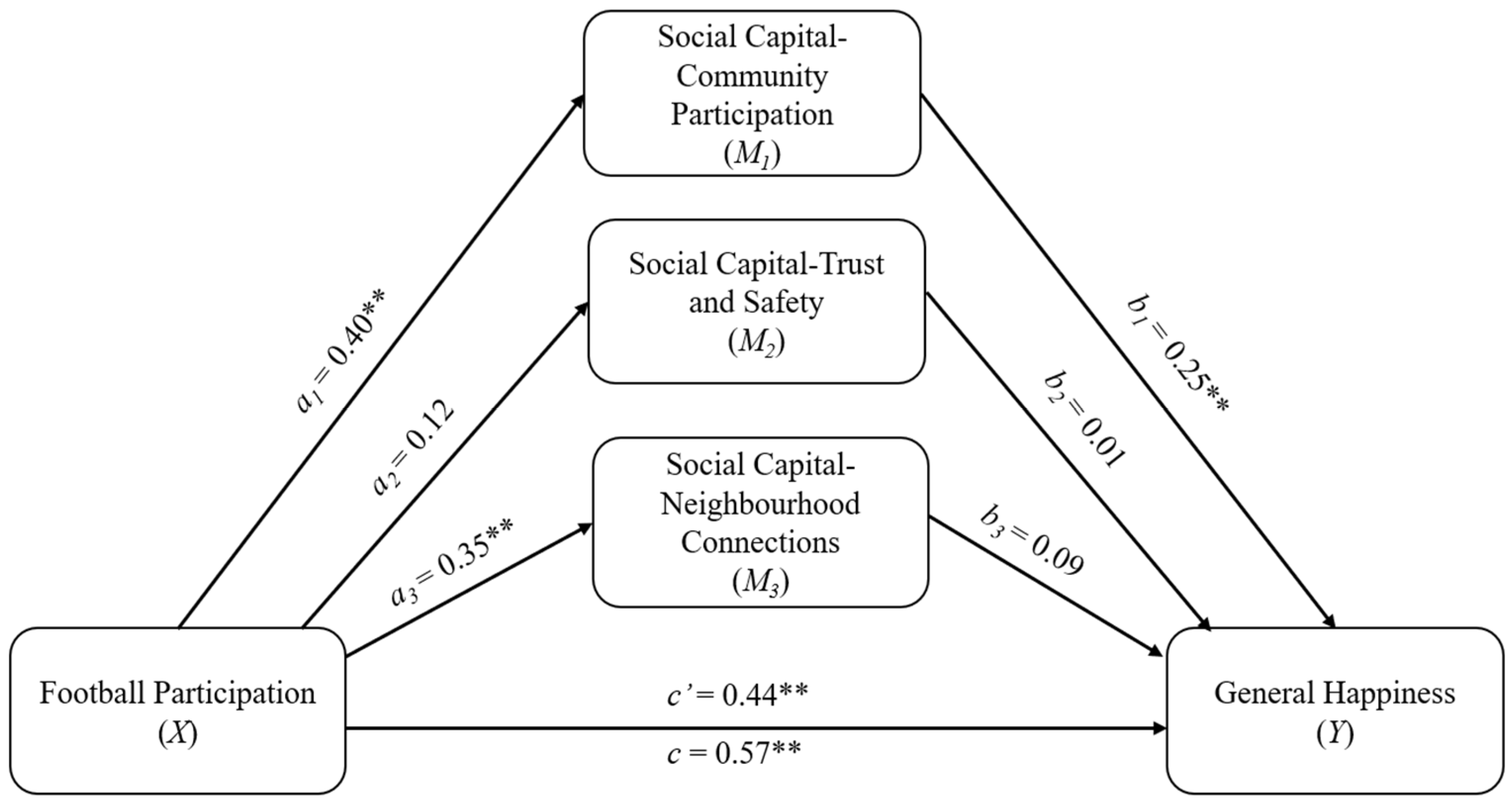
| M1 | M2 | M3 | Happiness (Y) | |||||||||
|---|---|---|---|---|---|---|---|---|---|---|---|---|
| Estimation | LLCI | ULCI | Estimation | LLCI | ULCI | Estimation | LLCI | ULCI | Estimation | LLCI | ULCI | |
| FP (X) | 0.40 ** | 0.26 | 0.53 | 0.12 | −0.18 | 0.25 | 0.35 ** | 0.21 | 0.48 | 0.44 ** | 0.30 | 0.57 |
| SC-Com (M1) | 0.25 ** | 0.14 | 0.36 | |||||||||
| SC-Trust (M2) | 0.01 | −0.08 | 0.10 | |||||||||
| SC-Nei (M3) | 0.09 | −0.02 | 0.19 | |||||||||
| R2 = 0.07 | R2 = 0.007 | R2 = 0.06 | R2 = 0.24 | |||||||||
| Unstandardized | Standardized Coefficients | ||||
|---|---|---|---|---|---|
| Estimation | LLCI | ULCI | p-Value | ||
| Direct effect | 0.43 ** | 0.30 | 0.57 | 0.29 | 0.000 |
| Indirect effect on M1 | 0.11 ** | 0.05 | 0.15 | 0.07 | 0.001 |
| Indirect effect on M2 | 0.01 | −0.01 | 0.01 | 0.00 | 0.843 |
| Indirect effect on M3 | 0.02 | −0.02 | 0.06 | 0.02 | 0.412 |
| Total effects | 0.57 ** | 0.43 | 0.70 | 0.38 | 0.000 |
Disclaimer/Publisher’s Note: The statements, opinions and data contained in all publications are solely those of the individual author(s) and contributor(s) and not of MDPI and/or the editor(s). MDPI and/or the editor(s) disclaim responsibility for any injury to people or property resulting from any ideas, methods, instructions or products referred to in the content. |
© 2026 by the authors. Licensee MDPI, Basel, Switzerland. This article is an open access article distributed under the terms and conditions of the Creative Commons Attribution (CC BY) license.
Share and Cite
Adatepe, E.; Kul, M.; Özkan, A.; Kırkbir, F.; Öz, Ü.; Ünlü, Y.; Seleciler, C.; Boz, E. Sport Participation and Happiness Among Veteran Footballers: The Mediating Role of Social Capital. Healthcare 2026, 14, 396. https://doi.org/10.3390/healthcare14030396
Adatepe E, Kul M, Özkan A, Kırkbir F, Öz Ü, Ünlü Y, Seleciler C, Boz E. Sport Participation and Happiness Among Veteran Footballers: The Mediating Role of Social Capital. Healthcare. 2026; 14(3):396. https://doi.org/10.3390/healthcare14030396
Chicago/Turabian StyleAdatepe, Eda, Murat Kul, Ali Özkan, Fatih Kırkbir, Ümit Öz, Yılmaz Ünlü, Cansu Seleciler, and Emre Boz. 2026. "Sport Participation and Happiness Among Veteran Footballers: The Mediating Role of Social Capital" Healthcare 14, no. 3: 396. https://doi.org/10.3390/healthcare14030396
APA StyleAdatepe, E., Kul, M., Özkan, A., Kırkbir, F., Öz, Ü., Ünlü, Y., Seleciler, C., & Boz, E. (2026). Sport Participation and Happiness Among Veteran Footballers: The Mediating Role of Social Capital. Healthcare, 14(3), 396. https://doi.org/10.3390/healthcare14030396