Care as a Central Concept: Dimensions, Inequalities and Challenges in Chronic Care in Contemporary Societies: A Narrative Review


Highlights
- Care is a structural, political, and transnational category that sustains life and healthcare systems.
- A transformative analysis of care must address its material dimension (as work), its subjective dimension (including emotional bonds and moral responsibility), and its political dimension (shaped by power relations).
- Advancing towards policies of social co-responsibility is essential, not only by promoting caring masculinities but also by strengthening public services, professionalizing the care sector, and formally recognizing care work.
- Further research is needed to promote the recognition, redistribution, and socialization of care, which are essential for social justice and for safeguarding the dignity of both caregivers (predominantly women) and care recipients.
Abstract
1. Introduction
2. Materials and Methods
2.1. Study Design
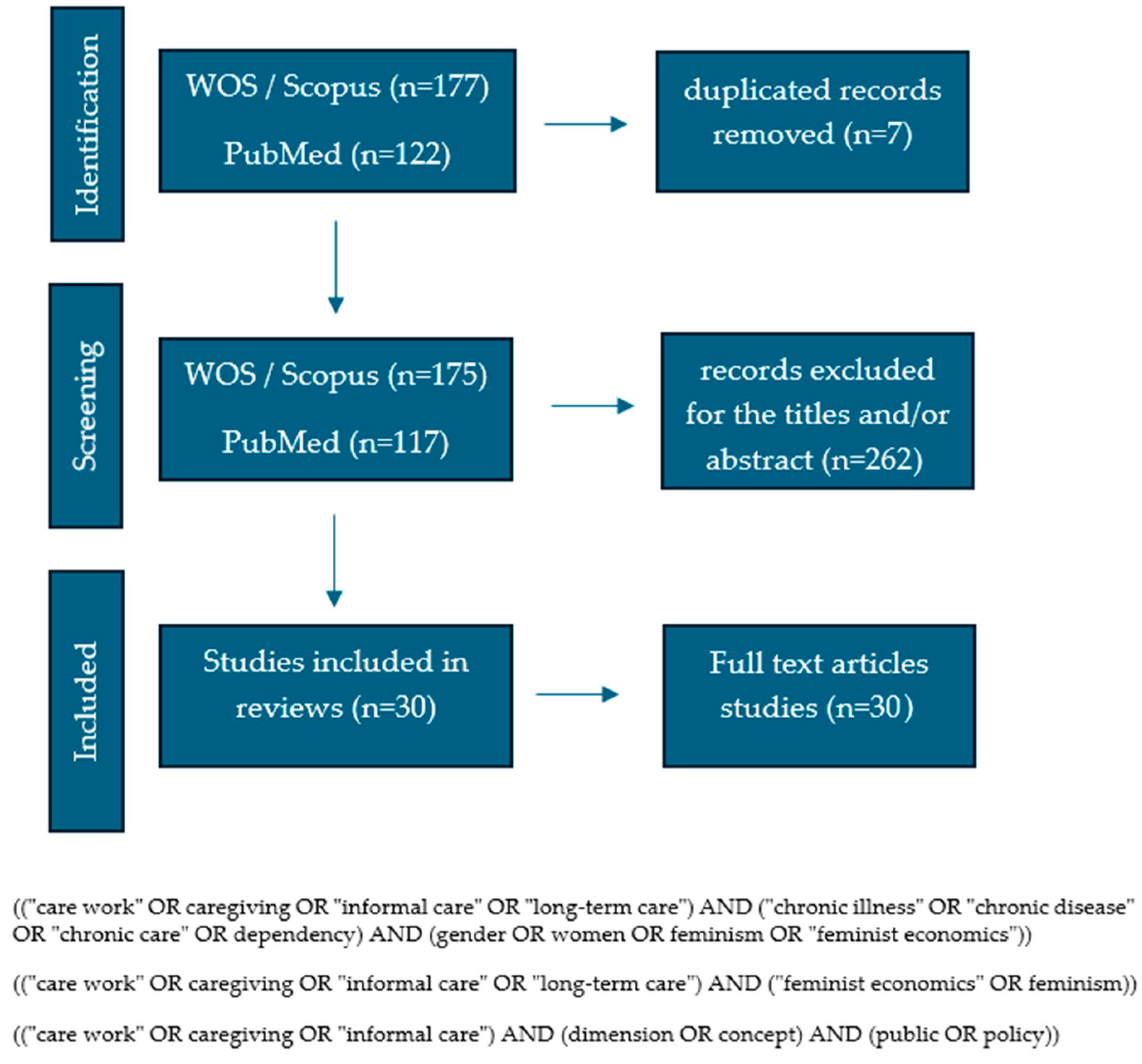
2.2. Search Strategy
2.3. Inclusion and Exclusion Criteria
- Peer-reviewed scientific articles.
- Literature reviews
- Qualitative, quantitative, and theoretical studies addressing chronic care from a social, gender, or political perspective.
- Studies focused exclusively on clinical interventions without analysis of the social context or family care work.
- Publications without access to the full text.
- Duplicate documents or sources containing redundant information.
- Studies not related to chronic care or to the structural analysis of care.
- No language restrictions apply.
2.4. Selection and Data Analysis Process
- Care as central and political concept.
- Dimensions of care (material–physical, subjective–relational, and political),
- Chronic care,
- Global care chains and intersectional inequalities
2.5. Ethical Approach and Scientific Rigor
3. Results
3.1. Care as a Central and Political Concept
3.1.1. Care as a Structural Category for Sustaining Life
3.1.2. Care as a Public Rather than a Private Issue

| Author(s), Year | Country/Region | Study Design/Approach | Population/Focus | Dimension of Care Addressed | Key Contributions | Relevance for Chronic Care with Feminist Perspective |
|---|---|---|---|---|---|---|
| [35] | New Zealand | Qualitative feminist intersectional research | Formal and informal care | Relational | The study shows that caregiving poses significant risks to caregivers’ health and wellbeing and may exacerbate existing gendered and racial health inequities. These impacts are shaped by socio-cultural pressures and intersecting systems of power, highlighting the need for greater institutional support and resources, particularly for caregivers with double care responsibilities. | Provides empirical evidence on how double-duty caregiving intensifies emotional, physical and economic burdens for women, particularly Māori and migrant caregivers, highlighting care as a relational practice shaped by gendered, cultural and structural inequalities and positioning caregiver support as a social justice and health promotion issue. |
| [36] | China | Concept mapping study | Carers, patients, professionals and community members | Political | The study highlights the potential of social capital to support informal caregivers of people with advanced chronic illnesses. While caregiving burden is well documented, the findings underscore the need to better identify and mobilize specific dimensions of social capital that can effectively address caregivers’ health and support needs at the community level. | The different dimensions of social capital can serve as a framework for developing social care programs and policies to support informal carers. |
| [37] | Australia | Qualitative research | Female migrant workers | Political | The article examines the lived experiences of Asian female aged care workers through the concept of carescape and a theory of agency. It shows how social and institutional structures both constrain and enable workers’ agency, shaping access to the aged care workforce and the development of social support networks and resilience. | Institutional and social structures are related to the agency and resilience of female migrant workers. |
| [38] | South Africa | Qualitative research | Caregivers and older care recipients | Relational and political | The study shows that conceptualizations of good care are shaped by, yet also challenge, prevailing policy and cultural ideals. It emphasizes the need for care policies and interventions that address the broader care ecology, particularly the formal carescape, and advocates relational approaches that balance the needs, rights, and experiential knowledge of both caregivers and care recipients. | Based on the theory of the ethics of care and within a framework of the ecology of care, the need for policies focused on caregivers and care recipients is highlighted. |
| [39] | Greece | Quantitative observational research, cross-sectional type | Family caregivers of cancer patients | Relational | Burden increase was found to be related to stress increase. Younger participants and patients’ female spouses had higher levels of stress. The present research also found that stress related to financial issues had an important role. Family caregiver support is found to be a matter of great importance, and healthcare professionals have to pay attention to their needs. | Provides empirical evidence that high levels of stress and caregiving burden among informal cancer caregivers are strongly associated with poorer quality of life, highlighting the emotional and material demands of chronic and highly complex home-based care and the need for greater caregiver support. |
| [40] | USA | Essay | Home care | Political | The article argues for a normative shift from individualistic to systemic approaches to care work, emphasizing the social, economic, and historical forces shaping contemporary care. It contends that improving working conditions through this lens can reduce tensions between caregivers and care recipients and better support feminist ethical ideals of care. | Re-centers home care within bioethics by framing care as socially necessary work shaped by political economy, gendered and racialized inequalities, and labor conditions, arguing for systemic rather than individualistic approaches to improving care in aging and chronic illness contexts. |
| [33] | Slovakia | Quantitative observational research, cross-sectional type | Informal caregivers—older adults with dementia | Relational, material and political | Implementing psycho-social and educational public health interventions focused on strengthening social support and maintaining positive perceptions of caregiving can help reduce the increased risk of caregiver burden in informal caregivers of older adults with dementia. | Provides empirical evidence that perceived social support and positive caregiving experiences significantly reduce caregiver burden in informal caregivers of people with dementia, highlighting the relational and emotional dimensions of chronic care and the structural reliance on informal caregiving. |
| [41] | International (Europe & Latin America) | Integrative Literature Review | Informal care | Political | The articles highlight the potential of personal assistance while stressing the need for greater resources to avoid its restriction to high-income contexts. From a feminist disability care ethics perspective, they show that informal care is largely provided by racialized migrant women and argue for a shift from individual and family responsibility toward collective models of care grounded in interdependence and autonomy. | Identifies politico-epistemic tensions between personal assistance and care from feminist and disability perspectives, highlighting care as a collective, interdependent and structurally unequal practice that requires public responsibility and policy-level transformation. |
| [42] | USA | Theoretical-analytical essay | Family caregiving | Political | The study analyzes older adult care work in the United States as a multilayered system of exploitation that reinforces gendered and racialized hierarchies under capitalist expansion. It contrasts two possible trajectories: increased commodification of care under neoliberalism versus the development of social welfare policies that reduce women’s reproductive labor burden and challenge existing inequalities. | Conceptualizes older adult care as an instrument of capital accumulation under neoliberal capitalism, demonstrating how unpaid and paid care work is structurally gendered, racialized and exploited, and framing care as a central political and structural issue in aging and chronic care systems. |
| [24] | Mexico | Qualitative research | Informal caregivers | Material-physical/relational | The paper examines how women’s paid and unpaid work trajectories are intertwined over the life course in Mexico, highlighting intergenerational differences and social inequalities. From a feminist economics perspective, it demonstrates the central role of domestic and unpaid care work in sustaining life and its relevance for economic analysis. | Shows material demands of chronic caregiving |
| [43] | Chile | Qualitative research | Informal caregivers | Political | The study identifies a complex web of daily care activities that generates significant overload for informal caregivers, with personal, family, and economic consequences. It shows that the sexist social organization of care produces gendered and precarious caregiving roles, framing informal care for dependent adults as a structural and political issue rather than a personal one. | The article raises, from a feminist perspective, how the growing crisis of care, accentuated in neoliberal states, generates an absorption of this problem by women, especially when it comes to dependent adults. |
| [44] | China | Bioethical analysis | Family care | Political | This article identified the constraint of gender hierarchy and its intersection with external social structure that exacerbate gendered oppression and exploitation of female labour in rural China. Normatively, it argues that the current configuration of rural family care, featured by structural impediments and exploration of female labour, is unjust. Some policy recommendations are proposed to empower caregivers and advance care for rural older people. | Relevant to ethical challenges in chronic illness care. This article adopted an empirical ethical approach that integrates ethnographical investigation and feminist ethical inquiry. |
| [25] | Internacional | Essay | COVID-19 Care | Political | The study highlights how the COVID-19 pandemic intensified existing structural inequalities and exposed the central role of paid and unpaid care work in sustaining societies and economies. From a feminist economics perspective, it underscores the need for policy approaches that prioritize social reproduction and human wellbeing over market-centered production. | It underscores the need for a structural reorganization of the economy that places care at its core. |
| [22] | Canada | Qualitative research | Family Caregivers | Political | They identify three themes central to a relational ethic of home support on two rural islands: the strength of intergenerational connections, community-embedded relationships, and care as compassionate civic engagement. Within each theme, they consider how shifting policy structures inform changes over time in the nature and delivery of home support. | Highlights emotional burden in long-term and chronic care |
| [31] | Europe | Review | Informal caregivers | Political | The study shows that demographic and socio-cultural changes are increasing dependency while threatening the availability of informal caregivers, with care responsibilities falling predominantly on women. From a gender perspective, it highlights how caregiver burden reinforces global gender inequalities and emphasizes the need for public, community, and health policy interventions—particularly within nursing practice—to promote more shared and equitable care arrangements. | It is advocated to include a gender perspective in the development of intervention plans to improve the quality of life of caregivers. |
| [30] | Europe: Austria, Germany, Italy (receiving countries), Poland, Romania (sending countries) | Scoping review | Migrant caregivers, care chains | Political | The study indicates that shortages of care workers, combined with cash benefits and strong norms of family responsibility, contribute to increased reliance on migrant carers, often in low-skilled or informal positions. It highlights how the COVID-19 pandemic exposed the fragility of these labor arrangements and underscores the need for policies that integrate migrant long-term care workers into public health research and European health workforce governance. | Demonstrates the structural dependence of European long-term care systems on migrant carers and introduces a trans-sectoral governance framework that links care systems, labour markets and migration policies, highlighting care as a central political and public health issue. |
| [32] | Netherlands | Review | Informal caregivers | Physical/relational | The study identifies caregiving duration and patients’ levels of dependency as key predictors of caregiver burden, with behavioral and cognitive factors shaping care demands. It emphasizes the need for disease-specific support interventions and highlights the potential of changing gendered role expectations—particularly increasing men’s involvement—to reduce the disproportionate burden borne by women. | Predictors of caregiver burden are identified. |
| [45] | China | Qualitative research | Live-in migrant care workers | Relational | Emotional labor allowed live-in migrant care workers to avoid conflict with older people, and to further protect their own welfare and that of others. There is a need to develop culturally appropriate interventions to empower live-in MCWs to deliver emotional labor in a moral manner. | Highlights the significance of empowering live-in migrant care workers by training them in ways that will help them to adapt to working conditions where they will encounter diverse customs and older people who will develop an increasing dependence on them. Analysis drawing on feminist phenomenology |
| [46] | Spain | Review | Care concept | Relational | They propose to extend the concepts of analysis from household production to any form of social interaction. So they define these concepts by the following categories of analysis: (a) the centrality of people’s needs in action; (b) the centrality of target achievement of the action; (c) the centrality of universal standards in action, (d) the centrality of the objects in dispute in the action. | In this paper they construct the concepts of care, provision and service as tools for analysis of social interaction from a gender perspective |
| [47] | Spain | Qualitative research | Informal caregivers | Relational | Results indicated that women report more guilt than men for abandoning family and friends, and because of their relationship with the dependent person. However, with respect to nursing home placement, no difference was observed as a function of gender. The high incidence of caregiver guilt needs to be addressed by health professionals to avoid the emergence of other mental health issues. | This study analyzes guilt among family caregivers of dependent patients, from a gender perspective |
| [48] | USA | Quantitative epidemiological observational research. | Informal caregivers | Political | The study shows that population ageing is increasing demand for informal family care while the pool of caregivers is shrinking, with women reporting higher and relationship-dependent levels of burden, particularly in mental and neurodegenerative conditions. It adopts a structural and global perspective, highlighting how welfare systems outsource care to families—especially in low- and lower-middle-income countries—and conceptualizes informal care as an uncompensated social asset sustaining healthcare systems amid ageing and chronic illness. | Provides robust cross-national evidence on the objective and subjective burden of informal caregiving in chronic illness, demonstrating strong gendered and socioeconomic inequalities and highlighting the structural dependence of health systems on unpaid family care. |
| [49] | Spain | Qualitative research | Migrant caregivers | Relational- Political. | The most important factors for carers’ health were the migration process and care tasks. Interpersonal relationships constituted the principal factor affecting the health of all involved: Good and egalitarian interpersonal relationships are a protective factor for health. | Seeking to understand the effects of care within the family provided by live-in female immigrants on elderly dependents and their families and the carers themselves, from a gender perspective. |
| [26] | UK | Theoretical | Theories of recognition. Dignity and care | Relational | The article shows that postmodern feminist and recognition theories challenge dominant liberal approaches by foregrounding the contingent, affective, and reflexive dimensions of care work. It reconceptualizes dignity as a contested and politicized concept, shifting debates on care from normative injunctions toward critical analyses of morally complex practices shaped by power relations. | Reframes dignity as a relational and politicised practice of care shaped by recognition, power and organisational conditions. The need to review the debate on dignity through the lens of feminism and theories of recognition is argued. |
| [34] | UK and Netherlands | Qualitative research. Binational comparative study. | Caregivers | Political | The study compares caregiver policies and experiences in England and the Netherlands, showing how European welfare states struggle to reconcile increased labor market participation with growing demands for family care. Drawing on the concepts of doulia and doulia rights, it finds that while both policy models have distinct strengths and weaknesses, neither demonstrates a strong commitment to protecting caregivers’ rights to provide care without economic hardship. | Applies the concept of “doulia rights” to empirical evidence, demonstrating that welfare and labour policies in different European regimes fail to adequately support informal caregivers combining work and chronic care, thereby revealing the structural dependence of care systems on unpaid caregiving. |
| [28] | USA | Conceptual and narrative public health analysis | Care model | Political | Health systems are structurally dependent on informal care. Caregiving is an emerging public health issue involving complex and fluctuating roles. Caregiving must be considered in the context of life span needs that vary according to the ages, developmental levels, mental health needs, and physical health demands of both caregivers and care recipients. | Proposal of a triadic care model (family caregiver—care recipient—professionals), integrated within a framework of social, political and demographic forces. |
| [27] | USA | Qualitative research | Female family caregivers | Political | Gender identity is a powerful aspect of self that shapes values, attitudes, and conduct. Family caregivers, particularly women, tend to forgo institutionalization of care recipients even when care demands are overwhelming. The reluctance of women to relinquish care raises questions about the relationship between gender identity and the bearing of burden. | Highlights that caregivers had internalized stereotypical female gender traits that support and facilitate the enduring of burden. |
| [29] | Spain | Theoretical–empirical public health study, using a gender and social class perspective | Care concept and caregivers | Political | Informal health care poses two key questions with regard to the issue of equity: differences in the burdens borne by men and women, which contribute to gender inequality and, depending on their educational and socio-economic level, inequities in their ability to choose and gain access to needed resources and support services, thus contributing to social class inequalities. Distributing the burden of caregiving between men and women, and between the family and the state, constitutes a crucial debate in public health. | Conceptualizes informal care as an invisible health care system and provides empirical evidence that caregiving in chronic and long-term care contexts is structurally feminized and socially stratified, generating profound gender and class inequalities and calling for policy-level redistribution of care responsibilities. |
| [21] | USA | Essay/Theoretical analysis | People with disabilities and caregivers. Ethics of care | Political | Persons with disabilities and those who help care for them must form an alliance to advance their common interests. This alliance can gain insight and inspiration from feminist thought insofar as caretaking is literally linked to problems of the representation of caretaking as “women’s work,’’ and more philosophically, by borrowing from the toolbox of feminist social, political, and economic analyses. | Provides normative basis for care policies in chronic care. Develops ethical framework linking care and justice. |
| [23] | USA | Feminist theory | Care ethics | Political—structural | Feminist critique of care ethics traditions | Frames care as political issue beyond private sphere |
| [20] | USA | Review | Family caregivers | Material-physical | The review highlights the central role of family caregivers—predominantly women—in sustaining long-term care for chronically ill elders and children. While caregiver burden is well documented, it underscores the limited attention given to intervention strategies and emphasizes the need for nursing practices and research focused on reducing caregiver burden. | Connects caregiving workload with chronic disease |
3.2. Dimensions of Care: Contributions to Understanding Chronic Care
3.2.1. Material–Physical Dimension
3.2.2. Subjective–Relational Dimension
3.2.3. Political Dimension
3.3. Global Care Chains and Their Impact on Chronic Care
4. Discussion
- (e)
- (f)
- (g)
- (h)
5. Conclusions
Author Contributions
Funding
Institutional Review Board Statement
Informed Consent Statement
Data Availability Statement
Conflicts of Interest
References
- World Health Organization. Ageing and Health; World Health Organization: Geneva, Switzerland, 2022. [Google Scholar]
- Ruíz Arias, E. Strategies for Providing Informal Family Care at Home to Dependent Persons and the Impact on the Health of Women and Men Who Provide Care. Ph.D. Thesis, University of Seville, Seville, Spain, 2016. [Google Scholar]
- García Calvente, M.M.; del Río Lozano, M.; Marcos, J. Gender inequalities in health deterioration as a result of informal care in Spain. Gac. Sanit. 2011, 25, 100–107. [Google Scholar] [CrossRef] [PubMed]
- Carrasco, C.; Borderías, C.; Torns, T. Care Work: History, Theory, and Policy; The Books of the Cataract: Madrid, Spain, 2011. [Google Scholar]
- Pérez Orozco, A. Feminist Subversion of the Economy: Contributions to a Debate on the Capital-Life Conflict; Traficantes de Sueños: Madrid, Spain, 2014. [Google Scholar]
- Agenjo-Calderon, A.; Gálvez-Muñoz, L. Feminist Economics: Theoretical and political dimensions. Am. J. Econ. Sociol. 2019, 78, 137–166. [Google Scholar] [CrossRef]
- Ezquerra, S. Care, crisis, and democracy: A feminist perspective. REC 2017, 23, 18–33. [Google Scholar]
- Durán, M.A. The Invisible Wealth of Care; University of Valencia: Valencia, Spain, 2018. [Google Scholar]
- Esteban, M.L. Care, a central concept in feminist theory: Contributions, risks, and dialogues with anthropology. CPC 2017, 22, 33–48. [Google Scholar]
- Butler, J.; Fraser, N. Recognition or Redistribution? A Debate Between Marxism and Feminism; Traficante de Sueños: Madrid, Spain, 2000. [Google Scholar]
- Grant, M.J.; Booth, A. A typology of reviews: An analysis of 14 review types and associated methodologies. Health Inf. Libr. J. 2009, 26, 91–108. [Google Scholar] [CrossRef]
- Greenhalgh, T.; Thorne, S.; Malterud, K. Time to challenge the spurious hierarchy of systematic over narrative reviews? Eur. J. Clin. Investig. 2018, 48, e12931. [Google Scholar] [CrossRef]
- Harding, S. Feminism and Methodology: Social Science Issues; Indiana University Press: Bloomington, IN, USA, 1987. [Google Scholar]
- Federici, S. Revolution at Zero Hour. Domestic Work, Reproduction, and Feminist Struggles; Traficantes de sueños: Madrid, Spain, 2013. [Google Scholar]
- Gilligan, C. Morality and Theory. Psychology of Female Development; FCE, Ed.: Tlalpan, Mexico, 1985. [Google Scholar]
- Tronto, J. Moral Boundaries. A Political Argument for an Ethic of Care; Routledge: Oxford, UK, 1993. [Google Scholar]
- Fraser, N. From Redistribution to Recognition? Dilemmas of Justice in the ‘Post-Socialist’ Era. New Left Rev. Crit. Think. Against Domin. 2000, 126–155. [Google Scholar]
- Braun, V.; Clarke, V. Using thematic analysis in psychology. Qual. Res. Psychol. 2006, 3, 77–101. [Google Scholar] [CrossRef]
- Lincoln, Y.S.; Guba, E.G. Naturalistic Inquiry; Sage: Newbury Park, CA, USA, 1985. [Google Scholar]
- Bull, M.J. Interventions for women as family caregivers. Annu. Rev. Nurs. Res. 2001, 19, 125–142. [Google Scholar] [CrossRef] [PubMed]
- Parks, J.A. Envisioning a kinder, gentler world: On recognition and remuneration for care workers. Theor. Med. Bioeth. 2003, 24, 489–499. [Google Scholar] [CrossRef]
- Barken, R.; Davies, M.J. A relational ethic of rural home support on two Gulf Island communities, 1978–2018. J. Aging Stud. 2020, 53, 100847. [Google Scholar] [CrossRef]
- Tong, R. Love’s labor in the health care system: Working toward gender equity. Hypatia 2002, 17, 200–213. [Google Scholar] [CrossRef]
- Ferraris, S.; Martínez Salgado, M. Sustaining life: Trajectories of paid and unpaid work among women in Mexico. Rev. Interdiscip Estud. Género Col. 2022, 8, 1–32. Available online: https://estudiosdegenero.colmex.mx/index.php/eg/article/view/883 (accessed on 27 November 2025). [CrossRef]
- Bahn, K.; Cohen, J.; van der Meulen Rodgers, Y. A feminist perspective on COVID-19 and the value of care work globally. Gend. Work Organ. 2020, 27, 695–699. [Google Scholar] [CrossRef] [PubMed]
- Aranda, K.; Jones, A. Dignity in health-care: A critical exploration using feminism and theories of recognition. Nurs. Inq. 2010, 17, 248–256. [Google Scholar] [CrossRef] [PubMed]
- Kramer, M.K. Self-characterizations of adult female informal caregivers: Gender identity and the bearing of burden. Res. Theory Nurs. Pract. 2005, 19, 137–161. [Google Scholar] [CrossRef]
- Talley, R.C.; Crews, J.E. Framing the public health of caregiving. Am. J. Public Health 2007, 97, 224–228. [Google Scholar] [CrossRef]
- del Mar García-Calvente, M.; Mateo-Rodríguez, I.; Eguiguren, A.P. The informal care system in terms of inequality. Gac. Sanit. 2004, 18, 132–139. Available online: http://scielo.isciii.es/scielo.php?script=sci_arttext&pid=S0213-91112004000400021&lng=es (accessed on 1 December 2025).
- Kuhlmann, E.; Falkenbach, M.; Klasa, K.; Pavolini, E.; Ungureanu, M.I. Migrant carers in Europe intimes of COVID-19: A call to action for European health workforce governance and a public health approach. Eur. J. Public Health 2020, 30, 22–27. [Google Scholar] [CrossRef]
- Cascella Carbó, G.F.; García-Orellán, R. Burden and Gender inequalities around Informal. Care. Investig. Educ. Enferm. 2020, 38, e10. [Google Scholar] [CrossRef]
- Lindt, N.; van Berkel, J.; Mulder, B.C. Determinants of overburdening among informal carers: A systematic review. BMC Geriatr. 2020, 20, 304. [Google Scholar] [CrossRef] [PubMed]
- Nemcikova, M.; Katreniakova, Z.; Nagyova, I. Social support, positive caregiving experience, and caregiver burden in informal caregivers of older adults with dementia. Front. Public Health 2023, 11, 1104250. [Google Scholar] [CrossRef] [PubMed]
- Arksey, H.; Morée, M. Supporting working carers: Do policies in England and The Netherlands reflect ‘doulia rights’? Health Soc. Care Community 2008, 16, 649–657. [Google Scholar] [CrossRef] [PubMed]
- Durville, L.G. ‘I Want People to Know out There, Just How Many Caregivers Struggle Between Work and Home’: Feminist Intersectional Research Exploring Caregiving Lived Experiences in New Zealand. Health Promot. J. Austr. 2025, 36, e70023. [Google Scholar] [CrossRef]
- Ng, M.S.N.; So, W.K.W.; Choi, K.C.; Chan, W.C.H.; Chan, H.Y.L.; Chan, C.W.H. Dimensions of Social Capital for Supporting Informal Carers of Patients With Advanced Chronic Illness in the Community: A Concept Mapping Study. Health Expect. 2025, 28, e70410. [Google Scholar] [CrossRef]
- Winarnita, M.; Leone, C.; Klassen, T.; Blackberry, I.D. Social resilience within the carescapes of Asian female migrant aged care workers. Front. Public Health 2025, 13, 1565750. [Google Scholar] [CrossRef]
- Brear, M.R.; Manderson, L.; Nkovana, T.; Harling, G. Conceptualisations of “good care” within informal caregiving networks for older people in rural South Africa. Soc. Sci. Med. 2024, 344, 116597. [Google Scholar] [CrossRef]
- Fellia, T.; Sarafis, P.; Bouletis, A.; Tzenetidis, V.; Papathanasiou, I.; Apostolidi, T.P.; Gkena, N.; Nikolentzos, A.; Patsopoulou, A.; Malliarou, M. Correlation of Cancer Caregiver’s Burden, Stress, and Their Quality of Life. Adv. Exp. Med. Biol. 2023, 1425, 267–273. [Google Scholar] [CrossRef]
- Gary, M.; Berlinger, N. Centering Home Care in Bioethics Scholarship, Education, and Practice. Hastings Cent. Rep. 2023, 53, 34–36. [Google Scholar] [CrossRef]
- Pino-Morán, J.A.; Rodríguez-Garrido, P.; Burrone, M.S. Politico-Epistemic Tensions Regarding Personal Assistance and Care for People with Disabilities: An Integrative Literature Review. Int. J. Environ. Res. Public Health 2023, 20, 1366. [Google Scholar] [CrossRef]
- Brady, S. Neoliberal Capitalism, Older Adult Care and Feminist Theory. CLR James J. 2022, 28, 85–108. [Google Scholar] [CrossRef]
- Grandón Valenzuela, D.E. The personal is political: A feminist analysis of the daily experience of informal female caregivers of adult people in dependence situation, in Santiago de Chile. Cad. Bras. Ter. Ocup. 2021, 29, e2161. [Google Scholar] [CrossRef]
- Zou, X.; Nie, J.B.; Fitzgerald, R. Gendered caregiving and structural constraints: An empirical ethical study. Nurs. Ethics 2021, 28, 387–401. [Google Scholar] [CrossRef] [PubMed]
- Ho, K.H.M.; Chiang, V.C.L.; Leung, D.; Cheung, D.S.K. A feminist phenomenology on the emotional labor and morality of live-in migrant care workers caring for older people in the community. BMC Geriatr. 2019, 19, 234. [Google Scholar] [CrossRef] [PubMed]
- Mora, E.; Pujal, M. Care beyond domestic work. Rev. Mex. Sociol. 2018, 80, 445–469. [Google Scholar] [CrossRef]
- Brea, M.T.; Albar, M.J.; Casado-Mejia, R. Gendering Guilt among Dependent Family Members’Caregivers. Span. J. Psychol. 2016, 19, E80. [Google Scholar] [CrossRef]
- Shahly, V.; Chatterji, S.; Gruber, M.J.; Al-Hamzawi, A.; Alonso, J.; Andrade, L.H.; Angermeyer, M.C.; Bruffaerts, R.; Bunting, B.; Caldas-de-Almeida, J.M.; et al. Cross-national differences in the prevalence and correlates of burden among older family caregivers in the World Health Organization World Mental Health (WMH) Surveys. Psychol. Med. 2013, 43, 865–879. [Google Scholar] [CrossRef]
- Casado-Mejía, R.; Ruiz-Arias, E.; Solano-Parés, A. Family care provided by immigrant women and its impact on the quality of care and health. Gac. Sanit. 2012, 26, 547–553. [Google Scholar] [CrossRef]
- Instituto Nacional de Estadística (INE). Proyecciones de la Población de España 2014–2064; Instituto Nacional de Estadística: Madrid, Spain, 2015. [Google Scholar]
- Giusto-Ampuero, A. Care practices: Intersubjectivity, intersectionality, and social policies. Prism. Soc. 2021, 32, 526–536. [Google Scholar]
- Martínez Franzoni, J. Cuidados. Between the feminist wave and austerity. Nueva Soc. 2022, 302, 62–70. [Google Scholar]
- Sondea Para Clece. The Future of Care. 2021. Available online: https://clece.es/es/2021/10/04/la-ayuda-a-domicilio-y-la-teleasistencia-marcan-el-futuro-del-cuidado-de-los-mayores/ (accessed on 15 December 2025).
- UN Women. The Progress of Women in Latin America and the Caribbean. Transforming Economies to Guarantee Rights; UN: Clayton, MO, USA, 2008. [Google Scholar]
- Portella, E. Feminism beyond welfare: Care, socialisation and the politics of the state. Fem. Theory 2025, 26, 286–308. [Google Scholar] [CrossRef]
- Tronto, J. Caring Democracy: Markets, Equality, and Justice; NYU Press: New York, NY, USA, 2013. [Google Scholar]
- Coelho, C.T.; Heidemann, I.T.; Schülter, B.; Rodrigues, L. Reflecting on the experiences of black women acting as caregivers in a home care context. Mediações 2025, 30, e52047. [Google Scholar]
- Rodríguez Enríquez, C. Economía feminista y economía del cuidado. Aportes conceptuales para el estudio de la desigualdad. Nueva Soc. 2015, 256, 1–15. [Google Scholar]
- Barañano Uribarri, M. Los Cuidados en el Movimiento Feminista: Cómo Hemos Llegado Hasta Aquí. In Feminismo y Crisis de los Cuidados: Desafíos y Reflexiones; Feminista, I., Uribarri, M.B., Moñux, U.C., Elkartea, E.M.G.N., de Garayalde Ulacia, A.F., Etxeberria, L.L., Crespo, I.O., Emilio, M.S., Etxepare, A.U., González, B.Z., et al., Eds.; STEILAS: Vitoria-Gasteiz, Spain, 2024. [Google Scholar]
- Faur, E. El Cuidado Infantil en el Siglo Xxi. Mujeres Malabaristas en Una Sociedad Desigual; Siglo XXI: Yucatán, Mexico, 2014. [Google Scholar]
- Instituto de Mayores y Servicios Sociales (IMSERSO). Informe Anual 2013 IMSERSO; Ministerio de Sanidad, Ed.: Madrid, Spain, 2013. [Google Scholar]
- Torres Enamorado, D. Profile of Male Family Caregivers in Seville and Cadiz. Characteristics of Their Caregiving. Ph.D. Thesis, University of Seville, Sevilla, Spain, 2017. [Google Scholar]
- López Martínez, J.; Crespo López, M. Cuidadoras y cuidadores: El efecto del género en el cuidado no profesional de los mayores. Bol. Sobre Envejec. Minist. Educ. 2008, 35, 2–30. [Google Scholar]
- Robinson, C.A.; Bottorff Joan, L.; Pesut Barbara Oliffe, J.L.; Tomlinson, J. The Male Face of Caregiving: A Scoping Review of Men Caring for a Person With Dementia. Am. J. Men’s Health 2014, 8, 409–426. [Google Scholar] [CrossRef]
- Donelan, K.; Hill, C.A.; Hoffman, C.; Scoles, K.; Feldman, P.H.; Levine, C.; Gould, D. Challenged to care: Informal caregivers in a changing health system. Health Aff. 2002, 21, 222–231. [Google Scholar] [CrossRef]
- Ruddick, S. Maternal thinking. In Women and Values: Reading in Recent Feminist Philosophy; Pearsall, M., Ed.; Belmont: Wadsworth, OH, USA, 1986; pp. 340–351. [Google Scholar]
- Otxoa, I.; Esteban, M.L. DIÁLOGO: Mari Luz Esteban e Isabel Otxoa. Boletín ECOS 2010, 10, 1–9. [Google Scholar]
- Hondagneu-Sotelo, P. Gender and Migration Scholarship: An Overview from a 21st Century Perspective. Migr. Int. 2011, 6, 219–233. [Google Scholar] [CrossRef]
- Parreñas Salazar, R. Servants of globalization. In Women, Migration and Domestic Work; Stanford University Press: Stanford, CA, USA, 2001. [Google Scholar]
- Rodríguez Cabrero, G. Social policies for care dependency in the European Welfare Regimes. Cuad. Relac. Laborales 2011, 29, 13–42. [Google Scholar] [CrossRef]
- Popay, J.; Roberts, H.; Sowden, A.; Petticrew, M.; Arai, L.; Rodgers, M.; Britten, N.; Roen, K.; Duffy, S. Guidance on the Conduct of Narrative Synthesis in Systematic Reviews; ESRC: London, UK, 2006. [Google Scholar]

Disclaimer/Publisher’s Note: The statements, opinions and data contained in all publications are solely those of the individual author(s) and contributor(s) and not of MDPI and/or the editor(s). MDPI and/or the editor(s) disclaim responsibility for any injury to people or property resulting from any ideas, methods, instructions or products referred to in the content. |
© 2026 by the authors. Licensee MDPI, Basel, Switzerland. This article is an open access article distributed under the terms and conditions of the Creative Commons Attribution (CC BY) license.
Share and Cite
Torres-Enamorado, D.; Casado-Mejía, R. Care as a Central Concept: Dimensions, Inequalities and Challenges in Chronic Care in Contemporary Societies: A Narrative Review. Healthcare 2026, 14, 359. https://doi.org/10.3390/healthcare14030359
Torres-Enamorado D, Casado-Mejía R. Care as a Central Concept: Dimensions, Inequalities and Challenges in Chronic Care in Contemporary Societies: A Narrative Review. Healthcare. 2026; 14(3):359. https://doi.org/10.3390/healthcare14030359
Chicago/Turabian StyleTorres-Enamorado, Dolores, and Rosa Casado-Mejía. 2026. "Care as a Central Concept: Dimensions, Inequalities and Challenges in Chronic Care in Contemporary Societies: A Narrative Review" Healthcare 14, no. 3: 359. https://doi.org/10.3390/healthcare14030359
APA StyleTorres-Enamorado, D., & Casado-Mejía, R. (2026). Care as a Central Concept: Dimensions, Inequalities and Challenges in Chronic Care in Contemporary Societies: A Narrative Review. Healthcare, 14(3), 359. https://doi.org/10.3390/healthcare14030359