Comparing Thriving at Work Among Trans-Tasman Early-Career Nurses: A Multinational Cross-Sectional Study


Highlights
- Early-career nurses in New Zealand experience higher levels of burnout and report colleague support as the key predictor of thriving at work, highlighting the need for workplaces to reduce workloads and foster social connection.
- In Australia, authenticity at work is the key predictor of thriving, highlighting the importance of organisational cultures that enable nurses to express their true selves and professional identity.
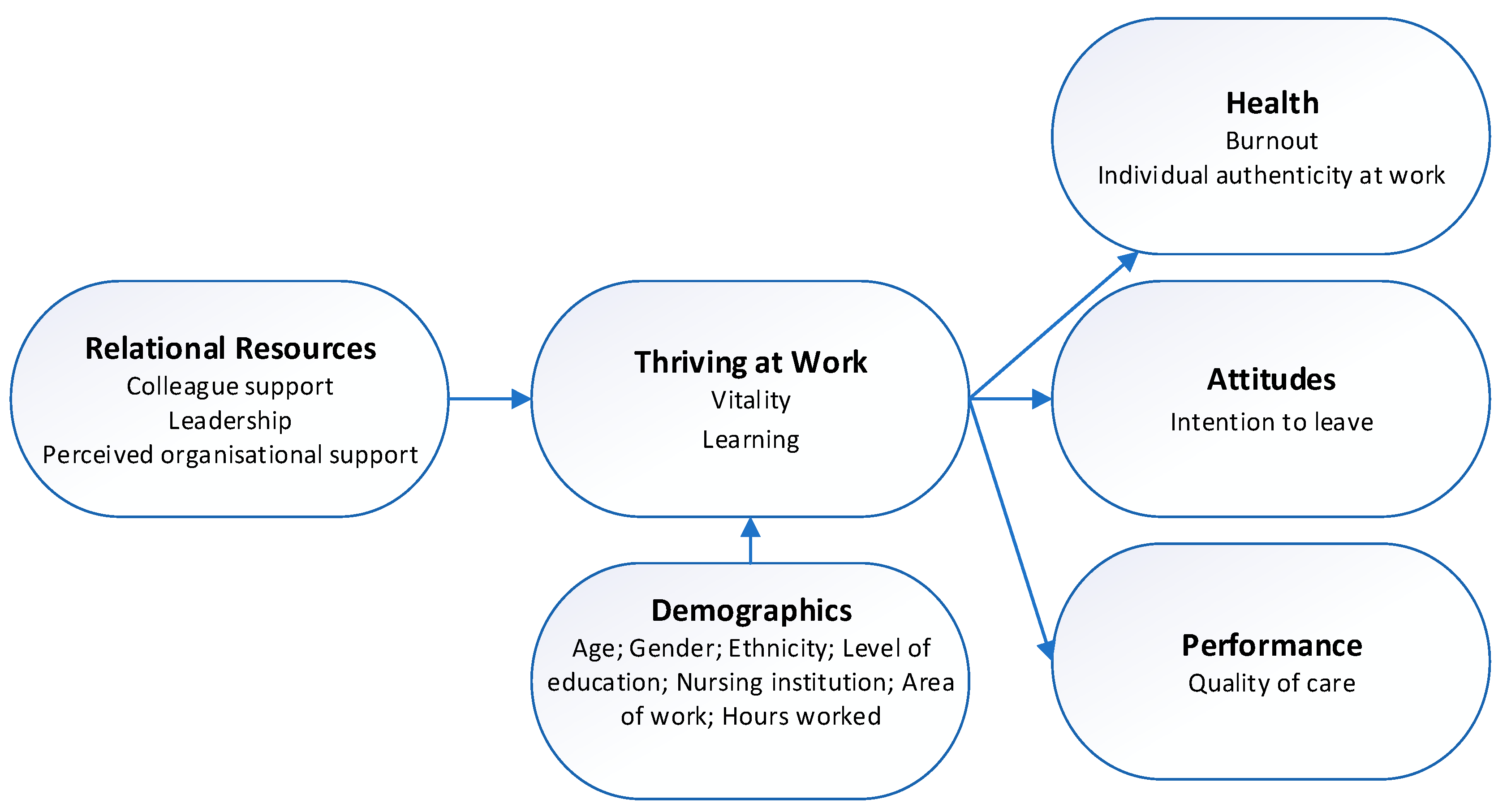
- Applying the Thriving at Work model to the New Zealand and Australian nursing context highlights important differences that organisations should address when developing workforce policies in each country.
- The issue of early-career nurse attrition from the profession is an international concern. This research provides an innovative and theory-informed approach to examining how organisations can better support early-career nurses, which can be used by health policy makers internationally.
Abstract
1. Introduction
2. Background
3. Study Aims
- To identify and compare the predictors of early-career nurses’ thriving at work in New Zealand and Australia;
- To provide innovative and theory-informed recommendations to improve organisational support for early-career nurses to increase retention in the profession.
4. Materials and Methods
4.1. Design
4.2. Study Setting and Sampling
4.3. Data Collection
4.3.1. Thriving at Work
4.3.2. Burnout
4.3.3. Colleague Support
4.3.4. Leadership
4.3.5. Organisational Support
4.3.6. Quality of Care
4.3.7. Individual Authenticity at Work
4.3.8. Intention to Leave the Profession
4.3.9. Demographics
4.4. Data Analysis
4.5. Ethical Considerations
5. Results
6. Discussion
6.1. Predictors of Thriving at Work
6.1.1. Burnout
6.1.2. Colleague Support
6.1.3. Authenticity at Work
6.2. Trans-Tasmin Migration
6.3. Recommendations to Improve Organisational Support of Early-Career Nurses
6.4. Limitations
7. Conclusions
Author Contributions
Funding
Institutional Review Board Statement
Informed Consent Statement
Data Availability Statement
Conflicts of Interest
Abbreviations
| ECN | Early-career nurse |
Appendix A
Survey Instrument
- Demographics:
- What is your current age (in whole years)?
- What is your gender identity?
- What is your ethnicity?
- What is your highest level of nursing education?
- Where did you complete your nursing education?
- Please select the option that most closely aligns to your area of work.
- How many hours do you usually work each week in your current role?
- Thriving at Work Scale:
- In relation to your work, rate how you agree with the following statements (7-point scale: 1 = Strongly disagree, 7 = Strongly agree):
- I find myself learning often.
- I continue to learn more and more as time goes by.
- I see myself continually improving.
- I am not learning.
- I have developed a lot as a person.
- I feel alive and vital.
- I have energy and spirit.
- I do not feel very energetic.
- I feel alert and awake.
- I am looking forward to each new day.
- Maslach Burnout Scale:
- When you think of your work overall, how often do you feel the following (5-point scale: 0 = Never, 4 = Always):
- Tired
- Physically weak/Sickly
- Difficulties sleeping
- Disappointed with people
- Trapped
- Worthless/Like a failure
- Hopeless
- Helpless
- Depressed
- “I’ve had it”
- Colleague Support:
- Please tell us about your relationships with colleagues (People you have the most contact with such as registered nurses, healthcare assistants, doctors, and allied health colleagues) (7-point scale: 1 = Strongly disagree, 7 = Strongly agree):
- My colleagues appreciate the value of my work and its results.
- My colleagues express a positive opinion on my work.
- My colleagues give me supportive advice.
- My colleagues help me with the performance of my tasks.
- Leadership (LMX-7):
- We’d like to know about your relationship with your immediate manager (the person who assesses your job performance, e.g., Charge Nurse) (7-point scale: 1 = Strongly disagree, 7 = Strongly agree):
- I know where I stand with my manager.
- My manager understands my problems and needs.
- My manager recognises my potential.
- My manager would use their power to help me solve problems at work.
- My manager would “bail me out” at their expense.
- I have enough confidence in my manager that I would defend and justify their decision if they were not present.
- I would characterise my working relationship with my manager as effective
- Perceived Organisational Support:
- These questions relate to the level of support you receive from your organisation (7-point scale: 1 = Strongly disagree, 7 = Strongly agree):
- Senior management really cares about my well-being.
- Senior management cares about my general satisfaction at work.
- Senior management shows very little concern for me.
- Quality of Care:
- Regarding your work over the last year, rate your answer to the following statements as honestly as possible. Please remember these answers are anonymous (5-point scale: 1 = Never, 5 = Often):
- I make mistakes without negative consequences to patients.
- I perform procedures without appropriate training.
- I make mistakes with negative consequences to patients.
- I fall short in the quality of care I provide to my patients.
- I do not have enough time or attention for my patients.
- Individual Authenticity at Work:
- At work, to what extent can you be who you really are? (7-point scale: 1 = Strongly disagree, 7 = Strongly agree):
- In this job, I can express myself.
- In this job, I don’t feel I need to hide who I really am.
- In this job, I can be myself.
- In this job, I don’t have to act like someone I’m not.
- In this job, I feel authentic.
- In this job, I can be who I really am.
- Intention to Leave:
- In terms of how you feel now about being a member of the nursing profession, rate your response to the following questions (7-point scale: 1 = Strongly disagree, 7 = Strongly agree):
- I want to leave the nursing profession as soon as possible.
- If I had it to do over again, I would still go into nursing.
- I plan to continue in nursing for the rest of my working life.
References
- World Health Organization. State of the World’s Nursing 2025: Investing in Education, Jobs, Leadership and Service Delivery. 2025. Available online: https://iris.who.int/server/api/core/bitstreams/a4173924-a18f-49b6-8bd1-9c2a4a098980/content (accessed on 6 July 2025).
- International Council of Nurses. New Report Calls for Global Action Plan to Address Nursing Workforce Crisis and Prevent an Avoidable Healthcare Disaster. 2022. Available online: https://www.icn.ch/news/new-report-calls-global-action-plan-address-nursing-workforce-crisis-and-prevent-avoidable (accessed on 24 January 2025).
- Heyes, R. How Many More Nurses Does New Zealand Need? 2025. Available online: https://www.nzno.org.nz/Portals/0/publications/Report%20-%20Infometrics%20report%20how%20many%20more%20nurses%20does%20New%20Zealand%20need%20August%202025%20FINAL.pdf (accessed on 7 October 2025).
- Djukic, M.; Kovner, C.T.; Brewer, C.S.; Fatehi, F.K.; Seltzer, J.R. A multi-state assessment of employer-sponsored quality improvement education for early-career registered nurses. J. Contin. Educ. Nurs. 2013, 44, 12–19. [Google Scholar] [CrossRef]
- Flinkman, M.; Isopahkala-Bouret, U.; Salanterä, S. Young registered nurses’ intention to leave the profession and professional turnover in early career: A qualitative case study. ISRN Nurs. 2013, 2013, 916061. [Google Scholar] [CrossRef]
- NSI Nursing Solutions Inc. 2025 NSI National Health Care Retention and RN Staffing Report. 2025. Available online: https://www.nsinursingsolutions.com/documents/library/nsi_national_health_care_retention_report.pdf (accessed on 24 October 2025).
- Sharma, G. Retaining Australian nurses: An analysis of nurses’ wages and exit rates. Aust. Econ. Pap. 2024, 63, 89–98. [Google Scholar] [CrossRef]
- Shah, M.K.; Gandrakota, N.; Cimiotti, J.P.; Ghose, N.; Moore, M.; Ali, M.K. Prevalence of and Factors Associated With Nurse Burnout in the US. JAMA Netw. Open 2021, 4, e2036469. [Google Scholar] [CrossRef]
- Cottle-Quinn, A.; Tower, M.; Eley, R. Factors that impact Australian early career nurses’ intentions to remain in their position and the profession: A prospective cohort study. J. Nurs. Manag. 2022, 30, 3419–3429. [Google Scholar] [CrossRef]
- El-Ibiary, S.Y.; Yam, L.; Lee, K.C. Assessment of Burnout and Associated Risk Factors Among Pharmacy Practice Faculty in the United States. Am. J. Pharm. Educ. 2017, 81, 75. [Google Scholar] [CrossRef]
- Kane, P. 10 Ways to Understand the Difference Between Millennials and Gen-Z: New Data Shows Remarkably Different Attitudes Between Millennials (Generation Y) and Gen-Z. What that Means for Your Business. 2022. Available online: https://www.inc.com/phillip-kane/10-ways-to-understand-difference-between-millennials-generation-y-vs-gen-z.html (accessed on 12 June 2025).
- Perlo, J.; Balik, B.; Swensen, S.; Kabcenell, A.; Feeley, D. IHI Framework for Improving Joy in Work; Institute for Healthcare Improvement: Boston, MA, USA, 2017. [Google Scholar]
- Jackson, D.; Firtko, A.; Edenborough, M. Personal resilience as a strategy for surviving and thriving in the face of workplace adversity: A literature review. J. Adv. Nurs. 2007, 60, 1–9. [Google Scholar] [CrossRef]
- Lyu, X.C.; Huang, S.S.; Ye, X.M.; Zhang, L.Y.; Zhang, P.; Wang, Y.J. What influences newly graduated registered nurses’ intention to leave the nursing profession? An integrative review. BMC Nurs 2024, 23, 57. [Google Scholar] [CrossRef]
- Turnbach, E.; Coates, L.; Vanek, F.D.; Cotter, E.; Pogue, C.A.; Clark, R.R.; Aiken, L.H.; Hugh, M.; Cleary, M.; Ley, C.; et al. Emergency Nurses’ Well-Being in Magnet Hospitals and Recommendations for Improvements in Work Environments: A Multicenter Cross-Sectional Observational Study. J. Emerg. Nurs. 2024, 50, 153–160. [Google Scholar] [CrossRef]
- Kennedy, L.; Brom, H.; Lasater, K.B.; Albert, N.M.P.; Gobel, B.M.H.; DeLemos, C.M.; Williams, L.M.M.; Aiken, L.H.P. Advanced Practice Registered Nurse Burnout in Magnet Hospitals: Opportunities for Organizational Intervention. J. Nurs. Adm. 2025, 55, 230–236. [Google Scholar] [CrossRef]
- Aiken, L.H.; Lasater, K.B.; Sloane, D.M.; Pogue, C.A.; Rosenbaum, K.E.F.; Muir, K.J.; McHugh, M.D. Physician and Nurse Well-Being and Preferred Interventions to Address Burnout in Hospital Practice: Factors Associated With Turnover, Outcomes, and Patient Safety. JAMA Health Forum 2023, 4, e231809. [Google Scholar] [CrossRef]
- Plsek, P.E.; Wilson, T. Complexity, leadership, and management in healthcare organisations. BMJ 2001, 323, 746–749. [Google Scholar] [CrossRef]
- Jacobs, S.; Moloney, W.; Terry, D.; Lewis, P.A.; Topping, A.; González-Agüero, M.; Cavanagh, S. Creating Organisational Working Conditions Where Nurses Can Thrive: An International Action Research Study. Nurs. Rep. 2025, 15, 95. [Google Scholar] [CrossRef]
- Spreitzer, G.; Sutcliffe, K.; Dutton, J.; Sonenshein, S.; Grant, A. A Socially Embedded Model of Thriving at Work. Organ. Sci. 2005, 16, 537–549. [Google Scholar] [CrossRef]
- Jordan, J.E.; Garner, K.; Bones, K.; McKenzie, L.; Linzer, M.; Rathert, C.; Goelz, E.; McCall, J.; Sawyer, E.; Baass, B.; et al. Improving joy at work and reducing burnout in health care workers in Victoria, Australia using the Institute for Healthcare Improvement joy in work framework: A mixed-methods study. Health Care Manag. Rev. 2025, 50, 3–12. [Google Scholar] [CrossRef]
- Kleine, A.-K.; Rudolph, C.W.; Zacher, H. Thriving at work: A meta-analysis. J. Organ. Behav. 2019, 40, 973–999. [Google Scholar] [CrossRef]
- Wan, Q.; Li, Z.; Zhou, W.; Shang, S. Effects of work environment and job characteristics on the turnover intention of experienced nurses: The mediating role of work engagement. J. Adv. Nurs. 2018, 74, 1332–1341. [Google Scholar] [CrossRef]
- Paterson, T.A.; Luthans, F.; Jeung, W. Thriving at work: Impact of psychological capital and supervisor support. J. Organ. Behav. 2014, 35, 434–446. [Google Scholar] [CrossRef]
- Goh, Z.; Eva, N.; Kiazad, K.; Jack, G.A.; De Cieri, H.; Spreitzer, G.M. An integrative multilevel review of thriving at work: Assessing progress and promise. J. Organ. Behav. 2022, 43, 197–213. [Google Scholar] [CrossRef]
- Spence Laschinger, H.K.; Fida, R. New nurses burnout and workplace wellbeing: The influence of authentic leadership and psychological capital. Burn. Res. 2014, 1, 19–28. [Google Scholar] [CrossRef]
- Engström, M.; Björkman, A.; Silén, M.; Wahlberg, A.C.; Skytt, B. Thriving at work as a mediator between nurses’ structural empowerment and job performance, work-personal life benefits, stress symptoms and turnover intentions: A cross-sectional study. BMC Nurs. 2025, 24, 175. [Google Scholar] [CrossRef]
- Cummings, G.G.; Tate, K.; Lee, S.; Wong, C.A.; Paananen, T.; Micaroni, S.P.; Chatterjee, G.E. Leadership styles and outcome patterns for the nursing workforce and work environment: A systematic review. Int. J. Nurs. Stud. 2018, 85, 19–60. [Google Scholar] [CrossRef]
- Eisenberger, R.; Huntington, R.; Hutchison, S.; Sowa, D. Perceived organizational support. J. Appl. Psychol. 1986, 71, 500–507. [Google Scholar] [CrossRef]
- Maslach, C.; Schaufeli, W.; Leiter, M. Job Burnout. Annu. Rev. Psychol. 2001, 52, 397–422. [Google Scholar] [CrossRef]
- Schaufeli, W.B.; Taris, T.W. The conceptualization and measurement of burnout: Common ground and worlds apart. Work. Stress 2005, 19, 256–262. [Google Scholar] [CrossRef]
- Leep-Lazar, K.; Ma, C.; Stimpfel, A.W. Factors Associated With Intent to Leave the Nursing Profession in the United States: An Integrative Review. Res. Nurs. Health 2025, 48, 429–440. [Google Scholar] [CrossRef]
- Kakemam, E.; Chegini, Z.; Rouhi, A.; Ahmadi, F.; Majidi, S. Burnout and its relationship to self-reported quality of patient care and adverse events during COVID-19: A cross-sectional online survey among nurses. J. Nurs. Manag. 2021, 29, 1974–1982. [Google Scholar] [CrossRef]
- Cordeiro, L.; Soares, C.B. Action research in the healthcare field: A scoping review. JBI Database Syst. Rev. Implement. Rep. 2018, 16, 1003–1047. [Google Scholar] [CrossRef]
- Vargas, C.; Whelan, J.; Brimblecombe, J.; Allender, S. Co-creation, co-design and co-production for public health: A perspective on definitions and distinctions. Public Health Res. Pract. 2022, 32, e3222210. [Google Scholar] [CrossRef]
- Porath, C.; Spreitzer, G.; Gibson, C.; Garnett, F.G. Thriving at work: Toward its measurement, construct validation, and theoretical refinement. J. Organ. Behav. 2012, 33, 250–275. [Google Scholar] [CrossRef]
- Maslach, C.; Jackson, S.; Leiter, M. The Maslach Burnout Inventory Manual; The Scarecrow Press: Lanham, MA, USA, 1997; pp. 191–218. [Google Scholar]
- Van Der Heijden, B.I.J.M. Organisational influences upon the development of occupational expertise throughout the career. Int. J. Train. Dev. 2003, 7, 142–165. [Google Scholar] [CrossRef]
- Graen, G.B.; Uhl-Bien, M. Relationship-based approach to leadership: Development of leader-member exchange (LMX) theory of leadership over 25 years: Applying a multi-level multi-domain perspective. Leadersh. Q. 1995, 6, 219–247. [Google Scholar] [CrossRef]
- Wayne, S.J.; Shore, L.M.; Liden, R.C. Perceived organizational support and leader-member exchange: A social exchange perspective. Acad. Manag. J. 1997, 40, 82–111. [Google Scholar] [CrossRef]
- van den Bosch, R.; Taris, T.W. Authenticity at work: Development and validation of an individual authenticity measure at work. J. Happiness Stud. 2014, 15, 1–18. [Google Scholar] [CrossRef]
- Dotson, M.J.; Dave, D.S.; Cazier, J.A.; Spaulding, T.J. An empirical analysis of nurse retention: What keeps RNs in nursing? J. Nurs. Adm. 2014, 44, 111–116. [Google Scholar] [CrossRef]
- Cai, A.; Tsay, R.S.; Chen, R. Variable Selection in Linear Regression With Many Predictors. J. Comput. Graph. Stat. 2009, 18, 573–591. [Google Scholar] [CrossRef]
- Lindsey, C.; Sheather, S. Variable Selection in Linear Regression. Stata J. 2010, 10, 650–669. [Google Scholar] [CrossRef]
- Pallant, J. SPSS Survival Manual, 7th ed.; Allen & Unwin: Crows Nest, Australia, 2020. [Google Scholar]
- Klingberg, S.; Stalmeijer, R.E.; Varpio, L. Using framework analysis methods for qualitative research: AMEE Guide No. 164. Med. Teach. 2024, 46, 603–610. [Google Scholar] [CrossRef]
- Macintosh, K. ‘Disingenuous’—Kiwi Nurses Challenge Claim Pay Rates Now on Par with Australia. Available online: https://kaitiaki.org.nz/article/disingenuous-kiwi-nurses-challenge-claim-pay-rates-now-on-par-with-australia/ (accessed on 15 September 2025).
- NSW Health. Safe Staffing to Deliver More Nurses for NSW Hospitals. Available online: https://www.health.nsw.gov.au/news/Pages/20240516_00.aspx (accessed on 17 September 2025).
- Hill, R. Health NZ to Employ More Graduate Nurses Part Time, Cut On-Job Training, Document Reveals. 2025. Available online: https://www.rnz.co.nz/news/national/571641/health-nz-to-employ-more-graduate-nurses-part-time-cut-on-job-training-document-reveals (accessed on 1 July 2025).
- Ching, H.Y.; Fang, Y.T.; Yun, W.K. How New Nurses Experience Workplace Belonging: A Qualitative Study. SAGE Open 2022, 12, 21582440221119471. [Google Scholar] [CrossRef]
- Terry, D.; Jacobs, S.; Moloney, W.; East, L.; Ryan, L.; Elliott, J.; Tulleners, T.; Masamba, H.; Peck, B. The Impact of Thriving at Work and Occupational Supports: Early Career Nurse Intentions to Leave an Organisation and Profession. J. Adv. Nurs. 2025, 81, 8608–8619. [Google Scholar] [CrossRef]
- Moloney, W.; Boxall, P.; Parsons, M.; Sheridan, N. Which factors influence New Zealand registered nurses to leave their profession? N. Z. J. Employ. Relat. 2017, 43, 1–13. [Google Scholar]
- Mental Health Foundation of New Zealand. Creating Mentally Healthy Workplace Environments for Māori. Available online: https://mentalhealth.org.nz/ (accessed on 4 December 2025).
- Cha, S.E.; Hewlin, P.F.; Roberts, L.M.; Buckman, B.R.; Leroy, H.; Steckler, E.L.; Ostermeier, K.; Cooper, D. Being your true self at work: Integrating the fragmented research on authenticity in organizations. Acad. Manag. Ann. 2019, 13, 633–671. [Google Scholar] [CrossRef]
- Longmore, M. Internationally-Qualified Nurses Behind 12,000-Surge to Australia. Available online: https://kaitiaki.org.nz/article/internationally-qualified-nurses-behind-12000-surge-to-australia/ (accessed on 23 February 2025).
- Buchan, J.; Prosser, L.; Huntington, A.; McEwan, M.; Byrne, C. International Nurse Migration: Implications for the New Zealand Nursing Workforce. 2025. Available online: https://www.nursingcouncil.org.nz/common/Uploaded%20files/Public/Publications/other_reports/2025-08-international-nurse-migration-nz-report.pdf (accessed on 18 September 2025).
- World Health Organization. Global Strategy on Human Resources for Health: Workforce 2030. 2016. Available online: https://www.who.int/publications/i/item/9789241511131 (accessed on 10 August 2025).



| Demographic Information | Frequency | ||||||
|---|---|---|---|---|---|---|---|
| n | % | n | % | n | % | ||
| New Zealand | Australia | Total | p-Value | ||||
| Gender (n = 319) | |||||||
| 19 | 7.0% | 3 | 6.3% | 22 | 6.9% | |
| 201 | 74.2% | 43 | 89.6% | 244 | 76.5% | 0.008 * |
| 1 | 0.4% | 1 | 2.1% | 2 | 0.6% | |
| 1 | 0.4% | 1 | 2.1% | 2 | 0.6% | |
| 49 | 18.1% | 0 | 0.0% | 49 | 15.4% | |
| Age (years) (n = 325) | |||||||
| 151 | 54.5% | 20 | 41.7% | 171 | 52.6% | 0.001 ** |
| 41 | 14.8% | 13 | 27.1% | 54 | 16.6% | |
| 24 | 8.7% | 14 | 29.2% | 38 | 11.7% | |
| 61 | 22.1% | 1 | 2.1% | 62 | 19.1% | |
| Ethnicity (n = 319) | |||||||
| 0 | 0.0% | 3 | 6.3% | 3 | 0.8% | 0.001 ** |
| 68 | 25.1% | 2 | 4.2% | 70 | 18.5% | |
| 85 | 31.4% | 35 | 72.9% | 120 | 31.7% | |
| 0 | 0.0% | 2 | 4.2% | 2 | 0.5% | |
| 42 | 15.5% | 2 | 4.2% | 44 | 11.6% | |
| 64 | 23.6% | 0 | 0.0% | 64 | 16.9% | |
| 7 | 2.6% | 0 | 0.0% | 7 | 1.8% | |
| 5 | 1.8% | 4 | 8.3% | 9 | 2.4% | |
| Education level (n = 320) | |||||||
| 205 | 75.4% | 45 | 93.8% | 250 | 78.1% | 0.019 * |
| 4 | 1.5% | 0 | 0.0% | 4 | 1.3% | |
| 3 | 1.1% | 0 | 0.0% | 3 | 0.9% | |
| 12 | 4.4% | 3 | 6.3% | 15 | 4.7% | |
| 48 | 17.6% | 0 | 0.0% | 48 | 15.0% | |
| Area of work (n = 320) | |||||||
| 38 | 14.0% | 15 | 31.3% | 53 | 16.6% | 0.001 ** |
| 20 | 7.4% | 0 | 0.0% | 20 | 6.3% | |
| 16 | 5.9% | 6 | 12.5% | 22 | 6.9% | |
| 51 | 18.8% | 0 | 0.0% | 51 | 15.9% | |
| 27 | 9.9% | 5 | 10.4% | 32 | 10.0% | |
| 70 | 25.7% | 12 | 25.0% | 82 | 25.6% | |
| 0 | 0.0% | 4 | 8.3% | 4 | 1.3% | |
| 50 | 18.4% | 6 | 12.5% | 56 | 17.5% | |
| Predictor Variables | Mean (Standard Deviation) | t | df | p-Value | |
|---|---|---|---|---|---|
| New Zealand | Australia | ||||
| Thriving | 4.929 (0.578) | 4.902 (0.476) | 0.290 | 311 | 0.772 |
| 5.256 (0.578) | 5.167 (0.459) | 0.966 | 312 | 0.335 |
| 4.600 (0.808) | 4.637 (0.734) | −0.284 | 311 | 0.777 |
| Burnout | 2.227 (0.734) | 1.790 (0.632) | 3.643 | 307 | 0.001 ** |
| Colleague support | 5.622 (0.946) | 5.488 (1.104) | 0.836 | 304 | 0.404 |
| Leadership support | 4.897 (1.130) | 5.062 (1.068) | −0.878 | 294 | 0.381 |
| Organisational support | 4.106 (0.886) | 4.162 (0.699) | −0.390 | 294 | 0.697 |
| Authenticity at work | 5.702 (1.938) | 5.073 (1.224) | 2.001 | 256 | 0.046 * |
| Quality of care | 2.671 (1.204) | 1.922 (0.538) | 3.915 | 286 | 0.001 ** |
| Intention to leave profession | 4.235 (0.719) | 4.235 (0.719) | −1.306 | 288 | 0.193 |
| Factor | R2 | Predictor | t | AdjOR | 95% CI | p-Value | |
|---|---|---|---|---|---|---|---|
| New Zealand | 0.433 | Gender | −2.019 | 0.925 | 0.999 | 1.001 | 0.167 |
| Ethnicity | 2.350 | 1.071 | 0.987 | 1.061 | 0.208 | ||
| Burnout | −4.219 | 0.755 | 0.729 | 0.891 | 0.001 ** | ||
| Colleague support | 5.552 | 1.448 | 1.148 | 1.338 | 0.001 ** | ||
| Organisational support | 1.043 | 1.062 | 0.968 | 1.112 | 0.298 | ||
| Authenticity at work | 0.895 | 1.061 | 0.980 | 1.054 | 0.372 | ||
| Australia | 0.797 | Gender | 1.110 | 1.145 | 0.886 | 1.510 | 0.275 |
| Ethnicity | 1.090 | 1.123 | 0.971 | 1.100 | 0.283 | ||
| Burnout | −1.842 | 0.796 | 0.695 | 1.017 | 0.074 | ||
| Colleague support | 1.594 | 1.236 | 0.975 | 1.232 | 0.120 | ||
| Organisational support | 1.772 | 1.217 | 0.980 | 1.338 | 0.085 | ||
| Authenticity at work | 2.852 | 1.480 | 1.046 | 1.303 | 0.007 * | ||
Disclaimer/Publisher’s Note: The statements, opinions and data contained in all publications are solely those of the individual author(s) and contributor(s) and not of MDPI and/or the editor(s). MDPI and/or the editor(s) disclaim responsibility for any injury to people or property resulting from any ideas, methods, instructions or products referred to in the content. |
© 2026 by the authors. Licensee MDPI, Basel, Switzerland. This article is an open access article distributed under the terms and conditions of the Creative Commons Attribution (CC BY) license.
Share and Cite
Moloney, W.; Terry, D.; Cavanagh, S.; Jacobs, S. Comparing Thriving at Work Among Trans-Tasman Early-Career Nurses: A Multinational Cross-Sectional Study. Healthcare 2026, 14, 313. https://doi.org/10.3390/healthcare14030313
Moloney W, Terry D, Cavanagh S, Jacobs S. Comparing Thriving at Work Among Trans-Tasman Early-Career Nurses: A Multinational Cross-Sectional Study. Healthcare. 2026; 14(3):313. https://doi.org/10.3390/healthcare14030313
Chicago/Turabian StyleMoloney, Willoughby, Daniel Terry, Stephen Cavanagh, and Stephen Jacobs. 2026. "Comparing Thriving at Work Among Trans-Tasman Early-Career Nurses: A Multinational Cross-Sectional Study" Healthcare 14, no. 3: 313. https://doi.org/10.3390/healthcare14030313
APA StyleMoloney, W., Terry, D., Cavanagh, S., & Jacobs, S. (2026). Comparing Thriving at Work Among Trans-Tasman Early-Career Nurses: A Multinational Cross-Sectional Study. Healthcare, 14(3), 313. https://doi.org/10.3390/healthcare14030313