Psychometric Evaluation of the 15-Item Five Facet Mindfulness Questionnaire: A Cross-Cultural Comparison Study Among English- and Chinese-Speaking Adult Mental Health Service Users
 , , , , , and
Abstract
1. Introduction
2. Research Questions
- Does the FFMQ-15 demonstrate adequate reliability?
- Does the five-factor model hold across groups?
- Is measurement invariance supported?
3. Methods
3.1. Participants
3.2. Measure
3.3. Data Analysis
4. Results
5. Discussion
6. Practical Implications and Limitations
7. Conclusions
Author Contributions
Funding
Institutional Review Board Statement
Informed Consent Statement
Data Availability Statement
Conflicts of Interest
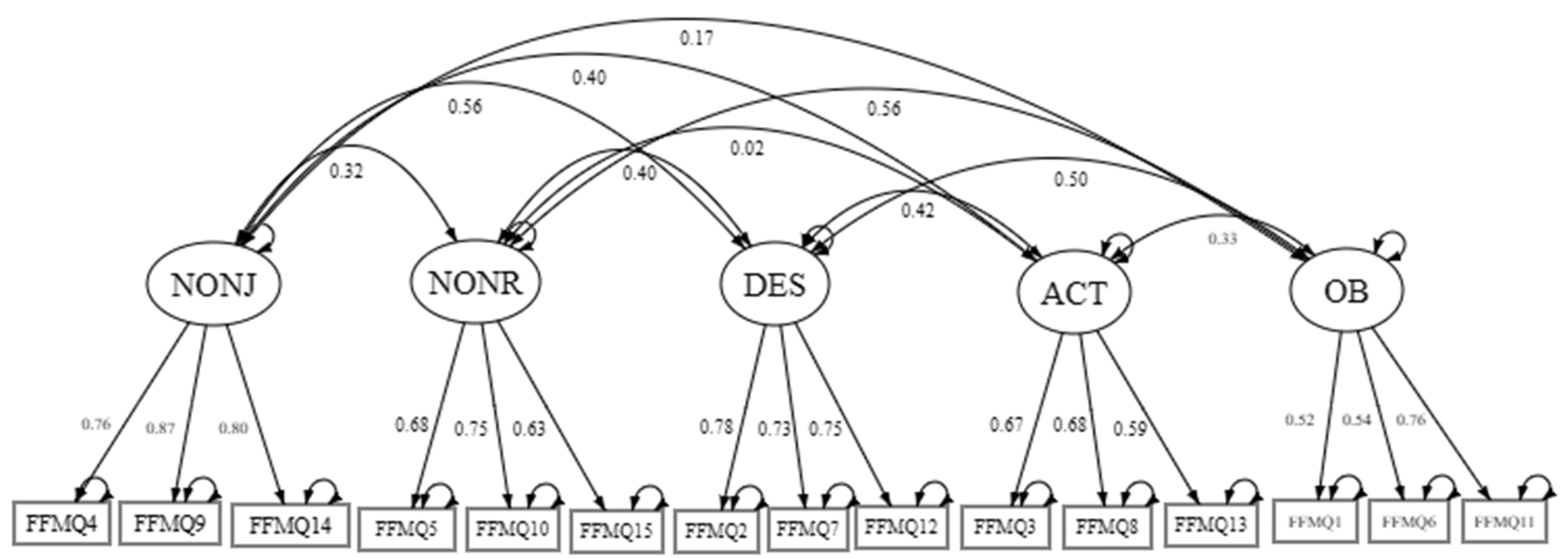
Appendix A. Standardized Factor Loadings, Residual Variances, R2 and Modification Indices for FFMQ Items

| Construct | Item | Standardized Loading | Residual Variance | R2 |
|---|---|---|---|---|
| NONJ | FFMQ4 | 0.755 | 0.430 | 0.570 |
| FFMQ9 | 0.865 | 0.251 | 0.749 | |
| FFMQ14 | 0.802 | 0.357 | 0.643 | |
| NONR | FFMQ5 | 0.681 | 0.536 | 0.464 |
| FFMQ10 | 0.754 | 0.432 | 0.568 | |
| FFMQ15 | 0.634 | 0.598 | 0.402 | |
| DES | FFMQ2 | 0.784 | 0.386 | 0.614 |
| FFMQ7 | 0.732 | 0.464 | 0.536 | |
| FFMQ12 | 0.749 | 0.439 | 0.561 | |
| ACT | FFMQ3 | 0.669 | 0.553 | 0.447 |
| FFMQ8 | 0.679 | 0.539 | 0.461 | |
| FFMQ13 | 0.594 | 0.647 | 0.353 | |
| OB | FFMQ1 | 0.520 | 0.730 | 0.270 |
| FFMQ6 | 0.544 | 0.704 | 0.296 | |
| FFMQ11 | 0.762 | 0.419 | 0.581 |
| Parameter | MI Value | Expected Change |
|---|---|---|
| OB=~ FFMQ2 | 16.32 | +0.70 |
| OB=~ FFMQ7 | 12.78 | −0.68 |
| NONJ=~ FFMQ2 | 17.15 | −0.61 |
| NONR=~ FFMQ2 | 13.48 | +0.68 |
| NONR=~ FFMQ7 | 11.49 | −0.69 |
Appendix B. R
| # Load required packages |
| library (lavaan) |
| library (semTools) |
| library (psych) |
| # Define CFA model for FFMQ-15 |
| ffmq_model <- ‘ |
| NONJ =~ FFMQ4 + FFMQ9 + FFMQ14 |
| NONR =~ FFMQ5 + FFMQ10 + FFMQ15 |
| DES =~ FFMQ2 + FFMQ7 + FFMQ12 |
| ACT =~ FFMQ3 + FFMQ8 + FFMQ13 |
| OB =~ FFMQ1 + FFMQ6 + FFMQ11 |
| ‘ |
| # Fit the model |
| fit ← cfa (ffmq_model, data = your_data, estimator = “ML”) |
| # --- Factor Loadings --- |
| summary (fit, standardized = TRUE, fit.measures = TRUE) |
| # --- Residuals --- |
| residuals (fit, type = “standardized”) |
| # --- Modification Indices --- |
| modindices (fit, sort = TRUE, minimum.value = 10) |
References
- Park, T.; Reilly-Spong, M.; Gross, C.R. Mindfulness: A Systematic Review of Instruments to Measure an Emergent Patient-Reported Outcome (PRO). Qual. Life Res. 2013, 22, 2639–2659. [Google Scholar] [CrossRef] [Scilit]
- Enkema, M.C.; McClain, L.; Bird, E.R.; Halvorson, M.A.; Larimer, M.E. Associations Between Mindfulness and Mental Health Outcomes: A Systematic Review of Ecological Momentary Assessment Research. Mindfulness 2020, 11, 2455–2469. [Google Scholar] [CrossRef] [Scilit]
- Vancappel, A.; Guerin, L.; Réveillère, C.; El-Hage, W. Disentangling the Link between Mindfulness and Dissociation: The Mediating Role of Attention and Emotional Acceptance. Eur. J. Trauma Dissociation 2021, 5, 100220. [Google Scholar] [CrossRef] [Scilit]
- Brown, K.W.; Ryan, R.M. The Benefits of Being Present: Mindfulness and Its Role in Psychological Well-Being. J. Pers. Soc. Psychol. 2003, 84, 822. [Google Scholar] [CrossRef] [Scilit] [PubMed]
- Baer, R.A.; Smith, G.T.; Lykins, E.; Button, D.; Krietemeyer, J.; Sauer, S.; Walsh, E.; Duggan, D.; Williams, J.M.G. Construct Validity of the Five Facet Mindfulness Questionnaire in Meditating and Nonmeditating Samples. Assessment 2008, 15, 329–342. [Google Scholar] [CrossRef] [Scilit] [PubMed]
- Forner, C. What Mindfulness Can Learn about Dissociation and What Dissociation Can Learn from Mindfulness. J. Trauma Dissociation 2019, 20, 1–15. [Google Scholar] [CrossRef] [Scilit]
- Sauer, S.; Walach, H.; Schmidt, S.; Hinterberger, T.; Lynch, S.; Büssing, A.; Kohls, N. Assessment of Mindfulness: Review on State of the Art. Mindfulness 2013, 4, 3–17. [Google Scholar] [CrossRef] [Scilit]
- Karl, J.A.; Prado, S.M.M.; Gračanin, A.; Verhaeghen, P.; Ramos, A.; Mandal, S.P.; Michalak, J.; Zhang, C.-Q.; Schmidt, C.; Tran, U.S.; et al. The Cross-Cultural Validity of the Five-Facet Mindfulness Questionnaire Across 16 Countries. Mindfulness 2020, 11, 1226–1237. [Google Scholar] [CrossRef] [Scilit]
- Baer, R.A.; Carmody, J.; Hunsinger, M. Weekly Change in Mindfulness and Perceived Stress in a Mindfulness-Based Stress Reduction Program. J. Clin. Psychol. 2012, 68, 755–765. [Google Scholar] [CrossRef] [Scilit]
- Gu, J.; Strauss, C.; Crane, C.; Barnhofer, T.; Karl, A.; Cavanagh, K.; Kuyken, W. Examining the Factor Structure of the 39-Item and 15-Item Versions of the Five Facet Mindfulness Questionnaire before and after Mindfulness-Based Cognitive Therapy for People with Recurrent Depression. Psychol. Assess. 2016, 28, 791. [Google Scholar] [CrossRef] [Scilit]
- Shorey, R.C.; Brasfield, H.; Anderson, S.; Stuart, G.L. Differences in Trait Mindfulness Across Mental Health Symptoms Among Adults in Substance Use Treatment. Subst. Use Misuse 2014, 49, 595–600. [Google Scholar] [CrossRef] [Scilit]
- Okafor, G.N.; Ford, B.Q.; Antonoplis, S.; Reina, A.M.; Lutfeali, S.; Shallcross, A.J. Measuring Mindfulness in Black Americans: A Psychometric Validation of the Five Facet Mindfulness Questionnaire. Mindfulness 2023, 14, 565–581. [Google Scholar] [CrossRef] [Scilit]
- Hu, H.; Lyu, R.; Dai, X.; Lu, S. Validating a Short-Form Five Facet Mindfulness Questionnaire among Chinese Early Adolescents. Mindfulness 2024, 15, 2632–2646. [Google Scholar] [CrossRef] [Scilit]
- Feliu-Soler, A.; Pérez-Aranda, A.; Luciano, J.V.; Demarzo, M.; Mariño, M.; Soler, J.; Van Gordon, W.; García-Campayo, J.; Montero-Marín, J. Psychometric Properties of the 15-Item Five Facet Mindfulness Questionnaire in a Large Sample of Spanish Pilgrims. Mindfulness 2021, 12, 852–862. [Google Scholar] [CrossRef] [Scilit]
- Douglas, S.P.; Craig, C.S. Collaborative and Iterative Translation: An Alternative Approach to Back Translation. J. Int. Mark. 2007, 15, 30–43. [Google Scholar] [CrossRef] [Scilit]
- Fung, S. Psychometric Evaluation of the Warwick-Edinburgh Mental Well-Being Scale (WEMWBS) with Chinese University Students. Health Qual. Life Outcomes 2019, 17, 46. [Google Scholar] [CrossRef] [Scilit] [PubMed]
- Khosravani, Y.; Dastjerdi, H.V. Back Translation vs. Collaborative Translation: A Comparative Study of Persian Subtitles in English Movies. Leb. Sprachen 2013, 58, 366–378. [Google Scholar] [CrossRef] [Scilit]
- Hu, L.; Bentler, P.M. Cutoff Criteria for Fit Indexes in Covariance Structure Analysis: Conventional Criteria versus New Alternatives. Struct. Equ. Model. Multidiscip. J. 1999, 6, 1–55. [Google Scholar] [CrossRef] [Scilit]
- Kline, R.B. Principles and Practice of Structural Equation Modeling; Guilford Publications: New York, NY, USA, 2023. [Google Scholar]
- Kaiser, H.F. An Index of Factorial Simplicity. Psychometrika 1974, 39, 31–36. [Google Scholar] [CrossRef] [Scilit]
- Fornell, C.; Larcker, D.F. Evaluating Structural Equation Models with Unobservable Variables and Measurement Error. J. Mark. Res. 1981, 18, 39–50. [Google Scholar] [CrossRef] [Scilit]
- Veehof, M.M.; Ten Klooster, P.M.; Taal, E.; Westerhof, G.J.; Bohlmeijer, E.T. Psychometric Properties of the Dutch Five Facet Mindfulness Questionnaire (FFMQ) in Patients with Fibromyalgia. Clin. Rheumatol. 2011, 30, 1045–1054. [Google Scholar] [CrossRef] [Scilit]
- Markus, H.R.; Kitayama, S. Cultural Variation in the Self-Concept. In The Self: Interdisciplinary Approaches; Strauss, J., Goethals, G.R., Eds.; Springer: New York, NY, USA, 1991; pp. 18–48. ISBN 978-1-4684-8266-9. [Google Scholar]
- Huang, Z.; Chen, W.; Peng, B.; Yan, H. Exploring the Mechanisms Linking Perceived School Climate to Negative Emotions in Adolescents: The Mediating Roles of Social Avoidance and Distress, and Psychological Resilience, with Physical Exercise Level as a Moderator. PLoS ONE 2025, 20, e0321726. [Google Scholar] [CrossRef] [Scilit]
- Roemer, A.; Cervin, M.; Medvedeva, A.; Bravo, A.J.; Medvedev, O.N. Big Five of Mindfulness and Personality: Cross-Cultural Network Analysis. Mindfulness 2024, 15, 37–47. [Google Scholar] [CrossRef] [Scilit]
- Peters, J.R.; Erisman, S.M.; Upton, B.T.; Baer, R.A.; Roemer, L. A Preliminary Investigation of the Relationships Between Dispositional Mindfulness and Impulsivity. Mindfulness 2011, 2, 228–235. [Google Scholar] [CrossRef] [Scilit]
- Cheung, G.W.; Rensvold, R.B. Evaluating Goodness-of-Fit Indexes for Testing Measurement Invariance. Struct. Equ. Model. Multidiscip. J. 2002, 9, 233–255. [Google Scholar] [CrossRef] [Scilit]


| Constructs | Measurements | Factor Loading | ||||
|---|---|---|---|---|---|---|
| 1 | 2 | 3 | 4 | 5 | ||
| NONJ | FFMQ4 | 0.796 | ||||
| FFMQ9 | 0.841 | |||||
| FFMQ14 | 0.853 | |||||
| NONR | FFMQ5 | 0.682 | ||||
| FFMQ10 | 0.824 | |||||
| FFMQ15 | 0.800 | |||||
| DES | FFMQ2 | 0.830 | ||||
| FFMQ7 | 0.775 | |||||
| FFMQ12 | 0.732 | |||||
| ACT | FFMQ3 | 0.793 | ||||
| FFMQ8 | 0.766 | |||||
| FFMQ13 | 0.692 | |||||
| OB | FFMQ1 | 0.703 | ||||
| FFMQ6 | 0.667 | |||||
| FFMQ11 | 0.748 | |||||
| Eigenvalue | 4.002 | 2.546 | 1.568 | 1.083 | 1.049 | |
| % of Variance Explained | 16.277 | 13.794 | 13.259 | 12.806 | 12.184 | |
| Cronbach’s Alpha | 0.848 | 0.797 | 0.729 | 0.682 | 0.616 | |
| McDonald’s Omega | 0.850 | 0.735 | 0.799 | 0.683 | 0.646 | |
| Construct | Measurement | Factor Loading | AVE | CR |
|---|---|---|---|---|
| NONJ (Non-Judging) | FFMQ4 | 0.755 | 0.654 | 0.741 |
| FFMQ9 | 0.865 | |||
| FFMQ14 | 0.802 | |||
| NONR (Non-Reactivity) | FFMQ5 | 0.681 | 0.478 | 0.732 |
| FFMQ10 | 0.754 | |||
| FFMQ15 | 0.634 | |||
| DES (Describing) | FFMQ2 | 0.784 | 0.570 | 0.800 |
| FFMQ7 | 0.732 | |||
| FFMQ12 | 0.749 | |||
| ACT (Acting with Awareness) | FFMQ3 | 0.669 | 0.420 | 0.685 |
| FFMQ8 | 0.679 | |||
| FFMQ13 | 0.594 | |||
| OB (Observing) | FFMQ1 | 0.520 | 0.382 | 0.689 |
| FFMQ6 | 0.544 | |||
| FFMQ11 | 0.762 |
Disclaimer/Publisher’s Note: The statements, opinions and data contained in all publications are solely those of the individual author(s) and contributor(s) and not of MDPI and/or the editor(s). MDPI and/or the editor(s) disclaim responsibility for any injury to people or property resulting from any ideas, methods, instructions or products referred to in the content. |
© 2026 by the authors. Licensee MDPI, Basel, Switzerland. This article is an open access article distributed under the terms and conditions of the Creative Commons Attribution (CC BY) license.
Share and Cite
Wong, M.Y.C.; Yuan, G.F.; Huang, S.-y.; Lian, A.E.Z.; Derin, G.; Akiş, A.D.; Bengwasan, P.D.; Fung, H.W. Psychometric Evaluation of the 15-Item Five Facet Mindfulness Questionnaire: A Cross-Cultural Comparison Study Among English- and Chinese-Speaking Adult Mental Health Service Users. Healthcare 2026, 14, 307. https://doi.org/10.3390/healthcare14030307
Wong MYC, Yuan GF, Huang S-y, Lian AEZ, Derin G, Akiş AD, Bengwasan PD, Fung HW. Psychometric Evaluation of the 15-Item Five Facet Mindfulness Questionnaire: A Cross-Cultural Comparison Study Among English- and Chinese-Speaking Adult Mental Health Service Users. Healthcare. 2026; 14(3):307. https://doi.org/10.3390/healthcare14030307
Chicago/Turabian StyleWong, Ming Yu Claudia, Guangzhe Frank Yuan, Shan-yan Huang, Amos En Zhe Lian, Görkem Derin, Aslı Dila Akiş, Peejay D. Bengwasan, and Hong Wang Fung. 2026. "Psychometric Evaluation of the 15-Item Five Facet Mindfulness Questionnaire: A Cross-Cultural Comparison Study Among English- and Chinese-Speaking Adult Mental Health Service Users" Healthcare 14, no. 3: 307. https://doi.org/10.3390/healthcare14030307
APA StyleWong, M. Y. C., Yuan, G. F., Huang, S.-y., Lian, A. E. Z., Derin, G., Akiş, A. D., Bengwasan, P. D., & Fung, H. W. (2026). Psychometric Evaluation of the 15-Item Five Facet Mindfulness Questionnaire: A Cross-Cultural Comparison Study Among English- and Chinese-Speaking Adult Mental Health Service Users. Healthcare, 14(3), 307. https://doi.org/10.3390/healthcare14030307