A Prevention-Focused Geospatial Epidemiology Framework for Identifying Multilevel Vulnerability Across Diverse Settings


Highlights
- Geospatial epidemiology uncovers spatially patterned vulnerabilities driven by ecological, structural, and built-environment determinants.
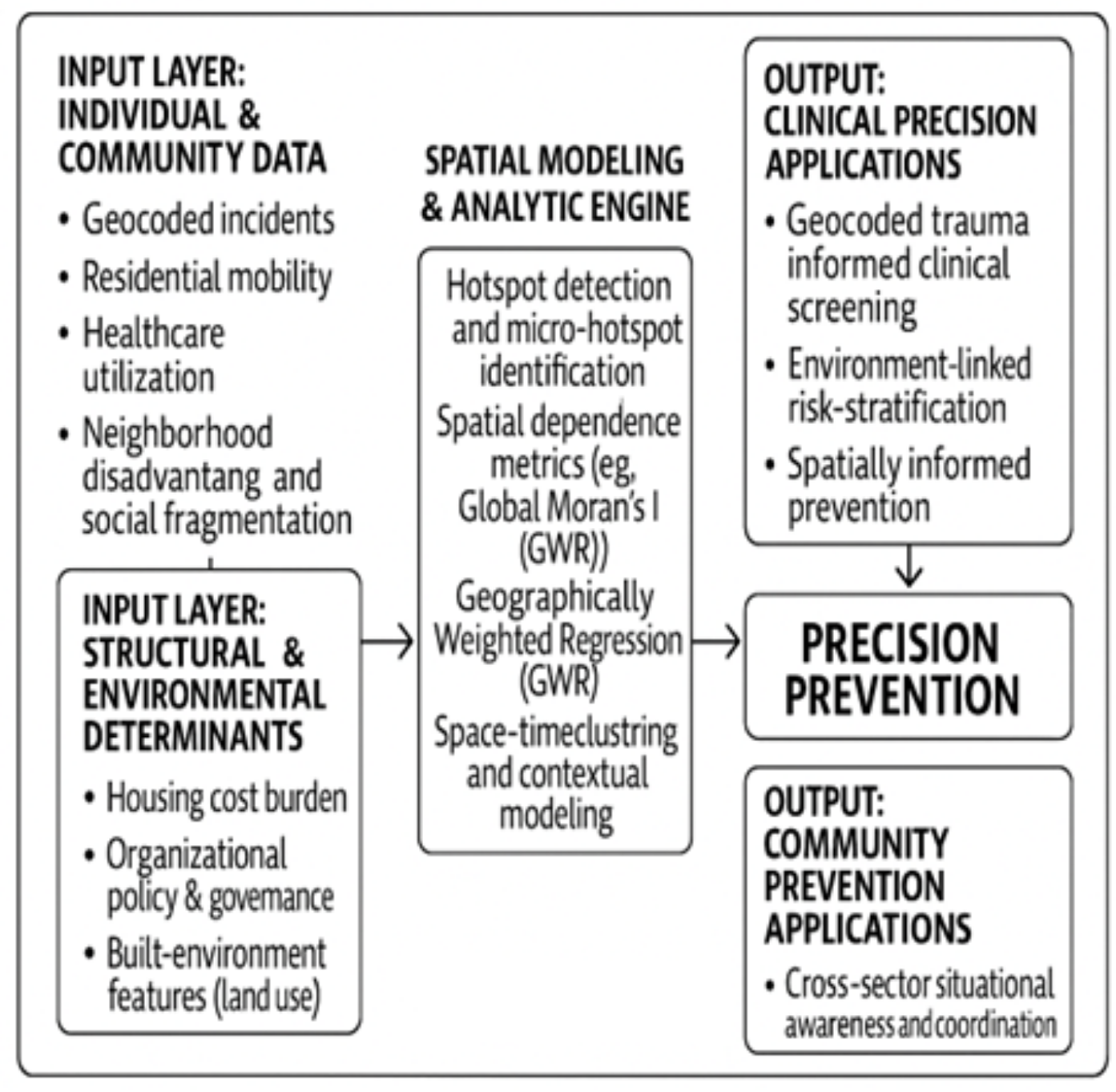
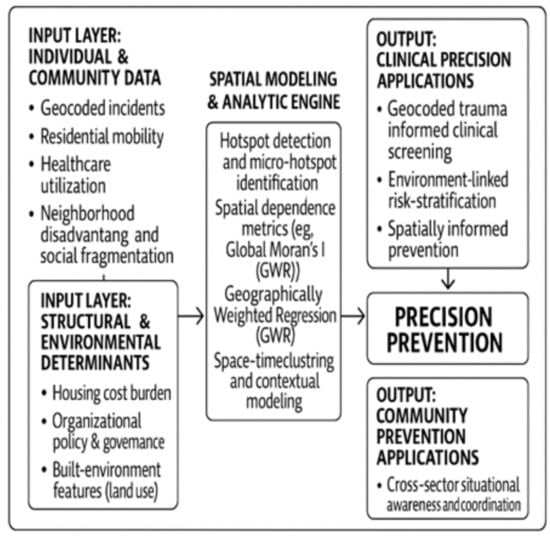
- The proposed architecture translates multilevel data into localized risk signatures for precision prevention strategies.
- Spatial intelligence enables earlier identification of risk, context-aware clinical screening, and targeted community-level interventions.
- Integrating geospatial analytics across systems helps overcome systemic data fragmentation, advancing equitable, context-responsive public health action.
Abstract
1. Introduction
- First, it operationalizes established spatial epidemiology methods within an anticipatory prevention workflow designed to identify risk before harm escalates;
- Second, it provides a concrete blueprint for clinical and health system integration, demonstrating how spatial intelligence can be embedded into routine decision-making processes such as trauma screening, discharge planning, and service coordination; and
- Third, it advances an ethical reframing of data fragmentation, positioning siloed data systems not merely as technical limitations, but as a form of structural blindness that public health and healthcare systems have an obligation to address.
2. Materials and Methods
2.1. The Geospatial Imperative in Prevention
2.1.1. Theoretical Foundations
- Routine Activities Theory (RAT) posits that preventable harms from violence to accidental injury occur when opportunity structures align with inadequate guardianship and environmental vulnerabilities; when a motivated individual, a suitable target, and the absence of a capable guardian converge in space and time [9]. Although traditionally applied to crime, the core framework applies broadly to public health contexts involving environmental exposure, transportation risk, substance-related harm, and unsafe social or physical environments. Our framework operationalizes these constructs using contextual data such as mobility corridors, nighttime activity zones, guardianship indicators like lighting, and location-specific environmental hazards to proxy these situational markers. However, when fragmented systems prevent integration of this data with health and justice records, the underlying “opportunity structure” for harm remains invisible, leaving public health responses perpetually reactive rather than anticipatory.
- Social Disorganization Theory (SDT) suggests that community-level structural factors such as residential instability, economic deprivation, and weakened institutional capacity diminish collective efficacy and heightened vulnerability [10]. When translated into spatial indicators, these community stressors help predict risk clustering by identifying neighborhoods that may require enhanced clinical screening, community engagement, and targeted prevention strategies. Data fragmentation, however, prevents analysts from distinguishing between a series of isolated incidents and the true structural hotspots predicted by SDT, fundamentally obscuring where neighborhood-level interventions are most needed.
- Lifestyle Exposure Theory (LET) explains how social roles and institutional affiliations, such as being a college student or a service member, lead to specific lifestyles that can increase exposure to high-risk environments [11]. This theory is particularly salient for institutional safety analysis. When identifiers for military or university affiliation are suppressed or unlinked from health and justice data, the specific risk signatures associated with these institutional lifestyles are erased. This creates an “institutional blind spot” that prevents the development of tailored, context-aware prevention strategies within these defined populations.
2.1.2. Value of GIS for Anticipatory Prevention and Health Equity
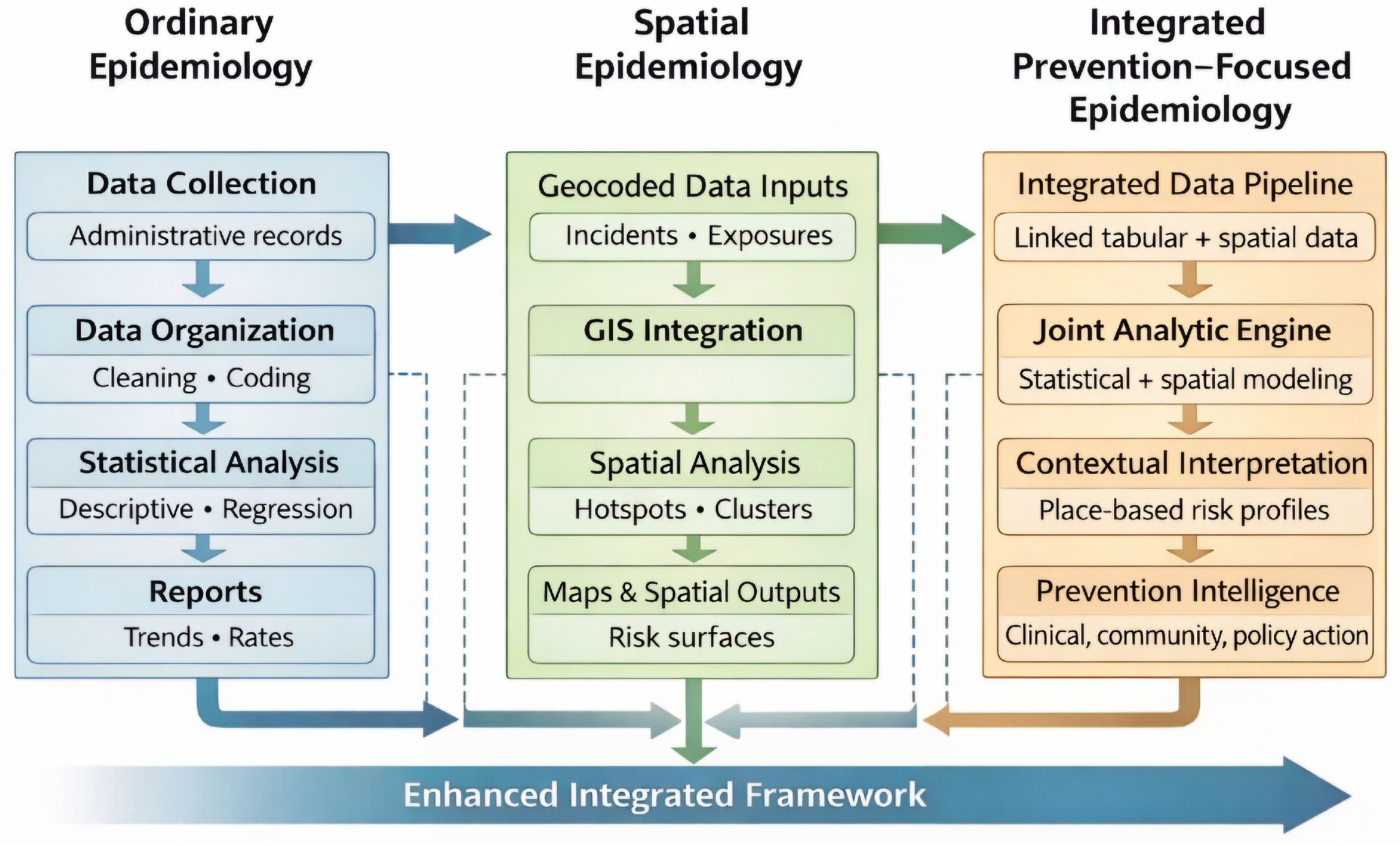
2.2. Prevention-Focused Spatial Epidemiology Framework
2.2.1. Multilevel Data Architecture for Spatial Prevention Modeling
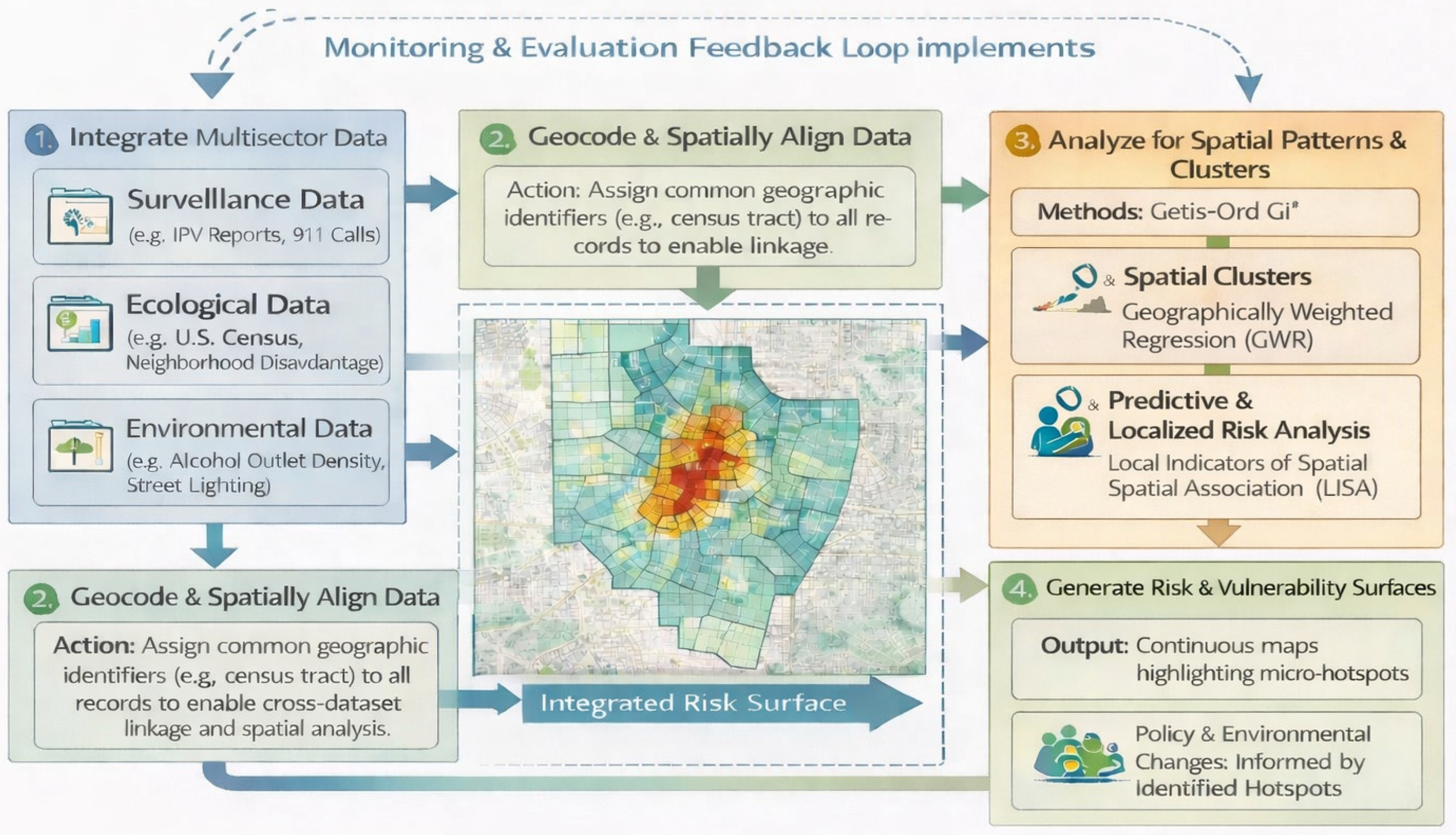
- Incident and Surveillance Data: This layer includes de-identified reports of harm, such as IPV incidents, substance-related emergency calls, or other safety records. When available, secure-access administrative datasets can provide additional temporal and situational markers, including the time of day and contextual circumstances of an event, which are critical for detecting fine-grained risk dynamics [7,15].
- Ecological Indicators: This layer quantifies underlying structural risk by incorporating community-level structural factors from sources like the U.S. Census. Applying key indicators reflecting economic disadvantage, residential mobility, and weakened collective efficacy illuminates underlying structural risk [9].
- Environmental Exposures: This layer provides situational context by mapping features of the built environment that influence vulnerability such as zoning regulations, commercial density, transportation networks, and guardianship indicators such as street lighting, the proximity to alcohol outlets and vacant lots [12].
2.2.2. The Barrier: A Fragmented Data Landscape
- Geographic Obscurity. This problem stems from a lack of standardized geographic identifiers across datasets. To preserve confidentiality, data are often intentionally truncated to a zip code or county level, a practice that severely limits their utility for the neighborhood-level analysis required for cluster detection. This issue is particularly acute in many public-use datasets, which frequently omit block group or tract identifiers altogether, thereby preventing the crucial linkage of incidents to environmental exposures or SDOH [7].
- Systemic Silos. Health, justice, and contextual, for instance behavioral and social service records are typically maintained in separate systems that seldom interoperate, a problem compounded by inconsistent variable definitions and variations in data quality. This fragmentation is especially pronounced within large organizations, such as academic institutions and military installations, where incident reporting, behavioral health encounters, and environmental monitoring records exist in disconnected databases. This makes it nearly impossible to connect structural or situational context to prevention and safety outcomes [16].
2.2.3. The Solution: Pathways to Data Integration and System Modernization
- Governance and Standardization. The first pathway is establishing a common operational foundation. This involves creating formal data-sharing agreements and most critically mandating the routine incorporation of standardized geographic identifiers across all relevant datasets. This enables data to be reliably aligned and compared, forming the bedrock of any multi-sector analysis [3,17].
- Technology and Infrastructure. The second pathway is leveraging modern technology. Secure-access research infrastructures, often called “data enclaves,” allow analysts to work with restricted microdata containing detailed geographic identifiers while maintaining strict confidentiality [18]. This can be paired with advances in administrative informatics that support the near real-time integration of data, enabling dynamic, space-time analyses that dramatically enhance situational awareness [19,20].

2.3. Analytic Framework
2.3.1. Analytic Stage 1: Detection of Spatial Clustering and Spatial Dependence
2.3.2. Analytic Stage 2: Integration of the SEM

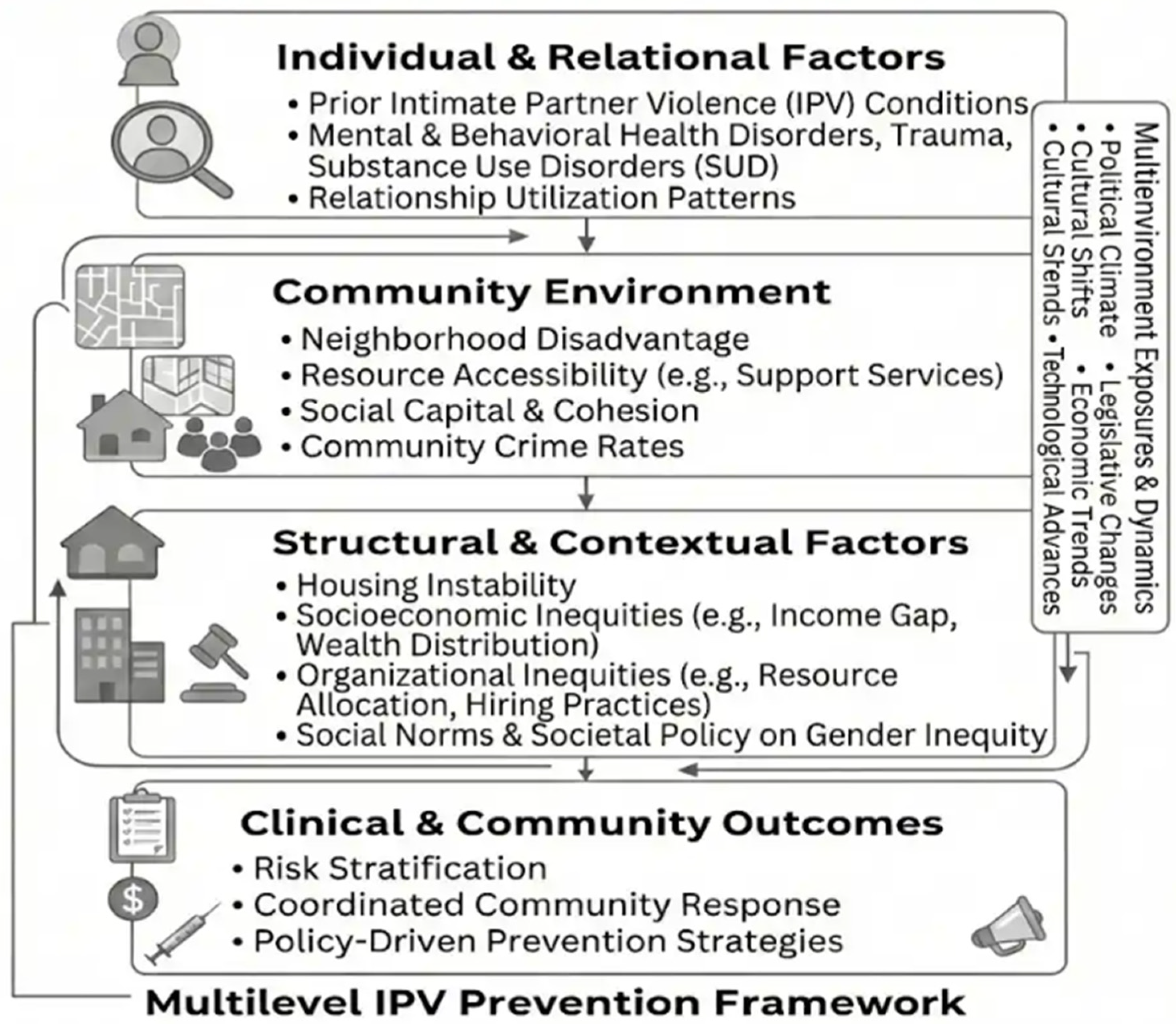
2.4. Spatial IPV Framework and Conceptual GIS Workflow

2.5. Applications of the Spatial Workflow Across Settings
2.5.1. National and Population Level Analysis
2.5.2. Clinical and Healthcare Settings
2.5.3. Municipal and Community Settings
2.5.4. Institutional Settings
- Military: The framework can examine how operational stressors, population turnover, isolation patterns, or duty-related schedules relate to IPV occurrence using installation districts, housing zones, or unit areas as the unit of analysis. Yet, analysts often face significant barriers in tracking personnel across different commands or linking on-base and off-base incidents, a data fragmentation issue noted in governmental audits that hinders effective prevention planning [26].
- College and Campus Settings: Similarly, on college campuses, the framework allow exploration of spatial clustering of dating violence, coercive control, and stalking using campus sectors, residence halls, or security patrol zones as the unit of analysis [15]. Combining campus climate indicators and environmental vulnerabilities can reveal concentrated risk near social hubs or low-visibility pathways where tailored prevention may be most impactful. However, such analyses are often limited by the same systemic silos seen in other large institutions, where law enforcement data is separated from student conduct and health records, masking the true spatial patterns of risk [16].
3. Results
3.1. Enhancing Spatially Informed Prevention and Clinical Decision Support
3.2. Fostering Cross-Sector Coordination and Shared Prevention Intelligence
3.3. Environmental and Situational Prevention Strategies
4. Discussion
4.1. Principal Contribution and Implications
4.2. Ethical Considerations and Data Governance
- Data Protection: Strict de-identification protocols and aggregation thresholds must be paired with tiered access controls within secure data enclaves accessible only to analysts with institutional review board approval [18]. Modern privacy-preserving machine learning techniques can provide further layers of protection [28].
- Preventing Bias: To ensure spatial models do not stigmatize communities or reinforce historical inequities, implementation should include Participatory GIS (PGIS) methods where residents help contextualize data [3]. Furthermore, algorithms must be audited for fairness to evaluate whether they disproportionately assign risk to structurally marginalized populations.
- The Ethical Imperative for Integration: An exclusive focus on the ethics of data use overlooks the profound ethical consequences of inaction. The systemic data fragmentation described throughout this paper creates a form of “structural blindness” that prevents public health systems from seeing and acting upon known risk mechanisms [16]. Therefore, there is an ethical imperative for integration, as failing to build the systems necessary to prevent harm perpetuates an inequitable status quo.
4.3. Limitations and Future Directions
4.3.1. Limitations
4.3.2. Future Directions
- Empirical Validation: The immediate next step is its application to high-resolution, restricted datasets to assess its performance and validity.
- Advocacy for Modernized Data Ecosystems: A critical long-term goal is to advocate for the development of integrated data ecosystems. This does not necessarily require centralizing all data; cutting-edge approaches like federated learning offer a powerful model for building collaborative analytics across siloed health systems while preserving patient privacy [29].
- Integration of Explainable AI (XAI): Future iterations could benefit from integrating XAI tools to improve model transparency and help stakeholders understand the complex drivers of risk, thereby increasing trust and adoption [30].
5. Conclusions
Funding
Institutional Review Board Statement
Informed Consent Statement
Data Availability Statement
Acknowledgments
Conflicts of Interest
References
- World Health Organization. Global Status Report on Violence Prevention 2014; WHO: Geneva, Switzerland, 2014. [Google Scholar]
- World Health Organization. Violence Against Women Prevalence Estimates, 2018; WHO: Geneva, Switzerland, 2021. [Google Scholar]
- Institute of Medicine. Primary Care and Public Health: Exploring Integration to Improve Population Health; The National Academies Press: Washington, DC, USA, 2012. [Google Scholar] [CrossRef]
- Rushton, G. Public health, GIS, and spatial analytic tools. Annu. Rev. Public Health 2003, 24, 43–56. [Google Scholar] [CrossRef]
- Elliott, P.; Wartenberg, D. Spatial epidemiology: Current approaches and future challenges. Environ. Health Perspect. 2004, 112, 998–1006. [Google Scholar] [CrossRef]
- Khoury, M.J.; Iademarco, M.F.; Riley, W.T. Precision public health for the era of big data. Am. J. Prev. Med. 2016, 50, 398–401. [Google Scholar] [CrossRef]
- Bureau of Justice Statistics. National Crime Victimization Survey: Technical Documentation, latest ed.; U.S. Department of Justice: Washington, DC, USA, 2017.
- Diez Roux, A.V. Investigating neighborhood and area effects on health. Am. J. Public Health 2001, 91, 1783–1789. [Google Scholar] [CrossRef] [PubMed]
- Cohen, L.E.; Felson, M. Social change and crime rate trends: A routine activity approach. Am. Sociol. Rev. 1979, 44, 588–608. [Google Scholar] [CrossRef]
- Sampson, R.J.; Raudenbush, S.W.; Earls, F. Neighborhoods and violent crime: A multilevel study of collective efficacy. Science 1997, 277, 918–924. [Google Scholar] [CrossRef] [PubMed]
- Hindelang, M.J.; Gottfredson, M.R.; Garofalo, J. Victims of Personal Crime: An Empirical Foundation for a Theory of Personal Victimization; Ballinger Publishing Company: Pensacola, FL, USA, 1978. [Google Scholar]
- Crowe, T.D. Crime Prevention Through Environmental Design, 2nd ed.; Butterworth-Heinemann: Oxford, UK, 2000. [Google Scholar]
- Bowen, E.A.; Bowen, S.K.; Bowen, L.M. Neighborhood disadvantage, collective efficacy, and exposure to violence. Am. J. Community Psychol. 2018, 62, 3–14. [Google Scholar] [CrossRef]
- Krieger, N. Epidemiology and the People’s Health: Theory and Context; Oxford University Press: Oxford, UK, 2011. [Google Scholar]
- Anselin, L. Thirty years of spatial econometrics. Pap. Reg. Sci. 2010, 89, 3–25. [Google Scholar] [CrossRef]
- Murphy, S.N.; Weber, G.; Mendis, M.; Gainer, V.; Chueh, H.C.; Churchill, S.; Kohane, I.S. Serving the Enterprise and Beyond with Informatics for Integrating Biology and the Bedside (i2b2). J. Am. Med. Inform. Assoc. 2010, 17, 124–130. [Google Scholar] [CrossRef]
- Sherman, J.E.; Spencer, J.; Preisser, J.S.; Gesler, W.M.; Arcury, T.A. A suite of methods for representing activity space in a healthcare accessibility study. Health Place 2005, 11, 333–346. [Google Scholar] [CrossRef]
- Desai, T.; Ritchie, F.; Welpton, R. The ‘Five Safes’: Designing data access for research. Health Inform. J. 2016, 22, 1460458216631548. [Google Scholar]
- Buckeridge, D.L. Outbreak detection through automated surveillance: A review of the determinants of detection. J. Biomed. Inform. 2007, 40, 370–379. [Google Scholar] [CrossRef] [PubMed]
- Anselin, L. Local indicators of spatial association—LISA. Geogr. Anal. 1995, 27, 93–115. [Google Scholar] [CrossRef]
- Getis, A.; Ord, J.K. The analysis of spatial association by use of distance statistics. Geogr. Anal. 1992, 24, 189–206. [Google Scholar] [CrossRef]
- Brunsdon, C.; Fotheringham, A.S.; Charlton, M.E. Geographically weighted regression: A method for exploring spatial nonstationarity. Geogr. Anal. 1996, 28, 281–298. [Google Scholar] [CrossRef]
- Mollalo, A.; Hamidi, B.; Lenert, L.A.; Alekseyenko, A.V. Application of Spatial Analysis on Electronic Health Records to Characterize Patient Phenotypes: Systematic Review. JMIR Med. Inform. 2024, 12, e58732. [Google Scholar] [CrossRef] [PubMed] [PubMed Central]
- Sabri, B.; Tharmarajah, S.; Njie-Carr, V.P.S.; Messing, J.T.; Loerzel, E.; Arscott, J.; Campbell, J.C. Safety Planning With Marginalized Survivors of Intimate Partner Violence: Challenges of Conducting Safety Planning Intervention Research With Marginalized Women. Trauma Violence Abuse 2022, 23, 1728–1751. [Google Scholar] [CrossRef]
- Wolf, K.C.; Ozer, E.J.; Raine, A. The missing link: A call for public health and criminal justice data integration for violence prevention. Am. J. Public Health 2019, 109, 682–684. [Google Scholar] [CrossRef]
- U.S. Government Accountability Office. Military Personnel: Better Data Integration Needed to Address Interpersonal Violence and Improve Prevention Efforts; GAO-22-105481; U.S. Government Accountability Office: Washington, DC, USA, 2022.
- Diez Roux, A.V. Integrating social and biologic factors in health research: A systems view. Ann. Epidemiol. 2007, 17, 569–574. [Google Scholar] [CrossRef]
- Price, W.N.; Cohen, I.G. Privacy in the age of medical big data. Nat. Med. 2019, 25, 37–43. [Google Scholar] [CrossRef]
- Lu, H.; Zhang, J. A survey on federated learning for healthcare informatics. ACM Comput. Surv. 2022, 55, 1–41. [Google Scholar] [CrossRef]
- Tjoa, E.; Guan, C. A Survey on Explainable Artificial Intelligence (XAI): Toward Medical XAI. IEEE Trans. Neural Netw. Learn. Syst. 2021, 32, 4793–4813. [Google Scholar] [CrossRef] [PubMed]
Disclaimer/Publisher’s Note: The statements, opinions and data contained in all publications are solely those of the individual author(s) and contributor(s) and not of MDPI and/or the editor(s). MDPI and/or the editor(s) disclaim responsibility for any injury to people or property resulting from any ideas, methods, instructions or products referred to in the content. |
© 2026 by the author. Licensee MDPI, Basel, Switzerland. This article is an open access article distributed under the terms and conditions of the Creative Commons Attribution (CC BY) license.
Share and Cite
Jean-Baptiste, C.O. A Prevention-Focused Geospatial Epidemiology Framework for Identifying Multilevel Vulnerability Across Diverse Settings. Healthcare 2026, 14, 261. https://doi.org/10.3390/healthcare14020261
Jean-Baptiste CO. A Prevention-Focused Geospatial Epidemiology Framework for Identifying Multilevel Vulnerability Across Diverse Settings. Healthcare. 2026; 14(2):261. https://doi.org/10.3390/healthcare14020261
Chicago/Turabian StyleJean-Baptiste, Cindy Ogolla. 2026. "A Prevention-Focused Geospatial Epidemiology Framework for Identifying Multilevel Vulnerability Across Diverse Settings" Healthcare 14, no. 2: 261. https://doi.org/10.3390/healthcare14020261
APA StyleJean-Baptiste, C. O. (2026). A Prevention-Focused Geospatial Epidemiology Framework for Identifying Multilevel Vulnerability Across Diverse Settings. Healthcare, 14(2), 261. https://doi.org/10.3390/healthcare14020261