Recovery Capital and Family Support Among Incarcerated Men with a History of Psychoactive Substance Use in a Single Romanian Penitentiary: A Qualitative Study


Highlights
- Illicit drug use was predominantly initiated under the influence of peer groups, criminogenic environments, and socioeconomic vulnerabilities.
- Abstinence achieved during incarceration was perceived by part of this sample as maintained under institutional constraint rather than as internally motivated recovery.
- The family functioned as both a risk and a protective factor; the quality, not merely the presence, of support distinguished protective from inadvertently facilitating family environments.
- Family support, occupational integration, and prosocial relationships were resources participants associated with periods of abstinence, alongside a recurring cognitive pattern of externalizing responsibility for use onto peers or circumstance.
Abstract
1. Introduction
Specific Objectives
- To explore the social, contextual, and individual factors associated with the initiation of psychoactive substance use, with an emphasis on the specific vulnerabilities of early onset and exposure to criminogenic environments.
- To examine participants’ subjective experiences of the effects of substance use, dependence, and withdrawal, including the impact on psychological and behavioral functioning.
- To analyze the cognitive and social mechanisms sustaining addictive behavior, including patterns of responsibility attribution and the relationship between substance use and criminal behavior.
- To investigate the role of the family as a protective factor and/or risk factor along the trajectory of substance use, within the theoretical framework of the recovery capital concept.
- To identify factors perceived as facilitators of or barriers to abstinence and recovery in the prison environment, including relevant institutional and relational resources.
- To examine participants’ perspectives on post-release social reintegration, including factors associated with the risk of recidivism and community reinsertion.
2. Materials and Methods
2.1. Study Design
2.2. Setting and Participants
2.3. Data Collection
2.4. Data Analysis
2.5. Trustworthiness and Rigor
2.6. Ethical Considerations
3. Results
3.1. Initiation Factors and Vulnerabilities Associated with the Onset of Illicit Drug Use
“I only used one drug, that being weed. I was with a group of friends, at my place. We were playing a shoot-‘em-up game on the computer. Being high, it was like I had more dexterity and I aimed a lot better”.(marijuana user, 26 years old)
“In 2020, at a party, I found out my partner was using cocaine, and she pulled me into a group of friends who used, which got me using too, so I’d be accepted into that circle of friends”.(heroin user, 30 years old)
“The first time I used legal highs was at school, with my classmates”.(new psychoactive substance user, 27 years old)
“I was under arrest for theft, and I got high for the first time in prison, together with a cellmate who had some. He suggested we get high together, because he didn’t want to hit the stuff alone, telling me I’d feel really good and forget all my problems. That’s how it started”.(marijuana user, 20 years old)
“I started using because of the pretty bad financial situation I was in. I started selling heroin, and then, out of curiosity and not knowing much about using, I started using it myself too”.(heroin user, 20 years old)
3.2. Clinical and Psychological Manifestations of Drug Use
“The moment I got high, besides feeling good, I just stopped caring about anything. I wasn’t scared, and I felt like the whole world was mine. I had no inhibitions”.(cocaine user, 25 years old)
“A state of detachment from everyday worries and problems, which caused me depression and insomnia during the hard times in life”.(new psychoactive substance user, 25 years old)
“The experience is different from one state to another. I’m very different when I’m high—I take really good care of my kids, I play with my kids, I do everything I can to see them happy”.(heroin user, 47 years old)
“After a long period of using, I just had no energy for anything anymore. I’d forget things, I had no appetite, I slept a lot, I was irritable, I had no interest in sex anymore, I had to drag myself to get to certain important places. My connection with my family left something to be desired, I started closing myself off and smoking a lot. Even as I watched myself sinking deeper into my thoughts, I didn’t have the strength to stop”.(marijuana user, 31 years old)
3.3. The Experience of Dependence and Withdrawal
“I don’t even want to remember it. I hated the vomiting spells. I’d throw up some yellow, bitter stuff. That happened when I didn’t get my dose on time. I never want that again”.(new psychoactive substance user, 40 years old)
“Very hard to put into words. Bone pain, vomiting, heavy sweating, insomnia. Your eyes water and your legs just give out”.(heroin user, 40 years old)
“It was like a high-voltage electric current started right in the middle of my brain and went down through the middle of my bones. It mostly happened to me while I was sleeping”.(cocaine user, 40 years old)
“I never had withdrawal. Anyway, marijuana’s a soft drug, it doesn’t do you any harm. I just slept more and didn’t feel like doing anything”.(marijuana user, 28 years old)
3.4. Cognitive and Social Mechanisms Sustaining Use
“It’s my fault. I was told that if I liked it I’d get hooked and keep using, but I took it as a joke. I’m the only one to blame, not my family or my friends… they told me what could happen… my family told me to quit, but I kept lying to them, because by then I was already hooked”.(new psychoactive substance user, 31 years old)
“My friends’ fault is that they influenced me. They told me you feel good and nothing bad happens to you”.(cocaine user, 29 years old)
“I ended up using drugs because of society as a whole… you can find them really easily and fast, and they get sold to anybody”.(marijuana user, 23 years old)
“I don’t feel guilty about it, because I’m not the one to blame. It’s their fault for corrupting me”.(new psychoactive substance user, 42 years old)
“I’d commit crimes to buy more, so I could get high and make some money too”.(heroin user, 34 years old)
“At first I had money from my job and from my family, then I started borrowing. As a last resort, when I had no way left to get money, I turned to stealing”.(marijuana user, 29 years old)
“My parents were always really rich. I never lacked for anything materially. They didn’t even know what I was doing with the money”.(marijuana user, 23 years old)
3.5. Family: Risk Factor, Protective Factor, and Source of Suffering
“I come from what I’d call a normal family. I got a good upbringing. They taught me right from wrong. Unfortunately, coming from a modest family, my folks were focused on work, and I ran wild until there was nothing more they could do about it”.(marijuana user, 34 years old)
“They were too soft raising me. They never scolded me, no matter what stupid thing I did”.(marijuana user, 37 years old)
“My parents were always stricter, but that wasn’t enough to stop me from ending up using drugs”.(marijuana user, 42 years old)
“I feel guilty that I didn’t spend more time with my kids and that lately I’ve only been in and out of prison… that’s brought me a lot of suffering… I lost my family, I lost my partner, the mother of my two kids. I lost some really important years of my life”.(new psychoactive substance user, 50 years old)
“The hardest thing to bear was seeing the suffering in my parents’ eyes. My mother’s heart will never be the same again. As for my father, I think deep in his soul he’ll never forgive me… I made him a laughingstock in front of everyone”.(cocaine user, 29 years old)
“I deeply, deeply regret how badly I treated my kids and my wife. I took the last money from the house to buy drugs. I never thought I was leaving them without food. I was never with them at kindergarten, I never went to their school shows. I wasn’t a good father… or a good husband either”.(new psychoactive substance user, 31 years old)
3.6. Recovery, Abstinence, and Identity Reconstruction
“I never wanted to quit, up until now, but now I’d like to quit for good. I’m getting on in years, I’m sick of this world. It’s been seven months since I’ve been locked up and I’m clean. My mind drifts to drugs every day, especially when someone’s talking about them”.(heroin user, 37 years old)
“I’ve never felt guilty about it. I don’t see why I’d quit drugs, because either way, I don’t act ugly when I’m high”.(heroin user, 35 years old)
“Drugs help me see the world differently… to be more sensitive and understand what love really means. I understood the true meaning of literature and romanticism. Drugs help you see the world from above”.(marijuana user, 23 years old)
“My advice would be to only use cocaine, because the rest of the drugs are really dangerous and put your life at risk. That is, if they had no other choice… cocaine isn’t addictive… personally, I wouldn’t quit”.(cocaine user, 42 years old)
“If you’re an artist and you really want to put on a show, it’s worth using. That’s the only way I managed to have my best performances. You’ve got energy and you’re creative… the whole world is yours and you put that across. You’re free to express whatever you want”.(cocaine user, 37 years old)
“The solution for getting away from drugs is having the ambition to leave behind the crowd you used with, to start a family and go to work, to mind your own business”.(cocaine user, 47 years old)
“Educating young people. When I got into drugs, I didn’t know anything about them”.(heroin user, 50 years old)
“Family is the only one who truly wants what’s good for you and can really help you. My family never left me on my own. My parents took me to a center, to get away from drugs”.(cocaine user, 29 years old)
“Not to listen to what others tell them, to listen to their family, because they’re the only ones who truly want what’s good for them, and to never touch drugs”.(marijuana user, 31 years old)
“To cut off all contact with the crowd that uses, or if they don’t have a crowd and use alone, to think about what their greatest wish on earth is. To realize they’re on a bad path and that everything depends only on them”.(marijuana user, 27 years old)
4. Discussion
4.1. The Experience of Use and Early Onset
4.2. Psychobehavioral Trajectory of Use and Attribution of Responsibility
4.3. Family as Ambivalent Recovery Capital and the Boundary Between Institutional Abstinence and Recovery
4.4. Social Reintegration, Recidivism Risk, and Implications for Continuity of Care
5. Conclusions
Limitations
Author Contributions
Funding
Institutional Review Board Statement
Informed Consent Statement
Data Availability Statement
Acknowledgments
Conflicts of Interest
Appendix A. Semi-Structured Interview Guide
Appendix A.1. Study Context
- What is your age?
- What is your place of residence prior to incarceration (urban/rural)?
- What is your marital status?
- Can you briefly describe your educational and occupational background?
- At what age did you first use drugs?
- What substances have you used?
- Can you describe the context in which you first used drugs (where were you, with whom, under what circumstances)?
- How long have you used drugs in total?
- How would you describe your experience while under the influence of drugs?
- How would you describe withdrawal symptoms and the experience of abstinence?
- On a scale from 1 to 10, who do you consider responsible for your drug use initiation (family, school, peers, community, society, yourself)?
- Can you explain why you assigned these levels of responsibility?
- What role did your family play in your upbringing and life development?
- How did you obtain financial resources to sustain drug use?
- Have you ever tried to stop using drugs? If yes, what motivated you?
- What helped you remain abstinent during those periods?
- How many times have you attempted to quit drug use?
- What were the main losses or negative consequences of drug use in your life?
- What do you consider the most effective way to overcome drug dependence?
- What advice would you give to someone trying to stop using drugs?
- What unmet needs have you experienced throughout your life?
- Do you experience feelings of guilt or remorse related to drug use? If yes, in what way?
- What is your biggest regret in life?
- What is your greatest source of joy or satisfaction?
- If you could change something in your life, what would it be?
- Please complete the sentence: “Life is worth living because…”
Appendix A.2. Ethical Framing Within Interview Process
- Participants were informed that participation was voluntary.
- They were assured that they could refuse to answer any question.
- Confidentiality and anonymity were guaranteed.
- No information provided was used for legal or institutional decision-making.
Appendix A.3. Notes on Use
References
- World Health Organization. Global Status Report on Alcohol and Health and Treatment of Substance Use Disorders; World Health Organization: Geneva, Switzerland, 2024; Available online: https://www.who.int/publications/i/item/9789240096745 (accessed on 10 March 2026).
- United Nations Office on Drugs and Crime (UNODC). World Drug Report 2026: Global Drug Markets Transforming Rapidly as Technology, Novel Drug Types and Instability Present Traffickers with New Opportunities; UNODC: Vienna, Austria, 2026; Available online: https://www.unodc.org/unodc/en/data-and-analysis/world-drug-report-2026.html (accessed on 25 August 2026).
- European Union Drugs Agency (EUDA). European Drug Report 2026: Trends and Developments; EUDA: Lisbon, Portugal, 2026; Available online: https://www.euda.europa.eu/publications/european-drug-report/2026_en (accessed on 25 August 2026).
- Brauer, M.; Roth, G.A.; Aravkin, A.Y.; Zheng, P.; Abate, K.H.; Abate, Y.H.; Abbafati, C.; Abbasgholizadeh, R.; Abbasi, M.A.; Abbasian, M.; et al. Global burden and strength of evidence for 88 risk factors in 204 countries and 811 subnational locations, 1990–2021: A systematic analysis for the Global Burden of Disease Study 2021. Lancet 2024, 403, 2162–2203. [Google Scholar] [CrossRef] [Scilit] [PubMed]
- Kang, J.; Kim, H.J.; Kim, M.S.; GBD 2023 Substance Use Collaborators; Shin, J.I.; Yon, D.K. Global burden of amphetamine, cannabis, cocaine and opioid use in 204 countries, 1990–2023: A Global Burden of Disease Study. Nat. Med. 2026, 32, 527–544. [Google Scholar] [CrossRef] [Scilit] [PubMed]
- Degenhardt, L.; Charlson, F.; Ferrari, A.; Santomauro, D.; Erskine, H.; Mantilla-Herrara, A.; Whiteford, H.; Leung, J.; Naghavi, M.; Griswold, M.; et al. The global burden of disease attributable to alcohol and drug use in 195 countries and territories, 1990–2016: A systematic analysis. Lancet Psychiatry 2018, 5, 987–1012. [Google Scholar] [CrossRef] [Scilit] [PubMed]
- Volkow, N.D.; Koob, G.F.; McLellan, A.T. Neurobiologic advances from the brain disease model of addiction. N. Engl. J. Med. 2016, 374, 363–371. [Google Scholar] [CrossRef] [Scilit] [PubMed]
- Volkow, N.D.; Blanco, C. Substance use disorders: A comprehensive update of classification, epidemiology, neurobiology, clinical aspects, treatment and prevention. World Psychiatry 2023, 22, 203–229. [Google Scholar] [CrossRef] [Scilit] [PubMed]
- Bennett, T.; Holloway, K.; Farrington, D.P. The statistical association between drug misuse and crime: A meta-analysis. Aggress. Violent Behav. 2008, 13, 107–118. [Google Scholar] [CrossRef] [Scilit]
- Fazel, S.; Yoon, I.A.; Hayes, A.J. Substance use disorders in prisoners: An updated systematic review and meta-regression analysis in recently incarcerated individuals. Addiction 2017, 112, 1725–1739. [Google Scholar] [CrossRef] [Scilit] [PubMed]
- Tomaz, V.; Moreira, D.; Souza Cruz, O. Criminal reactions to drug-using offenders: A systematic review of the effect of treatment and/or punishment on reduction of drug use and/or criminal recidivism. Front. Psychiatry 2023, 14, 935755. [Google Scholar] [CrossRef] [Scilit] [PubMed]
- Beeler, S.; Gerrish, O.; Aldred, B.G.; BlackDeer, A.A. Histories of violence among clients seeking substance use disorder treatment: A systematic mapping review. Front. Psychiatry 2024, 15, 1307641. [Google Scholar] [CrossRef] [Scilit] [PubMed]
- Darke, S. The toxicology of drug-related homicide. Drug Alcohol Rev. 2019, 38, 6–14. [Google Scholar] [CrossRef] [Scilit] [PubMed]
- Lin, C.; Cousins, S.J.; Zhu, Y.; Clingan, S.E.; Mooney, L.J.; Kan, E.; Wu, F.; Hser, Y.-I. A scoping review of social determinants of health’s impact on substance use disorders over the life course. J. Subst. Use Addict. Treat. 2024, 166, 209484. [Google Scholar] [CrossRef] [Scilit] [PubMed]
- Saladino, V.; Calaresi, D.; Petruccelli, F.; Verrastro, V. Reflections on recidivism and relapse prevention among Italian justice-involved juveniles: A general overview. Soc. Sci. 2024, 13, 254. [Google Scholar] [CrossRef] [Scilit]
- Park, S. A societal exploration of drug crime consequences. Addict. Criminol. 2023, 6, 176. Available online: https://www.alliedacademies.org/articles/a-societal-exploration-of-drug-crime-consequences.pdf (accessed on 10 January 2026).
- Bonta, J.; Andrews, D.A. The Psychology of Criminal Conduct, 7th ed.; Routledge: New York, NY, USA, 2024. [Google Scholar]
- Montanari, L.; Royuela, L.; Mazzilli, S.; Vandam, L.; Alvarez, E.; Llorens, N.; Carapinha, L.; Grohmannova, K.; Isajeva, L.; Ignataviciute, L.; et al. Prevalence of drug use before and during imprisonment in seven European countries (2014–2018). J. Community Psychol. 2024, 52, 1015–1030. [Google Scholar] [CrossRef] [Scilit] [PubMed]
- Laudet, A.B. The road to recovery: Where are we going and how do we get there? Empirically driven conclusions and future directions for service development and research. Subst. Use Misuse 2008, 43, 2001–2020. [Google Scholar] [CrossRef] [Scilit] [PubMed]
- Cloud, W.; Granfield, R. Conceptualizing recovery capital: Expansion of a theoretical construct. Subst. Use Misuse 2008, 43, 1971–1986. [Google Scholar] [CrossRef] [Scilit] [PubMed]
- Kelly, J.F.; Greene, M.C.; Bergman, B.G. Beyond abstinence: Changes in indices of quality of life with time in recovery in a nationally representative sample of U.S. adults. Alcohol. Clin. Exp. Res. 2018, 42, 770–780. [Google Scholar] [CrossRef] [Scilit] [PubMed]
- Wright, S.; Williams, R.; Finkelstein, N. Effectiveness of reentry programs for people with substance use disorders. Subst. Abus. Treat. Prev. Policy 2014, 9, 45. [Google Scholar] [CrossRef] [Scilit] [PubMed]
- Agenția Națională Antidrog. Raport Național Privind Situația Drogurilor 2023; Agenția Națională Antidrog: Bucharest, Romania, 2023. Available online: https://ana.gov.ro/wp-content/uploads/2025/01/RAPORT-NATIONAL-PRIVIND-SITUATIA-DROGURILOR_2023.pdf (accessed on 3 January 2026).
- Turcu, T.-A.; Lescaie, A.; Grama, A.R.; Strătulă, A.-C.; Vincene, A.-I.; Grigoraș, L.-M.; Jităreanu, C.; Babeu, A.M.; Gafencu, M.; Crăciun, M.-D.; et al. Patterns and emerging trends in acute poisoning with substances of abuse used for recreational purposes in adolescents: A six-year multicentre study. Life 2024, 14, 1033. [Google Scholar] [CrossRef] [Scilit] [PubMed]
- European Union Drugs Agency (EUDA). European Drug Report 2025: Trends and Developments—Harm Reduction. Table EDR25-HR-5: Availability of Drug-Related and Other Health and Social Care Interventions Targeting People Who Use Drugs and Are in Prison, EU+2, 2023; EUDA: Lisbon, Portugal, 2025; Available online: https://www.euda.europa.eu/publications/european-drug-report/2025/harm-reduction_en (accessed on 3 January 2026).
- Austin, A.; Favril, L.; Craft, S.; Thliveri, P.; Freeman, T.P. Factors associated with drug use in prison: A systematic review of quantitative and qualitative evidence. Int. J. Drug Policy 2023, 122, 104248. [Google Scholar] [CrossRef] [Scilit] [PubMed]
- Widyarini, N.; Utama, J.S.A.; Nur Cahyani Dewi, M.F. Substance Abuse in Indonesian Prisons: A Sociological Analysis of Risk and Protective Factors Through Structuration Theory and the Autonomous-Related Self. J. Drug Issues 2025. advance online publication. [Google Scholar] [CrossRef] [Scilit]
- Sandelowski, M. Whatever happened to qualitative description? Res. Nurs. Health 2000, 23, 334–340. [Google Scholar] [CrossRef] [Scilit]
- Sandelowski, M. What’s in a name? Qualitative description revisited. Res. Nurs. Health 2010, 33, 77–84. [Google Scholar] [CrossRef] [Scilit] [PubMed]
- Neergaard, M.A.; Olesen, F.; Andersen, R.S.; Sondergaard, J. Qualitative description—The poor cousin of health research? BMC Med. Res. Methodol. 2009, 9, 52. [Google Scholar] [CrossRef] [Scilit] [PubMed]
- Tong, A.; Sainsbury, P.; Craig, J. Consolidated criteria for reporting qualitative research (COREQ): A 32-item checklist for interviews and focus groups. Int. J. Qual. Health Care 2007, 19, 388–396. [Google Scholar] [CrossRef] [Scilit] [PubMed]
- Lincoln, Y.S.; Guba, E.G. Naturalistic Inquiry; Sage Publications: Newbury Park, CA, USA, 1985. [Google Scholar]
- Birt, L.; Scott, S.; Cavers, D.; Campbell, C.; Walter, F. Member checking: A tool to enhance trustworthiness or merely a nod to validation? Qual. Health Res. 2016, 26, 1802–1811. [Google Scholar] [CrossRef] [Scilit] [PubMed]
- Braun, V.; Clarke, V. Using thematic analysis in psychology. Qual. Res. Psychol. 2006, 3, 77–101. [Google Scholar] [CrossRef] [Scilit]
- Saunders, B.; Sim, J.; Kingstone, T.; Baker, S.; Waterfield, J.; Bartlam, B.; Burroughs, H.; Jinks, C. Saturation in qualitative research: Exploring its conceptualization and operationalization. Qual. Quant. 2018, 52, 1893–1907. [Google Scholar] [CrossRef] [Scilit] [PubMed]
- Nowell, L.S.; Norris, J.M.; White, D.E.; Moules, N.J. Thematic analysis: Striving to meet the trustworthiness criteria. Int. J. Qual. Methods 2017, 16, 1–13. [Google Scholar] [CrossRef] [Scilit]
- Kiger, M.E.; Varpio, L. Thematic analysis of qualitative data: AMEE Guide No. 131. Med. Teach. 2020, 42, 846–854. [Google Scholar] [CrossRef] [Scilit] [PubMed]
- Braun, V.; Clarke, V. One size fits all? What counts as quality practice in (reflexive) thematic analysis? Qual. Res. Psychol. 2021, 18, 328–352. [Google Scholar] [CrossRef] [Scilit]
- Miech, R.A.; Johnston, L.D.; Patrick, M.E.; O’Malley, P.M.; Bachman, J.G.; Schulenberg, J.E. Monitoring the Future National Survey Results on Drug Use, 1975–2022: Secondary School Students; Monitoring the Future Monograph Series; Institute for Social Research, University of Michigan: Ann Arbor, MI, USA, 2023; Available online: https://monitoringthefuture.org/wp-content/uploads/2023/01/mtfoverview2022.pdf (accessed on 1 February 2026).
- Das, P.; Das, T.; Roy, T.B. Social jeopardy of substance use among adolescents: A review to recognize the common risk and protective factors at the global level. Psychoactives 2023, 2, 113–132. [Google Scholar] [CrossRef] [Scilit]
- Volkow, N.D.; Boyle, M. Neuroscience of addiction: Relevance to prevention and treatment. Am. J. Psychiatry 2018, 175, 729–740. [Google Scholar] [CrossRef] [Scilit] [PubMed]
- Elbur, A.I.; Suprasert, B.; Mirzazadeh, A.; Wilson, E.C.; McFarland, W. Hooked before the first injection: The role of prescription opioids in early injection drug use initiation in San Francisco. Addict. Behav. Rep. 2026, 23, 100706. [Google Scholar] [CrossRef] [Scilit] [PubMed]
- Chamratrithirong, A.; Rhucharoenpornpanich, O.; Chaiphet, N.; Rosati, M.J.; Zimmerman, R.; Miller, B.; Fongkaew, W.; Chookhare, W.; Cupp, P.K.; Byrnes, H.F. Beginning the Thai Family Matters Project: An Areal Analysis of Bad Neighborhoods and Adolescents’ Problematic Behaviours in Thailand. Warasan Pr. Lae Sangkhom 2009, 18, 141–158. Available online: https://pmc.ncbi.nlm.nih.gov/articles/PMC2759101/ (accessed on 10 February 2026).
- Heilig, M.; Epstein, D.H.; Nader, M.A.; Shaham, Y. Time to connect: Bringing social context into addiction neuroscience. Nat. Rev. Neurosci. 2016, 17, 592–599. [Google Scholar] [CrossRef] [Scilit] [PubMed]
- Rhodes, T. The ‘risk environment’: A framework for understanding and reducing drug-related harm. Int. J. Drug Policy 2002, 13, 85–94. [Google Scholar] [CrossRef] [Scilit]
- Koob, G.F.; Volkow, N.D. Neurobiology of addiction: A neurocircuitry analysis. Lancet Psychiatry 2016, 3, 760–773. [Google Scholar] [CrossRef] [Scilit] [PubMed]
- Stellern, J.; Xiao, K.B.; Grennell, E.; Sanches, M.; Gowin, J.L.; Sloan, M.E. Emotion regulation in substance use disorders: A systematic review and meta-analysis. Addiction 2023, 118, 30–47. [Google Scholar] [CrossRef] [Scilit] [PubMed]
- Rada, C.; Lunga, R.-A. Emotion regulation difficulties and coping strategies in substance use disorders: Effects of severity, impulsivity, and social support in a clinical sample. Psychiatry Int. 2026, 7, 150. [Google Scholar] [CrossRef] [Scilit]
- Syasyila, K.; Kamaluddin, M.R.; Abdullah @ Mohd Nor, H.; Jamir Singh, P.S. Psychosocial determinants of recidivism risk among incarcerated individuals with a history of substance use: A systematic review. PLoS ONE 2025, 20, e0327810. [Google Scholar] [CrossRef] [Scilit] [PubMed]
- Solbakken, L.E.; Bergvik, S.; Wynn, R. Breaking down barriers to mental healthcare access in prison: A qualitative interview study with incarcerated males in Norway. BMC Psychiatry 2024, 24, 292. [Google Scholar] [CrossRef] [Scilit] [PubMed]
- Leasure, P.; Boehme, H.M. An experimental investigation examining the impact of medical association statements about drug addiction on perceptions of criminal culpability and punishment. Soc. Sci. 2024, 13, 373. [Google Scholar] [CrossRef] [Scilit]
- Heyman, G.M. Addiction: A Disorder of Choice; Harvard University Press: Cambridge, MA, USA, 2009. [Google Scholar]
- Best, D.; Hennessy, E.A. The science of recovery capital: Where do we go from here? Addiction 2022, 117, 1139–1145. [Google Scholar] [CrossRef] [Scilit] [PubMed]
- Marceau, K. The role of parenting in developmental trajectories of risk for adolescent substance use: A bioecological systems cascade model. Front. Psychol. 2023, 14, 1277419. [Google Scholar] [CrossRef] [Scilit] [PubMed]
- Russ, A.J.; Bullo, A.; Schulz, P.J. Do parental communication and monitoring counteract substance use in adolescents? A scoping review of dyadic studies. Health Commun. 2026, 41, 800–849. [Google Scholar] [CrossRef] [Scilit] [PubMed]
- Pinquart, M.; Reeg, A. Associations of parental monitoring and behavioral control with substance use in adolescents and emerging adults: A meta-analysis. Subst. Use Misuse 2025, 60, 1497–1505. [Google Scholar] [CrossRef] [Scilit] [PubMed]
- Goldstein, P.J. The drugs/violence nexus: A tripartite conceptual framework. J. Drug Issues 1985, 15, 493–506. [Google Scholar] [CrossRef] [Scilit]
- Lunga, R.A.; Rada, C.; Neagu, A.E.; Marinescu, V.; Rodideal, A.A. Substance use and violence in adolescence: Emotional and relational dynamics. Anthropol. Res. Stud. 2026, 16, 1–20. Available online: https://www.journalstudiesanthropology.ro/en/substance-use-and-violence-in-adolescence-emotional-and-relational-dynamics/ (accessed on 10 March 2026).
- Yang, M.; Mamy, J.; Gao, P.; Xiao, S. From abstinence to relapse: A preliminary qualitative study of drug users in a compulsory drug rehabilitation center in Changsha, China. PLoS ONE 2015, 10, e0130711. [Google Scholar] [CrossRef] [Scilit] [PubMed]
- Best, D.; Laudet, A. The Potential of Recovery Capital; RSA: London, UK, 2010. [Google Scholar]
- Davidson, L.; Nelson, A. Strength training as recovery capital in substance use disorders. J. Ment. Health Soc. Behav. 2025, 7, 201. [Google Scholar] [CrossRef] [Scilit]
- Gregory, V.L., Jr.; Wilkerson, D.A.; Wolfe-Taylor, S.N.; Miller, B.L.; Lipsey, A.D. Digital cognitive-behavioral therapy for substance use: Systematic review and meta-analysis of randomized controlled trials. Am. J. Drug Alcohol Abus. 2024, 50, 771–785. [Google Scholar] [CrossRef] [Scilit] [PubMed]
- Marlatt, G.A.; Donovan, D.M. Relapse Prevention: Maintenance Strategies in the Treatment of Addictive Behaviors, 2nd ed.; Guilford Press: New York, NY, USA, 2005. [Google Scholar]
- Lomas, C. Neurobiology, psychotherapeutic interventions, and emerging therapies in addiction: A systematic review. J. Addict. Dis. 2024, 44, 14–32. [Google Scholar] [CrossRef] [Scilit] [PubMed]
- Duncan, J.; Stansfield, R.; Hall, S.; O’Connor, T. Women’s engagement with humanist, spiritual and religious meaning-making in prison: A longitudinal study of its impact on recidivism. Religions 2018, 9, 171. [Google Scholar] [CrossRef] [Scilit]
- Strauss, T.; Swerin, D.D.; Rodgers, K. Establishing Continuity of Care: A Report on the Terry Reilly Health Services Mentally Ill Offender Community Transition Program; Idaho Statistical Analysis Center, Idaho State Police: Meridian, ID, USA, 2022; Available online: https://justiceresearch.dspacedirect.org/server/api/core/bitstreams/741e3ec4-4ebd-41ce-b1e1-5f756cac94d1/content (accessed on 10 February 2026).
- Chandler, R.K.; Fletcher, B.W.; Volkow, N.D. Treating drug abuse and addiction in the criminal justice system: Improving public health and safety. JAMA 2009, 301, 183–190. [Google Scholar] [CrossRef] [Scilit] [PubMed]
- Fazel, S.; Hurton, C.; Burghart, M.; DeLisi, M.; Yu, R. An updated evidence synthesis on the Risk-Need-Responsivity (RNR) model: Umbrella review and commentary. J. Crim. Justice 2024, 92, 102197. [Google Scholar] [CrossRef] [Scilit]
- Livingston, J.D.; Milne, T.; Fang, M.L.; Amari, E. The effectiveness of interventions for reducing stigma related to substance use disorders: A systematic review. Addiction 2012, 107, 39–50. [Google Scholar] [CrossRef] [Scilit] [PubMed]
- Ferrer-Pérez, C.; Montagud-Romero, S.; Blanco-Gandía, M.C. Neurobiological theories of addiction: A comprehensive review. Psychoactives 2024, 3, 35–47. [Google Scholar] [CrossRef] [Scilit]
- Guvernul României. Hotărârea Guvernului nr. 186 din 27 Februarie 2025 Privind Organizarea și Funcționarea Agenției Naționale pentru Politici și Coordonare în Domeniul Drogurilor și al Adicțiilor; Monitorul Oficial al României, nr. 184; Guvernul României: Bucharest, Romania, 2025; Available online: https://legislatie.just.ro/public/DetaliiDocument/295120 (accessed on 10 January 2026).


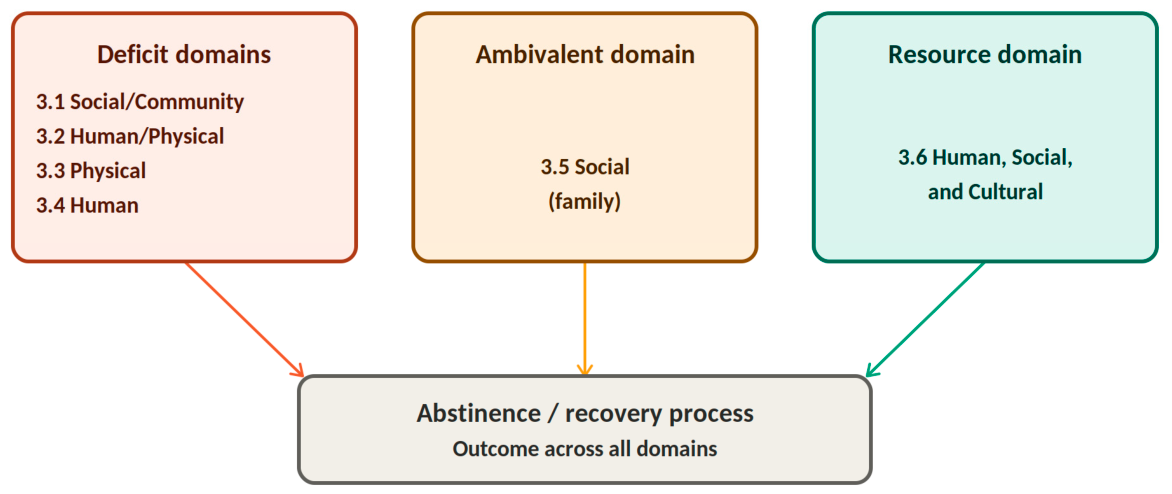
| Theme (Results) | Recovery Capital Domain [20] | Polarity |
|---|---|---|
| 3.1. Initiation factors and vulnerabilities associated with onset | Social/Community | Deficit (negative capital) |
| 3.2. Clinical and psychological manifestations of use | Human/Physical | Deficit (negative capital) |
| 3.3. Experience of dependence and withdrawal | Physical | Deficit (negative capital) |
| 3.4. Cognitive and social mechanisms sustaining use | Human | Deficit (negative capital) |
| 3.5. Family: risk factor, protective factor, and source of suffering | Social | Ambivalent (resource and deficit) |
| 3.6. Recovery, abstinence, and identity reconstruction | Human + Social + Cultural | Resource (positive, emergent capital) |
| Characteristic | Value |
|---|---|
| Residence prior to incarceration | Urban: 74%; Rural: 26% |
| Age group | 20–30 years: 32%; 31–40 years: 52%; 41–50 years: 14%; 51–60 years: 0%; 61–70 years: 2% |
| Marital status | Cohabiting relationship: 52%; Unmarried: 32%; Married: 10%; Divorced: 6% |
| Main substance used | Marijuana: 40%; Heroin: 30%; Cocaine: 16%; New psychoactive substances (“legal highs”): 14% |
| Age at initiation of use | 10–15 years: 20%; 16–20 years: 44%; 21–25 years: 28%; 30–35 years: 8% |
| Polydrug use (lifetime, ≥2 substance categories) | More than half of participants |
Disclaimer/Publisher’s Note: The statements, opinions and data contained in all publications are solely those of the individual author(s) and contributor(s) and not of MDPI and/or the editor(s). MDPI and/or the editor(s) disclaim responsibility for any injury to people or property resulting from any ideas, methods, instructions or products referred to in the content. |
© 2026 by the authors. Licensee MDPI, Basel, Switzerland. This article is an open access article distributed under the terms and conditions of the Creative Commons Attribution (CC BY) license.
Share and Cite
Rada, C.; Dina, M.-M.; Iureși, C.-R. Recovery Capital and Family Support Among Incarcerated Men with a History of Psychoactive Substance Use in a Single Romanian Penitentiary: A Qualitative Study. Healthcare 2026, 14, 2873. https://doi.org/10.3390/healthcare14172873
Rada C, Dina M-M, Iureși C-R. Recovery Capital and Family Support Among Incarcerated Men with a History of Psychoactive Substance Use in a Single Romanian Penitentiary: A Qualitative Study. Healthcare. 2026; 14(17):2873. https://doi.org/10.3390/healthcare14172873
Chicago/Turabian StyleRada, Cornelia, Maria-Miana Dina, and Cristina-Roxana Iureși. 2026. "Recovery Capital and Family Support Among Incarcerated Men with a History of Psychoactive Substance Use in a Single Romanian Penitentiary: A Qualitative Study" Healthcare 14, no. 17: 2873. https://doi.org/10.3390/healthcare14172873
APA StyleRada, C., Dina, M.-M., & Iureși, C.-R. (2026). Recovery Capital and Family Support Among Incarcerated Men with a History of Psychoactive Substance Use in a Single Romanian Penitentiary: A Qualitative Study. Healthcare, 14(17), 2873. https://doi.org/10.3390/healthcare14172873