1. Introduction
Postprocedural respiratory complications remain among the most consequential adverse events in pediatric surgical care. Mechanical ventilation, postoperative intubation, prolonged respiratory support, and extracorporeal membrane oxygenation (ECMO) may occur in the same broad administrative complication category, yet they represent different hospital-course patterns and may be associated with substantially different outcomes [
1,
2].
The Agency for Healthcare Research and Quality (AHRQ)’s Pediatric Quality Indicator 09 (PDI-09) provides a standardized framework for surveillance of postoperative respiratory failure among eligible pediatric surgical discharges. Its timing logic distinguishes prolonged mechanical ventilation and postoperative intubation relative to the first major operating-room (OR) procedure [
3]. However, PDI-09 is an occurrence-based quality indicator and does not by itself describe heterogeneity in respiratory-support patterns after a postprocedural respiratory complication has been coded.
Prior national work has identified demographic, clinical, procedural, and hospital factors associated with pediatric postoperative respiratory failure [
1,
2]. The contemporary pediatric ventilation and ECMO literature likewise emphasizes that respiratory support is clinically heterogeneous and that duration, escalation, and liberation occur within different physiologic contexts [
4,
5,
6,
7,
8]. National administrative data cannot reproduce continuous bedside respiratory courses, but procedure codes and procedure-day information can support reproducible hospital-course respiratory-support phenotypes.
To examine this heterogeneity, we analyzed the 2022 HCUP Kids’ Inpatient Database (KID). We identified operative discharges with the official HCUP Clinical Classifications Software Refined (CCSR) category RSP017 for postprocedural or postoperative respiratory system complication, anchored postoperative respiratory-support timing to major OR procedures, and classified mutually exclusive respiratory-support phenotypes. The primary outcome was directly observed in-hospital mortality.
We hypothesized that hospital-course respiratory-support phenotypes would be associated with different odds of in-hospital mortality after adjustment for age, sex, comorbidity burden, multisystem postoperative complication involvement, and procedure domain. The analysis was designed as an observational association study rather than a clinical prediction model or causal treatment-effect analysis.
2. Materials and Methods
2.1. Study Design and Data Source
We conducted a retrospective cross-sectional analysis of discharge-level data from the 2022 HCUP KID, sponsored by AHRQ. The KID is the largest publicly available all-payer pediatric inpatient database in the United States and uses a complex sampling design that supports national discharge-level inference when the supplied survey weights, strata, and hospital clusters are incorporated [
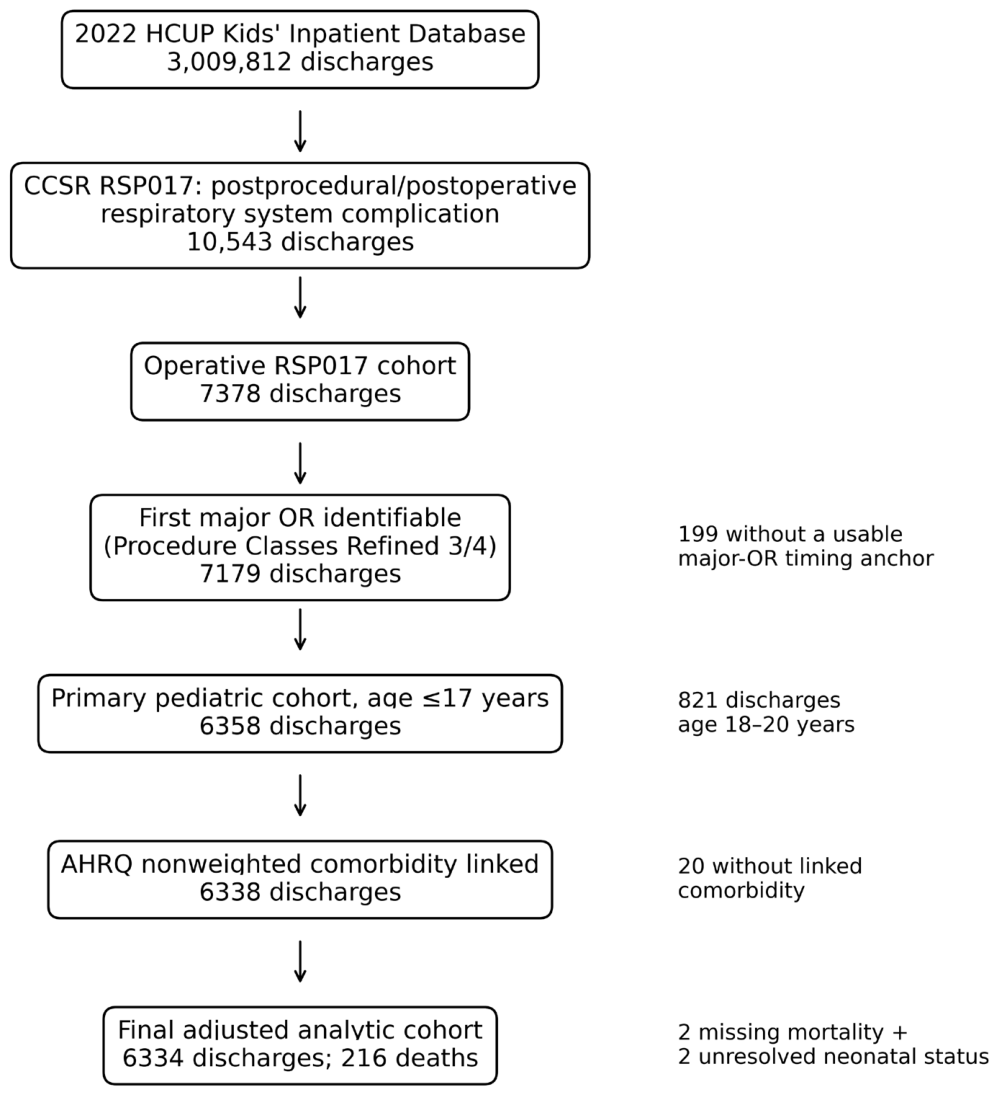
9]. The 2022 KID contains 3,009,812 sampled discharges. All reported sample counts are unweighted; regression estimates account for the KID design.
The study period was the calendar year 2022. The unit of analysis was an inpatient discharge. Statistical analyses were performed in SAS 9.4 with SAS/STAT (SAS Institute Inc., Cary, NC, USA).
2.2. Cohort Identification and Operative Anchor
We identified discharges assigned to CCSR diagnosis category RSP017, postprocedural or postoperative respiratory system complication. CCSR is an AHRQ/HCUP taxonomy that aggregates ICD-10-CM diagnosis codes into clinically coherent categories [
10]. We then restricted the cohort to discharges with at least one major OR procedure identified with HCUP Procedure Classes Refined classes 3 or 4 [
11]. This broader operative RSP017 cohort was used to characterize respiratory-support phenotypes and does not claim to reproduce the full PDI-09 denominator. Operational cohort and respiratory-support definitions are provided in
Appendix A.1 (
Table A1).
For each discharge, the primary operative anchor was the first hospital day containing a dated major procedure (Procedure Classes Refined class 3 or 4). If multiple qualifying major procedures occurred on the same hospital day, that shared day served as the anchor because KID does not provide within-day procedure sequencing. If major procedures occurred on more than one hospital day, the earliest dated major procedure was the primary anchor, consistent with the first-major-OR timing framework used by PDI-09 [
3,
11]. To assess whether a later operation could materially alter phenotype assignment, we repeated the timing classification using the last dated major OR as a sensitivity analysis.
Because the 2022 KID does not provide day-level age (AGEDAY), neonatal status among AGE = 0 discharges was classified with the HCUP AGE_NEONATE indicator [
9]. Two age-zero discharges had missing AGE_NEONATE and therefore could not be assigned to the prespecified neonatal or infant stratum. Exclusions from the final adjusted model were limited to records without a usable age classification, missing in-hospital mortality, or unavailable linked AHRQ nonweighted comorbidity burden.
Figure 1 and
Table A2 summarize cohort construction.
2.3. AHRQ-Anchored Respiratory-Support Phenotypes
AHRQ PDI-09 criteria were used to anchor the timing of postoperative respiratory support but were not used to claim reproduction of PDI-09 itself. Under version 2024 specifications, qualifying timing includes mechanical ventilation > 96 h with the last dated occurrence on or after the first major OR; mechanical ventilation 24–96 h with the last dated occurrence at least 2 days after the first major OR; and qualifying postoperative intubation with the last dated occurrence at least 1 day after the first major OR [
3]. Exact ICD-10-PCS timing codes and the timing-anchor quality audit are documented in
Appendix A.3 (
Table A3).
Five mutually exclusive hospital-course phenotypes were defined hierarchically: (1) ECMO support during the hospitalization; (2) postoperative mechanical ventilation > 96 h meeting the timing rule; (3) postoperative mechanical ventilation 24–96 h or qualifying postoperative intubation; (4) other invasive mechanical ventilation/intubation support that did not meet the preceding timed definitions; and (5) no coded mechanical ventilation, intubation, or ECMO. ECMO was assigned first to isolate hospitalizations involving extracorporeal support regardless of concurrent ventilation. Among non-ECMO discharges, >96 h ventilation was assigned before the 24–96 h/intubation category to resolve overlapping respiratory-support codes into mutually exclusive categories. The hierarchy was not intended as an ordinal severity scale.
Before hierarchical assignment, we quantified how many discharges met more than one candidate phenotype definition and documented the overlap patterns and resulting assignment. The primary hierarchy was fixed before the mortality models and was not altered in response to outcome cell counts. Sensitivity analyses (i) prioritized >96 h ventilation before ECMO, (ii) prioritized the 24–96 h/intubation category before >96 h ventilation while retaining ECMO first, and (iii) separated 24–96 h ventilation from qualifying postoperative intubation. These analyses tested whether the principal findings depended on a single classification rule.
2.4. Multisystem Complication Involvement, Comorbidity, and Procedure Domain
Multisystem involvement was defined as the respiratory complication plus at least one additional postoperative complication system identified in the analytic phenotype file. This is an administrative complication construct rather than a validated physiologic organ-dysfunction score and is used only as a marker of broader coded postoperative complication involvement [
12,
13,
14].
Comorbidity burden was obtained from a previously generated 2022 AHRQ Quality Indicators analytic lineage and linked back to current KID discharges by discharge and hospital identifiers. The source was deduplicated to one record per discharge before linkage. Comorbidity values were internally consistent across duplicate source rows; 6338 of 6358 primary-cohort records linked successfully (99.69%), and immutable discharge characteristics showed complete agreement in the validation audit (
Appendix A,
Table A4). Only the AHRQ nonweighted comorbidity count and its PDI-09 category indicators were imported; mortality and age-in-days variables from the historical analytic lineage were not used. The recovered indicators conformed exactly to the AHRQ PDI-09 count categories, with category 1 representing 1–2 counted conditions and category 2 representing ≥3 conditions [
15,
16].
Procedure domain was represented by six mutually exclusive categories derived from HCUP procedural CCSR clinical domains: cardiovascular; neurologic/ear, nose, and throat; musculoskeletal; gastrointestinal/hepatobiliary; respiratory; and other principal procedures [
17]. This study-specific collapse was used for case-mix adjustment and should not be interpreted as a validated procedure-severity index.
2.5. Outcome
The primary outcome was in-hospital mortality, defined from the 2022 KID DIED indicator. Mortality was selected as a directly observed, clinically unambiguous endpoint. Two records in the age-eligible cohort had missing mortality status and were excluded from mortality models.
2.6. Statistical Analysis
Descriptive analyses report unweighted sampled-discharge counts and proportions unless explicitly labeled as survey-weighted. To assess potential selection from the 24 age-eligible records excluded from the final adjusted model, we descriptively compared included and excluded records on age, sex, phenotype, multisystem involvement, procedure domain, observed mortality when available, and length of stay. Because the excluded group was small, no null-hypothesis significance tests were used for this comparison. Survey-weighted absolute mortality by phenotype and 95% confidence intervals were estimated with PROC SURVEYMEANS. Crude absolute mortality differences versus the reference phenotype were estimated with PROC SURVEYREG.
Crude phenotype associations and multivariable mortality models used PROC SURVEYLOGISTIC with KID_STRATUM as the stratum variable, HOSP_KID as the cluster variable, and DISCWT as the discharge weight. Taylor-series linearization was used for variance estimation. The full 2022 KID design file was retained, and the response was set missing outside the analytic subpopulation with NOMCAR rather than physically subsetting the survey design. The full KID contained 95 strata and 3811 hospital clusters; no values of DISCWT, KID_STRATUM, or HOSP_KID were missing in either the full KID or final analytic cohort. Although the final cohort represented 51 strata and 400 hospitals, all 95 strata and 3811 clusters were retained for variance estimation.
The prespecified primary model included respiratory-support phenotype, multisystem involvement, pediatric age category, sex, AHRQ nonweighted comorbidity burden, and procedure domain. Age was categorized as neonate (first 28 days), infant 29 days to <1 year, 1–4 years, 5–9 years, 10–14 years, and 15–17 years; age 1–4 years was the reference. Comorbidity burden was categorized as 0, 1–2, or ≥3 conditions, consistent with the AHRQ nonweighted PDI-09 comorbidity construct [
15,
16]. Adjusted odds ratios (aORs), 95% confidence intervals (CIs), and two-sided
p-values are reported. Odds ratios are interpreted on the odds scale and not as risk ratios.
Sensitivity analyses removed procedure domain from the covariate set, excluded ECMO occurring before the first major OR or with unknown timing, compared identical no-comorbidity models in the full eligible and comorbidity-complete samples, applied two alternative phenotype hierarchies, separated 24–96 h ventilation from qualifying postoperative intubation, and rebuilt timed phenotypes using the last rather than first major OR. The study was not designed to develop or compare clinical prediction models; therefore, calibration, reclassification, and decision-curve analyses were not performed. Model fit statistics and the c-statistic are retained only in
Appendix A as reproducibility diagnostics and are not interpreted as evidence of predictive validity. All statistical analyses were performed using SAS 9.4 with SAS/STAT (SAS Institute Inc., Cary, NC, USA).
4. Discussion
4.1. Principal Findings
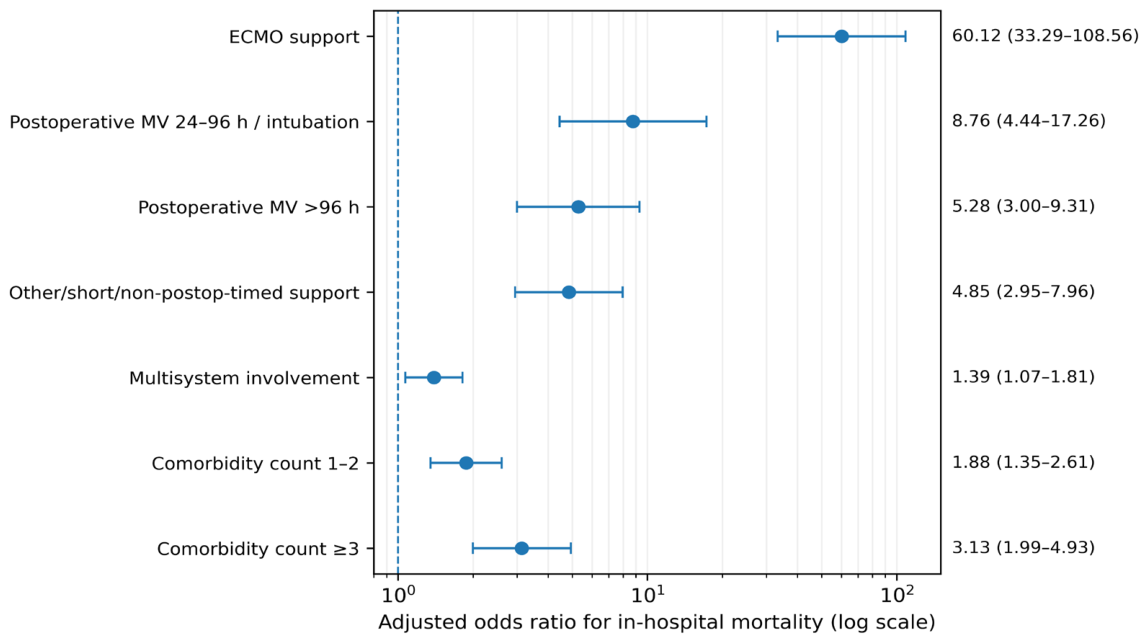
In this survey-weighted national analysis of pediatric operative discharges with postprocedural respiratory complications, hospital-course respiratory-support phenotypes were associated with markedly different in-hospital mortality. The ECMO phenotype had the highest absolute mortality and the largest adjusted odds ratio, while the other invasive-support categories also differed substantially from the reference group. These associations remained similar across alternative phenotype hierarchies, ECMO-timing restrictions, procedure-domain specifications, missing-comorbidity analyses, and a last-major-OR timing anchor.
A second important finding is that the primary phenotype categories should not be read as an ordinal severity scale. The combined postoperative 24–96 h ventilation/intubation category had higher mortality than the >96 h ventilation category in the primary analysis, but the disaggregated sensitivity showed that this pattern was driven principally by qualifying postoperative intubation rather than 24–96 h ventilation alone. This distinction sharpens the interpretation of the primary model and argues against equating longer coded ventilation duration with uniformly higher mortality.
4.2. Interpreting the Non-Monotonic Phenotype Pattern
Mechanical ventilation duration is partly conditioned on survival, physiology, operative timing, escalation decisions, and successful liberation. A patient who dies or undergoes abrupt escalation may not accumulate prolonged ventilation duration, whereas a child who survives a difficult postoperative course may remain ventilated for many days. Administrative timing categories therefore capture different hospital-course states rather than successive steps on a single severity continuum.
The disaggregated sensitivity analysis supports this interpretation. Qualifying postoperative intubation was associated with markedly higher mortality odds, whereas the estimate for 24–96 h mechanical ventilation alone was smaller and imprecise. The KID cannot determine whether qualifying intubation followed extubation failure, airway compromise, planned reintubation, progressive pulmonary disease, or another indication. Accordingly, these categories should be viewed as reproducible administrative phenotypes that identify groups for further clinical investigation, not as mechanistic explanations or treatment effects.
4.3. ECMO as a Hospital-Course Support Phenotype
ECMO support was associated with approximately 60-fold higher adjusted odds of mortality relative to the no-coded-MV/intubation/ECMO reference phenotype, and survey-weighted mortality was 35.46%. This estimate reflects the extreme underlying acuity of ECMO-treated hospitalizations as well as the support modality itself and must not be interpreted as a causal effect of ECMO. Contemporary pediatric ECMO studies similarly describe populations with substantial illness burden and mortality [
7,
8].
Excluding ECMO that occurred before the first major OR or had unknown timing left the adjusted estimate essentially unchanged. Reordering the hierarchy so that >96 h postoperative ventilation took precedence over ECMO also left ECMO strongly associated with mortality. These analyses reduce concern that the main ECMO association is simply an artifact of temporal anchoring or hierarchy priority, while still leaving clinical indication and disease severity unresolved.
4.4. Multisystem Involvement and Comorbidity Burden
Multisystem postoperative complication involvement was associated with mortality in the primary model, but the association was modest and somewhat sensitive to case-mix specification: when procedure domain was omitted, the estimate attenuated to 1.27 (95% CI 0.98–1.65). This pattern supports cautious interpretation of multisystem involvement as an administrative marker of broader postoperative complication burden rather than an independent physiologic organ-failure construct.
AHRQ nonweighted comorbidity burden showed a clearer graded association with mortality. Compared with children without counted AHRQ comorbidities, adjusted mortality odds were approximately 1.9-fold higher with 1–2 conditions and 3.1-fold higher with ≥3. This direction is consistent with the broader literature on pediatric medical complexity, including the 2024 update to the complex chronic conditions framework [
18]. Importantly, the respiratory-support phenotype associations remained substantial after adjustment for this baseline vulnerability.
4.5. Clinical and Quality-Improvement Implications
These findings are most appropriately used for hypothesis generation, administrative surveillance, and structured quality review rather than bedside treatment selection or comparative performance ranking. An occurrence-based indicator establishes that a postoperative respiratory complication was coded. The phenotype framework adds information about coded respiratory support and timing within the hospitalization, which may help identify distinct groups for targeted chart review.
The KID cannot establish whether an individual phenotype reflects a preventable complication, appropriate escalation, underlying disease severity, planned postoperative management, or institutional practice. A qualifying postoperative intubation, prolonged postoperative ventilation, and ECMO support therefore should not automatically be interpreted as equivalent quality failures or treatment pathways. External validation using clinical data with ventilator settings, indications, extubation events, and continuous timing is required before these phenotypes are used for bedside stratification or interhospital quality comparisons.
4.6. Strengths and Limitations
This study has several strengths. Cohort identification uses an official CCSR diagnosis category with an operative restriction based on Procedure Classes Refined; respiratory-support timing is anchored to major OR procedures, and the KID complex survey design is incorporated through discharge weights, strata, and hospital clusters. The analysis retained nearly all age-eligible records, quantified the characteristics of the small excluded group, reported survey-weighted absolute mortality and absolute mortality differences, audited pre-hierarchy overlap, and tested alternative hierarchy and operative-anchor definitions. The raw-code reconstruction reproduced the frozen primary phenotype assignments for all 6358 age-eligible records.
Limitations should constrain interpretation. Administrative data do not provide ventilator settings, positive end-expiratory pressure, arterial blood gases, oxygenation indices, PRISM scores, continuous bedside timing, extubation status, or the clinical indication for intubation. ICD-10-CM/PCS codes may be incomplete or misclassified. The RSP017 cohort is broader than PDI-09, and this study does not reproduce the AHRQ indicator. KID procedure days cannot establish within-day sequencing; when multiple major procedures occur on the same day, a common day anchor is unavoidable. When procedures span multiple days, the first major OR may not always be the procedure most clinically related to later respiratory support, although the last-major-OR sensitivity produced similar mortality associations.
The phenotypes are hospital-course administrative categories, not continuous clinical courses, and some respiratory-support components may occur after substantial deterioration has already developed. Residual confounding by illness severity is likely. Adjusted odds ratios should not be interpreted causally or as risk ratios. ECMO and postoperative intubation may reflect appropriate escalation rather than preventable harm. The multisystem variable is an administrative complication construct rather than a validated physiologic organ-dysfunction score. Phenotype 4 is heterogeneous; tracheostomy is vulnerable to survivor conditioning, and the analysis covers one KID release year. External validation in other years and clinical datasets is required. Additional reproducibility details are provided in
Appendix A.11.