Real-World Effectiveness and Safety of Esketamine Nasal Spray in Treatment-Resistant Depression: A Retrospective Observational Study

 , , ,
, , ,
Highlights
- In routine Saudi psychiatric care, intranasal esketamine was preferentially prescribed to patients with more severe depression and a greater number of previous antidepressant failures.
- In propensity-score matched analyses, follow-up PHQ-9 scores were modestly lower in the esketamine group than in the venlafaxine group; the estimated differences were 1.02 points at 3 months and 1.94 points at 6 months.
- Observed differences should be interpreted cautiously because treatment allocation was not randomized and follow-up outcomes were available only for patients retained in care.
- The absence of remission in either cohort emphasizes the continuing need for multimodal treatment pathways for treatment-resistant depression.
Abstract
1. Introduction
2. Materials and Methods
2.1. Study Design and Setting
2.2. Participants and Treatment Groups
2.3. Sample Size Calculation
2.4. Data Collection and Management
2.5. Outcome Definition
2.6. Statistical Analysis
3. Results
3.1. Baseline Patient Characteristics
3.2. Dosing Patterns
3.3. Treatment Outcomes
3.4. Propensity Scores Matching Analysis
3.5. Safety Profile
4. Discussion
5. Conclusions
Supplementary Materials
Author Contributions
Funding
Institutional Review Board Statement
Informed Consent Statement
Data Availability Statement
Acknowledgments
Conflicts of Interest
Abbreviations
| AD | Antidepressant |
| BMI | Body mass index |
| MCID | Minimal clinically important difference |
| MDD | Major depressive disorder |
| PHQ-9 | Patient Health Questionnaire-9 |
| SNRI | Serotonin-Norepinephrine Reuptake Inhibitor |
| SSRI | Selective Serotonin Reuptake Inhibitor |
| TCA | Tricyclic Antidepressants |
References
- Institute for Health Metrics and Evaluation (IHME). Global Burden of Disease 2023: Findings from the GBD 2023 Study; IHME: Seattle, WA, USA, 2025. [Google Scholar]
- Tyrovolas, S.; El Bcheraoui, C.; Alghnam, S.A.; Alhabib, K.F.; Almadi, M.A.H.; Al-Raddadi, R.M.; Bedi, N.; El Tantawi, M.; Krish, V.S.; Memish, Z.A.; et al. The burden of disease in Saudi Arabia 1990–2017: Results from the Global Burden of Disease Study 2017. Lancet Planet. Health 2020, 4, e195–e208. [Google Scholar] [CrossRef] [Scilit]
- Trevino, K.; McClintock, S.M.; McDonald Fischer, N.; Vora, A.; Husain, M.M. Defining treatment-resistant depression: A comprehensive review of the literature. Ann. Clin. Psychiatry 2014, 26, 222–232. [Google Scholar] [CrossRef] [Scilit]
- Demyttenaere, K.; Van Duppen, Z. The Impact of (the Concept of) Treatment-Resistant Depression: An Opinion Review. Int. J. Neuropsychopharmacol. 2019, 22, 85–92. [Google Scholar] [CrossRef] [Scilit]
- Zhdanava, M.; Pilon, D.; Ghelerter, I.; Chow, W.; Joshi, K.; Lefebvre, P.; Sheehan, J.J. The Prevalence and National Burden of Treatment-Resistant Depression and Major Depressive Disorder in the United States. J. Clin. Psychiatry 2021, 82, 20m13699. [Google Scholar] [CrossRef] [Scilit]
- Santomauro, D.F.; Mantilla Herrera, A.M.; Shadid, J.; Zheng, P.; Ashbaugh, C.; Pigott, D.M.; Abbafati, C.; Adolph, C.; Amlag, J.O.; Aravkin, A.Y.; et al. Global prevalence and burden of depressive and anxiety disorders in 204 countries and territories in 2020 due to the COVID-19 pandemic. Lancet 2021, 398, 1700–1712. [Google Scholar] [CrossRef] [Scilit]
- Akram, A.; Al-Sabahy, M.; Al-Jedai, A.; Almudaiheem, H.; Farghally, M.; Fallata, E.; Alibrahim, O.; Shoukry, T.; Basu, S.; Chalouhi, D.; et al. The clinical & economic burden of treatment-resistant depression in the Gulf-Cooperation Council: The Kingdom of Saudi Arabia, Kuwait and the United Arab Emirates. Int. J. Methods Psychiatr. Res. 2023, 32, e1952. [Google Scholar] [CrossRef] [Scilit]
- Lam, R.W.; Kennedy, S.H.; Adams, C.; Bahji, A.; Beaulieu, S.; Bhat, V.; Blier, P.; Blumberger, D.M.; Brietzke, E.; Chakrabarty, T.; et al. Canadian Network for Mood and Anxiety Treatments (CANMAT) 2023 Update on Clinical Guidelines for Management of Major Depressive Disorder in Adults: Réseau canadien pour les traitements de l’humeur et de l’anxiété (CANMAT) 2023: Mise à jour des lignes directrices cliniques pour la prise en charge du trouble dépressif majeur chez les adultes. Can. J. Psychiatry 2024, 69, 641–687. [Google Scholar] [CrossRef] [Scilit] [PubMed]
- Bennabi, D.; Charpeaud, T.; Yrondi, A.; Genty, J.B.; Destouches, S.; Lancrenon, S.; Alaïli, N.; Bellivier, F.; Bougerol, T.; Camus, V.; et al. Clinical guidelines for the management of treatment-resistant depression: French recommendations from experts, the French Association for Biological Psychiatry and Neuropsychopharmacology and the fondation FondaMental. BMC Psychiatry 2019, 19, 262. [Google Scholar] [CrossRef] [Scilit]
- Association, A.P. Clinical Practice Guideline for the Treatment of Depression Across Three Age Cohorts. 2019. Available online: https://www.apa.org/depression-guideline (accessed on 4 February 2025).
- Samalin, L.; Rothärmel, M.; Mekaoui, L.; Gaudré-Wattinne, E.; Codet, M.A.; Bouju, S.; Sauvaget, A. Esketamine nasal spray in patients with treatment-resistant depression: The real-world experience in the French cohort early-access programme. Int. J. Psychiatry Clin. Pract. 2022, 26, 352–362. [Google Scholar] [CrossRef] [Scilit]
- Heerlein, K.; Perugi, G.; Otte, C.; Frodl, T.; Degraeve, G.; Hagedoorn, W.; Oliveira-Maia, A.J.; Perez Sola, V.; Rathod, S.; Rosso, G.; et al. Real-world evidence from a European cohort study of patients with treatment resistant depression: Treatment patterns and clinical outcomes. J. Affect. Disord. 2021, 290, 334–344. [Google Scholar] [CrossRef] [Scilit]
- Oliveira-Maia, A.J.; Bobrowska, A.; Constant, E.; Ito, T.; Kambarov, Y.; Luedke, H.; Mulhern-Haughey, S.; von Holt, C. Treatment-Resistant Depression in Real-World Clinical Practice: A Systematic Literature Review of Data from 2012 to 2022. Adv. Ther. 2024, 41, 34–64. [Google Scholar] [CrossRef] [Scilit]
- Lundberg, J.; Cars, T.; Lööv, S.; Söderling, J.; Sundström, J.; Tiihonen, J.; Leval, A.; Gannedahl, A.; Björkholm, C.; Själin, M.; et al. Association of Treatment-Resistant Depression with Patient Outcomes and Health Care Resource Utilization in a Population-Wide Study. JAMA Psychiatry 2023, 80, 167–175. [Google Scholar] [CrossRef] [Scilit]
- Kishi, T.; Sakuma, K.; Nomura, I.; Matsuda, Y.; Mishima, K.; Iwata, N. Brexpiprazole as Adjunctive Treatment for Major Depressive Disorder Following Treatment Failure with at Least One Antidepressant in the Current Episode: A Systematic Review and Meta-Analysis. Int. J. Neuropsychopharmacol. 2019, 22, 698–709. [Google Scholar] [CrossRef] [Scilit]
- Popova, V.; Daly, E.J.; Trivedi, M.; Cooper, K.; Lane, R.; Lim, P.; Mazzucco, C.; Hough, D.; Thase, M.E.; Shelton, R.C.; et al. Efficacy and Safety of Flexibly Dosed Esketamine Nasal Spray Combined with a Newly Initiated Oral Antidepressant in Treatment-Resistant Depression: A Randomized Double-Blind Active-Controlled Study. Am. J. Psychiatry 2019, 176, 428–438. [Google Scholar] [CrossRef] [Scilit]
- Agency, E.M. Spravato: Summary of Product Characteristics. 2019. Available online: https://www.ema.europa.eu/en/medicines/human/EPAR/spravato#product-info (accessed on 4 February 2025).
- Daly, E.J.; Turkoz, I.; Salvadore, G.; Fedgchin, M.; Ionescu, D.F.; Starr, H.L.; Borentain, S.; Trivedi, M.H.; Thase, M.E.; Singh, J.B. The effect of esketamine in patients with treatment-resistant depression with and without comorbid anxiety symptoms or disorder. Depress. Anxiety 2021, 38, 1120–1130. [Google Scholar] [CrossRef] [Scilit]
- Daly, E.J.; Trivedi, M.H.; Janik, A.; Li, H.; Zhang, Y.; Li, X.; Lane, R.; Lim, P.; Duca, A.R.; Hough, D.; et al. Efficacy of Esketamine Nasal Spray Plus Oral Antidepressant Treatment for Relapse Prevention in Patients with Treatment-Resistant Depression: A Randomized Clinical Trial. JAMA Psychiatry 2019, 76, 893–903. [Google Scholar] [CrossRef] [Scilit]
- Reif, A.; Bitter, I.; Buyze, J.; Cebulla, K.; Frey, R.; Fu, D.J.; Ito, T.; Kambarov, Y.; Llorca, P.M.; Oliveira-Maia, A.J.; et al. Esketamine Nasal Spray versus Quetiapine for Treatment-Resistant Depression. N. Engl. J. Med. 2023, 389, 1298–1309. [Google Scholar] [CrossRef] [Scilit]
- Almadani, A.H.; Alghamdi, A.H.; Almazyad, G.M.; Alfawaz, S.I.; Ghaith, M.A.; Alshehri, A.A.; Aljaffer, M.A.; Alghamdi, S.A. Mental health professionals’ perspective on the use of esketamine in treatment-resistant depression and their motivation to adopt it: A Saudi cross-sectional study. Front. Psychiatry 2026, 17, 1726411. [Google Scholar] [CrossRef] [Scilit]
- Cuschieri, S. The STROBE guidelines. Saudi J. Anaesth. 2019, 13, S31–S34. [Google Scholar] [CrossRef] [Scilit] [PubMed]
- McIntyre, R.S.; Alsuwaidan, M.; Baune, B.T.; Berk, M.; Demyttenaere, K.; Goldberg, J.F.; Gorwood, P.; Ho, R.; Kasper, S.; Kennedy, S.H.; et al. Treatment-resistant depression: Definition, prevalence, detection, management, and investigational interventions. World Psychiatry 2023, 22, 394–412. [Google Scholar] [CrossRef] [Scilit]
- Zheng, J.Z.; Li, Y.; Lin, T.; Estrada, A.; Lu, X.; Feng, C. Sample Size Calculations for Comparing Groups with Continuous Outcomes. Shanghai Arch. Psychiatry 2017, 29, 250–256. [Google Scholar] [CrossRef] [Scilit]
- Kroenke, K.; Spitzer, R.L.; Williams, J.B. The PHQ-9: Validity of a brief depression severity measure. J. Gen. Intern. Med. 2001, 16, 606–613. [Google Scholar] [CrossRef] [Scilit] [PubMed]
- Belanger, H.G.; Lee, C.; Poliacoff, Z.; Gupta, C.T.; Winsberg, M. Early Response to Antidepressant Medications in Adults with Major Depressive Disorder: A Naturalistic Study and Odds of Remission at 14 Weeks. J. Clin. Psychopharmacol. 2023, 43, 46–54. [Google Scholar] [CrossRef] [Scilit]
- AlHadi, A.N.; AlAteeq, D.A.; Al-Sharif, E.; Bawazeer, H.M.; Alanazi, H.; AlShomrani, A.T.; Shuqdar, R.M.; AlOwaybil, R. An arabic translation, reliability, and validation of Patient Health Questionnaire in a Saudi sample. Ann. Gen. Psychiatry 2017, 16, 32. [Google Scholar] [CrossRef] [Scilit]
- Löwe, B.; Unützer, J.; Callahan, C.M.; Perkins, A.J.; Kroenke, K. Monitoring depression treatment outcomes with the patient health questionnaire-9. Med. Care 2004, 42, 1194–1201. [Google Scholar] [CrossRef] [Scilit]
- Hernán, M.A.; Robins, J.M. Using Big Data to Emulate a Target Trial When a Randomized Trial Is Not Available. Am. J. Epidemiol. 2016, 183, 758–764. [Google Scholar] [CrossRef] [Scilit] [PubMed]
- Bauer-Staeb, C.; Kounali, D.Z.; Welton, N.J.; Griffith, E.; Wiles, N.J.; Lewis, G.; Faraway, J.J.; Button, K.S. Effective dose 50 method as the minimal clinically important difference: Evidence from depression trials. J. Clin. Epidemiol. 2021, 137, 200–208. [Google Scholar] [CrossRef] [Scilit]
- Kounali, D.; Button, K.S.; Lewis, G.; Gilbody, S.; Kessler, D.; Araya, R.; Duffy, L.; Lanham, P.; Peters, T.J.; Wiles, N.; et al. How much change is enough? Evidence from a longitudinal study on depression in UK primary care. Psychol. Med. 2022, 52, 1875–1882. [Google Scholar] [CrossRef] [Scilit]
- Turkoz, I.; Alphs, L.; Singh, J.; Jamieson, C.; Daly, E.; Shawi, M.; Sheehan, J.J.; Trivedi, M.H.; Rush, A.J. Clinically meaningful changes on depressive symptom measures and patient-reported outcomes in patients with treatment-resistant depression. Acta Psychiatr. Scand. 2021, 143, 253–263. [Google Scholar] [CrossRef] [Scilit]
- The US Food and Drug Administration. SPRAVATO® (Esketamine) Nasal Spray, CIII. 2025. Available online: https://www.accessdata.fda.gov/drugsatfda_docs/label/2025/211243s016lbl.pdf (accessed on 1 June 2026).
- Higgins, A.; Nash, M.; Lynch, A.M. Antidepressant-associated sexual dysfunction: Impact, effects, and treatment. Drug Heal. Patient Saf. 2010, 2, 141–150. [Google Scholar] [CrossRef] [Scilit]
- Kamp, C.B.; Petersen, J.J.; Faltermeier, P.; Juul, S.; Siddiqui, F.; Moncrieff, J.; Horowitz, M.A.; Hengartner, M.P.; Kirsch, I.; Gluud, C.; et al. The risks of adverse events with venlafaxine for adults with major depressive disorder: A systematic review of randomised clinical trials with meta-analysis and Trial Sequential Analysis. Epidemiol. Psychiatr. Sci. 2024, 33, e51. [Google Scholar] [CrossRef] [Scilit]
- Machado, M.; Einarson, T.R. Comparison of SSRIs and SNRIs in major depressive disorder: A meta-analysis of head-to-head randomized clinical trials. J. Clin. Pharm. Ther. 2010, 35, 177–188. [Google Scholar] [CrossRef] [Scilit]



| Characteristic | Esketamine Nasal Spray+ Oral Antidepressants n = 82 | Oral Antidepressant Venlafaxine+ Oral Antidepressants n = 87 | SMD | Test Statistic | p Value |
|---|---|---|---|---|---|
| Age, mean (SD) [range], y | 37.1 (10.5) [20–62] | 36.6 (11.7) [18–73] | 0.042 | −0.270 | 0.786 |
| BMI, mean (SD) [range] | 27.1 (3.3) [20.1–40.1] | 27.3 (1.6) [22–31.2] | 0.371 | 2.38 | 0.017 |
| Duration of disease (SD) [range], y | 7.8 (7.2) [1–24] | 7.8 (7.9) [1–26] | 0.134 | 0.870 | 0.384 |
| Sex | |||||
| Male | 63 (76.8) | 53 (60.9) | 0.349 | 4.96 | 0.026 |
| Female | 19 (23.2) | 34 (39.1) | |||
| Nationality | |||||
| Saudi | 81 (98.8) | 87 (100) | 0.157 | 0.485 | |
| Non-Saudi | 1 (1.2) | 0 (0) | |||
| Marital status | |||||
| Married | 51 (62.2) | 59 (67.8) | 0.099 | 0.604 | 0.573 |
| Single | 28 (34.1) | 25 (28.7) | |||
| Divorced | 3 (3.7) | 3 (3.4) | |||
| Education level | |||||
| High school graduate or less | 45 (54.9) | 64 (73.6) | 0.587 | 0.001 | |
| University degree | 36 (43.9) | 17 (19.5) | |||
| Illiterate | 1 (1.2) | 6 (6.9) | |||
| Occupation | |||||
| Employed | 48 (58.5) | 45 (51.7) | 0.160 | 1.08 | 0.345 |
| Unemployed | 34 (41.6) | 42 (48.3) | |||
| Smoking status | |||||
| Non-smoker | 67 (82.7) | 69 (79.3) | 0.051 | 0.113 | 0.287 |
| Current smoker | 9 (11.1) | 11 (12.6) | |||
| Previous smoker | 5 (6.2) | 7 (8.0) | |||
| Family history of MDD | |||||
| Yes | 21 (25.6) | 30 (34.5) | 0.359 | 5.32 | 0.070 |
| No | 37 (45.1) | 44 (50.6) | |||
| Unknown | 24 (29.3) | 13 (14.9) | |||
| Baseline PHQ-9 score | 0.601 | 14.15 | 0.001 | ||
| 15–19 (moderately severe depression) | 30 (36.6) | 57 (65.5) | |||
| 20–27 (severe depression) | 52 (63.4) | 30 (34.5) | |||
| Number of previous failed AD. n (%) | 0.999 | 5.71 | 0.001 | ||
| 2 failed | 1 (1.2) | 19 (21.8) | |||
| 3–4 failed | 22 (26.8) | 45 (51.7) | |||
| 5–6 failed | 36 (43.9) | 19 (21.8) | |||
| 7–8 failed | 19 (23.2) | 4 (4.6) | |||
| 9–10 failed | 4 (4.9) | 0 (0) | |||
| Concurrent prescribed medications. n (%) | |||||
| SSRI | 43 (52.4) | 32 (36.8) | |||
| Fluoxetine | 21 (25.6) | 7 (8.0) | |||
| Escitalopram | 8 (9.8) | 10 (11.5) | |||
| Paroxetine | 8 (9.8) | 4 (4.6) | |||
| Sertraline | 5 (6.1) | 4 (4.6) | |||
| SNRI | 51 (62.2) | 64 (73.3) | |||
| Desvenlafaxine | 12 (14.6) | 11 (12.6) | |||
| Duloxetine | 7 (8.5) | 7 (8.0) | |||
| TCA | 14 (17.1) | 18 (20.7) | |||
| Amitriptyline | 7 (8.5) | 15 (17.2) | |||
| Clomipramine | 7 (8.5) | 3 (3.4) | |||
| Atypical antidepressant | 20 (24.4) | 23 (26.4) | |||
| Bupropion | 13 (15.9) | 5 (5.7) | |||
| Mirtazapine | 8 (9.8) | 22 (25.3) | |||
| Antipsychotics | 50 (61.0) | 54 (62.1)) | |||
| Quetiapine | 26 (31.7) | 35 (40.2) | |||
| Aripiprazole | 13 (15.9) | 12 (13.8) | |||
| Olanzapine | 12 (14.6) | 11 (12.6) | |||
| Benzodiazepines | 11 (13.4) | 5 (5.7) | |||
| Mood stabilizer | 3 (3.7) | (3.4) |
| Doses (mg) | Frequency (%) |
|---|---|
| Esketamine doses | |
| 56 | 21 (25.7) |
| 84 | 61 (74.3) |
| Dose frequency | Twice weekly (induction) then titrated |
| Venlafaxine doses | |
| 75 | 14 (16.1) |
| 150 | 56 (64.4) |
| 225 | 17 (19.5) |
| Dose frequency | Once daily |
| Outcome | Esketamine | Venlafaxine | Test Statistic | p Value |
|---|---|---|---|---|
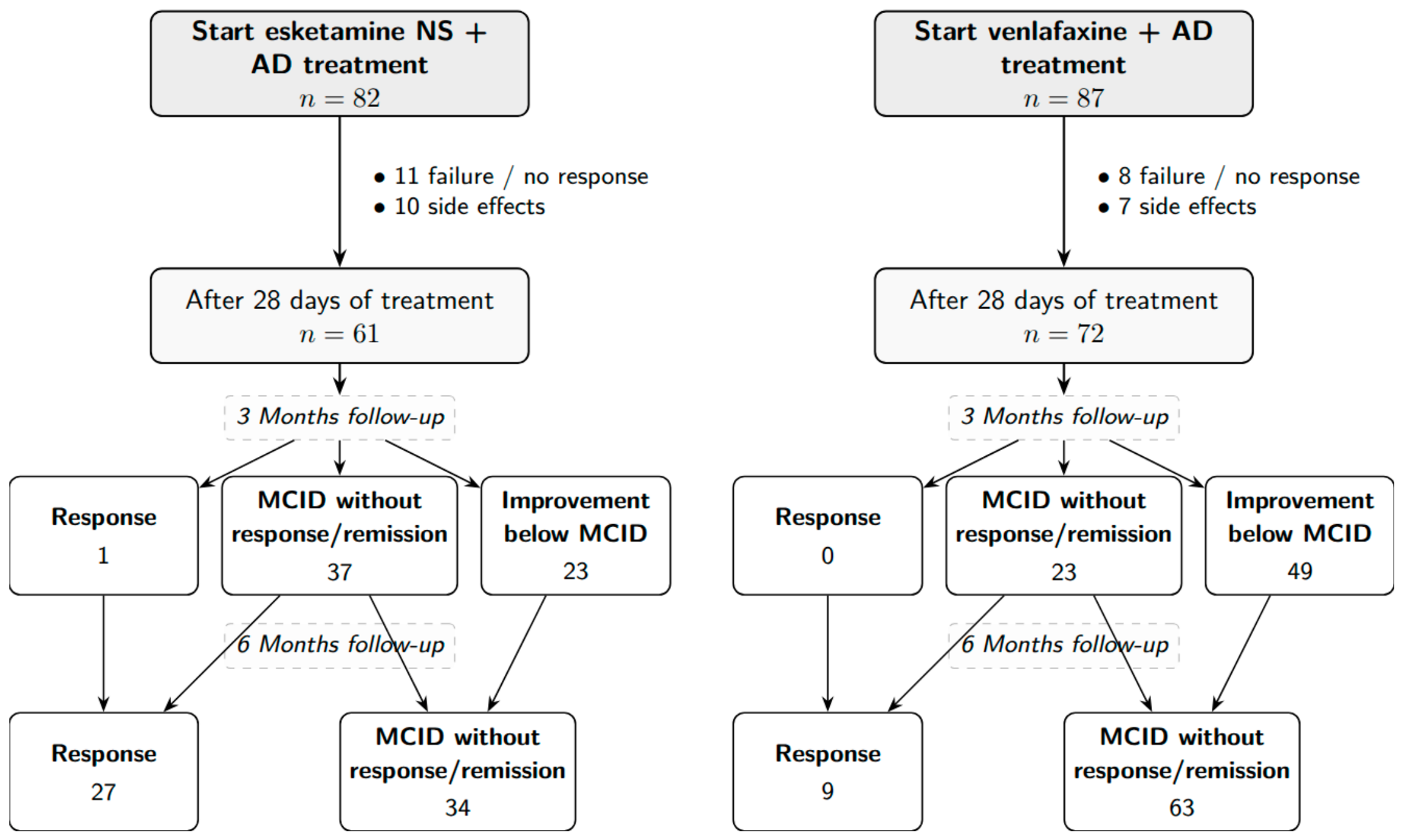
| 28-day induction phase | 1.76 | 0.182 | ||
| Continued treatment | 61 (74.4) | 72 (82.8) | ||
| Discontinued treatment | 21 (25.6) | 15 (17.2) | ||
| Reason for drug discontinuation | ||||
| Failure/No response | 11 (13.4) | 8 (9.2) | 0.003 | 0.955 |
| Patient preference/side effects | 10 (12.2) | 7 (8.0) | ||
| Continuation phase | 61 (74.4) | 72 (82.8) | ||
| Change in Follow-up PHQ-9 at 3 months | ||||
| Mean change (95% CI) | −4.73 (−5.37, −4.08) | −3.41 (−3.75, −3.07) | 3.81 | <0.001 |
| Remission | 0 (0) | 0 (0) | 0.001 | |
| Response | 1 (1.6) | 0 (0) | ||
| MCID without response/remission | 37 (60.7) | 23 (31.9) | ||
| Improvement below MCID | 23 (37.7) | 49 (68.1) | ||
| Change in Follow-up PHQ-9 at 6 months | ||||
| Mean change (95% CI) | −8.83 (−9.76, −7.90) | −6.26 (−6.87, −5.64) | 4.53 | <0.001 |
| Remission | 0 (0) | 0 (0) | 16.87 | 0.001 |
| Response | 27 (44.3) | 9 (12.5) | ||
| MCID without response/remission | 34 (55.7) | 63 (87.5) |
Disclaimer/Publisher’s Note: The statements, opinions and data contained in all publications are solely those of the individual author(s) and contributor(s) and not of MDPI and/or the editor(s). MDPI and/or the editor(s) disclaim responsibility for any injury to people or property resulting from any ideas, methods, instructions or products referred to in the content. |
© 2026 by the authors. Licensee MDPI, Basel, Switzerland. This article is an open access article distributed under the terms and conditions of the Creative Commons Attribution (CC BY) license.
Share and Cite
Ali, M.A.S.; Amirthalingam, P.; Alshareef, H.; Alassiry, M.Z.; Elshenawy, A.S.; Mansour, S.H.E.; Aljabri, A. Real-World Effectiveness and Safety of Esketamine Nasal Spray in Treatment-Resistant Depression: A Retrospective Observational Study. Healthcare 2026, 14, 2717. https://doi.org/10.3390/healthcare14172717
Ali MAS, Amirthalingam P, Alshareef H, Alassiry MZ, Elshenawy AS, Mansour SHE, Aljabri A. Real-World Effectiveness and Safety of Esketamine Nasal Spray in Treatment-Resistant Depression: A Retrospective Observational Study. Healthcare. 2026; 14(17):2717. https://doi.org/10.3390/healthcare14172717
Chicago/Turabian StyleAli, Mostafa A. Sayed, Palanisamy Amirthalingam, Hanan Alshareef, Mohammed Zayed Alassiry, Ahmed Samir Elshenawy, Sayed Hosam Eldin Mansour, and Ahmed Aljabri. 2026. "Real-World Effectiveness and Safety of Esketamine Nasal Spray in Treatment-Resistant Depression: A Retrospective Observational Study" Healthcare 14, no. 17: 2717. https://doi.org/10.3390/healthcare14172717
APA StyleAli, M. A. S., Amirthalingam, P., Alshareef, H., Alassiry, M. Z., Elshenawy, A. S., Mansour, S. H. E., & Aljabri, A. (2026). Real-World Effectiveness and Safety of Esketamine Nasal Spray in Treatment-Resistant Depression: A Retrospective Observational Study. Healthcare, 14(17), 2717. https://doi.org/10.3390/healthcare14172717