Effects of Different Nutritional Strategies on the Prevention and Management of Gestational Diabetes Mellitus: A Systematic Review and Network Meta-Analysis

Highlights
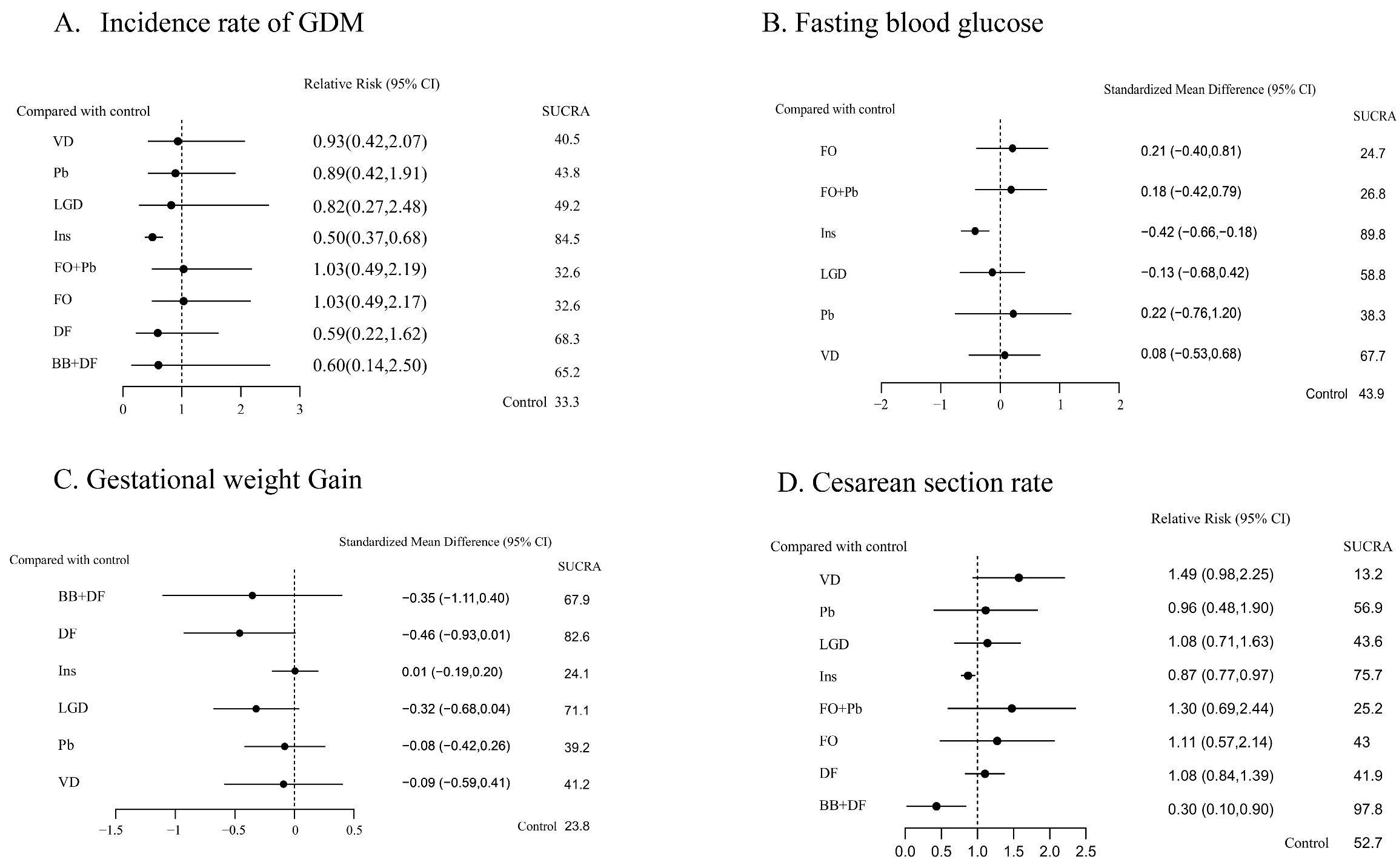
- Inositol supplementation was associated with reduced GDM incidence and lower FBG levels in high-risk pregnant women.
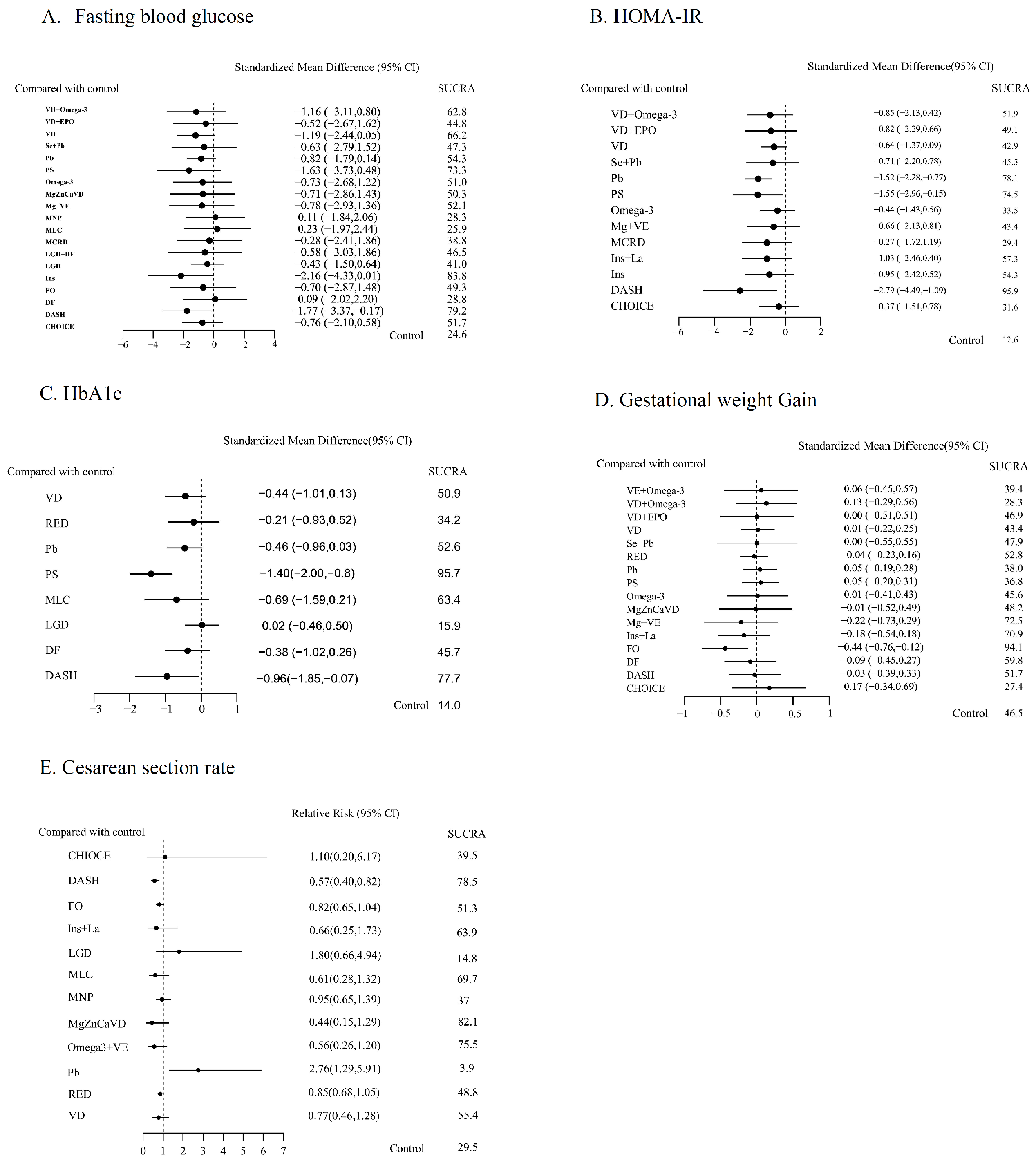
- Inositol, the DASH diet, and fish oil showed favorable effects on glycemic control, insulin resistance, and gestational weight gain in the included network me-ta-analysis.
- Nutritional strategies may have potential value in both the prevention and man-agement of GDM.
- Interventions with high SUCRA rankings but limited direct evidence, such as blueberry plus dietary fiber and magnesium–zinc–calcium–vitamin D supplementation, should be interpreted cautiously and require further validation.
Abstract
1. Introduction
2. Materials and Methods
2.1. Data Sources and Search Strategy
2.2. Inclusion and Exclusion Criteria
2.3. Data Extraction
2.4. Quality Assessment
2.5. Assessment of Evidence Certainty
2.6. Data Analysis
3. Results
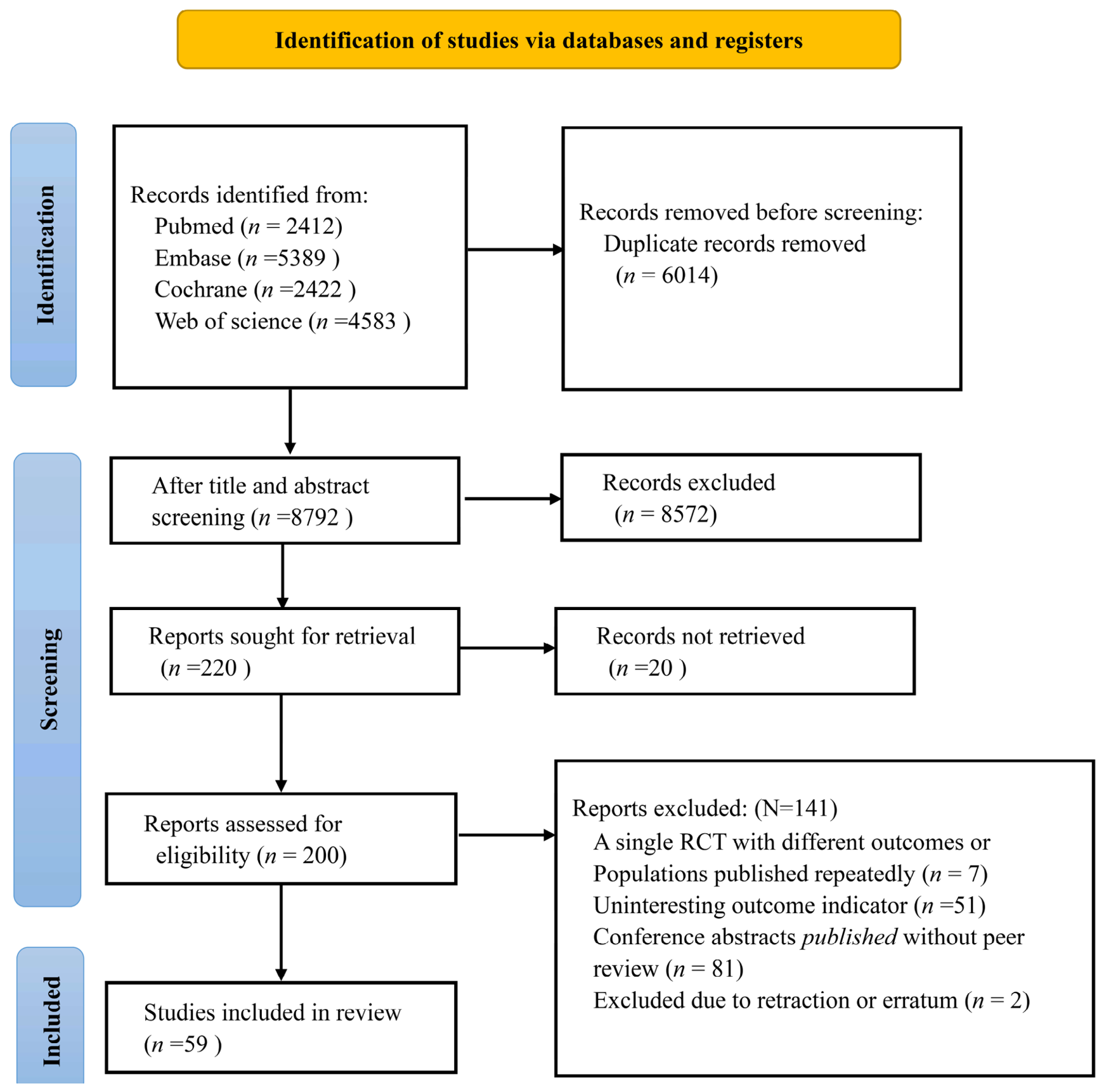
3.1. Study Selection
3.2. Characteristics of Included Studies
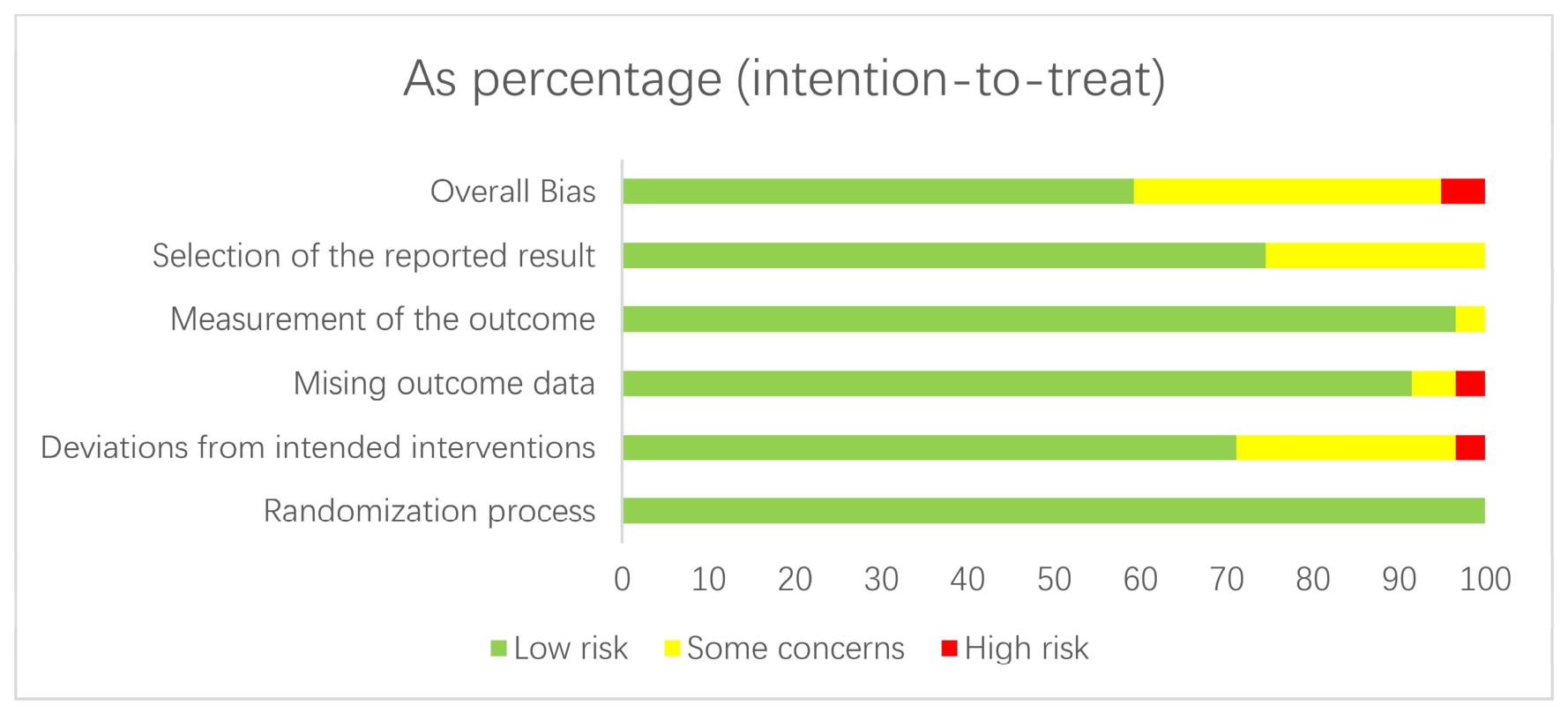
3.3. Risk of Bias of the Included Studies and Sensitivity Analyses
3.4. Certainty of Evidence
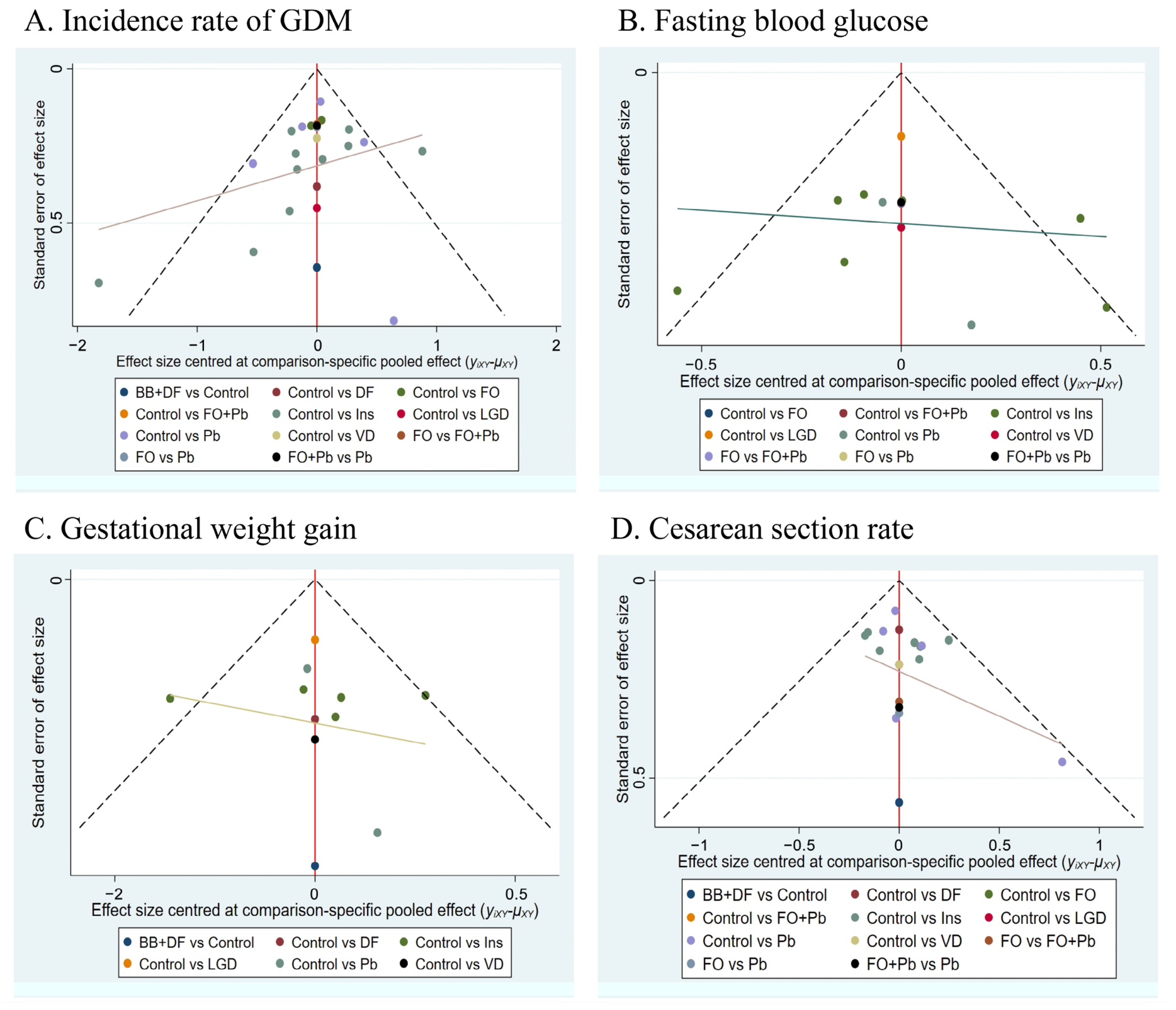
3.5. Outcomes in High-Risk Populations for GDM
3.5.1. Incidence of GDM
3.5.2. Fasting Blood Glucose
3.5.3. Gestational Weight Gain
3.5.4. Cesarean Section Rate
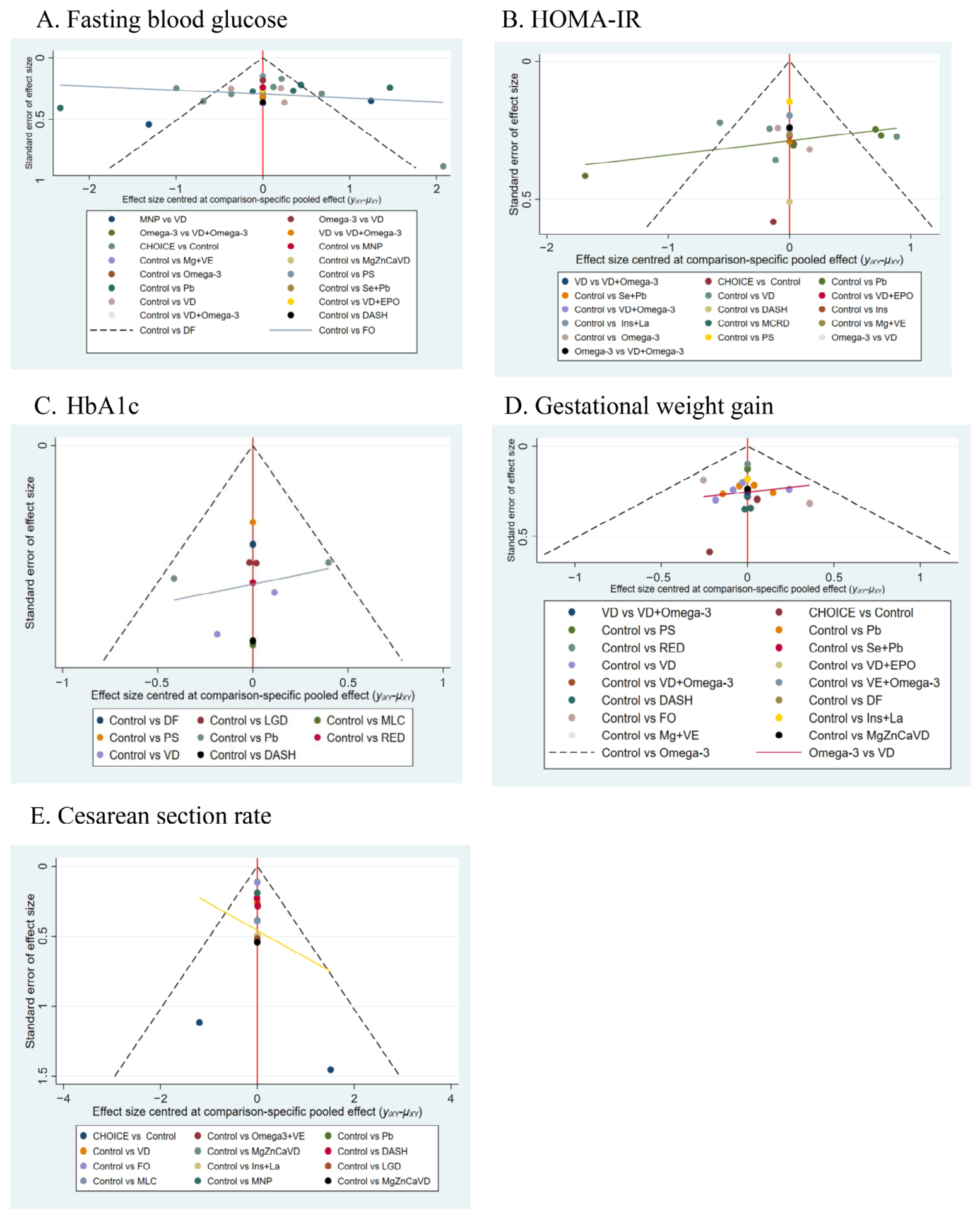
3.6. Outcomes in GDM Patients
3.6.1. Fasting Blood Glucose
3.6.2. HOMA-IR
3.6.3. Glycated Hemoglobin
3.6.4. Gestational Weight Gain
3.6.5. Cesarean Section Rate
4. Discussion
5. Conclusions
Supplementary Materials
Author Contributions
Funding
Institutional Review Board Statement
Informed Consent Statement
Data Availability Statement
Conflicts of Interest
Abbreviations
| BB | Blueberry |
| BMI | Body mass index |
| Ca | Calcium |
| CFU | Colony forming units |
| CHOICE | CHOICE diet |
| CI | Confidence interval |
| CSR | Cesarean section rate |
| DASH | Dietary Approaches to Stop Hypertension |
| DF | Dietary fiber |
| EPO | Evening primrose oil |
| FBG | Fasting blood glucose |
| FO | Fish oil |
| GDM | Gestational diabetes mellitus |
| GWG | Gestational weight gain |
| HbA1c | Glycated hemoglobin |
| HOMA-IR | Homeostatic Model Assessment for Insulin Resistance |
| IADPSG | International Association of Diabetes and Pregnancy Study Groups |
| Ins | Inositol |
| La | Alpha-lactalbumin |
| LGD | Low glycemic index diet |
| MCRD | Moderate carbohydrate high-fiber diet |
| Mg | Magnesium |
| MgZnCaVD | Magnesium–zinc–calcium–vitamin D complex |
| MLC | Modestly lower carbohydrate diet |
| MNP | Macronutrient preload |
| NMA | Network meta-analysis |
| Pb | Probiotics |
| PCOS | Polycystic ovary syndrome |
| PS | Plant sterols |
| RCTs | Randomized controlled trials |
| RED | Restricted energy diet |
| RR | Relative risk |
| Se | Selenium |
| SMD | Standardized mean difference |
| SUCRA | Surface under the cumulative ranking |
| VD | Vitamin D |
| VE | Vitamin E |
References
- McIntyre, H.D.; Catalano, P.; Zhang, C.; Desoye, G.; Mathiesen, E.R.; Damm, P. Gestational diabetes mellitus. Nat. Rev. Dis. Prim. 2019, 5, 47. [Google Scholar] [CrossRef] [Scilit] [PubMed]
- Wang, H.; Li, N.; Chivese, T.; Werfalli, M.; Sun, H.; Yuen, L.; Hoegfeldt, C.A.; Elise Powe, C.; Immanuel, J.; Karuranga, S.; et al. IDF Diabetes Atlas: Estimation of Global and Regional Gestational Diabetes Mellitus Prevalence for 2021 by International Association of Diabetes in Pregnancy Study Group’s Criteria. Diabetes Res. Clin. Pract. 2022, 183, 109050. [Google Scholar] [CrossRef] [Scilit] [PubMed]
- Metzger, B.E.; Lowe, L.P.; Dyer, A.R.; Trimble, E.R.; Sheridan, B.; Hod, M.; Chen, R.; Yogev, Y.; Coustan, D.R.; Catalano, P.M. Hyperglycemia and Adverse Pregnancy Outcome (HAPO) Study: Associations with neonatal anthropometrics. Diabetes 2009, 58, 453. [Google Scholar] [CrossRef] [Scilit] [PubMed]
- Johns, E.C.; Denison, F.C.; Norman, J.E.; Reynolds, R.M. Gestational Diabetes Mellitus: Mechanisms, Treatment, and Complications. Trends Endocrinol. Metab. 2018, 29, 743–754. [Google Scholar] [CrossRef] [Scilit] [PubMed]
- Yang, Y.; Wu, N. Gestational diabetes mellitus and preeclampsia: Correlation and influencing factors. Front. Cardiovasc. Med. 2022, 9, 831297. [Google Scholar] [CrossRef] [Scilit] [PubMed]
- Mishra, S.; Bhadoria, A.S.; Kishore, S.; Kumar, R. Gestational diabetes mellitus 2018 guidelines: An update. J. Fam. Med. Prim. Care 2018, 7, 1169–1172. [Google Scholar] [CrossRef] [Scilit] [PubMed]
- Lin, L.; Lin, J. Interactive effects and relative contribution of prepregnancy overweight and obesity, excessive gestational weight gain and gestational diabetes mellitus to macrosomia: A retrospective cohort in Fujian, China. Eur. J. Obstet. Gynecol. Reprod. Biol. 2024, 296, 354–359. [Google Scholar] [CrossRef] [Scilit] [PubMed]
- Rasmussen, L.; Poulsen, C.W.; Kampmann, U.; Smedegaard, S.B.; Ovesen, P.G.; Fuglsang, J. Diet and Healthy Lifestyle in the Management of Gestational Diabetes Mellitus. Nutrients 2020, 12, 3050. [Google Scholar] [CrossRef] [Scilit] [PubMed]
- Yamamoto, J.M.; Kellett, J.E.; Balsells, M.; García-Patterson, A.; Hadar, E.; Solà, I.; Gich, I.; van der Beek, E.M.; Castañeda-Gutiérrez, E.; Heinonen, S.; et al. Gestational Diabetes Mellitus and Diet: A Systematic Review and Meta-analysis of Randomized Controlled Trials Examining the Impact of Modified Dietary Interventions on Maternal Glucose Control and Neonatal Birth Weight. Diabetes Care 2018, 41, 1346–1361. [Google Scholar] [CrossRef] [Scilit] [PubMed]
- Association, A.D. Management of diabetes in pregnancy. Obstet. Gynecol. Surv. 2017, 72, 264–266. [Google Scholar] [CrossRef] [Scilit]
- Wang, H.-K.; Cheng, D.-C.; Yang, Y.-M.; Wang, X.-H.; Chen, Y.; Zhang, L.; Xiu, L.; Xu, X.-M. The Role of High-Content Complex Dietary Fiber in Medical Nutrition Therapy for Gestational Diabetes Mellitus. Front. Pharmacol. 2021, 12, 684898. [Google Scholar] [CrossRef] [Scilit] [PubMed]
- Ma, W.-J.; Huang, Z.-H.; Huang, B.-X.; Qi, B.-H.; Zhang, Y.-J.; Xiao, B.-X.; Li, Y.-H.; Chen, L.; Zhu, H.-L. Intensive low-glycaemic-load dietary intervention for the management of glycaemia and serum lipids among women with gestational diabetes: A randomized control trial. Public Health Nutr. 2014, 18, 1506–1513. [Google Scholar] [CrossRef] [Scilit] [PubMed]
- Hernandez, T.L.; Van Pelt, R.E.; Anderson, M.A.; Reece, M.S.; Reynolds, R.M.; de la Houssaye, B.A.; Heerwagen, M.; Donahoo, W.T.; Daniels, L.J.; Chartier-Logan, C.; et al. Women With Gestational Diabetes Mellitus Randomized to a Higher–Complex Carbohydrate/Low-Fat Diet Manifest Lower Adipose Tissue Insulin Resistance, Inflammation, Glucose, and Free Fatty Acids: A Pilot Study. Diabetes Care 2016, 39, 39–42. [Google Scholar] [CrossRef] [Scilit] [PubMed]
- Corcoy, R.; Mendoza, L.C.; Simmons, D.; Desoye, G.; Adelantado, J.M.; Chico, A.; Devlieger, R.; van Assche, A.; Galjaard, S.; Timmerman, D.; et al. The DALI vitamin D randomized controlled trial for gestational diabetes mellitus prevention: No major benefit shown besides vitamin D sufficiency. Clin. Nutr. 2020, 39, 976–984. [Google Scholar] [CrossRef] [Scilit] [PubMed]
- Nadeem, A.; Ayesha, S.; Saeed, M. Effect of Vitamin-D on Glycemic Parameters and Adiponectin in gestational diabetes. Pak. J. Med. Sci. 2024, 40, 1786–1790. [Google Scholar] [CrossRef] [Scilit] [PubMed]
- Rogozińska, E.; Chamillard, M.; Hitman, G.A.; Khan, K.S.; Thangaratinam, S. Nutritional manipulation for the primary prevention of gestational diabetes mellitus: A meta-analysis of randomised studies. PLoS ONE 2015, 10, e0115526. [Google Scholar] [CrossRef] [Scilit] [PubMed]
- Leucht, S.; Chaimani, A.; Cipriani, A.S.; Davis, J.M.; Furukawa, T.A.; Salanti, G. Network meta-analyses should be the highest level of evidence in treatment guidelines. Eur. Arch. Psychiatry Clin. Neurosci. 2016, 266, 477–480. [Google Scholar] [CrossRef] [Scilit] [PubMed]
- Tang, Q.; Zhong, Y.; Xu, C.; Li, W.; Wang, H.; Hou, Y. Effectiveness of five interventions used for prevention of gestational diabetes: A network meta-analysis. Medicine 2022, 101, e29126. [Google Scholar] [CrossRef] [Scilit] [PubMed]
- Zhang, L.; Wang, F.; Tashiro, S.; Liu, P.J. Effects of dietary approaches and exercise interventions on gestational diabetes mellitus: A systematic review and bayesian network meta-analysis. Adv. Nutr. 2024, 15, 100330. [Google Scholar] [CrossRef] [Scilit] [PubMed]
- Yu, L.; Zhu, Y.; Geng, L.; Xu, Y.; Zhao, M. Effect of different nutrients on blood glucose, inflammatory response and oxidative stress in gestational diabetes mellitus: A network meta-analysis. Br. J. Nutr. 2024, 131, 1513–1527. [Google Scholar] [CrossRef] [Scilit] [PubMed]
- Higgins, J.P.; Savović, J.; Page, M.J.; Elbers, R.G.; Sterne, J.A. Assessing risk of bias in a randomized trial. In Cochrane Handbook for Systematic Reviews of Interventions; John Wiley & Sons: Hoboken, NJ, USA, 2019; pp. 205–228. [Google Scholar] [CrossRef] [Scilit]
- Amaefule, C.E.; Drymoussi, Z.; Gonzalez Carreras, F.J.; Pardo Llorente, M.d.C.; Lanz, D.; Dodds, J.; Sweeney, L.; Pizzo, E.; Thomas, A.; Heighway, J.; et al. Myo-inositol nutritional supplement for prevention of gestational diabetes (EMmY): A randomised, placebo-controlled, double-blind pilot trial with nested qualitative study. BMJ Open 2022, 12, e050110. [Google Scholar] [CrossRef] [Scilit] [PubMed]
- Amirani, E.; Asemi, Z.; Taghizadeh, M. The effects of selenium plus probiotics supplementation on glycemic status and serum lipoproteins in patients with gestational diabetes mellitus: A randomized, double-blind, placebo-controlled trial. Clin. Nutr. ESPEN 2022, 48, 56–62. [Google Scholar] [CrossRef] [Scilit] [PubMed]
- Asemi, Z.; Karamali, M.; Esmaillzadeh, A. Favorable Effects of Vitamin D Supplementation on Pregnancy Outcomes in Gestational Diabetes: A Double Blind Randomized Controlled Clinical Trial. Horm. Metab. Res. 2014, 47, 565–570. [Google Scholar] [CrossRef] [Scilit] [PubMed]
- Asemi, Z.; Samimi, M.; Tabassi, Z.; Esmaillzadeh, A. The effect of DASH diet on pregnancy outcomes in gestational diabetes: A randomized controlled clinical trial. Eur. J. Clin. Nutr. 2014, 68, 490–495. [Google Scholar] [CrossRef] [Scilit] [PubMed]
- Asemi, Z.; Tabassi, Z.; Samimi, M.; Fahiminejad, T.; Esmaillzadeh, A. Favourable effects of the Dietary Approaches to Stop Hypertension diet on glucose tolerance and lipid profiles in gestational diabetes: A randomised clinical trial. Br. J. Nutr. 2012, 109, 2024–2030. [Google Scholar] [CrossRef] [Scilit] [PubMed]
- Asimakopoulos, G.; Pergialiotis, V.; Antsaklis, P.; Theodora, M.; Loutradis, D.; Daskalakis, G. Effect of dietary myo-inositol supplementation on the insulin resistance and the prevention of gestational diabetes mellitus: An open-label, randomized controlled trial. Arch. Gynecol. Obstet. 2024, 310, 1895–1903. [Google Scholar] [CrossRef] [Scilit] [PubMed]
- Basu, A.; Feng, D.; Planinic, P.; Ebersole, J.L.; Lyons, T.J.; Alexander, J.M. Dietary Blueberry and Soluble Fiber Supplementation Reduces Risk of Gestational Diabetes in Women with Obesity in a Randomized Controlled Trial. J. Nutr. 2021, 151, 1128–1138. [Google Scholar] [CrossRef] [Scilit] [PubMed]
- Callaway, L.K.; McIntyre, H.D.; Barrett, H.L.; Foxcroft, K.; Tremellen, A.; Lingwood, B.E.; Tobin, J.M.; Wilkinson, S.; Kothari, A.; Morrison, M.; et al. Probiotics for the Prevention of Gestational Diabetes Mellitus in Overweight and Obese Women: Findings From the SPRING Double-Blind Randomized Controlled Trial. Diabetes Care 2019, 42, 364–371. [Google Scholar] [CrossRef] [Scilit] [PubMed]
- Camarena Pulido, E.E.; Mora González, S.; Corona Gutiérrez, A.A.; Robledo Aceves, M.; Basso Barba, P.; Salgado Leyva, Y. Effect of supplementation with 5,000 IU of vitamin D on the glycemic profile of women with gestational diabetes mellitus. J. Perinat. Med. 2022, 50, 1225–1229. [Google Scholar] [CrossRef] [Scilit] [PubMed]
- Celentano, C.; Matarrelli, B.; Pavone, G.; Vitacolonna, E.; Mattei, P.A.; Berghella, V.; Liberati, M. The influence of different inositol stereoisomers supplementation in pregnancy on maternal gestational diabetes mellitus and fetal outcomes in high-risk patients: A randomized controlled trial. J. Matern.-Fetal Neonatal Med. 2018, 33, 743–751. [Google Scholar] [CrossRef] [Scilit] [PubMed]
- Chen, X.; Du, Z.; Zhang, Z.; Chen, D. D-Chiro Inositol Supplementation and the Occurrence of Gestational Diabetes: A Randomized Controlled Trial in China. Food Sci. Nutr. 2024, 13, e4601. [Google Scholar] [CrossRef] [Scilit] [PubMed]
- Corrado, F.; D’Anna, R.; Di Vieste, G.; Giordano, D.; Pintaudi, B.; Santamaria, A.; Di Benedetto, A. The effect of myoinositol supplementation on insulin resistance in patients with gestational diabetes. Diabet. Med. 2011, 28, 972–975. [Google Scholar] [CrossRef] [Scilit] [PubMed]
- D’Anna, R.; Di Benedetto, A.; Scilipoti, A.; Santamaria, A.; Interdonato, M.L.; Petrella, E.; Neri, I.; Pintaudi, B.; Corrado, F.; Facchinetti, F. Myo-inositol Supplementation for Prevention of Gestational Diabetes in Obese Pregnant Women. Obstet. Gynecol. 2015, 126, 310–315. [Google Scholar] [CrossRef] [Scilit] [PubMed]
- D’Anna, R.; Scilipoti, A.; Giordano, D.; Caruso, C.; Cannata, M.L.; Interdonato, M.L.; Corrado, F.; Di Benedetto, A. myo-Inositol supplementation and onset of gestational diabetes mellitus in pregnant women with a family history of type 2 diabetes: A prospective, randomized, placebo-controlled study. Diabetes Care 2013, 36, 854–857. [Google Scholar] [CrossRef] [Scilit] [PubMed]
- D’Anna, R.; Corrado, F.; Loddo, S.; Gullo, G.; Giunta, L.; Di Benedetto, A. Myoinositol plus α-lactalbumin supplementation, insulin resistance and birth outcomes in women with gestational diabetes mellitus: A randomized, controlled study. Sci. Rep. 2021, 11, 8866. [Google Scholar] [CrossRef] [Scilit] [PubMed]
- Dilli, D.; Doğan, N.N.; İpek, M.Ş.; Çavuş, Y.; Ceylaner, S.; Doğan, H.; Dursun, A.; Küçüközkan, T.; Zenciroğlu, A. MaFOS-GDM trial: Maternal fish oil supplementation in women with gestational diabetes and cord blood DNA methylation at insulin like growth factor-1 (IGF-1) gene. Clin. Nutr. ESPEN 2018, 23, 73–78. [Google Scholar] [CrossRef] [Scilit] [PubMed]
- Dolatkhah, N.; Hajifaraji, M.; Abbasalizadeh, F.; Aghamohammadzadeh, N.; Mehrabi, Y.; Mesgari Abbasi, M. Is there a value for probiotic supplements in gestational diabetes mellitus? A randomized clinical trial. J. Health Popul. Nutr. 2015, 33, 25. [Google Scholar] [CrossRef] [Scilit] [PubMed]
- Esmaeilzadeh, S.; Ghadimi, R.; Mashayekhamiri, S.; Delavar, M.A.; Basirat, Z. The Effect of Myo-inositol Supplementation on the Prevention of Gestational Diabetes in Overweight Pregnant Women: A Randomized, Double-blind, Controlled Trial. Res. Sq. 2023, 75, 357–364. [Google Scholar] [CrossRef] [Scilit] [PubMed]
- Gao, F.; Wang, G.; Wang, L.; Guo, N. Phytosterol nutritional supplement improves pregnancy and neonatal complications of gestational diabetes mellitus in a double-blind and placebo-controlled clinical study. Food Funct. 2017, 8, 424–428. [Google Scholar] [CrossRef] [Scilit] [PubMed]
- Ghanei, L.; Afaghi, A.; Ziaee, A. Effect of low glycemic load diet with and without wheat bran on glucose control in gestational diabetes mellitus: A randomized trial. Indian J. Endocrinol. Metab. 2013, 17, 689–692. [Google Scholar] [CrossRef] [Scilit] [PubMed]
- Grant, S.M.; Wolever, T.M.S.; O’Connor, D.L.; Nisenbaum, R.; Josse, R.G. Effect of a low glycaemic index diet on blood glucose in women with gestational hyperglycaemia. Diabetes Res. Clin. Pract. 2011, 91, 15–22. [Google Scholar] [CrossRef] [Scilit] [PubMed]
- Halkjær, S.I.; de Knegt, V.E.; Lo, B.; Nilas, L.; Cortes, D.; Pedersen, A.E.; Mirsepasi-Lauridsen, H.C.; Andersen, L.O.B.; Nielsen, H.V.; Stensvold, C.R.; et al. Multistrain Probiotic Increases the Gut Microbiota Diversity in Obese Pregnant Women: Results from a Randomized, Double-Blind Placebo-Controlled Study. Curr. Dev. Nutr. 2020, 4, nzaa095. [Google Scholar] [CrossRef] [Scilit] [PubMed]
- Hernandez, T.L.; Farabi, S.S.; Fosdick, B.K.; Hirsch, N.; Dunn, E.Z.; Rolloff, K.; Corbett, J.P.; Haugen, E.; Marden, T.; Higgins, J.; et al. Randomization to a Provided Higher-Complex-Carbohydrate Versus Conventional Diet in Gestational Diabetes Mellitus Results in Similar Newborn Adiposity. Diabetes Care 2023, 46, 1931–1940. [Google Scholar] [CrossRef] [Scilit] [PubMed]
- Hernandez, T.L.; Van Pelt, R.E.; Anderson, M.A.; Daniels, L.J.; West, N.A.; Donahoo, W.T.; Friedman, J.E.; Barbour, L.A. A Higher-Complex Carbohydrate Diet in Gestational Diabetes Mellitus Achieves Glucose Targets and Lowers Postprandial Lipids: A Randomized Crossover Study. Diabetes Care 2014, 37, 1254–1262. [Google Scholar] [CrossRef] [Scilit] [PubMed]
- Hu, Z.-G.; Tan, R.-S.; Jin, D.; Li, W.; Zhou, X.-Y. A Low Glycemic Index Staple Diet Reduces Postprandial Glucose Values in Asian Women with Gestational Diabetes Mellitus. J. Investig. Med. 2014, 62, 975–979. [Google Scholar] [CrossRef] [Scilit] [PubMed]
- Jafarnejad, S.; Saremi, S.; Jafarnejad, F.; Arab, A. Effects of a Multispecies Probiotic Mixture on Glycemic Control and Inflammatory Status in Women with Gestational Diabetes: A Randomized Controlled Clinical Trial. J. Nutr. Metab. 2016, 2016, 5190846. [Google Scholar] [CrossRef] [Scilit] [PubMed]
- Jamilian, M.; Hashemi Dizaji, S.; Bahmani, F.; Taghizadeh, M.; Memarzadeh, M.R.; Karamali, M.; Akbari, M.; Asemi, Z. A Randomized Controlled Clinical Trial Investigating the Effects of Omega-3 Fatty Acids and Vitamin E Co-Supplementation on Biomarkers of Oxidative Stress, Inflammation and Pregnancy Outcomes in Gestational Diabetes. Can. J. Diabetes 2017, 41, 143–149. [Google Scholar] [CrossRef] [Scilit] [PubMed]
- Jamilian, M.; Karamali, M.; Taghizadeh, M.; Sharifi, N.; Jafari, Z.; Memarzadeh, M.R.; Mahlouji, M.; Asemi, Z. Vitamin D and Evening Primrose Oil Administration Improve Glycemia and Lipid Profiles in Women with Gestational Diabetes. Lipids 2016, 51, 349–356. [Google Scholar] [CrossRef] [Scilit] [PubMed]
- Jamilian, M.; Mirhosseini, N.; Eslahi, M.; Bahmani, F.; Shokrpour, M.; Chamani, M.; Asemi, Z. The effects of magnesium-zinc-calcium-vitamin D co-supplementation on biomarkers of inflammation, oxidative stress and pregnancy outcomes in gestational diabetes. BMC Pregnancy Childbirth 2019, 19, 107. [Google Scholar] [CrossRef] [Scilit] [PubMed]
- Jamilian, M.; Samimi, M.; Ebrahimi, F.A.; Hashemi, T.; Taghizadeh, M.; Razavi, M.; Sanami, M.; Asemi, Z. The effects of vitamin D and omega-3 fatty acid co-supplementation on glycemic control and lipid concentrations in patients with gestational diabetes. J. Clin. Lipidol. 2017, 11, 459–468. [Google Scholar] [CrossRef] [Scilit] [PubMed]
- Jamilian, M.; Samimi, M.; Mirhosseini, N.; Afshar Ebrahimi, F.; Aghadavod, E.; Taghizadeh, M.; Asemi, Z. A Randomized Double-Blinded, Placebo-Controlled Trial Investigating the Effect of Fish Oil Supplementation on Gene Expression Related to Insulin Action, Blood Lipids, and Inflammation in Gestational Diabetes Mellitus-Fish Oil Supplementation and Gestational Diabetes. Nutrients 2018, 10, 163. [Google Scholar] [CrossRef] [Scilit] [PubMed]
- Karamali, M.; Dadkhah, F.; Sadrkhanlou, M.; Jamilian, M.; Ahmadi, S.; Tajabadi-Ebrahimi, M.; Jafari, P.; Asemi, Z. Effects of probiotic supplementation on glycaemic control and lipid profiles in gestational diabetes: A randomized, double-blind, placebo-controlled trial. Diabetes Metab. 2016, 42, 234–241. [Google Scholar] [CrossRef] [Scilit] [PubMed]
- Kijmanawat, A.; Panburana, P.; Reutrakul, S.; Tangshewinsirikul, C. Effects of probiotic supplements on insulin resistance in gestational diabetes mellitus: A double-blind randomized controlled trial. J. Diabetes Investig. 2018, 10, 163–170. [Google Scholar] [CrossRef] [Scilit] [PubMed]
- Kusinski, L.C.; Jones, D.; Atta, N.; Turner, E.; Smith, S.; Oude Griep, L.M.; Rennie, K.; De Lucia Rolfe, E.; Sharp, S.J.; Farewell, V.; et al. Reduced-energy diet in women with gestational diabetes: The dietary intervention in gestational diabetes DiGest randomized clinical trial. Nat. Med. 2025, 31, 514–523. [Google Scholar] [CrossRef] [Scilit] [PubMed]
- Li, L.; Xu, J.; Zhu, W.; Fan, R.; Bai, Q.; Huang, C.; Liu, J.; Li, Z.; Sederholm, M.; Norstedt, G.; et al. Effect of a macronutrient preload on blood glucose level and pregnancy outcome in gestational diabetes. J. Clin. Transl. Endocrinol. 2016, 5, 36–41. [Google Scholar] [CrossRef] [Scilit] [PubMed]
- Li, Q.; Xing, B. Vitamin D3-Supplemented Yogurt Drink Improves Insulin Resistance and Lipid Profiles in Women with Gestational Diabetes Mellitus: A Randomized Double Blinded Clinical Trial. Ann. Nutr. Metab. 2016, 68, 285–290. [Google Scholar] [CrossRef] [Scilit] [PubMed]
- Louie, J.C.; Markovic, T.P.; Perera, N.; Foote, D.; Petocz, P.; Ross, G.P.; Brand-Miller, J.C. A randomized controlled trial investigating the effects of a low-glycemic index diet on pregnancy outcomes in gestational diabetes mellitus. Diabetes Care 2011, 34, 2341–2346. [Google Scholar] [CrossRef] [Scilit] [PubMed]
- Maktabi, M.; Jamilian, M.; Amirani, E.; Chamani, M.; Asemi, Z. The effects of magnesium and vitamin E co-supplementation on parameters of glucose homeostasis and lipid profiles in patients with gestational diabetes. Lipids Health Dis. 2018, 17, 163. [Google Scholar] [CrossRef] [Scilit] [PubMed]
- Markovic, T.P.; Muirhead, R.; Overs, S.; Ross, G.P.; Louie, J.C.Y.; Kizirian, N.; Denyer, G.; Petocz, P.; Hyett, J.; Brand-Miller, J.C. Randomized Controlled Trial Investigating the Effects of a Low–Glycemic Index Diet on Pregnancy Outcomes in Women at High Risk of Gestational Diabetes Mellitus: The GI Baby 3 Study. Diabetes Care 2016, 39, 31–38. [Google Scholar] [CrossRef] [Scilit] [PubMed]
- Markussen, L.T.; Kivelä, J.; Lindström, J.; Ashrafi, R.A.; Heinonen, S.; Koivusalo, S.; Meinilä, J. Short-term effect of plant-based Nordic diet versus carbohydrate-restricted diet on glucose levels in gestational diabetes—The eMOM pilot study. BMC Nutr. 2023, 9, 87. [Google Scholar] [CrossRef] [Scilit] [PubMed]
- Matarrelli, B.; Vitacolonna, E.; D’angelo, M.; Pavone, G.; Mattei, P.A.; Liberati, M.; Celentano, C. Effect of dietary myo-inositol supplementation in pregnancy on the incidence of maternal gestational diabetes mellitus and fetal outcomes: A randomized controlled trial. J. Matern.-Fetal Neonatal Med. 2013, 26, 967–972. [Google Scholar] [CrossRef] [Scilit] [PubMed]
- Mijatovic, J.; Louie, J.C.Y.; Buso, M.E.C.; Atkinson, F.S.; Ross, G.P.; Markovic, T.P.; Brand-Miller, J.C. Effects of a modestly lower carbohydrate diet in gestational diabetes: A randomized controlled trial. Am. J. Clin. Nutr. 2020, 112, 284–292. [Google Scholar] [CrossRef] [Scilit] [PubMed]
- Moini, A.; Shirazi, M.; Sepidarkish, M.; Rabiei, M.; Tehranian, A.; Shizarpour, A.; Pirjani, R. Effect of myo-inositol on the prevention of gestational diabetes in high-risk pregnant women: An RCT. Int. J. Reprod. BioMed. 2025, 23, 323–332. [Google Scholar] [CrossRef] [Scilit] [PubMed]
- Nachum, Z.; Perlitz, Y.; Shavit, L.Y.; Magril, G.; Vitner, D.; Zipori, Y.; Weiner, E.; Alon, A.S.; Ganor-Paz, Y.; Nezer, M.; et al. The effect of oral probiotics on glycemic control of women with gestational diabetes mellitus—A multicenter, randomized, double-blind, placebo-controlled trial. Am. J. Obstet. Gynecol. MFM 2024, 6, 101224. [Google Scholar] [CrossRef] [Scilit] [PubMed]
- Pellonpera, O.; Mokkala, K.; Houttu, N.; Vahlberg, T.; Koivuniemi, E.; Tertti, K.; Ronnemaa, T.; Laitinen, K. Efficacy of Fish Oil and/or Probiotic Intervention on the Incidence of Gestational Diabetes Mellitus in an At-Risk Group of Overweight and Obese Women: A Randomized, Placebo-Controlled, Double-Blind Clinical Trial. Diabetes Care 2019, 42, 1009–1017. [Google Scholar] [CrossRef] [Scilit] [PubMed]
- Sahhaf Ebrahimi, F.; Homayouni Rad, A.; Mosen, M.; Abbasalizadeh, F.; Tabrizi, A.; Khalili, L. Effect of L. acidophilus and B. lactis on blood glucose in women with gestational diabetes mellitus: A randomized placebo-controlled trial. Diabetol. Metab. Syndr. 2019, 11, 75. [Google Scholar] [CrossRef] [Scilit] [PubMed]
- Santamaria, A.; Di Benedetto, A.; Petrella, E.; Pintaudi, B.; Corrado, F.; D’Anna, R.; Neri, I.; Facchinetti, F. Myo-inositol may prevent gestational diabetes onset in overweight women: A randomized, controlled trial. J. Matern.-Fetal Neonatal Med. 2015, 29, 3234–3237. [Google Scholar] [CrossRef] [Scilit] [PubMed]
- Shahriari, A.; Karimi, E.; Shahriari, M.; Aslani, N.; Khooshideh, M.; Arab, A. The effect of probiotic supplementation on the risk of gestational diabetes mellitus among high-risk pregnant women: A parallel double-blind, randomized, placebo-controlled clinical trial. Biomed. Pharmacother. 2021, 141, 111915. [Google Scholar] [CrossRef] [Scilit] [PubMed]
- Walsh, J.M.; McGowan, C.A.; Mahony, R.; Foley, M.E.; McAuliffe, F.M. Low glycaemic index diet in pregnancy to prevent macrosomia (ROLO study): Randomised control trial. BMJ 2012, 345, e5605. [Google Scholar] [CrossRef] [Scilit] [PubMed]
- Wickens, K.L.; Barthow, C.A.; Murphy, R.; Abels, P.R.; Maude, R.M.; Stone, P.R.; Mitchell, E.A.; Stanley, T.V.; Purdie, G.L.; Kang, J.M.; et al. Early pregnancy probiotic supplementation with Lactobacillus rhamnosus HN001 may reduce the prevalence of gestational diabetes mellitus: A randomised controlled trial. Br. J. Nutr. 2017, 117, 804–813. [Google Scholar] [CrossRef] [Scilit] [PubMed]
- Yao, J.; Cong, L.; Zhu, B.; Wang, T. Effect of dietary approaches to stop hypertension diet plan on pregnancy outcome patients with gestational diabetes mellitus. Bangladesh J. Pharmacol. 2015, 10, 732–738. [Google Scholar] [CrossRef] [Scilit]
- Zhang, D.; Sheng, J.; Chen, L.; Cheng, D.; Cao, Y.; Su, Y.; Jiang, Y.; Liu, W.; Yu, Y.; Jia, H.; et al. Effects of Dietary Fiber on the Risk of Gestational Diabetes Mellitus in Advanced Maternal Age Women: Study Protocol for a Randomized Controlled Trial. Mol. Nutr. Food Res. 2022, 67, e2200437. [Google Scholar] [CrossRef] [Scilit] [PubMed]
- Zhang, Q.; Cheng, Y.; He, M.; Li, T.; Ma, Z.; Cheng, H. Effect of various doses of vitamin D supplementation on pregnant women with gestational diabetes mellitus: A randomized controlled trial. Exp. Ther. Med. 2016, 12, 1889–1895. [Google Scholar] [CrossRef] [Scilit] [PubMed]
- Zhou, S.J.; Yelland, L.; McPhee, A.J.; Quinlivan, J.; Gibson, R.A.; Makrides, M. Fish-oil supplementation in pregnancy does not reduce the risk of gestational diabetes or preeclampsia. Am. J. Clin. Nutr. 2012, 95, 1378–1384. [Google Scholar] [CrossRef] [Scilit] [PubMed]
- Wei, J.; Yan, J.; Yang, H. Inositol Nutritional Supplementation for the Prevention of Gestational Diabetes Mellitus: A Systematic Review and Meta-Analysis of Randomized Controlled Trials. Nutrients 2022, 14, 2831. [Google Scholar] [CrossRef] [Scilit] [PubMed]
- Dell’Edera, D.; Sarlo, F.; Allegretti, A.; Simone, F.; Lupo, M.G.; Epifania, A.A. The influence of D-chiro-inositol and D-myo-inositol in pregnant women with glucose intolerance. Biomed. Rep. 2017, 7, 169–172. [Google Scholar] [CrossRef] [Scilit] [PubMed]
- Fan, C.; Liang, W.; Wei, M.; Gou, X.; Han, S.; Bai, J. Effects of D-chiro-inositol on glucose metabolism in db/db mice and the associated underlying mechanisms. Front. Pharmacol. 2020, 11, 354. [Google Scholar] [CrossRef] [Scilit] [PubMed]
- Brown, J.; Crawford, T.J.; Alsweiler, J.; Crowther, C.A. Dietary supplementation with myo-inositol in women during pregnancy for treating gestational diabetes. Cochrane Database Syst. Rev. 2016, 9, CD012048. [Google Scholar] [CrossRef] [Scilit] [PubMed]
- Özturan, A.; Arslan, S.; Kocaadam, B.; Elibol, E.; İmamoğlu, İ.; Karadağ, M.G. Effect of inositol and its derivatives on diabetes: A systematic review. Crit. Rev. Food Sci. Nutr. 2019, 59, 1124–1136. [Google Scholar] [CrossRef] [Scilit] [PubMed]
- Pintaudi, B.; Di Vieste, G.; Bonomo, M. The effectiveness of Myo-inositol and D-chiro inositol treatment in type 2 diabetes. Int. J. Endocrinol. 2016, 2016, 9132052. [Google Scholar] [CrossRef] [Scilit] [PubMed]
- Antony, P.J.; Gandhi, G.R.; Stalin, A.; Balakrishna, K.; Toppo, E.; Sivasankaran, K.; Ignacimuthu, S.; Al-Dhabi, N.A. Myoinositol ameliorates high-fat diet and streptozotocin-induced diabetes in rats through promoting insulin receptor signaling. Biomed. Pharmacother. 2017, 88, 1098–1113. [Google Scholar] [CrossRef] [Scilit] [PubMed]
- Di, J.; Fan, J.; Ma, F. Comparative efficacy of dietary interventions for glycemic control and pregnancy outcomes in gestational diabetes: A network meta-analysis of randomized controlled trials. Front. Endocrinol. 2025, 16, 1512493. [Google Scholar] [CrossRef] [Scilit] [PubMed]
- Kechagia, I.; Panagiotakos, D. An evidence-based assessment of the nutritional recommendations for the prevention of diabetes mellitus. Hormones 2025, 24, 59–70. [Google Scholar] [CrossRef] [Scilit] [PubMed]
- Lien, L.F.; Brown, A.J.; Ard, J.D.; Loria, C.; Erlinger, T.P.; Feldstein, A.C.; Lin, P.-H.; Champagne, C.M.; King, A.C.; McGuire, H.L.; et al. Effects of PREMIER lifestyle modifications on participants with and without the metabolic syndrome. Hypertension 2007, 50, 609–616. [Google Scholar] [CrossRef] [Scilit] [PubMed]
- Paula, T.P.; Viana, L.V.; Neto, A.T.; Leitao, C.B.; Gross, J.L.; Azevedo, M.J. Effects of the DASH diet and walking on blood pressure in patients with type 2 diabetes and uncontrolled hypertension: A randomized controlled trial. J. Clin. Hypertens. 2015, 17, 895–901. [Google Scholar] [CrossRef] [Scilit] [PubMed]
- Salehi-Sahlabadi, A.; Varkaneh, H.K.; Shahdadian, F.; Ghaedi, E.; Nouri, M.; Singh, A.; Farhadnejad, H.; Găman, M.-A.; Hekmatdoost, A.; Mirmiran, P. Effects of Phytosterols supplementation on blood glucose, glycosylated hemoglobin (HbA1c) and insulin levels in humans: A systematic review and meta-analysis of randomized controlled trials. J. Diabetes Metab. Disord. 2020, 19, 625–632. [Google Scholar] [CrossRef] [Scilit] [PubMed]
- Albracht-Schulte, K.; Kalupahana, N.S.; Ramalingam, L.; Wang, S.; Rahman, S.M.; Robert-McComb, J.; Moustaid-Moussa, N. Omega-3 fatty acids in obesity and metabolic syndrome: A mechanistic update. J. Nutr. Biochem. 2018, 58, 1–16. [Google Scholar] [CrossRef] [Scilit] [PubMed]
- Turner, T.F.; Nance, L.M.; Strickland, W.D.; Malcolm, R.J.; Pechon, S.; O′ Neil, P.M. Dietary Adherence and Satisfaction with a Bean-Based High-Fiber Weight Loss Diet: A Pilot Study. Int. Sch. Res. Not. 2013, 2013, 915415. [Google Scholar] [CrossRef] [Scilit] [PubMed]
- Corporeau, C.; Le Foll, C.; Cruciani-Guglielmacci, C.; Le Stunff, H.; Mithieux, G.; Magnan, C.; Delarue, J. Fish oil minimises feed intake and improves insulin sensitivity in Zucker fa/fa rats. Br. J. Nutr. 2024, 131, 749–761. [Google Scholar] [CrossRef] [Scilit] [PubMed]
- Chandalia, M.; Garg, A.; Lutjohann, D.; Von Bergmann, K.; Grundy, S.M.; Brinkley, L.J. Beneficial effects of high dietary fiber intake in patients with type 2 diabetes mellitus. N. Engl. J. Med. 2000, 342, 1392–1398. [Google Scholar] [CrossRef] [Scilit] [PubMed]
- Stull, A.J.; Cash, K.C.; Johnson, W.D.; Champagne, C.M.; Cefalu, W.T. Bioactives in blueberries improve insulin sensitivity in obese, insulin-resistant men and women. J. Nutr. 2010, 140, 1764–1768. [Google Scholar] [CrossRef] [Scilit] [PubMed]
- Rocha, D.M.U.P.; Caldas, A.P.S.; da Silva, B.P.; Hermsdorff, H.H.M.; Alfenas, R.d.C.G. Effects of blueberry and cranberry consumption on type 2 diabetes glycemic control: A systematic review. Crit. Rev. Food Sci. Nutr. 2019, 59, 1816–1828. [Google Scholar] [CrossRef] [Scilit] [PubMed]
- Shu, L.; Jiang, R.; Wang, F.; Xu, Y.; Wang, P.; Ma, Y.; Pan, J.; Huang, C. Effects of exercise on blood glucose levels and pregnancy outcomes in women with gestational diabetes mellitus: A meta-analysis and meta-regression. J. Exerc. Sci. Fit. 2025, 23, 291–300. [Google Scholar] [CrossRef] [Scilit] [PubMed]
- Merewood, A.; Mehta, S.D.; Chen, T.C.; Bauchner, H.; Holick, M.F. Association between vitamin D deficiency and primary cesarean section. J. Clin. Endocrinol. Metab. 2009, 94, 940–945. [Google Scholar] [CrossRef] [Scilit] [PubMed]
- Park, H.-j.; Lee, J.; Kim, J.-M.; Lee, H.A.; Kim, S.-H.; Kim, Y. A Study of Snack Consumption, Night-Eating Habits, and Nutrient Intake in Gestational Diabetes Mellitus. Clin. Nutr. Res. 2013, 2, 42–51. [Google Scholar] [CrossRef] [Scilit] [PubMed]
- Schoenaker, D.A.; Soedamah-Muthu, S.S.; Mishra, G.D. The association between dietary factors and gestational hypertension and pre-eclampsia: A systematic review and meta-analysis of observational studies. BMC Med. 2014, 12, 157. [Google Scholar] [CrossRef] [Scilit] [PubMed]
- Zang, Z.-S.; Xu, Y.-M.; Lau, A.T. Molecular and pathophysiological aspects of metal ion uptake by the zinc transporter ZIP8 (SLC39A8). Toxicol. Res. 2016, 5, 987–1002. [Google Scholar] [CrossRef] [Scilit] [PubMed]
- Das, S.; Maharjan, R.; Bajracharya, R.; Shrestha, R.; Karki, S.; Das, R.; Odland, J.Ø.; Odland, M.L. Pregnancy outcomes in women with gestational hypertension and preeclampsia at Paropakar Maternity and Women’s Hospital, Nepal: A retrospective study. PLoS ONE 2023, 18, e0286287. [Google Scholar] [CrossRef] [Scilit] [PubMed]



| Author | Year | Country | Population | N (T) | N (C) | Age (T) | Age (C) | Intervention | Dose | Outcomes |
|---|---|---|---|---|---|---|---|---|---|---|
| Moini [64] | 2025 | Iran | High-risk pregnant women | 71 | 74 | 32.81 ± 5.57 | 30.81 ± 6.22 | Inositol | 2000 mg, 2 times/day | A ↓, D ↓, E ↓ |
| Chen [32] | 2024 | China | High-risk pregnant women | 114 | 112 | 30 ± 4.51 | 30.65 ± 5.28 | Inositol | 500 mg, 2 times/day | A ↓, B →, E ↓ |
| Asimakopoulos [27] | 2024 | Greece | High-risk pregnant women | 94 | 98 | 33 ± 4.52 | 33.26 ± 5.46 | Inositol | 2000 mg, 2 times/day | A ↓, D ↓ |
| Zhang [73] | 2022 | China | High-risk pregnant women | 70 | 74 | 35.26 ± 1.8 | 35.19 ± 1.91 | DF | 24 g, 2 times/day | A →, B →, E → |
| Amaefule [22] | 2022 | UK | High-risk pregnant women | 99 | 99 | 31.4 ± 5.8 | 31.9 ± 5.6 | Inositol | 2 g, 2 times/day | A ↓, B ↓ |
| Esmaeilzadeh [39] | 2021 | Israel | High-risk pregnant women | 27 | 29 | 27.8 ± 4.2 | 29.3 ± 4.4 | Inositol | 2000 mg, NA | A ↓, B →, D ↓ |
| Shahriari [69] | 2021 | Iran | High-risk pregnant women | 241 | 266 | 31.83 ± 5.8 | 32.20 ± 5.51 | Probiotics | LA1, >7.5 × 10⁹ CFU; sp54cs, >1.5 × 10⁹ CFU; sp9cs, >6 × 10⁹ CFU; 1 time/day | A ↓, B ↓ |
| Basu [28] | 2021 | USA | High-risk pregnant women | 17 | 17 | 27 ± 5.3 | 27 ± 5.0 | Blueberries + DF | Blueberries, 280 g; Soluble fiber, 12 g; 1 time/day | A ↓, B →, E → |
| Halkjær [43] | 2020 | Denmark | High-risk pregnant women | 25 | 25 | 30.7 ± 4.5 | 30.7 ± 4.7 | Probiotics | 450 billion CFU, 1 time/day | A →, B →, D →, E → |
| Corcoy [14] | 2020 | Spain | High-risk pregnant women | 79 | 75 | 32.8 ± 5.4 | 32.2 ± 5.2 | Vitamin D | 800 IU, 2 times/day | A →, B →, C →, D →, E → |
| Callaway [29] | 2019 | Australia | High-risk pregnant women | 207 | 204 | 31.3 ± 4.7 | 31.7 ± 4.8 | Probiotics | >1 × 10⁹ CFU, 1 time/day | A →, B →, E → |
| Pellonpera [66] | 2019 | Finland | High-risk pregnant women | 328 | 110 | 30.4 ± 4.8 30.8 ± 4.8 30.8 ± 4.6 | 30.4 ± 4.1 | Fish Oil Probiotics Fish Oil + Probiotics | Fish Oil, 2 capsules, 1 time/day Probiotics, 1 capsule, 1 time/day | A →, B →, D → |
| Celentano [31] | 2018 | USA | High-risk pregnant women | 109 | 52 | 33.8 ± 4.3 | 33.9 ± 4.9 | Inositol | MI, 4000 mg, DCI, 500 mg, MI/DCI, 27.6 mg DCI + 1100 mg MI, 2 times/day | A ↓, B →, D ↓ |
| Wickens [71] | 2017 | New Zealand | High-risk pregnant women | 212 | 211 | 33.3 ± 4.48 | 34 ± 4.48 | Probiotics | HN001, 6 × 10⁹ CFU, 1 time/day | A ↓, B → |
| Markovic [60] | 2016 | Australia | High-risk pregnant women | 65 | 60 | 36 ± 4.4 | 34.7 ± 4.1 | LGD | Comprehensive Dietary Intervention | A →, B → |
| Santamaria [68] | 2015 | Italy | High-risk pregnant women | 95 | 102 | 32.1 ± 4.8 | 32.7 ± 5.3 | Inositol | 2 g, 2 times/day | A ↓, B →, D →, E → |
| D’Anna [34] | 2015 | Italy | High-risk pregnant women | 110 | 110 | 30.97 ± 19.53 | 31.21 ± 18.03 | Inositol | 2 g, 2 times/day | A ↓, B →, D ↓, E → |
| D’Anna [35] | 2013 | Italy | High-risk pregnant women | 99 | 98 | 31.0 ± 5.3 | 31.6 ± 5.6 | Inositol | 2 g, 2 times/day | A ↓, B →, E → |
| Matarrelli [62] | 2013 | Italy | High-risk pregnant women | 35 | 38 | 33.0 ± 4.9 | 33.8 ± 4.7 | Inositol | 2000 mg, 2 times/day | A ↓, D ↓ |
| Zhou [75] | 2012 | China | High-risk pregnant women | 1197 | 1202 | 28.9 ± 5.72 | 28.9 ± 5.6 | Fish Oil | 3 capsules, 1 time/day | A ↓ |
| Walsh [70] | 2012 | Iran | High-risk pregnant women | 383 | 398 | 32.0 ± 4.2 | 32.0 ± 4.2 | LGD | Comprehensive Dietary Intervention | D →, E ↓ |
| Author | Year | Country | Population | N (T) | N (C) | Age (T) | Age (C) | Intervention | Dose | Outcomes |
|---|---|---|---|---|---|---|---|---|---|---|
| Kusinski [55] | 2025 | UK | GDM patients | 214 | 211 | 33.26 ± 4.97 | 32.80 ± 5.11 | RED | Comprehensive Dietary Intervention | A →, D →, E ↓ |
| Nachum [65] | 2024 | Israel | GDM patients | 41 | 44 | 33.8 ± 4.7 | 32.7 ± 5.1 | Probiotics | >6 × 10⁹/capsule, 2 capsules/day | A →, D → |
| Nadeem [15] | 2024 | Pakistan | GDM patients | 17 | 17 | 27.0 ± 1.7 | 25.24 ± 3.2 | Vitamin D | 200,000 IU, a single intramuscular dose | B ↓, C ↓, E ↓ |
| Hernandez [44] | 2023 | USA | GDM patients | 23 | 23 | 33 ± 1 | 32 ± 1 | CHOICE | Comprehensive Dietary Intervention | A →, B →, C →, D → |
| Markussen [61] | 2023 | Finland | GDM patients | 36 | 36 | 32.7 ± 4.5 | 32.7 ± 4.6 | MCRD | Comprehensive Dietary Intervention | B →, C → |
| Camarena Pulido [30] | 2022 | Mexico | GDM patients | 27 | 27 | 32 ± 6.5 | 32 ± 6.5 | Vitamin D | 5000 IU, 1 time/day | B →, E → |
| Amirani [23] | 2022 | Iran | GDM patients | 26 | 25 | 27.1 ± 5.8 | 28.6 ± 3.8 | Probiotics + Se | Probiotics, 2 × 10⁹ CFU; Se, 200 mg; 1 time/day | B ↓, C ↓, D → |
| D’Anna [36] | 2021 | Italy | GDM patients | 60 | 59 | 34.3 ± 5.5 | 33.3 ± 6.4 | Inositol + α-lactalbumin | Inositol, 2 g; α-lactalbumin, 50 mg; 2 times/day | A →, B ↓, D → |
| Wang [11] | 2021 | China | GDM patients | 60 | 60 | 30.23 ± 3.78 | 30.47 ± 4.19 | DF | 18 g, 2 times/day | C ↓, D ↓, E ↓ |
| Mijatovic [63] | 2020 | Australia | GDM patients | 24 | 22 | 32.5 ± 0.9 | 34.2 ± 0.9 | MLC | Comprehensive Dietary Intervention | A →, C →, E → |
| Jamilian [50] | 2019 | Iran | GDM patients | 30 | 30 | 27.7 ± 4.0 | 29.1 ± 4.1 | MgZnCaVD | Mg, 100 mg+, Zn, 4 mg+, Ca, 400 mg+, Vitamin D, 200 IU, 2 times/day | A ↓, C →, D → |
| Sahhaf Ebrahimi [67] | 2019 | Iran | GDM patients | 42 | 42 | 31.64 ± 5.97 | 31.61 ± 5.49 | Probiotics | L. acidophilus + B. lactis, 106 CFU, 1 time/day | C ↓, E ↓ |
| Kijmanawat [54] | 2018 | Thailand | GDM patients | 28 | 29 | 32.50 ± 5.02 | 30.72 ± 5.05 | Probiotics | L. acidophilus, 1000 million CFU, Bifidobacterium bifidum, 1000 million CFU, 1 time/day | B ↓, C ↓, D → |
| Jamilian [52] | 2018 | Iran | GDM patients | 20 | 20 | 30.5 ± 3.8 | 30.8 ± 2.4 | Fish Oil | 1 capsule, 2 times/day | B ↓, C ↓, D → |
| Maktabi [59] | 2018 | Iran | GDM patients | 30 | 30 | 30.1 ± 5.9 | 31.5 ± 3.2 | Mg + Vitamin E | Mg, 250 mg, Vitamin E, 400 IU, 1 time/day | B ↓, C ↓, D → |
| Dilli [37] | 2018 | Turkey | GDM patients | 52 | 68 | 30.9 ± 5.3 | 32.7 ± 5.9 | Fish Oil | 1 capsule, 2 times/day | A →, D → |
| Jamilian [51] | 2017 | Iran | GDM patients | 105 | 35 | 31.5 ± 7.0 30.7 ± 3.5 31.2 ± 4.3 | 30.7 ± 4.1 | Omega-3, Vitamin D, Omega-3 + Vitamin D | Omega-3, 1000 mg, 2 times/day; Vitamin D, 50,000 IU, 1 time/2 weeks; | B ↓, C ↓, D → |
| Jamilian [48] | 2017 | Iran | GDM patients | 30 | 30 | 29.7 ± 5.5 | 30.4 ± 4.2 | Omega-3 + Vitamin E | Omega-3, 1000 mg; Vitamin E, 400 IU; 1 time/day | A ↓, D → |
| Gao [40] | 2017 | China | GDM patients | 123 | 121 | 29.8 ± 6.4 | 31.5 ± 5.2 | Plant sterols | 2 g, 2 times/day | B ↓, C ↓, D ↓, E ↓ |
| Hernandez [13] | 2016 | USA | GDM patients | 6 | 6 | 30 ± 1 | 28 ± 2 | CHOICE | Comprehensive Dietary Intervention | A →, B ↓, C ↓, D → |
| Jafarnejad [47] | 2016 | Iran | GDM patients | 41 | 41 | 31.9 ± 4.0 | 32.4 ± 3.1 | Probiotics | Lactic acid bacteria, 112.5 × 10⁹ CFU, 2 times/day | B ↓, C ↓, D →, E → |
| Zhang [74] | 2016 | China | GDM patients | 113 | 20 | 29.93 ± 4.82 | 29.8 ± 4.7 | Vitamin D | 200 IU, 1 time/day 50,000 IU, 1 time/month 50,000 IU 1 time/2 weeks | D → |
| Li [57] | 2016 | China | GDM patients | 49 | 48 | 28.3 ± 4.1 | 29.0 ± 5.3 | Vitamin D | 500 IU, 2 times/day | B ↓, C ↓, D → |
| Karamali [53] | 2016 | Iran | GDM patients | 30 | 30 | 31.8 ± 6.0 | 29.7 ± 4.0 | Probiotics | Acidophilus, 2 × 10⁹ CFU/g, L. Casei, 2 × 10⁹ CFU/g, B. bifidum, 2 × 10⁹ CFU/g, 1 time/day | B ↓, C ↓, D → |
| Jamilian [49] | 2016 | Iran | GDM patients | 30 | 30 | 28.4 ± 6.2 | 29.6 ± 4.3 | Vitamin D + EPO | Vitamin D, 1000 IU, EPO, 1000 mg, 1 time/day | B ↓, C ↓, D → |
| Li [56] | 2016 | China | GDM patients | 33 | 33 | 32.7 ± 4.9 | 30.8 ± 4.7 | MNP | Comprehensive Dietary Intervention | A →, C ↓ |
| Dolatkhah [38] | 2015 | Turkey | GDM patients | 29 | 27 | 28.14 ± 6.24 | 26.48 ± 5.23 | Probiotics | LA-5, BB-12, STY-31, LBY-27, >4 × 10⁹ CFU, 1 time/day | B ↓, C ↓ |
| Yao [72] | 2015 | China | GDM patients | 17 | 16 | 30.7 ± 5.6 | 28.3 ± 5.1 | DASH | Comprehensive Dietary Intervention | A ↓, B ↓, C ↓, D → |
| Hu [46] | 2015 | China | GDM patients | 66 | 64 | 29.7 ± 3.7 | 30.3 ± 4.9 | LGD | Comprehensive Dietary Intervention | C ↓ |
| Ma [12] | 2014 | China | GDM patients | 41 | 42 | 30.1 ± 3.8 | 30.0 ± 3.5 | LGD | Comprehensive Dietary Intervention | C ↓, E → |
| Asemi [25] | 2014 | Iran | GDM patients | 26 | 26 | 31.9 ± 6.1 | 30.7 ± 6.3 | DASH | Comprehensive Dietary Intervention | A ↓, D → |
| Asemi [24] | 2014 | Iran | GDM patients | 22 | 23 | 31.1 ± 5.5 | 30.8 ± 6.2 | Vitamin D | 50,000 IU 1 time/3 weeks | A →, D → |
| Hernandez [45] | 2014 | USA | GDM patients | 16 | 16 | 28.4 ± 1.0 | 28.4 ± 1.0 | CHOICE | Comprehensive Dietary Intervention | C → |
| Ghanei [41] | 2013 | Iran | GDM patients | 18 | 13 | NA | NA | LGD + DF | DF, 15 g 3 times/day | C → |
| Asemi [26] | 2012 | Iran | GDM patients | 17 | 17 | 30.7 ± 6.7 | 29.4 ± 6.2 | DASH | Comprehensive Dietary Intervention | C →, D →, E → |
| Grant [42] | 2011 | Canada | GDM patients | 24 | 23 | 34 ± 0.1 | 34 ± 1.1 | LGD | Comprehensive Dietary Intervention | C → |
| Louie [58] | 2011 | Australia | GDM patients | 47 | 45 | 34.0 ± 4.1 | 32.4 ± 4.5 | LGD | Comprehensive Dietary Intervention | A →, C ↓, E → |
| Corrado [33] | 2011 | Italy | GDM patients | 24 | 45 | 28.7 ± 3.5 | 28.4 ± 3.7 | Inositol | 2 g, 2 times/day | B ↓, C ↓ |
Disclaimer/Publisher’s Note: The statements, opinions and data contained in all publications are solely those of the individual author(s) and contributor(s) and not of MDPI and/or the editor(s). MDPI and/or the editor(s) disclaim responsibility for any injury to people or property resulting from any ideas, methods, instructions or products referred to in the content. |
© 2026 by the authors. Licensee MDPI, Basel, Switzerland. This article is an open access article distributed under the terms and conditions of the Creative Commons Attribution (CC BY) license.
Share and Cite
Shi, J.; Chen, K.; Tang, Y.; Ren, X.; Zhang, Y. Effects of Different Nutritional Strategies on the Prevention and Management of Gestational Diabetes Mellitus: A Systematic Review and Network Meta-Analysis. Healthcare 2026, 14, 2593. https://doi.org/10.3390/healthcare14162593
Shi J, Chen K, Tang Y, Ren X, Zhang Y. Effects of Different Nutritional Strategies on the Prevention and Management of Gestational Diabetes Mellitus: A Systematic Review and Network Meta-Analysis. Healthcare. 2026; 14(16):2593. https://doi.org/10.3390/healthcare14162593
Chicago/Turabian StyleShi, Jing, Ke Chen, Yingxue Tang, Xingzhe Ren, and Yong Zhang. 2026. "Effects of Different Nutritional Strategies on the Prevention and Management of Gestational Diabetes Mellitus: A Systematic Review and Network Meta-Analysis" Healthcare 14, no. 16: 2593. https://doi.org/10.3390/healthcare14162593
APA StyleShi, J., Chen, K., Tang, Y., Ren, X., & Zhang, Y. (2026). Effects of Different Nutritional Strategies on the Prevention and Management of Gestational Diabetes Mellitus: A Systematic Review and Network Meta-Analysis. Healthcare, 14(16), 2593. https://doi.org/10.3390/healthcare14162593