QAI/ML-SaMD: A Hybrid Health–Technology Quantifiable Quality Metric for Artificial Intelligence/Machine Learning-Based Software as a Medical Device


Abstract
1. Introduction
- Proposing a novel, structured metric that moves beyond a simple list of attributes to a quantifiable scoring framework, integrating both health-specific and IT-specific factors
- Providing a quantifiable scoring metric, including factor classification, weight assignment, and score aggregation.
- Empirically validating the metric through a multi-faceted analysis: (a) demonstrating its calculation and sensitivity via a controlled illustrative example, (b) providing expert-based validation to establish face validity and practical relevance, and (c) conducting an evidence-based case study by applying the metric to an FDA-authorized AI/ML-SaMD (IDx-DR), demonstrating its ability to produce a score that correctly classifies a real-world system and aligns with its regulatory status.
2. Related Work
2.1. Foundational Standards and Regulatory Frameworks
2.2. Identification of Persistent Challenges
2.3. Moving Towards Solutions: Frameworks and Consensus
2.4. The Critical Gap in Quality Quantification
2.5. Positioning of the Proposed QAI/ML-SaMD Metric
3. Measuring the AI/ML-SaMD Quality
3.1. On the Determination of Weights and Scores
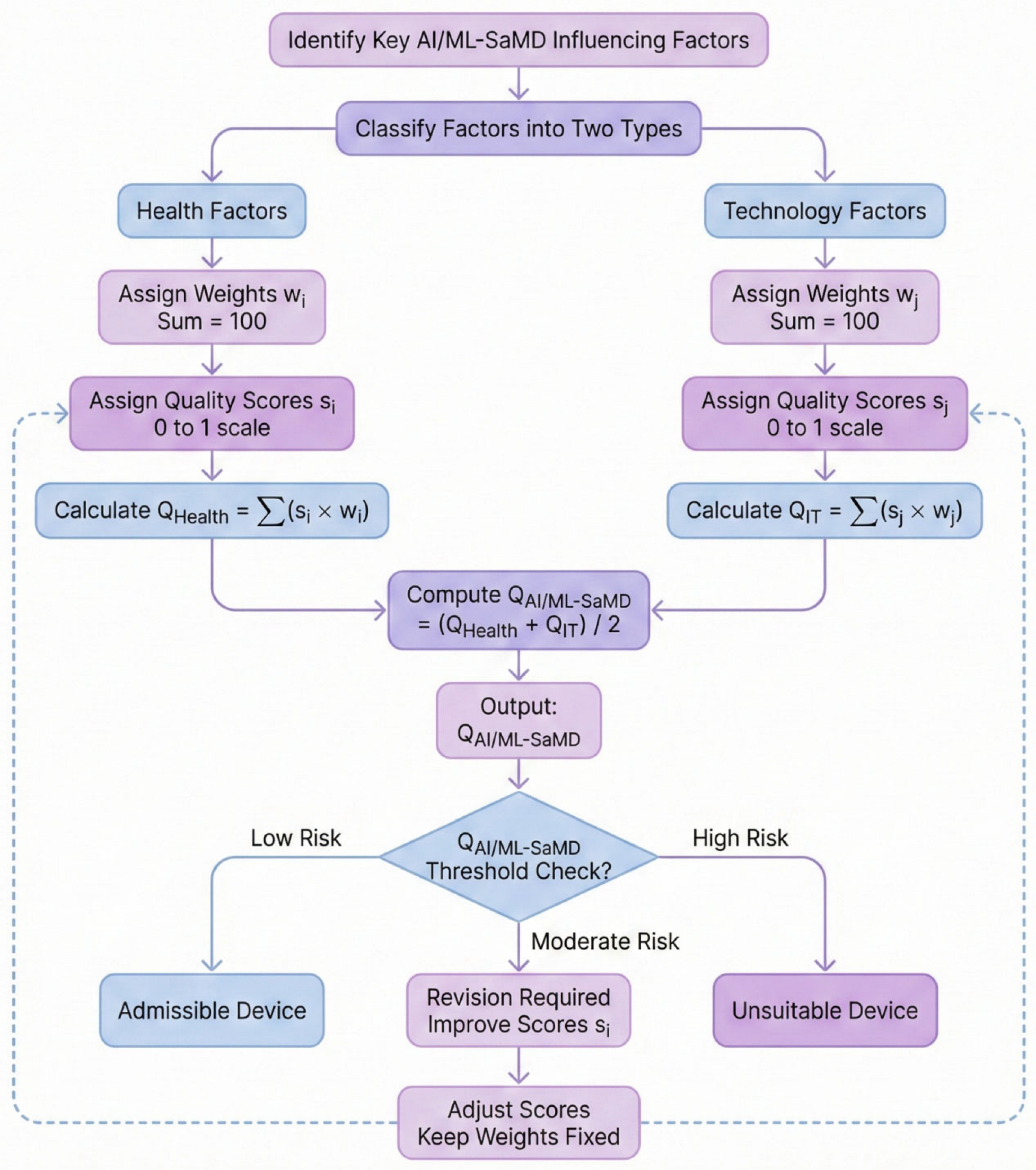
- Weight Calibration Phase: Before evaluation, the importance weights wi for each factor must be established for the specific deployment context. These weights should reflect stakeholder priorities (e.g., clinical, regulatory, technical) and can be determined through structured consensus methods such as the Delphi technique or the Analytic Hierarchy Process (AHP). This ensures the weighting scheme is objective, transparent, and aligned with the intended use of the AI/ML-SaMD system.
- Assessment and Improvement Phase: Once calibrated, the weights are held constant to maintain a stable reference framework. The quality scores si are then assigned based on evidence of the system’s actual performance (e.g., validation results, audit reports, or compliance documentation). In this phase, improvements in QAI/ML-SaMD are modeled by increasing the performance scores si while keeping weights fixed, thereby simulating quality enhancement without altering the agreed-upon importance of the underlying factors.
3.2. Benchmarking
4. Theoretical Validation
- 1.
- Non-Negativity: a measure satisfies non-negativity if its value is always greater than or equal to zero.
- For si and sj: The problem states scores are on a scale of 0–1 or 0–100, which means si ≥ 0 and sj ≥ 0.
- For wi and wj: As “relative importance weights,” they are inherently non-negative (wi ≥ 0, wj ≥ 0).
- For QIT, since wi ≥ 0 and si ≥ 0, their product (wi × si) is non-negative. The sum of non-negative terms is always non-negative. Thus, QIT ≥ 0.
- For QHealth, similarly, wj ≥ 0 and sj ≥ 0, so QHealth ≥ 0.
- For QAI/ML-SaMD, since QIT ≥ 0 and QHealth ≥ 0, and α, β ≥ 0, the product × is non-negative. Therefore, QAI/ML-SaMD ≥ 0.
- 2.
- Null Value: a measure should yield a value of zero when all its contributing factors are at their absolute minimum (indicating the lowest possible quality or absence of the measured attribute).
- To avoid nullifying the entire metric in cases where a factor score is zero, a microscopic correction factor ε = 1 × 10⁻⁹ is applied:s’ = max(s, ε), where ε = 1 × 10⁻⁹
- This preserves mathematical stability while effectively representing negligible quality contributions. The minimum possible score for any factor si or sj is a tiny value close to zero (ε). If all si = ε for QIT:QIT = ∑(wi × ε) = ε × ∑wi = ε
- If all sj = ε for QHealth:QHealth = ∑(wj × ε) = ε × ∑wj = ε
- For QAI/ML-SaMD, if QIT = ε and QHealth = ε:QAI/ML-SaMD = εα × εβ = ε(α+β) = ε1 = ε
- Thus, the metric approaches zero as scores approach zero.
- 3.
- Max Value: a measure should yield its maximum possible value when all its contributing factors are at their absolute maximum (indicating the highest possible quality).
- Let Smax be the maximum possible score (either 1 or 100).
- If all si = Smax for QIT, assuming ∑wi = 1 (as they are “relative importance weights”):QIT = ∑(wi × Smax) = Smax × ∑wi = Smax
- If all sj = Smax for QHealth, assuming ∑wj = 1:QHealth = ∑(wj × Smax) = Smax × ∑wj = Smax
- For QAI/ML-SaMD, if QIT = Smax and QHealth = Smax:QAI/ML-SaMD = (Smax)α × (Smax)β = (Smax)(α+β) = (Smax)1 = Smax
- 4.
- Normalization: a measure is normalized if its values consistently fall within a specified, bounded range, typically the same range as the individual input scores (e.g., [0, 1] or [0, 100]).
- As established above, the minimum value for QIT is ε (close to 0) and the maximum is Smax, so QIT ∈ [ε, Smax] ≈ [0, Smax]. Similarly, QHealth ∈ [0, Smax].
- For QAI/ML-SaMD, the minimum possible value of QAI/ML-SaMD is when both QIT and QHealth are at their minimum (ε):QAI/ML-SaMD = εα × εβ = ε(α+β) = ε ≈ 0
- The maximum possible value of QAI/ML-SaMD is when both QIT and QHealth are at their maximum (Smax):QAI/ML-SaMD = (Smax)α × (Smax)β = Smax(α+β) = Smax
- Therefore, QAI/ML-SaMD ∈ [0, Smax].
Alignment with Regulatory and Quality Frameworks
5. Empirical Validation
5.1. An Illustrative Example
5.2. Sensitivity Analysis of Weight Assignments
5.3. Expert-Based Validation
5.4. Empirical Application to the FDA-Authorized IDx-DR System
- 0.00–0.50: Significant deficiency or non-compliance (e.g., no evidence of regulatory approval), severe bias reported, major performance failure)
- 0.51–0.75: Partial compliance or moderate evidence (e.g., some documentation but not comprehensive, acceptable but suboptimal performance)
- 0.76–0.89: Strong evidence with minor gaps (e.g., robust data, clear documentation, minor limitations)
- 0.90–1.00: Exemplary evidence meeting all criteria (e.g., full regulatory approval, comprehensive validation, no reported issues)

| # | Factor | Evidence Basis | si | wi | si × wi |
|---|---|---|---|---|---|
| A. Health (Medical) Quality Factors | |||||
| 1 | Regulatory Approval | FDA De Novo (2018) + 510(k) clearance for clinical use [28,29] | 0.95 | 40 | 38.0 |
| 2 | Research Challenges (Data) | Large-scale training and data (≥900 patient prospective trial, diverse cases) [30] | 0.88 | 30 | 26.4 |
| 3 | Liability & Accountability | Fully autonomous designation under FDA regulation—a defined responsibility framework defined [29] | 0.82 | 20 | 16.4 |
| 4 | Human-Centric Factors | Human-factors/usability validation required and conducted during approval [29] | 0.88 | 10 | 8.8 |
| QHealth = 0.896 | |||||
| B. IT Quality Factors | |||||
| 1 | AI Model/Transparency | Modular lesion-detector + decision-fusion architecture (not a pure black-box) [31] | 0.72 | 22 | 15.8 |
| 2 | Algorithmic Bias | Subgroup performance tested across demography; no major dropouts reported [30,32] | 0.83 | 20 | 16.6 |
| 3 | Performance & Security | Sensitivity 87.2%, Specificity 90.7%, imageability 96.1%; FDA cybersecurity controls described [29,30] | 0.92 | 18 | 16.6 |
| 4 | Integration/Interoperability | Requires specific fundus camera + client software; no public broad EHR integration [29,31] | 0.62 | 16 | 9.9 |
| 5 | Continuous Learning & Evolution | Algorithm locked; updates require regulatory re-submission [29] | 0.65 | 14 | 9.1 |
| 6 | Software Business/Maintenance | Vendor licensing, maintenance, and post-market surveillance processes in place [29,33] | 0.75 | 10 | 7.5 |
| QIT = 0.755 | |||||
6. Threats to Validity and Limitations
- Internal validity: the extent to which measured variables cause observable effects in the experimental data. Our paper’s core contribution is proposing and providing initial validation for a metric, not establishing a definitive cause-and-effect relationship, so internal validity is not a concern.
- Construct validity: the most significant limitation concerns the construct of ‘quality’ itself. Our current model operationalizes quality through ten factors spanning IT and Health dimensions. While these factors are drawn from the most prevalent attributes in the literature [27], they are not exhaustive. Critical dimensions such as user experience (UX), detailed risk management (e.g., ISO 14971 severity/probability of harm [11]), and data governance (e.g., privacy, security protocols) are not explicitly incorporated. Consequently, the QAI/ML-SaMD score in its present form should be interpreted as a measure of technical and clinical robustness, rather than a comprehensive assessment of overall device quality. This defined scope was a necessary initial constraint, but it explicitly motivates the expansion of the model in future work.
- External validity: a limitation of this study is the application of the metric to a single FDA-authorized device (Section 5.4). While this demonstrates feasibility and aligns the score with regulatory status, it does not establish generalizability. Future work will apply the metric to a diverse portfolio of at least ten AI/ML-SaMD products—including devices that have received regulatory clearance, those rejected, and those currently in development—to validate the metric’s discriminative ability across varying quality levels.
7. Conclusions and Future Work
Funding
Institutional Review Board Statement
Informed Consent Statement
Data Availability Statement
Acknowledgments
Conflicts of Interest
Abbreviations
| AI | Artificial Intelligence |
| AHP | Analytic Hierarchy Process |
| CI/CD | Continuous Integration/Continuous Deployment |
| EMA | European Medicines Agency |
| EHR | Electronic Health Record |
| EU | European Union |
| FDA | U.S. Food and Drug Administration |
| GDPR | General Data Protection Regulation |
| GMLP | Good Machine Learning Practice |
| GQM | Goal-Question-Metric |
| HIPAA | Health Insurance Portability and Accountability Act |
| IDx-DR | IDx-Diabetic Retinopathy (FDA-authorized AI system) |
| IMDRF | International Medical Device Regulators Forum |
| ISO | International Organization for Standardization |
| IT | Information Technology |
| ML | Machine Learning |
| mtmDR | More-Than-Mild Diabetic Retinopathy |
| SaMD | Software as a Medical Device |
| SFDA | Saudi Food and Drug Authority |
| SRS | Simulation for Regulation of SaMD |
| UX | User Experience |
| WGM | Weighted Geometric Mean |
| WHO | World Health Organization |
References
- IMDRF SaMD Working Group. Software as a Medical Device (SaMD): Key Definitions. International Medical Device Regulators Forum (IMDRF). December 2013. Available online: https://www.imdrf.org/sites/default/files/docs/imdrf/final/technical/imdrf-tech-131209-samd-key-definitions-140901.pdf (accessed on 5 June 2026).
- Russell, S.; Norvig, P. Artificial Intelligence: A Modern Approach, 4th ed.; Pearson: Essex, UK, 2020. [Google Scholar]
- Ebad, S.A.; Zaghdoud, R.; Miled, A.B. Metrics and Quality Attributes of AI-SaMD (Software as Medical Device). Eng. Technol. Appl. Sci. Res. 2025, 15, 13–17. [Google Scholar] [CrossRef] [Scilit]
- Market Growth Reports. Software as a Medical Device (SaMD) Market Size, Share, Growth, and Industry Analysis, by Type (Cloud-Based, On Premise), by Application (Screening and Diagnosis, Monitoring and Alerting, Chronic Disease Management, Other), Regional Insights and Forecast to 2035 (Report ID: 100075). 2026. Available online: https://www.marketgrowthreports.com/market-reports/software-as-a-medical-device-samd-market-100075?utm_source=chatgpt.com (accessed on 5 August 2026).
- ISO/IEC Standard No. 25010:2023; Systems and Software Engineering—Systems and Software Quality Requirements and Evaluation (SQuaRE)—Product Quality Model. International Organization for Standardization & International Electrotechnical Commission: Geneva, Switzerland, 2023. Available online: https://www.iso.org/standard/78176.html (accessed on 5 August 2026).
- Chothani, F.; Movaliya, V.; Vaghela, K.; Zaveri, M.; Deshpande, S.; Kanki, N. Regulatory Prospective on Software as a Medical Device. Int. J. Drug Regul. Aff. 2022, 10, 13–17. [Google Scholar] [CrossRef] [Scilit]
- DeMarco, T. Controlling Software Projects; Yourdon Press: New York, NY, USA, 1982; Available online: https://archive.org/search.php?query=external-identifier%3A%22urn%3Aoclc%3Arecord%3A1255742290%22 (accessed on 5 August 2026).
- Fenton, N.; Bieman, J. Software Metrics: A Rigorous and Practical Approach, 3rd ed.; CRC Press: Boca Raton, FL, USA, 2014. [Google Scholar]
- Laurie, G.; Dove, E.; Ganguli-Mitra, A.; McMillan, C.; Postan, E.; Sethi, N.; Sorbie, A. The Cambridge Handbook of Health Research Regulation; Cambridge University Press: Cambridge, UK, 2021. [Google Scholar]
- Odaibo, S.G. Risk Management of AI/ML Software as a Medical Device (SaMD): On ISO 14971 and Related Standards and Guidances. arXiv 2021, arXiv:2109.07905. [Google Scholar] [CrossRef] [Scilit]
- ISO Standard No. 14971:2019; Medical Devices—Application of Risk Management to Medical Devices. International Organization for Standardization: Geneva, Switzerland, 2019. Available online: https://www.iso.org/standard/72704.html (accessed on 5 August 2026).
- Giansanti, D. The Regulation of Artificial Intelligence in Digital Radiology in the Scientific Literature: A Narrative Review of Reviews. Healthcare 2022, 10, 1824. [Google Scholar] [CrossRef] [Scilit] [PubMed]
- Hwang, E.J.; Goo, J.M.; Yoon, S.H.; Beck, K.S.; Seo, J.B.; Choi, B.W.; Chung, M.J.; Park, C.M.; Jin, K.N.; Lee, S.M. Use of Artificial Intelligence-Based Software as Medical Devices for Chest Radiography: A Position Paper from the Korean Society of Thoracic Radiology. Korean J. Radiol. 2021, 22, 1743–1748. [Google Scholar] [CrossRef] [Scilit] [PubMed]
- Reddy, S. Global Harmonization of Artificial Intelligence-Enabled Software as a Medical Device Regulation: Addressing Challenges and Unifying Standards. Mayo Clin. Proc. Dig. Health 2025, 3, 100191. [Google Scholar] [CrossRef] [Scilit] [PubMed]
- Yang, S.R.; Chien, J.T.; Lee, C.Y. Advancements in Clinical Evaluation and Regulatory Frameworks for AI-Driven Software as a Medical Device (SaMD). IEEE Open J. Eng. Med. Biol. 2024, 6, 147–151. [Google Scholar] [CrossRef] [Scilit] [PubMed]
- O’Driscoll, F.; O’Brien, N.; Guo, C.; Prime, M.; Darzi, A.; Ghafur, S. Clinical Simulation in the Regulation of Software as a Medical Device: An eDelphi Study. JMIR Form. Res. 2024, 8, e56241. [Google Scholar] [CrossRef] [Scilit] [PubMed]
- Klavetter, E.; Cruz, J.; Daniels, S.; Vidal, N.Y.; Vidal, D.E. Historical medical principles applied to the future of artificial intelligence software. Mayo Clin. Proc. Dig. Health 2023, 1, 115–119. [Google Scholar] [CrossRef] [Scilit] [PubMed]
- Mentzou, A.; Rogers, A.; Carvalho, E.; Daly, A.; Malone, M.; Kerasidou, X. Artificial intelligence in digital self-diagnosis tools: A narrative overview of reviews. Mayo Clin. Proc. Dig. Health 2025, 3, 100242. [Google Scholar] [CrossRef] [Scilit] [PubMed]
- Kitchenham, B.; Pfleeger, S.L.; Fenton, N. Towards a Framework for Software Measurement Validation. IEEE Trans. Softw. Eng. 1995, 21, 929–944. [Google Scholar] [CrossRef] [Scilit]
- Weyuker, E.J. Evaluating Software Complexity Measures. IEEE Trans. Softw. Eng. 1988, 14, 1357–1365. [Google Scholar] [CrossRef] [Scilit]
- Sommerville, I. Software Engineering, 10th ed.; Pearson: Essex, UK, 2015. [Google Scholar]
- Briand, L.; Daly, J.; Wuest, J. A unified framework for cohesion measurement in object-oriented systems. Empir. Softw. Eng. 1998, 3, 65–117. [Google Scholar] [CrossRef] [Scilit]
- Anderson, D.R.; Sweeney, D.J.; Williams, T.A.; Camm, J.D.; Cochran, J.J.; Fry, M.J.; Ohlmann, J.W. Statistics for Business and Economics, 15th ed.; Cengage: Boston, MA, USA, 2024. [Google Scholar]
- Saudi Food and Drug Authority. Guidance on Artificial Intelligence (AI) and Machine Learning (ML) Technologies Based Medical Devices; MDS-G-010-V1/230103; Saudi Food and Drug Authority (SFDA): Riyadh, Saudi Arabia, 2022. [Google Scholar]
- Ebad, S.A.; Ahmed, M.A. Functionality-based software packaging using sequence diagrams. Softw. Qual. J. 2015, 23, 453–481. [Google Scholar] [CrossRef] [Scilit]
- Basili, V.R.; Caldiera, G.; Rombach, H.D. The goal question metric paradigm. In Encyclopedia of Software Engineering; Marciniak, J.J., Ed.; Wiley: New York, NY, USA, 1994. [Google Scholar]
- Ebad, S.A.; Alhashmi, A.; Amara, M.; Miled, A.B.; Saqib, M. Artificial Intelligence-Based Software as a Medical Device (AI-SaMD): A Systematic Review. Healthcare 2025, 13, 817. [Google Scholar] [CrossRef] [Scilit] [PubMed]
- FDA. De Novo Classification Request for IDx-DR (DEN180001). Access Data, U.S. Food & Drug Administration. 2018. Available online: https://www.accessdata.fda.gov/cdrh_docs/reviews/DEN180001.pdf (accessed on 21 May 2026).
- Technology Networks. AI System Approved for Diabetic Retinopathy Diagnosis. 2018. Available online: https://www.technologynetworks.com/informatics/news/ai-system-approved-for-diabetic-retinopathy-diagnosis-308229 (accessed on 5 June 2026).
- Nanegrungsunk, O.; Ruamviboonsuk, P.; Grzybowski, A. Prospective studies on artificial intelligence (AI)-based diabetic retinopathy screening. Ann. Transl. Med. 2022, 10, 1297. [Google Scholar] [CrossRef] [Scilit] [PubMed]
- Khan, Z.; Gaidhane, A.M.; Singh, M.; Ganesan, S.; Kaur, M.; Sharma, G.C.; Rani, P.; Sharma, R.; Thapliyal, S.; Kushwaha, M.; et al. Diagnostic accuracy of IDX-DR for detecting diabetic retinopathy: A systematic review and meta-analysis. Am. J. Ophthalmol. 2025, 273, 192–204. [Google Scholar] [CrossRef] [Scilit] [PubMed]
- Chokshi, T.; Cruz, M.J.; Ross, J.; Yiu, G. Advances in teleophthalmology and artificial intelligence for diabetic retinopathy screening: A narrative review. Ann. Eye Sci. 2024, 9, 9. [Google Scholar] [CrossRef] [Scilit]
- Huber, S.L.; Parzer, V.; Ludvik, B.; Pollreisz, A.; Mahnert, N.; Brix, J.M. Evaluation of IDx-DR software for diabetic retinopathy screening in outpatient clinics: Efficacy, safety, and feasibility in a real-world setting. J. Diabetes Complicat. 2025, 39, 109120. [Google Scholar] [CrossRef] [Scilit] [PubMed]
- Wohlin, C.; Runeson, P.; Höst, M.; Ohlsson, M.C.; Regnell, B.; Wesslén, A. Experimentation in Software Engineering; Springer: Berlin/Heidelberg, Germany, 2012. [Google Scholar]


| QAI/ML-SaMD Range | Interpretation | Comment |
|---|---|---|
| 0–60 | Unsuitable device | Low Quality (High Risk) |
| 61–80 | Revision required | Moderate Quality (Moderate Risk) |
| 81–100 | Admissible for clinical validation | Good Quality (Low Risk) |
| Framework/Initiative | Focus | Type | How QAI/ML-SaMD Complements |
|---|---|---|---|
| FDA GMLP (FDA Good Machine Learning Practice (GMLP): https://www.fda.gov/media/153486/download, (accessed on 5 August 2026)) | Process guidance for AI/ML | Qualitative, process-oriented | Provides a quantitative outcome measure to track GMLP implementation success. |
| ISO/IEC 25023 (https://cdn.standards.iteh.ai/samples/35747/34b91bc957f647ce8bbb2093907d7bc0/ISO-IEC-25023-2016.pdf, (accessed on 5 August 2026)) | Software product quality measures | Quantitative, attribute-specific | Synthesizes multiple ISO qualities into one overall score for holistic SaMD assessment. |
| IMDRF SaMD (https://www.imdrf.org/sites/default/files/docs/imdrf/final/technical/imdrf-tech-140918-samd-framework-risk-categorization-141013.pdf, (accessed on 5 August 2026)) | Risk categorization & principles | High-level, regulatory | Operationalizes IMDRF principles into measurable, factor-weighted scores. |
| Responsible AI (EU AI Act (https://artificialintelligenceact.eu/, (accessed on 5 August 2026)) | Ethics, fairness, transparency | Principle-based | Quantifies ethical dimensions (bias, accountability) as part of the overall quality score. |
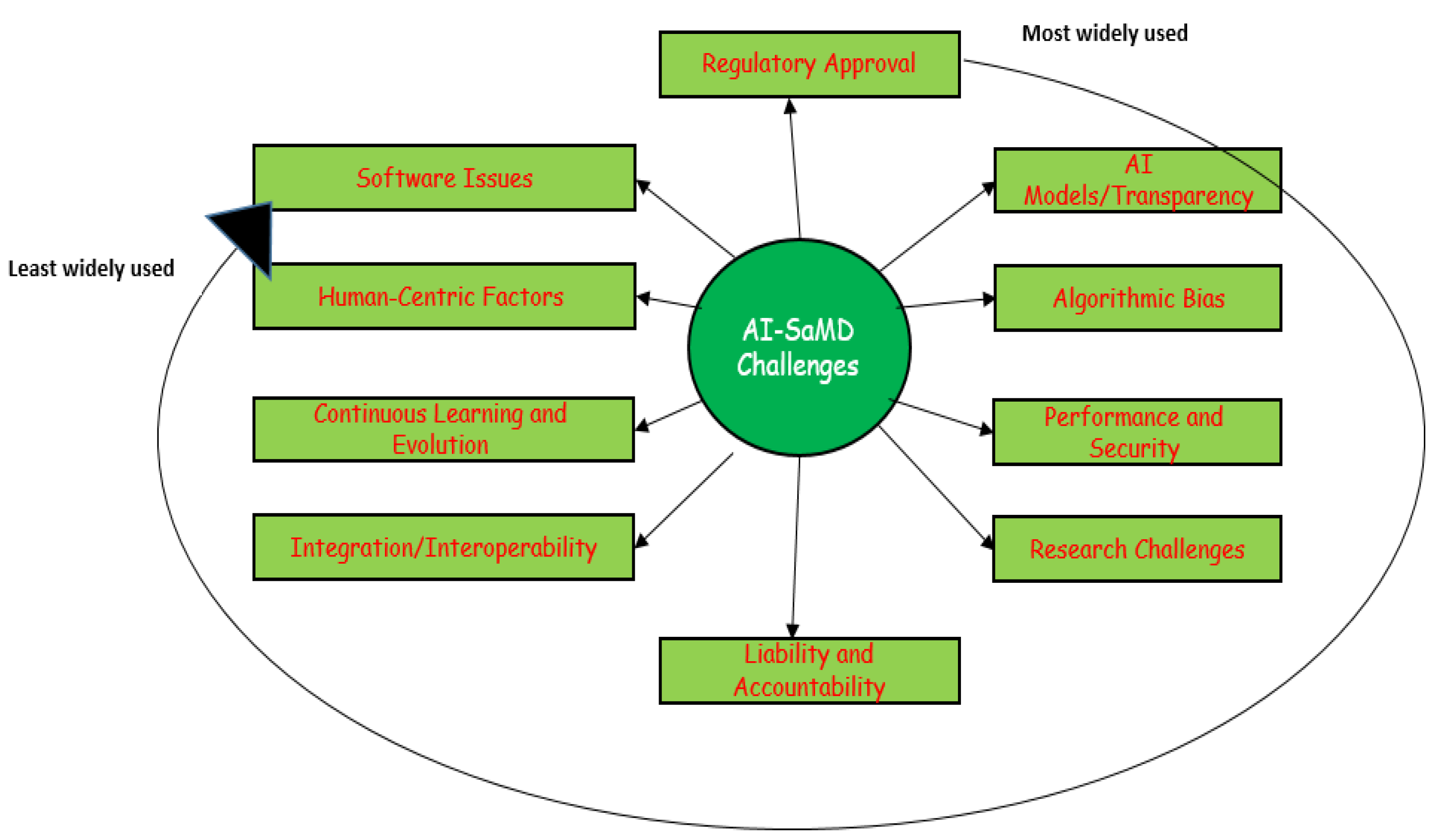
| # 1 | Type | Factor | Comment |
|---|---|---|---|
| 1 | Health | Regulatory Approval | e.g., FDA and European Medicines Agency (EMA). |
| 2 | Research Challenges | e.g., limited access to high-quality, diverse, and sufficiently large datasets. | |
| 3 | Liability and Accountability | e.g., ambiguity around who is responsible for errors. | |
| 4 | Human-Centric Factors | Human/organizational factors, including stakeholder collaboration, staff training, user acceptance, and skills of data governance. | |
| 1 | IT | AI Models/Transparency | Lack of transparency in “black-box” models generates outputs without interpretation, making it challenging to justify medical decisions. |
| 2 | Algorithmic Bias | e.g., demographic groups and risking unfair outcomes. | |
| 3 | Performance and Security | The AI/ML-SaMD consistently delivers speedy, secure outputs across diverse circumstances. | |
| 4 | Integration/Interoperability | Integrating with existing clinical systems, such as electronic health records (EHRs). | |
| 5 | Continuous Learning and Evolution | New data post-deployment requires monitoring to ensure consistency with standards. | |
| 6 | Software Business | e.g., updating, vendor support, documentation, licensing, and upgrading. |
| A. Health Quality Factors | ||||
|---|---|---|---|---|
| # | Factor | si | wi | si × wi |
| 1 | Regulatory Approval | 0.3 | 40 | 12.0 |
| 2 | Research Challenges (Data) | 0.3 | 30 | 9.0 |
| 3 | Liability & Accountability | 0.4 | 20 | 8.0 |
| 4 | Human-Centric Factors | 0.2 | 10 | 2.0 |
| QHealth = 0.310 | ||||
| B. IT Quality Factors | ||||
| 1 | AI Model/Transparency | 0.2 | 22 | 4.4 |
| 2 | Algorithmic Bias | 0.4 | 20 | 8.0 |
| 3 | Performance & Security | 0.3 | 18 | 5.4 |
| 4 | Integration/Interoperability | 0.3 | 16 | 4.8 |
| 5 | Continuous Learning & Evolution | 0.2 | 14 | 2.8 |
| 6 | Software Business/Maintenance | 0.3 | 10 | 3.0 |
| QIT = 0.284 | ||||
| Scores | QIT | QHealth | QAI/ML-SaMD | Scenario |
|---|---|---|---|---|
| IT scores: 0.6, 0.7, 0.4, 0.9, 0.4, 0.5 Health scores: 0.7, 0.4, 0.9, 0.6 | 0.594 | 0.640 | 0.617 | Revision required |
| IT scores: 0.9, 0.8, 0.95, 0.75, 0.6, 0.9 Health scores: 0.85, 0.75, 0.9, 0.9 | 0.823 | 0.835 | 0.829 | Admissible AI/ML-SaMD |
| Varied Factor (Change) | QIT | QHealth | QAI/ML-SaMD (0–1) | QAI/ML-SaMD (0–100) | Conclusion (Per Table 1) |
|---|---|---|---|---|---|
| Baseline (Table 4) | 0.284 | 0.310 | 0.297 | 29.7 | Unsuitable |
| +20% Regulatory Approval | 0.284 | 0.310 | 0.297 | 29.7 | Unsuitable |
| –20% Regulatory Approval | 0.284 | 0.290 | 0.287 | 28.7 | Unsuitable |
| +20% AI Model Transparency | 0.290 | 0.310 | 0.300 | 30.0 | Unsuitable |
| –20% AI Model Transparency | 0.278 | 0.310 | 0.294 | 29.4 | Unsuitable |
| +20% Algorithmic Bias | 0.296 | 0.310 | 0.303 | 30.3 | Unsuitable |
| –20% Algorithmic Bias | 0.272 | 0.310 | 0.291 | 29.1 | Unsuitable |
| Simultaneous ±10% All Weights | 0.281–0.287 | 0.305–0.315 | 0.293–0.301 | 29.3–30.1 | Unsuitable |
| Simultaneous ±10% Weights & Scores | 0.258–0.306 | 0.282–0.338 | 0.270–0.321 | 0.270–0.321 | Unsuitable |
Disclaimer/Publisher’s Note: The statements, opinions and data contained in all publications are solely those of the individual author(s) and contributor(s) and not of MDPI and/or the editor(s). MDPI and/or the editor(s) disclaim responsibility for any injury to people or property resulting from any ideas, methods, instructions or products referred to in the content. |
© 2026 by the author. Licensee MDPI, Basel, Switzerland. This article is an open access article distributed under the terms and conditions of the Creative Commons Attribution (CC BY) license.
Share and Cite
Ebad, S.A. QAI/ML-SaMD: A Hybrid Health–Technology Quantifiable Quality Metric for Artificial Intelligence/Machine Learning-Based Software as a Medical Device. Healthcare 2026, 14, 2587. https://doi.org/10.3390/healthcare14162587
Ebad SA. QAI/ML-SaMD: A Hybrid Health–Technology Quantifiable Quality Metric for Artificial Intelligence/Machine Learning-Based Software as a Medical Device. Healthcare. 2026; 14(16):2587. https://doi.org/10.3390/healthcare14162587
Chicago/Turabian StyleEbad, Shouki A. 2026. "QAI/ML-SaMD: A Hybrid Health–Technology Quantifiable Quality Metric for Artificial Intelligence/Machine Learning-Based Software as a Medical Device" Healthcare 14, no. 16: 2587. https://doi.org/10.3390/healthcare14162587
APA StyleEbad, S. A. (2026). QAI/ML-SaMD: A Hybrid Health–Technology Quantifiable Quality Metric for Artificial Intelligence/Machine Learning-Based Software as a Medical Device. Healthcare, 14(16), 2587. https://doi.org/10.3390/healthcare14162587