1. Introduction
Ischemic heart disease (IHD) remains the leading cardiovascular cause of death worldwide, and its burden is increasing as populations age and cardiometabolic risk accumulates [
1,
2,
3,
4]. The burden is especially relevant for low- and middle-income or transitioning health systems, where registry evidence remains comparatively limited [
4,
5]. In Kazakhstan and the wider Central Asian region, cardiovascular disease dominates the mortality profile while risk-factor control remains incomplete [
6]. In this setting, the emergency medical service (EMS) is often the first clinical contact for patients with cardiac symptoms, and crews must decide at the scene whether an IHD-coded patient requires hospital transport or can be managed without transfer.
Most prehospital coronary research has focused on acute coronary syndrome, treatment delay, PCI access, mortality or downstream adverse outcomes rather than on the operational conveyance decision itself [
7,
8,
9,
10]. A newer triage literature has shown that registry, dispatch, electrocardiographic and machine learning models can support risk stratification for chest pain or non-conveyance, usually reporting moderate discrimination and emphasizing the safety risks of both over-triage and under-triage [
10,
11,
12,
13,
14,
15,
16]. These studies provide the methodological basis for using routinely collected EMS data, but they do not fully answer how crews make the binary at-scene decision to transport or not transport patients with IHD in routine urban practice.
Comorbidity may be particularly important in routine IHD care because many EMS activations involve chronic coronary disease rather than time-critical STEMI/NSTEMI. Heart failure, atrial fibrillation, other arrhythmias and cardiogenic shock are strongly associated with emergency admission, adverse outcomes or escalation of care in hospital-based and registry studies [
17,
18,
19,
20,
21,
22,
23,
24,
25,
26,
27,
28], and demographic effects on ACS presentation and treatment are well documented [
29,
30,
31]. However, it remains uncertain whether the comorbidity and complication profile recorded by ambulance crews independently shapes the prehospital hospitalization/transport decision after adjustment for acute clinical form, demographic factors and operational variables. This uncertainty is especially important in Central Asian urban EMS systems, where local evidence is scarce and externally derived risk tools may not transfer directly.
To address this gap, we analyzed five years of EMS calls for IHD in Astana, Kazakhstan. The novelty of the study lies not in showing that shock or acute IHD prompt transport—which is clinically expected—but in quantifying, at the call level, whether routinely coded cardiac comorbidities and complications add independent information to a real EMS disposition decision in an understudied setting. The objectives were: (i) to describe demographic, clinical, comorbidity and operational characteristics by EMS disposition; (ii) to identify independent predictors of hospitalization/transport using multivariable logistic regression; and (iii) to estimate the relative contribution of comorbidity and complication fields compared with acuity, sex, age and operational factors.
2. Materials and Methods
2.1. Study Design and Setting
We performed a retrospective, observational cohort study of emergency medical service (EMS) calls attended for ischemic heart disease in Astana, the capital of Kazakhstan, over an approximately five-year period from 19 February 2020 to 30 June 2024. The final year (2024) therefore covers the first half of the calendar year only, which should be borne in mind when interpreting annual call volumes. Astana is served by a centralized municipal ambulance dispatch system that records each call electronically, including dispatch priority, crew type, response and on-scene time intervals, working diagnosis (coded to ICD-10) and final disposition. The study followed the principles of the Declaration of Helsinki, and only de-identified routinely collected operational data were analyzed. Reporting adheres to the STROBE recommendations for observational studies.
2.2. Participants and Case Definition
Eligible records were all EMS calls with a working diagnosis of ischemic heart disease, defined by ICD-10 codes I20–I25. In keeping with registry-based AMI studies that identify cases through principal discharge or working diagnoses [
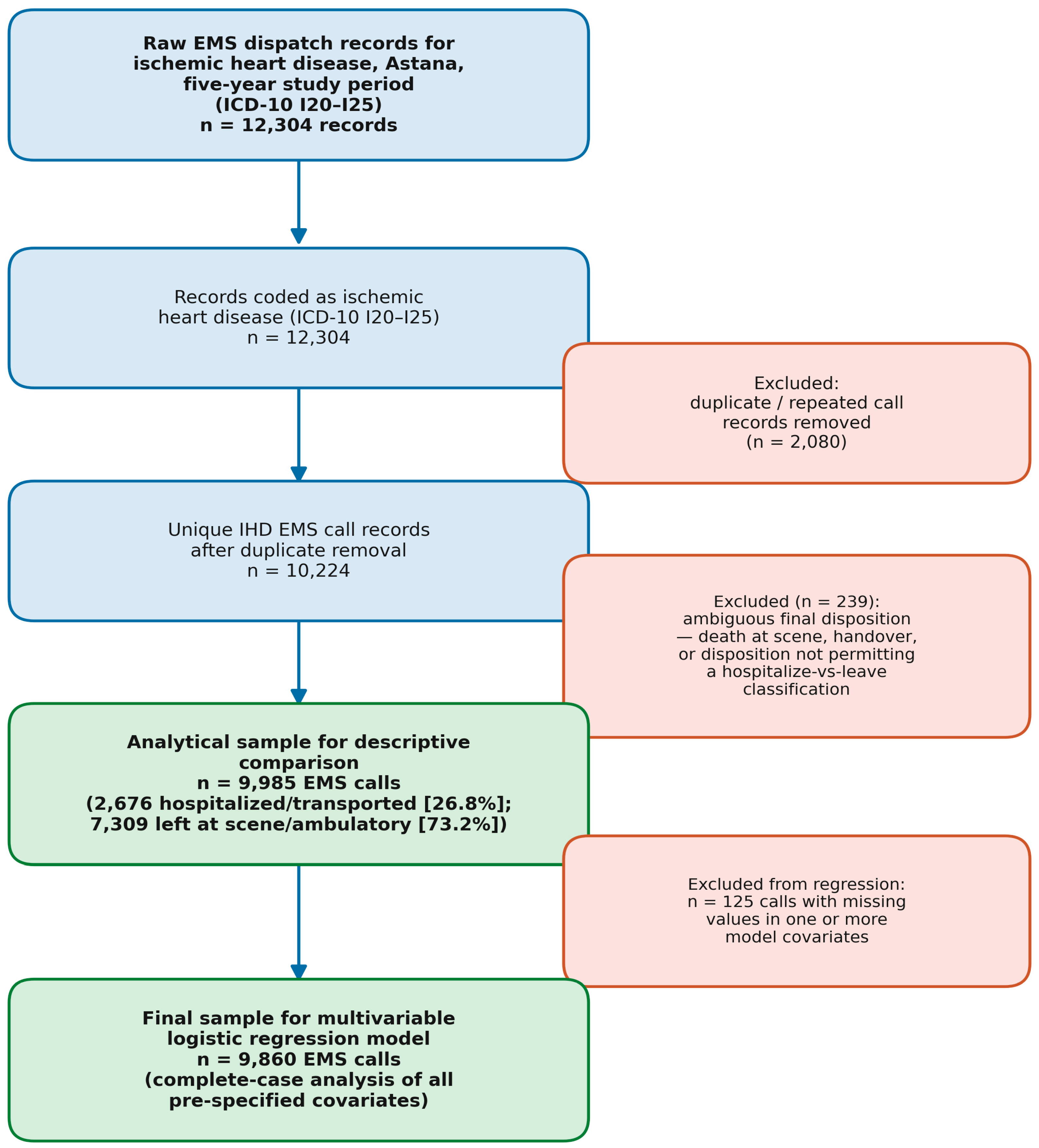
9], calls were classified into two clinical forms: acute/unstable IHD (unstable angina and acute coronary syndromes, including I20–I24) and chronic IHD (I25). Comorbidities and complications documented by the crew were captured as binary indicators using their respective ICD-10 codes: diabetes mellitus (E10–E14), chronic obstructive pulmonary disease and related obstructive disease (J40–J47), arterial hypertension (I10–I15), heart failure (I50), atrial fibrillation (I48), other arrhythmias (I47, I49), cardiogenic shock (R57.0) and pneumonia (J12–J18). After removal of 2080 duplicate call records from the 12,304 raw IHD-coded dispatch records and exclusion of 239 records with a final disposition of death at scene or handover that did not permit a hospitalize-versus-leave classification, 9985 calls were available for descriptive comparison and 9860 for the fully adjusted regression model. The complete data-processing and cleaning cascade is summarized in
Figure 1. The unit of analysis was the individual EMS call rather than the unique patient: each dispatch record represents one ambulance activation and the conveyance decision taken at that encounter. Because the dispatch dataset did not contain a stable patient identifier that could be reliably linked across calls, repeat calls by the same patient could not be collapsed to the patient level, and the analysis therefore treats calls as the sampling unit (see Limitations).
2.3. Outcome and Variables
The primary endpoint was field disposition, coded as hospitalization/transport to hospital (1) versus management at the scene or ambulatory care without hospital transfer (0). This endpoint reflects the operational decision made by the EMS crew and should be interpreted as an EMS transport/hospitalization decision, not as a patient-level clinical outcome. The dataset did not contain confirmed ACS diagnosis, in-hospital findings, mortality, re-contact after non-conveyance or adjudicated appropriateness of the decision. Candidate predictors, selected a priori on clinical and operational grounds, comprised: age (modeled both continuously and in categories <45, 45–59, 60–74 and ≥75 years), sex, clinical form of IHD (acute/unstable vs. chronic I25), the eight comorbidity/complication indicators listed above, the presence of any documented complication (DS3), dispatch urgency category (1–4), crew type (specialized vs. general/line) and EMS response time (modeled per additional 10 min). For the regression model, dispatch urgency was dichotomized into high urgency (categories 1–2) versus lower urgency (categories 3–4) because categories 1–2 correspond to high-priority, time-sensitive response in the local dispatch protocol and because category 1 and category 4 were sparse. The four original urgency categories are still shown descriptively in
Section 3.2. This dichotomy was therefore operational and model-stability driven, and it should not be interpreted as a complete measure of on-scene clinical severity. Two operational time intervals—call-to-arrival and arrival-to-hospital-delivery—were summarized descriptively.
2.4. Statistical Analysis
Continuous variables were summarized as median (interquartile range, IQR) and compared between hospitalized/transported and left-at-scene groups with the Mann–Whitney U test, given their skewed distributions. Categorical variables were summarized as counts and percentages and compared with the Pearson chi-square test. Following the analytical approach established in comparable registry studies of coronary disease [
7,
8,
9], independent associations with hospitalization/transport were estimated with an explanatory multivariable logistic regression model entering all pre-specified covariates simultaneously. The model was specified to quantify independent associations rather than to derive or validate a deployable prediction rule. Results are reported as adjusted odds ratios (aOR) with 95% confidence intervals (CI). Overall model significance was assessed with the log-likelihood-ratio test, and explained variation with McFadden’s pseudo-R2. Model performance was characterized in terms of discrimination (area under the receiver-operating-characteristic curve, AUC), overall accuracy (Brier score, together with a scaled Brier score relative to a prevalence-only model) and calibration (calibration intercept and slope, with a calibration plot of observed versus predicted probability across deciles of predicted risk). A 95% confidence interval for the AUC was obtained by percentile bootstrap (2000 resamples), and internal validity was assessed by bootstrap internal validation (500 resamples, Harrell’s optimism-correction procedure) to estimate the optimism-corrected AUC. A two-sided
p-value < 0.05 was considered statistically significant. Adjusted odds ratios were visualized as a forest plot on a logarithmic scale. Analyses were performed in Python (version 3.11.5; Python Software Foundation, Wilmington, DE, USA) using the statsmodels, scikit-learn and pandas libraries. Reporting followed the STROBE statement. The flow of records from the full set of EMS dispatch entries to the final analytical samples, including each exclusion step and the corresponding numbers, is summarized in
Figure 1.
3. Results
3.1. Analytical Sample and Overall Disposition
After duplicate removal and exclusion of calls without an unambiguous final disposition, the analytical sample comprised 9985 EMS calls for ischemic heart disease (IHD). Of 12,304 raw EMS dispatch records coded to ICD-10 I20–I25, 2080 duplicate call records were removed to leave 10,224 unique calls, and a further 239 calls with an ambiguous disposition were excluded; the full cleaning cascade is shown in
Figure 1. Overall, 2676 calls (26.8%) resulted in hospitalization/transport to hospital, whereas 7309 calls (73.2%) were managed at the scene or resulted in ambulatory care. This distribution supports the use of disposition as an operationally relevant EMS endpoint, but it does not provide evidence on confirmed ACS, mortality or the clinical appropriateness of individual transport and non-transport decisions.
3.2. Demographic, Clinical, Comorbidity and Operational Characteristics
Baseline characteristics by call outcome are presented in
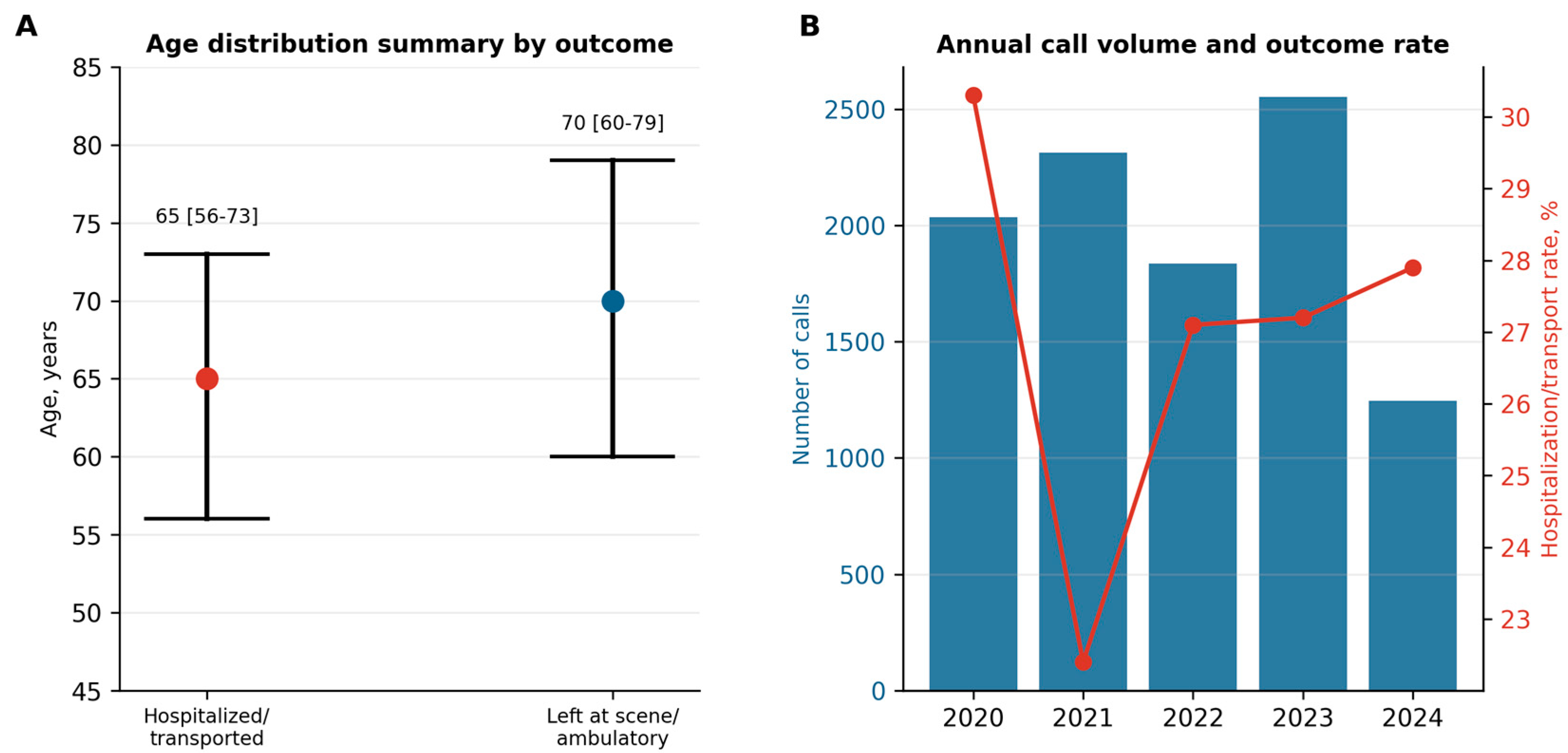
Table 1. The median age of the study population was 68 years (IQR 59–77), and women accounted for 55.1% of calls. Compared with patients left at the scene, hospitalized/transported patients were younger (median 65 years, IQR 56–73, vs. 70 years, IQR 60–79;
p < 0.001) and more frequently male (56.1% vs. 40.8%;
p < 0.001). The age gradient was most pronounced among patients aged ≥75 years, who represented 22.3% of hospitalized/transported calls but 34.4% of calls left at the scene.
Chronic IHD (ICD-10 I25) accounted for most EMS calls (95.8%), while acute/unstable forms of IHD accounted for 4.2% of the sample. Nevertheless, the clinical form differed markedly by disposition: acute/unstable IHD represented 11.3% of hospitalized/transported calls but only 1.7% of calls left at the scene (p < 0.001). Urgency category was also associated with disposition (p < 0.001), whereas crew type did not differ significantly in the univariable comparison (p = 0.593).
The comorbidity and complication profile was dominated by cardiac conditions. Heart failure was the most common coded comorbidity/complication (30.8% overall) and was more frequent among hospitalized/transported patients than among those left at the scene (37.8% vs. 28.2%;
p < 0.001). Other arrhythmias were also more frequent in the hospitalized/transported group (25.0% vs. 21.0%;
p < 0.001), and cardiogenic shock, although uncommon overall (1.0%), was strongly concentrated among hospitalized/transported calls (3.3% vs. 0.2%;
p < 0.001). In contrast, diabetes mellitus, COPD/obstructive disease, arterial hypertension, atrial fibrillation and pneumonia did not differ significantly between the outcome groups in unadjusted comparisons. Call-to-arrival response intervals were similar between the two dispositions; the arrival-to-hospital-delivery interval is defined only for calls resulting in hospitalization/transport and was therefore not compared between groups (
Table 1).
3.3. Multivariable Predictors of Emergency Hospitalization/Transport
The multivariable logistic regression model was statistically significant (likelihood-ratio test
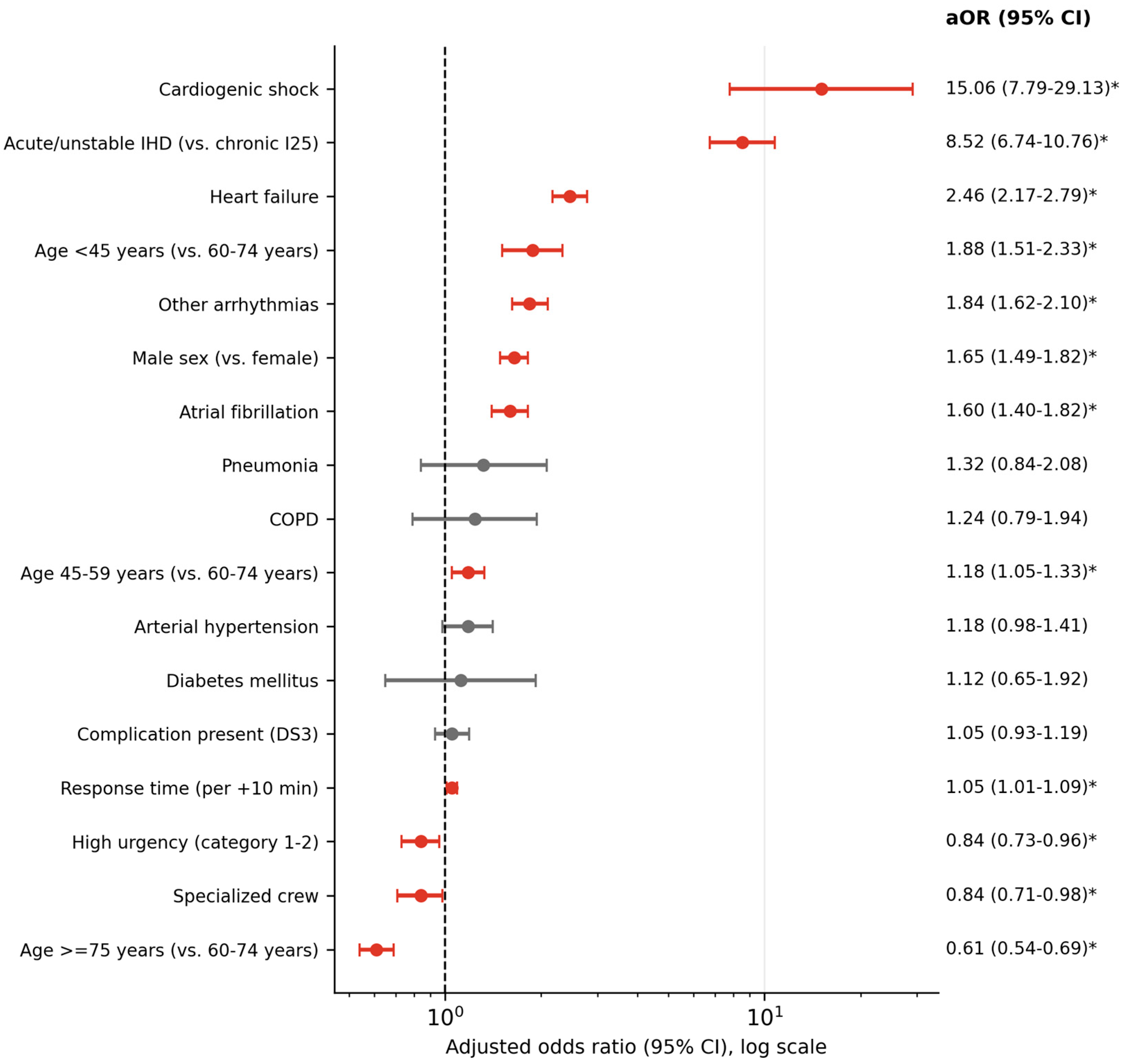
p < 0.001; McFadden pseudo-R2 = 0.093). Adjusted odds ratios (aORs) are shown graphically in
Figure 2 and reported numerically in
Table 2. As expected, acute severity variables showed the largest associations with hospitalization/transport; the additional analytic value of the model was to quantify whether routinely coded comorbidity variables retained independent associations after adjustment for acuity, demographic and operational factors.
Cardiogenic shock was the strongest independent predictor of hospitalization/transport (aOR 15.06; 95% CI 7.79–29.13; p < 0.001), followed by acute/unstable IHD compared with chronic I25-coded disease (aOR 8.52; 95% CI 6.74–10.76; p < 0.001). Among cardiac comorbidity indicators, heart failure (aOR 2.46; 95% CI 2.17–2.79), other arrhythmias (aOR 1.84; 95% CI 1.62–2.10) and atrial fibrillation (aOR 1.60; 95% CI 1.40–1.82) remained independently associated with higher odds of hospitalization/transport after adjustment for demographic, clinical and operational variables.
Demographic and operational covariates also contributed to the final model. Male sex was associated with increased odds of hospitalization/transport (aOR 1.65; 95% CI 1.49–1.82), as was age < 45 years compared with the 60–74-year reference group (aOR 1.88; 95% CI 1.51–2.33). By contrast, age ≥ 75 years was associated with lower adjusted odds (aOR 0.61; 95% CI 0.54–0.69). Each additional 10 min of EMS response time was associated with a modest increase in the adjusted odds of hospitalization/transport (aOR 1.05; 95% CI 1.01–1.09).
3.4. Model Performance and Internal Validation
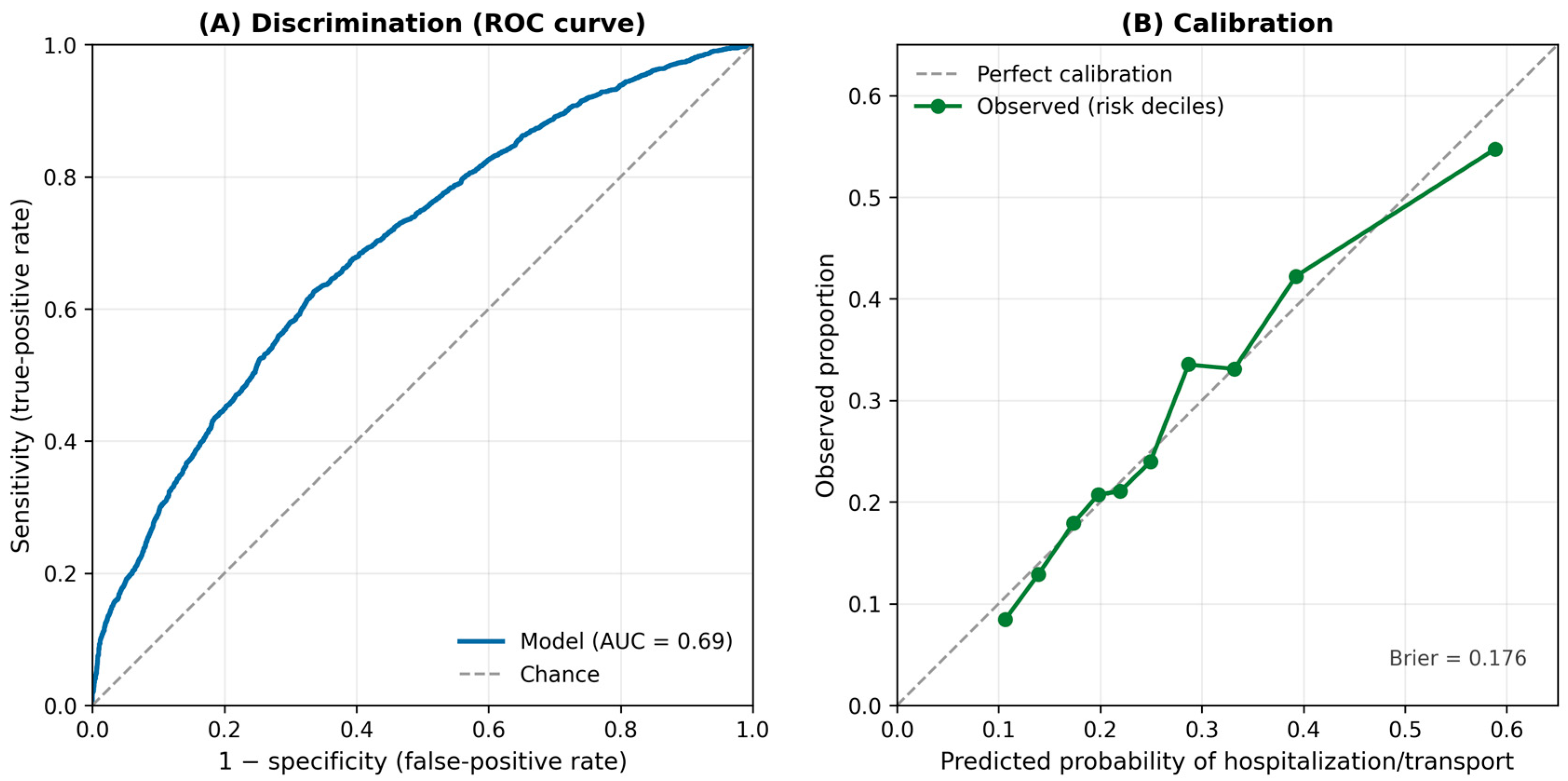
Because the model was specified to explain rather than to predict the at-scene disposition, its performance is reported to describe model fit rather than to support a deployable prediction tool. Discrimination was moderate: the area under the receiver-operating-characteristic curve (AUC) was 0.69 (95% CI 0.68–0.70;
Figure 3A). Overall accuracy of the predicted probabilities was modest, with a Brier score of 0.18 and a scaled Brier score of 0.10 relative to a prevalence-only model. Calibration across deciles of predicted risk was close to the identity line over the observed probability range (
Figure 3B), with an apparent calibration slope of 1.00 and intercept of 0.00 on the development data. Bootstrap internal validation (500 resamples, Harrell’s optimism-correction procedure) indicated minimal overfitting, with a mean optimism of 0.004 and an optimism-corrected AUC of 0.69. The AUC should be interpreted cautiously: it is below the approximate 0.74–0.79 reported for dedicated prehospital chest-pain triage models [
11,
12] and indicates that routinely coded dispatch variables explain only part of the transport decision. The predictors identified here are therefore best treated as candidate variables for future model development, not as a validated risk-stratification instrument.
3.5. Graphical Summary of Clinical Disposition and Comorbidity Burden
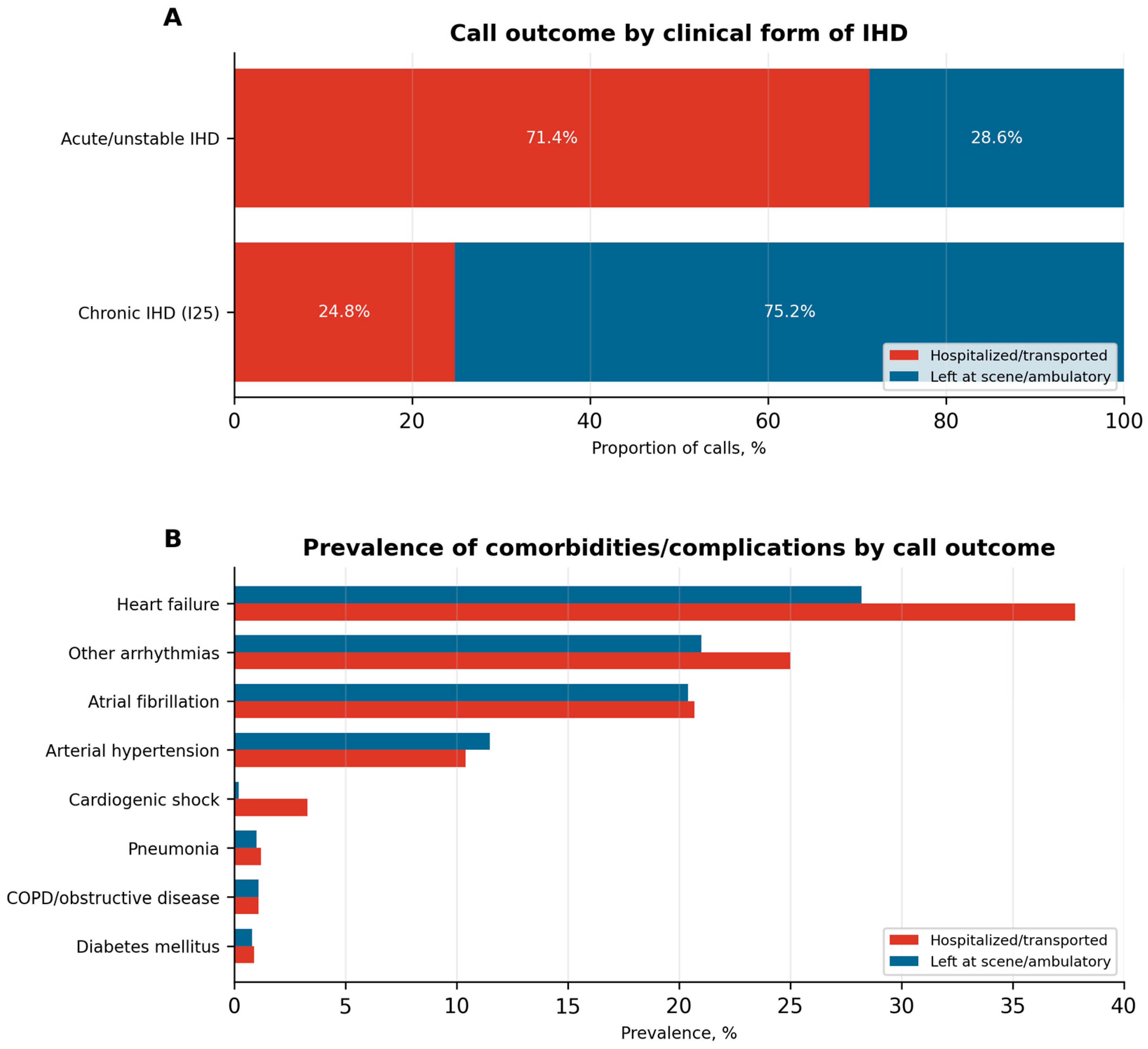
The graphical summaries complement the tabular findings by showing how disposition differs by clinical form and comorbidity profile. Acute/unstable IHD calls had a substantially higher hospitalization/transport proportion than chronic IHD calls (71.4% vs. 24.8%;
Figure 4A). The hospitalized/transported group also had a higher prevalence of heart failure, other arrhythmias and cardiogenic shock, whereas diabetes mellitus, COPD/obstructive disease and pneumonia were rare in both outcome groups (
Figure 4B).
3.6. Age Distribution and Annual Dynamics
Age and annual patterns are summarized in
Figure 5. The median-IQR plot confirms the younger profile of hospitalized/transported patients compared with those left at the scene (
Figure 5A), consistent with the values reported in
Table 1. Annual call volume varied across the observation period, while the hospitalization/transport rate declined in 2021 and then partially recovered in subsequent years (
Figure 5B).
Overall, hospitalization/transport among EMS calls for IHD was associated with both the acute clinical form of IHD and specific cardiac comorbidity/complication profiles. Cardiogenic shock and acute/unstable IHD were the dominant, clinically expected acuity-related predictors, while heart failure, other arrhythmias and atrial fibrillation remained independent comorbidity-related predictors after adjustment. Diabetes mellitus and COPD were rare in the coded EMS fields and did not show statistically significant adjusted associations in this dataset, suggesting limited capture of non-cardiac comorbidity in the available DS2/DS3 coding structure.
4. Discussion
In this five-year call-level analysis of 9985 EMS activations for IHD in Astana, the largest associations with hospitalization/transport were clinically expected: cardiogenic shock and acute/unstable IHD. The main contribution of the study is therefore more specific: it quantifies how routinely coded cardiac comorbidity and complication fields, recorded during real EMS work, remain independently associated with the transport decision after adjustment for acuity, demographic and operational variables. This endpoint is the crew-side disposition decision, not a clinical outcome or an adjudication of whether transport was appropriate. The findings should consequently be interpreted as explanatory evidence about EMS decision patterns rather than as direct evidence of patient prognosis or a ready decision-support rule.
4.1. Acuity, Comorbidity and the Wider Evidence
That hemodynamic instability and acute presentation dominated the model is concordant with clinical logic and the broader coronary literature: cardiogenic shock is the archetypal high-acuity complication, and contemporary staging systems and registries consistently report high in-hospital mortality, justifying escalation of care [
25,
26,
27]. Position statements on AMI complicated by cardiogenic shock likewise frame immediate transfer to definitive care as the default [
28]. The less self-evident finding concerns stable cardiac comorbidity. The independent association of heart failure with hospitalization/transport aligns with evidence showing that heart failure is a principal driver of emergency presentation, admission and readmission, and that regression- and machine learning-based tools can anticipate heart-failure ED visits and hospitalizations [
19,
20,
22]. The independent contributions of atrial fibrillation and other arrhythmias are also plausible because admission rates for atrial fibrillation increase in the presence of concomitant heart failure and multimorbidity [
23,
24]. More generally, multimorbidity is strongly associated with emergency admission and short-term mortality, and comorbidity-based scores such as the DICER-score have been developed for emergency-department demand stratification [
17,
18]. Our data extend this literature to the prehospital transport decision in a Central Asian urban EMS system, while recognizing that the associations reflect EMS disposition patterns rather than independently verified outcomes.
4.2. Response Time, Demography and the Crew-Side Decision
The association between longer response time and higher hospitalization/transport odds parallels the Beijing driving-time study, in which longer travel to PCI-capable hospitals raised case-fatality odds in graded fashion [
9]; in both settings, time behaves partly as a proxy for case severity and geographic remoteness rather than as a simple causal exposure. This interpretation is also consistent with local GIS-based evidence from Astana showing that urban environmental and spatiotemporal factors shape EMS response patterns [
32], while telemedicine- and system-delay studies have similarly emphasized the importance of operational delay [
33]. The demographic pattern we observed merits particular comment. Studies of patient-driven prehospital delay generally find that older age and female sex are associated with later presentation and poorer access [
7,
29,
30], whereas our crew-side outcome showed younger and male patients more likely to be conveyed and the oldest patients conveyed less often. The divergence is informative rather than contradictory: delay studies capture help-seeking behavior, while our outcome captures the hospitalization/transport decision made once the crew is on scene. Lower hospitalization/transport odds among patients aged ≥75 years may reflect a higher prevalence of chronic stable disease managed at home, ceilings-of-care considerations, frailty-related decisions or patient preference, and should be interpreted cautiously rather than read as simple under-triage—particularly because multimorbidity confers proportionally greater risk in younger patients [
18,
24]. Sex differences in symptom presentation and in delayed hospitalization reported for ACS and NSTEMI reinforce that demographic effects on prehospital outcomes are context-dependent and should be modeled explicitly [
29,
30].
Two operational associations ran counter to naive expectation and warrant explicit interpretation. First, high dispatch urgency (categories 1–2) was associated with slightly lower adjusted odds of hospitalization/transport (aOR 0.84). The dichotomy was chosen a priori for operational and statistical reasons: categories 1–2 represent the higher-priority response levels in the local dispatch protocol, while category 1 and category 4 were sparse. However, the combined high-urgency group was dominated by category 2, which accounted for 81.0% of all calls, and it was contrasted with a small, heterogeneous category 3–4 group. This imbalance can compress the contrast and plausibly pull the adjusted estimate below 1. Dispatch urgency is also assigned before direct clinical assessment, from limited caller information, and therefore differs conceptually from on-scene severity. The inverse coefficient should therefore not be read as evidence that higher urgency protects against transport; it more likely reflects classification structure, case-mix and residual confounding. Second, attendance by a specialized crew was associated with marginally lower adjusted odds of hospitalization/transport (aOR 0.84). This also should not be interpreted causally. Specialized crews are deployed non-randomly and may stabilize selected patients on scene, while their case mix is shaped by dispatch protocols. Both operational estimates are therefore endogenous to the dispatch and deployment process; only future analyses modeling urgency as all four categories, or using quasi-experimental designs, could determine whether these variables have an independent causal effect on transport.
4.3. Methodological Context and Implications
Methodologically, our study sits within an active stream of work building prehospital risk-stratification and dispatch models. Logistic regression and machine learning models for chest-pain triage and dispatch have achieved AUCs of roughly 0.74–0.79 using variables routinely available to EMS [
11,
12], and models using the prehospital electrocardiogram or non-conveyance follow-up data have performed similarly or modestly better while often reducing interpretability [
10,
13,
14]. Against that benchmark, the present AUC of 0.69 is not sufficient for clinical deployment. The practical implication is therefore limited and developmental: heart failure, arrhythmias and cardiogenic shock should be evaluated as candidate features in future models that also include vital signs, ECG findings, symptom severity, prehospital treatment and linked hospital outcomes. Until such models are prospectively validated, comorbidity-based decision tools should not be implemented for individual transport decisions. At the service-planning level, however, aggregated comorbidity patterns may help structure audit questions, identify documentation gaps and design safer evaluations of dispatch prioritization and crew allocation, while remaining mindful that both over-triage and under-triage carry measurable risk [
15,
16,
34,
35,
36].
4.4. Strengths and Limitations
The principal strengths of this study are its large, consecutive, population-based sample drawn from a centralized municipal dispatch system, its five-year span, its STROBE-compliant reporting [
37], and the use of a pre-specified multivariable model that mirrors the analytical standard of comparable coronary registries [
7,
8,
9]. Capturing the real at-scene hospitalization/transport decision, rather than a downstream hospital outcome, is a further strength with direct operational relevance, and the setting addresses a genuine evidence gap for Central Asian EMS systems [
5,
6].
Several limitations temper these strengths and directly address the interpretation of the findings. First, the endpoint was field disposition—hospitalization/transport versus management at the scene—not confirmed ACS, in-hospital diagnosis, mortality, readmission or an adjudicated measure of decision appropriateness. We therefore cannot determine whether transported patients truly required admission or whether non-conveyed patients were safely managed; non-conveyance safety can only be assessed through linkage to re-contact, hospital and mortality outcomes [
14,
15,
16]. Second, the analysis relies on working diagnoses and comorbidity indicators recorded by ambulance crews under time pressure. Misclassification and under-documentation are likely, as illustrated by the very low recorded prevalence of diabetes mellitus (0.8%) and COPD/obstructive disease (1.1%), which almost certainly reflect incomplete field coding rather than true comorbidity prevalence among patients with IHD. Such non-differential under-capture would tend to attenuate associations toward the null, so near-unity estimates for diabetes and COPD should not be interpreted as evidence of no clinical relevance. Third, important clinical variables were unavailable, including vital signs, 12-lead ECG findings, symptom characteristics and severity, pain scores, point-of-care troponin or other laboratory data, frailty measures, patient preference and prehospital treatments. Their absence is the most plausible explanation for the moderate discrimination observed (AUC 0.69) and sets an inherent ceiling for models based only on routine dispatch fields. The model should therefore be regarded as an explanatory association model, not as a deployable triage or risk-stratification instrument. Fourth, response time, dispatch urgency and crew type are partly endogenous to severity and dispatch protocols, so their adjusted odds ratios should be interpreted as conditional associations rather than causal effects. Fifth, the unit of analysis was the EMS call rather than the unique patient because the dispatch dataset lacked a stable cross-call patient identifier. Repeat calls could therefore not be clustered or collapsed, which may underestimate standard errors and narrow confidence intervals. Finally, the data derive from a single capital-city EMS system. Dispatch algorithms, crew scope of practice, hospital-network density, admission thresholds and non-conveyance protocols differ across systems; therefore, the specific adjusted odds ratios may not transfer directly to rural Kazakhstan, other Central Asian services or other health systems. Multicenter studies with harmonized definitions, patient-level linkage and prospective validation are needed to test generalizability.
4.5. Future Directions
Future work should first link prehospital records to hospital and mortality registries to evaluate the appropriateness and safety of transport and non-transport decisions. Subsequent models should incorporate vital signs, ECG findings, symptom severity, prehospital treatment and point-of-care biomarkers, and should be externally and prospectively validated before any use in individual triage. Only after that validation should comorbidity-aware risk stratification be considered for decision support; until then, these variables are best used for hypothesis generation, documentation improvement and service-level planning. Comparative studies across urban and rural EMS systems in Central Asia would help establish the generalizability of the predictors identified here.
5. Conclusions
In this cohort of 9985 EMS calls for ischemic heart disease in Astana, approximately one in four calls resulted in hospitalization/transport. The largest associations were the clinically expected acuity markers—cardiogenic shock and acute/unstable IHD—while routinely coded cardiac comorbidities, especially heart failure, atrial fibrillation and other arrhythmias, were independently associated with the EMS transport decision after adjustment. Male sex and younger age were associated with higher transport odds, whereas the oldest age group, specialized crews and higher dispatch urgency were associated with lower odds. These findings describe call-level EMS disposition patterns and should not be interpreted as patient outcomes or as evidence that any individual transport decision was clinically correct. Because model discrimination was only moderate and key clinical variables were unavailable, the results do not support the immediate implementation of a comorbidity-based triage tool. Instead, they identify candidate variables for future risk-stratification models that must include richer clinical data, linkage to patient outcomes and prospective validation before clinical use.
Author Contributions
Conceptualization, A.C. and O.T.; methodology, A.C. and O.T.; software, A.C.; validation, O.T. and A.C.; formal analysis, A.C. and O.T.; investigation, A.C.; resources, O.T.; data curation, A.C.; writing—original draft, A.C. and O.T.; writing—review and editing, O.T., G.Z. and A.C.; visualization, A.C.; supervision, O.T. and G.Z.; project administration, O.T.; funding acquisition, O.T. All authors have read and agreed to the published version of the manuscript.
Funding
This research was funded by the Committee of Science of the Ministry of Science and Higher Education of the Republic of Kazakhstan, grant number IRN AP22684799 “Scientific substantiation and development of a model of emergency medical care with the use of GIS-technology” (2024–2026).
Institutional Review Board Statement
The study was conducted in accordance with the Declaration of Helsinki, and approved by the Local Ethics Committee of NJSC Astana Medical University (Extract from Protocol No. 4, 29 April 2022).
Informed Consent Statement
Patient consent was not required by the Local Ethics Committee of Astana Medical University (Protocol No. 4, dated 29 April 2022) due to the retrospective nature of the study and the use of fully de-identified and anonymized archival data.
Data Availability Statement
The data presented in this study are available from the corresponding author upon reasonable request. Due to institutional data-use agreements, ethics requirements, and privacy considerations, the underlying retrospective emergency medical service records cannot be publicly shared, as there remains a potential risk of indirect participant re-identification.
Conflicts of Interest
Author Gulzira Zhussupova is affiliated with “SANAT” National Education Development Science Center, Astana, Kazakhstan. The organization had no involvement in the study design; the collection, analysis, or interpretation of data; the writing of the manuscript; or the decision to submit the article for publication. The remaining authors declare that they have no conflicts of interest.
Abbreviations
The following abbreviations are used in this manuscript:
| ACS | Acute coronary syndrome |
| AMI | Acute myocardial infarction |
| aOR | Adjusted odds ratio |
| AUC | Area under the curve |
| CI | Confidence interval |
| COPD | Chronic obstructive pulmonary disease |
| DS2 | Secondary diagnosis coding field |
| DS3 | Documented complication coding field |
| ED | Emergency department |
| EMS | Emergency medical service |
| ICD-10 | International Classification of Diseases, 10th Revision |
| IHD | Ischemic heart disease |
| IQR | Interquartile range |
| NSTEMI | Non-ST-elevation myocardial infarction |
| OR | Odds ratio |
| PCI | Percutaneous coronary intervention |
| ROC | Receiver-operating-characteristic |
| STEMI | ST-elevation myocardial infarction |
| STROBE | Strengthening the Reporting of Observational Studies in Epidemiology |
References
- GBD 2023 Cardiovascular Diseases Collaborators. Global, Regional, and National Burden of Cardiovascular Diseases and Risk Factors in 204 Countries and Territories, 1990–2023. J. Am. Coll. Cardiol. 2025, 86, 2167–2243. [Google Scholar] [CrossRef] [PubMed]
- Mensah, G.A.; Fuster, V.; Murray, C.J.L.; Roth, G.A. The Global Burden of Cardiovascular Diseases and Risks Collaborators. Global Burden of Cardiovascular Diseases and Risks, 1990–2022. J. Am. Coll. Cardiol. 2023, 82, 2350–2473. [Google Scholar] [CrossRef] [PubMed]
- Khan, M.A.; Hashim, M.J.; Mustafa, H.; Baniyas, M.Y.; Al Suwaidi, S.K.B.M.; AlKatheeri, R.; Alblooshi, F.M.K.; Almatrooshi, M.E.A.H.; Alzaabi, M.E.H.; Al Darmaki, R.S.; et al. Global Epidemiology of Ischemic Heart Disease: Results from the Global Burden of Disease Study. Cureus 2020, 12, e9349. [Google Scholar] [PubMed]
- Vaduganathan, M.; Mensah, G.A.; Turco, J.V.; Fuster, V.; Roth, G.A. The Global Burden of Cardiovascular Diseases and Risk: A Compass for Future Health. J. Am. Coll. Cardiol. 2022, 80, 2361–2371. [Google Scholar] [CrossRef] [PubMed]
- Timmis, A.; Vardas, P.; Townsend, N.; Torbica, A.; Katus, H.; De Smedt, D.; Gale, C.P.; Maggioni, A.P.; Petersen, S.E.; Huculeci, R.; et al. European Society of Cardiology: Cardiovascular Disease Statistics 2021. Eur. Heart J. 2022, 43, 716–799. [Google Scholar] [CrossRef] [PubMed]
- Supiyev, A.; Nurgozhin, T.; Zhumadilov, Z.; Peasey, A.; Hubacek, J.A.; Bobak, M. Prevalence, Awareness, Treatment and Control of Cardiovascular Risk Factors in Older Adults in Kazakhstan. Sci. Rep. 2017, 7, 44743. [Google Scholar] [CrossRef] [PubMed]
- Khaled, M.F.I.; Adhikary, D.K.; Islam, M.M.; Alam, M.M.; Rahman, M.W.; Chowdhury, M.T.; Perveen, R.; Ahmed, S.; Ashab, E.; Shakil, S.S.; et al. Factors Responsible for Prehospital Delay in Patients with Acute Coronary Syndrome in Bangladesh. Medicina 2022, 58, 1206. [Google Scholar] [CrossRef] [PubMed]
- Ohtaroglu Tokdil, K.; Tokdil, H.; Durmaz, E.; Karadag, B.; Kilickiran Avci, B.; Ikitimur, B.; Ozmen, E.; Tekin, A.M.; Pirdal, B.Z.; Ongen, Z. The Determinants of Delays and Their Impact on Clinical End Points in Acute ST-Segment Elevation Myocardial Infarction: A Single-Center Experience. Medicina 2025, 61, 447. [Google Scholar] [CrossRef] [PubMed]
- Chang, J.; Deng, Q.; Hu, P.; Yang, Z.; Guo, M.; Lu, F.; Su, Y.; Sun, J.; Qi, Y.; Long, Y.; et al. Driving Time to the Nearest Percutaneous Coronary Intervention-Capable Hospital and the Risk of Case Fatality in Patients with Acute Myocardial Infarction in Beijing. Int. J. Environ. Res. Public Health 2023, 20, 3166. [Google Scholar] [CrossRef] [PubMed]
- Al-Zaiti, S.; Besomi, L.; Bouzid, Z.; Faramand, Z.; Frisch, S.; Martin-Gill, C.; Gregg, R.; Saba, S.; Callaway, C.; Sejdić, E. Machine Learning-Based Prediction of Acute Coronary Syndrome Using Only the Pre-Hospital 12-Lead Electrocardiogram. Nat. Commun. 2020, 11, 3966. [Google Scholar] [CrossRef] [PubMed]
- Wibring, K.; Lingman, M.; Herlitz, J.; Ashfaq, A.; Bång, A. Development of a Prehospital Prediction Model for Risk Stratification of Patients with Chest Pain. Am. J. Emerg. Med. 2022, 51, 26–31. [Google Scholar] [CrossRef] [PubMed]
- Spangler, D.; Blomberg, H.; Smekal, D. The Potential of New Prediction Models for Emergency Medical Dispatch Prioritisation of Patients with Chest Pain. Scand. J. Trauma Resusc. Emerg. Med. 2022, 30, 34. [Google Scholar] [CrossRef] [PubMed]
- Pirneskoski, J.; Tamminen, J.; Kallonen, A.; Nurmi, J.; Kuisma, M.; Olkkola, K.T.; Hoppu, S. Random Forest Machine Learning Method Outperforms Prehospital National Early Warning Score for Predicting One-Day Mortality. Resusc. Plus 2020, 4, 100046. [Google Scholar] [CrossRef] [PubMed]
- Paulin, J.; Reunamo, A.; Kurola, J.; Moen, H.; Salanterä, S.; Riihimäki, H.; Vesanen, T.; Koivisto, M.; Iirola, T. Using Machine Learning to Predict Subsequent Events after EMS Non-Conveyance Decisions. BMC Med. Inform. Decis. Mak. 2022, 22, 166. [Google Scholar] [CrossRef] [PubMed]
- Ebben, R.H.A.; Vloet, L.C.M.; Speijers, R.F.; Tönjes, N.W.; Loef, J.; Pelgrim, T.; Hoogeveen, M.; Berben, S.A. A Patient-Safety and Professional Perspective on Non-Conveyance in Ambulance Care: A Systematic Review. Scand. J. Trauma Resusc. Emerg. Med. 2017, 25, 71. [Google Scholar] [CrossRef] [PubMed]
- Granlund, L.; Brännström, I.; Lindström, V. Factors Influencing Non-Conveyance Care Encounters in the Ambulance Service: Registered Nurses’ Experiences—A Qualitative Study. BMC Nurs. 2024, 23, 271. [Google Scholar] [CrossRef] [PubMed]
- Ruiz-Ramos, J.; Vela, E.; Monterde, D.; Blázquez-Andión, M.; Puig-Campmany, M.; Piera-Jiménez, J.; Carot, G.; Juanes-Borrego, A.M. Healthcare Risk Stratification Model for Emergency Departments Based on Drugs, Income and Comorbidities: The DICER-Score. BMC Emerg. Med. 2024, 24, 23. [Google Scholar] [CrossRef] [PubMed]
- Blayney, M.C.; Reed, M.J.; Masterson, J.A.; Anand, A.; Bouamrane, M.-M.; Fleuriot, J.; Luz, S.; Lyall, M.J.; Mercer, S.; Mills, N.L.; et al. Multimorbidity and Adverse Outcomes Following Emergency Department Attendance: Population-Based Cohort Study. BMJ Med. 2024, 3, e000731. [Google Scholar] [CrossRef] [PubMed]
- Chae, S.; Davoudi, A.; Song, J.; Evans, L.; Hobensack, M.; Bowles, K.H.; McDonald, M.V.; Barrón, Y.; Rossetti, S.C.; Cato, K.; et al. Predicting Emergency Department Visits and Hospitalizations for Patients with Heart Failure in Home Healthcare Using a Time Series Risk Model. J. Am. Med. Inform. Assoc. 2023, 30, 1622–1633. [Google Scholar] [CrossRef] [PubMed]
- Fine, N.M.; Kalmady, S.V.; Sun, W.; Greiner, R.; Howlett, J.G.; White, J.A.; McAlister, F.A.; Ezekowitz, J.A.; Kaul, P. Machine Learning for Risk Prediction after Heart Failure Emergency Department Visit or Hospital Admission Using Administrative Health Data. PLoS Digit. Health 2024, 3, e0000636. [Google Scholar] [CrossRef] [PubMed]
- McDonagh, T.A.; Metra, M.; Adamo, M.; Gardner, R.S.; Baumbach, A.; Böhm, M.; Carter, S.; Drazner, M.H.; Dunlay, S.M.; Fonarow, G.C.; et al. 2021 ESC Guidelines for the Diagnosis and Treatment of Acute and Chronic Heart Failure. Eur. Heart J. 2021, 42, 3599–3726. [Google Scholar] [CrossRef] [PubMed]
- Bozkurt, B.; Ahmad, T.; Alexander, K.; Baker, W.L.; Bosak, K.; Breathett, K.; Carter, S.; Drazner, M.H.; Dunlay, S.M.; Fonarow, G.C.; et al. HF Stats 2024: Heart Failure Epidemiology and Outcomes Statistics—A Report of the Heart Failure Society of America. J. Card. Fail. 2025, 31, 66–116. [Google Scholar] [CrossRef] [PubMed]
- Srivatsa, S.; Pazooki, P.; Lau, B.K.; Waller, A.; Brown, A.B.; McDonald, K.; Gehi, A.; Rosamond, W. Trends and Predictors of Emergency Department Outcomes in Atrial Fibrillation: A Statewide Analysis from North Carolina—2016 to 2023. J. Am. Coll. Emerg. Physicians Open 2025, 7, 100279. [Google Scholar] [CrossRef] [PubMed]
- Manemann, S.M.; Alonso, A.; Noseworthy, P.A.; Siontis, K.C.; Gersh, B.J.; Roger, V.L.; Ryu, E.; Killian, J.M.; Weston, S.A.; Vaughan, L.E.; et al. Multimorbidity in Atrial Fibrillation: Impact on Outcomes. J. Am. Heart Assoc. 2026, 15, e040612. [Google Scholar] [CrossRef] [PubMed]
- Jentzer, J.C.; Pöss, J.; Schaubroeck, H.; Morrow, D.A.; Hollenberg, S.M.; Mebazaa, A. Advances in the Management of Cardiogenic Shock. Crit. Care Med. 2023, 51, 1222–1233. [Google Scholar] [CrossRef] [PubMed]
- Kapur, N.K.; Kanwar, M.; Sinha, S.S.; Thayer, K.L.; Garan, A.R.; Hernandez-Montfort, J.; Zhang, Y.; Li, B.; Baca, P.; Dieng, F.; et al. Criteria for Defining Stages of Cardiogenic Shock Severity. J. Am. Coll. Cardiol. 2022, 80, 185–198. [Google Scholar] [CrossRef] [PubMed]
- Botti, G.; Pieri, M.; Cappannoli, L.; Munafò, A.R.; Gramegna, M.; Camporotondo, R.; Gamardella, M.; Aurigemma, C.; Ferlini, M.; Guida, S.; et al. Patterns of Disease Progression and Outcomes of Inferior ST-Elevation Myocardial Infarction Complicated by Cardiogenic Shock: The INSTINCT Registry. J. Clin. Med. 2025, 14, 2231. [Google Scholar] [CrossRef] [PubMed]
- Zeymer, U.; Bueno, H.; Granger, C.B.; Hochman, J.; Huber, K.; Lettino, M.; Price, S.; Schiele, F.; Tubaro, M.; Vranckx, P.; et al. Acute Cardiovascular Care Association Position Statement for the Diagnosis and Treatment of Patients with Acute Myocardial Infarction Complicated by Cardiogenic Shock. Eur. Heart J. Acute Cardiovasc. Care 2020, 9, 183–197. [Google Scholar] [CrossRef] [PubMed]
- Lawesson, S.S.; Isaksson, R.M.; Thylén, I.; Ericsson, M.; Ängerud, K.; Swahn, E. Gender Differences in Symptom Presentation of ST-Elevation Myocardial Infarction—An Observational Multicenter Survey Study. Int. J. Cardiol. 2018, 264, 7–11. [Google Scholar] [CrossRef] [PubMed]
- Bugiardini, R.; Cenko, E. Sex Differences in Myocardial Infarction Deaths. Lancet 2020, 396, 72–73. [Google Scholar] [CrossRef] [PubMed]
- Bashar, H.; Matetić, A.; Curzen, N.; Mamas, M.A. Invasive Management and In-Hospital Outcomes of Myocardial Infarction Patients in Rural versus Urban Hospitals in the United States. Cardiovasc. Revasc. Med. 2023, 46, 3–9. [Google Scholar] [CrossRef] [PubMed]
- Chayakova, A.; Tsigengagel, O. Urban Environmental Determinants and Spatiotemporal Patterns of Emergency Medical Service Response to Traumatic Injuries: A Five-Year Population-Based Study. Int. J. Environ. Res. Public Health 2026, 23, 434. [Google Scholar] [CrossRef] [PubMed]
- Rasmussen, M.B.; Frost, L.; Stengaard, C.; Brorholt-Petersen, J.U.; Dodt, K.K.; Søndergaard, H.M.; Terkelsen, C.J. Diagnostic Performance and System Delay Using Telemedicine for Prehospital Diagnosis in Triaging and Treatment of STEMI. Heart 2014, 100, 711–715. [Google Scholar] [CrossRef] [PubMed]
- Byrne, R.A.; Rossello, X.; Coughlan, J.J.; Barbato, E.; Berry, C.; Chieffo, A.; Claeys, M.J.; Dan, G.-A.; Dweck, M.R.; Galbraith, M.; et al. 2023 ESC Guidelines for the Management of Acute Coronary Syndromes. Eur. Heart J. 2023, 44, 3720–3826. [Google Scholar] [CrossRef] [PubMed]
- Visseren, F.L.J.; Mach, F.; Smulders, Y.M.; Carballo, D.; Koskinas, K.C.; Bäck, M.; Benetos, A.; Biffi, A.; Boavida, J.-M.; Capodanno, D.; et al. 2021 ESC Guidelines on Cardiovascular Disease Prevention in Clinical Practice. Eur. Heart J. 2021, 42, 3227–3337. [Google Scholar] [CrossRef] [PubMed]
- Wilson, M.H.; Habig, K.; Wright, C.; Hughes, A.; Davies, G.; Imray, C.H.E. Pre-Hospital Emergency Medicine. Lancet 2015, 386, 2526–2534. [Google Scholar] [CrossRef] [PubMed]
- von Elm, E.; Altman, D.G.; Egger, M.; Pocock, S.J.; Gøtzsche, P.C.; Vandenbroucke, J.P. The Strengthening the Reporting of Observational Studies in Epidemiology (STROBE) Statement. Lancet 2007, 370, 1453–1457. [Google Scholar] [CrossRef] [PubMed]
| Disclaimer/Publisher’s Note: The statements, opinions and data contained in all publications are solely those of the individual author(s) and contributor(s) and not of MDPI and/or the editor(s). MDPI and/or the editor(s) disclaim responsibility for any injury to people or property resulting from any ideas, methods, instructions or products referred to in the content. |