Assessment of Mental Health in Healthcare Personnel: A Review of DASS, MBI, and Zung Scales

 , , , and
Highlights
- DASS, MBI and Zung SDS are widely used and psychometrically validated instruments for assessing depression, anxiety, stress, and burnout in healthcare professionals.
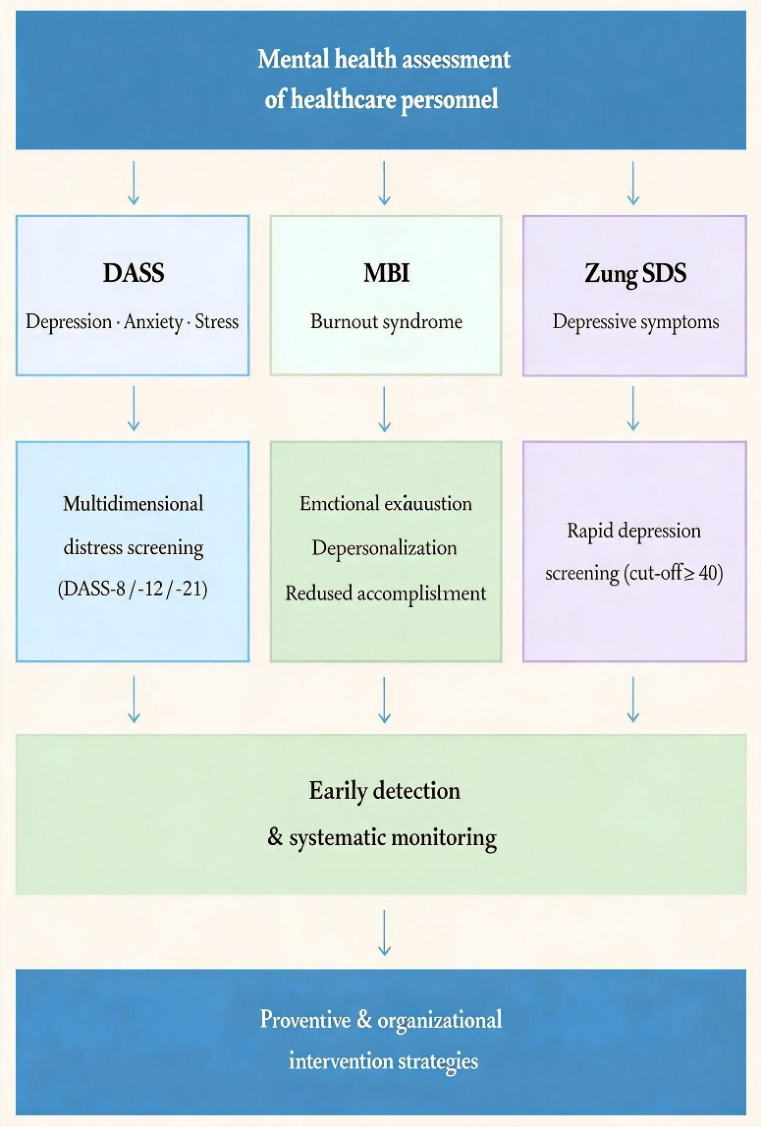
- DASS provides a multidimensional assessment of psychological distress; MBI is the primary tool for burnout evaluation, while Zung SDS enables rapid screening of depressive symptoms.
- DASS, MBI, and Zung SDS instruments may support early detection and monitoring of depression, anxiety, stress, and burnout in healthcare professionals, provided that they are used in an appropriate context and with adequate cultural and linguistic validation as well as appropriate cut-off points.
- Systematic monitoring using validated scales can improve preventive strategies, reduce burnout risk, and enhance the quality of healthcare services.
Abstract
1. Introduction
2. Materials and Methods
2.1. Review Design and Methodological Framework
2.2. Data Sources and Search Period
2.3. Search Strategy
2.4. Inclusion and Exclusion Criteria
2.5. Study Selection Process
2.6. Quality Assessment and Data Synthesis
2.7. Ethical Considerations
3. Results
3.1. Depression, Anxiety and Stress Scales (DASS)
3.1.1. Psychometric Properties and Comparison of DASS Versions
3.1.2. DASS in Clinical Populations
3.1.3. Cross-Cultural Validation of DASS
3.1.4. DASS in Specific Populations and Contexts
3.2. Maslach Burnout Inventory (MBI)
3.2.1. Application of MBI in Healthcare Settings
3.2.2. Psychometric Validation and Cross-Cultural Use of MBI
3.2.3. Critical Perspectives and Limitations of MBI
3.2.4. Comparison of MBI with Alternative Burnout Assessment Approaches
3.3. Zung Self-Rating Depression Scale (SDS)
3.3.1. Validation and Application of Zung SDS in Various Populations
3.3.2. Contemporary Evaluation and Limitations of Zung Scales
4. Discussion
5. Conclusions
6. Limitations
Supplementary Materials
Author Contributions
Funding
Institutional Review Board Statement
Informed Consent Statement
Data Availability Statement
Conflicts of Interest
Abbreviations
| DASS | Depression Anxiety Stress Scales |
| MBI | Maslach Burnout Inventory |
References
- Nagle, E.; Griskevica, I.; Rajevska, O.; Ivanovs, A.; Mihailova, S.; Skruzkalne, I. Factors Affecting Healthcare Workers Burnout and Their Conceptual Models: Scoping Review. BMC Psychol. 2024, 12, 637. [Google Scholar] [CrossRef] [PubMed]
- Amiri, S.; Mahmood, N.; Mustafa, H.; Javaid, S.F.; Khan, M.A.B. Occupational Risk Factors for Burnout Syndrome Among Healthcare Professionals: A Global Systematic Review and Meta-Analysis. Int. J. Environ. Res. Public Health 2024, 21, 1583. [Google Scholar] [CrossRef] [PubMed]
- Nagarajan, R.; Ramachandran, P.; Dilipkumar, R.; Kaur, P. Global Estimate of Burnout Among the Public Health Workforce: A Systematic Review and Meta-Analysis. Hum. Resour. Health 2024, 22, 30. [Google Scholar] [CrossRef] [PubMed]
- Quesada-Puga, C.; Izquierdo-Espin, F.J.; Membrive-Jiménez, M.J.; Aguayo-Estremera, R.; Cañadas-De La Fuente, G.A.; Romero-Béjar, J.L.; Gómez-Urquiza, J.L. Job Satisfaction and Burnout Syndrome Among Intensive-Care Unit Nurses: A Systematic Review and Meta-Analysis. Intensive Crit. Care Nurs. 2024, 83, 103660. [Google Scholar] [CrossRef] [PubMed]
- Kroenke, K.; Spitzer, R.L.; Williams, J.B.W. The PHQ-9: Validity of a Brief Depression Severity Measure. J. Gen. Intern. Med. 2001, 16, 606–613. [Google Scholar] [CrossRef] [PubMed]
- Spitzer, R.L.; Kroenke, K.; Williams, J.B.W.; Löwe, B. A Brief Measure for Assessing Generalized Anxiety Disorder: The GAD-7. Arch. Intern. Med. 2006, 166, 1092–1097. [Google Scholar] [CrossRef] [PubMed]
- Cohen, S.; Kamarck, T.; Mermelstein, R. A Global Measure of Perceived Stress. J. Health Soc. Behav. 1983, 24, 385–396. [Google Scholar] [CrossRef]
- Kristensen, T.S.; Borritz, M.; Villadsen, E.; Christensen, K.B. The Copenhagen Burnout Inventory: A New Tool for the Assessment of Burnout. Work Stress 2005, 19, 192–207. [Google Scholar] [CrossRef]
- Jesus, A.; Pitacho, L.; Moreira, A. Burnout and Suicidal Behaviours in Health Professionals in Portugal: The Moderating Effect of Self-Esteem. Int. J. Environ. Res. Public Health 2023, 20, 4325. [Google Scholar] [CrossRef] [PubMed]
- Soares, J.P.; Lopes, R.H.; Mendonça, P.B.S.; Silva, C.R.D.V.; Rodrigues, C.C.F.M.; Castro, J.L. Use of the Maslach Burnout Inventory Among Public Health Care Professionals: Scoping Review. JMIR Ment. Health 2023, 10, e44195. [Google Scholar] [CrossRef] [PubMed]
- Lovibond, S.H.; Lovibond, P.F. Manual for the Depression Anxiety Stress Scales, 2nd ed.; Psychology Foundation of Australia: Sydney, Australia, 1995. [Google Scholar]
- Moret-Tatay, A.; Pérez-Bermejo, M.; Murillo Llorente, M.T.; Moret-Tatay, C.; Esteve-Rodrigo, J.V.; De Stasio, S. Comparing Short Versions of the Depression, Anxiety and Stress Scale (DASS): A Psychometric Study in the Italian General Population. Acta Psychol. 2025, 259, 105372. [Google Scholar] [CrossRef] [PubMed]
- Wang, X.; Cao, C.H.; Liao, X.L.; Jiang, X.Y.; Griffiths, M.D.; Chen, I.H.; Lin, C.Y.; Malas, O. Comparing the Psychometric Evidence of the Depression, Anxiety, and Stress Scale-21 (DASS-21) between Spanish and Chinese Primary Schoolteachers: Insights from Classical Test Theory and Rasch Analysis. BMC Psychol. 2025, 13, 450. [Google Scholar] [CrossRef] [PubMed]
- Fox, R.S.; Lillis, T.A.; Gerhart, J.; Hoerger, M.; Duberstein, P. Multiple Group Confirmatory Factor Analysis of the DASS-21 Depression and Anxiety Scales: How Do They Perform in a Cancer Sample? Psychol. Rep. 2018, 121, 548–565. [Google Scholar] [CrossRef] [PubMed]
- Ali, A.M.; Alkhamees, A.A.; Hori, H.; Kim, Y.; Kunugi, H. The Depression Anxiety Stress Scale 21: Development and Validation of the Depression Anxiety Stress Scale 8-Item in Psychiatric Patients and the General Public for Easier Mental Health Measurement in a Post COVID-19 World. Int. J. Environ. Res. Public Health 2021, 18, 10142. [Google Scholar] [CrossRef] [PubMed]
- Makara-Studzińska, M.; Tyburski, E.; Załuski, M.; Adamczyk, K.; Mesterhazy, J.; Mesterhazy, A. Confirmatory Factor Analysis of Three Versions of the Depression Anxiety Stress Scale (DASS-42, DASS-21, and DASS-12) in Polish Adults. Front. Psychiatry 2022, 12, 770532. [Google Scholar] [CrossRef] [PubMed]
- Laranjeira, C.; Querido, A.; Sousa, P.; Dixe, M.A. Assessment and Psychometric Properties of the 21-Item Depression Anxiety Stress Scale (DASS-21) among Portuguese Higher Education Students during the COVID-19 Pandemic. Eur. J. Investig. Health Psychol. Educ. 2023, 13, 2546–2560. [Google Scholar] [CrossRef] [PubMed]
- Manzar, M.D.; Salahuddin, M.; Nureye, D.; Kashoo, F.Z.; Noohu, M.M.; Alotaibi, J.S.; Alamri, M.S.; Griffiths, M.D. Depression, Anxiety, and Stress Scale-21 (DASS-21): Further Psychometric Exploration Using Robust Item Response Theory and Classical Theory Measures Among University Students. PLoS ONE 2025, 20, e0325238. [Google Scholar] [CrossRef] [PubMed]
- Yılmaz Koğar, E.; Koğar, H. Using a Bifactor Exploratory Structural Equation Modeling Framework to Examine the Factor Structure of the Depression Anxiety and Stress Scales-21. Curr. Psychol. 2022, 42, 25807–25821. [Google Scholar] [CrossRef] [PubMed]
- Kakemam, E.; Navvabi, E.; Albelbeisi, A.H.; Saeedikia, F.; Rouhi, A.; Majidi, S. Psychometric Properties of the Persian Version of Depression Anxiety Stress Scale-21 Items (DASS-21) in a Sample of Health Professionals: A Cross-Sectional Study. BMC Health Serv. Res. 2022, 22, 111. [Google Scholar] [CrossRef] [PubMed]
- Hilvano-Cabungcal, A.M.; Bonito, S.R. Job-Related Factors Associated with Depression, Anxiety, and Stress among Healthcare Workers in a Tertiary Government Hospital in Metro Manila during the COVID-19 Pandemic. Acta Med. Philipp. 2025, 59, 57–65. [Google Scholar] [CrossRef] [PubMed]
- Pachi, A.; Sikaras, C.; Melas, D.; Alikanioti, S.; Soultanis, N.; Ivanidou, M.; Ilias, I.; Tselebis, A. Stress, Anxiety and Depressive Symptoms, Burnout and Insomnia Among Greek Nurses One Year After the End of the Pandemic: A Moderated Chain Mediation Model. J. Clin. Med. 2025, 14, 1145. [Google Scholar] [CrossRef] [PubMed]
- Maslach, C.; Jackson, S.E. Maslach Burnout Inventory Manual; Consulting Psychologists Press: Palo Alto, CA, USA, 1981. [Google Scholar]
- Lin, C.-Y.; Alimoradi, Z.; Griffiths, M.D.; Pakpour, A.H. Psychometric Properties of the Maslach Burnout Inventory for Medical Personnel (MBI-HSS-MP). Heliyon 2022, 8, e08868. [Google Scholar] [CrossRef] [PubMed]
- Bianchi, R.; Swingler, G.; Schonfeld, I.S. The Maslach Burnout Inventory Is Not a Measure of Burnout. Work 2024, 79, 1525–1527. [Google Scholar] [CrossRef] [PubMed]
- Knox, M.; Willard-Grace, R.; Huang, B.; Grumbach, K. Maslach Burnout Inventory and a Self-Defined, Single-Item Burnout Measure Produce Different Clinician and Staff Burnout Estimates. J. Gen. Intern. Med. 2018, 33, 1344–1351. [Google Scholar] [CrossRef] [PubMed]
- Zung, W.W.K. A Self-Rating Depression Scale. Arch. Gen. Psychiatry 1965, 12, 63–70. [Google Scholar] [CrossRef] [PubMed]
- Jokelainen, J.; Timonen, M.; Keinänen-Kiukaanniemi, S.; Härkönen, P.; Jurvelin, H.; Suija, K. Validation of the Zung Self-Rating Depression Scale (SDS) in Older Adults. Scand. J. Prim. Health Care 2019, 37, 353–357. [Google Scholar] [CrossRef] [PubMed]
- Lu, G.; Xiao, S.; He, J.; Xie, W.; Ge, W.; Meng, F.; Yang, Y.; Yu, S.; Liu, R. Prevalence of Depression and Its Correlation with Anxiety, Headache and Sleep Disorders among Medical Staff in the Hainan Province of China. Front. Public Health 2023, 11, 1122626. [Google Scholar] [CrossRef] [PubMed]
- Li, G.; Wei, C.; Fang, K.; Jiang, H.; Liu, Q.; Ou, J. The Correlated Factors of Anxiety and Depression among Chinese Hospital Staff during the COVID-19 Local Outbreak. Medicine 2024, 103, e40190. [Google Scholar] [CrossRef] [PubMed]
- Zhang, P.; Tang, L.; Ciren, D. Anxiety and Depression Survey and Analysis of Hospital Staff in a Designated Hospital in Shannan City During the COVID-19 Pandemic. Med. Sci. Monit. Basic Res. 2023, 29, e939514. [Google Scholar] [CrossRef] [PubMed]
- Li, S.; Shang, S.; Wang, J.; Yang, B.; Jiang, W. Research on the Psychological Status of Medical Staff during the COVID-19 Epidemic in China: A Longitudinal Study. Medicine 2023, 102, e34750. [Google Scholar] [CrossRef] [PubMed]
- Dunstan, D.A.; Scott, N. Clarification of the Cut-Off Score for Zung’s Self-Rating Depression Scale. BMC Psychiatry 2019, 19, 177. [Google Scholar] [CrossRef] [PubMed]
- Cheng, L.; Gao, W.; Xu, Y.; Yu, Z.; Wang, W.; Zhou, J.; Zang, Y. Anxiety and Depression in Rheumatoid Arthritis Patients: Prevalence, Risk Factors and Consistency between the Hospital Anxiety and Depression Scale and Zung’s Self-Rating Anxiety Scale/Depression Scale. Rheumatol. Adv. Pract. 2023, 7, rkad100. [Google Scholar] [CrossRef] [PubMed]
- Dunstan, D.A.; Scott, N.; Todd, A.K. Screening for Anxiety and Depression: Reassessing the Utility of the Zung Scales. BMC Psychiatry 2017, 17, 329. [Google Scholar] [CrossRef] [PubMed]



| Version | Items (Per Subscale) | Factor Structure/Reliability | Recommended Use |
|---|---|---|---|
| DASS-42 | 42 (14) | Original instrument; robust three-factor structure; high internal consistency | Full assessment and research baseline; longest administration |
| DASS-21 | 21 (7) | Most widely used version; three-factor structure replicated in systematic review/meta-analysis; subscale reliability typically reported as Cronbach’s α ≈ 0.80–0.94 | Standard choice across populations, including healthcare workers, when symptom differentiation matters |
| DASS-12 | 12 (4) | Retains a good three-factor structure (Polish adults), described as the best compromise between brevity and structural clarity | When symptom differentiation is needed but administration time is limited |
| DASS-8 | 8 | Best model fit and highest explained variance among the short forms, but limited domain coverage; most stable short form in a Saudi general + psychiatric sample | Rapid screening in primary healthcare and digital platforms |
| Attribute | DASS (Focus: DASS-21) | MBI (MBI-HSS/ MBI-HSS-MP) | Zung SDS |
|---|---|---|---|
| Construct(s) measured | Depression, anxiety, and stress (three negative emotional states) | Burnout | Depression severity |
| Developer (year) | Lovibond & Lovibond (1995) [11]; DASS-21 is the short form of the DASS-42 | Maslach & Jackson (1981) [23]; MBI-HSS-MP adapted for medical personnel | Zung (1965) [27] |
| Number of items | 21 (7 per subscale); full DASS-42 = 42 | 22 (MBI-HSS/MBI-HSS-MP) | 20 |
| Domains/ subscales | 3 subscales: Depression, Anxiety, Stress | 3 dimensions: emotional exhaustion, depersonalization, (reduced) personal accomplishment | Affective, cognitive, and somatic symptoms (2–4 factor solutions reported) |
| Response format | 4-point Likert (0–3); applies to the past week | 7-point frequency scale (0 = never… 6 = every day) | 4-point frequency scale (1–4); several items reverse-scored |
| Scoring | Sum 7 items per subscale; multiply by 2 for DASS-42 equivalence | Three separate subscale scores; no single total burnout score | Raw sum (20–80) → SDS Index = raw × 1.25 |
| Score range | 0–21 raw/0–42 per subscale (doubled) | Subscale-dependent (MBI-HSS: EE 0–54, DP 0–30, PA 0–48) | Raw 20–80/Index 25–100 |
| Cut-off/ interpretation | Severity bands per subscale (e.g., Depression: normal 0–9, mild 10–13, moderate 14–20, severe 21–27, extremely severe ≥28, doubled scores) | Subscale-specific high/moderate/low bands; thresholds vary by version and manual | Index < 50 normal, 50–59 mild, 60–69 moderate–marked, ≥70 severe |
| Administration time | ≈5–10 min | ≈10–15 min | ≈5–10 min |
| Licensing/cost | Free; public domain for research and clinical use (commercial use may require permission from the Psychology Foundation of Australia) | Proprietary (© Maslach & Jackson); licensed/purchased per administration via Mind Garden—not free | Freely reproduced; no central commercial licensor (Zung, 1965 [27]) |
| Populations validated in | General population, students, adolescents, older adults, oncology and chronic-illness patients, and healthcare workers; broad cross-cultural validation | Healthcare professionals internationally (e.g., Taiwan, Iran, UK, Sweden, Peru, Brazil); across genders and roles | Older adults, chronic-illness patients (e.g., RA, NSCLC), general and clinical populations; international cohorts |
| Key strengths | Three priority constructs in one brief tool; replicated three-factor structure; several validated short forms; free | Gold standard for burnout; internationally confirmed three-factor structure; comparability with the largest body of burnout research | Very short, simple, low reading level; rapid screening; long validation history |
| Main limitations | Subscales are correlated (especially depression–stress); some samples favor a one-factor solution; not diagnostic | Predominantly emotional-exhaustion focused; omits cognitive/physical and contextual dimensions; version/scoring heterogeneity limits cross-study comparison; can underestimate prevalence vs. single-item measures; licensing cost | Dated item wording; raw-vs-index cut-off confusion; less discriminating than newer multidimensional tools; best used as an initial screen |
| Suitability for healthcare staff | High—covers depression, anxiety and stress in one short administration | High for burnout specifically; pair with a distress measure for full coverage | Moderate–high as a quick depression screen; recommended alongside more comprehensive instruments |
Disclaimer/Publisher’s Note: The statements, opinions and data contained in all publications are solely those of the individual author(s) and contributor(s) and not of MDPI and/or the editor(s). MDPI and/or the editor(s) disclaim responsibility for any injury to people or property resulting from any ideas, methods, instructions or products referred to in the content. |
© 2026 by the authors. Licensee MDPI, Basel, Switzerland. This article is an open access article distributed under the terms and conditions of the Creative Commons Attribution (CC BY) license.
Share and Cite
Lupieri, T.; Hrvačić, M.; Švob Štrac, D.; Uzun, S.; Degmečić, D. Assessment of Mental Health in Healthcare Personnel: A Review of DASS, MBI, and Zung Scales. Healthcare 2026, 14, 2006. https://doi.org/10.3390/healthcare14132006
Lupieri T, Hrvačić M, Švob Štrac D, Uzun S, Degmečić D. Assessment of Mental Health in Healthcare Personnel: A Review of DASS, MBI, and Zung Scales. Healthcare. 2026; 14(13):2006. https://doi.org/10.3390/healthcare14132006
Chicago/Turabian StyleLupieri, Tanja, Martina Hrvačić, Dubravka Švob Štrac, Suzana Uzun, and Dunja Degmečić. 2026. "Assessment of Mental Health in Healthcare Personnel: A Review of DASS, MBI, and Zung Scales" Healthcare 14, no. 13: 2006. https://doi.org/10.3390/healthcare14132006
APA StyleLupieri, T., Hrvačić, M., Švob Štrac, D., Uzun, S., & Degmečić, D. (2026). Assessment of Mental Health in Healthcare Personnel: A Review of DASS, MBI, and Zung Scales. Healthcare, 14(13), 2006. https://doi.org/10.3390/healthcare14132006