Alcohol-Related Perceptions and High-Risk Drinking Among Brazilian College Students: The Role of Social Contexts, Motives, and Risk Behaviors

 , , , , ,
  ,
, 
Highlights
- Positive alcohol-related perceptions were associated with higher odds of high-risk alcohol use, whereas negative perceptions were inversely associated with risk indicators.
- Drinking in nightclubs/parties and bars, and driving after drinking, were strongly associated with high-risk alcohol use among Brazilian college students.
- University-based alcohol prevention efforts may benefit from addressing the perceived social and emotional rewards of drinking, not only alcohol-related harms.
- These findings highlight the relevance of high-risk social settings, driving after drinking, and combined alcohol use with other substances as potential targets for future harm-reduction research and intervention planning.
Abstract
1. Introduction
2. Materials and Methods
2.1. Study Design and Sample
2.2. Instruments
2.3. Data Analysis
3. Results
3.1. Sociodemographic Characteristics and Alcohol Consumption Profile
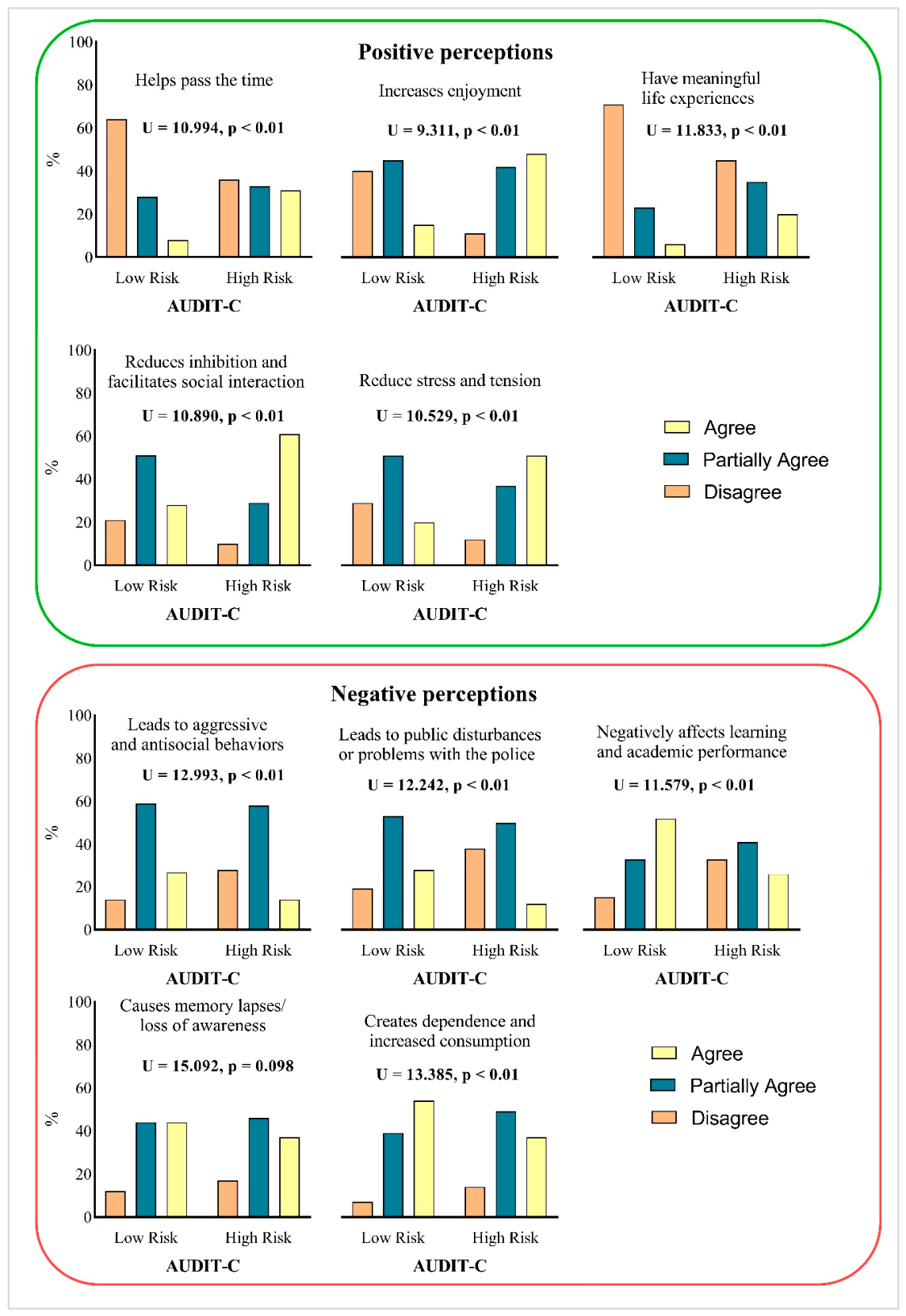
3.2. Positive and Negative Perceptions Regarding Alcohol Consumption
3.3. Differences in Perceptions Regarding Alcohol Consumption
3.4. Alcohol-Related Perceptions, Drinking Locations, and Risky Consumption
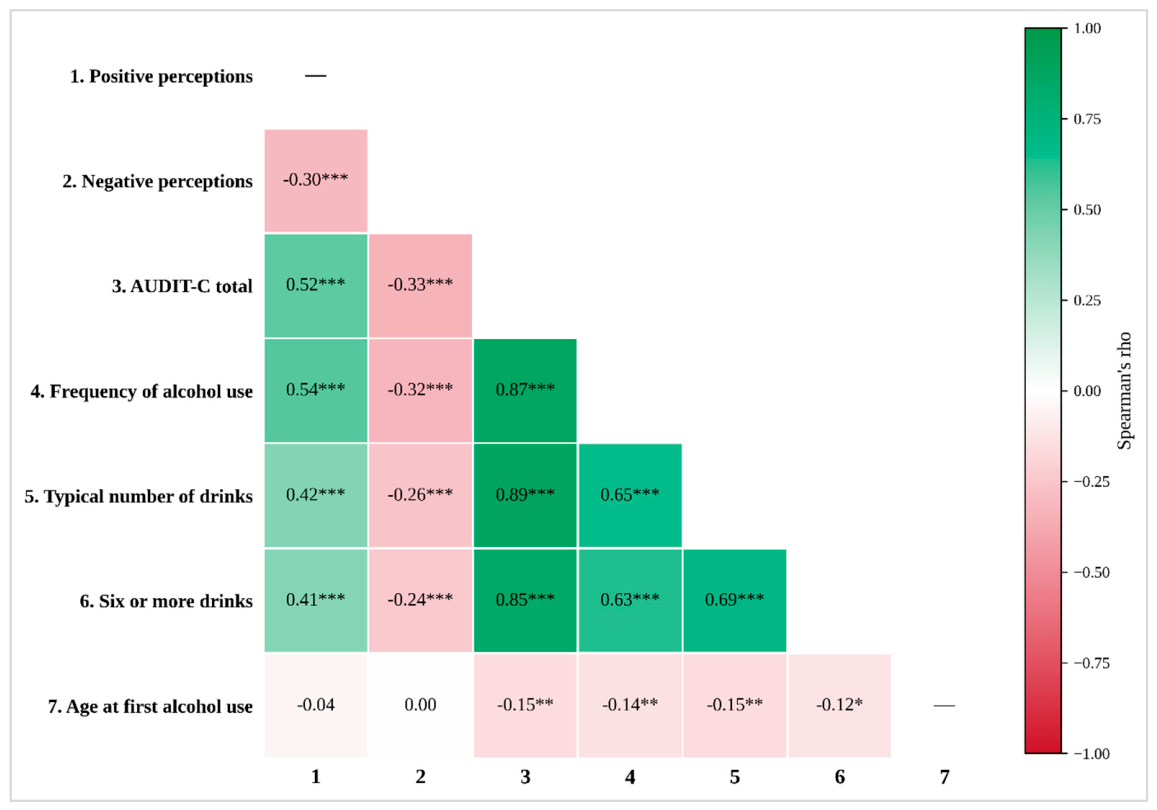
3.5. Complementary Correlations Among Perceptions and Alcohol Consumption Indicators
3.6. Risk Behaviors, Motivations, and Alcohol Consumption
3.7. Sensitivity Analyses
4. Discussion
5. Conclusions
Author Contributions
Funding
Institutional Review Board Statement
Informed Consent Statement
Data Availability Statement
Acknowledgments
Conflicts of Interest
Appendix A. Sensitivity Analyses

| Variables Examined | Outcome | aOR | 95% CI | p |
|---|---|---|---|---|
| Alcohol-related perceptions | ||||
| Positive perceptions | High-risk alcohol use | 4.76 | 2.99–7.58 | *** |
| Negative perceptions | 0.42 | 0.25–0.70 | *** | |
| Drinking locations | ||||
| Bars | High-risk alcohol use | 4.24 | 2.47–7.27 | *** |
| Restaurants | 0.64 | 0.32–1.29 | 0.21 | |
| Snack bars | 1.41 | 0.50–4.01 | 0.52 | |
| Nightclubs/parties | 4.43 | 2.62–7.49 | *** | |
| At home | 2.10 | 1.23–3.57 | ** | |
| Drinking locations | ||||
| Bars | Frequent consumption of six or more drinks | 9.39 | 4.25–20.71 | *** |
| Restaurants | 1.43 | 0.68–3.01 | 0.35 | |
| Snack bars | 0.77 | 0.27–2.22 | 0.63 | |
| Nightclubs/parties | 1.77 | 0.93–3.37 | 0.08 | |
| At home | 0.59 | 0.31–1.10 | 0.10 |
| Alcohol-Related Factors | aOR | 95% CI | p |
|---|---|---|---|
| Risk behaviors and consequences | |||
| Sexual intercourse under the influence of alcohol | 1.87 | 0.97–3.60 | 0.06 |
| Fights | 0.53 | 0.25–1.16 | 0.11 |
| Driving after drinking | 4.77 | 2.08–10.95 | *** |
| Riding with a drunk driver | 1.20 | 0.69–2.08 | 0.51 |
| Unprotected sex | 1.31 | 0.66–2.60 | 0.44 |
| Combined alcohol with other drugs | 3.00 | 1.71–5.26 | *** |
| Drinking motives | |||
| Enjoyment | 3.47 | 2.06–5.85 | *** |
| Curiosity | 1.43 | 0.81–2.50 | 0.22 |
| Peer influence/everyone drinks | 2.86 | 1.30–6.30 | ** |
| Forgetting problems | 2.93 | 1.05–8.17 | * |
| Relaxation | 2.06 | 1.16–3.66 | * |
| Enjoy drinking | 1.53 | 0.84–2.79 | 0.17 |
| Socializing | 2.04 | 1.05–3.96 | * |
| Loss of inhibitions | 1.38 | 0.53–3.60 | 0.50 |
| Other substance use | |||
| Tobacco | 1.37 | 0.72–2.60 | 0.34 |
| Electronic cigarette | 5.36 | 1.01–28.39 | * |
| Hookah | 0.66 | 0.02–18.62 | 0.81 |
| Inhalants | 2.59 | 0.24–28.13 | 0.43 |
| Marijuana | 2.61 | 1.46–4.67 | ** |
| Cocaine/crack | 1.62 | 0.39–6.78 | 0.51 |
| Psychedelics | 2.26 | 0.70–7.34 | 0.17 |
References
- Volkow, N.D.; Blanco, C. Substance use disorders: A comprehensive update of classification, epidemiology, neurobiology, clinical aspects, treatment and prevention. World Psychiatry 2023, 22, 203–229. [Google Scholar] [CrossRef] [PubMed]
- Centers for Disease Control and Prevention. Centers for Disease Control and Prevention. U.S. Department of Health and Human Services. Deaths from Excessive Alcohol Use in the United States. 2024. Available online: https://www.cdc.gov/mmwr/volumes/73/wr/mm7308a1.htm (accessed on 27 May 2026).
- Substance Abuse and Mental Health Services Administration. Key Substance Use and Mental Health Indicators in the United States: Results from the 2019 National Survey on Drug Use and Health; PEP20-07-01-001; Relatório HHS Publication, NSDUH Series H-55; Center for Behavioral Health Statistics and Quality, Substance Abuse and Mental Health Services Administration: Rockville, MD, USA, 2020. Available online: https://www.samhsa.gov/data/report/2019-nsduh-annual-national-report (accessed on 27 March 2026).
- World Health Organization. Global Status Report on Alcohol and Health 2018; World Health Organization: Geneva, Switzerland, 2018. [Google Scholar]
- Isaksson, J.; Sjöblom, S.; Schwab-Stone, M.; Stickley, A.; Ruchkin, V. Risk Factors Associated with Alcohol Use in Early Adolescence among American Inner-City Youth: A Longitudinal Study. Subst. Use Misuse 2020, 55, 358–366. [Google Scholar] [CrossRef] [PubMed]
- Krieger, H. The Epidemiology of Binge Drinking Among College-Age Individuals in the United States. Alcohol Res. Curr. Rev. 2018, 39, 23. [Google Scholar] [CrossRef] [PubMed]
- Allen, H.K.; Barrall, A.L.; Beck, K.H.; Vincent, K.B.; Arria, A.M. Situational context and motives of alcohol use among graduate student drinkers. Addict. Behav. 2020, 104, 106267. [Google Scholar] [CrossRef] [PubMed]
- Gomes, A.C.; Reichert, R.A.; De Micheli, D. Influência social e uso de álcool, cigarros eletrônicos e narguilé: Um estudo das percepções e motivações de estudantes universitários brasileiros. Rev. Inter. Educ. Sup. 2024, 11, e025035. [Google Scholar] [CrossRef]
- Montes, K.S.; Witkiewitz, K.; Pearson, M.R.; Leventhal, A.M. Alcohol, tobacco, and marijuana expectancies as predictors of substance use initiation in adolescence: A longitudinal examination. Psychol. Addict. Behav. 2019, 33, 26–34. [Google Scholar] [CrossRef] [PubMed]
- Stephenson, M.; Barr, P.; Ksinan, A.; Aliev, F.; Latvala, A.; Viken, R.; Rose, R.; Kaprio, J.; Dick, D.; Salvatore, J.E. Which adolescent factors predict alcohol misuse in young adulthood? A co-twin comparisons study. Addiction 2020, 115, 877–887. [Google Scholar] [CrossRef] [PubMed]
- Smith, M.A. Social Learning and Addiction. Behav. Brain Res. 2021, 398, 112954. [Google Scholar] [CrossRef] [PubMed]
- Sakae, T.M.; Dambrowski, K.; Remor, K.V.T. Prevalência do uso de substâncias psicoativas em estudantes dos cursos da área da saúde em uma universidade privada do sul do Brasil. Arq. Catarin. Med. 2017, 46, 140–153. [Google Scholar] [CrossRef]
- Kilian, C.; Klinger, S.; Manthey, J.; Rehm, J.; Huckle, T.; Probst, C. National and regional prevalence of interpersonal violence from others’ alcohol use: A systematic review and modelling study. Lancet Reg. Health Eur. 2024, 40, 100905. [Google Scholar] [CrossRef] [PubMed]
- Kenney, S.R.; DiGuiseppi, G.T.; Meisel, M.K.; Balestrieri, S.G.; Barnett, N.P. Poor mental health, peer drinking norms, and alcohol risk in a social network of first-year college students. Addict. Behav. 2018, 84, 151–159. [Google Scholar] [CrossRef] [PubMed]
- Silva, E.P.D.; Macena, R.H.M.; Araújo, L.F. Understanding the Interplay of Interpersonal Violence, Smoking, and Alcohol Consumption in Brazilian Adults: Evidence from a National Health Survey. J. Interpers. Violence 2026, 41, 2213–2241. [Google Scholar] [CrossRef] [PubMed]
- Lim, N.; Kennelly, N.; Chung, T.; Powell, M.Z.; Latendresse, S.J.; Sartor, C.E. Associations between alcohol-related parenting factors and youth alcohol expectancies: Considering the role of perceived friends’ disapproval of alcohol use. Alcohol Alcohol. 2026, 61, agag014. [Google Scholar] [CrossRef] [PubMed]
- Almeida, L.S.; Casanova, J.R.; Fernández, M.F.P.; Reppold, C.T.; Gonzalez, M.S.R. Validity studies of the scale of positive and negative perceptions about alcohol effects. Rev. Saúde Pública 2020, 54, 52. [Google Scholar] [CrossRef] [PubMed]
- Davidson, L.; Mefodeva, V.; Walter, Z.; Hides, L. Student perceptions of the current drinking culture in three Australian residential colleges: Drinking motives, consequences and recommendations for harm minimisation strategies. Drug Alcohol Rev. 2023, 42, 135–145. [Google Scholar] [CrossRef] [PubMed]
- Ghosh, A.; George, B.B.; Vij, J.; Pillai, R.R.; Soundappan, K.; Sharma, M.; Basu, D. Understanding Alcohol and Illicit Drug Use in Young College Students: A Qualitative Work from India Based on Social Norms Theory. Indian J. Psychol. Med. 2024, 02537176241283381. [Google Scholar] [CrossRef] [PubMed]
- Alshehri, F.S.; Ashour, A.M.; Bafhaid, H.S.; Algarni, A.S.; Harbi, M.H.; Alorfi, N.M. University Students’ Knowledge and Attitudes Toward Substance Abuse: A Cross-Sectional Study from Saudi Arabia. Healthcare 2025, 13, 1122. [Google Scholar] [CrossRef] [PubMed]
- de Sousa, Â.S.; de Moura Rocha, L.; de Sousa, I.J.; de Sousa, M.A.; Sipauba, F.A.; da Silva, S.V.; Paz, M.O.; Privado, P.F.; da Cruz Araujo, T.; de Sousa, L.S.; et al. Avaliação do consumo de bebidas alcoólicas entre estudantes universitários: Uma revisão prospectiva. Cad. Pedagógico 2024, 21, e7827. [Google Scholar] [CrossRef]
- Lojszczyk, A.; Wilson, R.; Wood, J.; Hutton, A. Motivational characteristics of recreational drug use among emerging adults in social settings: An integrative literature review. Front. Public Health 2023, 11, 1235387. [Google Scholar] [CrossRef] [PubMed]
- Pires, I.T.M.; Farinha, M.G.; Pillon, S.C.; Santos, M.A.D. Uso de Álcool e outras Substâncias Psicoativas por Estudantes Universitários de Psicologia. Psicol. Ciência Profissão 2020, 40, e191670. [Google Scholar] [CrossRef]
- Stamates, A.L.; Preonas, P.D.; Linden-Carmichael, A.N.; Junkin, E.; Roberts, R.; Lau-Barraco, C. Daily positive alcohol expectancies and alcohol use outcomes among college students. Addict. Res. Theory 2024, 32, 219–224. [Google Scholar] [CrossRef] [PubMed]
- Cortés-Tomás, M.T.; Giménez-Costa, J.A.; Motos-Sellés, P.; Sancerni-Beitia, M.D. Consequences, Motives, and Expectancies of Consumption as Predictors of Binge Drinking in University Women. Front. Psychol. 2022, 13, 862334. [Google Scholar] [CrossRef] [PubMed]
- Rhew, I.C.; Duckworth, J.C.; Lee, C.M. The association between intended drinking contexts and alcohol expectancies in college students: A daily diary study. Addict. Behav. 2021, 120, 106967. [Google Scholar] [CrossRef] [PubMed]
- Bartel, S.J.; Sherry, S.B.; Stewart, S.H. Examining Social Influences on Why We Drink: Perceived Drinking Motives in the Social Network Impact Individuals’ Own Drinking Motives and Alcohol Use. Subst. Use Misuse 2022, 57, 1931–1939. [Google Scholar] [CrossRef] [PubMed]
- Mackinnon, S.P.; Couture, M.E.; Cooper, M.L.; Kuntsche, E.; O’Connor, R.M.; Stewart, S.H.; DRINC Team. Cross-cultural comparisons of drinking motives in 10 countries: Data from the DRINC project. Drug Alcohol Rev. 2017, 36, 721–730. [Google Scholar] [CrossRef] [PubMed]
- Vornlocher, C.; Shiota, M.N. Drinking While Stressed and Drinking to Cope Differentially Relate to Mental Health. Behav. Sci. 2024, 14, 402. [Google Scholar] [CrossRef] [PubMed]


| Category | Subcategory | N | % |
|---|---|---|---|
| Gender | Female | 237 | 64.6 |
| Male | 122 | 33.2 | |
| Non-binary | 6 | 1.6 | |
| Gender fluid | 2 | 0.5 | |
| Education system | Public | 208 | 56.7 |
| Private | 143 | 39.0 | |
| Cooperative | 16 | 4.4 | |
| Study load | Part time | 262 | 71.4 |
| Full time | 105 | 28.6 | |
| Field of study | Humanities | 223 | 60.8 |
| Biological/Health Sciences | 83 | 22.6 | |
| Exact Sciences | 61 | 16.6 | |
| Alcohol consumption | Regular users | 299 | 81.5 |
| Non-users | 68 | 18.5 | |
| Age of onset of alcohol consumption | 0–5 years | 5 | 1.4 |
| 6–10 years | 17 | 4.6 | |
| 11–15 years | 147 | 40.1 | |
| 16–20 years | 185 | 50.4 | |
| 21–25 years | 10 | 2.7 | |
| 26–30 years | 3 | 0.8 | |
| Problems with alcohol use in the family | Yes | 226 | 61.6 |
| No | 78 | 21.3 | |
| Unknown | 63 | 17.2 | |
| AUDIT-C classification | High risk | 204 | 55.6 |
| Low risk | 163 | 44.4 | |
| AUDIT-C classification by gender | Female: high risk | 136 | 57.4 |
| Female: low risk | 101 | 42.6 | |
| Male: high risk | 64 | 52.5 | |
| Male: low risk | 58 | 47.5 | |
| Non-binary: high risk | 3 | 50.0 | |
| Non-binary: low risk | 3 | 50.0 | |
| Gender fluid: high risk | 1 | 50.0 | |
| Gender fluid: low risk | 1 | 50.0 |
| Item Evaluated | Agree n (%) | Partially Agree n (%) | Disagree n (%) | χ2 | p | Effect |
|---|---|---|---|---|---|---|
| Specific negative perceptions | ||||||
| Drinking alcohol leads to aggressive and antisocial behavior | 72 (19.6) | 214 (58.3) | 81 (22.1) | 16.57 | *** | 0.21 |
| Drinking alcohol is addictive and leads to increased consumption | 163 (44.4) | 164 (44.7) | 40 (10.9) | 12.62 | ** | 0.19 |
| Drinking alcohol causes disturbances of peace or problems with the police | 71 (19.3) | 188 (51.2) | 108 (29.4) | 22.87 | *** | 0.25 |
| Drinking alcohol causes memory lapses/loss of awareness | 147 (40.1) | 165 (45.0) | 55 (15.0) | 2.81 | 0.24 | 0.09 |
| Drinking alcohol negatively affects learning and academic performance | 137 (37.3) | 137 (37.3) | 93 (25.3) | 28.81 | *** | 0.28 |
| Specific positive perceptions | ||||||
| Drinking alcohol increases enjoyment | 122 (33.2) | 158 (43.1) | 87 (23.7) | 60.83 | *** | 0.41 |
| Drinking alcohol makes it easier to pass the time | 75 (20.4) | 113 (30.8) | 179 (48.8) | 37.96 | *** | 0.32 |
| Drinking alcohol facilitates meaningful life experiences | 50 (13.6) | 109 (29.7) | 208 (56.7) | 29.02 | *** | 0.28 |
| Drinking alcohol helps relieve stress or tension | 137 (37.3) | 158 (43.1) | 72 (19.6) | 43.26 | *** | 0.34 |
| Drinking alcohol loosens inhibitions and facilitates contact with colleagues | 169 (46.0) | 143 (39.0) | 55 (15.0) | 40.65 | *** | 0.33 |
| Variables Examined | High-Risk Alcohol Use | ||
|---|---|---|---|
| aOR | 95% CI | p | |
| Alcohol-related perceptions | |||
| Positive perceptions | 4.85 | 3.05–7.69 | *** |
| Negative perceptions | 0.50 | 0.31–0.79 | ** |
| Drinking locations | |||
| Bars | 3.91 | 2.33–6.55 | *** |
| Restaurants | 0.64 | 0.32–1.28 | 0.21 |
| Snack bars | 1.45 | 0.52–4.03 | 0.48 |
| Nightclubs/parties | 4.44 | 2.68–7.36 | *** |
| At home | 1.95 | 1.16–3.27 | * |
| Frequent consumption of six or more drinks | |||
| Drinking locations | |||
| Bars | 2.16 | 1.29–3.63 | ** |
| Restaurants | 0.99 | 0.53–1.86 | 0.97 |
| Snack bars | 0.74 | 0.28–1.99 | 0.56 |
| Nightclubs/parties | 0.66 | 0.41–1.08 | 0.10 |
| At home | 0.42 | 0.26–0.70 | *** |
| Alcohol-Related Factors | Risk Behaviors and Consequences | ||
|---|---|---|---|
| aOR | 95% CI | p | |
| Sexual intercourse under the influence of alcohol | 1.91 | 1.01–3.62 | * |
| Fights | 0.50 | 0.23–1.09 | 0.08 |
| Driving after drinking | 5.25 | 2.37–11.63 | *** |
| Riding with a drunk driver | 1.26 | 0.74–2.16 | 0.39 |
| Unprotected sex | 1.35 | 0.69–2.65 | 0.38 |
| Combined alcohol with other drugs | 2.76 | 1.60–4.76 | *** |
| Drinking motives | |||
| aOR | 95% CI | p | |
| Enjoyment | 3.60 | 2.17–5.97 | *** |
| Curiosity | 1.29 | 0.74–2.23 | 0.37 |
| Peer influence/everyone drinks | 2.77 | 1.30–5.90 | ** |
| Forgetting problems | 2.73 | 0.98–7.62 | 0.05 |
| Relaxation | 1.96 | 1.12–3.45 | * |
| Enjoy drinking | 1.61 | 0.90–2.87 | 0.11 |
| Socializing | 1.96 | 1.03–3.75 | * |
| Loss of inhibitions | 1.60 | 0.64–4.05 | 0.32 |
| Other substance use | |||
| aOR | 95% CI | p | |
| Tobacco | 1.26 | 0.67–2.38 | 0.47 |
| Electronic cigarette | 5.10 | 1.00–26.05 | 0.05 |
| Hookah | 0.66 | 0.03–15.61 | 0.80 |
| Inhalants | 3.14 | 0.31–32.37 | 0.34 |
| Marijuana | 2.47 | 1.41–4.33 | ** |
| Cocaine/crack | 1.93 | 0.48–7.81 | 0.36 |
| Psychedelics | 2.25 | 0.70–7.23 | 0.17 |
Disclaimer/Publisher’s Note: The statements, opinions and data contained in all publications are solely those of the individual author(s) and contributor(s) and not of MDPI and/or the editor(s). MDPI and/or the editor(s) disclaim responsibility for any injury to people or property resulting from any ideas, methods, instructions or products referred to in the content. |
© 2026 by the authors. Licensee MDPI, Basel, Switzerland. This article is an open access article distributed under the terms and conditions of the Creative Commons Attribution (CC BY) license.
Share and Cite
De Micheli, D.; da Silva, G.G.; Reichert, R.A.; Scatena, A.; da Silva, L.S.; Marchesano, V.d.S.; Dutra, B.B.; Freires, E.M.; Vitta, A.S.L.; de Oliveira, W.A.; et al. Alcohol-Related Perceptions and High-Risk Drinking Among Brazilian College Students: The Role of Social Contexts, Motives, and Risk Behaviors. Healthcare 2026, 14, 1993. https://doi.org/10.3390/healthcare14131993
De Micheli D, da Silva GG, Reichert RA, Scatena A, da Silva LS, Marchesano VdS, Dutra BB, Freires EM, Vitta ASL, de Oliveira WA, et al. Alcohol-Related Perceptions and High-Risk Drinking Among Brazilian College Students: The Role of Social Contexts, Motives, and Risk Behaviors. Healthcare. 2026; 14(13):1993. https://doi.org/10.3390/healthcare14131993
Chicago/Turabian StyleDe Micheli, Denise, Geisa Gomes da Silva, Richard Alecsander Reichert, Adriana Scatena, Laura Soares da Silva, Vinícius de Souza Marchesano, Bruno Barros Dutra, Evelin Moreira Freires, Amanda Severo Lins Vitta, Wanderlei Abadio de Oliveira, and et al. 2026. "Alcohol-Related Perceptions and High-Risk Drinking Among Brazilian College Students: The Role of Social Contexts, Motives, and Risk Behaviors" Healthcare 14, no. 13: 1993. https://doi.org/10.3390/healthcare14131993
APA StyleDe Micheli, D., da Silva, G. G., Reichert, R. A., Scatena, A., da Silva, L. S., Marchesano, V. d. S., Dutra, B. B., Freires, E. M., Vitta, A. S. L., de Oliveira, W. A., Romualdo, C., Baptista, M. N., & Andrade, A. L. M. (2026). Alcohol-Related Perceptions and High-Risk Drinking Among Brazilian College Students: The Role of Social Contexts, Motives, and Risk Behaviors. Healthcare, 14(13), 1993. https://doi.org/10.3390/healthcare14131993