Advancing Undergraduate Student Mental Healthcare of Social Anxiety Disorder: Evaluating the Acceptance of AR-Assisted Cognitive Behavioral Therapy Through TAM-Based Constructs




Abstract
1. Introduction
2. Model Development and Hypotheses
2.1. Technology Acceptance Model
2.2. Self-Efficacy
2.3. Facilitating Conditions
2.4. Social Influence
3. Methods
3.1. Participants
3.2. Measurements
3.3. Data Analysis
4. Results
4.1. Measurement Model Assessment
4.2. Structural Model Assessment
5. Discussions
5.1. Theoretical Implications
5.2. Practical Implications
5.3. Limitations and Future Research Opportunities
6. Conclusions
Author Contributions
Funding
Institutional Review Board Statement
Informed Consent Statement
Data Availability Statement
Acknowledgments
Conflicts of Interest
Abbreviations
| AR | Augmented reality |
| ATU | Attitude toward using |
| AVE | Average variance extracted |
| BI | Behavioral intention to use |
| CBT | Cognitive behavioral therapy |
| CFA | Confirmatory factor analysis |
| CFI | Comparative fit index |
| CR | Composite reliability |
| FC | Facilitating conditions |
| FL | Factor loading |
| PEOU | Perceived ease of use |
| PU | Perceived usefulness |
| RMSEA | Root mean square error of approximation |
| SAD | Social anxiety disorder |
| SAVE | Square root of average variance extracted |
| SE | Self-efficacy |
| SEM | Structural equation modeling |
| SI | Social influence |
| SPIN | Social Phobia Inventory |
| SRMR | Standardized root mean square residual |
| TAM | Technology acceptance model |
References
- Tang, X.; Liu, Q.; Cai, F.; Tian, H.; Shi, X.; Tang, S. Prevalence of social anxiety disorder and symptoms among Chinese children, adolescents and young adults: A systematic review and meta-analysis. Front. Psychol. 2022, 13, 792356. [Google Scholar] [CrossRef] [PubMed]
- Man, S.S.; Li, X.; Lin, X.J.; Lee, Y.-C.; Chan, A.H.S. Assessing the effectiveness of virtual reality interventions on anxiety, stress, and negative emotions in college students: A meta-analysis of randomized controlled trials. Int. J. Hum.–Comput. Interact. 2025, 41, 10495–10511. [Google Scholar]
- Morrison, A.S.; Heimberg, R.G. Social anxiety and social anxiety disorder. Annu. Rev. Clin. Psychol. 2013, 9, 249–274. [Google Scholar] [CrossRef] [PubMed]
- Gao, W.; Li, Y.; Yuan, J.; He, Q. The shared and distinct mechanisms underlying fear of evaluation in social anxiety: The roles of negative and positive evaluation. Depress. Anxiety 2025, 2025, 9559056. [Google Scholar] [CrossRef] [PubMed]
- Wu, Y.; Li, X.; Ji, X.; Ren, W.; Zhu, Y.; Chen, Z.; Du, X. Trends in the epidemiology of anxiety disorders from 1990 to 2021: A global, regional, and national analysis with a focus on the sociodemographic index. J. Affect. Disord. 2025, 373, 166–174. [Google Scholar] [CrossRef] [PubMed]
- Khan, A.; Gul, A.; Rizwan, M.; Khan, S.H. Social anxiety disorder among university students: A narrative review of prevalence, impact and interventions. J. Asian Dev. Stud. 2025, 14, 925–933. [Google Scholar] [CrossRef]
- Wang, J.; Guan, X.; Tao, N. GBD: Incidence rates and prevalence of anxiety disorders, depression and schizophrenia in countries with different SDI levels, 1990–2021. Front. Public Health 2025, 13, 1556981. [Google Scholar] [CrossRef] [PubMed]
- Rozen, N.; Aderka, I.M. Emotions in social anxiety disorder: A review. J. Anxiety Disord. 2023, 95, 102696. [Google Scholar] [CrossRef] [PubMed]
- Aderka, I.M.; Hofmann, S.G.; Nickerson, A.; Hermesh, H.; Gilboa-Schechtman, E.; Marom, S. Functional impairment in social anxiety disorder. J. Anxiety Disord. 2012, 26, 393–400. [Google Scholar] [CrossRef] [PubMed]
- Baumann, H.; Ksiezarczyk, A.-M. Co-Creation of Mental Health Intervention for Adolescents: A Social Hackathon Approach. Healthcare 2026, 14, 1315. [Google Scholar] [CrossRef] [PubMed]
- Varrette, M.; Berkenstock, J.; Greenwood-Ericksen, A.; Ortega, A.; Michaels, F.; Pietrobon, V.; Schodorf, M. Exploring the efficacy of cognitive behavioral therapy and role-playing games as an intervention for adults with social anxiety. Soc. Work Groups 2023, 46, 140–156. [Google Scholar]
- Nicoară, N.D.; Marian, P.; Petriș, A.O.; Delcea, C.; Manole, F. A review of the role of cognitive-behavioral therapy on anxiety disorders of children and adolescents. Pharmacophore 2023, 14, 35–39. [Google Scholar] [CrossRef]
- Öst, L.-G.; Enebrink, P.; Finnes, A.; Ghaderi, A.; Havnen, A.; Kvale, G.; Salomonsson, S.; Wergeland, G.J. Cognitive behavior therapy for adult anxiety disorders in routine clinical care: A systematic review and meta-analysis. Clin. Psychol. Sci. Pract. 2023, 30, 272. [Google Scholar] [CrossRef]
- Heimberg, R.G. Cognitive-behavioral therapy for social anxiety disorder: Current status and future directions. Biol. Psychiatry 2002, 51, 101–108. [Google Scholar] [CrossRef] [PubMed]
- Perera, R. Transformation of cognitive behavior therapy as a psychotherapeutic intervention in contemporary health care: A review. Vidyodaya J. Humanit. Soc. Sci. 2023, 8, 180–192. [Google Scholar] [CrossRef]
- Kunorubwe, T. Cultural adaptations of group CBT for depressed clients from diverse backgrounds: A systematic review. Cogn. Behav. Ther. 2023, 16, e35. [Google Scholar] [CrossRef]
- Vanhée, L.; Andersson, G.; Garcia, D.; Sikström, S. The rise of artificial intelligence for cognitive behavioral therapy: A bibliometric overview. Appl. Psychol. Health Well-Being 2025, 17, e70033. [Google Scholar] [CrossRef] [PubMed]
- Peng, L.; Man, S.S.; Chan, A.H.; Ng, J.Y. Personal, social and regulatory factors associated with telecare acceptance by Hong Kong older adults: An indication of governmental role in facilitating telecare adoption. Int. J. Hum.–Comput. Interact. 2023, 39, 1059–1071. [Google Scholar]
- Oliveira, C.; Pacheco, M.; Borges, J.; Meira, L.; Santos, A. Internet-delivered cognitive behavioral therapy for anxiety among university students: A systematic review and meta-analysis. Internet Interv. 2023, 31, 100609. [Google Scholar] [CrossRef] [PubMed]
- Helgadóttir, F.D.; Menzies, R.G.; Onslow, M.; Packman, A.; O’Brian, S. Online CBT I: Bridging the gap between Eliza and modern online CBT treatment packages. Behav. Change 2009, 26, 245–253. [Google Scholar] [CrossRef]
- Helgadóttir, F.D.; Menzies, R.G.; Onslow, M.; Packman, A.; O’Brian, S. Online CBT II: A Phase I trial of a standalone, online CBT treatment program for social anxiety in stuttering. Behav. Change 2009, 26, 254–270. [Google Scholar] [CrossRef]
- Menzies, R.E.; Julien, A.; Sharpe, L.; Menzies, R.G.; Helgadóttir, F.D.; Dar-Nimrod, I. Overcoming death anxiety: A phase I trial of an online CBT program in a clinical sample. Behav. Cogn. Psychother. 2023, 51, 374–379. [Google Scholar] [CrossRef] [PubMed]
- Rajkumar, R.P. Augmented reality as an aid to behavior therapy for anxiety disorders: A narrative review. Cureus 2024, 16, e69454. [Google Scholar] [CrossRef] [PubMed]
- Man, S.S.; Su, P.; Xiao, C.; Yun, H.; Chan, A.H.S. Effectiveness of augmented reality technology in improving navigation performance: A systematic review and meta-analysis. Ergonomics 2025, 1–16. [Google Scholar] [CrossRef] [PubMed]
- Hidayat, R.; Wardat, Y. A systematic review of augmented reality in science, technology, engineering and mathematics education. Educ. Inf. Technol. 2024, 29, 9257–9282. [Google Scholar]
- Chicchi Giglioli, I.A.; Pallavicini, F.; Pedroli, E.; Serino, S.; Riva, G. Augmented reality: A brand new challenge for the assessment and treatment of psychological disorders. Comput. Math. Methods Med. 2015, 2015, 862942. [Google Scholar] [CrossRef] [PubMed]
- Sulistiyono, M.; Hasyim, J.W.; Bernadhed, B.; Liantoni, F.; Sidauruk, A. Comparative study of marker-based and markerless tracking in augmented reality under variable environmental conditions. J. Soft Comput. Explor. 2024, 5, 413–422. [Google Scholar] [CrossRef]
- Youssef, S.; McDonnell, J.M.; Wilson, K.V.; Turley, L.; Cunniffe, G.; Morris, S.; Darwish, S.; Butler, J.S. Accuracy of augmented reality-assisted pedicle screw placement: A systematic review. Eur. Spine J. 2024, 33, 974–984. [Google Scholar] [CrossRef] [PubMed]
- Ye, C.; Zhang, R.; Li, X.; Deng, W.; Wang, J.; Shao, S. HGA-DP: Optimal Partitioning of Multimodal DNNs Enabling Real-Time Image Inference for AR-Assisted Communication Maintenance on Cloud-Edge-End Systems. Information 2025, 16, 1091. [Google Scholar]
- Man, S.S.; Wang, J.; Chan, A.H.S.; Liu, L. Ageing in the digital age: What drives virtual reality technology adoption among older adults? Ergonomics 2026, 69, 642–656. [Google Scholar] [PubMed]
- Horigome, T.; Kurokawa, S.; Sawada, K.; Kudo, S.; Shiga, K.; Mimura, M.; Kishimoto, T. Virtual reality exposure therapy for social anxiety disorder: A systematic review and meta-analysis. Psychol. Med. 2020, 50, 2487–2497. [Google Scholar] [CrossRef] [PubMed]
- Sarhan, M.Y.; Alarify, M.; Khojah, M. Unlocking AI Chatbot Potential in Healthcare: Trust-Enhanced DeLone & McLean IS Success Model. Healthcare 2026, 14, 1324. [Google Scholar] [PubMed]
- Li, M.; Patel, J.; Katapally, T.R. The impact of extended reality cognitive behavioral therapy on mental disorders among children and youth: A systematic review and meta-analysis protocol. PLoS ONE 2025, 20, e0315313. [Google Scholar] [CrossRef] [PubMed]
- Anggara, O.F.; Rahmasari, D.; Savira, S.I.; Dewi, D.K.; Budiani, M.S.; Satiningsih, S. The Effect of Using Augmented Reality to Lower Anxiety in Phobia Patients: Pengaruh Penggunaan Augmented Reality untuk Menurunkan Kecemasan pada Penderita Fobia. Procedia Soc. Sci. Humanit. 2024, 6, 98–101. [Google Scholar]
- Pattiasina, T.J.; Rosyid, H.A.; Handayani, A.N.; Junaedi, H.; Trianto, E.M. A review of virtual reality and serious games within cognitive behavioral therapy for social anxiety disorder. J. Pekommas 2024, 9, 93–107. [Google Scholar] [CrossRef]
- Li, Z.; Xiang, L.; Ning, J.; Li, W.; Huang, Y.; Xiao, X. Pathways to sustainable health care development: Study on the carbon reduction potential of telemedicine in China. J. Med. Internet Res. 2025, 27, e63927. [Google Scholar] [CrossRef] [PubMed]
- Sanfilippo, F.; Salvietti, G.; Blažauskas, T.; Gabriele, G.; Zafar, M.; Hua, M.T.; Zafar, M.H.; Moosavi, S.K.R.; Armalis, P.; Poursina, M. Integrating VR, AR, and haptics in basic surgical skills training: A review and perspective. IEEE Access 2025, 13, 99203–99220. [Google Scholar]
- Chabukswar, A.; Pahuja, S.; Kulkarni, S. Revolutionizing Healthcare: The Impact of Augmented and Virtual Reality (AR/VR) Technologies. In Augmented and Virtual Reality in Immersive Healthcare; John Wiley & Sons: Hoboken, NJ, USA, 2025; pp. 117–150. [Google Scholar] [CrossRef]
- Khan, K. Advancements and challenges in 360 augmented reality video streaming: A comprehensive review. Int. J. Comput. 2024, 13, 1–20. [Google Scholar] [CrossRef]
- Nævdal, R.; Vis, C.; Kenter, R.M.F. Therapist characteristics and acceptance of internet-delivered cognitive behavioral therapy: A national cross-sectional survey using the technology acceptance model after ten years of iCBT in Norway. Internet Interv. 2025, 42, 100881. [Google Scholar] [CrossRef] [PubMed]
- Kelly, S.; Kaye, S.-A.; White, K.M.; Oviedo-Trespalacios, O. What factors predict user acceptance of ChatGPT for mental and physical healthcare: An extended technology acceptance model framework. AI Soc. 2025, 40, 6257–6275. [Google Scholar] [CrossRef]
- Jones, C.; Miguel Cruz, A.; Smith-MacDonald, L.; Brown, M.R.; Vermetten, E.; Brémault-Phillips, S. Technology acceptance and usability of a virtual reality intervention for military members and veterans with posttraumatic stress disorder: Mixed methods unified theory of acceptance and use of technology study. JMIR Form. Res. 2022, 6, e33681. [Google Scholar] [CrossRef] [PubMed]
- Bouguettaya, A.; Aboujaoude, E. Using Extended Reality to Enhance Effectiveness and Group Identification in Remote Group Therapy for Anxiety Disorders: A Critical Analysis. JMIR Form. Res. 2024, 8, e64494. [Google Scholar] [CrossRef] [PubMed]
- Patel, S.; Akhtar, A.; Malins, S.; Wright, N.; Rowley, E.; Young, E.; Sampson, S.; Morriss, R. The acceptability and usability of digital health interventions for adults with depression, anxiety, and somatoform disorders: Qualitative systematic review and meta-synthesis. J. Med. Internet Res. 2020, 22, e16228. [Google Scholar] [CrossRef] [PubMed]
- Hazell, C.M.; Malinowski, J.; Edwards, B.; Bergin, A.D.G.; Berry, C.; Flynn, M.; Smyth, N.; Birkett, J. UniVRse: Protocol for a pilot randomised controlled trial of virtual reality cognitive-behaviour therapy for students with social anxiety. Pilot Feasibility Stud. 2026, 12, 25. [Google Scholar] [PubMed]
- Lau, C.K.; Saad, A.; Camara, B.; Rahman, D.; Bolea-Alamanac, B. Acceptability of digital mental health interventions for depression and anxiety: Systematic review. J. Med. Internet Res. 2024, 26, e52609. [Google Scholar] [CrossRef] [PubMed]
- Chen, H.; Rodriguez, M.A.; Qian, M.; Kishimoto, T.; Lin, M.; Berger, T. Predictors of treatment outcomes and adherence in internet-based cognitive behavioral therapy for social anxiety in China. Behav. Cogn. Psychother. 2020, 48, 291–303. [Google Scholar] [CrossRef] [PubMed]
- Man, S.S.; Ding, M.; Li, X.; Chan, A.H.S.; Zhang, T. Acceptance of highly automated vehicles: The role of facilitating condition, technology anxiety, social influence and trust. Int. J. Hum.–Comput. Interact. 2025, 41, 3684–3695. [Google Scholar]
- Davis, F.D. Perceived usefulness, perceived ease of use, and user acceptance of information technology. MIS Q. 1989, 13, 319–340. [Google Scholar] [CrossRef]
- Park, J.; Lee, H.; Kwon, Y.; Cho, G.; Yun, J. Factors Associated with the Intention to Adopt Digital Health Technologies for Physical Activity Among People with Disabilities: An Integrated Technology Acceptance Model–Theory of Planned Behavior Framework. Healthcare 2026, 14, 1344. [Google Scholar] [CrossRef] [PubMed]
- Lee, A.T.; Ramasamy, R.K.; Subbarao, A. Acceptance of Technological Innovations in Emergency Departments: An Empirical Study Based on an Extended TAM. Healthcare 2026, 14, 1273. [Google Scholar] [CrossRef] [PubMed]
- Adouani, Y.; Khenissi, M.A. Investigating computer science students’ intentions towards the use of an online educational platform using an extended technology acceptance model (e-TAM): An empirical study at a public university in Tunisia. Educ. Inf. Technol. 2024, 29, 14621–14645. [Google Scholar] [CrossRef]
- Zou, B.; Wang, C.; Yan, Y.; Du, X.; Ji, Y. Exploring English as a foreign language learners’ adoption and utilisation of ChatGPT for speaking practice through an extended technology acceptance model. Int. J. Appl. Linguist. 2025, 35, 689–704. [Google Scholar]
- Han, E.; Lee, B.; Yang, J. A Study on the Factors Affecting Acceptance Intention of Cognitive Behavioral Therapy Using Digital Therapeutics. J. Inst. Internet Broadcast. Commun. 2025, 25, 227–240. [Google Scholar]
- Bandura, A. Regulation of cognitive processes through perceived self-efficacy. Dev. Psychol. 1989, 25, 729. [Google Scholar]
- Huda, M.H.; Rahman, M.F.; Zalaya, Y.; Mukminin, M.A.; Purnamasari, T.; Hendarwan, H.; Su’udi, A.; Hasugian, A.R.; Yuniar, Y.; Handayani, R.S. A meta-analysis of technology-based interventions on treatment adherence and treatment success among TBC patients. PLoS ONE 2024, 19, e0312001. [Google Scholar] [PubMed]
- Moshe, I.; Terhorst, Y.; Paganini, S.; Schlicker, S.; Pulkki-Råback, L.; Baumeister, H.; Sander, L.B.; Ebert, D.D. Predictors of dropout in a digital intervention for the prevention and treatment of depression in patients with chronic back pain: Secondary analysis of two randomized controlled trials. J. Med. Internet Res. 2022, 24, e38261. [Google Scholar] [CrossRef] [PubMed]
- Tan, T.H.B.; Lim, S.; Vun, C.H.N. Role of technology self-efficacy and digital alliance in digital mental health tool acceptance among university students in Singapore. Int. J. Crowd Sci. 2024, 8, 101–109. [Google Scholar] [CrossRef]
- Pan, X. Technology acceptance, technological self-efficacy, and attitude toward technology-based self-directed learning: Learning motivation as a mediator. Front. Psychol. 2020, 11, 564294. [Google Scholar] [PubMed]
- Larsen, K.R. The technology acceptance model: Past, present, and future. Commun. Assoc. Inf. Syst. 2003, 12, 752–780. [Google Scholar] [CrossRef]
- Venkatesh, V.; Morris, M.G.; Davis, G.B.; Davis, F.D. User acceptance of information technology: Toward a unified view1. MIS Q. 2003, 27, 425–478. [Google Scholar] [CrossRef]
- Kalınkara, Y.; Özdemir, O. Anatomy in the metaverse: Exploring student technology acceptance through the UTAUT2 model. Anat. Sci. Educ. 2024, 17, 319–336. [Google Scholar] [PubMed]
- Baumeister, H.; Terhorst, Y.; Grässle, C.; Freudenstein, M.; Nübling, R.; Ebert, D.D. Impact of an acceptance facilitating intervention on psychotherapists’ acceptance of blended therapy. PLoS ONE 2020, 15, e0236995. [Google Scholar] [CrossRef] [PubMed]
- Hoian, I.; Budz, V. Anthropological and axiological dimensions of social expectations and their influence on society’s self-organization. Anthropol. Meas. Philos. Res. 2020, 76–86. [Google Scholar] [CrossRef]
- Venkatesh, V.; Davis, F.D. A theoretical extension of the technology acceptance model: Four longitudinal field studies. Manag. Sci. 2000, 46, 186–204. [Google Scholar] [CrossRef]
- Pérez-Torres, V. Social media: A digital social mirror for identity development during adolescence. Curr. Psychol. 2024, 43, 22170–22180. [Google Scholar] [CrossRef]
- Vannoy, S.A.; Palvia, P. The social influence model of technology adoption. Commun. ACM 2010, 53, 149–153. [Google Scholar] [CrossRef]
- Kachaturoff, M.; Caboral-Stevens, M.; Gee, M.; Lan, V.M. Effects of peer-mentoring on stress and anxiety levels of undergraduate nursing students: An integrative review. J. Prof. Nurs. 2020, 36, 223–228. [Google Scholar] [CrossRef] [PubMed]
- Man, S.S.; Xie, Y.; Chen, Y.; Chan, A.H.S.; Liu, L. Role of safety supervision, coworker support and safety training in shaping the safety behaviour of construction workers. Saf. Sci. 2025, 192, 106998. [Google Scholar] [CrossRef]
- Antony, M.M.; Coons, M.J.; McCabe, R.E.; Ashbaugh, A.; Swinson, R.P. Psychometric properties of the social phobia inventory: Further evaluation. Behav. Res. Ther. 2006, 44, 1177–1185. [Google Scholar] [CrossRef] [PubMed]
- Chang, J.H.; Jang, Y.J.; Yoon, S.C.; An, J.H.; Choi, J.-S.; Jeon, H.J. Digital Psychiatry with Virtual Reality and Augmented Reality: Recent Advances and Limitations. Clin. Psychopharmacol. Neurosci. 2026, 24, 240. [Google Scholar] [CrossRef] [PubMed]
- Fuentes, C.; Gómez, S.; De Stasio, S.; Berenguer, C. Augmented reality and learning-cognitive outcomes in autism spectrum disorder: A systematic review. Children 2025, 12, 493. [Google Scholar] [CrossRef] [PubMed]
- Zielke, M.A.; Zakhidov, D.; Lo, T.; Craig, S.D.; Rege, R.; Pyle, H.; Meer, N.V.; Kuo, N. Exploring social learning in collaborative augmented reality with pedagogical agents as learning companions. Int. J. Hum.–Comput. Interact. 2025, 41, 2424–2449. [Google Scholar]
- Connor, K.M.; Davidson, J.R.; Churchill, L.E.; Sherwood, A.; Weisler, R.H.; Foa, E. Psychometric properties of the Social Phobia Inventory (SPIN): New self-rating scale. Br. J. Psychiatry 2000, 176, 379–386. [Google Scholar] [PubMed]
- Zhang, X.; Han, X.; Dang, Y.; Meng, F.; Guo, X.; Lin, J. User acceptance of mobile health services from users’ perspectives: The role of self-efficacy and response-efficacy in technology acceptance. Inform. Health Soc. Care 2017, 42, 194–206. [Google Scholar] [PubMed]
- Chung, B.G.; Dong, H.L. Influential factors on technology acceptance of augmented reality (AR). Asia-Pac. J. Bus. Ventur. Entrep. 2019, 14, 153–168. [Google Scholar]
- Barrett, A.J.; Pack, A.; Quaid, E.D. Understanding learners’ acceptance of high-immersion virtual reality systems: Insights from confirmatory and exploratory PLS-SEM analyses. Comput. Educ. 2021, 169, 104214. [Google Scholar]
- Fussell, S.G.; Truong, D. Using virtual reality for dynamic learning: An extended technology acceptance model. Virtual Real. 2022, 26, 249–267. [Google Scholar] [PubMed]
- Wu, H.; Li, S.; Zheng, J.; Guo, J. Medical students’ motivation and academic performance: The mediating roles of self-efficacy and learning engagement. Med. Educ. Online 2020, 25, 1742964. [Google Scholar] [CrossRef] [PubMed]
- Buraimoh, O.F.; Boor, C.H.; Aladesusi, G.A. Examining facilitating condition and social influence as determinants of secondary school teachers’ behavioural intention to use mobile technologies for instruction. Indones. J. Educ. Res. Technol. 2023, 3, 25–34. [Google Scholar]
- Wong, T.K.M.; Man, S.S.; Chan, A.H.S. Exploring the acceptance of PPE by construction workers: An extension of the technology acceptance model with safety management practices and safety consciousness. Saf. Sci. 2021, 139, 105239. [Google Scholar] [CrossRef]
- Anderson, J.C.; Gerbing, D.W. Structural equation modeling in practice: A review and recommended two-step approach. Psychol. Bull. 1988, 103, 411. [Google Scholar] [CrossRef]
- Abd-El-Fattah, S.M. Structural equation modeling with AMOS: Basic concepts, applications and programming. J. Appl. Quant. Methods 2010, 5, 365–368. [Google Scholar]
- Hu, L.-T.; Bentler, P.M. Fit indices in covariance structure modeling: Sensitivity to underparameterized model misspecification. Psychol. Methods 1998, 3, 424. [Google Scholar] [CrossRef]
- Ab Hamid, M.R.; Sami, W.; Mohmad Sidek, M. Discriminant validity assessment: Use of Fornell & Larcker criterion versus HTMT criterion. Proc. J. Phys. Conf. Ser. 2017, 890, 012163. [Google Scholar] [CrossRef]
- Fornell, C.; Larcker, D.F. Evaluating structural equation models with unobservable variables and measurement error. J. Mark. Res. 1981, 18, 39–50. [Google Scholar] [CrossRef]
- Cronbach, L.J. Coefficient alpha and the internal structure of tests. Psychometrika 1951, 16, 297–334. [Google Scholar] [CrossRef]
- Cheung, G.W.; Rensvold, R.B. Evaluating goodness-of-fit indexes for testing measurement invariance. Struct. Equ. Model. 2002, 9, 233–255. [Google Scholar]
- Iqbal, J.; Sidhu, M.S. Acceptance of dance training system based on augmented reality and technology acceptance model (TAM). Virtual Real. 2022, 26, 33–54. [Google Scholar]
- Shyr, W.-J.; Wei, B.-L.; Liang, Y.-C. Evaluating students’ acceptance intention of augmented reality in automation systems using the technology acceptance model. Sustainability 2024, 16, 2015. [Google Scholar] [CrossRef]
- Al-Adwan, A.S.; Li, N.; Al-Adwan, A.; Abbasi, G.A.; Albelbisi, N.A.; Habibi, A. Extending the technology acceptance model (TAM) to predict university students’ intentions to use metaverse-based learning platforms. Educ. Inf. Technol. 2023, 28, 15381–15413. [Google Scholar] [CrossRef]
- Shankar, R.; Lim, A.; Xu, Q. Barriers and Facilitators to the Use of Large Language Model-Based Conversational Agents in Mental Healthcare: A Systematic Review. Healthcare 2026, 14, 1267. [Google Scholar] [CrossRef] [PubMed]
- Alharbi, A.; Bahari, G. Evaluation of Video-Based Instruction and a 360° Virtual Reality Module on Personal Protective Equipment Competency and Infection Prevention in Healthcare Settings: A Quasi-Experimental Study. Healthcare 2026, 14, 1266. [Google Scholar] [PubMed]
- Chahal, J.; Rani, N. Exploring the acceptance for e-learning among higher education students in India: Combining technology acceptance model with external variables. J. Comput. High. Educ. 2022, 34, 844–867. [Google Scholar] [CrossRef] [PubMed]
- Thongsri, N.; Shen, L.; Bao, Y. Investigating academic major differences in perception of computer self-efficacy and intention toward e-learning adoption in China. Innov. Educ. Teach. Int. 2020, 57, 577–589. [Google Scholar]
- Kulviwat, S.; Bruner, G.C., II; Neelankavil, J.P. Self-efficacy as an antecedent of cognition and affect in technology acceptance. J. Consum. Mark. 2014, 31, 190–199. [Google Scholar] [CrossRef]
- Xu, W.; Zhu, K.; Zhou, D.; Wang, C.; Wen, C. Examining the Effects of Habit and Self-Efficacy on Users’ Acceptance of a Map-Based Online Learning System via an Extended TAM. Educ. Sci. 2025, 15, 828. [Google Scholar]
- Khodabandeh, F.; Mombini, A. Exploring the effect of augmented reality technology on high school students’ vocabulary learning, personality traits, and self-efficacy in flipped and blended classes. Educ. Inf. Technol. 2024, 29, 16027–16050. [Google Scholar] [CrossRef]
- Arztmann, M.; Domínguez Alfaro, J.L.; Hornstra, L.; Jeuring, J.; Kester, L. In-game performance: The role of students’ socio-economic status, self-efficacy and situational interest in an augmented reality game. Br. J. Educ. Technol. 2024, 55, 484–498. [Google Scholar]
- Fitrianie, S.; Horsch, C.; Beun, R.J.; Griffioen-Both, F.; Brinkman, W.-P. Factors affecting user’s behavioral intention and use of a mobile-phone-delivered cognitive behavioral therapy for insomnia: A small-scale UTAUT analysis. J. Med. Syst. 2021, 45, 110. [Google Scholar] [CrossRef] [PubMed]
- Wut, T.M.; Lee, S.W.; Xu, J. How do facilitating conditions influence student-to-student interaction within an online learning platform? A new typology of the serial mediation model. Educ. Sci. 2022, 12, 337. [Google Scholar]
- Bervell, B.; Arkorful, V. LMS-enabled blended learning utilization in distance tertiary education: Establishing the relationships among facilitating conditions, voluntariness of use and use behaviour. Int. J. Educ. Technol. High. Educ. 2020, 17, 6. [Google Scholar] [CrossRef]
- Dahri, N.A.; Yahaya, N.; Al-Rahmi, W.M.; Aldraiweesh, A.; Alturki, U.; Almutairy, S.; Shutaleva, A.; Soomro, R.B. Extended TAM based acceptance of AI-Powered ChatGPT for supporting metacognitive self-regulated learning in education: A mixed-methods study. Heliyon 2024, 10, e29317. [Google Scholar] [PubMed]
- Manca, F.; Sivakumar, A.; Polak, J.W. The effect of social influence and social interactions on the adoption of a new technology: The use of bike sharing in a student population. Transp. Res. Part C Emerg. Technol. 2019, 105, 611–625. [Google Scholar] [CrossRef]
- Kim, J.; Lee, H.; Cho, Y.H. Learning design to support student-AI collaboration: Perspectives of leading teachers for AI in education. Educ. Inf. Technol. 2022, 27, 6069–6104. [Google Scholar] [CrossRef]
- Martin, F.; Borup, J. Online learner engagement: Conceptual definitions, research themes, and supportive practices. Educ. Psychol. 2022, 57, 162–177. [Google Scholar] [CrossRef]
- Wong, J.T.; Richland, L.E.; Hughes, B.S. Immediate versus delayed low-stakes questioning: Encouraging the testing effect through embedded video questions to support students’ knowledge outcomes, self-regulation, and critical thinking. Technol. Knowl. Learn. 2025, 30, 1421–1456. [Google Scholar]
- Man, S.S.; Fang, Y.; Chan, A.H.S.; Han, J. Exploring the acceptance of learning English through VR technology amongst secondary school students: Intrinsic and extrinsic motivation as key determinants. J. Educ. Comput. Res. 2026, 64, 243–274. [Google Scholar]
- Man, S.S.; Fang, Y.; Chan, A.H.S.; Han, J. VR technology acceptance for English learning amongst secondary school students: Role of classroom climate and language learning anxiety. Educ. Inf. Technol. 2025, 30, 4131–4155. [Google Scholar]
- Geisen, M.; Klatt, S. Real-time feedback using extended reality: A current overview and further integration into sports. Int. J. Sports Sci. Coach. 2022, 17, 1178–1194. [Google Scholar]
- Strzelecki, A.; ElArabawy, S. Investigation of the moderation effect of gender and study level on the acceptance and use of generative AI by higher education students: Comparative evidence from Poland and Egypt. Br. J. Educ. Technol. 2024, 55, 1209–1230. [Google Scholar] [CrossRef]
- Yuan, Z.; Liu, J.; Deng, X.; Ding, T.; Wijaya, T.T. Facilitating conditions as the biggest factor influencing elementary school teachers’ usage behavior of dynamic mathematics software in China. Mathematics 2023, 11, 1536. [Google Scholar] [CrossRef]
- Ruchiwit, M.; Vuthiarpa, S.; Ruchiwit, K.; Muijeen, K.; Phanphairoj, K. A Synthesized Model for Applying Stress Management and Biofeedback Interventions in Research Utilization: A Systematic Review and Meta-analysis. Clin. Pract. Epidemiol. Ment. Health 2024, 20, e17450179276691. [Google Scholar] [CrossRef] [PubMed]
- Tutul, R.; Buchem, I.; Jakob, A.; Pinkwart, N. Technology Acceptance in University Robot-Supported Quiz-Based Learning: Verbal-Only Versus Multimodal Feedback With Sound Input. IEEE Access 2025, 14, 956–965. [Google Scholar]
- Oyman, M.; Bal, D.; Ozer, S. Extending the technology acceptance model to explain how perceived augmented reality affects consumers’ perceptions. Comput. Hum. Behav. 2022, 128, 107127. [Google Scholar] [CrossRef]
- Maner, S.; Morris, P.G.; Flewitt, B.I. A systematic review of the effectiveness of compassion focused imagery in improving psychological outcomes in clinical and non-clinical adult populations. Clin. Psychol. Psychother. 2023, 30, 250–269. [Google Scholar] [PubMed]
- Wang, C.; Li, Y.; Fu, W.; Jin, J. Whether to trust chatbots: Applying the event-related approach to understand consumers’ emotional experiences in interactions with chatbots in e-commerce. J. Retail. Consum. Serv. 2023, 73, 103325. [Google Scholar] [CrossRef]
- Laumer, S.; Eckhardt, A. Why do people reject technologies: A review of user resistance theories. In Information Systems Theory: Explaining and Predicting Our Digital Society; Springer: New York, NY, USA, 2011; Volume 28, pp. 63–86. [Google Scholar]
- Ashmawy, R.; Zeina, S.; Kamal, E.; Shelbaya, K.; Gawish, N.; Sharaf, S.; Redwan, E.M.; Mehanna, A. A reliable tool for assessment of acceptance of e-consultation service in hospitals: The modified e-consultation Technology Acceptance Model (TAM) questionnaire. J. Egypt. Public Health Assoc. 2025, 100, 6. [Google Scholar] [PubMed]
- Sonderen, E.v.; Sanderman, R.; Coyne, J.C. Ineffectiveness of reverse wording of questionnaire items: Let’s learn from cows in the rain. PLoS ONE 2013, 8, e68967. [Google Scholar] [CrossRef] [PubMed]
- Russo, C.; Romano, L.; Clemente, D.; Iacovone, L.; Gladwin, T.E.; Panno, A. Gender differences in artificial intelligence: The role of artificial intelligence anxiety. Front. Psychol. 2025, 16, 1559457. [Google Scholar] [CrossRef] [PubMed]


| Construct | Item | Content | Reference |
|---|---|---|---|
| Perceived Ease of Use (PEOU) | PEOU1 | 1. Using AR to assist CBT in the treatment of SAD was easy for me. | [77] |
| PEOU2 | 2. Using the AR system was easy for me. | ||
| PEOU3 | 3. Learning how to use the AR system was easy for me. | ||
| Perceived Usefulness (PU) | PU1 | 1. Using AR to assist CBT would be useful for the treatment of SAD. | [78] |
| PU2 | 2. Using AR to assist CBT would make the treatment of SAD more effective. | ||
| PU3 | 3. Using AR to assist CBT would improve my social performance. | ||
| Self-efficacy (SE) | SE1 | 1. I am confident I can solve problems when I use AR to assist CBT in the treatment of SAD. | [79] |
| SE2 | 2. When I encounter difficulties, I can usually devise some solutions to address them. | ||
| SE3 | 3. I can face difficulties calmly because I trust in my ability. | ||
| Facilitating Conditions (FC) | FC1 | 1. I have the resources necessary to use AR to assist CBT in the treatment of SAD. | [80] |
| FC2 | 2. I have the knowledge necessary to use AR to assist CBT in the treatment of SAD. | ||
| FC3 | 3. I can get help from others when I have difficulties using AR to assist CBT in the treatment of SAD. | ||
| Social Influence (SI) | SI1 | 1. People who are important to me think I should use AR to assist CBT in the treatment of SAD. | [80] |
| SI2 | 2. People who influence my behavior believe that I should use AR to assist CBT in the treatment of SAD. | ||
| SI3 | 3. People whose opinions I value prefer me to use AR to assist CBT in the treatment of SAD. | ||
| Attitude toward Using (ATU) | ATU1 | 1. Using AR to assist CBT in the treatment of SAD is a good idea. | [78] |
| ATU2 | 2. Using AR to assist CBT in the treatment of SAD is a wise idea. | ||
| ATU3 | 3. I feel positive about using AR to assist CBT in the treatment of SAD. | ||
| Behavioral Intention to Use (BI) | BI1 | 1. Assuming I can use AR to assist CBT in the treatment of SAD, I intend to use it. | [81] |
| BI2 | 2. Given that I can use AR to assist CBT in the treatment of SAD, I predict that I will use it. | ||
| BI3 | 3. If I can use AR to assist CBT in the treatment of SAD, I would like to use it as much as possible. |
| Construct | Item | Mean | SD | FL | AVE | CR | Cronbach’s Alpha |
|---|---|---|---|---|---|---|---|
| Perceived Ease of Use (PEOU) | PEOU1 | 3.923 | 0.913 | 0.863 | 0.799 | 0.952 | 0.950 |
| PEOU2 | 3.955 | 0.926 | 0.932 | ||||
| PEOU3 | 3.894 | 0.831 | 0.886 | ||||
| Perceived Usefulness (PU) | PU1 | 3.786 | 0.913 | 0.892 | 0.738 | 0.915 | 0.913 |
| PU2 | 3.724 | 0.926 | 0.815 | ||||
| PU3 | 3.933 | 0.974 | 0.868 | ||||
| Self-efficacy (SE) | SE1 | 3.874 | 0.852 | 0.931 | 0.828 | 0.966 | 0.965 |
| SE2 | 3.951 | 0.914 | 0.884 | ||||
| SE3 | 3.487 | 0.923 | 0.915 | ||||
| Facilitating Conditions (FC) | FC1 | 3.564 | 1.011 | 0.917 | 0.870 | 0.981 | 0.979 |
| FC2 | 3.595 | 0.982 | 0.924 | ||||
| FC3 | 3.783 | 0.953 | 0.957 | ||||
| Social Influence (SI) | SI1 | 3.924 | 0.869 | 0.871 | 0.756 | 0.927 | 0.925 |
| SI2 | 3.868 | 0.914 | 0.889 | ||||
| SI3 | 3.916 | 0.847 | 0.848 | ||||
| Attitude toward Using (ATU) | ATU1 | 3.835 | 0.831 | 0.914 | 0.817 | 0.961 | 0.960 |
| ATU2 | 3.794 | 0.883 | 0.901 | ||||
| ATU3 | 3.843 | 0.948 | 0.897 | ||||
| Behavioral Intention to Use (BI) | BI1 | 3.769 | 0.932 | 0.859 | 0.737 | 0.914 | 0.912 |
| BI2 | 3.944 | 0.966 | 0.834 | ||||
| BI3 | 3.853 | 1.029 | 0.881 |
| SE | FC | SI | PEOU | PU | ATU | BI | |
|---|---|---|---|---|---|---|---|
| SE | 0.894 | ||||||
| FC | 0.564 | 0.859 | |||||
| SI | 0.435 | 0.659 | 0.910 | ||||
| PEOU | 0.759 | 0.684 | 0.524 | 0.933 | |||
| PU | 0.592 | 0.725 | 0.692 | 0.814 | 0.869 | ||
| ATU | 0.685 | 0.633 | 0.742 | 0.651 | 0.782 | 0.904 | |
| BI | 0.741 | 0.670 | 0.769 | 0.646 | 0.842 | 0.825 | 0.858 |
| Model Fit Indices | Model | Recommended Values | Results | References |
|---|---|---|---|---|
| χ2/df | 3.762 | <5 | Acceptable | [88] |
| CFI | 0.952 | ≥0.9 | Acceptable | |
| SRMR | 0.064 | <0.08 | Acceptable | |
| RMSEA | 0.058 | <0.08 | Acceptable |
| Hypothesis | Standardized Path Coefficient | p-Value |
|---|---|---|
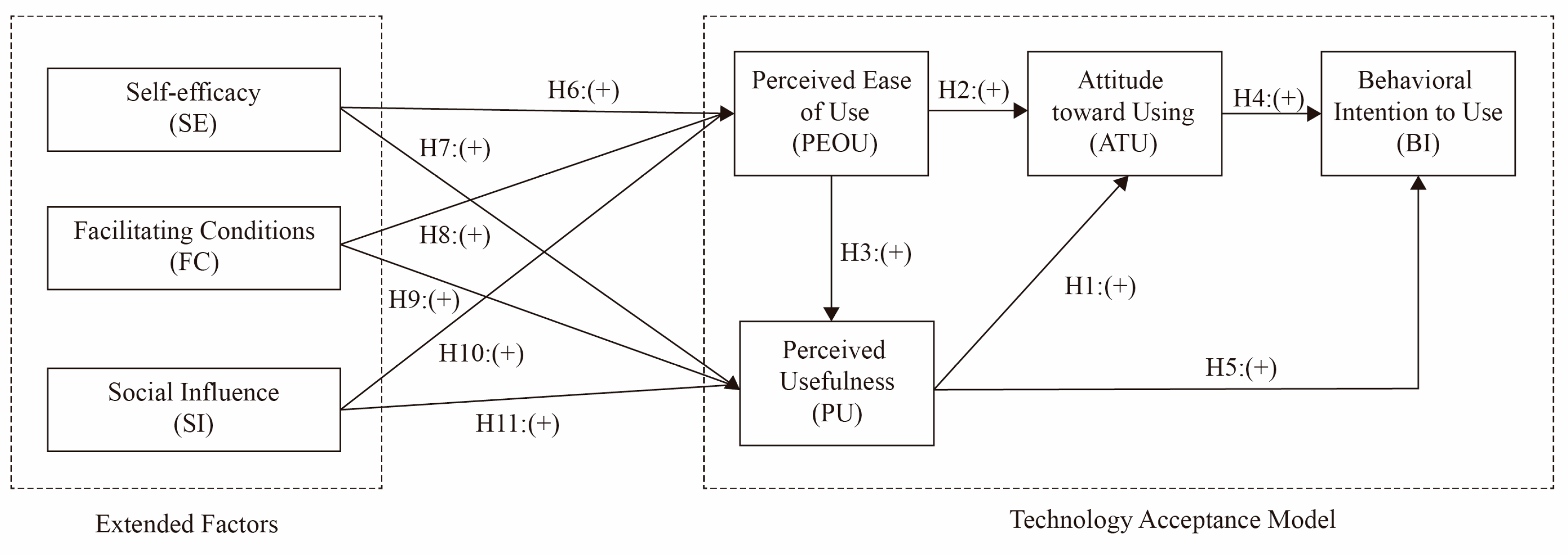
| H1: PU → ATU. | 0.426 | <0.001 |
| H2: PEOU → ATU. | 0.382 | <0.001 |
| H3: PEOU → PU. | 0.514 | <0.001 |
| H4: ATU → BI. | 0.538 | <0.001 |
| H5: PU → BI. | 0.561 | <0.001 |
| H6: SE → PEOU. | 0.412 | <0.001 |
| H7: SE → PU. | 0.325 | <0.001 |
| H8: FC→ PEOU. | 0.348 | <0.001 |
| H9: FC → PU. | 0.370 | <0.001 |
| H10: SI → PEOU. | 0.287 | <0.001 |
| H11: SI → PU. | 0.354 | <0.001 |
Disclaimer/Publisher’s Note: The statements, opinions and data contained in all publications are solely those of the individual author(s) and contributor(s) and not of MDPI and/or the editor(s). MDPI and/or the editor(s) disclaim responsibility for any injury to people or property resulting from any ideas, methods, instructions or products referred to in the content. |
© 2026 by the authors. Licensee MDPI, Basel, Switzerland. This article is an open access article distributed under the terms and conditions of the Creative Commons Attribution (CC BY) license.
Share and Cite
Zhou, Z.; Zhou, Y.; Ouyang, B.; Man, S.S.; Chan, A.H.S. Advancing Undergraduate Student Mental Healthcare of Social Anxiety Disorder: Evaluating the Acceptance of AR-Assisted Cognitive Behavioral Therapy Through TAM-Based Constructs. Healthcare 2026, 14, 1978. https://doi.org/10.3390/healthcare14131978
Zhou Z, Zhou Y, Ouyang B, Man SS, Chan AHS. Advancing Undergraduate Student Mental Healthcare of Social Anxiety Disorder: Evaluating the Acceptance of AR-Assisted Cognitive Behavioral Therapy Through TAM-Based Constructs. Healthcare. 2026; 14(13):1978. https://doi.org/10.3390/healthcare14131978
Chicago/Turabian StyleZhou, Zixuan, Yubo Zhou, Bo Ouyang, Siu Shing Man, and Alan Hoi Shou Chan. 2026. "Advancing Undergraduate Student Mental Healthcare of Social Anxiety Disorder: Evaluating the Acceptance of AR-Assisted Cognitive Behavioral Therapy Through TAM-Based Constructs" Healthcare 14, no. 13: 1978. https://doi.org/10.3390/healthcare14131978
APA StyleZhou, Z., Zhou, Y., Ouyang, B., Man, S. S., & Chan, A. H. S. (2026). Advancing Undergraduate Student Mental Healthcare of Social Anxiety Disorder: Evaluating the Acceptance of AR-Assisted Cognitive Behavioral Therapy Through TAM-Based Constructs. Healthcare, 14(13), 1978. https://doi.org/10.3390/healthcare14131978