1. Introduction
A personality disorder (PD) is a persistent and inflexible pattern of inner experience and behaviour that deviates markedly from the norms and expectations of an individual’s culture, is pervasive, has its onset in adolescence or early adulthood, is stable over time, and results in distress or impairment [
1]. In a meta-analysis, Winsper et al. estimated the worldwide pooled prevalence of any PD to be 7.8%, with 3.8% for Cluster A (odd/eccentric) disorders, 2.8% for Cluster B disorders (dramatic/erratic), and 5.0% for Cluster C disorders (anxious/fearful) [
2]. The association between PDs and other mental illnesses is marked by substantial comorbidity, shared risk factors, and reciprocal interactions, with PDs increasing the severity and chronicity of multiple psychiatric conditions [
3,
4]. PDs have also been linked to poorer quality of life and greater medical comorbidity, demonstrating their clinical and public health relevance [
5].
While personality disorders have traditionally been conceptualised using the categorical diagnoses in DSM-5 Section II, the DSM-5 also includes an Alternative Model for Personality Disorders (AMPD) in Section III that adopts a dimensional framework [
1]. Within the AMPD, personality pathology is described in terms of impairments in self and interpersonal functioning (Criterion A) and maladaptive personality traits (Criterion B), the latter operationalised through five broad domains—negative affectivity, detachment, antagonism, disinhibition, and psychoticism—and their constituent facets [
1,
6]. The Personality Inventory for DSM-5 (PID-5), a 220-item self-report measure, was developed to assess these Criterion B trait domains and has been translated into multiple languages [
6,
7]. To reduce respondent burden, the PID-5—Brief Form (PID-5-BF) was developed as a 25-item condensed version that assesses the same five higher-order domains, with five items each [
8,
9].
Personality disorders remain under-recognised in many Arabic-speaking settings, where brief, standardised, culturally appropriate assessment tools are limited. An Arabic version of the full 220-item PID-5 has been validated in a community sample from the United Arab Emirates [
10]; however, that work used the long form and a specific regional variety of Arabic. In Saudi settings, there remains a practical need for a brief instrument written in Standard Arabic that is suitable for routine clinical use and large surveys across regions and educational backgrounds. A standard-Arabic PID-5-BF could improve comparability with international studies and support the integration of dimensional trait assessment into research and practice. The same dataset analysed here was previously used to examine the sociodemographic correlates of maladaptive personality traits in Saudi adults [
11]; however, the present study addresses a distinct objective focused on the translation, content validity, reliability, and structural evaluation of the Arabic PID-5-BF.
3. Materials and Methods
3.1. Study Design and Source Data
This was an online psychometric study with three linked components: cultural adaptation and pilot testing, a short-term test–retest substudy, and a main community administration. Data collection proceeded in four sequential phases through a single online form: pilot cognitive debriefing (n = 25), first test–retest administration (n = 63), second test–retest administration approximately two weeks later (n = 58), and main community administration (n = 285).
3.2. Participants and Eligibility
Eligibility for the main analytic sample required informed consent, Saudi nationality, an age of 18 years or older, and complete age data. Participants were required to have completed all 25 PID-5-BF items and the core sociodemographic questions (age, gender, marital status, education level, employment/field of study, and region of residence). Recruitment was conducted online via social media and messaging applications; participation was voluntary and uncompensated.
3.3. Data Quality Criteria
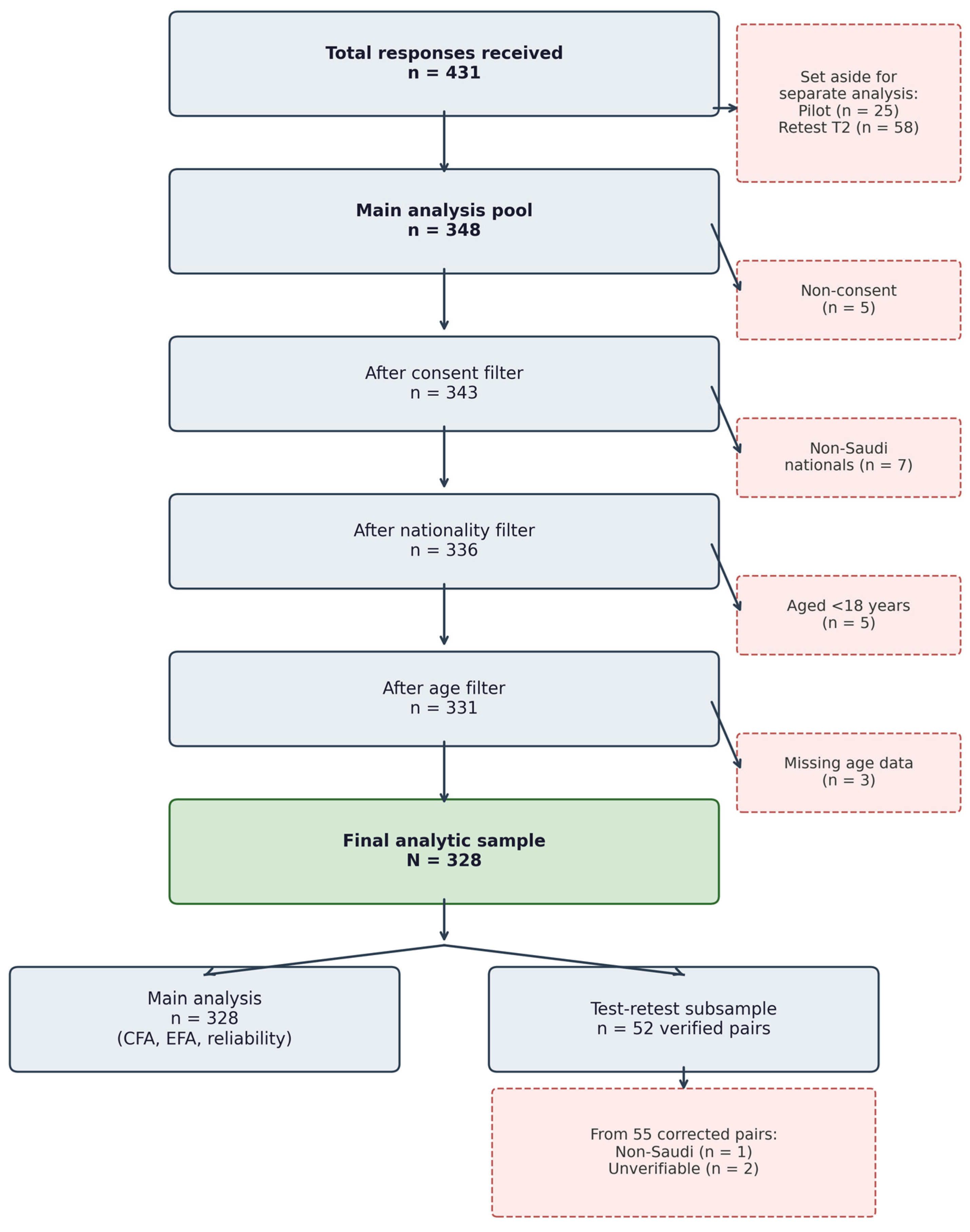
Data quality exclusions were kept separate from the eligibility criteria. Records were excluded during cleaning if consent was not provided (
n = 5), nationality was not Saudi (
n = 7), age was below 18 years (
n = 5), or age data were missing (
n = 3). The pilot cognitive debriefing sample (
n = 25) and the second retest administration (
n = 58) were analysed separately. Item responses recorded as Arabic text labels were recoded to the standard 0–3 numeric scale using a documented mapping verified against the original PID-5-BF response anchors [
8]. The participant flow is presented in
Figure 1.
3.4. Sample Size Considerations
The analytic sample of N = 328 participants exceeded psychometric guidelines recommending approximately 10 participants per item and a minimum of 200–300 cases for factor analysis [
12]. With 25 items, this sample size was adequate for CFA, EFA, reliability estimation, and parallel analysis. The analytic sample in the present study (N = 328) differs from the N = 343 reported in an earlier paper using the same dataset [
11]. The present analysis applied stricter exclusion criteria, namely the separation of the pilot cognitive debriefing sample (
n = 25) and the second test–retest administration (
n = 58) from the main community data, together with the consistent application of the eligibility criteria specified in
Section 3.2 and the data quality criteria specified in
Section 3.3.
3.5. Instrument and Scoring
The PID-5-BF is a 25-item self-report measure of maladaptive personality traits rated on a four-point scale from 0 (very false or often false) to 3 (very true or often true) [
8]. The instrument yields five domain scores based on five items each, with domain scores ranging from 0 to 15. In this study, domain scores were computed using the original APA item-to-domain mapping, in which domain assignments are non-sequential across the 25 items [
8]. A total score (range: 0–75) was computed by summing all items and treated only as a secondary descriptive index of shared maladaptive trait burden, not as evidence of unidimensionality.
3.6. Translation and Cultural Adaptation
The translation followed a multistep forward–backward approach consistent with published cross-cultural adaptation guidelines [
13,
14]. The PID-5-BF is copyrighted by the American Psychiatric Association (APA), which permits reproduction for clinical and research use without prior written permission [
8]. The process comprised five stages: (1) two independent bilingual clinicians with experience in psychometric assessment in Saudi Arabia produced forward translations into Standard Arabic; (2) an expert panel of bilingual clinicians familiar with DSM-5 terminology reconciled both versions into a consensus draft, selecting Standard Arabic wording understood across Saudi regions and avoiding dialect-specific expressions; (3) two translators blinded to the original independently back-translated the consensus Arabic version; (4) two bilingual experts compared both back-translations with the original and resolved discrepancies by consensus; and (5) the pre-final Arabic version was pilot-tested with 25 Arabic-speaking adults, who completed the scale and rated each item for clarity and simplicity.
3.7. Test–Retest Procedures
A subset of participants completed the questionnaire twice with a target interval of two weeks. Pair matching was verified by comparing contact identifiers, timestamps, and demographic consistency between administrations. Of the 55 attempted matched pairs, one non-Saudi respondent was excluded to maintain consistent eligibility, and two pairs were excluded because their identifiers could not be verified across administrations and the demographic data did not reliably confirm a match, leaving 52 verified matched pairs.
3.8. Statistical Analysis
Descriptive statistics were computed for all items and domain scores, including skewness, kurtosis, and item-level floor (score = 0) and ceiling (score = 3) percentages. Floor or ceiling rates exceeding 15% were flagged per convention. Normality was evaluated through skewness and kurtosis rather than null-hypothesis tests because the Kolmogorov–Smirnov test tends to reject normality in large samples even for trivial deviations.
Content validity indices were computed from the pilot data following Lynn [
15] and Polit and Beck [
16]. The item-level Content Validity Index (I-CVI) was defined as the proportion of pilot participants selecting one of the two highest response options for clarity and simplicity. The scale-level index (S-CVI/Ave) was computed as the mean of the item-level I-CVIs. An I-CVI ≥ 0.78 was considered acceptable, and an S-CVI/Ave ≥ 0.90 was considered excellent [
15,
16].
Internal consistency was evaluated using Cronbach’s alpha, corrected item–total correlations, and alpha-if-item-deleted indices. Test–retest reliability was estimated using the two-way random-effects, absolute agreement, single-measure intraclass correlation coefficient [ICC(2,1)] as defined by Shrout and Fleiss [
17], using the extended framework described by McGraw and Wong [
18] and the practical guidance summarised by Liljequist et al. [
19] and Mondal et al. [
20]. Ninety-five percent confidence intervals were computed via the F-distribution.
CFA was used to test the a priori five-factor model in which each item loaded on only one latent factor and the five factors were allowed to correlate. The model was estimated using maximum likelihood and evaluated with the chi-square statistic, comparative fit index (CFI; acceptable ≥0.90), Tucker–Lewis index (TLI; acceptable ≥0.90), root mean square error of approximation (RMSEA; acceptable ≤0.08) with a 90% confidence interval, and standardised root mean square residual (SRMR; acceptable ≤0.08) [
21].
EFA was performed as a complementary structural analysis using principal axis factoring (PAF) with Promax (oblique) rotation. Factorability was examined with the Kaiser–Meyer–Olkin (KMO) measure [
22] and Bartlett’s test of sphericity [
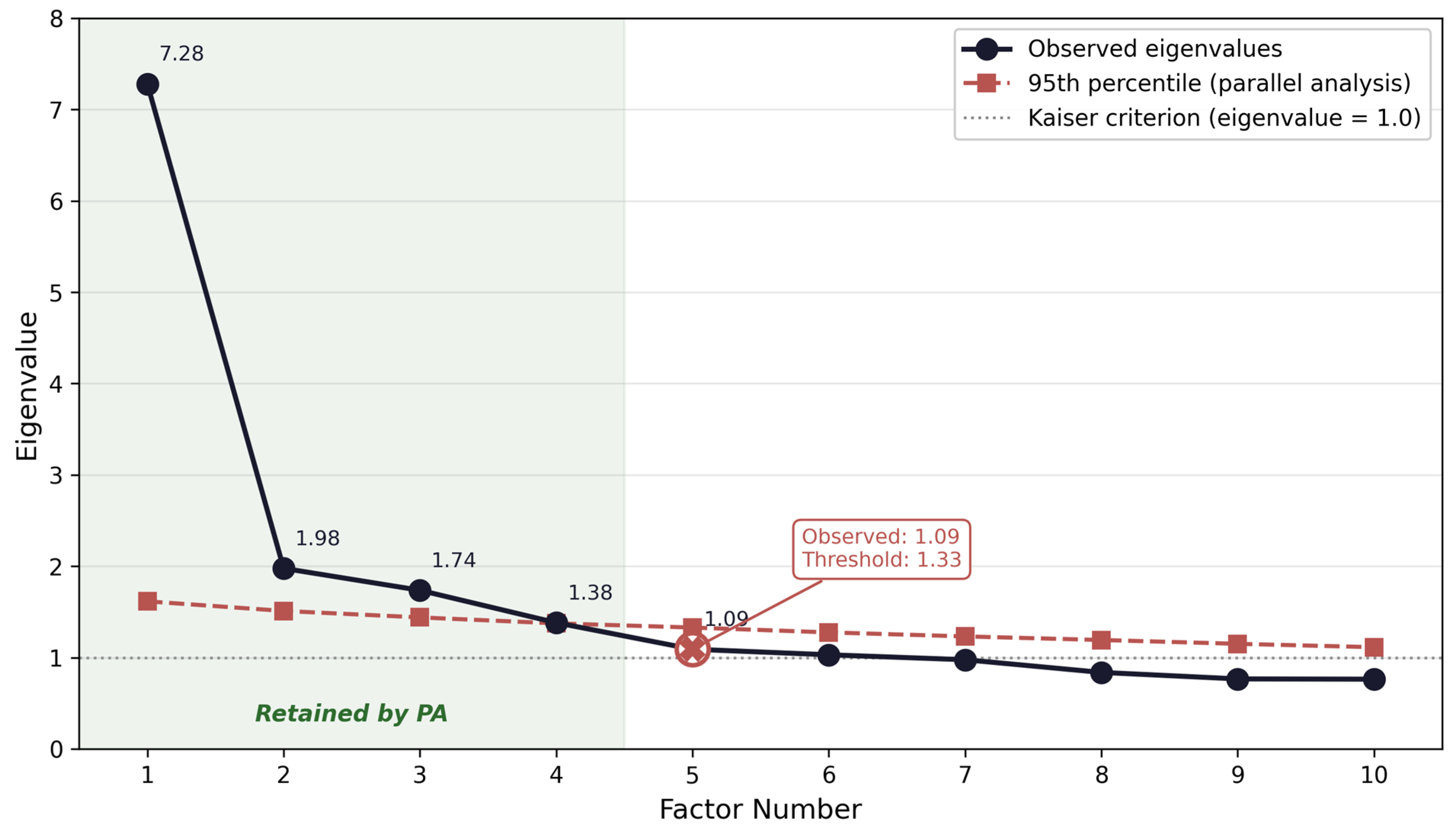
23]. Factor retention was informed by eigenvalues greater than 1.0, Horn’s parallel analysis [
24] with 1000 random datasets and a 95th-percentile criterion, the scree plot, and consistency with the expected five-domain PID-5-BF structure. The full pattern matrix, variance explained, and factor correlations from the oblique rotation are reported.
Descriptive statistics, reliability analyses (Cronbach’s alpha, corrected item–total correlations, alpha-if-item-deleted), exploratory factor analysis, and intraclass correlation coefficients were computed in IBM SPSS Statistics (v28; IBM Corp., Armonk, NY, USA). Confirmatory factor analysis and Horn’s parallel analysis were conducted in R (v4.3; R Foundation for Statistical Computing, Vienna, Austria) using the lavaan and psych packages.
6. Discussion
This study provides the first psychometric evaluation of the PID-5-BF in Standard Arabic that incorporates quantitative content validity data, confirmatory and exploratory factor analyses, parallel analysis, and verified test–retest reliability in a Saudi community sample. The findings support the Arabic PID-5-BF as a promising brief measure of maladaptive personality traits while identifying specific areas that require further psychometric work.
Content validity was strong, with S-CVI/Ave values of 0.93 for clarity and 0.94 for simplicity, both exceeding the 0.90 standard for excellent content validity [
15,
16]. Twenty-four of the twenty-five items met the 0.78 I-CVI threshold for clarity, with Item 20 falling marginally below (I-CVI = 0.76). The hierarchical social comparison expressed in this item may be conceptually or linguistically ambiguous in Arabic; future iterations could consider alternative phrasing while preserving the intended grandiosity content.
CFA of the a priori five-factor model produced mixed fit. The RMSEA was within the acceptable range (≤0.08), but CFI, TLI, and SRMR fell short of the 0.90 and 0.08 conventional thresholds [
21]. Comparable patterns have been reported in other PID-5-BF validations using maximum likelihood estimation for ordinal data [
27,
28]. Several factors likely contribute to the below-threshold incremental fit: the small number of items per factor (five) amplifies the relative impact of measurement error; the four-point ordinal response scale attenuates fit statistics computed under continuous estimation; and method variance from shared wording is not modelled. All standardised loadings were statistically significant and ranged from 0.38 to 0.79. The weakest loading, for Item 13 on detachment, may reflect cultural differences in the salience of romantic withdrawal as an indicator of interpersonal detachment in a context where unmarried young adults commonly abstain from romantic relationships for reasons unrelated to personality pathology.
Parallel analysis, the recommended objective criterion for factor retention [
24], supported four rather than five factors. The fifth factor’s eigenvalue exceeded the Kaiser criterion but fell below the 95th-percentile threshold from random data. This is not unprecedented in brief personality instruments with moderately correlated factors [
27,
28]. The CFA confirmed acceptable approximate fit (by RMSEA) for the five-factor model, and the five-factor EFA solution was interpretable and aligning with the theoretical structure. Although items generally loaded on their expected domains, cross-loadings were observed for several items, reflecting the theoretical overlap among maladaptive trait domains in the AMPD framework [
6]. The convergence of the CFA and EFA with theoretical expectations supports retaining the five-factor interpretation while acknowledging the empirical ambiguity of the fifth factor and the below-threshold incremental fit.
Internal consistency was acceptable for a brief five-item-per-domain instrument. Domain alphas ranged from 0.70 to 0.78, and the total-scale alpha was 0.89. These values are comparable to those reported in Italian [
27], Danish [
28], American [
29], Iranian [
30], Brazilian [
9], Norwegian [
31], and Spanish adolescent [
32] validations of the PID-5-BF. Cortina’s classic analysis [
25] reminds us that alpha is influenced by the number of items and the inter-item correlations; for a five-item domain, alphas in the 0.70–0.80 range represent an acceptable trade-off between brevity and internal consistency.
Test–retest reliability was good to excellent, with ICC(2,1) values ranging from 0.74 to 0.85 at the domain level and 0.88 for the total score over a mean retest interval of 16.1 days. ICCs were computed on verified matched pairs with a correctly specified two-way random-effects, absolute agreement model [
17,
18,
19]. However, the retest subsample was heavily male-skewed (86.5%) and younger (mean age 27.6 years) than the full analytic sample, limiting the generalisability of these stability estimates.
The pattern of item endorsement warrants particular attention. Domain-level floor and ceiling effects were limited, but item-level floor effects were substantial for antagonism items (Item 17: 58.2%; Item 22: 56.1%; Item 25: 50.3%). This pattern is supportive of the hypothesis that social desirability effects suppress endorsement of overtly antagonistic content in a collectivist cultural context where behaviours characterised as self-serving or exploitative are strongly stigmatised. In contrast, negative affectivity items showed ceiling effects (Item 8: 30.5%; Item 9: 24.7%), indicating that worry and emotional reactivity were frequently endorsed. Because no dedicated social desirability measure was administered, this interpretation remains indirect; future studies should incorporate such measures to examine response patterns directly in cross-cultural applications of the PID-5-BF.
Strengths and Limitations
The evaluation has several strengths: it provides the first psychometric evaluation of a standard-Arabic PID-5-BF in a Saudi adult sample; it uses transparent raw-data analysis with documented inclusion criteria and recoding; and it reports a broad range of psychometric indices (content validity, internal consistency, test–retest reliability, CFA, EFA, parallel analysis, and floor/ceiling effects) with full pattern matrices and factor correlations. Several limitations must be acknowledged. First, the sample was recruited by convenience through online messaging platforms, producing an over-representation of university-educated participants (67.7%). Second, no comparator instruments, clinical diagnoses, or functional outcome measures were administered, so convergent, discriminant, and criterion validity could not be assessed; this is a fundamental limitation of the available dataset. Third, the CFA incremental fit indices fell below conventional thresholds, and parallel analysis favoured four factors; the five-factor structure, while theoretically supported, requires replication in independent samples, preferably using ordinal estimation methods (e.g., WLSMV). Fourth, the retest subsample was small (n = 52), demographically unrepresentative, and recruited from a convenience source; therefore, temporal stability estimates should be considered preliminary. Fifth, substantial floor effects on antagonism items suggest that self-report assessment of socially undesirable traits may be attenuated in this cultural context. Finally, only a non-clinical community sample was examined, and the psychometric properties may differ in clinical populations.



 ,
,