4.1. Analysis of Findings
Across Romanian settings, we observed moderate objective AI legislation literacy (11.2 ± 4.1/20) alongside a marked familiarity gradient (GDPR 69.7% vs. EU AI Act 25.7%). This pattern is consistent with evidence that data-protection awareness is more mature than AI-specific governance preparedness, including Romanian public-sector experience where GDPR implementation has been described as uneven, resource-constrained, and strongly dependent on local compliance capacity [
36]. Similarly, international clinician surveys across multiple specialties show broad enthusiasm for AI’s potential but persistent uncertainty around regulation, accountability, and practical “rules of the road,” which likely depresses AI Act–specific familiarity when legal requirements are newly introduced or perceived as complex [
37]. Taken together, our results suggest that knowledge gaps are not simply “digital skills” gaps; rather, they reflect differential exposure to compliance workflows (e.g., DPIAs, procurement documentation, post-deployment monitoring) and the extent to which institutions operationalize these requirements into routine practice. This low EU AI Act familiarity (25.7%) should be interpreted critically in light of the Act’s phased implementation calendar rather than as simple professional disengagement. The Regulation entered into force in 2024, but its obligations apply progressively—prohibited practice provisions and AI literacy duties first, followed by governance and general purpose model rules, with the bulk of the high-risk obligations most relevant to clinical AI not becoming fully applicable until 2026–2027. At the time of data collection, much of the high-risk framework therefore remained prospective rather than operational, which plausibly explains why awareness lagged well behind the long-established, fully enforceable GDPR. Read this way, the GDPR–AI Act familiarity gap is less a static knowledge deficit than a predictable feature of a regulatory transition still in progress—and a time-limited window in which targeted, anticipatory literacy-building could pre-empt the compliance pressure that will accompany full applicability of the high-risk regime.
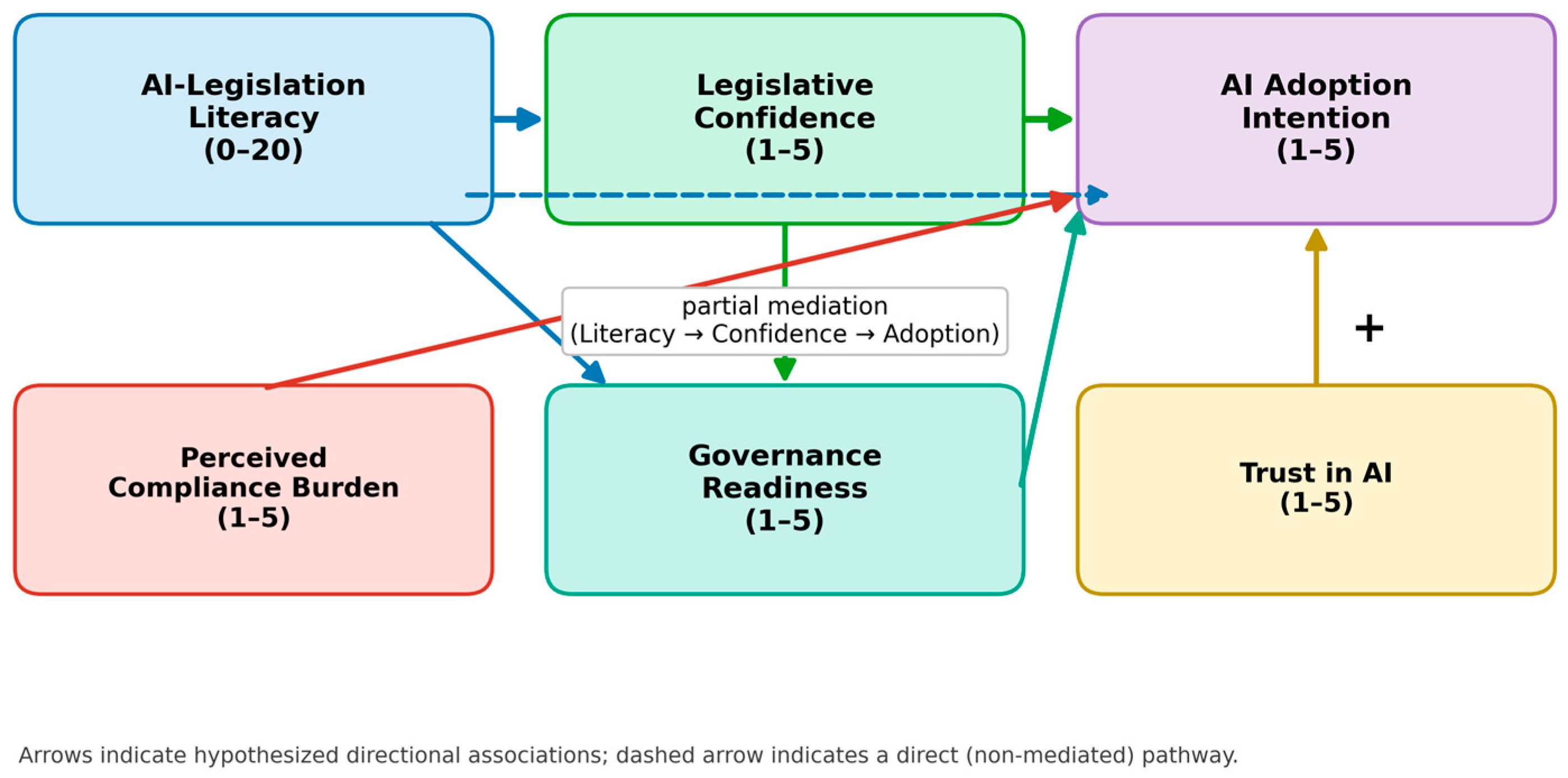
A key contribution of this study is the mechanistic structure linking literacy → confidence → adoption intention. Literacy correlated strongly with legislative confidence (ρ = 0.52), and confidence correlated with adoption intention (ρ = 0.41), with mediation supporting a partial indirect pathway (indirect effect 0.13; 95% CI 0.05–0.24). Prior work indicates that clinicians and trainees are often receptive to clinical AI yet report limited practical knowledge, and that greater understanding is associated with more favorable attitudes and implementation readiness [
38]. Institutional readiness research likewise emphasizes that training and organizational change support are central levers for shifting readiness from abstract optimism to operational use, which aligns with our finding that prior AI training doubled the odds of high adoption intention (aOR 2.10) [
39]. Mixed-methods evidence further shows that physicians’ acceptance hinges on perceived benefits, but also on transparency, role clarity, and concrete integration frameworks—elements that plausibly map onto “confidence” as the proximal determinant of action in high-accountability clinical environments [
40].
The observed literacy differences appear to be patterned by professional role, institutional environment, and prior exposure to digital health technologies rather than distributed at random. By role, objective literacy followed a clear gradient, with legal/compliance (15.8 ± 2.6) and IT/data staff (13.9 ± 3.1) having the highest scores and nurses the lowest (10.1 ± 3.7), mirroring the extent to which each role engages directly with regulatory and data governance tasks in daily practice. Institutional context is also plausibly relevant: our sample spanned public hospitals, private clinics, and academic centers, which differ substantially in access to compliance expertise, dedicated data-protection officers, procurement governance, and structured digital health training—differences that can shape the routine workflows through which legal knowledge is acquired and reinforced. Prior exposure appeared influential as well, because only 37.6% of respondents reported any prior AI-related training despite 42.2% reporting some AI use in workflow, and prior training remained an independent predictor of high adoption intention after adjustment (aOR 2.10). Together, these patterns suggest that literacy is not a fixed individual trait but is co-determined by occupational function, organizational infrastructure, and cumulative hands-on experience with digital tools. Because subgroup sizes for several roles were small and the design was cross-sectional, these role- and setting-level differences should be regarded as descriptive and hypothesis-generating; nonetheless, they reinforce the case for role-tailored and institution-specific literacy interventions rather than for uniform training delivered identically across all professional groups and care settings.
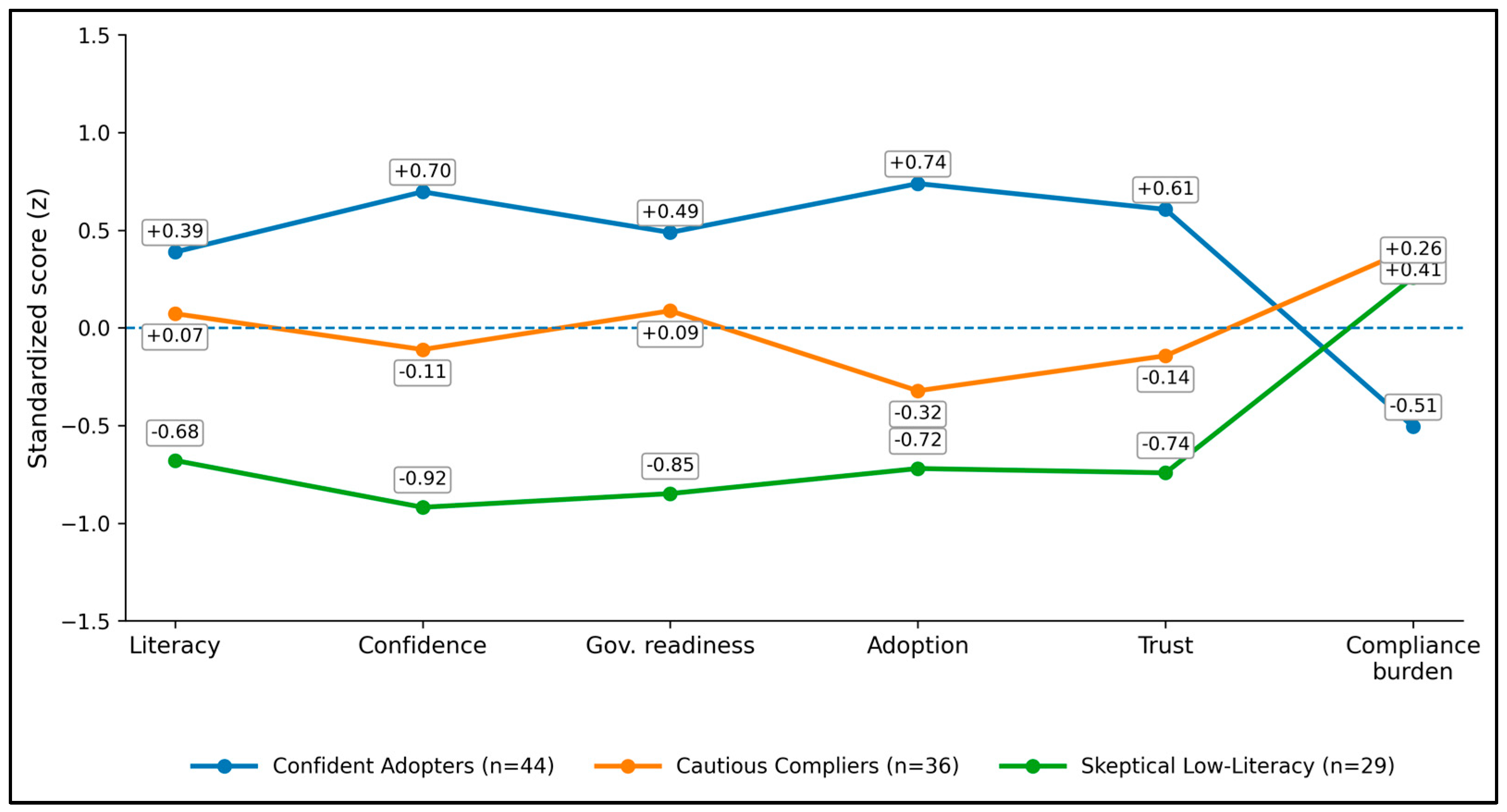
Beyond knowledge, trust emerged as a major independent correlate of high adoption intention (aOR 1.72 per +1 SD), reinforcing that governance must address not only compliance “checks,” but also beliefs about safety, reliability, and institutional stewardship. A recent systematic review on explainable AI (XAI) highlights a crucial nuance: explanations can increase or decrease clinicians’ trust depending on the format, cognitive load, and whether they align with clinical reasoning, implying that “more transparency” is not automatically “more trust” [
28]. In parallel, an integrative review of AI acceptance in hospitals identifies recurring determinants at the individual and organizational levels—perceived usefulness, workflow fit, competence/training, leadership support, and concerns about autonomy—supporting our interpretation that trust functions as a composite construct shaped by both technical features and the surrounding implementation environment [
29]. In our sample, the “Confident Adopters” phenotype combined higher trust (3.8 ± 0.5) with higher readiness (3.3 ± 0.6), suggesting that trust is reinforced when institutions visibly invest in governance capacity rather than placing responsibility solely on end-users. That trust operated as an independent predictor even after adjusting for literacy, confidence, and perceived burden warrants closer interpretation in terms of transparency, explainability, and ethical governance. Trust in clinical AI is best understood as warranted rather than blind; it is calibrated by whether a system’s behavior, limitations, and provenance can be scrutinized, not merely by surface-level confidence in its outputs. Transparency—encompassing disclosure of training data characteristics, intended use, performance across relevant subgroups, and known failure modes—provides the evidentiary basis on which clinicians can decide whether reliance is justified. Explainability contributes when it is matched to the clinical decision and the user’s reasoning; as the XAI evidence indicates, poorly designed or cognitively burdensome explanations can erode rather than build trust, so explainability should be treated as a means of supporting appropriate reliance and enabling error detection rather than as an end in itself. Ethical governance closes the loop by assigning clear accountability for oversight, validation, incident response, and redress, signaling to clinicians that responsibility for AI-assisted decisions is shared institutionally rather than displaced onto the individual at the point of care. Framed this way, the independent contribution of trust suggests that adoption strategies should pair technical transparency and fit-for-purpose explanations with visible ethical governance structures, since trust that is not anchored in genuine accountability and contestability risks becoming either misplaced over-reliance or defensive avoidance.
The inverse association between perceived compliance burden and high adoption intention (aOR 0.64 per +1 SD) helps explain the “Cautious Compliers” profile (highest burden: 4.1 ± 0.5) and the paradox that legal/compliance roles, despite having the highest literacy (15.8 ± 2.6), showed comparatively lower adoption intention (3.4 ± 0.7). Health system survey data indicate that organizations pursuing AI adoption consistently report friction in governance, resourcing, and implementation processes—domains that translate directly into perceived burden at the clinician/manager level [
30]. Legal scholarship on AI in practice also warns that clinicians may become “liability sinks,” absorbing accountability for AI-assisted decisions without proportional control over model design, validation evidence, or monitoring—an issue that can rationally inflate perceived compliance burden and suppress adoption enthusiasm even among AI supporters [
31]. Complementing this, systematic review work on medical liability in AI-supported diagnostics underscores persistent uncertainty across responsibility allocation, standards of care, and evidentiary expectations, reinforcing our interpretation that burden is not merely paperwork—it is perceived risk plus workload, especially under unclear accountability regimes [
32].
Finally, our phenotype approach (Confident Adopters; Cautious Compliers; Skeptical Low Literacy) offers an actionable bridge between implementation science and compliance strategy. Contemporary organizational case studies show that building AI governance capacity typically requires formal structures (multidisciplinary oversight, procurement pathways, validation/monitoring playbooks, documentation standards) and iterative learning loops to manage drift and post-deployment risk—features that align closely with our PCA-derived readiness dimensions (process/accountability vs. technical/documentation) [
33]. Enterprise-scaling guidance similarly argues that governance is the central risk-mitigation mechanism enabling safe scale-up across multiple AI solutions, rather than a single model-by-model effort [
34]. Qualitative implementation research using NASSS also emphasizes that adoption success depends on socio-technical complexity (technology, workflow, organization, and wider system) and that “one-size” implementation strategies often fail—supporting our conclusion that stratified interventions are likely needed: (i) targeted literacy/confidence training for Skeptical Low Literacy groups, (ii) burden reduction tooling and standardized templates (DPIA checklists, model documentation bundles) for Cautious Compliers, and (iii) scale-up pathways with monitoring and feedback for Confident Adopters [
35]. Viewed through the lens of healthcare workforce adaptation, these phenotypes can be read as differing positions along a continuum from active assimilation to principled or anxious resistance, rather than as fixed personality types. Confident Adopters resemble early adapting professionals who integrate new tools into their working identity and may act as local champions, but who also risk automation bias and over-reliance if scale-up outpaces oversight. Cautious Compliers are particularly informative for workforce adaptation: their willingness coexists with the highest perceived compliance burden, suggesting a form of conditional engagement in which adoption is gated by workload, accountability concerns, and the adequacy of institutional support—a profile prone to disengagement or “malicious compliance” if governance demands are perceived as unsupported or punitive. The Skeptical Low Literacy group most clearly embodies resistance rooted in low confidence and limited readiness rather than ideological opposition; their resistance is plausibly protective, signaling unmet needs for foundational knowledge, psychological safety, and low-friction support before more autonomous use is reasonable. Importantly, resistance in this framing is not simply a barrier to be overcome but a source of governance signals: skepticism concentrated among less prepared staff can flag inadequate training infrastructure, while cautious compliance can flag misaligned workload and accountability structures. Phenotype-matched change management—championing and structured scale-up for adopters, burden reduction and shared accountability for compliers, and confidence building, mentoring, and incremental exposure for skeptics—may therefore support durable workforce adaptation more effectively than uniform mandates, which tend to harden resistance in precisely the groups most in need of support.
Our phenotype framework also has implications beyond initial adoption because organizational readiness must be sustained after deployment. Healthcare AI systems can deteriorate when patient mix, workflow patterns, documentation practices, or clinical standards change, meaning that data drift, concept drift, and calibration drift become operational rather than purely technical problems. In this context, the two readiness dimensions identified by PCA map closely onto the infrastructure needed for lifecycle management: process/accountability capacity supports escalation pathways, incident review, and threshold setting, whereas technical/documentation capacity supports dataset versioning, performance surveillance, and change traceability. From this perspective, Confident Adopters may be suitable for locally supervised pilots with predefined monitoring triggers, Cautious Compliers may benefit from centrally managed monitoring templates and external audit support, and Skeptical Low Literacy settings may require simpler dashboards plus vendor- or network-supported monitoring before more autonomous use is attempted [
36,
37,
38,
39,
40].
The following observations on feedback loops and reinforcement learning from human feedback extend beyond our survey data and are offered as broader conceptual implications and an explanatory analogy rather than as empirical conclusions drawn from the present study. The mediating role of confidence further suggests that post-deployment learning loops should not be conceived only as safety mechanisms, but also as educational interfaces. Structured clinician feedback on incorrect outputs, borderline cases, unexpected workflow effects, and evolving clinical patterns could simultaneously improve models and strengthen users’ perceived competence. This logic resembles reinforcement learning from human feedback (RLHF), in which human preferences and corrections are used to refine model behavior over time [
41,
42]. In healthcare, phenotype-matched feedback design may be especially important: Confident Adopters may supply richer proactive feedback suitable for iterative optimization, Cautious Compliers may respond better to structured prompts embedded in governance workflows, and Skeptical Low Literacy users may need low-friction interfaces, worked examples, and immediate support so that feedback activity builds confidence rather than adding burden [
41,
42].
These lifecycle considerations are also relevant to compliance. The EU AI Act requires post-market monitoring for high-risk AI systems and expects providers to maintain mechanisms for collecting, documenting, and acting on performance and safety information throughout the system life cycle [
1,
21]. Our readiness dimensions may therefore be interpreted as pragmatic baseline indicators of an organization’s ability to operationalize legally required monitoring loops. A phenotype-matched deployment strategy—aligning monitoring intensity, feedback workflows, and governance support with local readiness—could help healthcare systems meet regulatory expectations while allocating implementation resources proportionately.
Although our survey did not directly measure exposure to generative systems, the rapid diffusion of generative AI and large multimodal models (LMMs) into healthcare warrants explicit consideration as a broader conceptual implication of our findings, because these tools materially widen the governance and literacy demands that the present study set out to characterize. Unlike narrow, task-specific classifiers, generative and multimodal systems are general-purpose, operate over free text, images, and structured data simultaneously, and are increasingly embedded in documentation, summarization, triage support, patient communication, and administrative workflows. This breadth introduces distinctive risks: fabrication of plausible but incorrect content (“hallucination”), inadvertent disclosure or memorization of sensitive health data, sensitivity to prompt phrasing, opaque and frequent model updates that complicate version control, automation bias when fluent outputs are over-trusted, and diffuse accountability when a single model is repurposed across many clinical and non-clinical tasks [
23,
24,
25]. The World Health Organization’s guidance on LMMs similarly emphasizes risks spanning accuracy, bias, data protection, and the difficulty of assigning responsibility across developers, deployers, and clinical users [
23]. These characteristics interact directly with our central constructs: they raise the literacy threshold required for safe use (since users must understand not only legal duties but also model failure modes), they place additional weight on trust calibration and transparency, and they amplify perceived compliance burden by blurring the boundary between a discrete “medical device” and a continuously evolving general-purpose tool. Conceptually, therefore, the GDPR-first, AI Act-lagging literacy profile we observed is likely to be most consequential precisely for these generative tools, where regulatory classification, oversight, and post-deployment control are least settled. The breadth of clinical applications now spanning AI—from breast cancer detection and risk prediction to deep learning prognostic models for cervical cancer metastasis and recurrence—further underscores why literacy and governance must keep pace with a rapidly expanding application landscape rather than with a single use case [
43,
44].
Building on this, post-deployment monitoring readiness and lifecycle governance deserve fuller treatment as the operational core of continuous compliance, again framed as a conceptual extension of our readiness findings rather than a direct empirical result. Under the EU AI Act, obligations for high-risk AI do not end at market entry: providers and deployers must sustain post-market monitoring, logging and record keeping, human oversight, and serious-incident reporting, and must keep technical documentation and risk management current across the system life cycle [
1,
21]. For adaptive or frequently updated systems, including generative and multimodal models, this implies an ongoing duty to detect and respond to data drift, concept drift, and calibration drift, to revalidate after material changes, and to monitor subgroup performance for emergent inequities. Our two readiness dimensions map onto the infrastructure that continuous compliance requires: the process/accountability dimension underpins escalation pathways, incident review, oversight committees, and change control governance, whereas the technical/documentation dimension underpins dataset versioning, performance surveillance, and traceability of model updates. Interpreted as baseline capability indicators, low readiness on either dimension signals a concrete compliance exposure rather than merely an organizational shortfall, because the same capacities that enable safe lifecycle management are those that the Act expects institutions to demonstrate on an ongoing basis. This reframes governance readiness from a one-time procurement checklist to a standing, auditable capability and suggests that institutions with predominantly Skeptical Low Literacy or Cautious Complier profiles may face disproportionate difficulty meeting continuous compliance obligations unless monitoring is centrally supported, templated, and embedded in routine workflows.
To make the revised literature synthesis explicit,
Table 9 maps each contemporary AI development to a concrete implementation challenge and to the empirical construct evaluated in this study.



 ,
,