Neurosurgical Theatres’ Carbon Net Efficiency: A Service Improvement Project Conducted via the Oxford Cranioplasty Pathway

 , ,
, ,  , and
, and 
Highlights
- Reducing carbon emissions from health and care activities aligns with the goals set by the United Nations Climate Change Conference of Parties (UN-CC-COP).
- The service improvement project described in this manuscript demonstrates the effectiveness of a partnership between public institutions and medtech companies.
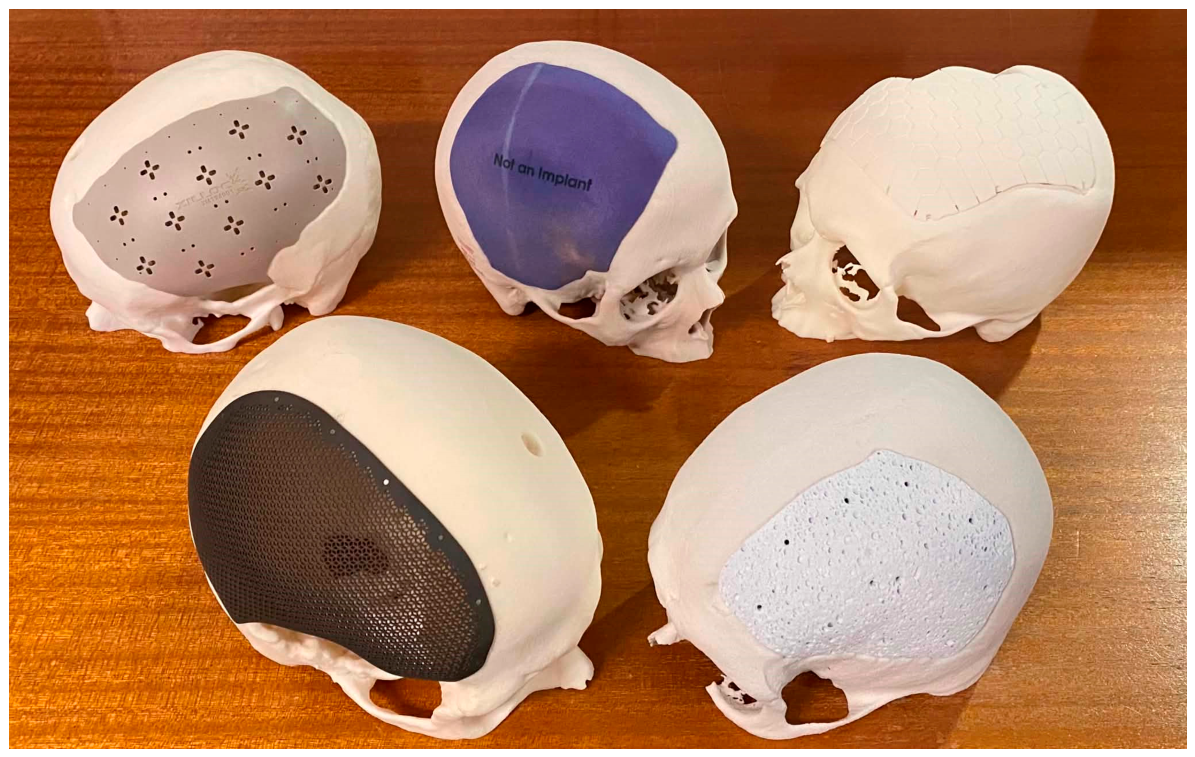
- Material choices, which are relevant in cranioplasty surgery, can also influence the carbon efficiency of cranioplasty pathways without compromising patients’ safety.
- Public health implications—What are the key implications or messages for practitioners, policy makers and/or researchers in public health?
- The diverse needs of various surgical subspecialties call for an ad hoc review of interventions aimed at reducing the carbon footprint related to surgical procedures.
- Different stakeholders bring valuable perspectives on designing service improvement projects to achieve carbon net efficiency of neurosurgical theatres.
Abstract
1. Introduction
2. Materials and Methods
2.1. Location
2.2. Carbon Footprint Estimation for Cranioplasty Surgery
- Scope 1: GHG emissions produced onsite by owned or directly controlled sources within an organization. These include fossil fuel combustion and use of anesthetic gases.
- Scope 2: Indirect sources of GHG emissions associated with the use of purchased energy including electricity, heating, steaming and cooling.
- Scope 3: Remaining indirect sources of GHG emissions within an organization including the supply chain required to produce pharmaceuticals and medical equipment, travel undertaken by members of staff, patients or visitors alongside water supply and waste disposal.
2.2.1. Scope 1
2.2.2. Scope 2
2.2.3. Scope 3
2.3. Carbon Footprint of Various Cranioplasty Materials
2.4. Designing the Sustainability Plan
3. Results
3.1. Carbon Footprint Analysis
3.2. Sustainability Plan
4. Discussion
4.1. Limitations
4.2. Future Development
5. Conclusions
Supplementary Materials
Author Contributions
Funding
Institutional Review Board Statement
Informed Consent Statement
Data Availability Statement
Acknowledgments
Conflicts of Interest
Abbreviations
| CO2e | Carbon dioxide equivalents |
| DEFRA | UK Department for Environment, Food and Rural Affairs |
| GHG | Greenhouse Gas |
| HVAC | Heating, ventilation, and cooling |
| ICE | Inventory of Carbon and Energy |
| ISO | International Organization for Standardization |
| LCA | Life cycle assessment |
| NHS | National Health Service |
| PEEK | Polyetheretherketone |
| PEKK | Polyetherketoneketone |
| PHA | Porous hydroxyapatite |
| PMMA | Polymethylmethacrylate |
| PPE | Protective personal equipment |
| UN-CC-COP | United Nations Climate Change Conference of Parties |
References
- Rizan, C.; Steinbach, I.; Nicholson, R.; Lillywhite, R.; Reed, M.; Bhutta, M.F. The Carbon Footprint of Surgical Operations: A Systematic Review. Ann. Surg. 2020, 272, 986–995. [Google Scholar] [CrossRef] [PubMed]
- Tennison, I.; Roschnik, S.; Ashby, B.; Boyd, R.; Hamilton, I.; Oreszczyn, T.; Owen, A.; Romanello, M.; Ruyssevelt, P.; Sherman, J.D.; et al. Health care’s response to climate change: A carbon footprint assessment of the NHS in England. Lancet Planet. Health 2021, 5, e84–e92. [Google Scholar] [CrossRef] [PubMed]
- NHS England and NHS Improvement. Interim NHS People Plan; NHS England: Leeds, UK, 2019. [Google Scholar]
- NHS Sustainable Development Unit. Reducing the Use of Natural Resources in Health and Social Care; NHS Sustainable Development Unit: Cambridge, UK, 2018. [Google Scholar]
- Owen, A.; Giesekam, J.; Barrett, J. 2019 Data Release of Material Footprint and Resource Efficiency for the UK; NHS Sustainable Development Unit: Cambridge, UK, 2019. [Google Scholar]
- Elkington, J. Towards the Sustainable Corporation: Win-Win-Win Business Strategies for Sustainable Development. Calif. Manag. Rev. 1994, 36, 90–100. [Google Scholar] [CrossRef]
- Talibi, S.S.; Scott, T.; Hussain, R.A. The Environmental Footprint of Neurosurgery Operations: An Assessment of Waste Streams and the Carbon Footprint. Int. J. Env. Res. Public Health 2022, 19, 5995. [Google Scholar] [CrossRef] [PubMed]
- MacNeill, A.J.; Lillywhite, R.; Brown, C.J. The impact of surgery on global climate: A carbon footprinting study of operating theatres in three health systems. Lancet Planet. Health 2017, 1, e381–e388. [Google Scholar] [CrossRef] [PubMed]
- Brighton & Sussex Medical School; Centre for Sustainable Healthcare; UK Health Alliance on Climate Change. Green Surgery: Reducing the Environmental Impact of Surgical Care; UKHACC: London, UK, 2023; Available online: https://ukhealthalliance.org/sustainable-healthcare/green-surgery-report/ (accessed on 30 April 2025).
- Rizan, C.; Lillywhite, R.; Reed, M.; Bhutta, M.F. The carbon footprint of products used in five common surgical operations: Identifying contributing products and processes. J. R. Soc. Med. 2023, 116, 199–213. [Google Scholar] [CrossRef] [PubMed]
- Thiel, C.L.; Eckelman, M.; Guido, R.; Huddleston, M.; Landis, A.E.; Sherman, J.; Shrake, S.O.; Copley-Woods, N.; Bilec, M.M. Environmental Impacts of Surgical Procedures: Life Cycle Assessment of Hysterectomy in the United States. Environ. Sci. Technol. 2015, 49, 1779–1786. [Google Scholar] [CrossRef] [PubMed]
- Thiel, C.L.; Schehlein, E.; Ravilla, T.; Ravindran, R.D.; Robin, A.L.; Saeedi, O.J.; Schuman, J.S.; Venkatesh, R. Cataract surgery and environmental sustainability: Waste and lifecycle assessment of phacoemulsification at a private healthcare facility. J. Cataract. Refract. Surg. 2017, 43, 1391–1398. [Google Scholar] [CrossRef] [PubMed]
- Fountain, D.M.; Henry, J.; Honeyman, S.; O’Connor, P.; Sekhon, P.; Piper, R.J.; Edlmann, E.; Martin, M.; Whiting, G.; Turner, C.; et al. First Report of a Multicenter Prospective Registry of Cranioplasty in the United Kingdom and Ireland. Neurosurgery 2021, 89, 518–526. [Google Scholar] [CrossRef] [PubMed]
- Iaccarino, C.; Chibbaro, S.; Sauvigny, T.; Timofeev, I.; Zaed, I.; Franchetti, S.; Mee, H.; Belli, A.; Buki, A.; De Bonis, P.; et al. Consensus-based recommendations for diagnosis and surgical management of cranioplasty and post-traumatic hydrocephalus from a European panel. Brain Spine 2024, 4, 102761. [Google Scholar] [CrossRef] [PubMed]
- Fricia, M.; Nicolosi, F.; Ganau, M.; Cebula, H.; Todeschi, J.; Santin, M.D.N.; Nannavecchia, B.; Morselli, C.; Chibbaro, S. Cranioplasty with Porous Hydroxyapatite Custom-Made Bone Flap: Results from a Multicenter Study Enrolling 149 Patients Over 15 Years. World Neurosurg. 2019, 121, 160–165. [Google Scholar] [CrossRef] [PubMed]
- Ganau, M.; Cebula, H.; Fricia, M.; Zaed, I.; Todeschi, J.; Scibilia, A.; Gallinaro, P.; Coca, A.; Chaussemy, D.; Ollivier, I.; et al. Surgical preference regarding different materials for custom-made allograft cranioplasty in patients with calvarial defects: Results from an internal audit covering the last 20 years. J. Clin. Neurosci. 2020, 74, 98–103. [Google Scholar] [CrossRef] [PubMed]
- ISO 14067:2018; Greenhouse Gases—Carbon Footprint of Products—Requirements and Guidelines for Quantification. ISO: Geneva, Switzerland, 2006. Available online: https://www.iso.org/standard/71206.html (accessed on 30 April 2025).
- World Business Council for Sustainable Development; World Resources Institute. The Greenhouse Gas Protocol: A Corporate Accounting and Reporting Standard (Revised Edition); World Business Council for Sustainable Development: Geneva, Switzerland; World Resources Institute: Washington, DC, USA, 2015. [Google Scholar]
- Misrai, V.; Rijo, E.; Cottenceau, J.B.; Zorn, K.C.; Enikeev, D.; Elterman, D.; Bhojani, N.; De La Taille, A.; Herrmann, T.R.W.; Robert, G.; et al. A Standardized Method for Estimating the Carbon Footprint of Disposable Minimally Invasive Surgical Devices: Application in Transurethral Prostate Surgery. Ann. Surg. Open 2021, 2, e094. [Google Scholar] [CrossRef] [PubMed]
- Department for Environment, Food and Rural Affairs/Department for Business, Energy & Industrial Strategy. UK Government GHG Conversion Factors for Company Reporting [Database]; Department for Environment, Food and Rural Affairs/Department for Business, Energy & Industrial Strategy: London, UK, 2021.
- Jones, C.; Hammond, G. Inventory of Carbon and Energy v3.0 [Database]; Circular Ecology, University of Bath: Bath, UK, 2019. [Google Scholar]
- Parvatker, A.G.; Tunceroglu, H.; Sherman, J.D.; Coish, P.; Anastas, P.; Zimmerman, J.B.; Eckelman, M.J. Cradle-to-Gate Greenhouse Gas Emissions for Twenty Anesthetic Active Pharmaceutical Ingredients Based on Process Scale-Up and Process Design Calculations. ACS Sustain. Chem. Eng. 2019, 7, 6580–6591. [Google Scholar] [CrossRef]
- World Resources Institute. Technical Guidance for Calculating Scope 3 Emissions; World Resources Institute: Washington, DC, USA, 2013; Available online: https://ghgprotocol.org/sites/default/files/standards/Scope3_Calculation_Guidance_0.pdf (accessed on 30 April 2025).
- McGain, F.; Sheridan, N.; Wickramarachchi, K.; Yates, S.; Chan, B.; McAlister, S. Carbon Footprint of General, Regional, and Combined Anesthesia for Total Knee Replacements. Anesthesiology 2021, 135, 976–991. [Google Scholar] [CrossRef] [PubMed]
- Miles, S. Stakeholder Theory Classification: A Theoretical and Empirical Evaluation of Definitions. J. Bus. Ethics 2017, 142, 437–459. [Google Scholar]
- Kemona, A.; Piotrowska, M. Polyurethane Recycling and Disposal: Methods and Prospects. Polymers 2020, 12, 1752. [Google Scholar] [CrossRef] [PubMed]
- Binhammer, A.; Jakubowski, J.; Antonyshyn, O.; Binhammer, P. Comparative Cost-Effectiveness of Cranioplasty Implants. Plast. Surg. 2020, 28, 29–39. [Google Scholar] [CrossRef] [PubMed]
- Shoham, M.A.; Baker, N.M.; Peterson, M.E.; Fox, P. The environmental impact of surgery: A systematic review. Surgery 2022, 172, 897–905. [Google Scholar] [CrossRef] [PubMed]
- Bravo, D.; Thiel, C.; Bello, R.; Moses, A.; Paksima, N.; Melamed, E. What a Waste! The Impact of Unused Surgical Supplies in Hand Surgery and How We Can Improve. Hand 2023, 18, 1215–1221. [Google Scholar] [CrossRef] [PubMed]
- Lee, Y.K.; Hariri, A.; Ghedia, R.; Tikka, T.; Kim, D. Healing patient, harming planet? A drive towards sustainable surgery: Review of waste production and recyclability of surgical instrument packaging. Ann. R. Coll. Surg. Engl. 2024, 106, 492–497. [Google Scholar] [CrossRef] [PubMed]
- Chowdhury, A.; Hillier-Smith, R.; Imran, H.; Iqbal, R.; Colaço, H.B. Carbon footprint reduction in shoulder surgery by the rationalisation of single-use convenience packs. Shoulder Elb. 2025, 17585732251364390. [Google Scholar] [CrossRef] [PubMed]
- Labib, P.L.; Ford, B.; Winfield, M.; Douie, W.J.; Kanwar, A.; Sanders, G. Revising a laparoscopic appendicectomy set to reduce reliance on disposable surgical instruments: Supporting the transition to sustainable surgical practice. Ann. R. Coll. Surg. Engl. 2024, 106, 167–172. [Google Scholar] [CrossRef] [PubMed]
- Lee, W.; Wong-Michalak, S.; Krishna, V.; Shue, E.H.; Pelayo, J.C.; Kim, E.S. Instrument Tray Standardization for Pediatric Laparoscopic Appendectomy: A Sustainability Initiative. J. Surg. Res. 2025, 314, 334–339. [Google Scholar] [CrossRef] [PubMed]
- Leone, N.; Scozzari, G.; Olandese, F.; Horeman, T.; Passera, R.; Arezzo, A.; Morino, M. “O.R. GOES GREEN”: A first step toward reducing our carbon footprint in the operating room and hospital. Updates Surg. 2024, 76, 2019–2029. [Google Scholar] [CrossRef] [PubMed]
- Carmona-Pomada, B.; Diaz-Co, L.; Azaroual El Bachiri, H.; Nieto-Lorente, N.; Muriel-Serrano, G.; Zarza-Sánchez, L.; Caro-Benito, C.; Monistrol, O. Segregation and Recycling in the Operating Room. An Intervention to Accelerate the Decarbonisation Process in the Health Sector. J. Clin. Nurs. 2025, 34, 4735–4746. [Google Scholar] [CrossRef] [PubMed]
- Gorgun, E.; Dehipawala, S.; O’Hara, M.; Naoumtchik, E.; Gangoli, G.; Ricketts, C.; Tommaselli, G.A. Environmental Sustainability Initiatives in the Operating Room: A Scoping Review. Ann. Surg. Open 2024, 5, e451. [Google Scholar] [CrossRef] [PubMed]
- Conrad, R.; Douma, C. Strategies to Engage Frontline Teams and Leaders in Sustainable Change. Newborn Infant. Nurs. Rev. 2015, 15, 57–60. [Google Scholar] [CrossRef]
- Chibbaro, S.; Zaed, I.; Dannhoff, G.; Todeschi, J.; Mallereau, C.H.; Prisco, L.; Alfieri, A.; Bernhardt, K.; Sartoretti, E.; Halatsch, M.E.; et al. Cranioplasty complications in severe traumatic brain injury: Implications of timing of surgery, implant material and incidence of vetriculomegaly versus Post-Traumatic hydrocephalus. Neurosurg. Rev. 2025, 48, 659. [Google Scholar] [CrossRef] [PubMed]
- Ganau, M.; Ligarotti, G.K.I.; Ganau, L.; Prisco, L. Letter: Early Cranioplasty is Associated With Greater Neurological Improvement: A Systematic Review and Meta-Analysis. Neurosurgery 2018, 83, E87–E89. [Google Scholar] [CrossRef] [PubMed]
- Tinterri, B.; Capo, G.; Chibbaro, S.; Ganau, M.; Cannizzaro, D.; Zaed, I. Letter: Complications of Cranioplasty in Relation to Material: Systematic Review, Network Meta-Analysis and Meta-Regression. Neurosurgery 2022, 90, e50–e51. [Google Scholar] [CrossRef] [PubMed]
- Lonigro, S.; Magdum, S.A.; Jayamohan, J.; Thomas, G.P.L.; Ganau, M. Letter to the Editor Regarding “Bone Flap Resorption After Cranioplasty: Risk Factors and Proposal of the Flap Integrity Score”. World Neurosurg. 2024, 185, 477–479. [Google Scholar] [CrossRef] [PubMed]
- Ganau, M.; Calisto, A.; Thomas, G.P.L. Considerations regarding FACE-Q® craniofacial as a newly developed QoL-PROMs questionnaire suitable for paediatric and adult cranioplasty patients. Neurosurg. Rev. 2023, 46, 141. [Google Scholar] [CrossRef] [PubMed]
- Boukobza, M.; Cebula, H.; Pop, R.; Kouakou, F.; Sadoun, A.; Coca, H.A.; Polivka, M.; Diemidio, P.; Ganau, M.; George, B.; et al. Cystic meningioma: Radiological, histological, and surgical particularities in 43 patients. Acta Neurochir. 2016, 158, 1955–1964. [Google Scholar] [CrossRef] [PubMed]
- Gubian, A.; Ganau, M.; Cebula, H.; Todeschi, J.; Scibilia, A.; Noel, G.; Spatola, G.; Chaussemy, D.; Nannavecchia, B.; Gallinaro, P.; et al. Intracranial Solitary Fibrous Tumors: A Heterogeneous Entity with an Uncertain Clinical Behavior. World Neurosurg. 2019, 126, e48–e56. [Google Scholar] [CrossRef] [PubMed]
- D’Arco, F.; Khan, F.; Mankad, K.; Ganau, M.; Caro-Dominguez, P.; Bisdas, S. Differential diagnosis of posterior fossa tumours in children: New insights. Pediatr. Radiol. 2018, 48, 1955–1963. [Google Scholar] [CrossRef] [PubMed]
- Ganau, M.; Foroni, R.I.; Gerosa, M.; Zivelonghi, E.; Longhi, M.; Nicolato, A. Radiosurgical options in neuro-oncology: A review on current tenets and future opportunities. Part I: Therapeutic strategies. Tumori J. 2014, 100, 459–465. [Google Scholar] [CrossRef] [PubMed]
- Ganau, M.; Foroni, R.I.; Gerosa, M.; Ricciardi, G.K.; Longhi, M.; Nicolato, A. Radiosurgical options in neuro-oncology: A review on current tenets and future opportunities. Part II: Adjuvant radiobiological tools. Tumori J. 2015, 101, 57–63. [Google Scholar] [CrossRef] [PubMed]
- Mülhaupt, R. Green Polymer Chemistry and Bio-based Plastics: Dreams and Reality. Macromol. Chem. Phys. 2013, 214, 159–174. [Google Scholar] [CrossRef]
- Iwata, T. Biodegradable and Bio-Based Polymers: Future Prospects of Eco-Friendly Plastics. Angew. Chem. Int. 2015, 54, 3210–3215. [Google Scholar] [CrossRef]
- Song, T.; Qiu, Z.-Y.; Cui, F.Z. Biomaterials for reconstruction of cranial defects. Front. Mater. Sci. 2015, 9, 346–354. [Google Scholar] [CrossRef]
- Rehman, O.U.; Ali, Y. Enhancing healthcare supply chain resilience: Decision-making in a fuzzy environment. Int. J. Logist. Manag. 2022, 33, 520–546. [Google Scholar] [CrossRef]
- Corinna Cagliano, A.; De Marco, A.; Rafele, C.; Arese, M. A decision-making approach for investigating the potential effects of near sourcing on supply chain. Strateg. Outsourcing Int. J. 2012, 5, 100–120. [Google Scholar] [CrossRef]
- Alfina, K.N.; Ratnayake, R.M.C.; Wibisono, D.; Basri, M.H.; Mulyono, N.B. Prioritizing Performance Indicators for the Circular Economy Transition in Healthcare Supply Chains. Circ. Econ. Sust. 2025, 5, 231–276. [Google Scholar] [CrossRef]
- Láng, J.; Ganau, M.; Prisco, L.; Bozsik, K.; Banczerowski, P. Syndrome of trephined-underestimated and poorly understood complication after decompressive craniectomy. Ideggyogy Sz 2016, 69, 227–232. [Google Scholar] [CrossRef] [PubMed]
- Hao, L.; Yang, H.; Du, S.; Zhao, N.; Wang, Y. The growth process of hierarchical porous hydroxyapatite microspheres precipitated by propionamide and citrate through hydrothermal synthesis. Mater. Lett. 2014, 131, 252–254. [Google Scholar] [CrossRef]
- Ramanan, S.; Mkongo, G.; Zhang, O.; Wen, H.; Mtalo, F.; Shen, J. Assessing the environmental impact of bone char production by in-situ emission monitoring and life cycle assessment. J. Clean. Prod. 2022, 367, 132974. [Google Scholar] [CrossRef]
- Aronsson, H.; Abrahamsson, M.; Spens, K. Developing lean and agile health care supply chains. Supply Chain Manag. 2011, 16, 176–183. [Google Scholar] [CrossRef]
- Bhopal, A.; Norheim, O.F. Fair pathways to net-zero healthcare. Nat. Med. 2023, 29, 1078–1084. [Google Scholar] [CrossRef] [PubMed]
- Latta, M.; Shaw, C.; Gale, J. The carbon footprint of cataract surgery in Wellington. N. Z. Med. J. 2021, 134, 13–21. [Google Scholar] [PubMed]
- Ferrero, A.; Thouvenin, R.; Hoogewoud, F.; Marcireau, I.; Offret, O.; Louison, P.; Monnet, D.; Brézin, A.P. The carbon footprint of cataract surgery in a French University Hospital. J. Fr. D’ophtalmologie 2022, 45, 57–64. [Google Scholar] [CrossRef] [PubMed]



| SCOPE 2 EMISSIONS | ||||
| CATEGORIES | QUANTITY (kWh/h) | CARBON FOOTPRINT (kg CO2e) | CONTRIBUTION TO TOTAL SCOPE 2 CARBON FOOTPRINT (%) | CONTRIBUTION TO TOTAL CARBON FOOPRINT (%) |
| Heating | 132.63 | 42.44 | 52 | 40.67 |
| Ventilation | 38.91 | 21.01 | 26 | 20.13 |
| Air Conditioning | 24.96 | 14.73 | 18 | 14.12 |
| Lighting | 5.96 | 3.21 | 4 | 3.09 |
| TOTAL (SCOPE 2) | 81.39 | 100 | 78.01 | |
| SCOPE 3 EMISSIONS | ||||
| CATEGORIES | QUANTITY (kg) | CARBON FOOTPRINT (kg CO2e) | CONTRIBUTION TO TOTAL SCOPE 3 CARBON FOOTPRINT (%) | CONTRIBUTION TO TOTAL CARBON FOOPRINT (%) |
| Medical equipment | 1.83 | 9.64 | 42 | 9.24 |
| Waste disposal | 4.35 | 12 | 52 | 11.5 |
| Non-volatile pharmaceuticals and chemicals | - | 1.32 | 6 | 1.26 |
| TOTAL (SCOPE 3) | 22.96 | 100 | 22 | |
| TOTAL CARBON FOOTPRINT | 104.35 | 100 | (78.01 + 22) | |
| MATERIAL | AVERAGE WEIGHT (g) | ESTIMATED CARBON FOOTPRINT (kg CO2e) |
|---|---|---|
| 3D printed Ti6Al4V Titanium | 46 | 0.9476 |
| Polymethylmethacrylate PMMA | 131 | 0.8344 |
| Polyetheretherketone PEEK | 83 | 1.49151 |
| Polyetherketoneketone PEKK | 79 | 1.74037 |
| Porous Hydroxyapatite PHA | 106 | 0.37418 |
| Hybrid Ti6Al4V coated with CaHPO4(H2O)2 Titanium mesh & calcium phosphate | 116 | Not calculated (production discontinued in Sept 2023) |
| PACKAGING BEFORE S.I.P. | PACKAGING AT RE-AUDIT | |
|---|---|---|
| CARBON FOOTPRINT Polyurethane foam cushions (kg CO2e) | 0.6872 | none |
| CARBON FOOTPRINT Air-filled high density polyethylene plastic bags (kg CO2e) | none | 0.0203 |
| CARBON FOOTPRINT Laminated Card User Manual (kg CO2e) | 0.4071 | None |
| CARBON FOOTPRINT Recyclable Double Wall Corrugated Cardboard box (kg CO2e/kg) | 0.3778 | 0.3252 |
| WEIGHT Cranoplasty box (kg) | 1.12 | 0.75 |
| SIZE Cranoplasty box Height, Length, Width (cm) | 58 × 33 × 11 | 49 × 26 × 19 |
| VOLUME Cranoplasty box (cm3) | 24.206 | 21.054 |
| DECREASE IN CARBON FOOTPRINT RELATED TO PACKAGING ONLY (%) | −76.53% | |
| CATEGORY | STUDY DETAILS | INTERVENTION | CO2e MEASUREMENT | OUTCOME |
|---|---|---|---|---|
| AUDIT | Bravo et al. [29] United States | Audit of waste generated due to unused disposable supplies in customs packs for hand surgery | Environmentally Extended Input Output (EEIO) Life Cycle Assessment (LCA) model to determine waste associated CO2e | 22.6% of single-use items opened within a pack constituted waste accounting for a total of 441 kg CO2e |
| Lee YK et al. [30] United Kingdom | Audit of packaging waste generated locally for thyroidectomy procedures in the NHS to determine national CO2e burden per year | Packaging waste from standardized surgical instrument sets and draping was collected for classification, weighing and analysis. Average weights for each waste category were used to estimate the annual weight and CO2e impact of packaging-related waste for thyroidectomies in the UK. The Hospital Episodes Statistics (national surgical registry) was employed for the estimation. Carbon footprint was calculated according to the method of waste disposal. | Estimated UK-wide total packaging waste weight: 4.2 tonnes. Estimated UK-wide total packaging waste carbon footprint: 1048 kg CO2e | |
| RESOURCE OPTIMIZATION | Chowdhury et al. [31] United Kingdom | Optimization of single-use pack for shoulder surgery to reduce waste and associated carbon footprint | Cradle-to-gate carbon footprint analysis using emission factors provided by the UK Government GHG Conversion Factors for Company Reporting database and the ICE database. | 643.8 kg CO2e reduction per annum |
| Labib et al. [32] United Kingdom | Revision of laparoscopic appendicectomy instrument set | Cradle-to-grave carbon footprint analysis based on emission factors provided by the UK Government GHG factors 2021 report and ICE database. | 62% CO2e reduction per case. Estimated to reduce by 68% single-use instruments per year equivalent to saving 3 tonnes of CO2e emitted during the lifetime of the new set. | |
| Lee W et al. [33] United States | Instrument tray standardization for pediatric laparoscopic appendicectomy to reduce the number of surgical trays and single-use items opened per case | Carbon footprint analysis based on average energy and its associated CO2e costs to sterilize a single-instrument tray. Conversion factors were obtained from the US Environmental Protection Agency. | 33% median reduction in CO2e per case | |
| WASTE MANAGEMENT | Leone at al [34] Italy | Optimization of clean and infectious waste segregation in the OR to reduce costs and CO2e associated with incineration of biohazardous waste | Method of CO2e calculation was not reported | A total of 2809.2 kg of waste was recycled, instead of undergoing incineration, equivalent to saving 1265.04 kg CO2e. |
| Carmona-Pomada et al. [35] Spain | Multi-level intervention to optimize waste segregation of non-hazardous waste in the OR | Carbon footprint was calculated according to the method of waste disposal. Emission factors were provided by the Catalan Office for Climate Change. | 534.6 kg CO2e saved per week equivalent to 85% reduction in emissions |
Disclaimer/Publisher’s Note: The statements, opinions and data contained in all publications are solely those of the individual author(s) and contributor(s) and not of MDPI and/or the editor(s). MDPI and/or the editor(s) disclaim responsibility for any injury to people or property resulting from any ideas, methods, instructions or products referred to in the content. |
© 2026 by the authors. Licensee MDPI, Basel, Switzerland. This article is an open access article distributed under the terms and conditions of the Creative Commons Attribution (CC BY) license.
Share and Cite
Lonigro, S.; Antwi-Yeboah, Y.; Carella, F.; dos Reis, T.; Thomas, G.P.L.; Ching, R.; Prisco, L.; Ganau, M. Neurosurgical Theatres’ Carbon Net Efficiency: A Service Improvement Project Conducted via the Oxford Cranioplasty Pathway. Healthcare 2026, 14, 1828. https://doi.org/10.3390/healthcare14131828
Lonigro S, Antwi-Yeboah Y, Carella F, dos Reis T, Thomas GPL, Ching R, Prisco L, Ganau M. Neurosurgical Theatres’ Carbon Net Efficiency: A Service Improvement Project Conducted via the Oxford Cranioplasty Pathway. Healthcare. 2026; 14(13):1828. https://doi.org/10.3390/healthcare14131828
Chicago/Turabian StyleLonigro, Sara, Yaw Antwi-Yeboah, Francesca Carella, Tania dos Reis, Gregory P. L. Thomas, Rosanna Ching, Lara Prisco, and Mario Ganau. 2026. "Neurosurgical Theatres’ Carbon Net Efficiency: A Service Improvement Project Conducted via the Oxford Cranioplasty Pathway" Healthcare 14, no. 13: 1828. https://doi.org/10.3390/healthcare14131828
APA StyleLonigro, S., Antwi-Yeboah, Y., Carella, F., dos Reis, T., Thomas, G. P. L., Ching, R., Prisco, L., & Ganau, M. (2026). Neurosurgical Theatres’ Carbon Net Efficiency: A Service Improvement Project Conducted via the Oxford Cranioplasty Pathway. Healthcare, 14(13), 1828. https://doi.org/10.3390/healthcare14131828