Optimizing Regional Access to Extracorporeal Cardiopulmonary Resuscitation: A Geographic-Information-System-Based Comparison of Hospital- and Prehospital-Initiated Strategies in Nara Prefecture, Japan
 , , , ,
Highlights
- This geographic-information-system-based simulation study demonstrated that a physician-staffed ambulance strategy for prehospital extracorporeal cardiopulmonary resuscitation (ECPR) could achieve broader geographic coverage compared with expanding hospital-based ECPR facilities, without requiring additional fixed hospital infrastructure.
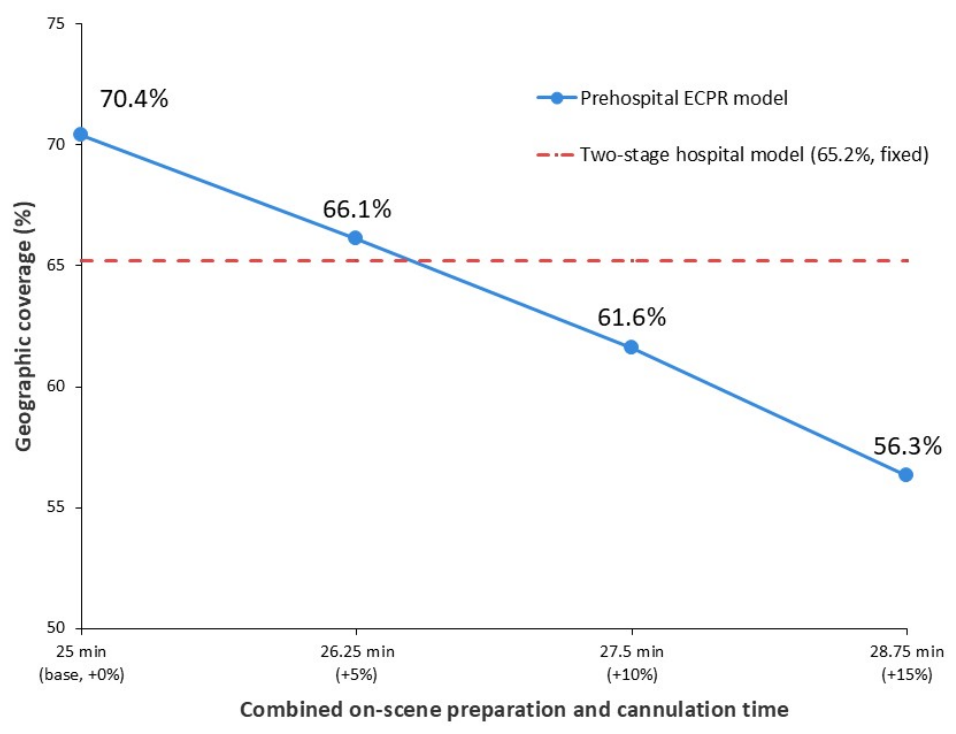
- However, sensitivity analysis revealed that this geographic advantage was contingent on achieving on-scene procedures within the assumed time parameters.
- A mobility-focused prehospital ECPR model extended potential access beyond what was achievable through hospital expansion, particularly in resource-limited areas.
- Optimization of prehospital deployment may represent a geographically feasible approach to expanding ECPR access in mixed urban–rural regions**, though operational feasibility and cost-effectiveness require further evaluation before clinical implementation.
Abstract
1. Introduction
2. Materials and Methods
2.1. Study Design
2.2. Study Setting
2.3. Study Population
2.4. Simulation Design and Time Parameters
2.4.1. Two-Stage Hospital Model Subcomponents
- Call to EMS arrival: 10 min, based on the prefecture’s average call-to-scene interval (10.4 min [28]).
- On-scene EMS activity: 20 min, reflecting the local median of 17 min but rounded conservatively to account for potential delays. This is also based on previous studies showing that prolonged on-scene resuscitation beyond 20 min is associated with decreased survival in OHCA cases without ROSC [29,30].
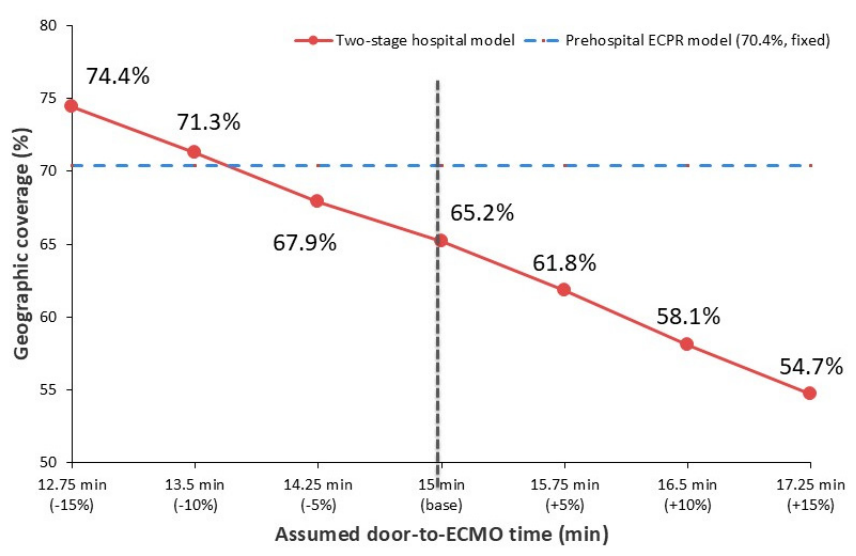
- Hospital arrival to ECMO pump-on: 15 min, based on institutional experience at Nara Medical University Hospital, where door-to-ECMO initiation is typically achieved within 15 min, consistent with organized ECPR program benchmarks [31].
2.4.2. Prehospital ECPR Model Subcomponents
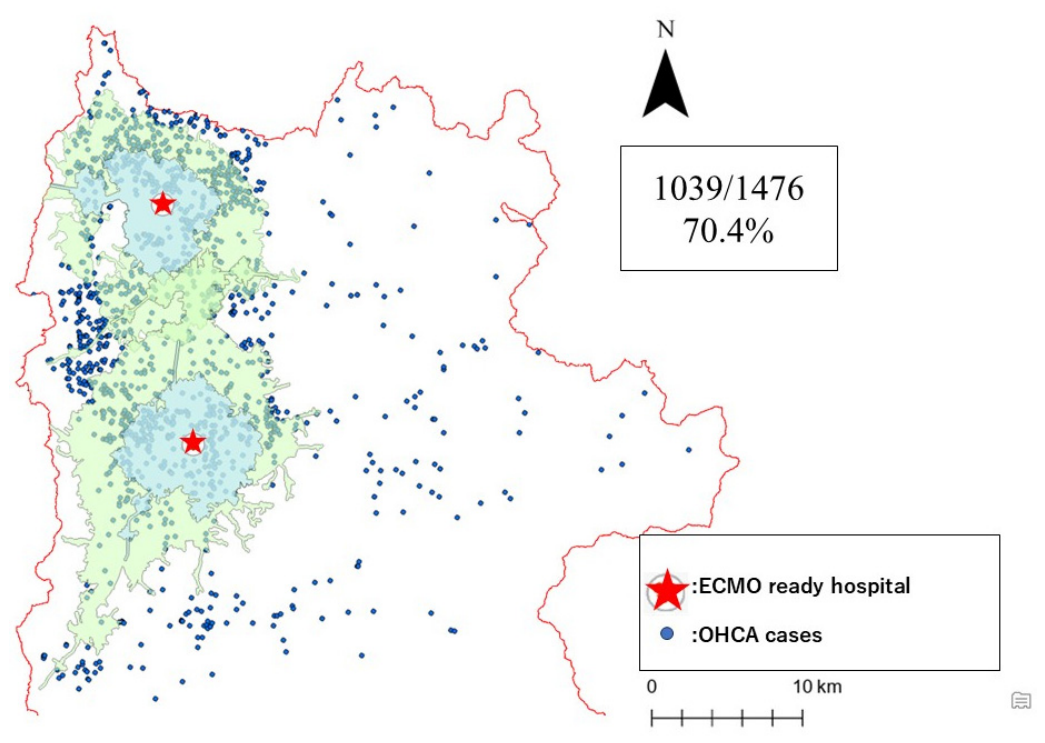
- Although EMS typically arrives at the scene within approximately 10 min after the emergency call, the prehospital ECPR team was modeled as being dispatched separately from one of the ECMO-ready base hospitals once the case was identified as a witnessed cardiac arrest.
- Call-to-dispatch preparation: 10 min, representing the time required for assembling the ECMO team and loading equipment prior to departure.
- On-scene preparation for cannulation: 10 min, based on in-hospital preparation times for sterile setup and equipment arrangement under current ECMO protocols at Nara Medical University Hospital.
- Cannulation-to-ECMO pump-on: 15 min, consistent with institutional benchmarks and previously reported intervals in organized ECPR programs [30].
2.5. Patient Demographics and EMS Operational Characteristics
2.6. Outcome
2.7. Statistical Analysis
2.8. Sensitivity Analysis
3. Results
3.1. Case Selection and Study Cohort
3.2. Baseline Characteristics of Included Cases
3.3. Baseline Geographic Coverage Under the Current System
3.4. Comparison of Hospital-Based Versus Prehospital ECPR Models
3.5. Residual Uncovered Areas
3.6. Results of Sensitivity Analysis
4. Discussion
4.1. Interpretation of Findings
4.2. Geographic Disparities and Equity
4.3. Implementation Challenges
4.4. Policy Implications
4.5. Limitations
5. Conclusions
Author Contributions
Funding
Institutional Review Board Statement
Informed Consent Statement
Data Availability Statement
Conflicts of Interest
Abbreviations
| AED | Automated External Defibrillator |
| CPC | Cerebral Performance Category |
| CPR | Cardiopulmonary Resuscitation |
| ECPR | Extracorporeal Cardiopulmonary Resuscitation |
| ECMO | Extracorporeal Membrane Oxygenation |
| EMS | Emergency Medical Services |
| GIS | Geographic Information System |
| IQR | Interquartile Range |
| OHCA | Out-of-Hospital Cardiac Arrest |
| ROSC | Return of Spontaneous Circulation |
References
- Merchant, R.M.; Topjian, A.A.; Panchal, A.R.; Cheng, A.; Aziz, K.; Berg, K.M.; Lavonas, E.J.; Magid, D.J. Part 1: Executive summary: American Heart Association guidelines for cardiopulmonary resuscitation and emergency cardiovascular care. Circulation 2020, 142, S337–S357. [Google Scholar] [CrossRef] [PubMed]
- Perkins, G.D.; Gräsner, J.T.; Semeraro, F.; Olasveengen, T.; Soar, J.; Lott, C.; Van de Voorde, P.; Madar, J.; Zideman, D.; Mentzelopoulos, S.; et al. European Resuscitation Council Guidelines 2021: Executive summary. Resuscitation 2021, 161, 1–60. [Google Scholar] [CrossRef] [PubMed]
- Matsuyama, T.; Ohta, B.; Kiyohara, K.; Kitamura, T. Cardiopulmonary resuscitation duration and favorable neurological outcome after out-of-hospital cardiac arrest: A nationwide multicenter observational study in Japan (the JAAM-OHCA registry). Crit. Care 2022, 26, 120. [Google Scholar] [CrossRef] [PubMed]
- Fire and Disaster Management Agency (FDMA). White Paper on Emergency and Rescue; Ministry of Internal Affairs and Communications: Tokyo, Japan, 2023. Available online: https://www.fdma.go.jp/publication/rescue/items/kkkg_r05_01_kyukyu.pdf (accessed on 1 March 2026). (In Japanese)
- Hadaya, J.; Dobaria, V.; Aguayo, E.; Kwon, O.J.; Sanaiha, Y.; Hyunh, A.; Sareh, S.; Benharash, P. National trends in utilization and outcomes of extracorporeal support for in- and out-of-hospital cardiac arrest. Resuscitation 2020, 151, 181–188. [Google Scholar] [CrossRef] [PubMed]
- Addison, D.; Cheng, E.; Forrest, P.; Livingstone, A.; Morton, R.L.; Dennis, M. Cost-effectiveness of extracorporeal cardiopulmonary resuscitation for adult out-of-hospital cardiac arrest: A systematic review. Resuscitation 2022, 178, 19–25. [Google Scholar] [CrossRef] [PubMed]
- Pagura, L.; Fabris, E.; Rakar, S.; Gabrielli, M.; Mazzaro, E.; Sinagra, G.; Stolfo, D. Does extracorporeal cardiopulmonary resuscitation improve survival with favorable neurological outcome in out-of-hospital cardiac arrest? A systematic review and meta-analysis. J. Crit. Care 2024, 84, 154882. [Google Scholar] [CrossRef] [PubMed]
- Sakamoto, T.; Morimura, N.; Nagao, K.; Asai, Y.; Yokota, H.; Nara, S.; Hase, M.; Tahara, Y.; Atsumi, T. Extracorporeal cardiopulmonary resuscitation versus conventional cardiopulmonary resuscitation in adults with out-of-hospital cardiac arrest: A prospective observational study. Resuscitation 2014, 85, 762–768. [Google Scholar] [CrossRef] [PubMed]
- Scquizzato, T.; Bonaccorso, A.; Consonni, M.; Scandroglio, A.M.; Swol, J.; Landoni, G.; Zangrillo, A. Extracorporeal cardiopulmonary resuscitation for out-of-hospital cardiac arrest: A systematic review and meta-analysis of randomized and propensity score-matched studies. Artif. Organs 2022, 46, 755–762. [Google Scholar] [CrossRef] [PubMed]
- Sonneville, R.; Schmidt, M. Extracorporeal cardiopulmonary resuscitation for adults with refractory out-of-hospital cardiac arrest: Towards better neurological outcomes. Circulation 2020, 141, 887–890. [Google Scholar] [CrossRef] [PubMed]
- Patricio, D.; Peluso, L.; Brasseur, A.; Lheureux, O.; Belliato, M.; Vincent, J.L.; Creteur, J.; Taccone, F.S. Comparison of extracorporeal and conventional cardiopulmonary resuscitation: A retrospective propensity score matched study. Crit. Care 2019, 23, 27. [Google Scholar] [CrossRef] [PubMed]
- Shih, H.M.; Lin, W.J.; Lin, Y.C.; Chang, S.S.; Chang, K.C.; Yu, S.H. Extracorporeal cardiopulmonary resuscitation for patients with refractory out-of-hospital cardiac arrest: A propensity score matching, observational study. Sci. Rep. 2024, 14, 9912. [Google Scholar] [CrossRef] [PubMed]
- Siao, F.Y.; Chiu, C.C.; Chiu, C.W.; Chen, Y.C.; Chen, Y.L.; Hsieh, Y.K.; Lee, C.H.; Wu, C.T.; Chou, C.C.; Yen, H.H. Managing cardiac arrest with refractory ventricular fibrillation in the emergency department: Conventional cardiopulmonary resuscitation versus extracorporeal cardiopulmonary resuscitation. Resuscitation 2015, 92, 70–76. [Google Scholar] [CrossRef] [PubMed]
- Gottula, A.L.; Shaw, C.R.; Gorder, K.L.; Lane, B.H.; Latessa, J.; Qi, M.; Koshoffer, A.; Al-Araji, R.; Young, W.; Bonomo, J.; et al. Eligibility of out-of-hospital cardiac arrest patients for extracorporeal cardiopulmonary resuscitation in the United States: A geographic information system model. Resuscitation 2022, 180, 111–120. [Google Scholar] [CrossRef] [PubMed]
- Millerchip, O.; Eddison, J.; Rosenberg, A.; Bailey, J.; Raitt, J. Database and geospatial mapping study of those eligible for extracorporeal cardiopulmonary resuscitation in the Thames valley Region, England. Resusc. Plus 2025, 22, 100879. [Google Scholar] [CrossRef] [PubMed]
- Leung, K.H.B.; Hartley, L.; Moncur, L.; Gillon, S.; Short, S.; Chan, T.C.Y.; Clegg, G.R. Assessing feasibility of proposed extracorporeal cardiopulmonary resuscitation programmes for out-of-hospital cardiac arrest in Scotland via geospatial modelling. Resuscitation 2024, 200, 110256. [Google Scholar] [CrossRef] [PubMed]
- McCloskey, C.; Zeller, J.; Berk, A.; Patil, N.; Ajayakumar, J.; Curtis, A.; Curtis, J. Prevalence and geographic features of patients eligible for extracorporeal cardiopulmonary resuscitation. Resuscitation 2023, 188, 109837. [Google Scholar] [CrossRef] [PubMed]
- Bartos, J.A.; Frascone, R.J.; Conterato, M.; Wesley, K.; Lick, C.; Sipprell, K.; Vuljaj, N.; Burnett, A.; Peterson, B.K.; Simpson, N.; et al. The Minnesota mobile extracorporeal cardiopulmonary resuscitation consortium for treatment of out-of-hospital refractory ventricular fibrillation: Program description, performance, and outcomes. eClinicalMedicine 2020, 29, 100632. [Google Scholar] [CrossRef] [PubMed]
- Gottula, A.L.; Van Wyk, H.; Qi, M.; Vogelsong, M.A.; Shaw, C.R.; Tonna, J.E.; Johnson, N.J.; Condella, A.; Bartos, J.A.; Berrocal, V.J.; et al. Geospatial access to extracorporeal membrane oxygenation in the United States. Crit. Care Med. 2025, 53, e874–e883. [Google Scholar] [CrossRef] [PubMed]
- Lamhaut, L.; Jouffroy, R.; Kalpodjian, A.; Deluze, T.; Phillipe, P.; Vivien, B.; An, K.; Carli, P. Successful treatment of refractory cardiac arrest by emergency physicians using pre-hospital ECLS. Resuscitation 2012, 83, e177–e178. [Google Scholar] [CrossRef] [PubMed]
- Kruit, N.; Burns, B.; Shearer, N.; Hui, J.; Coggins, A.; Buscher, H.; Granger, E.; Ostrowski, K.; Plunkett, B.; Southwood, T.J.; et al. Pre-hospital ECPR for refractory cardiac arrest—The PRECARE pilot feasibility study. Resuscitation 2025, 212, 110631. [Google Scholar] [CrossRef] [PubMed]
- Singer, B.; Hla, T.T.W.; Abu-Habsa, M.; Davies, G.; Wrigley, F.; Faulkner, M.; Finney, S.J. Sub30: Feasibility study of a pre-hospital extracorporeal membrane oxygenation (ECMO) in patients with refractory out-of-hospital cardiac arrest in London, United Kingdom. Resuscitation 2025, 207, 110455. [Google Scholar] [CrossRef] [PubMed]
- Fujita, K.; Konn, A.; Ogura, T.; Kon, Y.; Kondo, E.; Konno, S.; Nodagashira, T. Prehospital extracorporeal cardiopulmonary resuscitation for cardiac arrest patients in rural areas: A case report of two patients. Acute Med. Surg. 2020, 7, e577. [Google Scholar] [CrossRef] [PubMed]
- Nara Prefecture. Standards for Transport and Acceptance of Patients. Revised 30 May 2023. Available online: https://www.pref.nara.jp/secure/57381/2023.05.31lkaisei.pdf (accessed on 1 March 2026). (In Japanese)
- Otani, T.; Sawano, H.; Natsukawa, T.; Nakashima, T.; Oku, H.; Gon, C.; Takahagi, M.; Hayashi, Y. Low-flow time is associated with a favorable neurological outcome in out-of-hospital cardiac arrest patients resuscitated with extracorporeal cardiopulmonary resuscitation. J. Crit. Care 2018, 48, 15–20. [Google Scholar] [CrossRef] [PubMed]
- Soar, J.; Nolan, J.P.; Böttiger, B.W.; Perkins, G.D.; Lott, C.; Carli, P.; Pellis, T.; Sandroni, C.; Skrifvars, M.B.; Smith, G.B.; et al. European Resuscitation Council guidelines for resuscitation 2015. Resuscitation 2015, 95, 100–147. [Google Scholar] [CrossRef] [PubMed]
- Richardson, A.C.; Tonna, J.E.; Nanjayya, V.; Nixon, P.; Abrams, D.C.; Raman, L.; Bernard, S.; Finney, S.J.; Grunau, B.; Youngquist, S.T.; et al. Extracorporeal cardiopulmonary resuscitation in adults. Interim guideline consensus statement from the Extracorporeal Life Support Organization. ASAIO J. 2021, 67, 221–228. [Google Scholar] [CrossRef] [PubMed]
- Fire and Disaster Management Agency of Japan. Emergency Medical Services Statistics by Fire Department in 2023; Ministry of Internal Affairs and Communications: Tokyo, Japan, 2024. Available online: https://www.fdma.go.jp/singi_kento/kento/items/post-151/03/sankou4.pdf (accessed on 1 March 2026). (In Japanese)
- de Graaf, C.; Beesems, S.G.; Koster, R.W. Time of on-scene resuscitation in out of-hospital cardiac arrest patients transported without return of spontaneous circulation. Resuscitation 2019, 138, 235–242, Corrigendum in Resuscitation 2019, 140, 223. https://doi.org/10.1016/j.resuscitation.2019.05.003. [Google Scholar] [CrossRef] [PubMed]
- Grunau, B.; Reynolds, J.; Scheuermeyer, F.; Stenstom, R.; Stub, D.; Pennington, S.; Cheskes, S.; Ramanathan, K.; Christenson, J. Relationship between Time-to-ROSC and survival in out-of-hospital cardiac arrest ECPR Candidates: When is the best time to consider transport to hospital? Prehosp. Emerg. Care 2016, 20, 615–622. [Google Scholar] [CrossRef] [PubMed]
- Abrams, D.; MacLaren, G.; Lorusso, R.; Price, S.; Yannopoulos, D.; Vercaemst, L.; Bělohlávek, J.; Taccone, F.S.; Aissaoui, N.; Shekar, K.; et al. Extracorporeal cardiopulmonary resuscitation in adults: Evidence and implications. Intensive Care Med. 2022, 48, 1–15. [Google Scholar] [CrossRef] [PubMed]
- Kanda, Y. Investigation of the freely available easy-to-use software “EZR” for medical statistics. Bone Marrow Transpl. 2013, 48, 452–458. [Google Scholar] [CrossRef]
- Grunau, B.; Kime, N.; Leroux, B.; Rea, T.; Van Belle, G.; Menegazzi, J.J.; Kudenchuk, P.J.; Vaillancourt, C.; Morrison, L.J.; Elmer, J.; et al. Association of Intra-arrest transport vs continued on-scene resuscitation with survival to hospital discharge among patients with out-of-hospital cardiac arrest. JAMA 2020, 324, 1058–1067. [Google Scholar] [CrossRef] [PubMed]
- Dennis, M.; Zmudzki, F.; Burns, B.; Scott, S.; Gattas, D.; Reynolds, C.; Buscher, H.; Forrest, P. Cost effectiveness and quality of life analysis of extracorporeal cardiopulmonary resuscitation (ECPR) for refractory cardiac arrest. Resuscitation 2019, 139, 49–56. [Google Scholar] [CrossRef] [PubMed]
- Matsuoka, Y.; Goto, R.; Atsumi, T.; Morimura, N.; Nagao, K.; Tahara, Y.; Asai, Y.; Yokota, H.; Ariyoshi, K.; Yamamoto, Y.; et al. Cost-effectiveness of extracorporeal cardiopulmonary resuscitation for out-of-hospital cardiac arrest: A multi-centre prospective cohort study. Resuscitation 2020, 157, 32–38. [Google Scholar] [CrossRef] [PubMed]
- Oude Lansink-Hartgring, A.; van den Hengel, B.; van der Bij, W.; Erasmus, M.E.; Mariani, M.A.; Rienstra, M.; Cernak, V.; Vermeulen, K.M.; van den Bergh, W.M. Hospital costs of extracorporeal life support therapy. Crit. Care Med. 2016, 44, 717–723. [Google Scholar] [CrossRef] [PubMed]
- Song, C.; Dennis, M.; Burns, B.; Dyson, S.; Forrest, P.; Ramanan, M.; Levinson, D.; Moylan, E. Improving access to extracorporeal membrane oxygenation for out of hospital cardiac arrest: Pre-hospital ECPR and alternate delivery strategies. Scand. J. Trauma Resusc. Emerg. Med. 2022, 30, 77. [Google Scholar] [CrossRef] [PubMed]
- Hutin, A.; Ricard-Hibon, A.; Briole, N.; Dupin, A.; Dagron, C.; Raphalen, J.H.; Mungur, A.; An, K.; Carli, P.; Lamhaut, L. First description of a helicopter-borne ECPR team for remote refractory out-of-hospital cardiac arrest. Prehosp. Emerg. Care 2022, 26, 89–92. [Google Scholar] [PubMed]
- Gottula, A.L.; Qi, M.; Lane, B.H.; Shaw, C.R.; Gorder, K.; Powell, E.; Danielson, K.; Ciullo, A.; Johnson, N.J.; Tonna, J.E.; et al. Prehospital ground and helicopter-based extracorporeal cardiopulmonary resuscitation (ECPR) reduce barriers to ECPR: A GIS model. Prehosp. Emerg. Care 2025, 29, 53–61. [Google Scholar] [CrossRef]
- Ali, S.; Moors, X.; van Schuppen, H.; Mommers, L.; Weelink, E.; Meuwese, C.L.; Kant, M.; van den Brule, J.; Kraemer, C.E.; Vlaar, A.P.J.; et al. A national multi centre pre-hospital ECPR stepped wedge study; design and rationale of the ON-SCENE study. Scand. J. Trauma Resusc. Emerg. Med. 2024, 32, 31. [Google Scholar] [CrossRef] [PubMed]



| Characteristic | Value (All Patients n = 1476) |
|---|---|
| Patient age, years | 82.0 (72.0–88.0) |
| Male, n (%) | 881 (59.9) |
| Bystander chest compressions, n (%) | 807 (54.7) |
| Shockable rhythm at EMS arrival, n (%) | 229 (15.5) |
| Advanced airway management by EMS, n (%) | 1161 (78.7) |
| Intravenous access by EMS, n (%) | 663 (46.3) |
| Epinephrine administration by EMS, n (%) | 636 (43.1) |
| Time from emergency call to EMS arrival at scene, min | 9.0 (7.0–11.0) |
| EMS on-scene time, min | 17.0 (13.0–22.0) |
| Scene-to-hospital transport time, min | 10.0 (6.0–14.0) |
| ROSC, n (%) | 243 (16.5) |
| CPC 1–2, n (%) | 73 (4.4) |
| (A) Current System Versus Two-Stage Hospital Model | |||
| Two-Stage: Covered | Two-Stage: Not Covered | Total | |
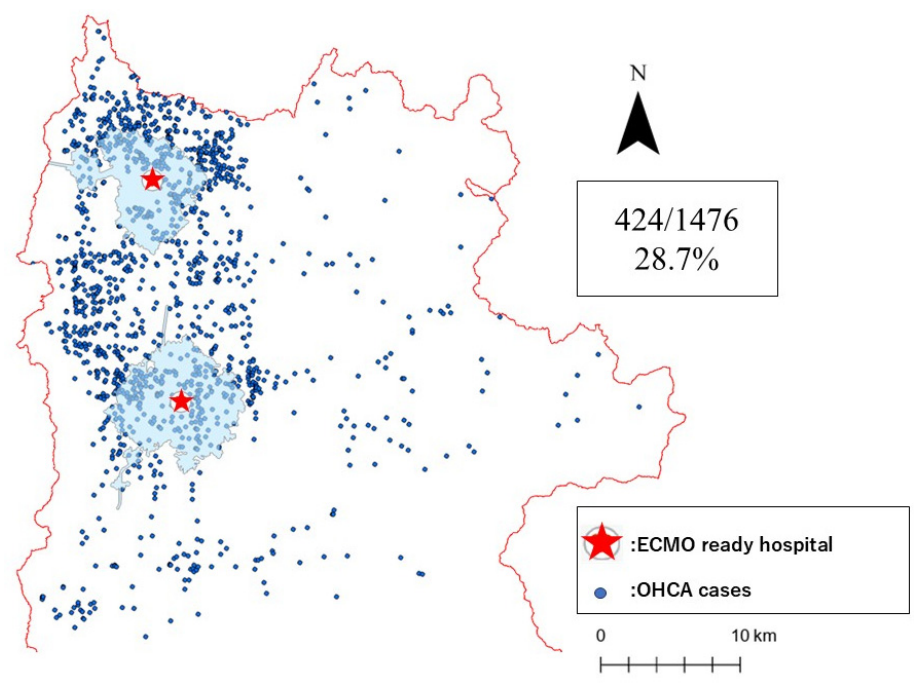
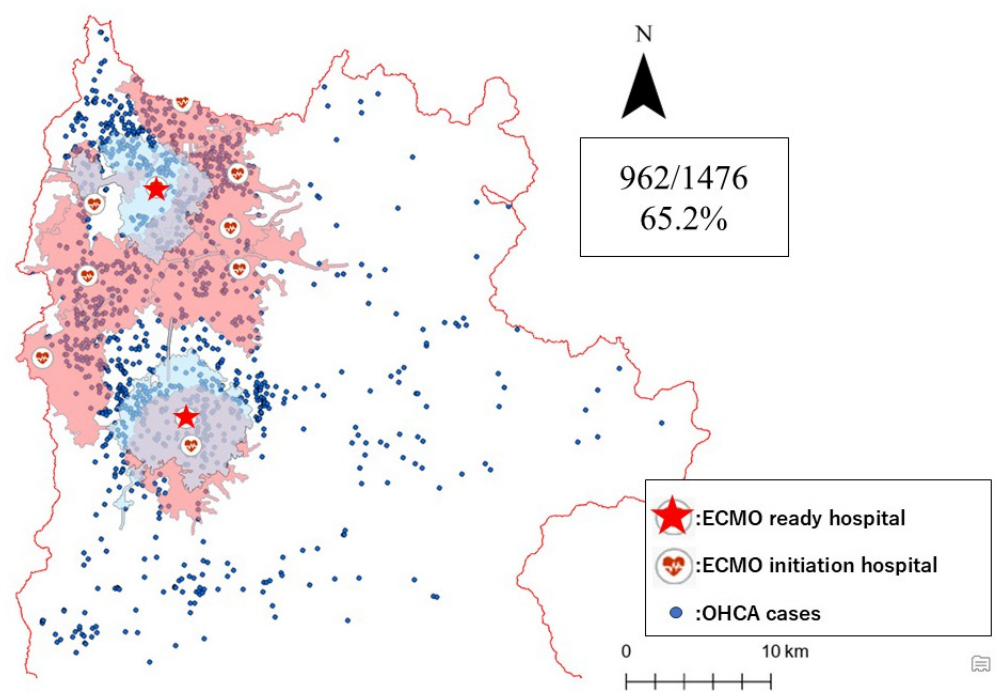
| Current: Covered | 424 (28.7%) | 0 (0.0%) | 424 (28.7%) |
| Current: Not covered | 538 (36.4%) | 514 (34.8%) | 1052 (71.3%) |
| Total | 962 (65.2%) | 514 (34.8%) | 1476 (100%) |
| (B) Two-Stage Hospital Model Versus Prehospital ECPR Model | |||
| Prehospital: Covered | Prehospital: Not Covered | Total | |
| Two-stage: Covered | 750 (50.8%) | 212 (14.4%) | 962 (65.2%) |
| Two-stage: Not covered | 289 (19.6%) | 225 (15.2%) | 514 (34.8%) |
| Total | 1039 (70.4%) | 437 (29.6%) | 1476 (100%) |
Disclaimer/Publisher’s Note: The statements, opinions and data contained in all publications are solely those of the individual author(s) and contributor(s) and not of MDPI and/or the editor(s). MDPI and/or the editor(s) disclaim responsibility for any injury to people or property resulting from any ideas, methods, instructions or products referred to in the content. |
© 2026 by the authors. Licensee MDPI, Basel, Switzerland. This article is an open access article distributed under the terms and conditions of the Creative Commons Attribution (CC BY) license.
Share and Cite
Kinoshita, A.; Asai, H.; Kawai, Y.; Miyazaki, K.; Yamamoto, K.; Okuda, H.; Fukushima, H. Optimizing Regional Access to Extracorporeal Cardiopulmonary Resuscitation: A Geographic-Information-System-Based Comparison of Hospital- and Prehospital-Initiated Strategies in Nara Prefecture, Japan. Healthcare 2026, 14, 1762. https://doi.org/10.3390/healthcare14121762
Kinoshita A, Asai H, Kawai Y, Miyazaki K, Yamamoto K, Okuda H, Fukushima H. Optimizing Regional Access to Extracorporeal Cardiopulmonary Resuscitation: A Geographic-Information-System-Based Comparison of Hospital- and Prehospital-Initiated Strategies in Nara Prefecture, Japan. Healthcare. 2026; 14(12):1762. https://doi.org/10.3390/healthcare14121762
Chicago/Turabian StyleKinoshita, Arisa, Hideki Asai, Yasuyuki Kawai, Keita Miyazaki, Koji Yamamoto, Hirozumi Okuda, and Hidetada Fukushima. 2026. "Optimizing Regional Access to Extracorporeal Cardiopulmonary Resuscitation: A Geographic-Information-System-Based Comparison of Hospital- and Prehospital-Initiated Strategies in Nara Prefecture, Japan" Healthcare 14, no. 12: 1762. https://doi.org/10.3390/healthcare14121762
APA StyleKinoshita, A., Asai, H., Kawai, Y., Miyazaki, K., Yamamoto, K., Okuda, H., & Fukushima, H. (2026). Optimizing Regional Access to Extracorporeal Cardiopulmonary Resuscitation: A Geographic-Information-System-Based Comparison of Hospital- and Prehospital-Initiated Strategies in Nara Prefecture, Japan. Healthcare, 14(12), 1762. https://doi.org/10.3390/healthcare14121762