‘It Just Wears You Down’: A Qualitative Exploration of the Experiences and Wellness Needs of Organ Transplant Caregivers to Inform the Development of Support Resources
 , ,
, ,  ,
, 
Highlights
- Caregivers to organ transplant candidates and recipients experience a high burden of caregiving-related tasks, which can negatively impact their physical and mental well-being.
- Organ transplant caregivers express a need for tailored resources to better support both their caregiving responsibilities and their own health and well-being.
- Future work should explore approaches that support patients and caregivers both individually and collectively, considering their interconnected needs and relationship.
- Caregiver needs vary across contexts, relationships, and settings; therefore, interventions should be flexible and tailored to the specific context in which caregiving occurs.
Abstract
1. Introduction
2. Materials and Methods
3. Results
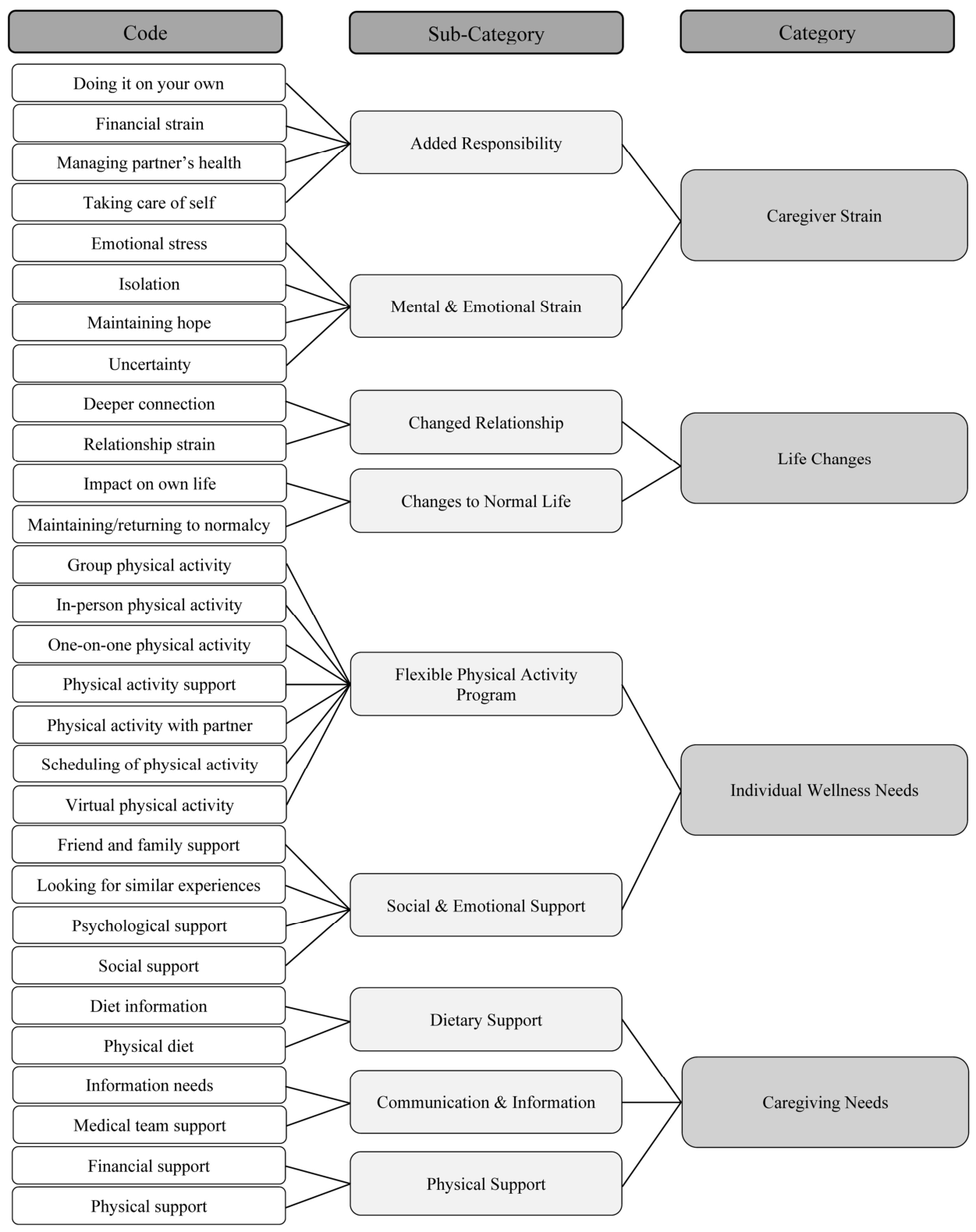
3.1. Caregiver Strain
3.1.1. Added Responsibility
“We have this ten-year-old, and we have these two dogs, and you know we have pets, we have a horse, and like all these things need to be taken care of and it’s really just me, right? My wife’s got enough energy to be up and about for an hour, hour and a half a day. So, it all kind of falls on me, you know?”(P3)
3.1.2. Mental and Emotional Strain
“You don’t know what’s going to happen. We don’t. You don’t know, is he going to live? Is he not going to live? And if he does get to transplant, what’s it going to be like after”(P1)
“I can handle a bumpy ride. But it just, it wears on you, you know? It wears you down.”(P3)
“I mean, as a husband, you don’t, you don’t know the fear and the pain or whatever it is that your wife is going through and it’s like there’s nothing you can do for them, right? It feels so helpless. There’s just nothing you can do. Like you can be there and that’s it”.(P7)
3.2. Life Changes
3.2.1. Changed Relationship
“He doesn’t want to go out anywhere. He doesn’t want to do anything outside…we do our doctor’s visits when we have to, but other than that he doesn’t want to do anything else. Which sometimes annoys me, you know?”(P5)
“If you think that my husband loved it, then you got another story coming to you. There’s no man that wants to be babied by his wife…there’s no man that wants that or no wife that wants that. It’s very, very stressful”(P6)
3.2.2. Changes to Normal Life
“The biggest challenge is just coming back to a place where I can start focusing on my own goals and objectives”(P2)
3.3. Individual Wellness Needs
3.3.1. Flexible Physical Activity Program
“[Virtually] you wouldn’t have the interaction there, the back and forth with ideas, for interacting with the peer group. In person would be okay, as long as there’s not big viruses going around. You have immunocompromised people that you don’t want to bring it back to”(P4)
“When they started her physio…she had to go to the gym. So, when she went to the gym, I went with her. I signed the waiver, and I started working out with her, which was a great benefit to me…I really enjoyed the time when I got in the gym and even though she’s home [from the hospital], the two of us go to the gym twice a week together”(P8)
3.3.2. Social and Emotional Support
“It would be really nice to be able to have someone to talk to that’s experienced it or gone through it, as opposed to some random psychologist that thinks they can tell you what’s going on. And they’ve never even had a death in their family, let alone someone who is in dire need of a transplant!”(P6)
3.4. Caregiving Needs
3.4.1. Dietary Support
“Like if there was like a Hello Fresh [meal kit service] for kidney patients and their families, where, you know, you’re not even preparing the meal, you’re just sending the ingredients to the house for the recipe and saying, “Good luck!” Like that’d be better than trying to plan meals and stuff all the time, you know, like that was that was probably one of the hardest things, trying to come up with meals that fit the diet restrictions, and were still edible”(P2)
3.4.2. Communication and Information
“Yes, there was no doubt that if there was any questions to ask, or whatever it was, they were answered, and if they didn’t have the answers they got them for me…everybody was just awesome, that’s all I can say”(P8)
“They could have walked through certain scenarios and said, “Okay, if this happens, this is what you’ll will be looking for you to do.” So yeah, maybe something like that, like some different scenarios that could have happened would have been helpful to prepare me a little bit more”(P1)
3.4.3. Physical Support
“Even if you could get like help with groceries, maybe once a month, or gas, like here’s a $200 allowance to help you do something. So, whether that pays a bill, it pays your gas that day, pays your parking for the hospital, pays for me to have my day off. It would be really nice in those scenarios to not have to use a vacation or an unpaid day to go help your significant other for a lifesaving appointment, right?”(P6)
4. Discussion
4.1. Development of TWP Caregiver Resources
4.2. Strengths and Limitations
5. Conclusions
Author Contributions
Funding
Institutional Review Board Statement
Informed Consent Statement
Data Availability Statement
Acknowledgments
Conflicts of Interest
Abbreviations
| TWP | Transplant Wellness Program |
References
- Grinyo, J.M. Why is organ transplantation clinically important? Cold Spring Harb. Perspect. Med. 2013, 3, a014985. [Google Scholar] [CrossRef]
- Solbu, A.; Cadzow, R.B.; Pullano, T.; Brinser-Day, S.; Tumiel-Berhalter, L.; Kayler, L.K. Interviews With Lay Caregivers About Their Experiences Supporting Patients Throughout Kidney Transplantation. Prog. Transplant. 2024, 34, 21–31. [Google Scholar] [CrossRef]
- Jesse, M.T.; Hansen, B.; Bruschwein, H.; Chen, G.; Nonterah, C.; Peipert, J.D.; Dew, M.A.; Thomas, C.; Ortega, A.D.; Balliet, W.; et al. Findings and recommendations from the organ transplant caregiver initiative: Moving clinical care and research forward. Am. J. Transplant. 2021, 21, 950–957. [Google Scholar] [CrossRef]
- Meltzer, L.J.; Rodrigue, J.R. Psychological Distress in Caregivers of Liver and Lung Transplant Candidates. J. Clin. Psychol. Med. Settings 2001, 8, 173–180. [Google Scholar] [CrossRef]
- Yagelniski, A.; Rosaasen, N.; Cardinal, L.; Fenton, M.E.; Tam, J.; Mansell, H. A Qualitative Study to Explore the Needs of Lung Transplant Caregivers. Prog. Transplant. 2020, 30, 243–248. [Google Scholar] [CrossRef]
- Fox, D.E.; Hall, M.; Thibodeau, C.; Coldwell, K.; Lauder, L.; Dewell, S.L.; Davidson, S.J. The experiences of patients, caregivers and donors on transplant journeys in Canada: A convergent parallel mixed methods study. J. Eval. Clin. Pract. 2024, 30, 268–280. [Google Scholar] [CrossRef]
- Glaze, J.A.; Brooten, D.; Youngblut, J.A.; Hannan, J.; Page, T. The Lived Experiences of Caregivers of Lung Transplant Recipients. Prog. Transplant. 2021, 31, 299–304. [Google Scholar] [CrossRef]
- Deng, L.X.; Sharma, A.; Gedallovich, S.M.; Tandon, P.; Hansen, L.; Lai, J.C. Caregiver Burden in Adult Solid Organ Transplantation. Transplantation 2023, 107, 1482–1491. [Google Scholar] [CrossRef]
- Walker, R.C.; Hanson, C.S.; Palmer, S.C.; Howard, K.; Morton, R.L.; Marshall, M.R.; Tong, A. Patient and Caregiver Perspectives on Home Hemodialysis: A Systematic Review. Am. J. Kidney Dis. 2015, 65, 451–463. [Google Scholar] [CrossRef] [PubMed]
- Zhang, N.; Tian, Z.; Liu, X.; Yu, X.; Wang, L. Burden, coping and resilience among caregivers for patients with chronic obstructive pulmonary disease: An integrative review. J. Clin. Nurs. 2024, 33, 1346–1361. [Google Scholar] [CrossRef] [PubMed]
- Matthews, M.; McKeaveney, C.; Noble, H.; Reid, J. Exploring the unmet needs and experiences of informal caregivers of patients with end-stage kidney disease (ESKD) receiving haemodialysis—A qualitative study. PLoS ONE 2024, 19, e0302525. [Google Scholar] [CrossRef]
- Young, A.L.; Rowe, I.A.; Absolom, K.; Jones, R.L.; Downing, A.; Meader, N.; Glaser, A.; Toogood, G.J. The effect of Liver Transplantation on the quality of life of the recipient’s main caregiver—A systematic review. Liver Int. 2017, 37, 794–801. [Google Scholar] [CrossRef]
- Divdar, Z.; Foroughameri, G.; Farokhzadian, J. The psychosocial needs and quality of life of family caregivers of patients with organ transplant. J. Res. Nurs. 2019, 24, 344–355. [Google Scholar] [CrossRef]
- Gilbertson, E.L.; Krishnasamy, R.; Foote, C.; Kennard, A.L.; Jardine, M.J.; Gray, N.A. Burden of Care and Quality of Life Among Caregivers for Adults Receiving Maintenance Dialysis: A Systematic Review. Am. J. Kidney Dis. 2019, 73, 332–343. [Google Scholar] [CrossRef] [PubMed]
- Goetzinger, A.M.; Blumenthal, J.A.; O’Hayer, C.V.; Babyak, M.A.; Hoffman, B.M.; Ong, L.; Davis, R.D.; Smith, S.R.; Rogers, J.G.; Milano, C.A.; et al. Stress and coping in caregivers of patients awaiting solid organ transplantation. Clin. Transplant. 2012, 26, 97–104. [Google Scholar] [CrossRef] [PubMed]
- Vovlianou, S.; Koutlas, V.; Ikonomou, M.; Vassilikopoulos, T.; Papoulidou, F.; Dounousi, E. Quality of life of caregivers of end-stage kidney disease patients: Caregivers or care recipients? J. Ren. Care 2023, 49, 56–72. [Google Scholar] [CrossRef]
- Hipólito, N.; Ruivo, A.; Martins, S.; Dinis, B.; Flora, S.; Marques, A.; Brooks, D.; Silva, C.G.; Januário, F.; Silva, S.; et al. Relationship between Distress Related to Caregiver Burden and Physical Activity in Informal Caregivers of Patients with COPD. COPD J. Chronic Obstr. Pulm. Dis. 2020, 17, 562–567. [Google Scholar] [CrossRef] [PubMed]
- Stathopoulou, A.; Fragkiadakis, G.F. Assessment of psychological distress and quality of life of family caregivers caring for patients with chronic diseases at home. AIMS Public Health 2023, 10, 456–468. [Google Scholar] [CrossRef]
- Lazarus, R.S.; Folkman, S. Stress, Appraisal, and Coping; Springer Publishing Company: New York, NY, USA, 1984. [Google Scholar]
- Biggs, A.; Brough, P.; Drummond, S. Lazarus and Folkman’s Psychological Stress and Coping Theory. In The Handbook of Stress and Health, 1st ed.; Wiley Online Library: Hoboken, NJ, USA, 2017; pp. 349–364. [Google Scholar]
- Jesse, M.T.; Gartrelle, K.; Bruschwein, H.; Hug, G.; LeTarte, B.; Lerret, S.; Dew, M.A. Non-pharmacological interventions engaging organ transplant caregivers: A systematic review. Clin. Transplant. 2022, 36, e14611. [Google Scholar] [CrossRef]
- Khouban-Shargh, R.; Mirhosseini, S.; Ghasempour, S.; Basirinezhad, M.H.; Abbasi, A. Stress management training program to address caregiver burden and perceived stress among family caregivers of patients undergoing hemodialysis: A randomized controlled trial study. BMC Nephrol. 2024, 25, 350. [Google Scholar] [CrossRef]
- Cuthbert, C.A.; King-Shier, K.M.; Ruether, J.D.; Tapp, D.M.; Wytsma-Fisher, K.; Fung, T.S.; Culos-Reed, S.N. The Effects of Exercise on Physical and Psychological Outcomes in Cancer Caregivers: Results From the RECHARGE Randomized Controlled Trial. Ann. Behav. Med. 2018, 52, 645–661. [Google Scholar] [CrossRef]
- Rodakowski, J.; Skidmore, E.R.; Rogers, J.C.; Schulz, R. Role of Social Support in Predicting Caregiver Burden. Arch. Phys. Med. Rehabil. 2012, 93, 2229–2236. [Google Scholar] [CrossRef]
- Cardoso, C.; Lumini, M.J.; Martins, T. Effects of physical exercise in reducing caregivers burden: A systematic review. Front. Public Health 2025, 13, 1474913. [Google Scholar] [CrossRef] [PubMed]
- Lambert, S.D.; Duncan, L.R.; Kapellas, S.; Bruson, A.M.; Myrand, M.; Santa Mina, D.; Culos-Reed, N.; Lambrou, A. A Descriptive Systematic Review of Physical Activity Interventions for Caregivers: Effects on Caregivers’ and Care Recipients’ Psychosocial Outcomes, Physical Activity Levels, and Physical Health. Ann. Behav. Med. 2016, 50, 907–919. [Google Scholar] [CrossRef] [PubMed]
- Signe, A.; Elmståhl, S. Psychosocial intervention for family caregivers of people with dementia reduces caregiver’s burden: Development and effect after 6 and 12 months. Scand. J. Caring Sci. 2008, 22, 98–109. [Google Scholar] [CrossRef]
- Pucciarelli, G.; Lommi, M.; Magwood, G.S.; Simeone, S.; Colaceci, S.; Vellone, E.; Alvaro, R. Effectiveness of dyadic interventions to improve stroke patient–caregiver dyads’ outcomes after discharge: A systematic review and meta-analysis study. Eur. J. Cardiovasc. Nurs. 2021, 20, 14–33. [Google Scholar] [CrossRef]
- Sim, J.A.P.; Perinpanayagam, M.A.; Bahry, V.; Wytsma-Fisher, K.; Burak, K.W.; Isaac, D.L.; Mustata, S.; Culos-Reed, S.N. An Exercise and Wellness Behavior Change Program for Solid Organ Transplant: A Clinical Research Protocol for the Transplant Wellness Program. Can. J. Kidney Health Dis. 2024, 11, 20543581241289196. [Google Scholar] [CrossRef]
- Simpson, V.; Edwards, N.; Kovich, M. Conversations about wellness: A qualitative analysis of patient narratives post annual wellness visit. Geriatr. Nurs. 2021, 42, 681–686. [Google Scholar] [CrossRef]
- Oliver, M.D.; Baldwin, D.R.; Datta, S. Health to Wellness: A Review of Wellness Models and Transitioning Back to Health. Int. J. Health Wellness Soc. 2018, 9, 41–56. [Google Scholar] [CrossRef]
- Hsieh, H.F.; Shannon, S.E. Three approaches to qualitative content analysis. Qual. Health Res. 2005, 15, 1277–1288. [Google Scholar] [CrossRef]
- Vaughan, C.; Trail, T.E.; Mahmud, A.; Dellva, S.; Tanielian, T.; Friedman, E. Informal Caregivers’ Experiences and Perceptions of a Web-Based Peer Support Network: Mixed-Methods Study. J. Med. Internet Res. 2018, 20, e257. [Google Scholar] [CrossRef]
- Friedman, E.M.; Trail, T.E.; Vaughan, C.A.; Tanielian, T. Online peer support groups for family caregivers: Are they reaching the caregivers with the greatest needs? J. Am. Med. Inform. Assoc. 2018, 25, 1130–1136. [Google Scholar] [CrossRef] [PubMed]
- Lambert, S.D.; Duncan, L.R.; Ellis, J.; Schaffler, J.L.; Loban, E.; Robinson, J.W.; Culos-Reed, N.; Matthew, A.; Clayberg, K.; Santa Mina, D.; et al. Acceptability and Usefulness of a Dyadic, Tailored, Web-Based, Psychosocial and Physical Activity Self-Management Program (TEMPO): A Qualitative Study. J. Clin. Med. 2020, 9, 3284. [Google Scholar] [CrossRef]
- Milbury, K.; Liao, Z.; Shannon, V.; Mallaiah, S.; Nagarathna, R.; Li, Y.; Yang, C.; Carmack, C.; Bruera, E.; Cohen, L. Dyadic yoga program for patients undergoing thoracic radiotherapy and their family caregivers: Results of a pilot randomized controlled trial. Psycho-Oncol. 2019, 28, 615–621. [Google Scholar] [CrossRef]
- Keats, M.R.; Christensen, T.; Grandy, S.A.; Mason, R.; Munroe, C.A.; Snow, S.; Wood, L.; Blanchard, C. A Dyadic Approach to Cancer Care: Examining the Feasibility and Preliminary Effectiveness of a Partner-Based Exercise Intervention for Caregivers and Their Care Recipients. Int. J. Environ. Res. Public Health 2026, 23, 56. [Google Scholar] [CrossRef] [PubMed]
- Palmer, S.C.; Hanson, C.S.; Craig, J.C.; Strippoli, G.F.M.; Ruospo, M.; Campbell, K.; Johnson, D.W.; Tong, A. Dietary and Fluid Restrictions in CKD: A Thematic Synthesis of Patient Views From Qualitative Studies. Am. J. Kidney Dis. 2015, 65, 559–573. [Google Scholar] [CrossRef]
- Stevenson, J.; Tong, A.; Gutman, T.; Campbell, K.L.; Craig, J.C.; Brown, M.A.; Lee, V.W. Experiences and Perspectives of Dietary Management Among Patients on Hemodialysis: An Interview Study. J. Ren. Nutr. 2018, 28, 411–421. [Google Scholar] [CrossRef]
- Michie, S.; van Stralen, M.M.; West, R. The behaviour change wheel: A new method for characterising and designing behaviour change interventions. Implement. Sci. 2011, 6, 42. [Google Scholar] [CrossRef] [PubMed]
- Malterud, K.; Siersma, V.D.; Guassora, A.D. Sample Size in Qualitative Interview Studies: Guided by Information Power. Qual. Health Res. 2016, 26, 1753–1760. [Google Scholar] [CrossRef]

Disclaimer/Publisher’s Note: The statements, opinions and data contained in all publications are solely those of the individual author(s) and contributor(s) and not of MDPI and/or the editor(s). MDPI and/or the editor(s) disclaim responsibility for any injury to people or property resulting from any ideas, methods, instructions or products referred to in the content. |
© 2026 by the authors. Licensee MDPI, Basel, Switzerland. This article is an open access article distributed under the terms and conditions of the Creative Commons Attribution (CC BY) license.
Share and Cite
Sim, J.A.P.; Exall, A.L.; Perinpanayagam, M.A.; Isaac, D.L.; Burak, K.W.; Mustata, S.; Culos-Reed, S.N. ‘It Just Wears You Down’: A Qualitative Exploration of the Experiences and Wellness Needs of Organ Transplant Caregivers to Inform the Development of Support Resources. Healthcare 2026, 14, 1679. https://doi.org/10.3390/healthcare14121679
Sim JAP, Exall AL, Perinpanayagam MA, Isaac DL, Burak KW, Mustata S, Culos-Reed SN. ‘It Just Wears You Down’: A Qualitative Exploration of the Experiences and Wellness Needs of Organ Transplant Caregivers to Inform the Development of Support Resources. Healthcare. 2026; 14(12):1679. https://doi.org/10.3390/healthcare14121679
Chicago/Turabian StyleSim, Jenna A. P., Ashley L. Exall, Maneka A. Perinpanayagam, Debra L. Isaac, Kelly W. Burak, Stefan Mustata, and S. Nicole Culos-Reed. 2026. "‘It Just Wears You Down’: A Qualitative Exploration of the Experiences and Wellness Needs of Organ Transplant Caregivers to Inform the Development of Support Resources" Healthcare 14, no. 12: 1679. https://doi.org/10.3390/healthcare14121679
APA StyleSim, J. A. P., Exall, A. L., Perinpanayagam, M. A., Isaac, D. L., Burak, K. W., Mustata, S., & Culos-Reed, S. N. (2026). ‘It Just Wears You Down’: A Qualitative Exploration of the Experiences and Wellness Needs of Organ Transplant Caregivers to Inform the Development of Support Resources. Healthcare, 14(12), 1679. https://doi.org/10.3390/healthcare14121679