Scheduling Group Care in Routine Perinatal Care: Identifying Implementation Modifications Across Belgium, Kosovo, and the UK

 , , , , , ,
Abstract
1. Introduction
Aim and Research Focus
- what modifications related to the scheduling of GC occurred across three countries
- the processes through which the modifications were made
2. Methods
2.1. Design
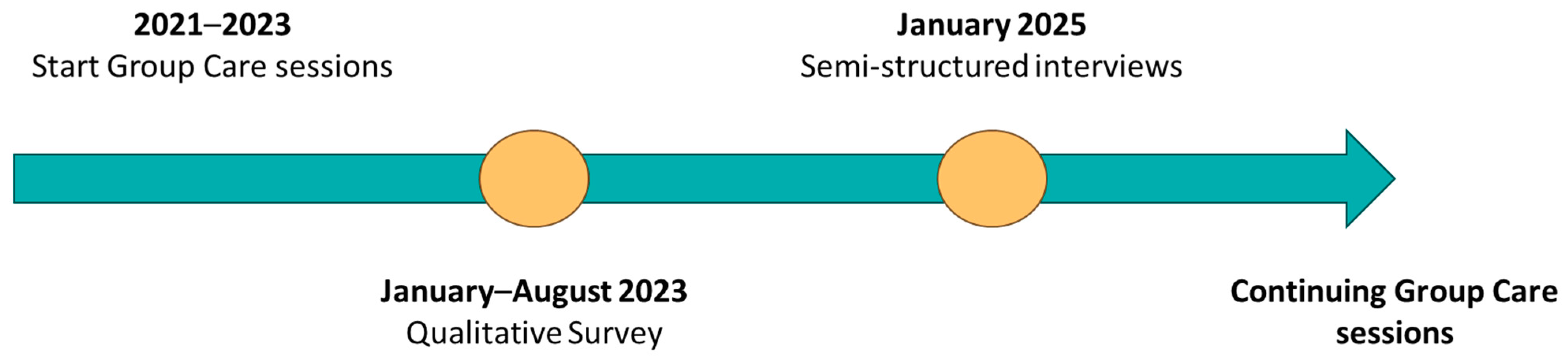
2.2. Data Collection
2.3. Sampling
2.4. Data Analysis
3. Results
3.1. Responses
3.2. Cross-Country Modifications Regarding Scheduling
3.3. Combination of Group Care and Individual Consultations: The Best of Two Worlds?
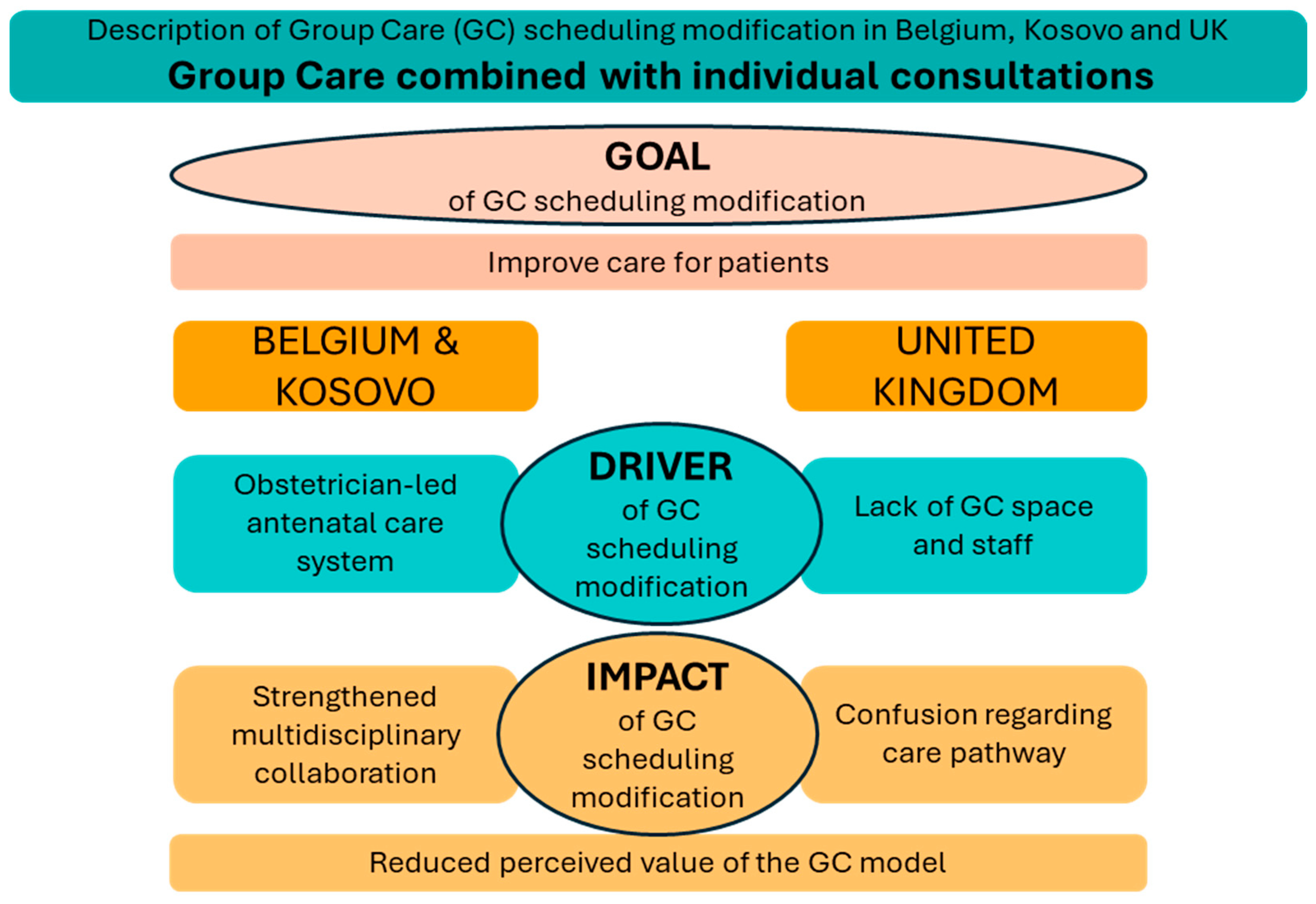
3.3.1. Description of the Modification
“They had planned changes in the number of Group Care sessions (fewer sessions) and planned fewer consultations with the obstetrician. But, in practice, the obstetricians didn’t reduce their individual consultations. Therefore, Group Care is more additional care.”(Survey, Belgium)
“In the beginning it was not planned. It came up later, after women started to complain that it is not possible for them to come in two different days for receiving medical services. This is why we decided to help them [the participants] in this form”(Survey, Kosovo)
3.3.2. Goal
3.3.3. Drivers
“But in other sites they [obstetricians] didn’t accept it very well. What I heard from the midwives, the facilitators of the group care program, is that they see it like they [the GC facilitators] are interrupting their work [from the obstetricians], like they are interfering in their field. […] And some of them [obstetricians] supported the Group Care program because they knew what they [the GC facilitators] are doing there, the aim of the Group Care.”(Interview, Kosovo)
“The care pathway for women taking Group Care is being partially integrated into a long-standing negotiation of the prenatal care pathway and remains one of the most challenging aspects of group care in my opinion.”(Survey, Belgium)
3.3.4. Impact
“It was nice to hear, what the obstetrician said the previous time: ‘Yes, I’m so happy that you are working on that, on the psychosocial issues, because I was also worried about that.’ And I thought, yes, okay, so they also feel that we [GC facilitators] are an added value for them [the obstetricians], which we certainly also feel about them.”(Interview, Belgium)
“What is also important there, is the emotional support. Because for the midwives… it does require quite something to prepare in the Group Care way. Especially since we work with vulnerable groups, you know. These are sometimes quite complex situations that demand a lot from the midwife, both in terms of time, effort, and emotionally. … And then we hear from the physicians, ‘Yes, but you’re doing well, you’re doing really well.’ These are physicians we can call or with whom we can vent, like, ‘gosh, this is a difficult case’, you know?”(Interview, Belgium)
“So, and it ended up meaning that the midwives ended up doing a lot of additional one-to-one appointments because people started thinking of the groups as education and thinking of the appointments as care.”(Interview, UK)
“Having some one-to-one and some groups did not turn out to be the best of all worlds. What it turned out to do is firstly: it did affect the bonding of some of the groups because they didn’t get to know each other as well. But I think more importantly, it created a lot of confusion.”(Interview, UK)
“It is the cultural norm to have medical follow-up of the pregnancy by an obstetrician; they can’t be left out of the schedule. Midwives are not allowed to conduct ultrasounds in Belgium.”(Survey, Belgium)
3.4. Digital Integration of GC in the Booking and Medical Record System
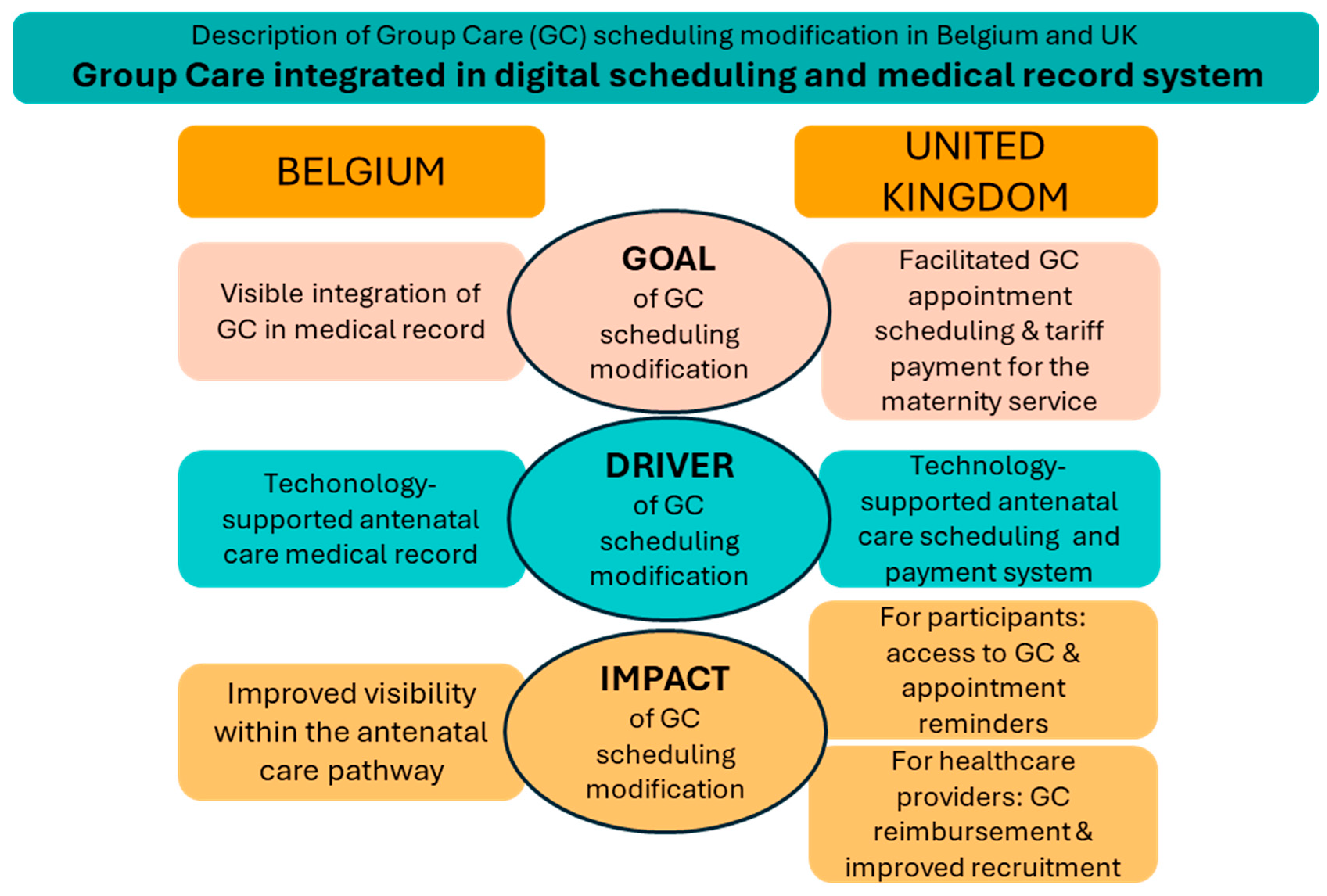
3.4.1. Description of the Modification
3.4.2. Goal
3.4.3. Drivers
“But because it wasn’t in their computer system, they weren’t being paid for it at all because, you know, there was no record that they were giving this care. So that’s one of the things that alerted us.”(Interview, UK)
3.4.4. Impact
“This required significant back and forth with IT and resulted in some confusion for women and missed groups during the initial GC_1000 roll out. I was impressed by how hard the GC site steering committee worked to correct this and I think early involvement of IT for scheduling in future in a context where there is electronic scheduling is essential.”(Survey, UK, site 1)
“You have to give yourself enough time when you’re planning to make sure that’s in place. That’s, you know, you want that in place before you start recruiting. So, what we found is that really you really need to give yourself planning time.”(Interview, UK)
4. Discussion
Limitations and Strengths
5. Conclusions
Supplementary Materials
Author Contributions
Funding
Institutional Review Board Statement
Informed Consent Statement
Data Availability Statement
Acknowledgments
Conflicts of Interest
References
- Juckett, L.A.; Bernard, K.P.; Clark, M.A.; Gadbois, E.A.; Wright, B.; Thomas, K.S. Core functions and forms in home-delivered meal programs: A stakeholder-driven approach to identifying essential practices. Implement. Sci. Commun. 2025, 6, 43. [Google Scholar] [CrossRef]
- Kelly, M.P.; Noyes, J.; Kane, R.L.; Chang, C.; Uhl, S.; Robinson, K.A.; Springs, S.; Butler, M.E.; Guise, J.-M. AHRQ series on complex intervention systematic reviews—Paper 2: Defining complexity, formulating scope, and questions. J. Clin. Epidemiol. 2017, 90, 11–18. [Google Scholar] [CrossRef]
- Lau, R.; Stevenson, F.; Ong, B.N.; Dziedzic, K.; Treweek, S.; Eldridge, S.; Everitt, H.; Kennedy, A.; Qureshi, N.; Rogers, A. Achieving change in primary care—Causes of the evidence to practice gap: Systematic reviews of reviews. Implement. Sci. 2015, 11, 40. [Google Scholar] [CrossRef]
- Dixon-Woods, M.; Baker, R.; Charles, K.; Dawson, J.; Jerzembek, G.; Martin, G.; McCarthy, I.; McKee, L.; Minion, J.; Ozieranski, P. Culture and behaviour in the English National Health Service: Overview of lessons from a large multimethod study. BMJ Qual. Saf. 2014, 23, 106–115. [Google Scholar] [CrossRef] [PubMed]
- Blanco-Cazeaux, I.; Ferté, T.; Bruzek, C.; Gaudart, M.; Ngabdo, K.; Wittwer, J.; Francis-Oliviero, F. Targeting health equity through complex health interventions: Which evaluation methods and designs are used? A scoping review. Public Health 2025, 249, 105962. [Google Scholar] [CrossRef]
- Roth, I.J.; Tiedt, M.K.; Barnhill, J.L.; Karvelas, K.R.; Faurot, K.R.; Gaylord, S.; Gardiner, P.; Miller, V.E.; Leeman, J. Feasibility of Implementation Mapping for Integrative Medical Group Visits. J. Altern. Complement. Med. 2021, 27, S71–S80. [Google Scholar] [CrossRef] [PubMed]
- Tucker, S.; McNett, M.; Mazurek Melnyk, B.; Hanrahan, K.; Hunter, S.C.; Kim, B.; Cullen, L.; Kitson, A. Implementation Science: Application of Evidence-Based Practice Models to Improve Healthcare Quality. Worldviews Evid. Based Nurs. 2021, 18, 76–84. [Google Scholar] [CrossRef]
- Glasgow, R.E.; Vogt, T.M.; Boles, S.M. Evaluating the public health impact of health promotion interventions: The RE-AIM framework. Am. J. Public Health 1999, 89, 1322–1327. [Google Scholar] [CrossRef] [PubMed]
- Monks, T. Operational research as implementation science: Definitions, challenges and research priorities. Implement. Sci. 2016, 11, 81. [Google Scholar] [CrossRef]
- Wiltsey Stirman, S.; Gamarra, J.M.; Bartlett, B.A.; Calloway, A.; Gutner, C.A. Empirical examinations of modifications and adaptations to evidence-based psychotherapies: Methodologies, impact, and future directions. Clin. Psychol. Sci. Pract. 2017, 24, 396. [Google Scholar]
- Stirman, S.W.; Miller, C.J.; Toder, K.; Calloway, A. Development of a framework and coding system for modifications and adaptations of evidence-based interventions. Implement. Sci. 2013, 8, 65. [Google Scholar] [CrossRef]
- Rising, S.S.; Quimby, C.H. The CenteringPregnancy Model: The Power of Group Health Care; Springer Publishing Company: Princeton, NJ, USA, 2016. [Google Scholar]
- Sadiku, F.; Bucinca, H.; Talrich, F.; Molliqaj, V.; Selmani, E.; McCourt, C.; Rijnders, M.; Little, G.; Goodman, D.C.; Rising, S.S.; et al. Maternal satisfaction with group care: A systematic review. AJOG Glob. Rep. 2024, 4, 100301. [Google Scholar] [CrossRef] [PubMed]
- Lazar, J.; Boned-Rico, L.; Olander, E.K.; McCourt, C. A systematic review of providers’ experiences of facilitating group antenatal care. Reprod. Health 2021, 18, 180. [Google Scholar] [CrossRef]
- Horn, A.; Orgill, M.; Billings, D.L.; Slemming, W.; Van Damme, A.; Crone, M.; Gwele, M.; Leister, N.; Hindori-Mohangoo, A.D.; Beeckman, K. Belonging: A meta-theme analysis of women’s community-making in group antenatal and postnatal care. Front. Public Health 2025, 13, 1506956. [Google Scholar] [CrossRef]
- Catling, C.J.; Medley, N.; Foureur, M.; Ryan, C.; Leap, N.; Teate, A.; Homer, C.S. Group versus conventional antenatal care for women. Cochrane Database Syst. Rev. 2015, 2015, Cd007622. [Google Scholar] [CrossRef]
- Cunningham, S.D.; Grilo, S.; Lewis, J.B.; Novick, G.; Rising, S.S.; Tobin, J.N.; Ickovics, J.R. Group Prenatal Care Attendance: Determinants and Relationship with Care Satisfaction. Matern. Child Health J. 2017, 21, 770–776. [Google Scholar] [CrossRef] [PubMed]
- Cunningham, S.D.; Lewis, J.B.; Shebl, F.M.; Boyd, L.M.; Robinson, M.A.; Grilo, S.A.; Lewis, S.M.; Pruett, A.L.; Ickovics, J.R. Group Prenatal Care Reduces Risk of Preterm Birth and Low Birth Weight: A Matched Cohort Study. J. Women’s Health 2019, 28, 17–22. [Google Scholar] [CrossRef]
- Park, C.H.; Driver, N.; Richards, R.C., Jr.; Ward, P. The Effects of CenteringPregnancy: A Quasi-Experimental Evaluation. Healthcare 2025, 13, 1052. [Google Scholar] [CrossRef]
- Wagijo, M.A.; Crone, M.; Bruinsma-van Zwicht, B.; van Lith, J.; Billings, D.; Rijnders, M. The Effect of CenteringPregnancy Group Antenatal Care on Maternal, Birth, and Neonatal Outcomes Among Low-Risk Women in the Netherlands: A Stepped-Wedge Cluster Randomized Trial. J. Midwifery Women’s Health 2024, 69, 191–201. [Google Scholar] [CrossRef]
- Grenier, L.; Suhowatsky, S.; Kabue, M.M.; Noguchi, L.M.; Mohan, D.; Karnad, S.R.; Onguti, B.; Omanga, E.; Gichangi, A.; Wambua, J.; et al. Impact of group antenatal care (G-ANC) versus individual antenatal care (ANC) on quality of care, ANC attendance and facility-based delivery: A pragmatic cluster-randomized controlled trial in Kenya and Nigeria. PLoS ONE 2019, 14, e0222177. [Google Scholar] [CrossRef] [PubMed]
- Irigoyen, M.M.; Leib, S.M.; Paoletti, A.M.; DeLago, C.W. Timeliness of immunizations in centeringparenting. Acad. Pediatr. 2021, 21, 948–954. [Google Scholar] [CrossRef]
- Friedman, S.; Calderon, B.; Gonzalez, A.; Suruki, C.; Blanchard, A.; Cahill, E.; Kester, K.; Muna, M.; Elbel, E.; Purushothaman, P. Pediatric practice redesign with group well child care visits: A multi-site study. Matern. Child Health J. 2021, 25, 1265–1273. [Google Scholar] [CrossRef]
- Gullett, H.; Salib, M.; Rose, J.; Stange, K.C. An evaluation of CenteringParenting: A group well-child care model in an urban federally qualified community health center. J. Altern. Complement. Med. Paradig. Pract. Policy Adv. Integr. Health 2019, 25, 727–732. [Google Scholar] [CrossRef]
- Lori, J.R.; Ofosu-Darkwah, H.; Boyd, C.J.; Banerjee, T.; Adanu, R.M. Improving health literacy through group antenatal care: A prospective cohort study. BMC Pregnancy Childbirth 2017, 17, 228. [Google Scholar] [CrossRef] [PubMed]
- World Health Organization. WHO Recommendations on Maternal and Newborn Care for a Positive Postnatal Experience; World Health Organization: Geneva, Switzerland, 2022.
- Abrams, J.A.; Forte, J.; Bettler, C.; Maxwell, M. Considerations for Implementing Group-Level Prenatal Health Interventions in Low-Resource Communities: Lessons Learned From Haiti. J. Midwifery Women’s Health 2018, 63, 121–126. [Google Scholar] [CrossRef]
- Gresh, A.; Wilson, D.; Fenick, A.; Patil, C.L.; Coker, T.; Rising, S.S.; Glass, N.; Platt, R. A Conceptual Framework for Group Well-Child Care: A Tool to Guide Implementation, Evaluation, and Research. Matern. Child Health J. 2023, 27, 991–1008. [Google Scholar] [CrossRef]
- Patil, C.L.; Klima, C.S.; Steffen, A.D.; Leshabari, S.C.; Pauls, H.; Norr, K.F. Implementation challenges and outcomes of a randomized controlled pilot study of a group prenatal care model in Malawi and Tanzania. Int. J. Gynecol. Obstet. 2017, 139, 290–296. [Google Scholar] [CrossRef] [PubMed]
- Wiseman, O.; Emmett, L.; Hickford, G.; Knight, M.; Lazar, J.; Yuill, C.; McCourt, C. The challenges and opportunities for implementing group antenatal care (‘Pregnancy Circles’) as part of standard NHS maternity care: A co-designed qualitative study. Midwifery 2022, 109, 103333. [Google Scholar] [CrossRef] [PubMed]
- Baldwin, K.; Phillips, G. Voices along the journey: Midwives’ perceptions of implementing the CenteringPregnancy model of prenatal care. J. Perinat. Educ. 2011, 20, 210. [Google Scholar] [CrossRef] [PubMed]
- Novick, G.; Sadler, L.S.; Knafl, K.A.; Groce, N.E.; Kennedy, H.P. In a hard spot: Providing group prenatal care in two urban clinics. Midwifery 2013, 29, 690–697. [Google Scholar] [CrossRef]
- Novick, G.; Womack, J.A.; Lewis, J.; Stasko, E.C.; Rising, S.S.; Sadler, L.S.; Cunningham, S.C.; Tobin, J.N.; Ickovics, J.R. Perceptions of Barriers and Facilitators During Implementation of a Complex Model of Group Prenatal Care in Six Urban Sites. Res. Nurs. Health 2015, 38, 462–474. [Google Scholar] [CrossRef]
- Andrade-Romo, Z.; Heredia-Pi, I.B.; Fuentes-Rivera, E.; Alcalde-Rabanal, J.; Cacho, L.B.B.; Jurkiewicz, L.; Darney, B.G. Group prenatal care: Effectiveness and challenges to implementation. Rev. Saude Publica 2019, 53, 85. [Google Scholar] [CrossRef]
- Martens, N.; Crone, M.R.; Hindori-Mohangoo, A.; Hindori, M.; Reis, R.; Hoxha, I.S.; Abanga, J.; Matthews, S.; Berry, L.; van der Kleij, R.M.J.J.; et al. Group Care in the first 1000 days: Implementation and process evaluation of contextually adapted antenatal and postnatal group care targeting diverse vulnerable populations in high-, middle- and low-resource settings. Implement. Sci. Commun. 2022, 3, 125. [Google Scholar] [CrossRef] [PubMed]
- Van Damme, A.; Talrich, F.; Crone, M.; Rijnders, M.; Patil, C.L.; Rising, S.S.; Abanga, J.; Billings, D.L.; Hindori-Mohangoo, A.D.; Hindori, M.P.; et al. Identifying anticipated challenges when implementing Group Care: Context-analyses across seven countries to develop an Anticipated Challenges Framework. Midwifery 2024, 139, 104166. [Google Scholar] [CrossRef]
- Wiseman, O.; McCourt, C.; Wiggins, M.; Mehay, A.; Lazar, J.; Sawtell, M.; Hatherall, B.; Salisbury, C.; Hunter, R.; Hamborg, T. What Influences the Implementation of Group Antenatal Care in English NHS Maternity Settings? Findings from a Qualitative Process Evaluation Integrated Within a Randomised Controlled Trial of Pregnancy Circles. 2025. (Preprint). Available online: https://www.researchsquare.com/article/rs-6396617/v1 (accessed on 20 December 2025).
- Heredia-Pi, I.B.; Fuentes-Rivera, E.; Andrade-Romo, Z.; Bravo Bolaños Cacho, M.d.L.; Alcalde-Rabanal, J.; Jurkiewicz, L.; Darney, B.G. The Mexican experience adapting CenteringPregnancy: Lessons learned in a publicly funded health care system serving vulnerable women. J. Midwifery Women’s Health 2018, 63, 602–610. [Google Scholar] [CrossRef]
- Horn, A.; Antonioli, E.; Wiseman, O.; Leister, N.; Knight, M.; Rodriguez, A.; Bradley, S.; McCourt, C. Why continuity of carer matters in group care: A qualitative analysis of women’s experiences of Pregnancy & Parenting Circles in England. Midwifery 2026, 156, 104735. [Google Scholar] [CrossRef]
- McCourt, C.V.E.; Beeckman, K.; Van Damme, A.; Eerens Sarango, B.; Abanga, J.; Bu, S.; Bucina, H.; Ryan, J.; Crone, M. Group Care for the First 1000 Days—Report WP5 Process, Impact, Program Evaluation and Cost-Effectiveness; City St George’s, University London: London, UK, 2025. [Google Scholar]
- Braun, V.; Clarke, V.; Boulton, E.; Davey, L.; McEvoy, C. The online survey as a qualitative research tool. Int. J. Soc. Res. Methodol. 2021, 24, 641–654. [Google Scholar] [CrossRef]
- Wiltsey Stirman, S.; Baumann, A.A.; Miller, C.J. The FRAME: An expanded framework for reporting adaptations and modifications to evidence-based interventions. Implement. Sci. 2019, 14, 58. [Google Scholar] [CrossRef]
- Malterud, K.; Siersma, V.; Guassora, A.D. Information power: Sample content and size in qualitative studies. In Qualitative Research in Psychology: Expanding Perspectives in Methodology and Design; American Psychological Association: Washington, DC, USA, 2021; pp. 67–81. [Google Scholar] [CrossRef]
- Braun, V.; Clarke, V. Using thematic analysis in psychology. Qual. Res. Psychol. 2006, 3, 77–101. [Google Scholar] [CrossRef]
- Freidson, E. Profession of Medicine: A Study of the Sociology of Applied Knowledge; University of Chicago Press: Chicago, IL, USA, 1988. [Google Scholar]
- Abbott, A. The System of Professions: An Essay on the Division of Expert Labor; University of Chicago Press: Chicago, IL, USA, 2014. [Google Scholar]
- Davis-Floyd, R. The technocratic, humanistic, and holistic paradigms of childbirth. Int. J. Gynecol. Obstet. 2001, 75, S5–S23. [Google Scholar] [CrossRef] [PubMed]
- Toth, F. Sovereigns under Siege. How the medical profession is changing in Italy. Soc. Sci. Med. 2015, 136–137, 128–134. [Google Scholar] [CrossRef]
- Liu, S. Boundaries and professions: Toward a processual theory of action. J. Prof. Organ. 2018, 5, 45–57. [Google Scholar] [CrossRef]
- Allen, D. The nursing-medical boundary: A negotiated order? Sociol. Health Illn. 1997, 19, 498–520. [Google Scholar]
- Siberry, A.; Adams, T.L.; Leach, B. “Place matters”: Midwives’ interprofessional relations in rural and urban institutional contexts. SSM Qual. Res. Health 2023, 4, 100309. [Google Scholar] [CrossRef]
- Svensson, R. The Interplay between Doctors and Nurses—A Negotiated Order Perspective. Sociol. Health Illn. 2008, 18, 379–398. [Google Scholar] [CrossRef]
- D’amour, D.; Ferrada-Videla, M.; San Martin Rodriguez, L.; Beaulieu, M.-D. The conceptual basis for interprofessional collaboration: Core concepts and theoretical frameworks. J. Interprof. Care 2005, 19, 116–131. [Google Scholar] [CrossRef]
- Reeves, S.; Pelone, F.; Harrison, R.; Goldman, J.; Zwarenstein, M. Interprofessional collaboration to improve professional practice and healthcare outcomes. Cochrane Database Syst. Rev. 2017, 6, Cd000072. [Google Scholar] [CrossRef] [PubMed]
- Gresh, A.; Van Damme, A.; Billings, D.L.; Rising, S.S.; Ibrahim, S.; Ajibola, A.; Chirwa, E.; Don-Aki, J.; Donoho, N.; Hindori, M. Integrating postnatal care into the redesign of group care beyond birth. Arch. Public Health 2025, 83, 34. [Google Scholar] [CrossRef] [PubMed]
- Speziale, H.S.; Streubert, H.J.; Carpenter, D.R. Qualitative Research in Nursing: Advancing the Humanistic Imperative; Lippincott Williams & Wilkins: Philadelphia, PA, USA, 2011. [Google Scholar]
- Palinkas, L.A. Qualitative and mixed methods in mental health services and implementation research. J. Clin. Child Adolesc. Psychol. 2014, 43, 851–861. [Google Scholar] [CrossRef]
- Braun, V.; Clarke, V. To saturate or not to saturate? Questioning data saturation as a useful concept for thematic analysis and sample-size rationales. Qual. Res. Sport Exerc. Health 2021, 13, 201–216. [Google Scholar] [CrossRef]
- Zetterlund, J.; von Thiele Schwarz, U.; Hasson, H.; Neher, M. A Slippery Slope When Using an Evidence-Based Intervention Out of Context. How Professionals Perceive and Navigate the Fidelity-Adaptation Dilemma-A Qualitative Study. Front. Health Serv. 2022, 2, 883072. [Google Scholar] [CrossRef] [PubMed]
- Carroll, C.; Patterson, M.; Wood, S.; Booth, A.; Rick, J.; Balain, S. A conceptual framework for implementation fidelity. Implement. Sci. 2007, 2, 40. [Google Scholar] [CrossRef] [PubMed]
- Terrana, A.; Viglione, C.; Rhee, K.; Rabin, B.; Godino, J.; Aarons, G.A.; Chapman, J.; Melendrez, B.; Holguin, M.; Osorio, L.; et al. The core functions and forms paradigm throughout EPIS: Designing and implementing an evidence-based practice with function fidelity. Front. Health Serv. 2024, 3, 1281690. [Google Scholar] [CrossRef] [PubMed]



| Characteristics | Belgium | Kosovo | UK |
|---|---|---|---|
| Number of participating sites | 3 | 2 | 2 |
| Type of GC | Antenatal | Antenatal | Antenatal (1) Antenatal and postnatal continuous (1) |
| Type of facility | Primary care (1) Hospital (1) | Hospital (2) | Hospital (1) Collaboration- antenatal care + health visitor postnatal care. |
| Who leads routine antenatal care | Obstetrician | Obstetrician | Midwives |
| GC implementation plan | six/seven antenatal GC sessions facilitated by midwives, complemented by three individual consultations with an obstetrician | eight antenatal GC sessions facilitated by midwives, supplemented with monthly individual consultations with an obstetrician | 9 antenatal GC sessions organised by midwives; participants referred to an obstetrician only in cases of pregnancy complications or risks, in accordance with standard care protocols |
| Country | Participating Sites | Number of Survey Responses | Interviews Completed | |||
|---|---|---|---|---|---|---|
| Country Lead | Facilitator | Group Care Global Consultant | Total Responses | |||
| Belgium | 3 | 3 | 3 | 3 | 9 | 3 |
| Kosovo | 2 | 2 | 2 | 1 | 5 | 1 |
| UK | 2 | 2 | 1 | 2 | 5 | 1 |
| Total | 7 | 7 | 6 | 6 | 19 | 5 |
Disclaimer/Publisher’s Note: The statements, opinions and data contained in all publications are solely those of the individual author(s) and contributor(s) and not of MDPI and/or the editor(s). MDPI and/or the editor(s) disclaim responsibility for any injury to people or property resulting from any ideas, methods, instructions or products referred to in the content. |
© 2026 by the authors. Licensee MDPI, Basel, Switzerland. This article is an open access article distributed under the terms and conditions of the Creative Commons Attribution (CC BY) license.
Share and Cite
Van Damme, A.; Talrich, F.; Billings, D.L.; McCourt, C.; Gresh, A.; Patil, C.L.; Crone, M.; Rijnders, M.; Hoxha, I.; Rising, S.S.; et al. Scheduling Group Care in Routine Perinatal Care: Identifying Implementation Modifications Across Belgium, Kosovo, and the UK. Healthcare 2026, 14, 1642. https://doi.org/10.3390/healthcare14121642
Van Damme A, Talrich F, Billings DL, McCourt C, Gresh A, Patil CL, Crone M, Rijnders M, Hoxha I, Rising SS, et al. Scheduling Group Care in Routine Perinatal Care: Identifying Implementation Modifications Across Belgium, Kosovo, and the UK. Healthcare. 2026; 14(12):1642. https://doi.org/10.3390/healthcare14121642
Chicago/Turabian StyleVan Damme, Astrid, Florence Talrich, Deborah L. Billings, Christine McCourt, Ashley Gresh, Crystal L. Patil, Matty Crone, Marlies Rijnders, Ilir Hoxha, Sharon Schindler Rising, and et al. 2026. "Scheduling Group Care in Routine Perinatal Care: Identifying Implementation Modifications Across Belgium, Kosovo, and the UK" Healthcare 14, no. 12: 1642. https://doi.org/10.3390/healthcare14121642
APA StyleVan Damme, A., Talrich, F., Billings, D. L., McCourt, C., Gresh, A., Patil, C. L., Crone, M., Rijnders, M., Hoxha, I., Rising, S. S., & Beeckman, K. (2026). Scheduling Group Care in Routine Perinatal Care: Identifying Implementation Modifications Across Belgium, Kosovo, and the UK. Healthcare, 14(12), 1642. https://doi.org/10.3390/healthcare14121642