A Mixed-Methods Examination of Interdisciplinary Strategies for Addressing Trauma and Chronic Pain in Group Therapy

 , , and
Highlights
- The interdisciplinary group intervention was feasible and acceptable, with high attendance and fidelity.
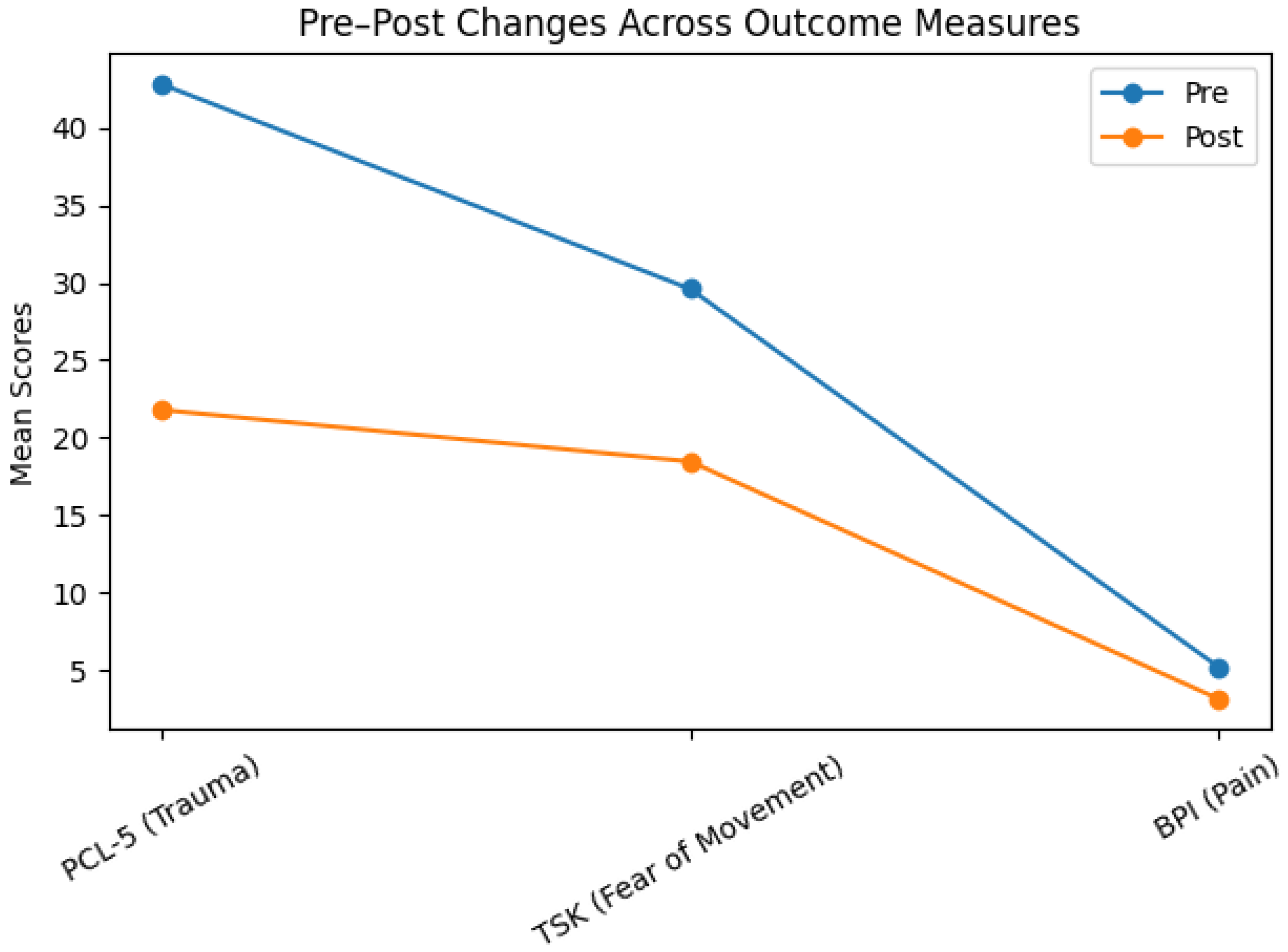
- Pre/post outcomes suggested improvements in trauma symptoms, fear of movement, pain, and postural neutrality, though findings are preliminary given the small sample.
- Interdisciplinary, mind–body group interventions may provide a feasible model for integrating physical and mental health care for clients with co-occurring trauma and chronic pain.
- Findings highlight the value of cross-disciplinary training and collaboration, suggesting that counselor–physical therapist partnerships may expand the scope and impact of trauma-informed care in community settings.
Abstract
1. Introduction
1.1. The Need for Interdisciplinary Care
1.2. Research Question
2. Materials and Methods
2.1. Research Design
2.2. Research Team and Trustworthiness
2.3. Data Collection and Instrumentation
2.3.1. Quantitative Instrumentation and Data Collection
2.3.2. Qualitative Instrumentation and Data Collection
2.4. Data Analysis
2.4.1. Quantitative Data Analysis
2.4.2. Qualitative Data Analysis
2.4.3. Intervention Design Summary
3. Results
3.1. Participants
3.2. Trauma and Chronic Pain Experience
3.2.1. Quantitative Results:
3.2.2. Qualitative Findings:
- Theme 1: The Persistent Burden of Pain and Trauma
- Subtheme 1.1: Disconnection from the Body
- Subtheme 1.2: Avoidance of Life Activities
- Theme 2: Seeking Meaning and Understanding of Pain
3.3. Feasibility and Acceptability
3.3.1. Quantitative Results
3.3.2. Qualitative Findings
- Theme 3: Structure and Group Size
- Theme 4: Sustainability and Accessibility
3.4. Emotional and Physical Outcomes
3.4.1. Quantitative Results
3.4.2. Qualitative Findings:
- Theme 5: Physical and Emotional Benefits
- Theme 6: Increased Mind–Body Awareness and Emotional Healing
3.5. Group Cohesion and Support
3.5.1. Quantitative Findings
3.5.2. Qualitative Findings
- Theme 7: Deepened Emotional Processing Through Group Work
- Subtheme 7.1 Engaged and Empathic Group Facilitators
3.6. Physical Therapy Outcomes
4. Discussion
4.1. Trauma and Pain Relief
4.2. Mind–Body Awareness
4.3. Group Support and Emotional Regulation
5. Limitations
6. Future Research
7. Conclusions
Author Contributions
Funding
Institutional Review Board Statement
Informed Consent Statement
Data Availability Statement
Conflicts of Interest
Abbreviations
| PRI | Postural Restoration Institute |
| PTSD | Posttraumatic Stress Disorder |
References
- Benjet, C.; Bromet, E.; Karam, E.G.; Kessler, R.C.; McLaughlin, K.A.; Ruscio, A.M.; Koenen, K.C. The epidemiology of traumatic event exposure worldwide: Results from the World Mental Health Survey Consortium. Psychol. Med. 2016, 46, 327–343. [Google Scholar] [CrossRef]
- Centers for Disease Control and Prevention. Trauma and Its Public Health Impact; CDC: Atlanta, GA, USA, 2020. Available online: https://www.cdc.gov/aces/about/index.html (accessed on 8 August 2024).
- Substance Abuse and Mental Health Services Administration. In Trauma-Informed Care in Behavioral Health Services; SAMHSA: Rockville, MD, USA, 2014.
- Bergman, H.E.; Przeworski, A.; Feeny, N.C. Rates of subthreshold PTSD among U.S. military veterans and Service members: A literature review. Mil. Psychol. 2017, 29, 117–127. [Google Scholar] [CrossRef]
- Korte, K.J.; Allan, N.P.; Gros, D.F.; Acierno, R. Differential treatment response trajectories in individuals with subclinical and clinical PTSD. J. Anxiety Disord. 2016, 38, 95–101. [Google Scholar] [CrossRef]
- Rikard, S.M.; Strahan, A.E.; Schmit, K.M.; Guy, G.P. Chronic pain among adults—United States, 2019–2021. MMWR Morb. Mortal. Wkly. Rep. 2023, 72, 379–385. [Google Scholar] [CrossRef]
- Yong, R.J.; Mullins, P.M.; Bhattacharyya, N. Prevalence of chronic pain among adults in the United States. Pain 2021, 162, 941–949. [Google Scholar] [CrossRef]
- Vos, T.; Lim, S.S.; Abbafati, C.; Abbas, K.M.; Abbasi, M.; Abbasifard, M.; Abbasi-Kangevari, M.; Abbastabar, H.; Abd-Allah, F.; Abdelalim, A.; et al. Global burden of 369 diseases and injuries in 204 countries and territories, 1990–2019: A systematic analysis for the Global Burden of Disease Study 2019. Lancet 2020, 396, 1204–1222. [Google Scholar] [CrossRef] [PubMed]
- IASP Announces Revised Definition of Pain. 2021. Available online: https://www.iasp-pain.org/publications/iasp-news/iasp-announces-revised-definition-of-pain/ (accessed on 15 May 2026).
- Elbinoune, I.; Amine, B.; Shyen, S.; Guedira, N.; Hajjaj-Hassouni, N. Chronic neck pain and anxiety and depression: Prevalence and associated risk factors. Pan Afr. Med. J. 2016, 24, 89. [Google Scholar] [CrossRef]
- Aaron, R.V.; Ravyts, S.G.; Carnahan, N.D.; Bhattiprolu, K.; Harte, N.; McCaulley, C.C.; Vitalicia, L.; Rogers, A.B.; Wegener, S.T.; Dudeney, J. Prevalence of depression and anxiety among adults with chronic pain. JAMA Netw. Open 2025, 8, e250268. [Google Scholar] [CrossRef] [PubMed]
- 12; Ravn, S.L.; Hartvigsen, J.; Hansen, M.; Sterling, M.; Andersen, T.E. Do post-traumatic pain and post-traumatic stress symptomatology mutually maintain each other? A systematic review of cross-lagged studies. Pain 2018, 159, 2159–2169. [Google Scholar] [CrossRef]
- Siqveland, J.; Hussain, A.; Lindstrøm, J.C.; Ruud, T.; Hauff, E. Prevalence of posttraumatic stress disorder in persons with chronic pain: A meta-analysis. Front. Psychiatry 2017, 8, 164. [Google Scholar] [CrossRef] [PubMed]
- Manuel, J.; Rudolph, L.; Beissner, F.; Neubert, T.-A.; Dusch, M.; Karst, M. Traumatic events, posttraumatic stress disorder, and central sensitization in chronic pain patients of a German university outpatient pain clinic. Psychosom. Med. 2023, 85, 351–357. [Google Scholar] [CrossRef]
- Delgado-Sánchez, A.; Brown, C.; Charalambous, C.; Sivan, M.; Jones, A. Trauma in childhood is associated with greater pain catastrophizing. Pain Rep. 2023, 8, e1093. [Google Scholar] [CrossRef]
- Jadhakhan, F.; Evans, D.W.; Falla, D. The role of post-traumatic stress symptoms in the development of chronic pain: A systematic review. Eur. J. Pain 2023, 27, 183–200. [Google Scholar] [CrossRef]
- Morris, M.C.; Bruehl, S.; Rao, U.; Goodin, B.R.; Karlson, C.; Carter, C.; Nag, S.; Huber, F.A.; Bendinskas, K.G.; Hidoyatov, M.; et al. Biobehavioral predictors of pain intensity and interference: A prospective study. J. Pain 2024, 25, 104501. [Google Scholar] [CrossRef]
- McKernan, L.C.; Johnson, B.N.; Crofford, L.J.; Lumley, M.A.; Bruehl, S.; Cheavens, J.S. Posttraumatic stress symptoms mediate the effects of trauma exposure on clinical indicators of central sensitization in patients with chronic pain. Clin. J. Pain 2019, 35, 385–393. [Google Scholar] [CrossRef]
- Nanavaty, N.; Thompson, C.G.; Meagher, M.W.; McCord, C.; Mathur, V.A. Traumatic life experience and pain sensitization. Clin. J. Pain 2022, 39, 15–28. [Google Scholar] [CrossRef]
- Scioli-Salter, E.R.; Forman, D.E.; Otis, J.D.; Gregor, K.; Valovski, I.; Rasmusson, A.M. The shared neuroanatomy and neurobiology of comorbid chronic pain and PTSD: Therapeutic implications. Clin. J. Pain 2015, 31, 363–374. [Google Scholar]
- Fakhereddin, M.F. The Genetics of Pain: An Exploration of Gene-by-Environment Interactions and Their Effects on Pain Interactions and Their Effects on Pain. Ph.D. Thesis, Western University, London, Canada, 2022. [Google Scholar]
- Hildenbrand, A.K.; Marsac, M.L.; Daly, B.P.; Chute, D.; Kassam-Adams, N. Acute pain and posttraumatic stress after pediatric injury. J. Pediatr. Psychol. 2015, 41, 98–107. [Google Scholar] [CrossRef] [PubMed]
- Sommer, C.A. Vicarious traumatization, trauma-sensitive supervision, and counselor preparation. Couns. Educ. Superv. 2008, 48, 61–71. [Google Scholar] [CrossRef]
- Goodman, L.A.; Sullivan, C.M.; Serrata, J.; Perilla, J.; Wilson, J.M.; Fauci, J.E.; DiGiovanni, C.D. Development and Validation of the Trauma-Informed Practice Scales. J. Comm. Psy 2016, 44, 747–764. [Google Scholar] [CrossRef]
- Greene, R.R.; Galambos, C.; Lee, Y. Resilience theory. J. Hum. Behav. Soc. Environ. 2004, 8, 75–91. [Google Scholar] [CrossRef]
- Engel, G.L. The need for a new medical model: A challenge for biomedicine. Science 1977, 196, 129–136. [Google Scholar] [CrossRef] [PubMed]
- Gatchel, R.J.; McGeary, D.D.; McGeary, C.A.; Lippe, B. Interdisciplinary chronic pain management: Past, present, and future. Am. Psychol. 2014, 69, 119–130. [Google Scholar] [CrossRef]
- Szulc, P.; Wendt, M.; Waszak, M.; Tomczak, M.; Cieślik, K.; Trzaska, T. Impact of mckenzie method therapy enriched by muscular energy techniques on subjective and objective parameters related to spine function in patients with chronic low back pain. Med. Sci. Monit. 2015, 21, 2918–2932. [Google Scholar] [CrossRef]
- Elvina, M.; Ibrahim, M.; Widada, W.; Suwito, J. Alternative treatments for pain through Dhikr, hijamah and Herbal Medicine as Integrative Medicine. In Alternative Medicine—Update; IntechOpen: London, UK, 2020. [Google Scholar]
- Joypaul, S.; Kelly, F.; McMillan, S.S.; King, M.A. Multi-disciplinary interventions for chronic pain involving education: A systematic review. PLoS ONE 2019, 14, e0223306. [Google Scholar] [CrossRef]
- You, D.S.; Ziadni, M.S.; Cooley, C.E.; Talavera, D.C.; Mackey, S.C.; Poupore-King, H. Effectiveness of a multidisciplinary rehabilitation program with chronic back pain: A pilot cohort data analysis. J. Back Musculoskelet. Rehabil. 2021. [Google Scholar] [CrossRef]
- Paulokat, H.M.; Klinder, A.; Mittelmeier, W.; Bajorat, J.; Osmanski-Zenk, K. Evaluation of a four-week interdisciplinary multimodal pain therapy program. Life 2025, 15, 576. [Google Scholar] [CrossRef]
- Panisch, L.S.; Jansen, S.M.; Abudushalamu, F.; Petersen, T.R.; Meriwether, K.V. Patient perspectives on the psychosocial impact of chronic pelvic pain and implications for Integrated Behavioral Care Approaches. J. Behav. Health Serv. Res. 2025, 53, 115–130. [Google Scholar] [CrossRef]
- Hruska, R. ACA Rehab Symposium. In Influence of Pelvic Alignment on Respiration: The Role of the Diaphragm in Postural Restoration; Postural Restoration Institute: Lincoln, NE, USA, 2016. [Google Scholar]
- Hruska, R. ACA Rehab Symposium. In Postural Respiration: Integration of Posture, Breathing, and Movement; Postural Restoration Institute: Lincoln, NE, USA, 2016. [Google Scholar]
- Levine, P.A. Waking the Tiger: Healing Trauma; North Atlantic Books: Berkeley, CA, USA, 1997. [Google Scholar]
- Hruska, R. The Science. 2024. Available online: https://www.posturalrestoration.com/the-science/ (accessed on 15 May 2026).
- Waldron, J.L.; McKenney, M.A.; Samuel, M.N.; Girouard, T.J.; Turner, C.L.; Radzak, K.N. The use of postural restoration for treatment of chronic rotator cuff pathology: A case report. Int. J. Sports Phys. Ther. 2020, 15, 832–839. [Google Scholar] [CrossRef] [PubMed]
- Fouladi, N.; Minoonejad, H.; Rajabi, R. Comparing the effects of the postural restoration exercises with and without core stability exercises in patients with non-specific chronic low back pain. J. Mod. Rehabil. 2024, 18, 41–54. [Google Scholar] [CrossRef]
- Salimi, A.; Sadeghi, H.; Memar, R.; Sadeghi-demneh, E. The effect of Postural Restoration Institute training on selected kinematic variables of lower limbs and pelvis during walking in middle-aged men with nonspecific chronic low back pain: A prospective observational study. Sci. J. Rehabil. Med. 2024, 162–179. [Google Scholar] [CrossRef]
- Bordoni, B.; Zanier, E. Anatomic connections of the diaphragm influence of respiration on the body system. J. Multidiscip. Healthc. 2013, 6, 281–291. [Google Scholar] [CrossRef]
- Hodges, P.W. Core stability exercise in chronic low back pain. Orthop. Clin. N. Am. 2003, 34, 245–254. [Google Scholar] [CrossRef]
- Porges, S.W. The Polyvagal Theory; W.W. Norton: New York, NY, USA, 2011. [Google Scholar]
- Kolacz, J.; Porges, S.W. Chronic diffuse pain and functional gastrointestinal disorders after traumatic stress: Pathophysiology through a polyvagal perspective. Front. Med. 2018, 5, 145. [Google Scholar] [CrossRef] [PubMed]
- Fetters, M.D.; Curry, L.A.; Creswell, J.W. Achieving integration in mixed methods designs-principles and practices. Health Serv. Res. 2013, 48, 2134–2156. [Google Scholar] [CrossRef] [PubMed]
- Creswell, J.W.; Creswell, J.D. Research Design: Qualitative, Quantitative, and Mixed Methods Approaches, 5th ed.; SAGE: Thousand Oaks, CA, USA, 2018. [Google Scholar]
- Braun, V.; Clarke, V. Using thematic analysis in psychology. Qual. Res. Psychol. 2006, 3, 77–101. [Google Scholar] [CrossRef]
- Creswell, J.W. Research Design: Qualitative, Quantitative, and Mixed Methods Approaches, 3rd ed.; SAGE: Thousand Oaks, CA, USA, 2009. [Google Scholar]
- Nowell, L.S.; Norris, J.M.; White, D.E.; Moules, N.J. Thematic analysis: Striving to meet the trustworthiness criteria. Int. J. Qual. Methods 2017, 16, 1–13. [Google Scholar] [CrossRef]
- Blevins, C.A.; Weathers, F.W.; Davis, M.T.; Witte, T.K.; Domino, J.L. The PTSD Checklist for DSM-5 (PCL-5): Development and initial psychometric evaluation. J. Trauma. Stress 2015, 28, 489–498. [Google Scholar] [CrossRef]
- Tkachuk, G.A.; Harris, C.A. Psychometric Properties of the Tampa Scale for kinesiophobia-11 (TSK-11). J. Pain 2012, 13, 970–977. [Google Scholar] [CrossRef]
- Tan, G.; Jensen, M.P.; Thornby, J.I.; Shanti, B.F. Validation of the Brief Pain Inventory for chronic nonmalignant pain. J. Pain 2004, 5, 133–137. [Google Scholar] [CrossRef]
- MacKenzie, K.R. The clinical application of a group climate measure. In Advances in Group Psychotherapy; Dies, R.R., MacKenzie, K.R., Eds.; International Universities Press: New York, NY, USA, 1983; pp. 159–170. [Google Scholar]
- Braun, V.; Clarke, V. Successful Qualitative Research: A Practical Guide for Beginners; SAGE: London, UK, 2013. [Google Scholar]
- Wang, C.C.; Burris, M.A. Photovoice: Concept, methodology, and use for participatory needs assessment. Health Educ. Behav. 1997, 24, 369–387. [Google Scholar] [CrossRef]
- Christopher, J.C. Counseling psychology and the moral tradition: Toward an integrative ethical framework. Couns. Psychol. 2004, 32, 435–465. [Google Scholar]
- Isobel, S. Trauma-qualitative research: Some methodological and practical considerations. Int. J. Ment. Health Nurs. 2021, 30, 675–690. [Google Scholar] [CrossRef]
- Braun, V.; Clarke, V. Thematic Analysis: A Practical Guide; SAGE: London, UK, 2021. [Google Scholar]
- Clarke, V.; Braun, V. Teaching thematic analysis. Psychologist 2013, 26, 120–123. [Google Scholar]
- Clarke, V.; Braun, V. Using thematic analysis in counselling and psychotherapy research: A critical reflection. Couns. Psychother. Res. 2018, 18, 107–110. [Google Scholar] [CrossRef]
- Flynn, R. Purposive sampling in qualitative research. In Encyclopedia of Research Design; SAGE: Thousand Oaks, CA, USA, 2022. [Google Scholar]
- Johns Hopkins Medicine. Chronic Pain: Definition and Clinical Overview; Johns Hopkins Medicine: Baltimore, MD, USA, 2021.
- Patton, M.Q. Qualitative Research and Evaluation Methods, 3rd ed.; SAGE: Thousand Oaks, CA, USA, 2002. [Google Scholar]
- Turk, D.C.; Wilson, H.D.; Cahana, A. Treatment of chronic non-cancer pain. Lancet 2011, 377, 2226–2235. [Google Scholar] [CrossRef]
- Krebs, E.E.; Carey, T.S.; Weinberger, M. Accuracy of the pain numeric rating scale as a screening test in primary care. J. Gen. Intern Med. 2007, 10, 1453–1458. [Google Scholar] [CrossRef]
- Vlaeyen, J.W.S.; Linton, S.J. Fear-avoidance and its consequences in chronic musculoskeletal pain: A state of the art. Pain 2000, 85, 317–332. [Google Scholar] [CrossRef] [PubMed]
- Melzack, R.; Wall, P.D. Pain mechanisms: A new theory. Science 1965, 150, 971–979. [Google Scholar] [CrossRef]
- Yalom, I.D.; Leszcz, M. The Theory and Practice of Group Psychotherapy, 6th ed.; Basic Books: New York, NY, USA, 2020. [Google Scholar]
- Maxwell, J.A. Qualitative Research Design: An Interactive Approach, 3rd ed.; SAGE: Thousand Oaks, CA, USA, 2013. [Google Scholar]
- Tufford, L.; Newman, P. Bracketing in qualitative research. Qual. Soc. Work 2012, 11, 80–96. [Google Scholar] [CrossRef]
- Grady, C. Payment of clinical research subjects. J. Clin. Investig. 2005, 115, 1681–1687. [Google Scholar] [CrossRef] [PubMed]
- Podsakoff, P.M.; MacKenzie, S.B.; Lee, J.; Podsakoff, N.P. Common method biases in behavioral research: A critical review. J. Appl. Psychol. 2003, 88, 879–903. [Google Scholar] [CrossRef] [PubMed]
- Mortel, T.F. Faking it: Social desirability response bias in self-report research. Aust. J. Adv. Nurs. 2008, 25, 40–48. [Google Scholar]


| Session | Focus | Components |
|---|---|---|
| Week 1 | Orientation and Awareness | Introduction to group; overview of trauma and chronic pain; foundational breathing and postural exercises; establishment of group norms |
| Week 2 | Mind–Body Connection | Psychoeducation on the nervous system; continued breathing and postural exercises; introduction to mind–body awareness; group reflection |
| Week 3 | Emotional Awareness | Identification of emotional responses; exploration of connections between emotional and physical experiences; introduction of regulation strategies; group discussion |
| Week 4 | Regulation and Integration | Application of regulation techniques; integration of physical and emotional awareness; deeper group processing |
| Week 5 | Interpersonal Processing | Exploration of shared experiences; development of group cohesion; examination of relational dynamics; continued applied exercises |
| Week 6 | Consolidation and Reflection | Review and integration of key concepts; reflection on participant experiences; discussion of continued application beyond the intervention |
Disclaimer/Publisher’s Note: The statements, opinions and data contained in all publications are solely those of the individual author(s) and contributor(s) and not of MDPI and/or the editor(s). MDPI and/or the editor(s) disclaim responsibility for any injury to people or property resulting from any ideas, methods, instructions or products referred to in the content. |
© 2026 by the authors. Licensee MDPI, Basel, Switzerland. This article is an open access article distributed under the terms and conditions of the Creative Commons Attribution (CC BY) license.
Share and Cite
Schneider, K.M.; Limberg, D.; Schneider, K.M.; Balane, C.; Barnes, J.; Sandonato, B.; Blount, A.J. A Mixed-Methods Examination of Interdisciplinary Strategies for Addressing Trauma and Chronic Pain in Group Therapy. Healthcare 2026, 14, 1622. https://doi.org/10.3390/healthcare14121622
Schneider KM, Limberg D, Schneider KM, Balane C, Barnes J, Sandonato B, Blount AJ. A Mixed-Methods Examination of Interdisciplinary Strategies for Addressing Trauma and Chronic Pain in Group Therapy. Healthcare. 2026; 14(12):1622. https://doi.org/10.3390/healthcare14121622
Chicago/Turabian StyleSchneider, Kara M., Dodie Limberg, Krista M. Schneider, Claire Balane, Jessica Barnes, Brittany Sandonato, and Ashley J. Blount. 2026. "A Mixed-Methods Examination of Interdisciplinary Strategies for Addressing Trauma and Chronic Pain in Group Therapy" Healthcare 14, no. 12: 1622. https://doi.org/10.3390/healthcare14121622
APA StyleSchneider, K. M., Limberg, D., Schneider, K. M., Balane, C., Barnes, J., Sandonato, B., & Blount, A. J. (2026). A Mixed-Methods Examination of Interdisciplinary Strategies for Addressing Trauma and Chronic Pain in Group Therapy. Healthcare, 14(12), 1622. https://doi.org/10.3390/healthcare14121622