Data-Driven Commissioning to Reduce Type 2 Diabetes Related Health Disparities in The Netherlands: Using Key Informant Group Interviews



Highlights
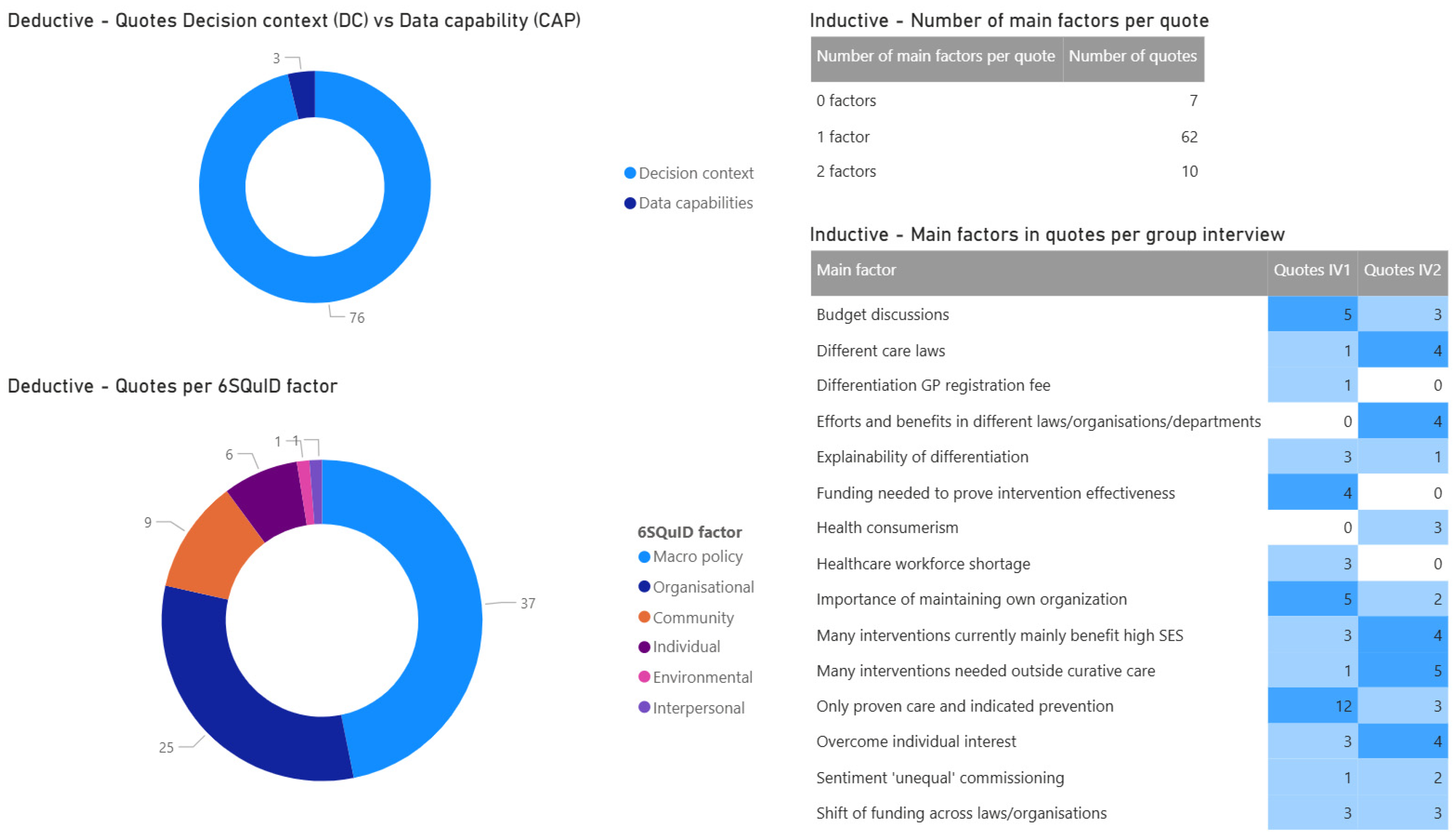
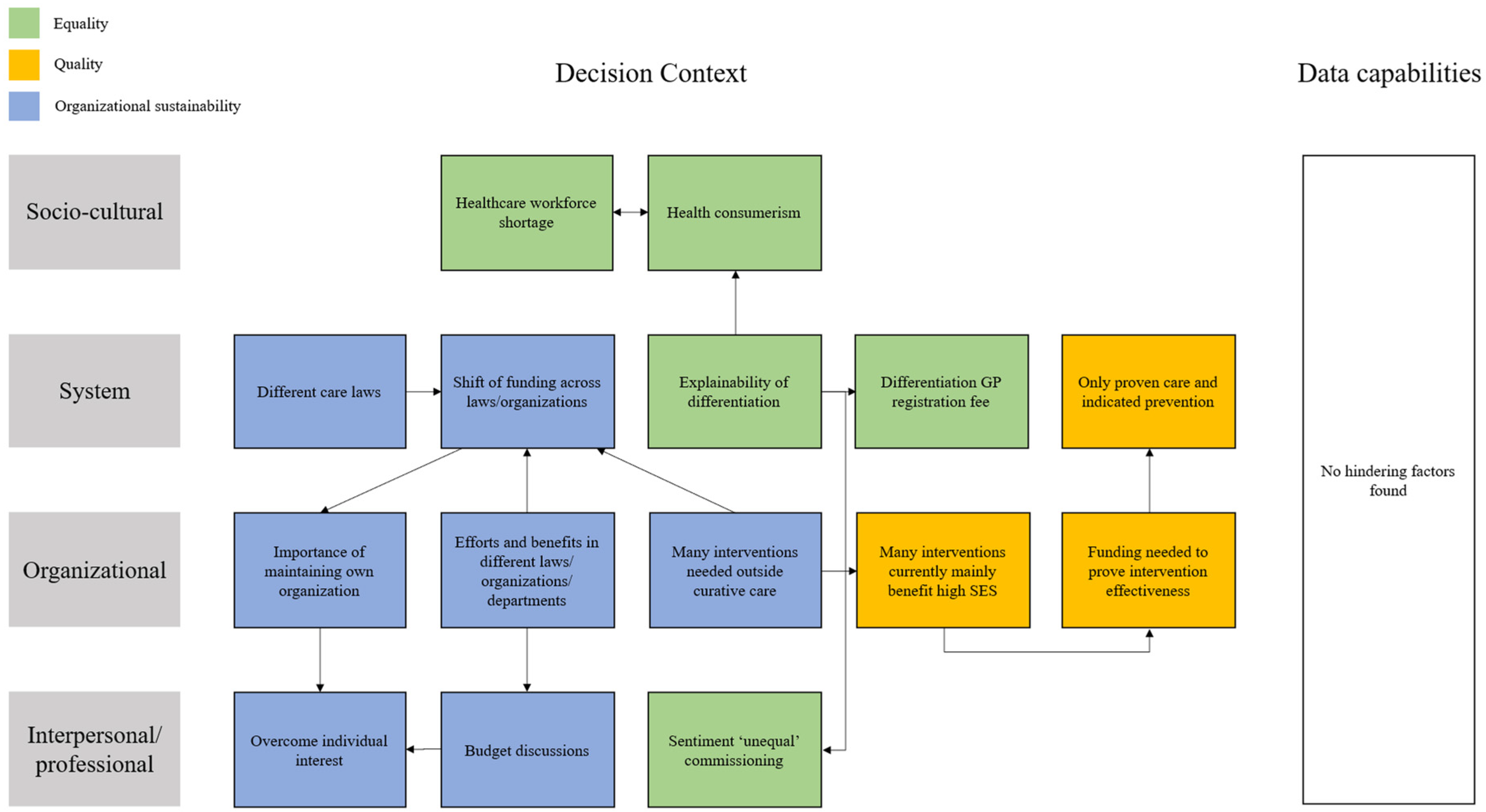
- This explorative study adds the fifteen factors influencing commissioners’ ability to use data to reduce health disparities in type 2 diabetes and shows that commissioners experience barriers in actionable perspectives rather than in data capabilities.
- Additionally, it identifies three themes containing paradoxical mechanisms that hinder data-driven commissioning: equality, where efforts to ensure equal access lead to unfavorable unequal outcomes; quality, where a focus on evidence-based healthcare interventions limits effectiveness in reducing health disparities; and organizational sustainability, where conservative organizational behavior threatens long-term viability.
- Current policy often focusses on data capabilities rather than the ability to implement data-driven approaches.
- To limit the rising healthcare usage associated with disparities, policies must be designed to break the paradoxical mechanisms. Further policy analyses are needed to better understand which conditions facilitate commissioners.
Abstract
1. Background
2. Methods
- Define and understand the problem and its causes.
- Clarify which causal or contextual factors are malleable and have the greatest scope for change.
- Identify how to bring about change: the change mechanism.
2.1. Key Informant Group Interviews
2.2. Participants
2.3. Data Analysis
3. Results
3.1. Participants
3.1.1. Step 1: Defining and Understanding the Problem and Its Causes
“In essence, our focus in commissioning is not on reducing health disparities. It remains a challenge to identify a viable approach to address disparities.”
“What I find particularly complex is that specialist medical care consists of 23 specialties, and the costs associated with diabetes care are actually quite small in comparison. You have to choose how to spend your time.”
“You might wonder with several data-supported initiatives: when is it good enough? And who gets to decide, the National Healthcare Institute, or can we decide ourselves?”
3.1.2. Step 2: Clarify Which Causal or Contextual Factors Are Malleable and Have Greatest Scope for Change
“Ideally we should first collectively determine what we want. What do we want to do differently? Only then should we incorporate the data. What kind of data do we need? And then organize accordingly.”
3.1.3. Causal and Contextual Factors
“It is naive to think that as insurers, we lack the data capabilities to gain insights into health disparities. The issue lies not in obtaining the data, but in the actionable perspectives we can develop thereafter.”
3.1.4. Socio-Cultural Factors (Environmental and Community)
3.1.5. System-Level Factors (Macro Policy)
“So if the Ministry of Health really has the courage, they won’t organize this from within the ministry alone. Healthcare accounts for only 10% of resilience—the rest lies with the Ministry of Finance, the Ministry of Housing, and so on—it’s a vast societal challenge.”
“We cannot invest in general prevention as an insurer, but we are very interested in targeted prevention for specific groups.”
“We have undertaken projects where we have observed that forgiving debts or even purchasing debts can help reduce health costs. Technically, we are not allowed to do that. There is a distinction between the formal role and the informal role or what is sensible. In fact, as a health insurer, we are supposed to commission healthcare.”
“We need a shared goal, but more importantly, we must identify where the problems lie and work together to solve them.”
3.1.6. Organizational Factors
“I think that if we really want to make progress in reducing health disparities, there needs to be a clear problem owner who takes the lead in identifying key influence points and opportunities, and who actively engages and encourages the various stakeholders to act on them.”
“When I was still working as a researcher, many colleagues were very frustrated because their goal was to reduce health disparities. However, every project they undertook seemed to only increase these differences, as they consistently reached only highly educated individuals, no matter how effective, how appealing, how well-designed the interventions were. So, that is indeed a significant challenge.”
“The challenge lies in the fact that funds can only be allocated to proven interventions, yet implementing an intervention is necessary to gather the evidence of its effectiveness.”
3.1.7. Interpersonal (Individual and Interpersonal)
3.1.8. Relations Between Main Factors
3.1.9. Step 3: Identify How to Bring About Change: The Change Mechanism
4. Discussion
- Equality paradox: Efforts to ensure equal access lead to unfavorable unequal outcomes.
- Quality paradox: A focus on evidence-based healthcare interventions limits effectiveness in reducing health disparities.
- Organizational sustainability paradox: Current conservative organization behavior threatens the long-term viability of organizations.
5. Strengths and Limitations
6. Conclusions
Supplementary Materials
Author Contributions
Funding
Institutional Review Board Statement
Informed Consent Statement
Data Availability Statement
Acknowledgments
Conflicts of Interest
References
- Tatulashvili, S.; Fagherazzi, G.; Dow, C.; Cohen, R.; Fosse, S.; Bihan, H. Socioeconomic inequalities and type 2 diabetes complications: A systematic review. Diabetes Metab. 2020, 46, 89–99. [Google Scholar] [CrossRef] [Scilit]
- Roorda, E.; den Braber, M. Inkoophulp geeft inzicht in ziekte en preventie. Available online: https://www.zorgakkoorden.nl/actueel/nieuws/inkoophulp-geeft-inzicht-in-ziekte-en-preventie/ (accessed on 22 February 2025).
- Diez Roux, A.V. Complex Systems Thinking and Current Impasses in Health Disparities Research. Am. J. Public Health 2011, 101, 1627–1634. [Google Scholar] [CrossRef]
- Geurten, R.J.; Struijs, J.N.; Bilo, H.J.G.; Ruwaard, D.; Elissen, A.M.J. Disentangling Population Health Management Initiatives in Diabetes Care: A Scoping Review. Int. J. Integr. Care 2024, 24, 3. [Google Scholar] [CrossRef] [Scilit]
- Bartunek, J.M.; Moch, M.K. First-Order, Second-Order, and Third-Order Change and Organization Development Interventions: A Cognitive Approach. J. Appl. Behav. Sci. 1987, 23, 483–500. [Google Scholar] [CrossRef] [Scilit]
- Rotmans, J.; Loorbach, D. Complexity and Transition Management. J. Ind. Ecol. 2009, 13, 184–196. [Google Scholar] [CrossRef] [Scilit]
- Kreuter, M.W.; De Rosa, C.; Howze, E.H.; Baldwin, G.T. Understanding Wicked Problems: A Key to Advancing Environmental Health Promotion. Health Educ. Behav. 2004, 31, 441–454. [Google Scholar] [CrossRef] [Scilit]
- Rittel, H.W.J.; Webber, M.M. Dilemmas in a general theory of planning. Policy Sci. 1973, 4, 155–169. [Google Scholar] [CrossRef] [Scilit]
- Regmi, K.; Mudyarabikwa, O. A systematic review of the factors—Barriers and enablers—Affecting the implementation of clinical commissioning policy to reduce health inequalities in the National Health Service (NHS), UK. Public Health 2020, 186, 271–282. [Google Scholar] [CrossRef] [Scilit] [PubMed]
- Wenzl, M.; McCuskee, S.; Mossialos, E. Commissioning for equity in the NHS: Rhetoric and practice. Br. Med. Bull. 2015, 115, 5–17. [Google Scholar] [CrossRef] [Scilit] [PubMed]
- Brown, A.F.; Ma, G.X.; Miranda, J.; Eng, E.; Castille, D.; Brockie, T.; Jones, P.; Airhihenbuwa, C.O.; Farhat, T.; Zhu, L.; et al. Structural Interventions to Reduce and Eliminate Health Disparities. Am. J. Public Health 2019, 109, S72–S78. [Google Scholar] [CrossRef] [Scilit] [PubMed]
- de Bakker, D.H.; Struijs, J.N.; Baan, C.B.; Raams, J.; de Wildt, J.E.; Vrijhoef, H.J.; Schut, F.T. Early results from adoption of bundled payment for diabetes care in the Netherlands show improvement in care coordination. Health Aff. 2012, 31, 426–433. [Google Scholar] [CrossRef] [Scilit]
- Integraal Zorgakkoord. 2022. Available online: https://www.rijksoverheid.nl/documenten/2022/09/16/integraal-zorgakkoord-samen-werken-aan-gezonde-zorg (accessed on 18 May 2026).
- GALA—Gezond en Actief Leven Akkoord. 2023. Available online: https://www.rijksoverheid.nl/documenten/2023/01/31/gala-gezond-en-actief-leven-akkoord (accessed on 18 May 2026).
- Aanvullend Zorg- en Welzijnsakkoord (AZWA). 2025. Available online: https://www.rijksoverheid.nl/documenten/2025/08/31/aanvullend-zorg-en-welzijnsakkoord-azwa (accessed on 18 May 2026).
- Bussemaker, J.; S Jongers, T.; Vonk, R. Gezondheidsverschillen voorbij. TSG Tijdschr. Gezondheidswet. 2021, 99, 36–39. [Google Scholar] [CrossRef] [Scilit]
- Thornton, P.L.; Kumanyika, S.K.; Gregg, E.W.; Araneta, M.R.; Baskin, M.L.; Chin, M.H.; Crespo, C.J.; de Groot, M.; Garcia, D.O.; Haire-Joshu, D.; et al. New research directions on disparities in obesity and type 2 diabetes. Ann. N. Y. Acad. Sci. 2020, 1461, 5–24. [Google Scholar] [CrossRef] [Scilit]
- Lindenfeld, Z.; Pagán, J.A.; Silver, D.; McNeill, E.; Mostafa, L.; Zein, D.; Chang, J.E. Stakeholder Perspectives on Data-Driven Solutions to Address Cardiovascular Disease and Health Equity in New York City. AJPM Focus 2023, 2, 100093. [Google Scholar] [CrossRef] [Scilit]
- Foster, N.; Durand, D.J.; Johnson, P.T.; Glover, M.; Narayan, A.K. Emerging Value-Based Care Payment Mechanisms to Reduce Health Inequities: The Accountable Care Organization Realizing Equity, Access, and Community Health Model. J. Am. Coll. Radiol. 2024, 21, 1402–1405. [Google Scholar] [CrossRef] [Scilit] [PubMed]
- Kist, J.M.; Vos, R.C.; Mairuhu, A.T.A.; Struijs, J.N.; van Peet, P.G.; Vos, H.M.M.; van Os, H.J.A.; Beishuizen, E.D.; Sijpkens, Y.W.J.; Faiq, M.A.; et al. SCORE2 cardiovascular risk prediction models in an ethnic and socioeconomic diverse population in the Netherlands: An external validation study. eClinicalMedicine 2023, 57, 101682. [Google Scholar] [CrossRef] [Scilit]
- van Vooren, N.J.E.; Steenkamer, B.M.; Baan, C.A.; Drewes, H.W. Transforming towards sustainable health and wellbeing systems: Eight guiding principles based on the experiences of nine Dutch Population Health Management initiatives. Health Policy 2020, 124, 37–43. [Google Scholar] [CrossRef] [Scilit] [PubMed]
- Jager, A.; Papoutsi, C.; Wong, G. The usage of data in NHS primary care commissioning: A realist evaluation. BMC Prim. Care 2023, 24, 275. [Google Scholar] [CrossRef] [Scilit] [PubMed]
- Wye, L.; Brangan, E.; Cameron, A.; Gabbay, J.; Klein, J.H.; Pope, C. Evidence based policy making and the ‘art’ of commissioning—How English healthcare commissioners access and use information and academic research in ‘real life’ decision-making: An empirical qualitative study. BMC Health Serv. Res. 2015, 15, 430. [Google Scholar] [CrossRef] [Scilit]
- Roorda, E.; Bruijnzeels, M.; Struijs, J.; Spruit, M. Business intelligence systems for population health management: A scoping review. JAMIA Open 2024, 7, ooae122. [Google Scholar] [CrossRef] [Scilit]
- Wight, D.; Wimbush, E.; Jepson, R.; Doi, L. Six steps in quality intervention development (6SQuID). J. Epidemiol. Community Health 2016, 70, 520–525. [Google Scholar] [CrossRef] [Scilit]
- Ahmed, S.K. The pillars of trustworthiness in qualitative research. J. Med. Surg. Public Health 2024, 2, 100051. [Google Scholar] [CrossRef] [Scilit]
- Elo, S.; Kyngäs, H. The qualitative content analysis process. J. Adv. Nurs. 2008, 62, 107–115. [Google Scholar] [CrossRef] [Scilit] [PubMed]
- Roorda, E.; den Braber, M. Beschikbare Kennis en Data Samenbrengen als Zorginkoper. 2024. Available online: https://www.youtube.com/watch?v=g_12uu62scE (accessed on 18 May 2026).
- Merrild, C.H.; Risør, M.B.; Vedsted, P.; Andersen, R.S. Class, Social Suffering, and Health Consumerism. Med. Anthropol. 2016, 35, 517–528. [Google Scholar] [CrossRef] [Scilit] [PubMed]
- Whitehead, M. The concepts and principles of equity and health. Int. J. Health Serv. 1992, 22, 429–445. [Google Scholar] [CrossRef] [Scilit]
- Braveman, P.; Egerter, S.; Williams, D.R. The Social Determinants of Health: Coming of Age. Annu. Rev. Public Health 2011, 32, 381–398. [Google Scholar] [CrossRef] [Scilit]
- Claffey, T.F.; Agostini, J.V.; Collet, E.N.; Reisman, L.; Krakauer, R. Payer-Provider Collaboration In Accountable Care Reduced Use And Improved Quality In Maine Medicare Advantage Plan. Health Aff. 2012, 31, 2074–2083. [Google Scholar] [CrossRef] [Scilit]
- Kannarkat, J.T.; Hartle, J.E.; Parekh, N. Need for payer-provider partnerships in addressing social determinants of health. J. Manag. Care Spec. Pharm. 2021, 27, 791–796. [Google Scholar] [CrossRef] [Scilit]
- DeMeester, R.H.; Xu, L.J.; Nocon, R.S.; Cook, S.C.; Ducas, A.M.; Chin, M.H. Solving Disparities Through Payment And Delivery System Reform: A Program To Achieve Health Equity. Health Aff. 2017, 36, 1133–1139. [Google Scholar] [CrossRef] [Scilit] [PubMed]
- 35; Briggs, A.D.M.; Fraze, T.K.; Glick, A.L.; Beidler, L.B.; Shortell, S.M.; Fisher, E.S. How Do Accountable Care Organizations Deliver Preventive Care Services? A Mixed-Methods Study. J. Gen. Intern. Med. 2019, 34, 2451–2459. [Google Scholar] [CrossRef] [Scilit]
- van Ede, A.; Minderhout, N.; Bruijnzeels, M.; Numans, M.; Stein, V. Mechanisms for a successful implementation of a Population Health Management approach: A scoping review. Int. J. Integr. Care 2022, 22, 164. [Google Scholar] [CrossRef] [Scilit]
- Luftman, J.; Brier, T. Achieving and sustaining business-IT alignment. Calif. Manag. Rev. 1999, 42, 109–122. [Google Scholar] [CrossRef] [Scilit]


Disclaimer/Publisher’s Note: The statements, opinions and data contained in all publications are solely those of the individual author(s) and contributor(s) and not of MDPI and/or the editor(s). MDPI and/or the editor(s) disclaim responsibility for any injury to people or property resulting from any ideas, methods, instructions or products referred to in the content. |
© 2026 by the authors. Licensee MDPI, Basel, Switzerland. This article is an open access article distributed under the terms and conditions of the Creative Commons Attribution (CC BY) license.
Share and Cite
Roorda, E.; Bruijnzeels, M.; Struijs, J.; Spruit, M. Data-Driven Commissioning to Reduce Type 2 Diabetes Related Health Disparities in The Netherlands: Using Key Informant Group Interviews. Healthcare 2026, 14, 1621. https://doi.org/10.3390/healthcare14121621
Roorda E, Bruijnzeels M, Struijs J, Spruit M. Data-Driven Commissioning to Reduce Type 2 Diabetes Related Health Disparities in The Netherlands: Using Key Informant Group Interviews. Healthcare. 2026; 14(12):1621. https://doi.org/10.3390/healthcare14121621
Chicago/Turabian StyleRoorda, Els, Marc Bruijnzeels, Jeroen Struijs, and Marco Spruit. 2026. "Data-Driven Commissioning to Reduce Type 2 Diabetes Related Health Disparities in The Netherlands: Using Key Informant Group Interviews" Healthcare 14, no. 12: 1621. https://doi.org/10.3390/healthcare14121621
APA StyleRoorda, E., Bruijnzeels, M., Struijs, J., & Spruit, M. (2026). Data-Driven Commissioning to Reduce Type 2 Diabetes Related Health Disparities in The Netherlands: Using Key Informant Group Interviews. Healthcare, 14(12), 1621. https://doi.org/10.3390/healthcare14121621