FAIR-Birth: Development and Feasibility Testing of an AI-Supported Advance Birth Planning Application for Midwifery-Led Antenatal Care—A Mixed-Methods Study Protocol
 , , , and
Abstract
1. Introduction
2. Theoretical Framework
2.1. From Advance Care Planning to Advance Birth Planning
2.2. Shared Decision-Making in Midwifery-Led Intrapartum Care
2.3. Health Equity and the FAIR Framework
3. The FAIR-Birth Intervention Concept
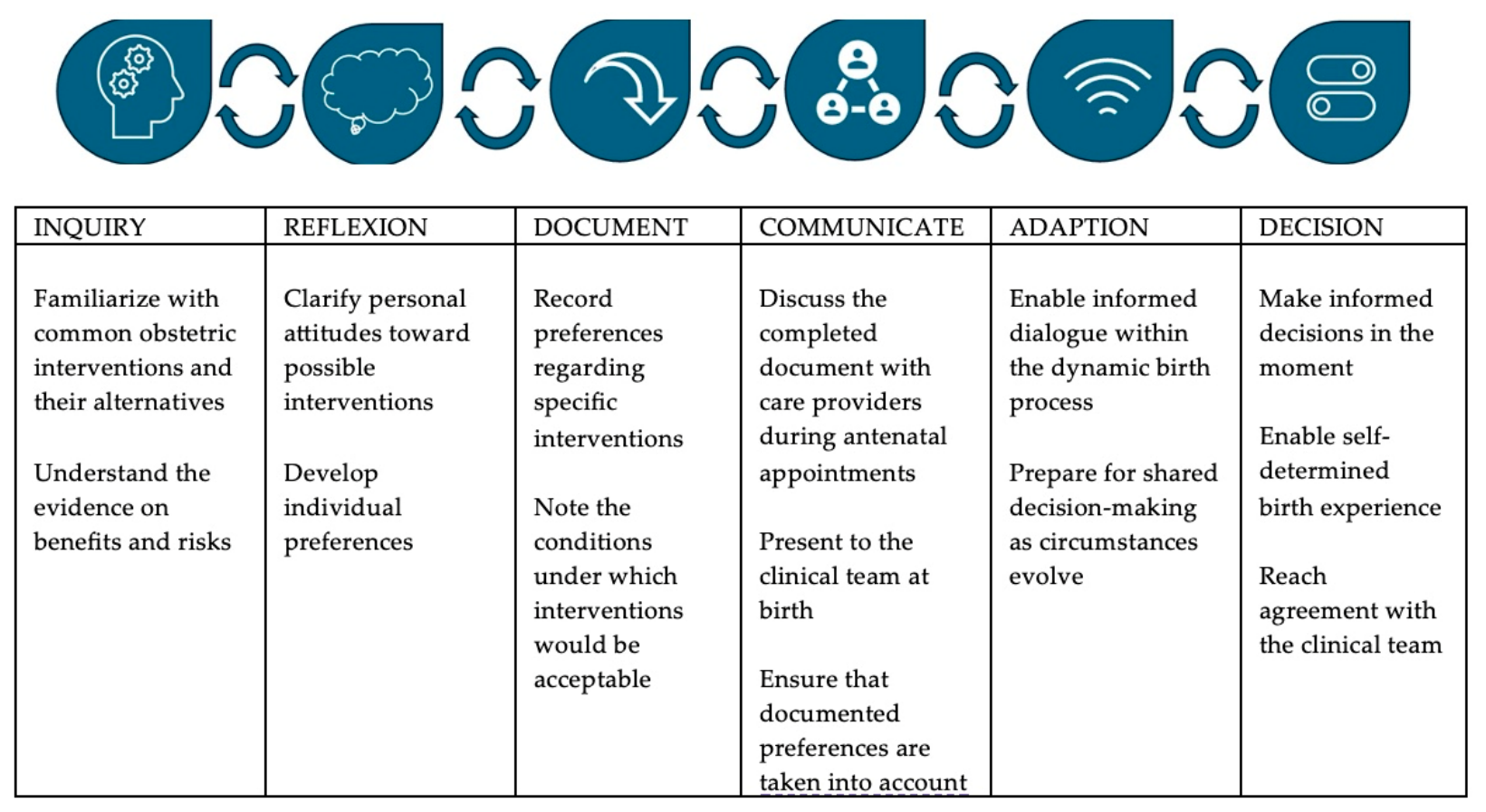
3.1. The Advance Birth Planning Instrument
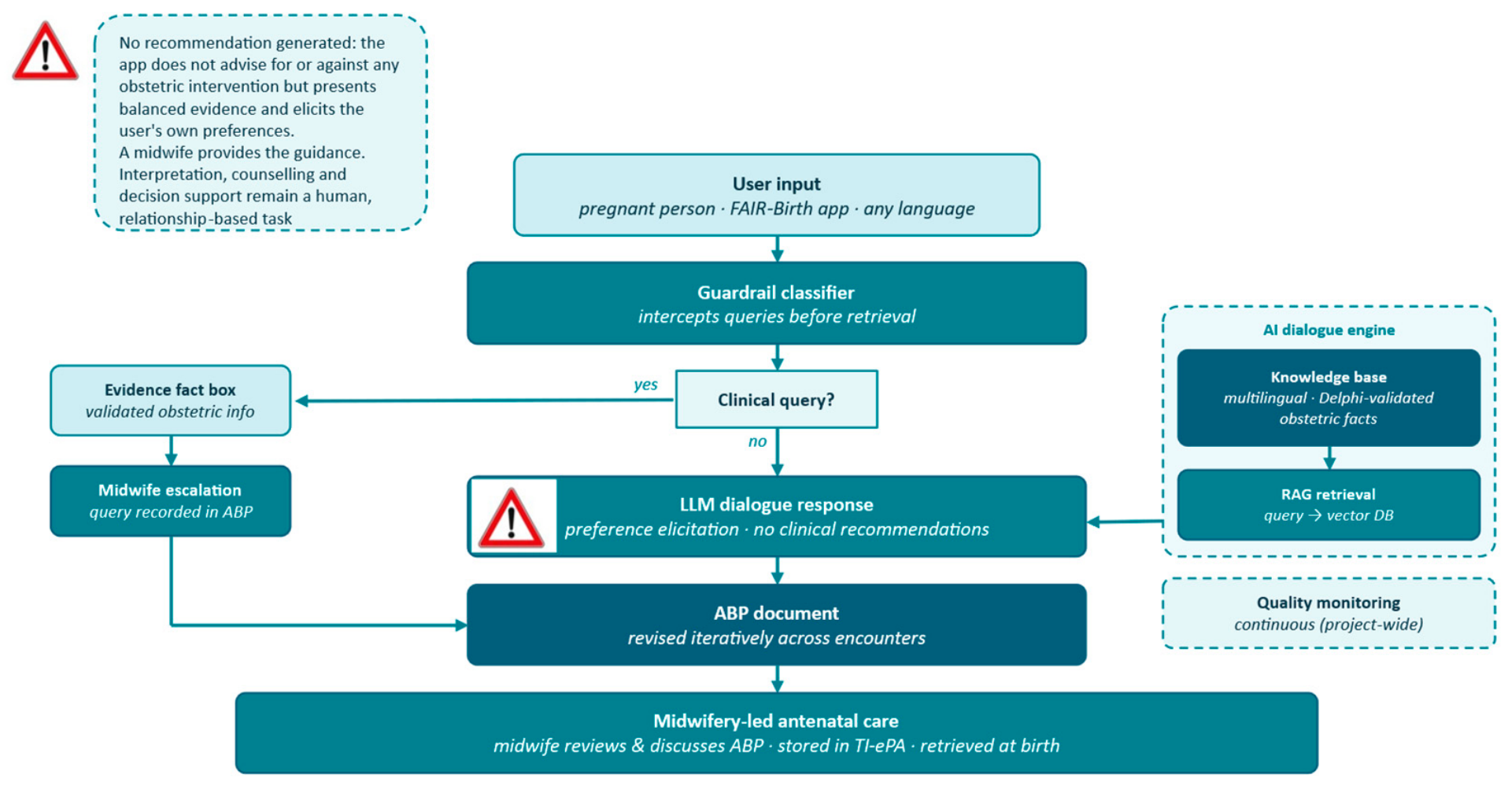
3.2. The FAIR-Birth Application: LLM Architecture and Knowledge Infrastructure
3.3. Embedding FAIR-Birth in Midwifery-Led Antenatal Care
4. Proposed Development and Evaluation Methodology
4.1. Methodological Framework
4.2. Phase 1: Systematic Development (Months 1–18)
- Workstream 1: Systematic literature review
- Workstream 2: Participatory instrument development
- Workstream 3: Knowledge base development and Delphi validation
- Workstream 4: Technical development and usability testing
4.3. Phase 2: Feasibility Study (Months 19–30)
- Setting and participants
- Quantitative feasibility outcomes
- Progression decision
- Qualitative component
- Integration
- Ethics and governance
5. Discussion
6. Conclusions
Author Contributions
Funding
Institutional Review Board Statement
Informed Consent Statement
Data Availability Statement
Acknowledgments
Conflicts of Interest
Abbreviations
| ABP | Advance Birth Planning |
| ACP | Advance Care Planning |
| CB-PTSD | Childbirth-Related Post-Traumatic Stress Disorder |
| FGM/C | Female Genital Mutilation/Cutting |
| LLM | Large Language Model |
| MRC | Medical Research Council |
| PPI | Patient and Public Involvement |
| RAG | Retrieval Augmented Generation |
| SDM | Shared Decision-Making |
| TI-ePA | Telematikinfrastruktur Electronic Patient Record |
References
- Gesellschaft für Qualität in der Außerklinischen Geburtshilfe e.V. (QUAG e.V.) Qualitätsbericht 2024 Außerklinische Geburtshilfe in Deutschland. 2025. Available online: https://quag.de/downloads/QUAG_Bericht2024.pdf (accessed on 25 May 2026).
- Statista Anzahl der Geburten in Bayern von 1991 bis 2025. Available online: https://de.statista.com/statistik/daten/studie/588880/umfrage/anzahl-der-geburten-in-bayern/ (accessed on 23 May 2026).
- Limmer, C.M.; Stoll, K.; Vedam, S.; Leinweber, J.; Gross, M.M. Measuring Disrespect and Abuse during Childbirth in a High-Resource Country: Development and Validation of a German Self-Report Tool. Midwifery 2023, 126, 103809. [Google Scholar] [CrossRef] [Scilit] [PubMed]
- Heyne, C.-S.; Kazmierczak, M.; Souday, R.; Horesh, D.; Lambregtse-van Den Berg, M.; Weigl, T.; Horsch, A.; Oosterman, M.; Dikmen-Yildiz, P.; Garthus-Niegel, S. Prevalence and Risk Factors of Birth-Related Posttraumatic Stress among Parents: A Comparative Systematic Review and Meta-Analysis. Clin. Psychol. Rev. 2022, 94, 102157. [Google Scholar] [CrossRef] [Scilit]
- Horsch, A.; Garthus-Niegel, S.; Ayers, S.; Chandra, P.; Hartmann, K.; Vaisbuch, E.; Lalor, J. Childbirth-Related Posttraumatic Stress Disorder: Definition, Risk Factors, Pathophysiology, Diagnosis, Prevention, and Treatment. Am. J. Obstet. Gynecol. 2024, 230, S1116–S1127. [Google Scholar] [CrossRef] [Scilit] [PubMed]
- Downe, S.; Finlayson, K.; Oladapo, O.; Bonet, M.; Gülmezoglu, A.M. What Matters to Women during Childbirth: A Systematic Qualitative Review. PLoS ONE 2018, 13, e0194906. [Google Scholar] [CrossRef] [Scilit]
- Taheri, M.; Takian, A.; Taghizadeh, Z.; Jafari, N.; Sarafraz, N. Creating a Positive Perception of Childbirth Experience: Systematic Review and Meta-Analysis of Prenatal and Intrapartum Interventions. Reprod. Health 2018, 15, 73. [Google Scholar] [CrossRef] [Scilit] [PubMed]
- Webb, R.; Ayers, S.; Bogaerts, A.; Jeličić, L.; Pawlicka, P.; Van Haeken, S.; Uddin, N.; Xuereb, R.B.; Kolesnikova, N.; COST action CA18211:DEVoTION team. When Birth Is Not as Expected: A Systematic Review of the Impact of a Mismatch between Expectations and Experiences. BMC Pregnancy Childbirth 2021, 21, 475. [Google Scholar] [CrossRef] [Scilit]
- Sandall, J.; Soltani, H.; Gates, S.; Shennan, A.; Devane, D. Midwife-Led Continuity Models versus Other Models of Care for Childbearing Women. Cochrane Database Syst. Rev. 2016, 2016, CD004667. [Google Scholar] [CrossRef] [Scilit]
- Bell, C.H.; Muggleton, S.; Davis, D.L. Birth Plans: A Systematic, Integrative Review into Their Purpose, Process, and Impact. Midwifery 2022, 111, 103388. [Google Scholar] [CrossRef] [Scilit]
- Vlassak, E.M.E.; Keulen, J.K.J.; Miteniece, E.; De Ritter, R.; Hendrix, M.J.C.; Nieuwenhuijze, M.J. Care Providers’ and Parents’ Experiences with Implementing the Conversational Health Literacy Assessment Tool (CHAT)-Maternity-Care in the Netherlands: A Mixed Methods Study. Healthcare 2025, 13, 1173. [Google Scholar] [CrossRef] [Scilit]
- Bell, C.H.; Lukersmith, S.; Dahlen, H.G.; Davis, D. Informed, Supported, Confident: A Realist Evaluation of The Birth Map. Women Birth 2025, 38, 102117. [Google Scholar] [CrossRef] [Scilit]
- Amil, S.; Da, S.-M.-A.-R.; Plaisimond, J.; Roch, G.; Sasseville, M.; Bergeron, F.; Gagnon, M.-P. Interactive Conversational Agents for Perinatal Health: A Mixed Methods Systematic Review. Healthcare 2025, 13, 363. [Google Scholar] [CrossRef] [Scilit]
- Recker, F.; Neubauer, R.; Wittek, A.; Scholten, N. Large Language Models and Women’s Health: A Digital Companion for Informed Decision-Making. Arch. Gynecol. Obstet. 2025, 312, 663–670. [Google Scholar] [CrossRef] [Scilit] [PubMed]
- Leitner, K.; Cutri-French, C.; Mandel, A.; Christ, L.; Koelper, N.; McCabe, M.; Seltzer, E.; Scalise, L.; Colbert, J.A.; Dokras, A.; et al. A Conversational Agent Using Natural Language Processing for Postpartum Care for New Mothers: Development and Engagement Analysis. JMIR AI 2025, 4, e58454. [Google Scholar] [CrossRef] [Scilit]
- Grotlüschen, A.; Buddeberg, K. LEO 2018: Leben mit Geringer Literalität, 1st ed.; W. Bertelsmann Verlag: Bielefeld, Germany, 2020. [Google Scholar]
- Higginbottom, G.M.; Safipour, J.; Yohani, S.; O’Brien, B.; Mumtaz, Z.; Paton, P.; Chiu, Y.; Barolia, R. An Ethnographic Investigation of the Maternity Healthcare Experience of Immigrants in Rural and Urban Alberta, Canada. BMC Pregnancy Childbirth 2016, 16, 20. [Google Scholar] [CrossRef] [Scilit] [PubMed]
- Hill, J.; Werringloer, T.; Keim, U.; Meisl, M.; Plappert, C.F. Educating for Equity: Preparing Student Midwives for Antenatal Care of Vulnerable Pregnant Women—A Pilot Study. Healthcare 2026, 14, 952. [Google Scholar] [CrossRef] [Scilit]
- Topol, E.J. High-Performance Medicine: The Convergence of Human and Artificial Intelligence. Nat. Med. 2019, 25, 44–56. [Google Scholar] [CrossRef] [Scilit]
- Sudore, R.L.; Lum, H.D.; You, J.J.; Hanson, L.C.; Meier, D.E.; Pantilat, S.Z.; Matlock, D.D.; Rietjens, J.A.C.; Korfage, I.J.; Ritchie, C.S.; et al. Defining Advance Care Planning for Adults: A Consensus Definition from a Multidisciplinary Delphi Panel. J. Pain Symptom Manag. 2017, 53, 821–832.e1. [Google Scholar] [CrossRef] [Scilit]
- Schichtel, M.; Wee, B.; Perera, R.; Onakpoya, I. The Effect of Advance Care Planning on Heart Failure: A Systematic Review and Meta-Analysis. J. Gen. Intern. Med. 2020, 35, 874–884. [Google Scholar] [CrossRef] [Scilit] [PubMed]
- Lin, Y.-J.; Chen, Y.-J.; Ling, D.I.; Fang, J.-R.; Wu, J.-Y.; Lo, Y.-T. Effectiveness of Advance Care Planning for End-of-Life Outcomes in Nursing Home Residents with Dementia: A Systematic Review and Meta-Analysis. J. Am. Med. Dir. Assoc. 2026, 27, 105974. [Google Scholar] [CrossRef] [Scilit]
- McMahan, R.D.; Tellez, I.; Sudore, R.L. Deconstructing the Complexities of Advance Care Planning Outcomes: What Do We Know and Where Do We Go? A Scoping Review. J. Am. Geriatr. Soc. 2021, 69, 234–244. [Google Scholar] [CrossRef] [Scilit]
- Detering, K.M.; Hancock, A.D.; Reade, M.C.; Silvester, W. The Impact of Advance Care Planning on End of Life Care in Elderly Patients: Randomised Controlled Trial. BMJ 2010, 340, c1345. [Google Scholar] [CrossRef] [Scilit]
- Garten, L.; Von Der Hude, K.; Strahleck, T.; Krones, T. Extending the Concept of Advance Care Planning to the Perinatal Period. Klin. Padiatr. 2020, 232, 249–256. [Google Scholar] [CrossRef] [Scilit] [PubMed]
- Hahlweg, P.; Bieber, C.; Levke Brütt, A.; Dierks, M.-L.; Dirmaier, J.; Donner-Banzhoff, N.; Eich, W.; Geiger, F.; Klemperer, D.; Koch, K.; et al. Moving towards Patient-Centered Care and Shared Decision-Making in Germany. Z. Evidenz Fortbild. Qual. Gesundheitswesen 2022, 171, 49–57. [Google Scholar] [CrossRef] [Scilit]
- Scheibler, F.; Geiger, F.; Wehkamp, K.; Danner, M.; Debrouwere, M.; Stolz-Klingenberg, C.; Schuldt-Joswig, A.; Sommer, C.G.; Kopeleva, O.; Bünzen, C.; et al. Patient-Reported Effects of Hospital-Wide Implementation of Shared Decision-Making at a University Medical Centre in Germany: A Pre–Post Trial. BMJ Evid.-Based Med. 2023, 29, 87–95. [Google Scholar] [CrossRef] [Scilit]
- Elwyn, G.; Frosch, D.L.; Kobrin, S. Implementing Shared Decision-Making: Consider All the Consequences. Implement. Sci. 2015, 11, 114. [Google Scholar] [CrossRef] [Scilit]
- AWMF-Leitlinienprogramm. Vaginale Geburt Am Termin: S3-Leitlinie Langversion; Deutsche Gesellschaft für Gynäkologie und Geburtshilfe (DGGG): Berlin, Germany, 2020. [Google Scholar]
- Megregian, M.; Emeis, C.; Nieuwenhuijze, M. The Impact of Shared Decision-Making in Perinatal Care: A Scoping Review. J. Midwife Womens Health 2020, 65, 777–788. [Google Scholar] [CrossRef] [Scilit] [PubMed]
- Rawls, J. A Theory of Justice: Original Edition; Harvard University Press: Cambridge, MA, USA, 2005. [Google Scholar]
- Sarela, A.I. Rawlsian Justice in Healthcare: A Response to Cox and Fritz. J. Med. Ethics 2021, 48, 413–415. [Google Scholar] [CrossRef] [Scilit]
- Silva-Fernández, C.S.; De La Calle, M.; Suta, M.A.; Arribas, S.M.; Garrosa, E.; Ramiro-Cortijo, D. Psychometric Evaluation of Women’s Knowledge of Healthcare Rights and Perception of Resource Scarcity during Maternity. Healthcare 2024, 12, 2045. [Google Scholar] [CrossRef] [Scilit]
- Ayesh, M.; Gutiérrez-Rolón, N.; Alva-Manchego, F. CardiffNLP at CLEARS-2025: Prompting Large Language Models for Plain Language and Easy-to-Read Text Rewriting. arXiv 2025, arXiv:2508.03240. [Google Scholar]
- Qin, L.; Chen, Q.; Zhou, Y.; Chen, Z.; Li, Y.; Liao, L.; Li, M.; Che, W.; Yu, P.S. A Survey of Multilingual Large Language Models. Patterns 2025, 6, 101118. [Google Scholar] [CrossRef] [Scilit] [PubMed]
- Lühnen, J.; Albrecht, M.; Mühlhauser, I.; Steckelberg, A. Leitlinie Evidenzbasierte Gesundheitsinformation. 2017. Available online: https://www.leitlinie-gesundheitsinformation.de/wp-content/uploads/2017/07/Leitlinie-evidenzbasierte-Gesundheitsinformation.pdf (accessed on 23 May 2026).
- Hinneburg, J.; Wilhelm, C.; Ellermann, C. Methodenpapier für die Entwicklung von Faktenboxen; Harding-Zentrum für Risikokompetenz: Potsdam, Germany, 2020. [Google Scholar]
- Brett, J.; Staniszewska, S.; Mockford, C.; Herron-Marx, S.; Hughes, J.; Tysall, C.; Suleman, R. A Systematic Review of the Impact of Patient and Public Involvement on Service Users, Researchers and Communities. Patient 2014, 7, 387–395. [Google Scholar] [CrossRef] [Scilit]
- Leinweber, J.; Fontein-Kuipers, Y.; Karlsdottir, S.I.; Ekström-Bergström, A.; Nilsson, C.; Stramrood, C.; Thomson, G. Developing a Woman-centered, Inclusive Definition of Positive Childbirth Experiences: A Discussion Paper. Birth 2023, 50, 362–383. [Google Scholar] [CrossRef] [Scilit]
- Hoffmann, L.; Hilger, N.; Banse, R. The Mindset of Birth Predicts Birth Outcomes: Evidence from a Prospective Longitudinal Study. Eur. J. Soc. Psychol. 2023, 53, 857–871. [Google Scholar] [CrossRef] [Scilit]
- Mokkink, L.B.; Terwee, C.B.; Knol, D.L.; Stratford, P.W.; Alonso, J.; Patrick, D.L.; Bouter, L.M.; de Vet, H.C. The COSMIN Checklist for Evaluating the Methodological Quality of Studies on Measurement Properties: A Clarification of Its Content. BMC Med. Res. Methodol. 2010, 10, 22. [Google Scholar] [CrossRef] [Scilit]
- Mokkink, L.B.; Herbelet, S.; Tuinman, P.R.; Terwee, C.B. Content Validity: Judging the Relevance, Comprehensiveness, and Comprehensibility of an Outcome Measurement Instrument—A COSMIN Perspective. J. Clin. Epidemiol. 2025, 185, 111879. [Google Scholar] [CrossRef] [Scilit]
- Lewis, P.; Perez, E.; Piktus, A.; Petroni, F.; Karpukhin, V.; Goyal, N.; Küttler, H.; Lewis, M.; Yih, W.; Rocktäschel, T.; et al. Retrieval-Augmented Generation for Knowledge-Intensive NLP Tasks. Adv. Neural Inf. Process. Syst. 2020, 33, 9459–9474. [Google Scholar]
- Kang, X.; Shi, D.; Chen, L. Model Whisper: Steering Vectors Unlock Large Language Models’ Potential in Test-Time. Proc. AAAI Conf. Artif. Intell. 2026, 40, 31392–31400. [Google Scholar] [CrossRef] [Scilit]
- Konen, K.; Jentzsch, S.; Diallo, D.; Schütt, P.; Bensch, O.; Baff, R.E.; Opitz, D.; Hecking, T. Style Vectors for Steering Generative Large Language Model 2024. In Findings of the Association for Computational Linguistics: EACL 2024; Association for Computational Linguistics: Stroudsburg, PA, USA, 2024. [Google Scholar]
- Zentrum verantwortungsbewusste Digitalisierung (ZEVEDI). Zur Forschungsethischen Begutachtung von KI-Forschungsprojekten Handreichung zur Unterstützung der Arbeit von Ethikkommissionen an Hochschulen, Version 1.0; Zentrum verantwortungsbewusste Digitalisierung: Darmstadt, Germany, 2022.
- World Health Organization. WHO Transitioning to Midwifery Models of Care: Global Position Paper; World Health Organization: Geneva, Switzerland, 2024. [Google Scholar]
- Skivington, K.; Matthews, L.; Simpson, S.A.; Craig, P.; Baird, J.; Blazeby, J.M.; Boyd, K.A.; Craig, N.; French, D.P.; McIntosh, E.; et al. A New Framework for Developing and Evaluating Complex Interventions: Update of Medical Research Council Guidance. BMJ 2021, 374, n2061. [Google Scholar] [CrossRef] [Scilit] [PubMed]
- Craig, P.; Dieppe, P.; Macintyre, S.; Michie, S.; Nazareth, I.; Petticrew, M. Developing and Evaluating Complex Interventions: The New Medical Research Council Guidance. BMJ 2008, 337, a1655. [Google Scholar] [CrossRef] [Scilit] [PubMed]
- Kuehlmeyer, K.; Jansky, B.; Mertz, M.; Marckmann, G. Transformative Medical Ethics: A Framework for Changing Practice According to Normative–Ethical Requirements. Bioethics 2024, 38, 241–251. [Google Scholar] [CrossRef] [Scilit] [PubMed]
- Page, M.J.; McKenzie, J.E.; Bossuyt, P.M.; Boutron, I.; Hoffmann, T.C.; Mulrow, C.D.; Shamseer, L.; Tetzlaff, J.M.; Akl, E.A.; Brennan, S.E.; et al. The PRISMA 2020 Statement: An Updated Guideline for Reporting Systematic Reviews. BMJ 2021, 372, n71. [Google Scholar] [CrossRef] [Scilit]
- Casp UK. Critical Appraisal Skills Programme (CASP) Check Lists. 2020-11-20 [2021-07-09]. 2017. Available online: https://casp-uk.net/casp-tools-checklists (accessed on 25 May 2026).
- Hong, Q.N.; Fàbregues, S.; Bartlett, G.; Boardman, F.; Cargo, M.; Dagenais, P.; Gagnon, M.-P.; Griffiths, F.; Nicolau, B.; O’Cathain, A.; et al. The Mixed Methods Appraisal Tool (MMAT) Version 2018 for Information Professionals and Researchers. Educ. Inf. 2018, 34, 285–291. [Google Scholar] [CrossRef] [Scilit]
- JBI Critical Appraisal Tools. Available online: https://jbi.global/critical-appraisal-tools (accessed on 25 May 2026).
- Braun, V.; Clarke, V. To Saturate or Not to Saturate? Questioning Data Saturation as a Useful Concept for Thematic Analysis and Sample-Size Rationales. Qual. Res. Sport Exerc. Health 2021, 13, 201–216. [Google Scholar] [CrossRef] [Scilit]
- Braun, V.; Clarke, V. Reflecting on Reflexive Thematic Analysis. Qual. Res. Sport Exerc. Health 2019, 11, 589–597. [Google Scholar] [CrossRef] [Scilit]
- Braun, V.; Clarke, V. Supporting Best Practice in Reflexive Thematic Analysis Reporting in Palliative Medicine: A Review of Published Research and Introduction to the Reflexive Thematic Analysis Reporting Guidelines (RTARG). Palliat. Med. 2024, 38, 608–616. [Google Scholar] [CrossRef] [Scilit] [PubMed]
- Diamond, I.R.; Grant, R.C.; Feldman, B.M.; Pencharz, P.B.; Ling, S.C.; Moore, A.M.; Wales, P.W. Defining Consensus: A Systematic Review Recommends Methodologic Criteria for Reporting of Delphi Studies. J. Clin. Epidemiol. 2014, 67, 401–409. [Google Scholar] [CrossRef] [Scilit]
- Stoyanov, S.R.; Hides, L.; Kavanagh, D.J.; Zelenko, O.; Tjondronegoro, D.; Mani, M. Mobile App Rating Scale: A New Tool for Assessing the Quality of Health Mobile Apps. JMIR Mhealth Uhealth 2015, 3, e27. [Google Scholar] [CrossRef] [Scilit] [PubMed]
- Creswell, J.W.; Plano Clark, V.L. Designing and Conducting Mixed Methods Research, 3rd ed.; SAGE: Los Angeles, CA, USA, 2018. [Google Scholar]
- Whitehead, A.L.; Sully, B.G.O.; Campbell, M.J. Pilot and Feasibility Studies: Is There a Difference from Each Other and from a Randomised Controlled Trial? Contemp. Clin. Trials 2014, 38, 130–133. [Google Scholar] [CrossRef] [Scilit]
- Hollins Martin, C.J.; Martin, C.R. Development and Psychometric Properties of the Birth Satisfaction Scale-Revised (BSS-R). Midwifery 2014, 30, 610–619. [Google Scholar] [CrossRef] [Scilit]
- Mattern, E.; Ayerle, G.M. Qualitätsgesicherte Übersetzung des Wijma Delivery Expectancy Questionnaire (W-DEQ_A) ins Deutsche. Z. Geburtshilfe Neonatol. 2022, 226, 56–62. [Google Scholar] [CrossRef] [Scilit]
- Stewart, A.L.; Nápoles, A.M.; Piawah, S.; Santoyo-Olsson, J.; Teresi, J.A. Guidelines for Evaluating the Feasibility of Recruitment in Pilot Studies of Diverse Populations: An Overlooked but Important Component. Ethn. Dis. 2020, 30, 745–754. [Google Scholar] [CrossRef] [Scilit]
- Eldridge, S.M.; Lancaster, G.A.; Campbell, M.J.; Thabane, L.; Hopewell, S.; Coleman, C.L.; Bond, C.M. Defining Feasibility and Pilot Studies in Preparation for Randomised Controlled Trials: Development of a Conceptual Framework. PLoS ONE 2016, 11, e0150205. [Google Scholar] [CrossRef] [Scilit]
- Avery, K.N.L.; Williamson, P.R.; Gamble, C.; O’Connell Francischetto, E.; Metcalfe, C.; Davidson, P.; Williams, H.; Blazeby, J.M. Informing Efficient Randomised Controlled Trials: Exploration of Challenges in Developing Progression Criteria for Internal Pilot Studies. BMJ Open 2017, 7, e013537. [Google Scholar] [CrossRef] [Scilit]
- Malterud, K.; Siersma, V.D.; Guassora, A.D. Sample Size in Qualitative Interview Studies: Guided by Information Power. Qual. Health Res. 2016, 26, 1753–1760. [Google Scholar] [CrossRef] [Scilit]
- Fetters, M.D.; Curry, L.A.; Creswell, J.W. Achieving Integration in Mixed Methods Designs-Principles and Practices. Health Serv. Res. 2013, 48, 2134–2156. [Google Scholar] [CrossRef] [Scilit]
- Guetterman, T.C.; Fetters, M.D.; Creswell, J.W. Integrating Quantitative and Qualitative Results in Health Science Mixed Methods Research Through Joint Displays. Ann. Fam. Med. 2015, 13, 554–561. [Google Scholar] [CrossRef] [Scilit]
- DFG Leitlinien zur Sicherung Guter Wissenschaftlicher Praxis—Kodex 2019. Available online: https://www.dfg.de/de/grundlagen-themen/grundlagen-und-prinzipien-der-foerderung/gwp/kodex (accessed on 25 May 2026).
- Schulz, A.A.; Wirtz, M.A. Interprofessional Collaboration in Obstetric and Midwifery Care—Multigroup Comparison of Midwives’ and Physicians’ Perspective. Healthcare 2025, 13, 1798. [Google Scholar] [CrossRef] [Scilit]
- Gerdon, F.; Bach, R.L.; Kern, C.; Kreuter, F. Social Impacts of Algorithmic Decision-Making: A Research Agenda for the Social Sciences. Big Data Soc. 2022, 9, 205395172210893. [Google Scholar] [CrossRef] [Scilit]
- Vollert, B.; Schurig, N.; Zieß, V.; Weise, V.; Seefeld, L.; Göbel, A.; Birdir, C.; Wimberger, P.; Garthus-Niegel, S. Subjective Birth Experience and Person-Centred Care in Obstetrics: Study Protocol of the Prospective Mixed-Methods Research Project RESPECT. Geburtshilfe Frauenheilkd. 2025, 85, 1169–1194. [Google Scholar] [CrossRef] [Scilit]
- Bradway, M.; Wang, B.; Nybakke, H.L.; Ingebrigtsen, S.A.; Dyb, K.; Rødseth, E. Rethinking the Digital Divide in Health: A Critical Interpretive Synthesis of Research Literature. Front. Digit. Health 2026, 7, 1683565. [Google Scholar] [CrossRef] [Scilit]
- Grummt, S.; Sedlmayr, B. Approaches to Promoting Patients’ and Citizens’ eHealth Literacy. In Proceedings of the 18th International Joint Conference on Biomedical Engineering Systems and Technologies, Porto, Portugal, 20–22 February 2025; pp. 758–765. [Google Scholar] [CrossRef] [Scilit]



| Component | Preliminary Technical Decisions | Safety & Guardrail Architecture | Expected Performance & Monitoring Metrics |
|---|---|---|---|
| Knowledge Access | Retrieval-Augmented Generation (RAG) using a local vector database. | System-prompt constraints; confinement to expert-validated facts. | Instruction-following rate (accuracy tracking). |
| Dialogue Steering | Non-fine-tuning adaptation; inference-time steering and few-shot prompting. | Guardrail classifier intercepts direct clinical queries. | Adversarial refusal rates (intercepting out-of-scope requests). |
| Human Alignment | Dynamic adaptation to user language and health-literacy level. | Redirection of clinical questions to evidence fact boxes and human midwives. | Human-preference alignment scores. |
Disclaimer/Publisher’s Note: The statements, opinions and data contained in all publications are solely those of the individual author(s) and contributor(s) and not of MDPI and/or the editor(s). MDPI and/or the editor(s) disclaim responsibility for any injury to people or property resulting from any ideas, methods, instructions or products referred to in the content. |
© 2026 by the authors. Licensee MDPI, Basel, Switzerland. This article is an open access article distributed under the terms and conditions of the Creative Commons Attribution (CC BY) license.
Share and Cite
Schunk, M.; Hübener, C.; Robert, S.; Bayerl, S.P.; Luegmair, K. FAIR-Birth: Development and Feasibility Testing of an AI-Supported Advance Birth Planning Application for Midwifery-Led Antenatal Care—A Mixed-Methods Study Protocol. Healthcare 2026, 14, 1607. https://doi.org/10.3390/healthcare14121607
Schunk M, Hübener C, Robert S, Bayerl SP, Luegmair K. FAIR-Birth: Development and Feasibility Testing of an AI-Supported Advance Birth Planning Application for Midwifery-Led Antenatal Care—A Mixed-Methods Study Protocol. Healthcare. 2026; 14(12):1607. https://doi.org/10.3390/healthcare14121607
Chicago/Turabian StyleSchunk, Michaela, Christoph Hübener, Sebastian Robert, Sebastian P. Bayerl, and Karolina Luegmair. 2026. "FAIR-Birth: Development and Feasibility Testing of an AI-Supported Advance Birth Planning Application for Midwifery-Led Antenatal Care—A Mixed-Methods Study Protocol" Healthcare 14, no. 12: 1607. https://doi.org/10.3390/healthcare14121607
APA StyleSchunk, M., Hübener, C., Robert, S., Bayerl, S. P., & Luegmair, K. (2026). FAIR-Birth: Development and Feasibility Testing of an AI-Supported Advance Birth Planning Application for Midwifery-Led Antenatal Care—A Mixed-Methods Study Protocol. Healthcare, 14(12), 1607. https://doi.org/10.3390/healthcare14121607