Developing Methods for Observing Awe Narration in Psilocybin-Assisted Therapy
 , , ,
, , ,
Abstract
1. Introduction
2. Methods
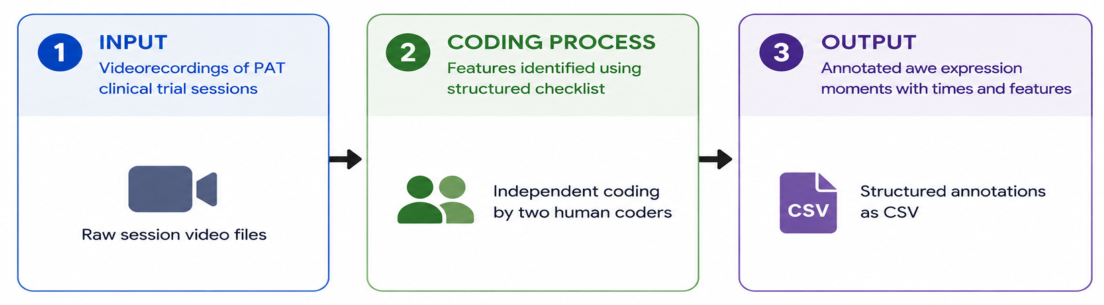
2.1. Overview
2.2. Participants and Setting
2.3. Conceptual Definition of Awe
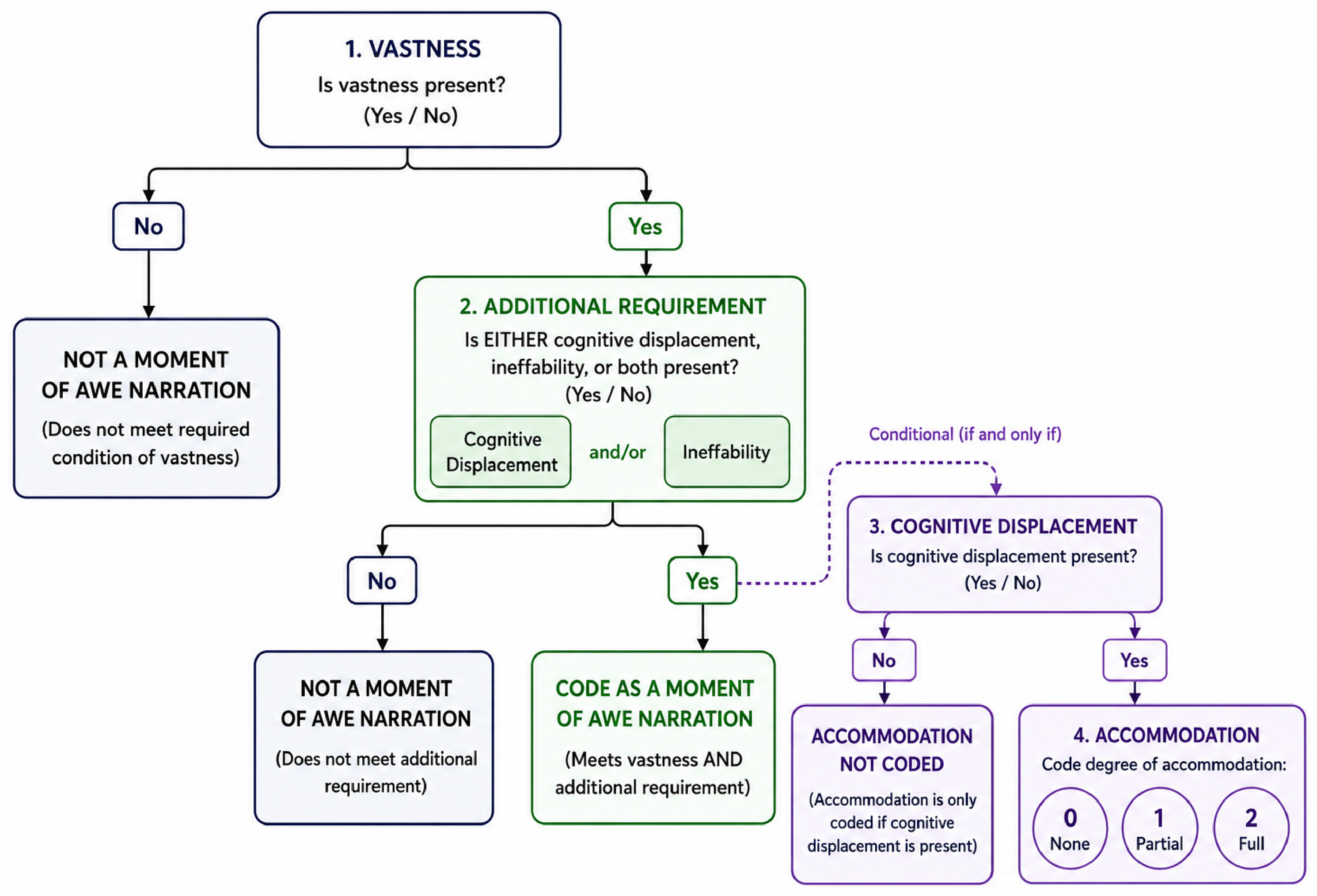
2.4. Candidate Features of Awe Narration
“It was one of the most profound and um meaningful experiences of my life [vastness]. Shocking of its revelations, daunting at times, sometimes unbearably beautiful [need for accommodation], and mystical, divine, and it opened up a whole world of ideas and thoughts [vastness]. Any metaphor I could use would be inadequate to describe it [ineffability].”(Participant T, Integration.)
2.5. Analyses
“It’s so many things in life. It’s the taste of your favorite ice cream. It’s the smell of your favorite flower. It’s the sight of your favorite child, your wife, your loved ones.”(Participant T, Integration.)
3. Results
3.1. Vastness
3.2. Ineffability
3.3. Need for Accommodation
“Well, I don’t have to be concrete about it and say, define it. I don’t have to. I could just experience it and feel it and remember it. Um, I don’t, I don’t have to put it in words.”(Participant H, Integration Encounter.)
Participant: It’s still all inside of me. It’s just, like, everything that happened yesterday came from inside of me.Therapist: Yeah. Yeah, okay. And so what’s your thought right now about that?Participant: I think--I think I’m not going to figure it out. [laugh]Therapist: Okay. Okay. And what’s that like for you, not to-to know that you’re not going to figure it out?Participant: I kind of like it. It feels like a relief. You know? Like I’m not-I’m not going to find the meaning, I don’t think. Like I’m not going to find that profound thing that I’m seeking. I think it’s just going to be the process of seeking, is what it is.(Participant P, Integration Encounter.)
4. Discussion
5. Conclusions
Author Contributions
Funding
Institutional Review Board Statement
Informed Consent Statement
Data Availability Statement
Acknowledgments
Conflicts of Interest
References
- Muthumaraswamy, S.D.; Baggott, M.J.; Schenberg, E.E.; Repantis, D.; Wolff, M.; Forsyth, A.; Noorani, T. Psychedelic-assisted therapy as a complex intervention: Implications for clinical trial design. Ther. Adv. Psychopharmacol. 2025, 15, 20451253251381074. [Google Scholar] [CrossRef]
- Barr, P.J.; Gramling, R.; Vosoughi, S. Preparing for the Widespread Adoption of Clinic Visit Recording. N. Engl. J. Med. Artif. Intell. 2024, 1, 11. [Google Scholar] [CrossRef]
- Goldberg, S.B.; Flemotomos, N.; Martinez, V.R.; Tanana, M.J.; Kuo, P.B.; Pace, B.T.; Villatte, J.L.; Georgiou, P.G.; Van Epps, J.; Imel, Z.E.; et al. Machine learning and natural language processing in psychotherapy research: Alliance as example use case. J. Couns. Psychol. 2020, 67, 438–448. [Google Scholar] [CrossRef] [PubMed]
- Javed, A.; Rizzo, D.M.; Lee, B.S.; Gramling, R. Somtimes: Self organizing maps for time series clustering and its application to serious illness conversations. Data Min. Knowl. Discov. 2024, 38, 813–839. [Google Scholar] [CrossRef] [PubMed]
- Sanders, J.J.; Blanch-Hartigan, D.; Ericson, J.; Tarbi, E.; Rizzo, D.; Gramling, R.; van Vliet, L. Methodological innovations to strengthen evidence-based serious illness communication. Patient Educ. Couns. 2023, 114, 107790. [Google Scholar] [CrossRef]
- Matt, J.E.; Rizzo, D.M.; Javed, A.; Eppstein, M.J.; Manukyan, V.; Gramling, C.; Dewoolkar, A.M.; Gramling, R. An Acoustical and Lexical Machine-Learning Pipeline to Identify Connectional Silences. J. Palliat. Med. 2023, 26, 1627–1633. [Google Scholar] [CrossRef]
- Bai, Y.; Ocampo, J.; Jin, G.; Chen, S.; Benet-Martinez, V.; Monroy, M.; Anderson, C.; Keltner, D. Awe, daily stress, and elevated life satisfaction. J. Pers. Soc. Psychol. 2021, 120, 837–860. [Google Scholar] [CrossRef]
- Sturm, V.E.; Datta, S.; Roy, A.R.K.; Sible, I.J.; Kosik, E.L.; Veziris, C.R.; Chow, T.E.; Morris, N.A.; Neuhaus, J.; Kramer, J.H.; et al. Big smile, small self: Awe walks promote prosocial positive emotions in older adults. Emotion 2022, 22, 1044–1058. [Google Scholar] [CrossRef]
- Chen, Y.; Hu, F.; Xiao, Q.; Liu, Z. The shock of Awe experience to our soul is more directly on cognitive well-being than affective well-being. Sci. Rep. 2025, 15, 10619. [Google Scholar] [CrossRef]
- Rudd, M.; Vohs, K.D.; Aaker, J. Awe expands people’s perception of time, alters decision making, and enhances well-being. Psychol. Sci. 2012, 23, 1130–1136. [Google Scholar] [CrossRef]
- Yaden, D.B.; Newberg, A.B. The Varieties of Spiritual Experience: 21st Century Research and Perspectives; Oxford University Press: New York, NY, USA, 2022; Volume X, 430p. [Google Scholar]
- Goldy, S.P.; Hendricks, P.S.; Keltner, D.; Yaden, D.B. Considering distinct positive emotions in psychedelic science. Int. Rev. Psychiatry 2024, 36, 908–919. [Google Scholar] [CrossRef]
- Griffiths, R.; Richards, W.; Johnson, M.; McCann, U.; Jesse, R. Mystical-type experiences occasioned by psilocybin mediate the attribution of personal meaning and spiritual significance 14 months later. J. Psychopharmacol. 2008, 22, 621–632. [Google Scholar] [CrossRef]
- Agrawal, M.; Roddy, K.; Jenkins, B.; Leeks, C.; Emanuel, E. Long-term benefits of single-dose psilocybin in depressed patients with cancer. Cancer 2025, 131, e35889. [Google Scholar] [CrossRef]
- Gramling, R.; Bennett, E.; Curtis, K.; Richards, W.; Rizzo, D.M.; Arnoldy, F.; Hegg, L.; Porter, J.; Honstein, H.; Pratt, S.; et al. Developing a Direct Observation Measure of Therapeutic Connection in Psilocybin-Assisted Therapy: A Feasibility Study. J. Palliat. Med. 2023, 26, 1702–1708. [Google Scholar] [CrossRef]
- Keltner, D.; Haidt, J. Approaching awe, a moral, spiritual, and aesthetic emotion. Cogn. Emot. 2003, 17, 297–314. [Google Scholar] [CrossRef] [PubMed]
- Song, J.Y.; Klein, J.W.; Cha, Y.J.; Goldy, S.; Sun, H.; Tisch, J.; Bastian, B. From vastness to unity: Awe strengthens identity fusion. Emotion 2026, 26, 479–494. [Google Scholar] [CrossRef] [PubMed]
- Song, J.Y.; Klebl, C.; Bastian, B. Awe promotes moral expansiveness via the small-self. Front. Psychol. 2023, 14, 1097627. [Google Scholar] [CrossRef] [PubMed]
- Belser, A.B.; Agin-Liebes, G.; Swift, T.C.; Terrana, S.; Devenot, N.; Friedman, H.L.; Guss, J.; Bossis, A.; Ross, S. Patient Experiences of Psilocybin-Assisted Psychotherapy: An Interpretative Phenomenological Analysis. J. Humanist. Psychol. 2017, 57, 354–388. [Google Scholar] [CrossRef]
- Manetta, E.; Bhatia, I. “It was just so hard”: Ineffability as a mixed expressive. Glossa J. Gen. Linguist. 2024, 9, 1–26. [Google Scholar] [CrossRef]
- Andresen, M.; Vauth, M.; Zinsmeister, H. Modeling Ambiguity with Many Annotators and Self-Assessments of Annotator Certainty. In Proceedings of Association for Computational Linguistics; Association for Computational Linguistics: Austin, TX, USA, 2020; pp. 48–59. [Google Scholar]
- Lincoln, Y.S.; Guba, E.G. Naturalistic Inquiry; Sage Publications: Beverly Hills, CA, USA, 1985; 416p. [Google Scholar]
- Carhart-Harris, R.L.; Nutt, D.J. Serotonin and brain function: A tale of two receptors. J. Psychopharmacol. 2017, 31, 1091–1120. [Google Scholar] [CrossRef]
- Brouwer, A.; Carhart-Harris, R.L. Pivotal mental states. J. Psychopharmacol. 2021, 35, 319–352. [Google Scholar] [CrossRef] [PubMed]
- Yaden, D.B.; Kaufman, S.B.; Hyde, E.; Chirico, A.; Gaggioli, A.; Zhang, J.W.; Keltner, D. The development of the Awe Experience Scale (AWE-S): A multifactorial measure for a complex emotion. J. Posit. Psychol. 2019, 14, 474–488. [Google Scholar] [CrossRef]
- Petri, G.; Expert, P.; Turkheimer, F.; Carhart-Harris, R.; Nutt, D.; Hellyer, P.J.; Vaccarino, F. Homological scaffolds of brain functional networks. J. R. Soc. Interface 2014, 11, 101. [Google Scholar] [CrossRef]
- Papo, D. Commentary: The entropic brain: A theory of conscious states informed by neuroimaging research with psychedelic drugs. Front Hum. Neurosci. 2016, 10, 423. [Google Scholar] [CrossRef] [PubMed]
- Bathje, G.J.; Majeski, E.; Kudowor, M. Psychedelic integration: An analysis of the concept and its practice. Front Psychol. 2022, 13, 824077. [Google Scholar] [CrossRef] [PubMed]



| Primary Features | Definition | Sample Linguistic Markers | Illustrative Example |
|---|---|---|---|
| Vastness | Expressions relating to anything being much larger than the self (i.e., physically, socially, conceptually). | Lexical items referring to size or relative size of the physical world or iconically large things (e.g., NYC, Redwood Trees, Ocean), similes or metaphors tied to expansive concepts (e.g., time, space, infinity, the universe). | “I was in that space where there was this, in front of me, like this cascade, and it was a cascade of stories, it was the infinite possibilities of all the stories that could ever exist.” (Participant E, Integration.) |
| Cognitive Disruption | Discussions related to an experience that is radically new or outside the current cognitive framings of the participant. | Statements of inherent contradiction or veridical paradox, superlative or extreme evaluative predicates (e.g., amazing, devastating). | “It really opened up a completely different dimension of the experience where I was in that space of non-judgement and infinite possibilities. Everything and nothing and everything and nothing and everything and nothing. It didn’t matter. And that was the most amazing thing. It didn’t matter. It was not good or bad, it just didn’t matter, didn’t matter, didn’t matter. So that was, that was, that was, yeah, really, really amazing.” (Participant E, Dosing.) |
| Accommodation | Expressions suggesting that mental structures have shifted or expanded to make sense of this new experience/cognitive disruption; reflecting meaning or sense-making (N/A without cognitive disruption). | Stative verbs (guess/think) or factive verbs (know/realize) with clausal complements; explicit mention of “meaning” or “understanding”. | “That one’s a little—it’s funny because that one, like I said, was a crystal clear message in the session, but I don’t exactly know what it means. I’m still trying to figure out what about that—the ashamed part—and how that applies to me.” (Participant K, Integration.) |
| Ineffability | When a participant is unable to articulate some aspect of their experience because of its profound nature and due to the strength of their affective response. | Long pauses (+2 s), word- and sentence-level restarts, dedicated discourse markers (i.e., ineffability just), explicit acknowledgement of expressive difficulty. | “I don’t know how- it’s hard to put into words…” (Participant I, Dosing.) |
Disclaimer/Publisher’s Note: The statements, opinions and data contained in all publications are solely those of the individual author(s) and contributor(s) and not of MDPI and/or the editor(s). MDPI and/or the editor(s) disclaim responsibility for any injury to people or property resulting from any ideas, methods, instructions or products referred to in the content. |
© 2026 by the authors. Licensee MDPI, Basel, Switzerland. This article is an open access article distributed under the terms and conditions of the Creative Commons Attribution (CC BY) license.
Share and Cite
Tarbi, E.C.; Bhatia, I.; Balach, N.; Buehler, S.; Demeo-Meres, M.; Gramling, C.; Thambi, T.; Hart, J.; Reblin, M.; Rizzo, D.M.; et al. Developing Methods for Observing Awe Narration in Psilocybin-Assisted Therapy. Healthcare 2026, 14, 1589. https://doi.org/10.3390/healthcare14111589
Tarbi EC, Bhatia I, Balach N, Buehler S, Demeo-Meres M, Gramling C, Thambi T, Hart J, Reblin M, Rizzo DM, et al. Developing Methods for Observing Awe Narration in Psilocybin-Assisted Therapy. Healthcare. 2026; 14(11):1589. https://doi.org/10.3390/healthcare14111589
Chicago/Turabian StyleTarbi, Elise C., Ian Bhatia, Nabil Balach, Suzannah Buehler, Magdalena Demeo-Meres, Cailin Gramling, Tej Thambi, Julia Hart, Maija Reblin, Donna M. Rizzo, and et al. 2026. "Developing Methods for Observing Awe Narration in Psilocybin-Assisted Therapy" Healthcare 14, no. 11: 1589. https://doi.org/10.3390/healthcare14111589
APA StyleTarbi, E. C., Bhatia, I., Balach, N., Buehler, S., Demeo-Meres, M., Gramling, C., Thambi, T., Hart, J., Reblin, M., Rizzo, D. M., Gramling, R., Agrawal, M., & Manetta, E. (2026). Developing Methods for Observing Awe Narration in Psilocybin-Assisted Therapy. Healthcare, 14(11), 1589. https://doi.org/10.3390/healthcare14111589