

The Effects of Occupational Stress and Stress Management on the Performance of Frontline Healthcare Service Workers



Abstract
1. Introduction
2. Literature Review and Hypotheses
2.1. Stress and Stress Management
2.2. Occupational Stress in Frontline Healthcare Services
2.3. Occupational Stress and Employee Performance
3. Materials and Methods
3.1. Recruiting Participants
3.2. Survey Measures
3.3. Data Analysis
4. Results
4.1. Reliability and Validity of Survey Measures
4.2. First Model Assessment: Lower-Order Constructs of Job Demands
4.3. Second Model Assessment: Higher-Order Construct of Job Demands
4.4. Descriptive Statistics
4.5. Hypothesis Testing
4.6. Gender Effects
4.7. Simple Slope Analyses
5. Discussion of Results
5.1. Job Demands
5.2. Eustress and Savoring
5.3. Psychological Distress and Avoidance Coping
6. Limitations and Future Directions
7. Contributions and Conclusions
Author Contributions
Funding
Institutional Review Board Statement
Informed Consent Statement
Data Availability Statement
Conflicts of Interest
Abbreviations
| JD | Job Demands |
| EU | Eustress |
| PD | Psychological Distress |
| SAV | Savoring |
| AVO | Avoidance Coping |
| EE | Employee Engagement |
| TI | Turnover Intention |
| WL | Workload |
| RC | Role Conflict |
| WC | Work Complexity |
Appendix A

| Construct | Item Code | Item |
|---|---|---|
| Job Demands | WL1 | I never seem to have enough time to get everything done at work |
| WL2 | The amount of work I am expected to do is too much | |
| WL3 | My daily activities are affected because of workload | |
| WL4 | I have no energy left at the end of the working day | |
| RC1 | I have to do things that should be done differently | |
| RC2 | I have to work on unnecessary things | |
| RC3 | I receive an assignment without the proper manpower to complete it | |
| RC4 | I receive an assignment without adequate resources and materials to execute it | |
| RC5 | I work with two or more groups who operate quite differently | |
| RC6 | I have to break a rule or policy in order to carry out an assignment | |
| RC7 | I receive incompatible requests from two or more people | |
| RC8 | I do things that are apt to be accepted by one person and not accepted by others | |
| WC1 | I work with many different work tasks at the same time | |
| WC2 | The pre-requisites for my work change which have consequences for what to do next | |
| WC3 | I work under high time pressure due to a heavy workload | |
| WC4 | There is no time to work continuously with more comprehensive tasks | |
| WC5 | There are disturbing interruptions in my work | |
| Eustress | EUR1 | I feel excited |
| EUR2 | I feel determined | |
| EUR3 | I sense I am energetic | |
| EUR4 | I sense I am physically in shape | |
| EUR5 | I sense I am full of life | |
| EUR6 | I am ready to act! | |
| EUR7 | I am willing to expand efforts on my work | |
| EUR8 | I am prepared to engage in my work | |
| Psychological Distress | PD1 | Did you feel tired out for no good reason? |
| PD2 | Did you feel nervous? | |
| PD3 | Did you feel so nervous that nothing could calm you down? | |
| PD4 | Did you feel hopeless? | |
| PD5 | Did you feel restless or fidgety? | |
| PD6 | Did you feel so restless you could not sit still? | |
| PD7 | Did you feel depressed? | |
| PD8 | Did you feel that everything is an effort? | |
| PD9 | Did you feel so sad that nothing could cheer you up? | |
| PD10 | Did you feel worthless? | |
| Savoring | SAV1 | Get pleasure from looking forward |
| SAV2 | Can feel the joy of anticipation | |
| SAV3 | Can enjoy events before they occur | |
| SAV4 | Can feel good by imagining outcome | |
| SAV5 | Know how to make the most of good time | |
| SAV6 | Can prolong enjoyment by own effort | |
| SAV7 | Enjoy looking back on happy times | |
| SAV8 | Feel fully able to appreciate good things | |
| SAV9 | Find it easy to enjoy self when want to | |
| SAV10 | Like to store memories for later recall | |
| SAV11 | Can feel good by remembering past | |
| SAV12 | Easy to rekindle joy from happy memories | |
| Avoidance Coping | AVO1 | Went on as if nothing had happened |
| AVO2 | Felt bad that I couldn’t avoid the problem | |
| AVO3 | Kept my feelings to myself | |
| AVO4 | Slept more than usual | |
| AVO5 | Got mad at the people or things that caused the problem | |
| AVO6 | Tried to forget the whole thing | |
| AVO7 | Tried to make myself feel better by eating, drinking, smoking, taking medications | |
| AVO8 | Avoided being with people in general | |
| AVO9 | Kept others from knowing how bad things were | |
| AVO10 | Refused to believe it had happened | |
| Employee Engagement | EE1 | At work, I feel bursting with energy |
| EE2 | At my job, I feel strong and vigorous | |
| EE3 | When I get up in the morning, I feel like going to work | |
| EE4 | I can continue working for very long periods at a time | |
| EE5 | At my job, I am very resilient, mentally | |
| EE6 | At my work I always persevere, even when things do not go well | |
| EE7 | I find the work that I do full of meaning and purpose | |
| EE8 | I am enthusiastic about my job | |
| EE9 | My job inspires me | |
| EE10 | I am proud on the work that I do | |
| EE11 | To me, my job is challenging | |
| EE12 | Time flies when I’m working | |
| EE13 | When I am working, I forget everything else around me | |
| EE14 | I feel happy when I am working intensely | |
| EE15 | I am immersed in my work | |
| EE16 | I get carried away when I’m working | |
| EE17 | It is difficult to detach myself from my job | |
| Turnover Intention | TI1 | I often think of leaving the organization |
| TI2 | I intend to look for a new job within the next year | |
| TI3 | If I could choose again, I would not work for this organization |


References
- Greene, S.; Thapliyal, H.; Caban-Holt, A. A Survey of Affective Computing for Stress Detection: Evaluating Technologies in Stress Detection for Better Health. IEEE Consum. Electron. Mag. 2016, 5, 44–56. [Google Scholar] [CrossRef]
- Can, Y.S.; Arnrich, B.; Ersoy, C. Stress Detection in Daily Life Scenarios Using Smart Phones and Wearable Sensors: A Survey. J. Biomed. Inform. 2019, 92, 103139. [Google Scholar] [CrossRef]
- Goel, M.; Verma, J.P. Workplace Stress and Coping Mechanism in a Cohort of Indian Service Industry. Asia Pac. Manag. Rev. 2021, 26, 113–119. [Google Scholar] [CrossRef]
- Ariza-Montes, A.; Arjona-Fuentes, J.M.; Han, H.; Law, R. Work Environment and Well-Being of Different Occupational Groups in Hospitality: Job Demand–Control–Support Model. Int. J. Hosp. Manag. 2018, 73, 1–11. [Google Scholar] [CrossRef]
- Merlo, S.; Podbregar, I. Workplace Stress and Well-Being in Nursing: Insights from a Slovenian Cross-Sectional Study. Healthcare 2026, 14, 760. [Google Scholar] [CrossRef] [PubMed]
- Dzinamarira, T.; Murewanhema, G.; Mhango, M.; Iradukunda, P.G.; Chitungo, I.; Mashora, M.; Makanda, P.; Atwine, J.; Chimene, M.; Mbunge, E.; et al. COVID-19 Prevalence among Healthcare Workers. A Systematic Review and Meta-Analysis. Int. J. Environ. Res. Public Health 2021, 19, 146. [Google Scholar] [CrossRef]
- Saleem, F.; Malik, M.I.; Qureshi, S.S. Work Stress Hampering Employee Performance During COVID-19: Is Safety Culture Needed? Front. Psychol. 2021, 12, 655839. [Google Scholar] [CrossRef]
- Trougakos, J.P.; Chawla, N.; McCarthy, J.M. Working in a Pandemic: Exploring the Impact of COVID-19 Health Anxiety on Work, Family, and Health Outcomes. J. Appl. Psychol. 2020, 105, 1234–1245. [Google Scholar] [CrossRef]
- Bridgland, V.M.E.; Moeck, E.K.; Green, D.M.; Swain, T.L.; Nayda, D.M.; Matson, L.A.; Hutchison, N.P.; Takarangi, M.K.T. Why the COVID-19 Pandemic Is a Traumatic Stressor. PLoS ONE 2021, 16, e0240146. [Google Scholar] [CrossRef]
- Herraiz-Recuenco, L.; Alonso-Martínez, L.; Hannich-Schneider, S.; Puente-Alcaraz, J. Causes of Stress among Healthcare Professionals and Successful Hospital Management Approaches to Mitigate It during the COVID-19 Pandemic: A Cross-Sectional Study. Int. J. Environ. Res. Public Health 2022, 19, 12963. [Google Scholar] [CrossRef]
- Harter, J. Globally, Employees Are More Engaged—And More Stressed. Available online: https://www.gallup.com/workplace/506798/globally-employees-engaged-stressed.aspx (accessed on 18 April 2026).
- Muñoz, S.; Iglesias, C.A. An Agent Based Simulation System for Analyzing Stress Regulation Policies at the Workplace. J. Comput. Sci. 2021, 51, 101326. [Google Scholar] [CrossRef]
- Moyo, N.; Bhappu, A.D.; Bhebhe, M.; Ncube, F. Perceived Risk of COVID-19 and Employee Decision-Making: How Psychological Distress during the Pandemic Increases Negative Performance Outcomes among Healthcare Workers. Int. J. Environ. Res. Public Health 2022, 19, 6762. [Google Scholar] [CrossRef] [PubMed]
- Moyo, N. Antecedents of Employee Disengagement Amid COVID-19 Pandemic. Pol. J. Manag. Stud. 2020, 22, 323–334. [Google Scholar] [CrossRef]
- Labrague, L.J.; Santos, J.A.A. COVID-19 Anxiety among Front-line Nurses: Predictive Role of Organisational Support, Personal Resilience and Social Support. J. Nurs. Manag. 2020, 28, 1653–1661. [Google Scholar] [CrossRef]
- Centers for Disease Control and Prevention Health Workers Face a Mental Health Crisis: Workers Report Harassment, Burnout, and Poor Mental Health; Supportive Workplaces Can Help. Available online: https://www.cdc.gov/vitalsigns/health-worker-mental-health/index.html (accessed on 22 May 2026).
- Salgado de Snyder, V.N.; Villatoro, A.P.; McDaniel, M.D.; Ocegueda, A.S.; Garcia, D.; Parra-Medina, D. Occupational Stress and Mental Health Among Healthcare Workers Serving Socially Vulnerable Populations During the COVID-19 Pandemic. Front. Public Health 2021, 9, 782846. [Google Scholar] [CrossRef]
- Ding, X.; Jian, Z.; Xu, Y.; Lin, Z.; Chen, Z.; Zhang, Y.; Huang, H.; Chen, R.; Xia, P.; Zhang, W.; et al. Psychological Stress and Coping Strategies among Frontline Healthcare Workers Supporting Patients with Coronavirus Disease 2019: A Retrospective Study and Literature Review. Ther. Adv. Respir. Dis. 2022, 16. [Google Scholar] [CrossRef]
- Pluut, H.; Curșeu, P.L.; Fodor, O.C. Development and Validation of a Short Measure of Emotional, Physical, and Behavioral Markers of Eustress and Distress (MEDS). Healthcare 2022, 10, 339. [Google Scholar] [CrossRef]
- Nelson, D.L.; Simmons, B.L. Savoring Eustress While Coping with Distress: The Holistic Model of Stress. In Handbook of Occupational Health Psychology; Quick, J.C., Tetrick, L.E., Eds.; American Psychological Association: Washington, DC, USA, 2011; pp. 55–74. [Google Scholar]
- Selye, H. Stress without Distress. In Psychopathology of Human Adaptation; Springer: Boston, MA, USA, 1976; pp. 137–146. [Google Scholar]
- Monroe, S.M.; Slavich, G.M. Psychological Stressors. In Stress: Concepts, Cognition, Emotion, and Behavior; Elsevier: Amsterdam, The Netherlands, 2016; pp. 109–115. [Google Scholar]
- Nixon, A.E.; Mazzola, J.J.; Bauer, J.; Krueger, J.R.; Spector, P.E. Can Work Make You Sick? A Meta-Analysis of the Relationships between Job Stressors and Physical Symptoms. Work Stress 2011, 25, 1–22. [Google Scholar] [CrossRef]
- Baca-Garcia, E.; Parra, C.P.; Perez-Rodriguez, M.M.; Sastre, C.D.; Torres, R.R.; Saiz-Ruiz, J.; de Leon, J. Psychosocial Stressors May Be Strongly Associated with Suicide Attempts. Stress Health 2007, 23, 191–198. [Google Scholar] [CrossRef]
- Sowan, W.; Rutin, R.; Cohen, M. Chronic Stressors, Coping Strategies, and Depressive Symptoms: A Comparison across Older Age Groups. Stress Health 2023, 39, 1037–1046. [Google Scholar] [CrossRef] [PubMed]
- Thapa, D.K.; Visentin, D.C.; Kornhaber, R.; Cleary, M. Prevalence and Factors Associated with Depression, Anxiety, and Stress Symptoms among Older Adults: A Cross-sectional Population-based Study. Nurs. Health Sci. 2020, 22, 1139–1152. [Google Scholar] [CrossRef]
- Wheaton, B.; Montazer, S. A Handbook for the Study of Mental Health; Scheid, T.L., Wright, E.R., Eds.; Cambridge University Press: Cambridge, UK, 2017. [Google Scholar]
- Demerouti, E.; Bakker, A.B.; Nachreiner, F.; Schaufeli, W.B. The Job Demands-Resources Model of Burnout. J. Appl. Psychol. 2001, 86, 499–512. [Google Scholar] [CrossRef]
- Bakker, A.B.; Demerouti, E. Job Demands–Resources Theory: Frequently Asked Questions. J. Occup. Health Psychol. 2024, 29, 188–200. [Google Scholar] [CrossRef]
- Hayes, A.; Hoover, J.N.; Karunanayake, C.P.; Uswak, G.S. Perceived Causes of Stress among a Group of Western Canadian Dental Students. BMC Res. Notes 2017, 10, 714. [Google Scholar] [CrossRef]
- Bakker, A.B.; Demerouti, E. The Job Demands-Resources Model: State of the Art. J. Manag. Psychol. 2007, 22, 309–328. [Google Scholar] [CrossRef]
- Miller, S.M.; Mangan, C.E. Interacting Effects of Information and Coping Style in Adapting to Gynecologic Stress: Should the Doctor Tell All? J. Pers. Soc. Psychol. 1983, 45, 223–236. [Google Scholar] [CrossRef] [PubMed]
- Roth, S.; Cohen, L.J. Approach, Avoidance, and Coping with Stress. Am. Psychol. 1986, 41, 813–819. [Google Scholar] [CrossRef]
- Lazarus, R.S.; DeLongis, A.; Folkman, S.; Gruen, R. Stress and Adaptational Outcomes: The Problem of Confounded Measures. Am. Psychol. 1985, 40, 770–779. [Google Scholar] [CrossRef]
- Barker, T.V.; Buzzell, G.A.; Fox, N.A. Approach, Avoidance, and the Detection of Conflict in the Development of Behavioral Inhibition. New Ideas Psychol. 2019, 53, 2–12. [Google Scholar] [CrossRef]
- Mullen, B.; Suls, J. The Effectiveness of Attention and Rejection as Coping Styles: A Meta-Analysis of Temporal Differences. J. Psychosom. Res. 1982, 26, 43–49. [Google Scholar] [CrossRef] [PubMed]
- Kristensen, S.M.; Danielsen, A.G.; Jeno, L.M.; Larsen, T.M.B.; Urke, H.B. The Within-Person Effect of Psychological Distress on Social Self-Efficacy: A Random Intercept Cross-Lagged Panel Model. J. Res. Adolesc. 2022, 32, 1369–1387. [Google Scholar] [CrossRef]
- Simmons, B.L.; Nelson, D.L. Eustress at Work: The Relationship between Hope and Health in Hospital Nurses. Health Care Manag. Rev. 2001, 26, 7–18. [Google Scholar] [CrossRef] [PubMed]
- Anjum, A.; Zhao, Y.; Faraz, N. An Empirical Study Analyzing the Moderating Effect of Supervisor Support and Mediating Effect of Presenteeism among Eustress, Distress, and Innovative Behavior. Behav. Sci. 2023, 13, 219. [Google Scholar] [CrossRef]
- Hargrove, M.B.; Quick, J.C.; Nelson, D.L.; Quick, J.D. The Theory of Preventive Stress Management: A 33-year Review and Evaluation. Stress Health 2011, 27, 182–193. [Google Scholar] [CrossRef]
- Compas, B.E.; Connor-Smith, J.K.; Saltzman, H.; Thomsen, A.H.; Wadsworth, M.E. Coping with Stress during Childhood and Adolescence: Problems, Progress, and Potential in Theory and Research. Psychol. Bull. 2001, 127, 87–127. [Google Scholar] [CrossRef]
- Cavanaugh, M.A.; Boswell, W.R.; Roehling, M.V.; Boudreau, J.W. An Empirical Examination of Self-Reported Work Stress among U.S. Managers. J. Appl. Psychol. 2000, 85, 65–74. [Google Scholar] [CrossRef]
- LePine, M.A. The Challenge-Hindrance Stressor Framework: An Integrative Conceptual Review and Path Forward. Group Organ. Manag. 2022, 47, 223–254. [Google Scholar] [CrossRef]
- Agyemang, G.; Bema, Y.; Eturu, D.A.; Bawontuo, V.; Kuupiel, D. Occupational Stress and Burnout Experience among Healthcare Workers Compounded by the COVID-19 Pandemic in Africa: A Scoping Review Protocol. Syst. Rev. 2023, 12, 34. [Google Scholar] [CrossRef]
- Ramalho, P.; Nunes, A.; Silva, F.M.; Ramalho, A.; Flores, G.; Monteiro, D.; Duarte-Mendes, P. Effects of a Workplace Exercise Program on Stress, Burnout, and Quality of Life in Radiologic Technologists: A Randomized Controlled Trial. Healthcare 2026, 14, 1063. [Google Scholar] [CrossRef] [PubMed]
- Cambra-Fierro, J.; Melero-Polo, I.; Vázquez-Carrasco, R. The Role of Frontline Employees in Customer Engagement. Rev. Española Investig. Mark. ESIC 2014, 18, 67–77. [Google Scholar] [CrossRef]
- Doleman, G.; De Leo, A.; Bloxsome, D. The Impact of Pandemics on Healthcare Providers’ Workloads: A Scoping Review. J. Adv. Nurs. 2023, 79, 4434–4454. [Google Scholar] [CrossRef]
- Alharbi, H.A. COVID-19-Related Effects on the Psychological Well-Being and Resilience of Frontline Expatriate Nurses in the Kingdom of Saudi Arabia: A Qualitative Analysis. Healthcare 2025, 13, 2200. [Google Scholar] [CrossRef]
- Baranauskas, M.; Kupčiūnaitė, I.; Lieponienė, J.; Stukas, R. Sleep Quality and Professional Burnout in Clinical Nurses: A Cross-Sectional Study. Healthcare 2025, 13, 2727. [Google Scholar] [CrossRef] [PubMed]
- Dabou, E.A.A.; Adam, S.; Mohamed, M.G.; Carezon Bedolido, M.G.; Militar, K.A. Investigating Physical Activity as a Predictor of Psychological Distress in UAE Nursing Students. Healthcare 2025, 13, 2112. [Google Scholar] [CrossRef]
- Kołodziej, K.; Wilczek-Rużyczka, E.; Majda, A. The Relationship Between Resilience Level and Perceived Stress Intensity Among Psychiatric Nurses. Healthcare 2025, 13, 2746. [Google Scholar] [CrossRef]
- Sorina, E.; Diana, S.; Cosoroabă, R.M.; Zara, F.; Novacescu, D.; Dumitru, C.S.; Patrascu, R.; Enache, A. Burnout and Moral Injury in Healthcare Workers: An Observational Study in a Romanian Chronic Care Hospital. Healthcare 2025, 13, 2278. [Google Scholar] [CrossRef] [PubMed]
- Park, H.J.; Hong, S.H.; Kim, N.H.; Shin, S.H. Influences of Experience of Violence and Cognitive-Emotion Regulation Strategies on Psychiatric Nurses’ Post-Traumatic Stress. Healthcare 2025, 13, 3090. [Google Scholar] [CrossRef]
- Danacı, E.; Arıca, E.Ö.; Erdoğan, T.K. The Relationship Between Stress of Conscience and Quiet Quitting in Nurses: The Mediating Role of Compassion Fatigue. Healthcare 2026, 14, 316. [Google Scholar] [CrossRef] [PubMed]
- Galanis, P.; Vraka, I.; Fragkou, D.; Bilali, A.; Kaitelidou, D. Nurses’ Burnout and Associated Risk Factors during the COVID-19 Pandemic: A Systematic Review and Meta-analysis. J. Adv. Nurs. 2021, 77, 3286–3302. [Google Scholar] [CrossRef]
- Lorente, L.; Vera, M.; Peiró, T. Nurses’ Stressors and Psychological Distress during the COVID-19 Pandemic: The Mediating Role of Coping and Resilience. J. Adv. Nurs. 2021, 77, 1335–1344. [Google Scholar] [CrossRef]
- Shanafelt, T.; Ripp, J.; Trockel, M. Understanding and Addressing Sources of Anxiety Among Health Care Professionals During the COVID-19 Pandemic. JAMA 2020, 323, 2133. [Google Scholar] [CrossRef]
- Topi, M.; Tsioufi, P.; Fradelos, E.C.; Malli, F.; Koukia, E.; Mangoulia, P. The Impact of Compassion Fatigue on the Psychological Well-Being of Nurses Caring for Patients with Dementia: A Cross-Sectional Post-COVID-19 Data Analysis. Healthcare 2026, 14, 224. [Google Scholar] [CrossRef]
- Abdulaziz, A.; Bashir, M.; Alfalih, A.A. The Impact of Work-Life Balance and Work Overload on Teacher’s Organizational Commitment: Do Job Engagement and Perceived Organizational Support Matter. Educ. Inf. Technol. 2022, 27, 9641–9663. [Google Scholar] [CrossRef]
- Schwab, R.L.; Iwanicki, E.F.; Pierson, D.A. Assessing Role Conflict and Role Ambiguity: A Cross Validation Study. Educ. Psychol. Meas. 1983, 43, 587–593. [Google Scholar] [CrossRef]
- Melin, M.; Astvik, W.; Bernhard-Oettel, C. New Work Demands in Higher Education. A Study of the Relationship between Excessive Workload, Coping Strategies and Subsequent Health among Academic Staff. Qual. High. Educ. 2014, 20, 290–308. [Google Scholar] [CrossRef]
- Creagh, S.; Thompson, G.; Mockler, N.; Stacey, M.; Hogan, A. Workload, Work Intensification and Time Poverty for Teachers and School Leaders: A Systematic Research Synthesis. Educ. Rev. 2025, 77, 661–680. [Google Scholar] [CrossRef]
- Inegbedion, H.; Inegbedion, E.; Peter, A.; Harry, L. Perception of Workload Balance and Employee Job Satisfaction in Work Organisations. Heliyon 2020, 6, e03160. [Google Scholar] [CrossRef]
- Fan, J.; Smith, A.P. The Impact of Workload and Fatigue on Performance. In Communications in Computer and Information Science: Human Mental Workload: Models and Applications (H-WORKLOAD 2017); Longo, L., Leva, M., Eds.; Springer: Cham, Switzerland, 2017; pp. 90–105. [Google Scholar]
- Pappa, S.; Ntella, V.; Giannakas, T.; Giannakoulis, V.G.; Papoutsi, E.; Katsaounou, P. Prevalence of Depression, Anxiety, and Insomnia among Healthcare Workers during the COVID-19 Pandemic: A Systematic Review and Meta-Analysis. Brain Behav. Immun. 2020, 88, 901–907. [Google Scholar] [CrossRef]
- da Silva Neto, R.M.; Benjamim, C.J.R.; de Medeiros Carvalho, P.M.; Neto, M.L.R. Psychological Effects Caused by the COVID-19 Pandemic in Health Professionals: A Systematic Review with Meta-Analysis. Prog. Neuropsychopharmacol. Biol. Psychiatry 2021, 104, 110062. [Google Scholar] [CrossRef]
- Hassanie, S.; Olugbade, O.A.; Karadas, G.; Altun, Ö. The Impact of Workload on Workers’ Traumatic Stress and Mental Health Mediated by Career Adaptability during COVID-19. Sustainability 2022, 14, 12010. [Google Scholar] [CrossRef]
- Izdebski, Z.; Kozakiewicz, A.; Białorudzki, M.; Dec-Pietrowska, J.; Mazur, J. Occupational Burnout in Healthcare Workers, Stress and Other Symptoms of Work Overload during the COVID-19 Pandemic in Poland. Int. J. Environ. Res. Public Health 2023, 20, 2428. [Google Scholar] [CrossRef]
- McKenzie, S.H.; Harris, M.F. Understanding the Relationship between Stress, Distress and Healthy Lifestyle Behaviour: A Qualitative Study of Patients and General Practitioners. BMC Fam. Pract. 2013, 14, 166. [Google Scholar] [CrossRef]
- Zhu, D.; Wang, J.; Zhao, Y.; Yang, L.; Gao, J.; Chang, X.; Li, S.; Zheng, Y. The Status of Occupational Stress and Its Influence on the Health of Medical Staff in Lanzhou, China. Int. J. Environ. Res. Public Health 2022, 19, 10808. [Google Scholar] [CrossRef]
- Spiers, J.; Buszewicz, M.; Chew-Graham, C.; Dunning, A.; Taylor, A.K.; Gopfert, A.; Van Hove, M.; Teoh, K.R.-H.; Appleby, L.; Martin, J.; et al. What Challenges Did Junior Doctors Face While Working during the COVID-19 Pandemic? A Qualitative Study. BMJ Open 2021, 11, e056122. [Google Scholar] [CrossRef]
- Søvold, L.E.; Naslund, J.A.; Kousoulis, A.A.; Saxena, S.; Qoronfleh, M.W.; Grobler, C.; Münter, L. Prioritizing the Mental Health and Well-Being of Healthcare Workers: An Urgent Global Public Health Priority. Front. Public Health 2021, 9, 679397. [Google Scholar] [CrossRef]
- Rizzo, J.R.; House, R.J.; Lirtzman, S.I. Role Conflict and Ambiguity in Complex Organizations. Adm. Sci. Q. 1970, 15, 150. [Google Scholar] [CrossRef]
- Sahay, S.; Gigliotti, R.A.; Dwyer, M. Role Conflict, Job Crafting, Stress and Resilience among Nurses during COVID-19. J. Contingencies Crisis Manag. 2022, 30, 234–243. [Google Scholar] [CrossRef]
- Crawford, E.R.; LePine, J.A.; Rich, B.L. Linking Job Demands and Resources to Employee Engagement and Burnout: A Theoretical Extension and Meta-Analytic Test. J. Appl. Psychol. 2010, 95, 834–848. [Google Scholar] [CrossRef]
- Gilboa, S.; Shirom, A.; Fried, Y.; Cooper, C. A Meta-Analysis of Work Demand Stressors and Job Performance: Examining Main and Moderating Effects. Pers. Psychol. 2008, 61, 227–271. [Google Scholar] [CrossRef]
- Karkkola, P.; Kuittinen, M.; Hintsa, T. Role Clarity, Role Conflict, and Vitality at Work: The Role of the Basic Needs. Scand. J. Psychol. 2019, 60, 456–463. [Google Scholar] [CrossRef]
- Van den Broeck, A.; Ferris, D.L.; Chang, C.-H.; Rosen, C.C. A Review of Self-Determination Theory’s Basic Psychological Needs at Work. J. Manag. 2016, 42, 1195–1229. [Google Scholar] [CrossRef]
- Rydenfält, C.; Persson, J.; Erlingsdóttir, G.; Larsson, R.; Johansson, G. Home Care Nurses’ and Managers’ Work Environment during the COVID-19 Pandemic: Increased Workload, Competing Demands, and Unsustainable Trade-Offs. Appl. Ergon. 2023, 111, 104056. [Google Scholar] [CrossRef] [PubMed]
- Sung, S.Y.; Antefelt, A.; Choi, J.N. Dual Effects of Job Complexity on Proactive and Responsive Creativity: Moderating Role of Employee Ambiguity Tolerance. Group Organ. Manag. 2017, 42, 388–418. [Google Scholar] [CrossRef]
- Tian, Q.; Bai, J.; Wu, T. Should We Be “Challenging” Employees? A Study of Job Complexity and Job Crafting. Int. J. Hosp. Manag. 2022, 102, 103165. [Google Scholar] [CrossRef]
- Jackson, J.; Anderson, J.E.; Maben, J. What Is Nursing Work? A Meta-Narrative Review and Integrated Framework. Int. J. Nurs. Stud. 2021, 122, 103944. [Google Scholar] [CrossRef]
- Allen, D. The Invisible Work of Nurses; Routledge: London, UK, 2014. [Google Scholar]
- Bogossian, F.; Winters-Chang, P.; Tuckett, A. “The Pure Hard Slog That Nursing Is…”: A Qualitative Analysis of Nursing Work. J. Nurs. Scholarsh. 2014, 46, 377–388. [Google Scholar] [CrossRef]
- Burger, J.L.; Parker, K.; Cason, L.; Hauck, S.; Kaetzel, D.; O’Nan, C.; White, A. Responses to Work Complexity: The Novice to Expert Effect. West. J. Nurs. Res. 2010, 32, 497–510. [Google Scholar] [CrossRef]
- Scheffer, B.K.; Rubenfeld, M.G. A Consensus Statement on Critical Thinking in Nursing. J. Nurs. Educ. 2000, 39, 352–359. [Google Scholar] [CrossRef]
- Simmons, B. Clinical Reasoning: Concept Analysis. J. Adv. Nurs. 2010, 66, 1151–1158. [Google Scholar] [CrossRef]
- Johansen, M.L.; O’Brien, J.L. Decision Making in Nursing Practice: A Concept Analysis. Nurs. Forum 2016, 51, 40–48. [Google Scholar] [CrossRef] [PubMed]
- Potter, P.; Wolf, L.; Boxerman, S.; Grayson, D.; Sledge, J.; Dunagan, C.; Evanoff, B. Understanding the Cognitive Work of Nursing in the Acute Care Environment. J. Nurs. Adm. 2005, 35, 327–335. [Google Scholar] [CrossRef] [PubMed]
- Baethge, A.; Deci, N.; Dettmers, J.; Rigotti, T. “Some Days Won’t End Ever”: Working Faster and Longer as a Boundary Condition for Challenge versus Hindrance Effects of Time Pressure. J. Occup. Health Psychol. 2019, 24, 322–332. [Google Scholar] [CrossRef]
- Lepine, J.A.; Podsakoff, N.P.; Lepine, M.A. A Meta-Analytic Test of the Challenge Stressor–Hindrance Stressor Framework: An Explanation for Inconsistent Relationships Among Stressors and Performance. Acad. Manag. J. 2005, 48, 764–775. [Google Scholar] [CrossRef]
- Podsakoff, N.P.; LePine, J.A.; LePine, M.A. Differential Challenge Stressor-Hindrance Stressor Relationships with Job Attitudes, Turnover Intentions, Turnover, and Withdrawal Behavior: A Meta-Analysis. J. Appl. Psychol. 2007, 92, 438–454. [Google Scholar] [CrossRef]
- Vinckx, M.-A.; Bossuyt, I.; Dierckx de Casterlé, B. Understanding the Complexity of Working under Time Pressure in Oncology Nursing: A Grounded Theory Study. Int. J. Nurs. Stud. 2018, 87, 60–68. [Google Scholar] [CrossRef]
- Cabarkapa, S.; Nadjidai, S.E.; Murgier, J.; Ng, C.H. The Psychological Impact of COVID-19 and Other Viral Epidemics on Frontline Healthcare Workers and Ways to Address It: A Rapid Systematic Review. Brain Behav. Immun. Health 2020, 8, 100144. [Google Scholar] [CrossRef]
- Nelson, D.L.; Simmons, B.L. Eustress: An Elusive Construct, an Engaging Pursuit. In Research in Occupational Stress and Wellbeing; Perrewe, P.L., Ganster, D.C., Eds.; Elsevier: Amsterdam, The Netherlands, 2003; Volume 3, pp. 265–322. [Google Scholar]
- Vleugels, W.; Kilroy, S.; Vervoort, L.; Put, C.; De Witte, H. The Combined Influence of Occupational Stressors and Individual Lifestyle Behaviors on Employee Stress Complaints: Additive or Interactive Effects? Int. J. Stress Manag. 2022, 29, 372–378. [Google Scholar] [CrossRef]
- Musyoka, M.; Ogutu, M.; Awino, Z. Employee Stress and Performance of Companies Listed in the Nairobi Securities Exchange. DBA-Afr. Manag. Rev. 2012, 3, 115–129. [Google Scholar]
- Atatsi, E.A.; Stoffers, J.; Kil, A. Factors Affecting Employee Performance: A Systematic Literature Review. J. Adv. Manag. Res. 2019, 16, 329–351. [Google Scholar] [CrossRef]
- Roster, C.A.; Ferrari, J.R. Does Work Stress Lead to Office Clutter, and How? Mediating Influences of Emotional Exhaustion and Indecision. Environ. Behav. 2020, 52, 923–944. [Google Scholar] [CrossRef]
- Anderson, P.; Pulich, M. Managing Workplace Stress in a Dynamic Environment. Health Care Manag. 2001, 19, 1–10. [Google Scholar] [CrossRef] [PubMed]
- Al-Hawajreh, K.M. Exploring the Relationship between Occupational Stress and Organizational Commitment among Nurses in Selected Jordanian Hospitals. Dirasat Adm. Sci. 2013, 40, 127–143. [Google Scholar] [CrossRef]
- Mo, Y.; Deng, L.; Zhang, L.; Lang, Q.; Pang, H.; Liao, C.; Wang, N.; Tao, P.; Huang, H. Anxiety of Nurses to Support Wuhan in Fighting against COVID-19 Epidemic and Its Correlation with Work Stress and Self-efficacy. J. Clin. Nurs. 2021, 30, 397–405. [Google Scholar] [CrossRef]
- Moreno Fortes, A.; Tian, L.; Huebner, E.S. Occupational Stress and Employees Complete Mental Health: A Cross-Cultural Empirical Study. Int. J. Environ. Res. Public Health 2020, 17, 3629. [Google Scholar] [CrossRef]
- Muñoz, S.; Iglesias, C.Á.; Mayora, O.; Osmani, V. Prediction of Stress Levels in the Workplace Using Surrounding Stress. Inf. Process. Manag. 2022, 59, 103064. [Google Scholar] [CrossRef]
- Saunders, M.; Thornhill, A. Trust and Mistrust in Organizations: An Exploration Using an Organizational Justice Framework. Eur. J. Work Organ. Psychol. 2004, 13, 493–515. [Google Scholar] [CrossRef]
- Wickham, S.; Taylor, P.; Shevlin, M.; Bentall, R.P. The Impact of Social Deprivation on Paranoia, Hallucinations, Mania and Depression: The Role of Discrimination Social Support, Stress and Trust. PLoS ONE 2014, 9, e105140. [Google Scholar] [CrossRef]
- Yunita, P.I.; Saputra, I.G.N.W.H. Millennial Generation in Accepting Mutations: Impact on Work Stress and Employee Performance. Int. J. Soc. Sci. Humanit. 2019, 3, 102–114. [Google Scholar] [CrossRef][Green Version]
- Lazarus, R.S.; Folkman, S. Stress, Appraisal, and Coping; Springer: New York, NY, USA, 1984. [Google Scholar]
- Skinner, E.A.; Edge, K.; Altman, J.; Sherwood, H. Searching for the Structure of Coping: A Review and Critique of Category Systems for Classifying Ways of Coping. Psychol. Bull. 2003, 129, 216–269. [Google Scholar] [CrossRef] [PubMed]
- Johnson, K. Towards an Understanding of Labour Turnover. Serv. Ind. Rev. 1981, 1, 4–17. [Google Scholar] [CrossRef]
- Zaghini, F.; Marti, F.; Gonzalez, C.I.A.; Lo Monaco, M.; Bartoli, D.; Figura, M.; Gioiello, G. Coordinator Leadership in the Relationship Between Burnout and Nurses’ Intention to Leave: A Cross-Sectional Study. Healthcare 2026, 14, 858. [Google Scholar] [CrossRef]
- Mobley, W.H.; Griffeth, R.W.; Hand, H.H.; Meglino, B.M. Review and Conceptual Analysis of the Employee Turnover Process. Psychol. Bull. 1979, 86, 493–522. [Google Scholar] [CrossRef]
- Stovel, M.; Bontis, N. Volunt. Turnover: Knowl. Manag.–Friend Or Foe? J. Intellect. Cap. 2002, 3, 303–322. [Google Scholar] [CrossRef]
- Yang, J.-T. Effect of Newcomer Socialisation on Organisational Commitment, Job Satisfaction, and Turnover Intention in the Hotel Industry. Serv. Ind. J. 2008, 28, 429–443. [Google Scholar] [CrossRef]
- Maslach, C.; Leiter, M.P. The Truth About Burnout: How Organizations Cause Personal Stress and What to Do About It; Jossey-Bass: San Francisco, CA, USA, 1997. [Google Scholar]
- Schaufeli, W.B.; Bakker, A.B. Job Demands, Job Resources, and Their Relationship with Burnout and Engagement: A Multi-sample Study. J. Organ. Behav. 2004, 25, 293–315. [Google Scholar] [CrossRef]
- Caniëls, M.C.J.; Semeijn, J.H.; Renders, I.H.M. Mind the Mindset! The Interaction of Proactive Personality, Transformational Leadership and Growth Mindset for Engagement at Work. Career Dev. Int. 2018, 23, 48–66. [Google Scholar] [CrossRef]
- Edwards, J.R.; Cooper, C.L. The Impacts of Positive Psychological States on Physical Health: A Review and Theoretical Framework. Soc. Sci. Med. 1988, 27, 1447–1459. [Google Scholar] [CrossRef]
- Hass, R.W.; Katz-Buonincontro, J.; Reiter-Palmon, R. Disentangling Creative Mindsets from Creative Self-Efficacy and Creative Identity: Do People Hold Fixed and Growth Theories of Creativity? Psychol. Aesthet. Creat. Arts 2016, 10, 436–446. [Google Scholar] [CrossRef]
- Keating, L.A.; Heslin, P.A. The Potential Role of Mindsets in Unleashing Employee Engagement. Hum. Resour. Manag. Rev. 2015, 25, 329–341. [Google Scholar] [CrossRef]
- Snyder, C.R.; Sympson, S.C.; Ybasco, F.C.; Borders, T.F.; Babyak, M.A.; Higgins, R.L. Development and Validation of the State Hope Scale. J. Pers. Soc. Psychol. 1996, 70, 321–335. [Google Scholar] [CrossRef]
- Staw, B.M.; Barsade, S.G. Affect and Managerial Performance: A Test of the Sadder-but-Wiser vs. Happier-and-Smarter Hypotheses. Adm. Sci. Q. 1993, 38, 304. [Google Scholar] [CrossRef]
- Han, S.J.; Stieha, V. Growth Mindset for Human Resource Development: A Scoping Review of the Literature with Recommended Interventions. Hum. Resour. Dev. Rev. 2020, 19, 309–331. [Google Scholar] [CrossRef]
- Chauhan, V.; Galwankar, S.; Arquilla, B.; Garg, M.; Somma, S.; El-Menyar, A.; Krishnan, V.; Gerber, J.; Holland, R.; Stawicki, S. Novel Coronavirus (COVID-19): Leveraging Telemedicine to Optimize Care While Minimizing Exposures and Viral Transmission. J. Emerg. Trauma Shock 2020, 13, 20. [Google Scholar] [CrossRef]
- Zeng, G.; Chen, X.; Cheung, H.Y.; Peng, K. Teachers’ Growth Mindset and Work Engagement in the Chinese Educational Context: Well-Being and Perseverance of Effort as Mediators. Front. Psychol. 2019, 10, 839. [Google Scholar] [CrossRef]
- Cutumisu, M.; Brown, M.R.G.; Fray, C.; Schmölzer, G.M. Growth Mindset Moderates the Effect of the Neonatal Resuscitation Program on Performance in a Computer-Based Game Training Simulation. Front. Pediatr. 2018, 6, 195. [Google Scholar] [CrossRef]
- Le Fevre, M.; Matheny, J.; Kolt, G.S. Eustress, Distress, and Interpretation in Occupational Stress. J. Manag. Psychol. 2003, 18, 726–744. [Google Scholar] [CrossRef]
- Mittal, V.; Ross, W.T. The Impact of Positive and Negative Affect and Issue Framing on Issue Interpretation and Risk Taking. Organ. Behav. Hum. Decis. Process. 1998, 76, 298–324. [Google Scholar] [CrossRef]
- Thomas, K.W.; Velthouse, B.A. Cognitive Elements of Empowerment: An “Interpretive” Model of Intrinsic Task Motivation. Acad. Manag. Rev. 1990, 15, 666–681. [Google Scholar] [CrossRef]
- Selye, H. Confusion and Controversy in the Stress Field. J. Hum. Stress 1975, 1, 37–44. [Google Scholar] [CrossRef]
- Bryant, F.B.; Veroff, J. Savoring: A New Model of Positive Experience; Psychology Press: Mahwah, NJ, USA, 2017. [Google Scholar]
- Quoidbach, J.; Berry, E.V.; Hansenne, M.; Mikolajczak, M. Positive Emotion Regulation and Well-Being: Comparing the Impact of Eight Savoring and Dampening Strategies. Pers. Individ. Dif. 2010, 49, 368–373. [Google Scholar] [CrossRef]
- Stefan Bracha, H.; Ralston, T.C.; Matsukawa, J.M.; Williams, A.E.; Bracha, A.S. Does “Fight or Flight” Need Updating? Psychosomatics 2004, 45, 448–449. [Google Scholar] [CrossRef]
- Ridner, S.H. Psychological Distress: Concept Analysis. J. Adv. Nurs. 2004, 45, 536–545. [Google Scholar] [CrossRef]
- Jones, M.C.; Johnston, D.W. Evaluating the Impact of a Worksite Stress Management Programme for Distressed Student Nurses: A Randomised Controlled Trial. Psychol. Health 2000, 15, 689–706. [Google Scholar] [CrossRef]
- Suls, J.; Fletcher, B. The Relative Efficacy of Avoidant and Nonavoidant Coping Strategies: A Meta-Analysis. Health Psychol. 1985, 4, 249–288. [Google Scholar] [CrossRef]
- Teasdale, E.L. Workplace Stress. Psychiatry 2006, 5, 251–254. [Google Scholar] [CrossRef]
- Endler, N.S.; Parker, J.D. Multidimensional Assessment of Coping: A Critical Evaluation. J. Pers. Soc. Psychol. 1990, 58, 844–854. [Google Scholar] [CrossRef]
- Hofmann, S.G.; Hay, A.C. Rethinking Avoidance: Toward a Balanced Approach to Avoidance in Treating Anxiety Disorders. J. Anxiety Disord. 2018, 55, 14–21. [Google Scholar] [CrossRef]
- Ruby, C.; Kirby, J.; Mian, R.K.; Grossman Verner, H.M. Stress Reduction in Frontline Health Care Workers with Rapid On-Shift Interventions. Nurse Lead. 2025, 23, 353–362. [Google Scholar] [CrossRef]
- Van Bogaert, P.; Peremans, L.; Van Heusden, D.; Verspuy, M.; Kureckova, V.; Van de Cruys, Z.; Franck, E. Predictors of Burnout, Work Engagement and Nurse Reported Job Outcomes and Quality of Care: A Mixed Method Study. BMC Nurs. 2017, 16, 5. [Google Scholar] [CrossRef]
- Waddill-Goad, S.M. Stress, Fatigue, and Burnout in Nursing. J. Radiol. Nurs. 2019, 38, 44–46. [Google Scholar] [CrossRef]
- Atamou, L.; Rahmadiyah, D.C.; Hassan, H.; Setiawan, A. Analysis of the Determinants of Stunting among Children Aged below Five Years in Stunting Locus Villages in Indonesia. Healthcare 2023, 11, 810. [Google Scholar] [CrossRef]
- Khaleel, A.; Abu-Asal, M.; Zakariea, A.B.; Alejielat, R.; Al-Nweiran, A.Z. The Role of Pharmacists and Community Pharmacies in the Screening, Knowledge, and Awareness of Diabetes Mellitus Type 2 in Jordanian People Visiting Community Pharmacies. J. Clin. Med. 2023, 12, 923. [Google Scholar] [CrossRef]
- Moss, A.J.; Rosenzweig, C.; Robinson, J.; Jaffe, S.N.; Litman, L. Is It Ethical to Use Mechanical Turk for Behavioral Research? Relevant Data from a Representative Survey of MTurk Participants and Wages. Behav. Res. Methods 2023, 55, 4048–4067. [Google Scholar] [CrossRef]
- Cunningham, J.A.; Godinho, A.; Kushnir, V. Using Mechanical Turk to Recruit Participants for Internet Intervention Research: Experience from Recruitment for Four Trials Targeting Hazardous Alcohol Consumption. BMC Med. Res. Methodol. 2017, 17, 156. [Google Scholar] [CrossRef]
- Kessler, R.C.; Andrews, G.; Colpe, L.J.; Hiripi, E.; Mroczek, D.K.; Normand, S.-L.T.; Walters, E.E.; Zaslavsky, A.M. Kessler Psychological Distress Scale. PsycTESTS Dataset 2012. [Google Scholar] [CrossRef]
- Bryant, F. Savoring Beliefs Inventory (SBI): A Scale for Measuring Beliefs about Savouring. J. Ment. Health 2003, 12, 175–196. [Google Scholar] [CrossRef]
- Vitaliano, P.P.; Russo, J.; Carr, J.E.; Maiuro, R.D.; Becker, J. The Ways of Coping Checklist: Revision and Psychometric Properties. Multivar. Behav. Res. 1985, 20, 3–26. [Google Scholar] [CrossRef]
- Schaufeli, W.B.; Bakker, A.B.; Salanova, M. The Measurement of Work Engagement with a Short Questionnaire: A Cross-National Study. Educ. Psychol. Meas. 2006, 66, 701–716. [Google Scholar] [CrossRef]
- Mobley, W.H.; Horner, S.O.; Hollingsworth, A.T. An Evaluation of Precursors of Hospital Employee Turnover. J. Appl. Psychol. 1978, 63, 408–414. [Google Scholar] [CrossRef]
- Cronk, B.C. How to Use SPSS®; Routledge: New York, NY, USA, 2023. [Google Scholar]
- Hair, J.F.; Hult, G.T.M.; Ringle, C.M.; Sarstedt, M.; Danks, N.P.; Ray, S. Evaluation of Reflective Measurement Models. In Partial Least Squares Structural Equation Modeling (PLS-SEM) Using R; Springer: Cham, Switzerland, 2021; pp. 75–90. [Google Scholar] [CrossRef]
- Bonett, D.G.; Wright, T.A. Cronbach’s Alpha Reliability: Interval Estimation, Hypothesis Testing, and Sample Size Planning. J. Organ. Behav. 2015, 36, 3–15. [Google Scholar] [CrossRef]
- Henseler, J.; Ringle, C.M.; Sarstedt, M. A New Criterion for Assessing Discriminant Validity in Variance-Based Structural Equation Modeling. J. Acad. Mark. Sci. 2015, 43, 115–135. [Google Scholar] [CrossRef]
- Taber, K.S. The Use of Cronbach’s Alpha When Developing and Reporting Research Instruments in Science Education. Res. Sci. Educ. 2018, 48, 1273–1296. [Google Scholar] [CrossRef]
- Esmer, S.; Nguyen, H.-O.; Bandara, Y.M.; Yeni, K. Non-Price Competition in the Port Sector: A Case Study of Ports in Turkey. Asian J. Shipp. Logist. 2016, 32, 3–11. [Google Scholar] [CrossRef]
- Lam, L.W. Impact of Competitiveness on Salespeople’s Commitment and Performance. J. Bus. Res. 2012, 65, 1328–1334. [Google Scholar] [CrossRef]
- Fornell, C.; Larcker, D.F. Evaluating Structural Equation Models with Unobservable Variables and Measurement Error. J. Mark. Res. 1981, 18, 39–50. [Google Scholar] [CrossRef]
- Wang, X.; Cheng, Z. Cross-Sectional Studies. Chest 2020, 158, S65–S71. [Google Scholar] [CrossRef]
- Leon, A.C. Descriptive and Inferential Statistics. In Comprehensive Clinical Psychology; Elsevier: Amsterdam, The Netherlands, 1998; pp. 243–285. [Google Scholar]
- Barakat, M.; Sallam, M. Pharmacy Workforce: A Systematic Review of Key Drivers of Pharmacists’ Satisfaction and Retention. J. Pharm. Policy Pract. 2025, 18, 2470848. [Google Scholar] [CrossRef]
- Metzger, I.W.; Blevins, C.; Calhoun, C.D.; Ritchwood, T.D.; Gilmore, A.K.; Stewart, R.; Bountress, K.E. An Examination of the Impact of Maladaptive Coping on the Association between Stressor Type and Alcohol Use in College. J. Am. Coll. Health 2017, 65, 534–541. [Google Scholar] [CrossRef]
- Hershcovis, M.S.; Cameron, A.-F.; Gervais, L.; Bozeman, J. The Effects of Confrontation and Avoidance Coping in Response to Workplace Incivility. J. Occup. Health Psychol. 2018, 23, 163–174. [Google Scholar] [CrossRef] [PubMed]
- Podsakoff, P.M.; MacKenzie, S.B.; Lee, J.-Y.; Podsakoff, N.P. Common Method Biases in Behavioral Research: A Critical Review of the Literature and Recommended Remedies. J. Appl. Psychol. 2003, 88, 879–903. [Google Scholar] [CrossRef]
- Kay, C.S. Why You Shouldn’t Trust Data Collected on MTurk. Behav. Res. Methods 2025, 57, 340. [Google Scholar] [CrossRef]
- Phillips, G.; Kendino, M.; Brolan, C.E.; Herron, L.-M.; Körver, S.; Motofaga, S.; Cox, M. Women on the Frontline: Exploring the Gendered Experience for Pacific Healthcare Workers during the COVID-19 Pandemic. Lancet Reg. Health West. Pac. 2024, 42, 100961. [Google Scholar] [CrossRef] [PubMed]
- Dahò, M. An Exploration of the Emotive Experiences and the Representations of Female Care Providers Working in a Perinatal Hospice. A Pilot Qualitative Study. Clin. Neuropsychiatry 2021, 18, 55–64. [Google Scholar] [CrossRef] [PubMed]
- Lynn, S.K.; Zhang, X.; Barrett, L.F. Affective State Influences Perception by Affecting Decision Parameters Underlying Bias and Sensitivity. Emotion 2012, 12, 726–736. [Google Scholar] [CrossRef] [PubMed]
- Taris, T.W.; Kessler, S.R.; Kelloway, E.K. Strategies Addressing the Limitations of Cross-Sectional Designs in Occupational Health Psychology: What They Are Good for (and What Not). Work Stress 2021, 35, 1–5. [Google Scholar] [CrossRef]

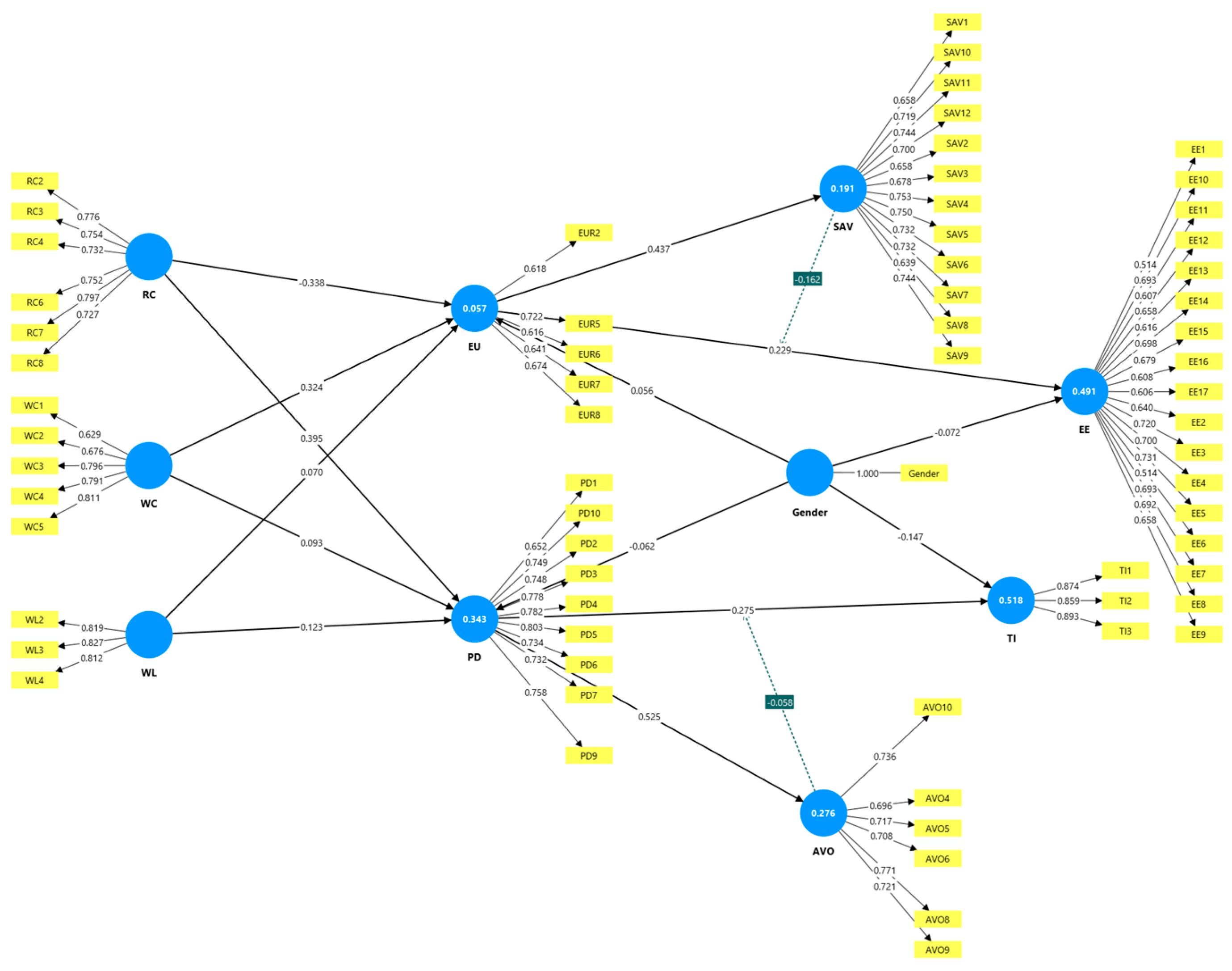
| Measure | Cronbach’s Alpha | Rho_a | Rho_c | AVE |
|---|---|---|---|---|
| Role Conflict (RC) | 0.851 | 0.858 | 0.889 | 0.573 |
| Work Complexity (WC) | 0.797 | 0.817 | 0.860 | 0.554 |
| Workload (WL) | 0.756 | 0.757 | 0.860 | 0.672 |
| Eustress (EU) | 0.667 | 0.667 | 0.789 | 0.429 |
| Savoring (SAV) | 0.910 | 0.912 | 0.924 | 0.504 |
| Psychological Distress (PD) | 0.902 | 0.903 | 0.920 | 0.562 |
| Avoidance Coping (AVO) | 0.819 | 0.821 | 0.869 | 0.526 |
| Employee Engagement (EE) | 0.914 | 0.920 | 0.926 | 0.425 |
| Turnover Intention (TI) | 0.848 | 0.854 | 0.908 | 0.766 |
| Measure | RC | WC | WL | EU | SAV | PD | AVO | EE |
|---|---|---|---|---|---|---|---|---|
| RC | ||||||||
| WC | 0.915 | |||||||
| WL | 0.944 | 0.943 | ||||||
| EU | 0.148 | 0.214 | 0.130 | |||||
| SAV | 0.337 | 0.478 | 0.383 | 0.558 | ||||
| PD | 0.641 | 0.571 | 0.602 | 0.168 | 0.236 | |||
| AVO | 0.896 | 0.846 | 0.847 | 0.131 | 0.395 | 0.609 | ||
| EE | 0.346 | 0.444 | 0.340 | 0.587 | 0.683 | 0.213 | 0.339 | |
| TI | 0.851 | 0.822 | 0.834 | 0.097 | 0.269 | 0.620 | 0.790 | 0.218 |
| Measure | Cronbach’s Alpha | Rho_a | Rho_c | AVE |
|---|---|---|---|---|
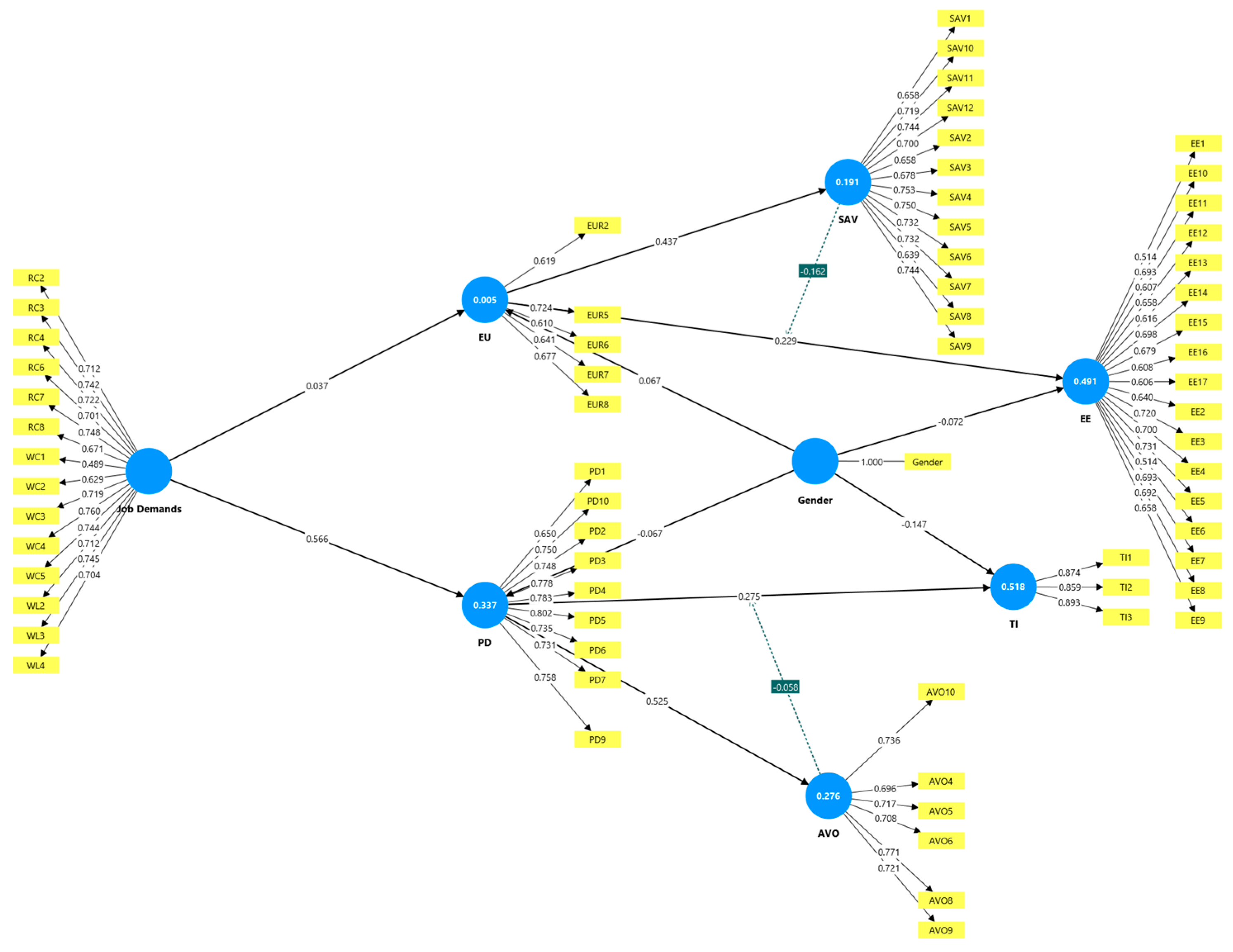
| JD | 0.920 | 0.926 | 0.931 | 0.494 |
| EU | 0.667 | 0.668 | 0.789 | 0.430 |
| SAV | 0.910 | 0.912 | 0.924 | 0.504 |
| PD | 0.902 | 0.904 | 0.920 | 0.562 |
| AVO | 0.819 | 0.821 | 0.869 | 0.526 |
| EE | 0.914 | 0.920 | 0.926 | 0.425 |
| TI | 0.848 | 0.853 | 0.908 | 0.766 |
| Measure | JD | EU | SAV | PD | AVO | EE |
|---|---|---|---|---|---|---|
| JD | ||||||
| EU | 0.171 | |||||
| SAV | 0.406 | 0.558 | ||||
| PD | 0.623 | 0.168 | 0.236 | |||
| AVO | 0.890 | 0.131 | 0.395 | 0.609 | ||
| EE | 0.388 | 0.587 | 0.683 | 0.213 | 0.339 | |
| TI | 0.858 | 0.097 | 0.269 | 0.620 | 0.790 | 0.218 |
| Measure | JD | EU | SAV | PD | AVO | EE | IT |
|---|---|---|---|---|---|---|---|
| JD | 0.703 | ||||||
| EU | 0.025 | 0.655 | |||||
| SAV | 0.354 | 0.437 | 0.71 | ||||
| PD | 0.577 | −0.103 | 0.203 | 0.749 | |||
| AVO | 0.774 | 0.069 | 0.338 | 0.525 | 0.725 | ||
| EE | 0.323 | 0.476 | 0.634 | 0.158 | 0.279 | 0.652 | |
| TI | 0.764 | −0.052 | 0.231 | 0.546 | 0.662 | 0.134 | 0.875 |
| Measure | Mean | SD | Gender | JD | EU | SAV | PD | AVO | EE |
|---|---|---|---|---|---|---|---|---|---|
| Gender | 1.330 | 0.481 | 1 | ||||||
| JD | 3.582 | 0.739 | −0.152 ** | 1 | |||||
| EU | 4.068 | 0.488 | 0.049 | 0.033 | 1 | ||||
| SAV | 5.347 | 0.958 | 0.023 | 0.389 ** | 0.427 ** | 1 | |||
| PD | 2.745 | 0.794 | −0.160 ** | 0.559 ** | −0.084 | 0.219 ** | 1 | ||
| AVO | 3.614 | 0.678 | −0.123 * | 0.818 ** | 0.121 * | 0.471 ** | 0.521 ** | 1 | |
| EE | 5.123 | 0.917 | −0.021 | 0.357 ** | 0.447 ** | 0.623 ** | 0.185 ** | 0.370 ** | 1 |
| TI | 3.278 | 1.093 | −0.234 ** | 0.753 ** | −0.046 | 0.235 ** | 0.520 ** | 0.663 ** | 0.154 ** |
| Model Path | Path Coefficient (β) | T Statistics | p Values | 2.50% | 97.50% |
|---|---|---|---|---|---|
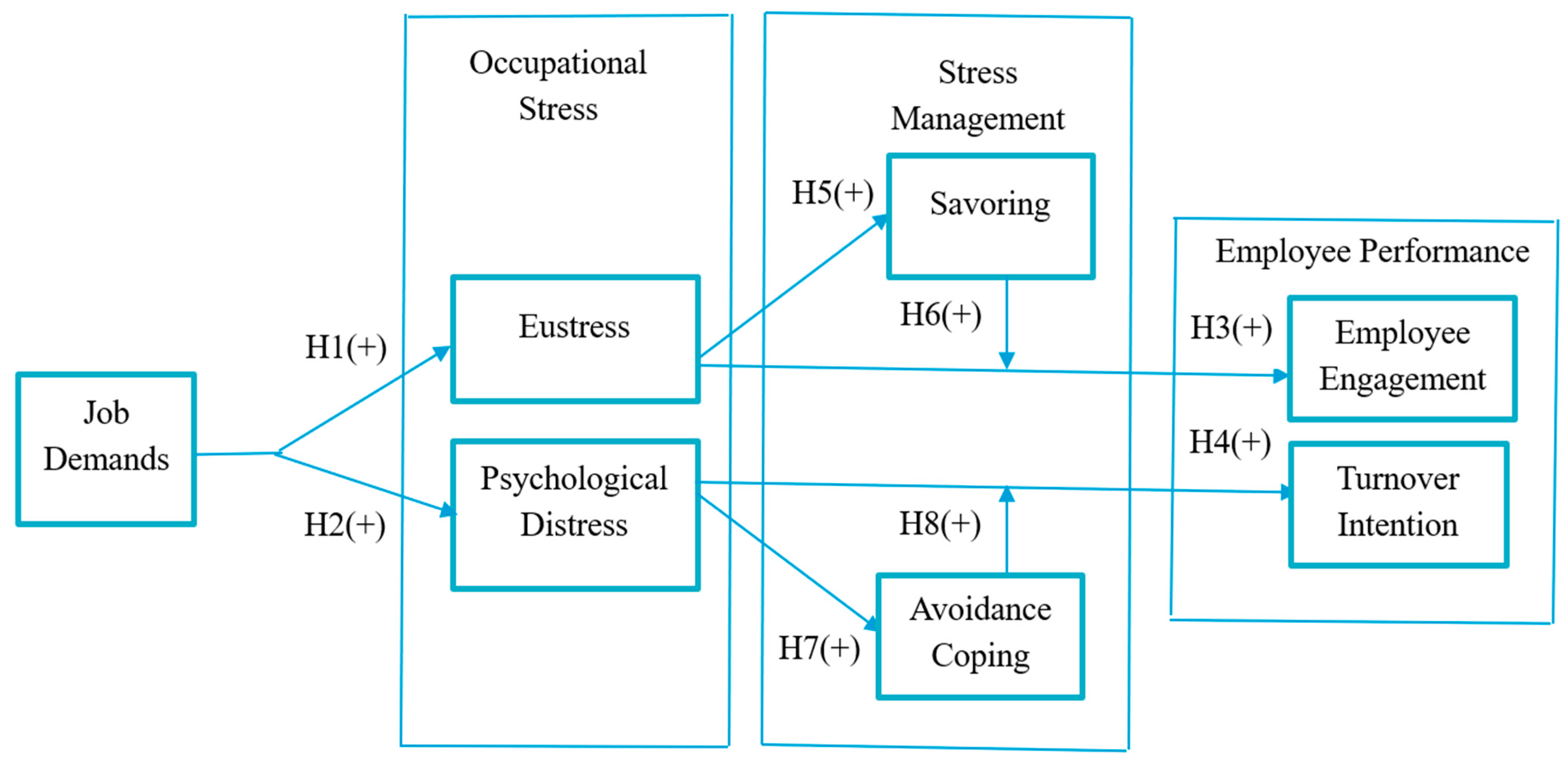
| JD → EU (H1) | 0.037 | 0.530 | 0.596 | −0.077 | 0.208 |
| JD → PD (H2) | 0.566 | 14.032 | 0.000 ** | 0.483 | 0.644 |
| EU → EE (H3) | 0.229 | 4.181 | 0.000 ** | 0.105 | 0.335 |
| PD → IT (H4) | 0.275 | 5.918 | 0.000 ** | 0.162 | 0.353 |
| EU → SAV (H5) | 0.437 | 6.961 | 0.000 ** | 0.321 | 0.562 |
| SAV × EU → EE (H6) | −0.162 | 2.932 | 0.003 ** | −0.230 | −0.018 |
| PD → AVO (H7) | 0.525 | 12.457 | 0.000 ** | 0.459 | 0.626 |
| AVO × PD → TI (H8) | −0.058 | 1.931 | 0.054 * | −0.120 | −0.012 |
| Model Path | Path Coefficient (β) | T Statistics | p Values | 2.50% | 97.50% |
|---|---|---|---|---|---|
| Gender → EE | −0.072 | 1.911 | 0.056 | −0.139 | 0.009 |
| Gender → EU | 0.067 | 1.268 | 0.205 | −0.038 | 0.173 |
| Gender → TI | −0.147 | 3.907 | 0.000 ** | −0.206 | −0.057 |
| Gender → PD | −0.067 | 1.916 | 0.055 | −0.141 | −0.004 |
| Model Path | Path Coefficient (β) | T Statistics | p Values | 95.0% (CI) Lower Bound | 95.0% (CI) Upper Bound |
|---|---|---|---|---|---|
| Low SAV × EU = EE | −0.187 | −3.871 | 0.000 | −0.359 | −0.117 |
| High SAV × EU = EE | −0.190 | −3.871 | 0.000 | −0.359 | −0.117 |
| Low AVO × PD = TI | −0.131 | −2.248 | 0.025 | −0.285 | −0.019 |
| High AVO × PD = TI | −0.098 | −2.248 | 0.025 | −0.285 | −0.019 |
Disclaimer/Publisher’s Note: The statements, opinions and data contained in all publications are solely those of the individual author(s) and contributor(s) and not of MDPI and/or the editor(s). MDPI and/or the editor(s) disclaim responsibility for any injury to people or property resulting from any ideas, methods, instructions or products referred to in the content. |
© 2026 by the authors. Licensee MDPI, Basel, Switzerland. This article is an open access article distributed under the terms and conditions of the Creative Commons Attribution (CC BY) license.
Share and Cite
Moyo, N.; Bhappu, A.D. The Effects of Occupational Stress and Stress Management on the Performance of Frontline Healthcare Service Workers. Healthcare 2026, 14, 1582. https://doi.org/10.3390/healthcare14111582
Moyo N, Bhappu AD. The Effects of Occupational Stress and Stress Management on the Performance of Frontline Healthcare Service Workers. Healthcare. 2026; 14(11):1582. https://doi.org/10.3390/healthcare14111582
Chicago/Turabian StyleMoyo, Ngqabutho, and Anita D. Bhappu. 2026. "The Effects of Occupational Stress and Stress Management on the Performance of Frontline Healthcare Service Workers" Healthcare 14, no. 11: 1582. https://doi.org/10.3390/healthcare14111582
APA StyleMoyo, N., & Bhappu, A. D. (2026). The Effects of Occupational Stress and Stress Management on the Performance of Frontline Healthcare Service Workers. Healthcare, 14(11), 1582. https://doi.org/10.3390/healthcare14111582