Physical Activity Modifies the Association Between Atherogenic Index of Plasma and New-Onset Diabetes in Middle-Aged and Older Adults

Highlights
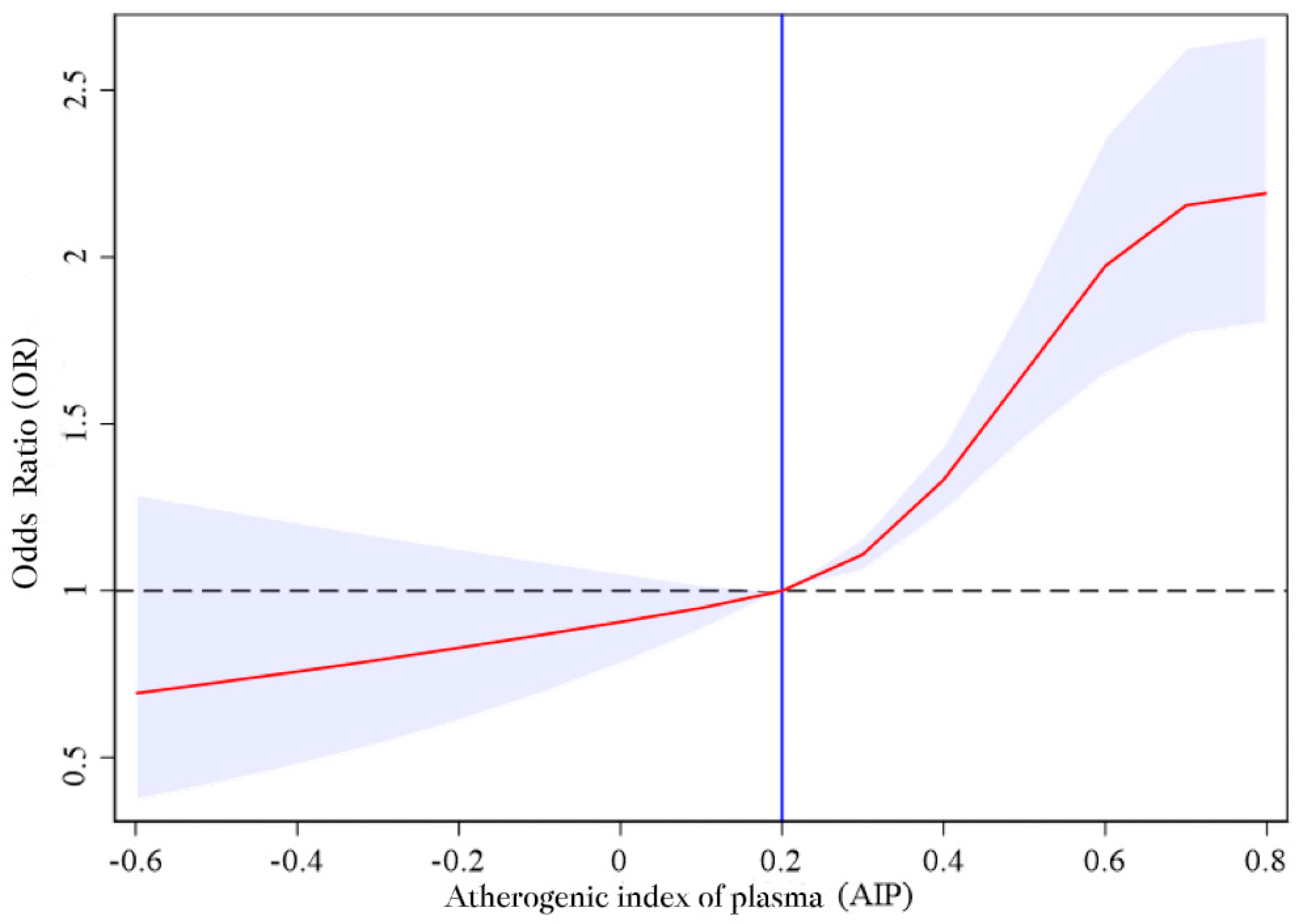
- Elevated atherogenic index of plasma (AIP) is linearly associated with a higher risk of new-onset diabetes.
- The risk of diabetes increases 2.27-fold per one-standard-deviation increase in AIP.
- Regular physical activity significantly attenuates the positive association between AIP and diabetes risk.
- The AIP–diabetes link remains potent in non-exercisers but loses significance in regular exercisers.
Abstract
1. Introduction
2. Methods
2.1. Study Participants
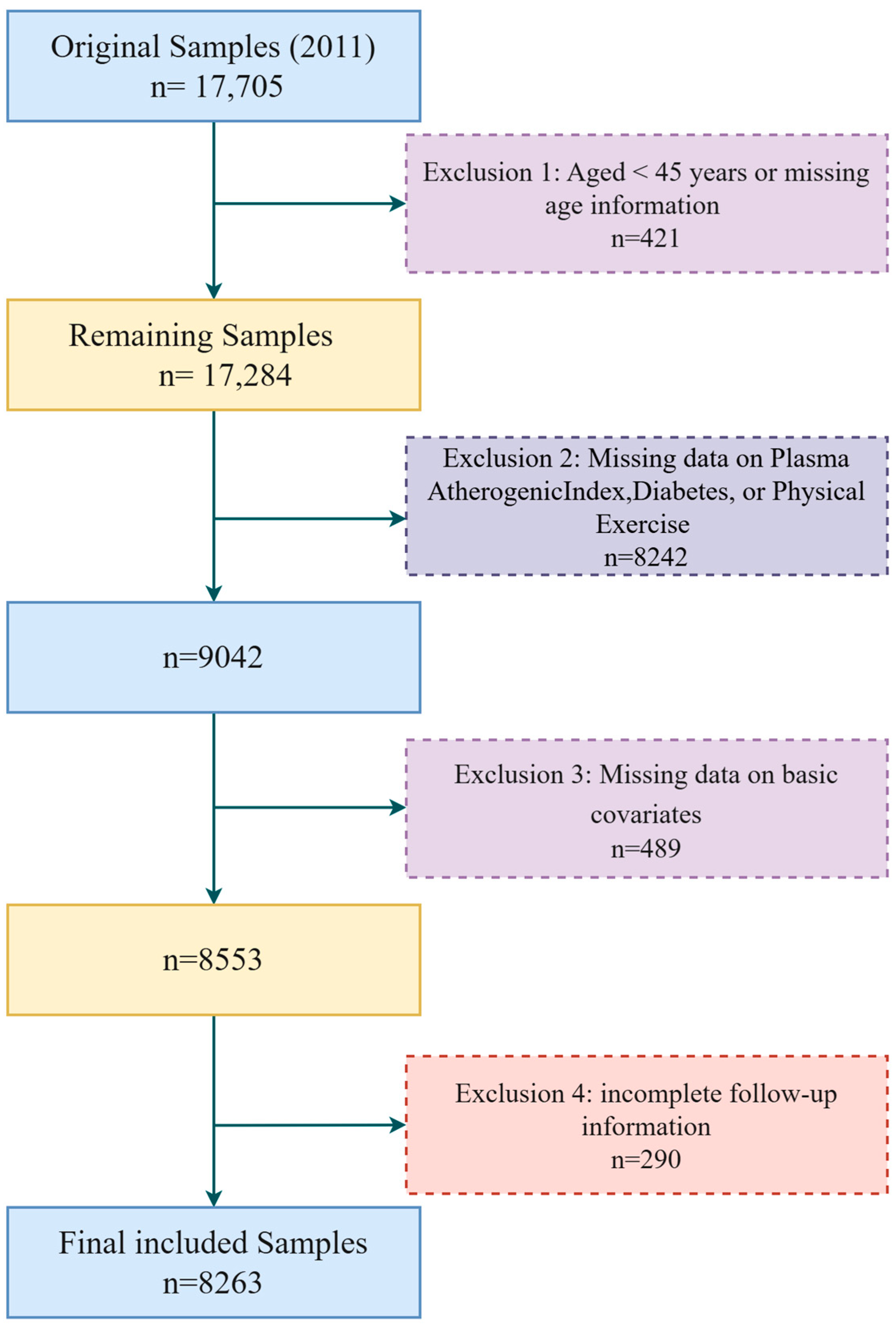
- (1)
- Exclusion of participants aged <45 years or with missing age information (n = 421);
- (2)
- Exclusion due to missing data on Atherogenic index of plasma, Diabetes, or Physical Exercise (n = 8242);
- (3)
- Exclusion due to missing data on basic covariates (n = 489);
- (4)
- Exclusion due to incomplete follow-up information (n = 290).
2.2. Assessment of Exposures and Outcomes
2.3. Selection of Potential Covariables
2.4. Statistical Analyses
3. Results
3.1. Baseline Characteristics of Participants
3.2. The Relationship Between Atherogenic Index of Plasma and New-Onset Diabetes in Middle-Aged and Older Adults
3.3. Subgroup Analysis of Physical Exercise
3.4. Sensitivity Analysis
3.5. Dose–Response
4. Discussion
5. Advantages and Limitations
6. Conclusions
Author Contributions
Funding
Institutional Review Board Statement
Informed Consent Statement
Data Availability Statement
Acknowledgments
Conflicts of Interest
Abbreviations
| CHARLS | China Health and Retirement Longitudinal Study |
| PA | physical activity |
| AIP | atherogenic index of plasma |
| RCS | Restricted cubic splines |
| HDL-C | high-density lipoprotein cholesterol |
| TG | triglycerides |
| FFAs | free fatty acids |
| AMPK | AMP-activated protein kinase |
| GLUT4 | glucose transporter 4 |
| FPG | Fasting Plasma Glucose |
References
- Saeedi, P.; Petersohn, I.; Salpea, P.; Malanda, B.; Karuranga, S.; Unwin, N.; Colagiuri, S.; Guariguata, L.; Motala, A.A.; Ogurtsova, K.; et al. Global and regional diabetes prevalence estimates for 2019 and projections for 2030 and 2045: Results from the International Diabetes Federation Diabetes Atlas, 9(th) edition. Diabetes Res. Clin. Pract. 2019, 157, 107843. [Google Scholar] [CrossRef]
- Zhang, Y.; Wang, D.D. Gut microbiome in type 2 diabetes: Insights from metagenomics, multi-omics, and diet-microbe interactions. Gut Microbes 2026, 18, 2644682. [Google Scholar] [CrossRef]
- Ogle, G.D.; Wang, F.; Haynes, A.; Gregory, G.A.; King, T.W.; Deng, K.; Dabelea, D.; James, S.; Jenkins, A.J.; Li, X.; et al. Global type 1 diabetes prevalence, incidence, and mortality estimates 2025: Results from the International diabetes Federation Atlas, 11th Edition, and the T1D Index Version 3.0. Diabetes Res. Clin. Pract. 2025, 225, 112277. [Google Scholar] [CrossRef]
- He, X.Y.; Lu, Z.W.; Guo, Y.F.; Zhao, R.C.; Liu, Z. Association between atherogenic index of plasma and new onset of type 2 diabetes among elderly in China: A longitudinal study. Front. Endocrinol. 2025, 16, 1632400. [Google Scholar] [CrossRef]
- Hill, M.J.; Metcalfe, D.; McTernan, P.G. Obesity and diabetes: Lipids, ‘nowhere to run to’. Clin. Sci. 2009, 116, 113–123. [Google Scholar] [CrossRef]
- Dobiásová, M.; Frohlich, J. The plasma parameter log (TG/HDL-C) as an atherogenic index: Correlation with lipoprotein particle size and esterification rate in apoB-lipoprotein-depleted plasma (FER(HDL)). Clin. Biochem. 2001, 34, 583–588. [Google Scholar] [CrossRef] [PubMed]
- Boden, G.; Lebed, B.; Schatz, M.; Homko, C.; Lemieux, S. Effects of acute changes of plasma free fatty acids on intramyocellular fat content and insulin resistance in healthy subjects. Diabetes 2001, 50, 1612–1617. [Google Scholar] [CrossRef]
- Liu, J.; Jahn, L.A.; Fowler, D.E.; Barrett, E.J.; Cao, W.; Liu, Z. Free fatty acids induce insulin resistance in both cardiac and skeletal muscle microvasculature in humans. J. Clin. Endocrinol. Metab. 2011, 96, 438–446. [Google Scholar] [CrossRef] [PubMed]
- Choi, C.S.; Lee, F.N.; Youn, J.H. Free fatty acids induce peripheral insulin resistance without increasing muscle hexosamine pathway product levels in rats. Diabetes 2001, 50, 418–424. [Google Scholar] [CrossRef][Green Version]
- Lam, T.K.; van de Werve, G.; Giacca, A. Free fatty acids increase basal hepatic glucose production and induce hepatic insulin resistance at different sites. Am. J. Physiol.-Endocrinol. Metab. 2003, 284, E281–E290. [Google Scholar] [CrossRef] [PubMed]
- Bhatti, J.S.; Sehrawat, A.; Mishra, J.; Sidhu, I.S.; Navik, U.; Khullar, N.; Kumar, S.; Bhatti, G.K.; Reddy, P.H. Oxidative stress in the pathophysiology of type 2 diabetes and related complications: Current therapeutics strategies and future perspectives. Free Radic. Biol. Med. 2022, 184, 114–134. [Google Scholar] [CrossRef]
- Di Bartolo, B.A.; Cartland, S.P.; Genner, S.; Manuneedhi, C.P.; Vellozzi, M.; Rye, K.A.; Kavurma, M.M. HDL Improves Cholesterol and Glucose Homeostasis and Reduces Atherosclerosis in Diabetes-Associated Atherosclerosis. J. Diabetes Res. 2021, 2021, 6668506. [Google Scholar] [CrossRef]
- Manell, H.; Kristinsson, H.; Kullberg, J.; Ubhayasekera, S.; Mörwald, K.; Staaf, J.; Cadamuro, J.; Zsoldos, F.; Göpel, S.; Sargsyan, E.; et al. Hyperglucagonemia in youth is associated with high plasma free fatty acids, visceral adiposity, and impaired glucose tolerance. Pediatr. Diabetes 2019, 20, 880–891. [Google Scholar] [CrossRef]
- Ried-Larsen, M.; Johansen, M.Y.; MacDonald, C.S.; Hansen, K.B.; Christensen, R.; Wedell-Neergaard, A.S.; Pilmark, N.S.; Langberg, H.; Vaag, A.A.; Pedersen, B.K.; et al. Type 2 diabetes remission 1 year after an intensive lifestyle intervention: A secondary analysis of a randomized clinical trial. Diabetes Obes. Metab. 2019, 21, 2257–2266. [Google Scholar] [CrossRef]
- Heiskanen, M.A.; Motiani, K.K.; Mari, A.; Saunavaara, V.; Eskelinen, J.J.; Virtanen, K.A.; Koivumäki, M.; Löyttyniemi, E.; Nuutila, P.; Kalliokoski, K.K.; et al. Exercise training decreases pancreatic fat content and improves beta cell function regardless of baseline glucose tolerance: A randomised controlled trial. Diabetologia 2018, 61, 1817–1828. [Google Scholar] [CrossRef] [PubMed]
- Kirwan, J.P.; Solomon, T.P.; Wojta, D.M.; Staten, M.A.; Holloszy, J.O. Effects of 7 days of exercise training on insulin sensitivity and responsiveness in type 2 diabetes mellitus. Am. J. Physiol.-Endocrinol. Metab. 2009, 297, E151–E156. [Google Scholar] [CrossRef] [PubMed]
- Magalhães, J.P.; Melo, X.; Correia, I.R.; Ribeiro, R.T.; Raposo, J.; Dores, H.; Bicho, M.; Sardinha, L.B. Effects of combined training with different intensities on vascular health in patients with type 2 diabetes: A 1-year randomized controlled trial. Cardiovasc. Diabetol. 2019, 18, 34. [Google Scholar] [CrossRef] [PubMed]
- Motiani, K.K.; Collado, M.C.; Eskelinen, J.J.; Virtanen, K.A.; Löyttyniemi, E.; Salminen, S.; Nuutila, P.; Kalliokoski, K.K.; Hannukainen, J.C. Exercise Training Modulates Gut Microbiota Profile and Improves Endotoxemia. Med. Sci. Sports Exerc. 2020, 52, 94–104. [Google Scholar] [CrossRef]
- Yu, Y.; Zhu, G.; Zhang, Z.; Wang, H.; Zeng, L.; Xia, J.; Liu, X.; Fang, C.; Liu, S.; Yang, Y.; et al. Exercise ameliorates nonalcoholic fatty liver disease by reducing the IGFBP5 to IGF1 ratio to activate AMPK pathway. Sci. Rep. 2025, 15, 23083. [Google Scholar] [CrossRef]
- Diniz, T.A.; de Lima, J.E.; Teixeira, A.A.; Biondo, L.A.; Da, R.L.; Valadão, I.C.; Silveira, L.S.; Cabral-Santos, C.; de Souza, C.O.; Rosa, N.J. Aerobic training improves NAFLD markers and insulin resistance through AMPK-PPAR-α signaling in obese mice. Life Sci. 2021, 266, 118868. [Google Scholar] [CrossRef]
- Niu, Y.; Hu, S.; Zhang, Y.; Yang, J.; Zhang, J.; He, R.; Chen, L.; Xu, L.; Zhao, H.; Gan, B.; et al. Lactate-activated GPR81/FARP1 signaling drives insulin-independent glucose uptake and metabolic control. Cell Res. 2026, 36, 137–151. [Google Scholar] [CrossRef]
- Pengyu, F.; Huiyun, X.; Lijing, G. HMGB1: A key molecule linking chronic inflammation to complications in type 2 diabetes mellitus and a target for exercise intervention. Front. Endocrinol. 2026, 17, 1769497. [Google Scholar] [CrossRef]
- Ahmad, T.; Chasman, D.I.; Buring, J.E.; Lee, I.M.; Ridker, P.M.; Everett, B.M. Physical activity modifies the effect of LPL, LIPC, and CETP polymorphisms on HDL-C levels and the risk of myocardial infarction in women of European ancestry. Circ. Cardiovasc. Genet. 2011, 4, 74–80. [Google Scholar] [CrossRef] [PubMed]
- Kim, K.H.; Sami, M.; Wilson, K.S.; Fisher, K.L. Physical activity as a moderator of the association between central obesity and Type 2 diabetes in Asian American older adults. Obes. Pillars 2025, 16, 100224. [Google Scholar] [CrossRef]
- Gyasi, R.M.; Adjakloe, Y.; Siaw, L.P.; James, P.B.; Amoah, P.A.; Abass, K.; Adu-Gyamfi, S.; Phillips, D.R. The effect-modification of physical activity on the association of pain with impaired physical function in aging adults. Exp. Gerontol. 2022, 163, 111791. [Google Scholar] [CrossRef]
- Zhao, Y.; Hu, Y.; Smith, J.P.; Strauss, J.; Yang, G. Cohort profile: The China Health and Retirement Longitudinal Study (CHARLS). Int. J. Epidemiol. 2014, 43, 61–68. [Google Scholar] [CrossRef]
- American Diabetes Association Professional Practice Committee. 2. Classification and Diagnosis of Diabetes: Standards of Medical Care in Diabetes-2022. Diabetes Care 2022, 45, S17–S38. [Google Scholar] [CrossRef] [PubMed]
- Lamprou, S.; Evangelidis, N.; Koletsos, N.; Zografou, I.; Stoimeni, A.; Mintziori, G.; Gkolias, V.; Trakatelli, C.M.; Savopoulos, C.; Doumas, M.; et al. Microvascular Dysfunction in Patients with Prediabetes: Novel Methods Identify Impaired Microcirculation. Life 2026, 16, 326. [Google Scholar] [CrossRef] [PubMed]
- Shi, Y.; Wen, M. Sex-specific differences in the effect of the atherogenic index of plasma on prediabetes and diabetes in the NHANES 2011–2018 population. Cardiovasc. Diabetol. 2023, 22, 19. [Google Scholar] [CrossRef]
- Yin, B.; Wu, Z.; Xia, Y.; Xiao, S.; Chen, L.; Li, Y. Non-linear association of atherogenic index of plasma with insulin resistance and type 2 diabetes: A cross-sectional study. Cardiovasc. Diabetol. 2023, 22, 157. [Google Scholar] [CrossRef]
- Zheng, X.; Zhang, X.; Han, Y.; Hu, H.; Cao, C. Nonlinear relationship between atherogenic index of plasma and the risk of prediabetes: A retrospective study based on Chinese adults. Cardiovasc. Diabetol. 2023, 22, 205. [Google Scholar] [CrossRef]
- Li, Y.; Gu, R.; Chen, L.; Zhao, Q.; Wang, Y. Cumulative atherosclerosis index of plasma exposure and new-onset diabetes in middle-aged and older adults: A prospective cohort analysis from the China Health and Retirement Longitudinal Study. Front. Nutr. 2025, 12, 1653764. [Google Scholar] [CrossRef]
- Yang, S.; Gou, X.; Dong, H.; Chen, L.; Wang, Y.; Wu, J. Physical activity modifies the association between atherogenic index of plasma and prediabetes and diabetes: A cross-sectional analysis. J. Diabetes 2024, 16, e70006. [Google Scholar] [CrossRef]
- Kim, S.H. Reframing prediabetes: A call for better risk stratification and intervention. J. Intern. Med. 2024, 295, 735–747. [Google Scholar] [CrossRef]
- Niroumand, S.; Khajedaluee, M.; Khadem-Rezaiyan, M.; Abrishami, M.; Juya, M.; Khodaee, G.; Dadgarmoghaddam, M. Atherogenic Index of Plasma (AIP): A marker of cardiovascular disease. Med. J. Islam. Repub. Iran 2015, 29, 240. [Google Scholar]
- Chen, J.; Fei, S.; Chan, L.; Gan, X.; Shao, B.; Jiang, H.; Li, S.; Kuang, P.; Liu, X.; Yang, S. Inflammatory signaling pathways in pancreatic β-cell: New insights into type 2 diabetes pathogenesis. Pharmacol. Res. 2025, 216, 107776. [Google Scholar] [CrossRef]
- Eguchi, N.; Vaziri, N.D.; Dafoe, D.C.; Ichii, H. The Role of Oxidative Stress in Pancreatic β Cell Dysfunction in Diabetes. Int. J. Mol. Sci. 2021, 22, 1509. [Google Scholar] [CrossRef] [PubMed]
- Gursky, O. Structural stability and functional remodeling of high-density lipoproteins. Febs Lett. 2015, 589, 2627–2639. [Google Scholar] [CrossRef] [PubMed]
- Ouyang, F.W.; Chiang, H.H.; Hsu, W.L.; Tsai, M.H.; Huang, C.Y.; Remaley, A.T.; Akyol, O.; Chen, C.H. Dysfunctional high-density lipoprotein: An updated review. Front. Cardiovasc. Med. 2025, 12, 1713387. [Google Scholar] [CrossRef] [PubMed]
- Fridberg, H.; Wiklund, M.; Snellman, F.; Rosendahl, E.; Hedlund, M.; Boraxbekk, C.J.; Lindelöf, N. Negotiating a physically active life in tune with ageing: A grounded theory study of older persons’ experiences of participating in high-intensity interval training. BMC Geriatr. 2025, 25, 11. [Google Scholar] [CrossRef]
- Friedrichsen, M.; Mortensen, B.; Pehmøller, C.; Birk, J.B.; Wojtaszewski, J.F. Exercise-induced AMPK activity in skeletal muscle: Role in glucose uptake and insulin sensitivity. Mol. Cell. Endocrinol. 2013, 366, 204–214. [Google Scholar] [CrossRef]
- Mingzheng, X.; You, W. AMPK/mTOR balance during exercise: Implications for insulin resistance in aging muscle. Mol. Cell. Biochem. 2025, 480, 5941–5953. [Google Scholar] [CrossRef]
- Franczyk, B.; Gluba-Brzózka, A.; Ciałkowska-Rysz, A.; Ławiński, J.; Rysz, J. The Impact of Aerobic Exercise on HDL Quantity and Quality: A Narrative Review. Int. J. Mol. Sci. 2023, 24, 4653. [Google Scholar] [CrossRef]
- Wang, X.; Huang, C.; Liu, Y.; Han, Y.; Hu, H. Association of estimated glomerular filtration rate and incident pre-diabetes: A secondary 5-year longitudinal cohort study in Chinese people. Front. Endocrinol. 2022, 13, 965545. [Google Scholar] [CrossRef] [PubMed]
- Venojärvi, M.; Korkmaz, A.; Wasenius, N.; Manderoos, S.; Heinonen, O.J.; Lindholm, H.; Aunola, S.; Eriksson, J.G.; Atalay, M. 12 weeks’ aerobic and resistance training without dietary intervention did not influence oxidative stress but aerobic training decreased atherogenic index in middle-aged men with impaired glucose regulation. Food Chem. Toxicol. 2013, 61, 127–135. [Google Scholar] [CrossRef] [PubMed]
- Shen, S.; Qi, H.; He, X.; Lu, Y.; Yang, C.; Li, F.; Wang, L.; Qiang, D.; Shui, K.; Zhou, L.; et al. Aerobic Exercise for a Duration of 90 min or Longer Per Week may Reduce the Atherogenic Index of Plasma. Sci. Rep. 2018, 8, 1730. [Google Scholar] [CrossRef]
- Colberg, S.R.; Sigal, R.J.; Yardley, J.E.; Riddell, M.C.; Dunstan, D.W.; Dempsey, P.C.; Horton, E.S.; Castorino, K.; Tate, D.F. Physical Activity/Exercise and Diabetes: A Position Statement of the American Diabetes Association. Diabetes Care 2016, 39, 2065–2079. [Google Scholar] [CrossRef] [PubMed]
- Jung, U.J.; Choi, M.S. Obesity and its metabolic complications: The role of adipokines and the relationship between obesity, inflammation, insulin resistance, dyslipidemia and nonalcoholic fatty liver disease. Int. J. Mol. Sci. 2014, 15, 6184–6223. [Google Scholar] [CrossRef]



| Variable Type | Variable Name | Variable Description |
|---|---|---|
| Core Variables | New-Onset Diabetes | New-onset diabetes = 1, no new-onset diabetes = 0 |
| Core variable | Physical Activity | Participation = 1, Non-participation = 0 |
| Core Exposure | Atherogenic index of plasma | Logarithm of the triglyceride-to-HDL cholesterol ratio |
| Socio-demographic covariates | Age | 45–59 years = 1, 60–74 years = 2, 75 years and older = 3 |
| Gender | Male = 1, Female = 0 | |
| Marital Status | Married = 1, Unmarried/Divorced/Widowed, etc. = 0 | |
| Education Level | Elementary school or below = 1, Middle school = 2, High school or above = 3 | |
| Household Registration Status | Non-agricultural household registration = 1, Agricultural household registration = 0 | |
| Health Behavior Covariates | Smoking | Smoker = 1, Non-smoker = 0 |
| Alcohol consumption | Alcohol consumption = 1, No alcohol consumption = 0 | |
| Sleep Duration | Less than 6 h/day = 1, 6–8 h/day = 2, More than 8 h/day = 3 | |
| History of chronic diseases Covariates | Hypertension | Present = 1, Absent = 0 |
| Dyslipidemia | Present = 1, Absent = 0 | |
| Chronic lung disease | Yes = 1, No = 0 | |
| Chronic kidney disease | Yes = 1, No = 0 | |
| Heart disease | Yes = 1, No = 0 | |
| Asthma | Yes = 1, No = 0 |
| Variable | No Diabetes (n = 7546) | New-Onset Diabetes (n = 717) | X2 | p |
|---|---|---|---|---|
| AIP | 0.32 (0.13, 0.54) | 0.45 (0.24, 0.67) | <0.001 | |
| Age group, n (%) | 0.014 | |||
| 45–59 years | 4099 (54.32) | 407 (56.76) | ||
| 60–74 years | 2880 (38.17) | 282 (39.33) | ||
| ≥75 years | 567 (7.51) | 28 (3.91) | ||
| Sex, n (%) | 2.398 | 0.122 | ||
| Female | 4003 (53.05) | 402 (56.07) | ||
| Male | 3543 (46.95) | 315 (43.93) | ||
| Marital status, n (%) | 2.755 | 0.097 | ||
| Married | 6618 (87.70) | 644 (89.82) | ||
| Others | 928 (12.30) | 73 (10.18) | ||
| Education, n (%) | 0.211 | 0.857 | ||
| ≤Primary | 5283 (70.01) | 502 (70.01) | ||
| Middle school | 1523 (20.18) | 148 (20.64) | ||
| ≥High school | 740 (9.81) | 67 (9.34) | ||
| Residence, n (%) | 0.454 | 0.500 | ||
| Agricultural | 6315 (83.69) | 607 (84.66) | ||
| Non-agricultural | 1231 (16.31) | 110 (15.34) | ||
| Smoking, n (%) | 8.182 | 0.004 | ||
| No | 4545 (60.23) | 471 (65.69) | ||
| Yes | 3001 (39.77) | 246 (34.31) | ||
| Alcohol, n (%) | 1.841 | 0.175 | ||
| No | 5064 (67.11) | 499 (69.60) | ||
| Yes | 2482 (32.89) | 218 (30.40) | ||
| Sleep duration, n (%) | 1.825 | 0.401 | ||
| <6 h | 2231 (29.57) | 229 (31.94) | ||
| 6–8 h | 4682 (62.05) | 428 (59.69) | ||
| >8 h | 633 (8.39) | 60 (8.37) | ||
| Hypertension, n (%) | 53.441 | <0.001 | ||
| No | 5877 (77.88) | 472 (65.83) | ||
| Yes | 1669 (22.12) | 245 (34.17) | ||
| Dyslipidemia, n (%) | 7.367 | 0.007 | ||
| No | 6972 (92.39) | 642 (89.54) | ||
| Yes | 574 (7.61) | 75 (10.46) | ||
| Chronic lung disease, n (%) | 0.311 | 0.577 | ||
| No | 6775 (89.78) | 639 (89.12) | ||
| Yes | 771 (10.22) | 78 (10.88) | ||
| Chronic kidney disease, n (%) | 0.242 | 0.623 | ||
| No | 7076 (93.77) | 669 (93.31) | ||
| Yes | 470 (6.23) | 48 (6.69) | ||
| Heart disease, n (%) | 2.363 | 0.124 | ||
| No | 6730 (89.19) | 626 (87.31) | ||
| Yes | 816 (10.81) | 91 (12.69) | ||
| Asthma, n (%) | 0.027 | 0.869 | ||
| No | 7271 (96.36) | 690 (96.23) | ||
| Yes | 275 (3.64) | 27 (3.77) | ||
| Physical activity, n (%) | 0.523 | 0.470 | ||
| No | 4807 (63.70) | 447 (62.34) | ||
| Yes | 2739 (36.30) | 270 (37.66) | ||
| High-intensity PA, n (%) | 0.036 | 0.849 | ||
| No | 6421 (85.09) | 612 (85.36) | ||
| Yes | 1125 (14.91) | 105 (14.64) | ||
| Moderate-intensity PA, n (%) | 2.038 | 0.154 | ||
| No | 5788 (76.70) | 533 (74.34) | ||
| Yes | 1758 (23.30) | 184 (25.66) | ||
| Low-intensity PA, n (%) | 0.181 | 0.670 | ||
| No | 5100 (67.59) | 479 (66.81) | ||
| Yes | 2446 (32.41) | 238 (33.19) |
| Variable | Model 1 OR (95% CI) | Model 2 OR (95% CI) | Model 3 OR (95% CI) | Model 4 OR (95% CI) |
|---|---|---|---|---|
| Per SD | 2.521 (2.024–3.141) | 2.487 (1.993–3.102) | 2.511 (2.012–3.133) | 2.266 (1.807–2.843) |
| Quartiles | ||||
| Q1 (ref.) | 1 | 1 | 1 | 1 |
| Q2 | 1.343 (1.044–1.729) | 1.333 (1.035–1.716) | 1.336 (1.037–1.720) | 1.312 (1.018–1.691) |
| Q3 | 1.740 (1.367–2.216) | 1.725 (1.354–2.197) | 1.725 (1.353–2.198) | 1.629 (1.276–2.080) |
| Q4 | 2.555 (2.032–3.214) | 2.526 (2.007–3.180) | 2.541 (2.018–3.200) | 2.325 (1.840–2.937) |
| p for trend | <0.001 | <0.001 | <0.001 | <0.001 |
| Variable | Group | OR (95% CI) | p-Value for Interaction |
|---|---|---|---|
| Physical Activity | |||
| No-participation | 2.735 (2.087–3.582) | <0.001 | |
| Participated | 1.471 (0.962–2.247) | ||
| High-intensity | |||
| No-participation | 2.343 (1.841–2.983) | 0.142 | |
| Participated | 2.045 (1.042–4.013) | ||
| Moderate-intensity | |||
| No-participation | 2.457 (1.908–3.164) | 0.089 | |
| Participated | 1.740 (1.033–2.926) | ||
| Low-intensity | |||
| No-participation | 2.618 (2.010–3.409) | 0.045 | |
| Participated | 1.557 (0.994–2.437) |
| Variable | Total N | Diabetes Samples (%) | OR | 95% CI |
|---|---|---|---|---|
| Per SD | 7617 | 642 (8.43) | 2.259 | 1.776–2.873 |
| Quantiles | ||||
| Q1 | 1969 | 107 (5.43) | Ref | Ref |
| Q2 | 1946 | 139 (7.14) | 1.302 | 1.002–1.691 |
| Q3 | 1893 | 168 (8.87) | 1.588 | 1.233–2.046 |
| Q4 | 1806 | 228 (12.62) | 2.307 | 1.810–2.942 |
| p for trend | <0.001 | <0.001 | ||
Disclaimer/Publisher’s Note: The statements, opinions and data contained in all publications are solely those of the individual author(s) and contributor(s) and not of MDPI and/or the editor(s). MDPI and/or the editor(s) disclaim responsibility for any injury to people or property resulting from any ideas, methods, instructions or products referred to in the content. |
© 2026 by the authors. Licensee MDPI, Basel, Switzerland. This article is an open access article distributed under the terms and conditions of the Creative Commons Attribution (CC BY) license.
Share and Cite
Song, Y.; Lan, J.; Ke, Y.; Tang, L. Physical Activity Modifies the Association Between Atherogenic Index of Plasma and New-Onset Diabetes in Middle-Aged and Older Adults. Healthcare 2026, 14, 1529. https://doi.org/10.3390/healthcare14111529
Song Y, Lan J, Ke Y, Tang L. Physical Activity Modifies the Association Between Atherogenic Index of Plasma and New-Onset Diabetes in Middle-Aged and Older Adults. Healthcare. 2026; 14(11):1529. https://doi.org/10.3390/healthcare14111529
Chicago/Turabian StyleSong, Yuhong, Jinyan Lan, Yu Ke, and Lixu Tang. 2026. "Physical Activity Modifies the Association Between Atherogenic Index of Plasma and New-Onset Diabetes in Middle-Aged and Older Adults" Healthcare 14, no. 11: 1529. https://doi.org/10.3390/healthcare14111529
APA StyleSong, Y., Lan, J., Ke, Y., & Tang, L. (2026). Physical Activity Modifies the Association Between Atherogenic Index of Plasma and New-Onset Diabetes in Middle-Aged and Older Adults. Healthcare, 14(11), 1529. https://doi.org/10.3390/healthcare14111529