This is an early access version, the complete PDF, HTML, and XML versions will be available soon.
Article

Nationwide Trends in Hospital-Acquired Pressure Ulcers, 2018–2024

by
Emanuele Sebastiani
1,2,*,
Danilo Catania
3,
Stefano Domenico Cicala
3,
Massimo Maurici
1,
Michele Tancredi Loiudice
2 and
Giovanni Baglio
2
1
Department of Biomedicine and Prevention, University of Rome Tor Vergata, 00133 Rome, Italy
2
Research and International Relations Unit, Italian National Agency for Regional Healthcare Services, 00187 Roma, Italy
3
Simple Operative Unit Statistics and Health Information Flows, Italian National Agency for Regional Healthcare Services, 00187 Rome, Italy
*
Author to whom correspondence should be addressed.
Healthcare 2026, 14(11), 1492; https://doi.org/10.3390/healthcare14111492

Submission received: 19 April 2026 / Revised: 22 May 2026 / Accepted: 26 May 2026 / Published: 27 May 2026
(This article belongs to the Special Issue Health Services, Health Literacy and Nursing Quality)

Abstract

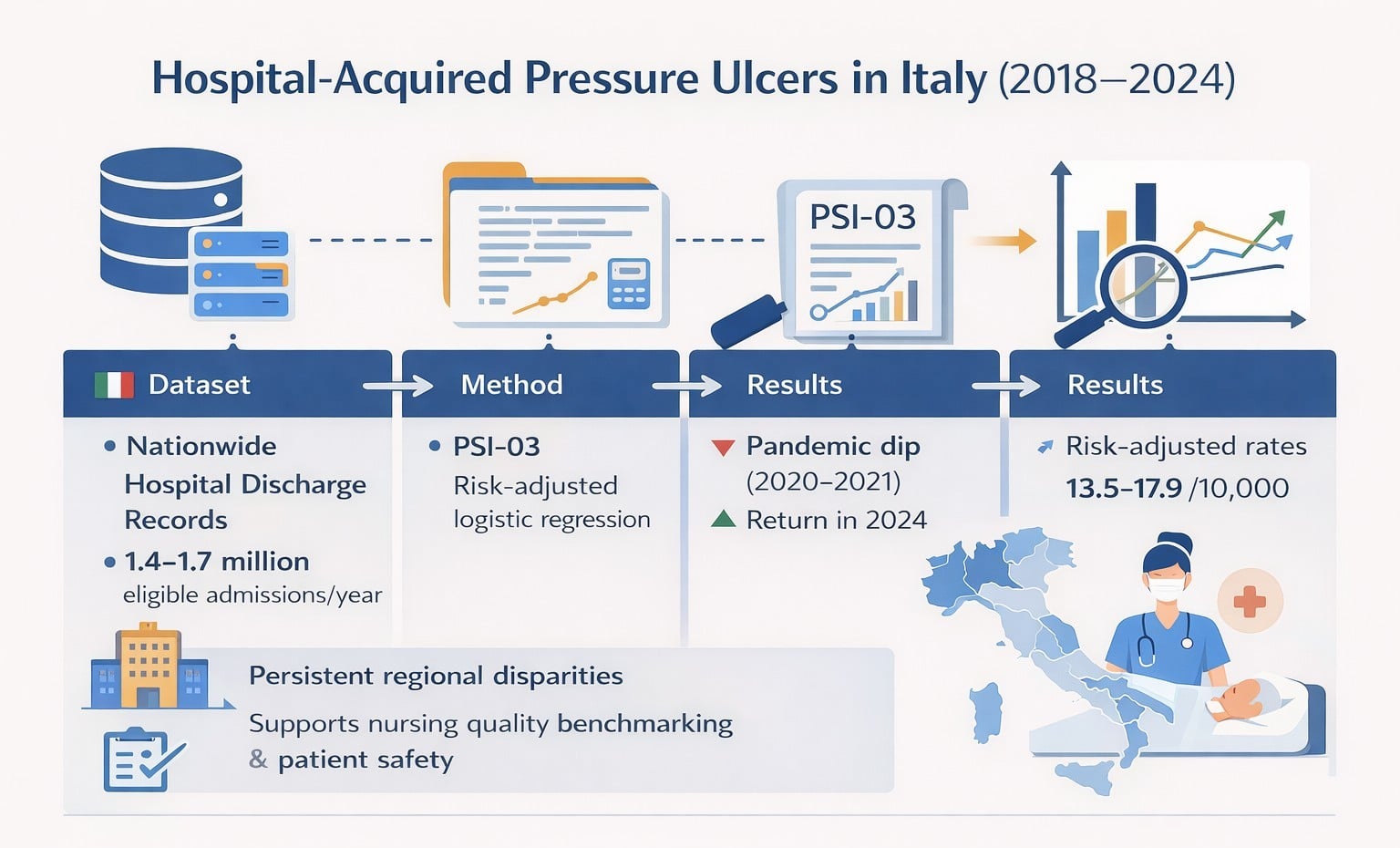
Aim: To estimate national incidence, temporal trends, and regional variability of hospital-acquired pressure ulcers in Italy from 2018 to 2024 using age-adjusted models and regional estimates. Design: Retrospective nationwide observational study using hospital administrative data. Methods: All Italian Hospital Discharge Records (SDOs) for adults aged ≥ 18 years with hospital stays ≥ 5 days between 2018 and 2024 were analysed. Records with pre-existing or principal diagnoses of pressure ulcer and excluded MDC/DRG categories were omitted according to adapted AHRQ PSI 03 specifications. The final dataset represented eligible hospitalizations considered at risk for hospital-acquired pressure ulcers. Crude and age-adjusted rates per 10,000 eligible discharges were estimated using logistic regression models. Results: Eligible discharges declined from approximately 1.7 million in 2018 to 1.4 million in 2020, increasing to 1.5 million in 2024. Within this population, coded hospital-acquired pressure ulcer events decreased from 3657 to 1888, then increased to 2728. Age-adjusted national rates ranged from 13.5 to 21.3 per 10,000 eligible discharges, showing temporal fluctuations during the study period, including a reduction during 2020–2021 followed by a gradual return toward pre-pandemic levels. Substantial regional variability was observed, with lower median annual adjusted rates in regions such as Friuli Venezia Giulia and Toscana and higher values in Lazio and Abruzzo. Conclusions: This nationwide analysis provides an initial descriptive overview of temporal and regional variability in coded hospital-acquired pressure ulcer events identified through an adapted PSI 03-based administrative indicator in Italy. The findings may contribute to future methodological discussion and exploratory development of nursing-sensitive indicators using national administrative healthcare databases. Implications for the profession and/or patient care: The integration of nursing-sensitive administrative indicators into national quality monitoring systems may represent an initial methodological area for future benchmarking activities, indicator validation processes, and descriptive evaluation of preventive care practices using national healthcare administrative databases. Impact (addressing): Problem: limited national evidence on hospital-acquired pressure ulcers and interregional variability in Italy. Main findings: temporal fluctuations in age-adjusted rates and persistent regional heterogeneity in coded pressure ulcer events. Impact: administrative data may represent a preliminary and exploratory source for the study of nursing-sensitive outcomes and patient safety indicators at national level.
Keywords: pressure ulcers; patient safety indicators; nursing-sensitive outcomes; hospital discharge records; quality of care pressure ulcers; patient safety indicators; nursing-sensitive outcomes; hospital discharge records; quality of care
Graphical Abstract