From Stress to Burnout: Exploring the Protective and Predictive Factors for Nurses’ Well-Being

Abstract
1. Introduction
2. Review of the Literature
2.1. Occupational Stress Among Nurses
2.2. Identification and Analysis of Burnout in Nurses
2.3. Self-Efficacy
2.4. Job Satisfaction
3. Hypotheses Development and Research Model
3.1. Occupational Stress and Burnout
3.2. Occupational Stress and Job Satisfaction
3.3. Job Satisfaction and Burnout
3.4. Job Satisfaction as a Mediating Effect
3.5. Self-Efficacy as a Moderating Effect
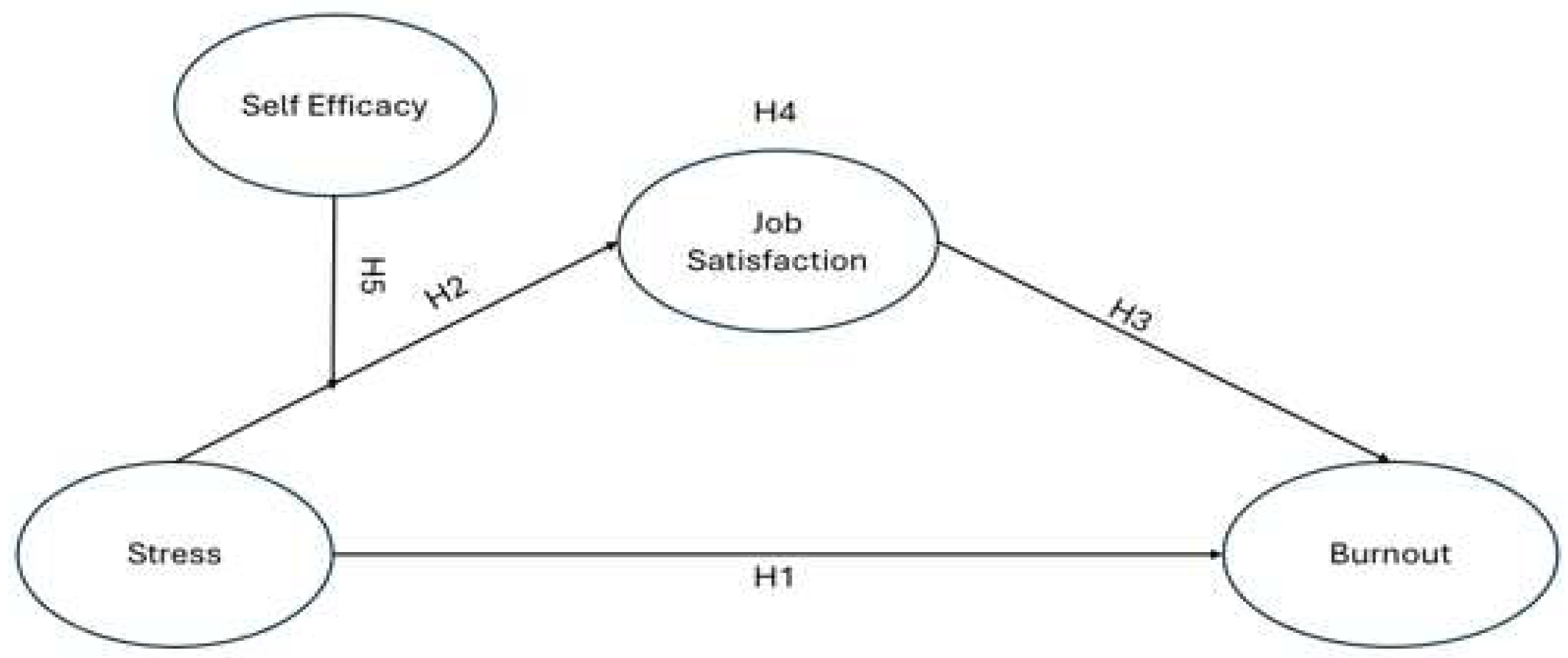
3.6. Research Model
4. Research Methodology
4.1. Sample and Data Collection
4.2. Measures
4.2.1. Perceived Stress Scale (PSS)
4.2.2. General Self-Efficacy Scale
4.2.3. Career Satisfaction Scale
4.2.4. Burnout Inventory (CBI)
4.3. Statistical Analysis
5. Results
5.1. Data Analysis
5.1.1. Descriptive Analytics
5.1.2. Measurement Model
5.1.3. Hypotheses Testing
6. Discussion
6.1. Implications
6.1.1. Theoretical Implications
6.1.2. Practical Implications
6.2. Limitations, Recommendations, and Future Research
6.3. Conclusions
Author Contributions
Funding
Institutional Review Board Statement
Informed Consent Statement
Data Availability Statement
Conflicts of Interest
Abbreviations
| OS | occupational stress |
| BO | burnout |
| SE | self-efficacy |
| JS | job satisfaction |
| CFA | confirmatory factor analysis |
| SEM | structural equation modeling |
| PSS | perceived stress scale |
| GSE | general self-efficacy scale |
| CSS | career satisfaction scale |
| (CBI) | Copenhagen Burnout Inventory |
References
- Maslach, C.; Leiter, M.P. Burnout: The Cost of Caring. J. Occup. Health Psychol. 2016, 21, 223–234. [Google Scholar]
- World Health Organization. Burn-Out an “Occupational Phenomenon”: International Classification of Diseases; WHO: Geneva, Switzerland, 2019. [Google Scholar]
- Aiken, L.H.; Clarke, S.P.; Sloane, D.M.; Sochalski, J.; Silber, J.H. Hospital nurse staffing and patient mortality, nurse burnout, and job dissatisfaction. JAMA 2002, 288, 1987–1993. [Google Scholar] [CrossRef] [PubMed]
- Freudenberger, H.J. Staff burnout. J. Soc. Issues 1974, 30, 159–165. [Google Scholar] [CrossRef]
- Leiter, M.P.; Maslach, C. Areas of worklife: A structured approach to organizational predictors of job burnout. Res. Occup. Stress Well Being 2004, 3, 91–134. [Google Scholar]
- Xie, Z.; Wang, A.; Chen, B. Nurse burnout and job satisfaction: A meta-analysis. Int. J. Nurs. Stud. 2020, 107, 103694. [Google Scholar]
- Shoji, K.; Lesnierowska, M.; Smoktunowicz, E.; Benight, C.C. Associations between job burnout and self-efficacy. Int. J. Stress Manag. 2016, 23, 35–57. [Google Scholar]
- Schwarzer, R.; Hallum, S. Perceived self-efficacy as a protective factor in teachers’ burnout. Appl. Psychol. Int. Rev. 2008, 57, 152–169. [Google Scholar] [CrossRef]
- Lim, H.; Lee, S.; Choi, Y.J. Relationship between self-efficacy, burnout, and job performance among psychiatric nurses during COVID-19 pandemic. Medicina 2022, 58, 171. [Google Scholar] [CrossRef]
- Azemi, S.; Dianat, I.; Abdollahzade, F.; Bazazan, A.; Vahedian-Azimi, A.; Dehnavi, Z.M. Self-efficacy as a mediator between work-related stress and mental health among hospital nurses in Iran. Work 2022, 71, 697–706. [Google Scholar]
- Ibrahim, H.A.; Al-Khathami, A. Work-related stress and burnout among nurses in Saudi public hospitals. J. Nurs. Manag. 2019, 27, 1662–1673. [Google Scholar]
- Judge, T.A.; Thoresen, C.J.; Bono, J.E.; Patton, G.K. The job satisfaction–job performance relationship: A meta-analysis. Psychol. Bull. 2001, 127, 376–407. [Google Scholar] [CrossRef]
- Garman, A.N.; Corrigan, P.W.; Morris, S. Staff burnout and patient satisfaction: Evidence of relationships from a national survey. J. Healthc. Manag. 2002, 47, 198–212. [Google Scholar]
- Aiken, L.H.; Sermeus, W.; Van den Heede, K.; Sloane, D.M. Nurse staffing and education and hospital mortality in nine European countries: A retrospective observational study. Lancet 2012, 383, 1824–1830. [Google Scholar] [CrossRef] [PubMed]
- Estryn-Béhar, M.; Van der Heijden, B.I.; Oginska, H.; Camerino, D.; Le Nezet, O.; Conway, P.M.; Fry, C.; Hasselhorn, H.-M. NEXT Study Group. The impact of social work environment, teamwork characteristics, burnout, and personal factors upon intent to leave among European nurses. Med. Care 2007, 45, 939–950. [Google Scholar] [CrossRef] [PubMed]
- Al Mutair, A.S.; Al Obaid, R.S.; Al Mutairi, N.S. The effect of work-related stress on job satisfaction and burnout among Saudi nurses. Saudi J. Nurs. Health Sci. 2021, 5, 12–20. [Google Scholar]
- AlHadi, A.N.; Almutlaq, M.I.; Almohawes, M.K.; Shadid, A.M.; Alangari, A.A. Prevalence and treatment preference of burnout, depression, and anxiety among mental health professionals in Saudi Arabia. J. Nat. Sci. Med. 2022, 5, 57–64. [Google Scholar] [CrossRef]
- Halabi, J.; Abu-Snieneh, H. Predictors of burnout among nurses in Jordan: The impact of workload and organizational support. J. Nurs. Res. 2021, 29, e149. [Google Scholar]
- Gomez-Urquiza, J.L.; De la Fuente-Solana, E.I.; Albendín-García, L.; Vargas-Pecino, C.; Ortega-Campos, E.; Cañadas-De la Fuente, G.A. Prevalence of burnout syndrome in emergency nurses: A meta-analysis. Crit. Care Nurs. 2017, 37, e1–e9. [Google Scholar] [CrossRef] [PubMed]
- Sami, W. Burnout among nurses in Cairo’s public hospitals. Egypt J. Nurs. 2023, 12, 115–123. [Google Scholar]
- Ahmed, H. Self-efficacy and occupational stress in Egyptian nurses. Int. J. Nurs. Stud. 2021, 58, 42–50. [Google Scholar]
- Nour Eldin, A. The role of job satisfaction in reducing burnout in Egyptian healthcare. Middle East J. Nurs. 2022, 15, 88–97. [Google Scholar]
- Sami, W.; Al-Maqbali, M.; Alghamdi, A. Occupational stress, job satisfaction and intention to leave among nurses working in critical care settings in Jordan: A cross-sectional study. J. Nurs. Manag. 2023, 31, 789–798. [Google Scholar]
- Alfuqaha, O.A.; Alkawareek, M.Y.; Alsharah, H.S. Self-evaluation and professional status as predictors of burnout among nurses in Jordan. PLoS ONE 2019, 14, e0213935. [Google Scholar] [CrossRef] [PubMed]
- AlQahtani, M.M.; Sayed, A.A. Job satisfaction among Saudi nurses: A cross-sectional study. J. Nurs. Manag. 2020, 28, 621–630. [Google Scholar]
- Alharbi, J.; Wilson, R.; Woods, C. Self-efficacy, job stress, and burnout among nurses in Saudi Arabia. Int. J. Nurs. Pract. 2016, 22, 444–453. [Google Scholar]
- Al-Haroon, H.I.; Al-Qahtani, M.F. The demographic predictors of job satisfaction among the nurses of a major public hospital in KSA. J. Taibah Univ. Med. Sci. 2020, 15, 32–38. [Google Scholar] [CrossRef] [PubMed]
- Kim, H.; Ji, J.; Kao, D. Burnout and physical health among social workers: A three-year longitudinal study. Soc. Work 2011, 56, 258–268. [Google Scholar] [CrossRef]
- Kristensen, T.S.; Borritz, M.; Villadsen, E.; Christensen, K.B. The Copenhagen Burnout Inventory: A new tool for the assessment of burnout. Work. Stress 2005, 19, 192–207. [Google Scholar] [CrossRef]
- Adriaenssens, J.; De Gucht, V.; Maes, S. Determinants and prevalence of burnout in emergency nurses: A systematic review and meta-analysis. J. Adv. Nurs. 2015, 71, 1045–1059. [Google Scholar]
- Al-Otaibi, H.; Al-Mutairi, S. Occupational stress and burnout among nurses in Saudi Arabia: A cross-sectional study. Saudi Med. J. 2021, 42, 456–462. [Google Scholar]
- Schaufeli, W.B.; Enzmann, D. The Burnout Companion to Study and Practice: A Critical Analysis; Taylor & Francis: London, UK, 1998. [Google Scholar]
- Laschinger, H.K.S.; Finegan, J.; Wilk, P. Situational and dispositional influences on nurses’ workplace well-being: A time-lagged analysis. J. Nurs. Manag. 2011, 19, 232–243. [Google Scholar]
- Leiter, M.P.; Maslach, C. Burnout and engagement: Contributions to a new vision. Burn. Res. 2017, 5, 55–57. [Google Scholar] [CrossRef]
- Brough, P.; Driscoll, O. Work-family conflict and stress in nurses. J. Occup. Health Psychol. 2010, 15, 345–356. [Google Scholar]
- Khamisa, N.; Oldenburg, B.; Peltzer, K.; Ilic, D. Work-related stress, burnout, job satisfaction, and general health of nurses. Int. J. Environ. Res. Public Health 2015, 12, 652–666. [Google Scholar] [CrossRef] [PubMed]
- Leiter, M.P.; Bakker, A.B.; Maslach, C. Burnout at Work: A Psychological Perspective; Psychology Press: East Sussex, UK, 2014. [Google Scholar]
- AbuAlRub, R.F. Job stress, job performance, and social support among hospital nurses. J. Nurs. Sch. 2004, 36, 73–78. [Google Scholar] [CrossRef]
- Al-Omari, A.; Al Mutair, A.; Shamsan, A.; Al Mutairi, A. Predicting burnout factors among healthcare providers at private hospitals in Saudi Arabia and United Arab Emirates: A cross-sectional study. Appl. Sci. 2020, 10, 157. [Google Scholar] [CrossRef]
- Clinton, M.; Bou-Karroum, K.; Doumit, M.A.; Richa, N.; Alameddine, M. Determining levels of nurse burnout during the COVID-19 pandemic and Lebanon’s political and financial collapse. BMC Nurs. 2022, 21, 11. [Google Scholar] [CrossRef] [PubMed]
- Khalil, H.A.; Aziz, A.R. Occupational burnout in Iraqi nurses: The role of stressors and psychological support in war zones. Middle East J. Psychiatry 2020, 18, 88–97. [Google Scholar]
- Browning, E.D. Moral distress and psychological empowerment in critical care nurses caring for patients with COVID-19. Dimens. Crit. Care Nurs. 2019, 38, 302–310. [Google Scholar]
- Moss, M.; Good, V.S.; Gozal, D.; Kleinpell, R.; Sessler, C.N. A critical care societies collaborative statement: Burnout syndrome in critical care health-care professionals. Am. J. Respir. Crit. Care Med. 2016, 194, 106–113. [Google Scholar] [CrossRef]
- Pappa, S.; Ntella, V.; Giannakas, T.; Giannakoulis, V.G.; Papoutsi, E.; Katsaounou, P. Prevalence of depression, anxiety, and insomnia among healthcare workers during the COVID-19 pandemic: A systematic review and meta-analysis. Brain Behav. Immun. 2020, 88, 901–907. [Google Scholar] [CrossRef]
- Arias-Ulloa, C.A.; Huamani, C.; Calizaya-Milla, Y.E. Psychological distress and its association with burnout and work engagement in healthcare workers during the COVID-19 pandemic. Int. J. Ment. Health Nurs. 2023, 32, 180–189. [Google Scholar]
- Frese, M. Stress at work and psychosomatic complaints: A causal interpretation. J. Appl. Psychol. 1985, 70, 314–328. [Google Scholar] [CrossRef]
- Parkes, K.R. Occupational stress among student nurses: A natural experiment. J. Appl. Psychol. 1982, 67, 784–796. [Google Scholar] [CrossRef] [PubMed]
- Kim, S.Y.; Park, H.J.; Lee, H. Longitudinal effects of occupational stress on job satisfaction and career retention in Korean nurses: A 2023 prospective study. Int. J. Nurs. Stud. 2023, 137, 104407. [Google Scholar]
- Theorell, T.; Hammarström, A.; Aronsson, G.; Träskman Bendz, L.; Grape, T.; Hogstedt, C.; Marteinsdottir, I.; Skoog, I.; Hall, C. A systematic review including meta-analysis of work environment and depressive symptoms. BMC Public Health 2015, 15, 738. [Google Scholar] [CrossRef] [PubMed]
- Häusser, J.A.; Mojzisch, A.; Niesel, M.; Schulz-Hardt, S. Ten years on: A review of recent research on the Job Demand–Control (Support) model and psychological well-being. Work. Stress 2010, 24, 1–35. [Google Scholar] [CrossRef]
- Zhang, Y.; Liu, H.; Zhang, L.; Wang, Y.; Bai, M.; Wang, Y. Workplace violence against nurses: A cross-sectional study. Int. J. Nurs. Stud. 2017, 72, 8–14. [Google Scholar] [CrossRef] [PubMed]
- Zhang, Y.; Zhang, Y.; Wang, J.; Wang, P. The relationship between workplace violence and job satisfaction among nurses in China: The mediating role of burnout. J. Nurs. Manag. 2017, 25, 598–604. [Google Scholar]
- Dollard, M.F.; Bailey, T.S.; McLinton, S.S.; Richards, P.A. Psychosocial safety climate, psychosocial and physical risk factors in the workplace. Health Promot. Int. 2015, 30, 493–501. [Google Scholar]
- Rafiei, S.; Azizi, S.M.; Sabzevari, S.; Zarea, K. The moderating role of self-efficacy in the relationship between occupational stress and mental health in nurses: A cross-sectional study. J. Psychiatr. Ment. Health Nurs. 2024, 31, 23–31. [Google Scholar]
- Pisanti, R.; van der Doef, M.; Maes, S.; Meier, L.L.; Lazzari, D.; Violani, C. Occupational coping self-efficacy explains distress and well-being in nurses beyond psychosocial job characteristics. Front. Psychol. 2015, 6, 1143. [Google Scholar] [CrossRef]
- Pisanti, R.; Lombardo, C.; Lucidi, F.; Lazzari, D.; Bertini, M. Development and validation of a brief Occupational Coping Self-Efficacy Questionnaire (OCSE) for stress-related job conditions. J. Psychosom. Res. 2008, 64, 507–516. [Google Scholar]
- Cabrera-Aguilar, M.; Sánchez-García, M.; López-González, L.; Hidalgo-Rasmussen, C. Self-efficacy as a moderator between job stress and work engagement among nurses: A cross-sectional study. Int. J. Environ. Res. Public Health 2023, 20, 1167. [Google Scholar]
- Brislin, R.W. Back-translation for cross-cultural research. J. Cross-Cult. Psychol. 1970, 1, 185–216. [Google Scholar] [CrossRef]
- Cohen, S.; Kamarck, T.; Mermelstein, R. A global measure of perceived stress. J. Health Soc. Behav. 1983, 24, 385–396. [Google Scholar] [CrossRef]
- Chaaya, M.; Osman, H.; Naassan, G.; Mahfoud, Z. Validation of the Arabic version of the Cohen Perceived Stress Scale (PSS-10) among pregnant and postpartum women. BMC Psychiatry 2010, 10, 111. [Google Scholar] [CrossRef]
- Schwarzer, R.; Jerusalem, M. Generalized Self-Efficacy Scale. In Measures in Health Psychology: A User’s Portfolio; Causal and Control Beliefs; Weinman, J., Wright, S., Johnston, M., Eds.; NFER-NELSON: Windsor, UK, 1995; pp. 35–37. [Google Scholar]
- Dardas, L.A.; Silva, S.G.; Smoski, M.J.; Noonan, D.; Simmons, L.A. The Arabic version of the General Self-Efficacy Scale: Psychometric evaluation in Saudi Arabia. J. Nurs. Meas. 2017, 25, 135–149. [Google Scholar]
- Greenhaus, J.H.; Parasuraman, S.; Wormley, W.M. Effects of race on organizational experiences, job performance evaluations, and career outcomes. Acad. Manag. J. 1990, 33, 64–86. [Google Scholar] [CrossRef]
- Al-Fadhel, M.; Khalid, K. Career satisfaction scale: Translation and validation of an Arabic version among Kuwaiti employees. Int. J. Bus. Soc. Sci. 2021, 12, 45–52. [Google Scholar]
- Hair, J.F.; Black, W.C.; Babin, B.J.; Anderson, R.E. Multivariate Data Analysis, 7th ed.; Pearson Prentice Hall: Upper Saddle River, NJ, USA, 2010. [Google Scholar]
- Fornell, C.; Larcker, D.F. Evaluating structural equation models with unobservable variables and measurement error. J. Mark. Res. 1981, 18, 39–50. [Google Scholar] [CrossRef]
- El-Gilany, A.H.; Amr, M. Job satisfaction and burnout among nurses in Al-Hassa, Saudi Arabia and Alexandria, Egypt. J. Egypt Public Health Assoc. 2010, 85, 135–150. [Google Scholar]
- Bakker, A.B.; Demerouti, E.; Verbeke, W. Using the Job Demands-Resources model to predict burnout and performance. Hum. Resour. Manag. 2004, 43, 83–104. [Google Scholar] [CrossRef]
- Van der Heijden, B.I.J.M.; Mulder, R.H.; König, C.; Anselmann, V. Toward a mediation model for nurses’ well-being and psychological distress effects of quality of leadership and social support at work. Medicine 2019, 98, e17337. [Google Scholar] [CrossRef]
- Shdaifat, E.A.; Alquwez, N.; Almazan, J.U.; Tork, H.M.; Alsolami, F.; Tumala, R.B. The mediating role of job satisfaction between occupational stress and burnout among nurses in a teaching hospital in Saudi Arabia. J. Taibah Univ. Med. Sci. 2023, 18, 573–580. [Google Scholar]
- Almetery, A.; Alghamdi, A.; Shalabi, R.; Alshehri, R. Exploring work-related stress and burnout among nurses: The role of job satisfaction. Saudi J. Health Sci. 2023, 12, 98–104. [Google Scholar]
- Bandura, A. Self-Efficacy: The Exercise of Control; W. H. Freeman: New York, NY, USA, 1997. [Google Scholar]
- Duffy, R.D.; Autin, K.L.; Douglass, R.P. Examining self-efficacy as a moderator of the relation between work stressors and work meaning. J. Career Assess. 2019, 27, 336–348. [Google Scholar]
- Zhang, Y.; Zhang, Y.; Zhang, Y.; Su, H. The impact of workplace violence on job satisfaction and burnout among nurses: A cross-sectional study. Int. J. Nurs. Stud. 2017, 72, 104–110. [Google Scholar] [CrossRef]
- Leiter, M.P.; Maslach, C. Banishing Burnout: Six Strategies for Improving Your Relationship with Work; Jossey-Bass: San Francisco, CA, USA, 2005. [Google Scholar]
- Alenezi, A.M.; Alshammari, F.S.; Alotaibi, S.T. Occupational stress and job satisfaction among healthcare providers in various healthcare settings: A comparative study. Saudi Med. J. 2022, 43, 483–489. [Google Scholar]
- Laschinger, H.K.S.; Wong, C.A.; Greco, P. The impact of staff nurse empowerment on person–job fit and work engagement/burnout. Nurs. Adm. Q. 2001, 25, 76–82. [Google Scholar] [CrossRef]



| Demographic Profile | Category | Frequency | Percent (%) |
|---|---|---|---|
| Age | Under 25 | 54 | 22 |
| 25–35 | 100 | 40.8 | |
| 36–44 | 71 | 29 | |
| 45 and above | 20 | 8.2 | |
| Gender | Male | 79 | 32.2 |
| Female | 166 | 67.8 | |
| Nationality | Saudi | 93 | 38 |
| Non-Saudi | 152 | 62 | |
| Educational level | Diploma | 141 | 57.6 |
| Bachelor’s degree | 76 | 31 | |
| Master’s degree | 28 | 11.4 | |
| Experience | 0–3 years | 54 | 22 |
| 4–8 years | 25 | 10.2 | |
| 9–15 years | 78 | 31.8 | |
| 15 years and above | 88 | 35.9 | |
| Department | Orthopedics | 11 | 4.5 |
| Dialysis | 7 | 2.9 | |
| Cardiac Catheterization unit | 15 | 6.1 | |
| Operating Room | 21 | 8.6 | |
| ER | 46 | 18.8 | |
| ICU | 12 | 4.9 | |
| OPD | 15 | 6.1 | |
| Ward—pediatrics | 11 | 4.5 | |
| Internal Medicine | 41 | 16.7 | |
| Ward—Surgery | 54 | 22 | |
| Oncology | 7 | 2.9 | |
| Cardiology | 5 | 2 |
| Variables | Mean | Std. Deviation | OS | JS | SE | BU |
|---|---|---|---|---|---|---|
| OS | 2.72 | 1.174 | 0.976 | |||
| JS | 3.74 | 1.127 | −0.532 ** | 0.957 | ||
| SE | 2.54 | 0.755 | 0.016 ns | 0.022 ns | 0.943 | |
| BU | 3.67 | 1.794 | 0.696 ** | −0.465 ** | 0.057 ns | 0.994 |
| X2/df | p | GFI | CFI | TLI | SRMR | RMSEA | PCLOSE | AGFI |
|---|---|---|---|---|---|---|---|---|
| 1.533 | 0.000 | 0.784 | 0.969 | 0.967 | 0.0276 | 0.047 | 0.880 | 0.760 |
| Construct | Items | Factor Loading | CR | AVE |
|---|---|---|---|---|
| Occupational stress | OS1 | 0.912 | 0.976 | 0.801 |
| OS10 | 0.889 | |||
| OS2 | 0.924 | |||
| OS3 | 0.883 | |||
| OS4 | 0.921 | |||
| OS5 | 0.881 | |||
| OS6 | 0.883 | |||
| OS7 | 0.898 | |||
| OS8 | 0.897 | |||
| OS9 | 0.861 | |||
| Job satisfaction | JS1 | 0.880 | 0.957 | 0.818 |
| JS2 | 0.914 | |||
| JS3 | 0.935 | |||
| JS4 | 0.857 | |||
| JS5 | 0.934 | |||
| Self-efficacy | SE1 | 0.818 | 0.943 | 0.624 |
| SE10 | 0.777 | |||
| SE2 | 0.772 | |||
| SE3 | 0.763 | |||
| SE4 | 0.841 | |||
| SE5 | 0.817 | |||
| SE6 | 0.744 | |||
| SE7 | 0.793 | |||
| SE8 | 0.768 | |||
| SE9 | 0.799 | |||
| Burnout | PB1 | 0.932 | 0.932 | 0.873 |
| PB2 | 0.937 | |||
| PB3 | 0.926 | |||
| PB4 | 0.928 | |||
| PB5 | 0.925 | |||
| PB6 | 0.941 | |||
| WB1 | 0.955 | |||
| WB2 | 0.954 | |||
| WB3 | 0.958 | |||
| WB4 | 0.935 | |||
| WB5 | 0.959 | |||
| WB6 | 0.954 | |||
| WB7 | 0.954 | |||
| CB1 | 0.954 | |||
| CB2 | 0.933 | |||
| CB3 | 0.953 | |||
| CB4 | 0.963 | |||
| CB5 | 0.900 | |||
| CB6 | 0.887 |
| Hypotheses | Relationships | Beta Coefficient | T Values | p Values | Decisions |
|---|---|---|---|---|---|
| Direct effect | |||||
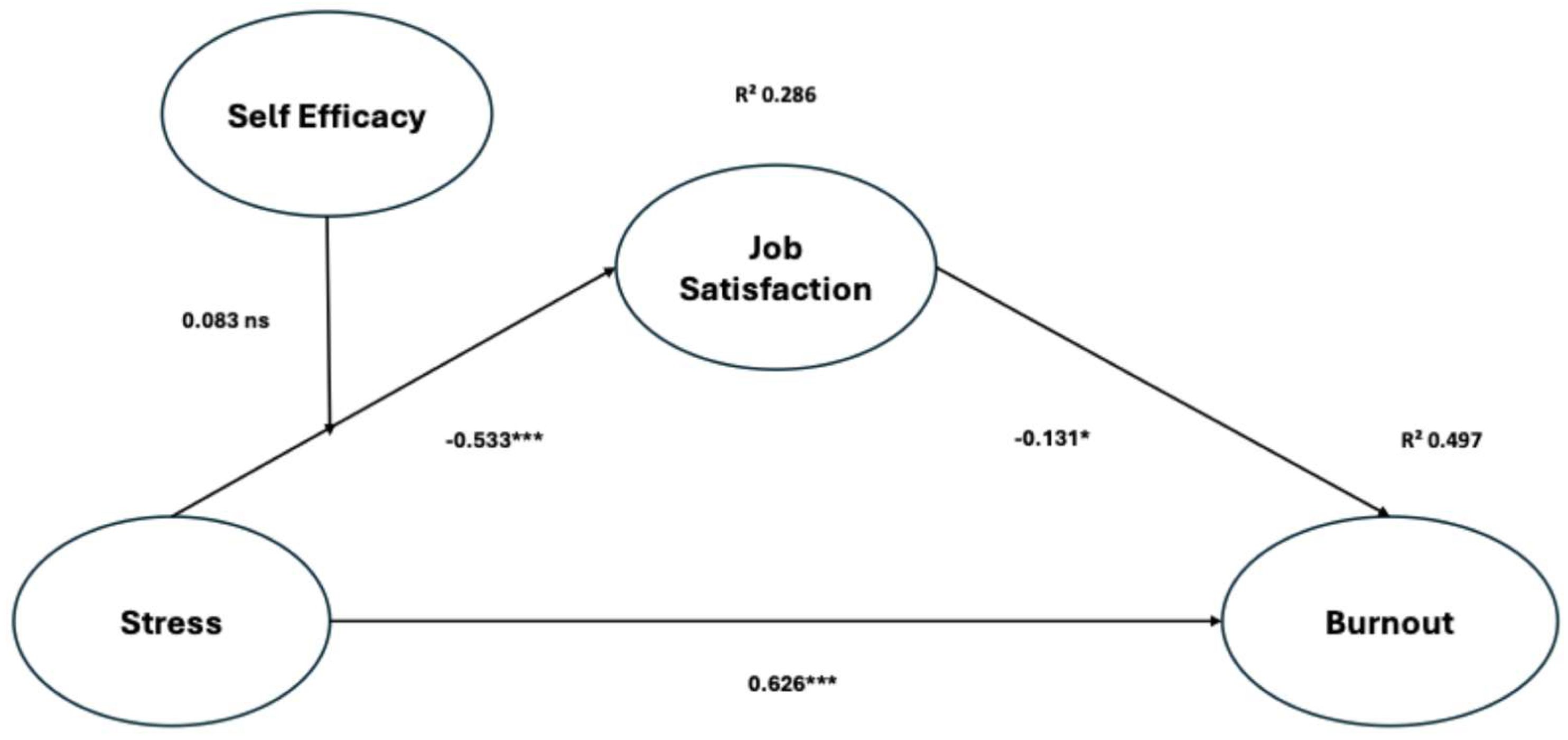
| H1 | OS -> BU | 0.626 *** | 11.688 | 0.000 | Significant |
| H2 | OS -> JS | −0.533 *** | −9.856 | 0.000 | Significant |
| H3 | JS -> BU | −0.131 * | −2.451 | 0.014 | Significant |
| Mediation effect | |||||
| H4 | OS -> JS -> BU | 0.107 ** | 6.29 | 0.004 | Significant |
| Moderation effect | |||||
| H5 | OS × SE -> JS | −0.083 | −0.965 | 0.334 | Non-significant |
Disclaimer/Publisher’s Note: The statements, opinions and data contained in all publications are solely those of the individual author(s) and contributor(s) and not of MDPI and/or the editor(s). MDPI and/or the editor(s) disclaim responsibility for any injury to people or property resulting from any ideas, methods, instructions or products referred to in the content. |
© 2026 by the authors. Licensee MDPI, Basel, Switzerland. This article is an open access article distributed under the terms and conditions of the Creative Commons Attribution (CC BY) license.
Share and Cite
Dukhaykh, S.; Bawzeer, S. From Stress to Burnout: Exploring the Protective and Predictive Factors for Nurses’ Well-Being. Healthcare 2026, 14, 1423. https://doi.org/10.3390/healthcare14101423
Dukhaykh S, Bawzeer S. From Stress to Burnout: Exploring the Protective and Predictive Factors for Nurses’ Well-Being. Healthcare. 2026; 14(10):1423. https://doi.org/10.3390/healthcare14101423
Chicago/Turabian StyleDukhaykh, Suad, and Shaikhah Bawzeer. 2026. "From Stress to Burnout: Exploring the Protective and Predictive Factors for Nurses’ Well-Being" Healthcare 14, no. 10: 1423. https://doi.org/10.3390/healthcare14101423
APA StyleDukhaykh, S., & Bawzeer, S. (2026). From Stress to Burnout: Exploring the Protective and Predictive Factors for Nurses’ Well-Being. Healthcare, 14(10), 1423. https://doi.org/10.3390/healthcare14101423