Educating, Contextualizing, and Deferring: Qualitative Investigation of Physician Communication About Chronic Kidney Disease
 , , and
Abstract
1. Background
2. Methods
Analysis
3. Results
3.1. Participant Characteristics
3.2. Provider Communication Themes
3.2.1. Providing Information and Education
3.2.2. Providing Health Context
3.2.3. Deferring to Other Providers
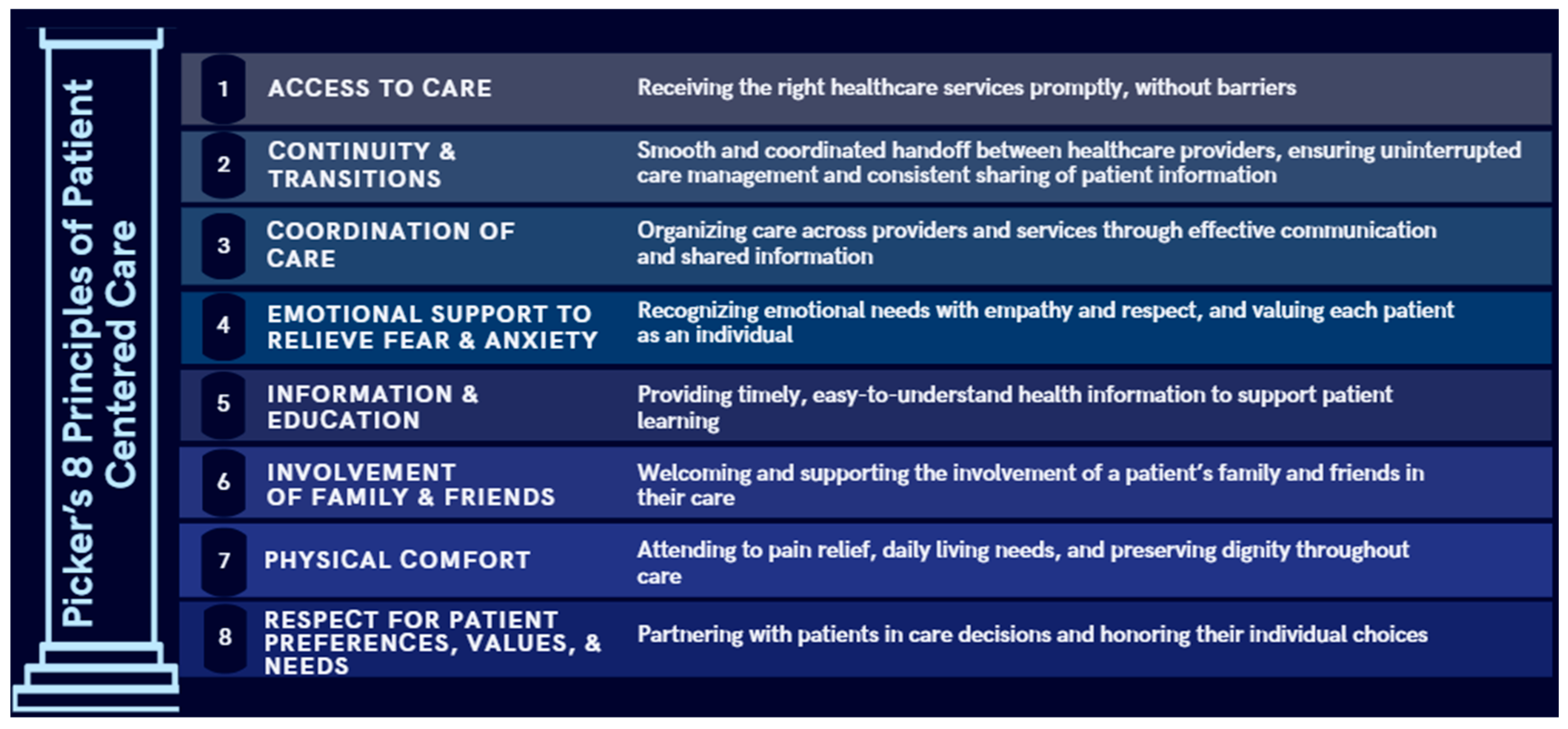
3.3. Provider Communication Approaches and Patient-Centered Care Mapping
4. Discussion
4.1. Information/Education and Use of Context
4.2. Respect for Values and Emotional Support
4.3. Coordination/Deferral and Access Trade-Offs
4.4. Under-Used Elements: Family/Support Involvement and Physical Comfort
4.5. Strengths and Limitations
4.6. Recommendations
5. Conclusions
Author Contributions
Funding
Institutional Review Board Statement
Informed Consent Statement
Data Availability Statement
Acknowledgments
Conflicts of Interest
Abbreviations
| CKD | Chronic Kidney Disease |
| PCP | Primary Care Physician |
| SDM | Shared Decision-Making |
| SDOH | Social Determinants of Health |
References
- Medicine, J.H. End Stage Renal Disease (ESRD). Available online: https://www.hopkinsmedicine.org/health/conditions-and-diseases/end-stage-renal-failure (accessed on 14 May 2026).
- CDC. Chronic Kidney Disease in the United States. Available online: https://www.cdc.gov/kidney-disease/php/data-research/index.html (accessed on 14 May 2026).
- Cruz, M.C.; Andrade, C.; Urrutia, M.; Draibe, S.; Nogueira-Martins, L.A.; Sesso Rde, C. Quality of life in patients with chronic kidney disease. Clinics 2011, 66, 991–995. [Google Scholar] [CrossRef] [PubMed]
- Fraser, S.D.; Roderick, P.J.; May, C.R.; McIntyre, N.; McIntyre, C.; Fluck, R.J.; Shardlow, A.; Taal, M.W. The burden of comorbidity in people with chronic kidney disease stage 3: A cohort study. BMC Nephrol. 2015, 16, 193. [Google Scholar] [CrossRef]
- Weiner, D.E. Public health consequences of chronic kidney disease. Clin. Pharmacol. Ther. 2009, 86, 566–569. [Google Scholar] [CrossRef] [PubMed]
- Tummalapalli, S.L.; Powe, N.R.; Keyhani, S. Trends in Quality of Care for Patients with CKD in the United States. Clin. J. Am. Soc. Nephrol. 2019, 14, 1142–1150. [Google Scholar] [CrossRef]
- Evidence Based Medicine Working Group. A new approach to teaching the practice of medicine. JAMA 1992, 268, 2420–2425. [Google Scholar] [CrossRef]
- Green, A.R.; Carrillo, J.E.; Betancourt, J.R. Why the disease-based model of medicine fails our patients. West. J. Med. 2002, 176, 141–143. [Google Scholar]
- O’Hare, A.M.; Rodriguez, R.A.; Bowling, C.B. Caring for patients with kidney disease: Shifting the paradigm from evidence-based medicine to patient-centered care. Nephrol. Dial. Transpl. 2016, 31, 368–375. [Google Scholar] [CrossRef]
- O’Hare, A.M. Patient-Centered Care in Renal Medicine: Five Strategies to Meet the Challenge. Am. J. Kidney Dis. 2018, 71, 732–736. [Google Scholar] [CrossRef]
- Epstein, R.M.; Street, R.L., Jr. The values and value of patient-centered care. Ann. Fam. Med. 2011, 9, 100–103. [Google Scholar] [CrossRef]
- Ronald, M.E.; Richard, L.S. Patient-Centered Communication in Cancer Care: Promoting Healing and Reducing Suffering; National Cancer Institut: Bethesda, MD, USA, 2007. [CrossRef]
- Institute of Medicine Committee on Quality of Health Care in America. Crossing the Quality Chasm: A New Health System for the 21st Century; National Academies Press: Washington, DC, USA, 2001.
- Stewart, M.; Brown, J.B.; Donner, A.; McWhinney, I.R.; Oates, J.; Weston, W.W.; Jordan, J. The impact of patient-centered care on outcomes. J. Fam. Pract. 2000, 49, 796–804. [Google Scholar] [PubMed]
- Gerteis, M.; Edgman-Levitan, S.; Dalley, J.; Delbanco, T. Through the Patient’s Eyes; John Wiley & Sons, Ltd.: Hoboken, NJ, USA, 2002; Volume 36, pp. 1104–1105. [Google Scholar]
- Loban, K.; Milland, T.; Hales, L.; Lam, N.N.; Dipchand, C.; Sandal, S. Understanding the Healthcare Needs of Living Kidney Donors Using the Picker Principles of Patient-centered Care: A Scoping Review. Transplantation 2025, 109, 110–122. [Google Scholar] [CrossRef] [PubMed]
- Furmenti, M.F.; Bertarelli, G.; Ferrè, F. Person-centred care in oncological home services: A scoping review of patients’ and caregivers’ experience and needs. BMC Health Serv. Res. 2025, 25, 232. [Google Scholar] [CrossRef]
- Hagendijk, M.E.; Zipfel, N.; Melles, M.; van der Wees, P.J.; Hulshof, C.T.J.; Çölkesen, E.B.; Hoving, J.L.; van der Burg-Vermeulen, S.J. Towards person-centred work-focused healthcare for people with cardiovascular disease: A qualitative exploration of patients’ experiences and needs. Disabil. Rehabil. 2025, 47, 194–206. [Google Scholar] [CrossRef]
- Kuipers, S.J.; Nieboer, A.P.; Cramm, J.M. Easier Said Than Done: Healthcare Professionals’ Barriers to the Provision of Patient-Centered Primary Care to Patients with Multimorbidity. Int. J. Environ. Res. Public Health 2021, 18, 6057. [Google Scholar] [CrossRef]
- Mandel, E.I.; Fox, M.; Schell, J.O.; Cohen, R.A. Shared Decision-Making and Patient Communication in Nephrology Practice. Adv. Kidney Dis. Health 2024, 31, 5–12. [Google Scholar] [CrossRef]
- Tiu, H.; Fagerlin, A.; Roney, M.; Kerr, E.; Ojo, A.; Rothman, E.; Nunes, J.W. Provider perspectives on chronic kidney disease diagnosis delivery. Clin. Nephrol. 2018, 89, 205–213. [Google Scholar] [CrossRef]
- Bowling, C.B.; O’Hare, A.M. Managing older adults with CKD: Individualized versus disease-based approaches. Am. J. Kidney Dis. 2012, 59, 293–302. [Google Scholar] [CrossRef]
- Dicicco-Bloom, B.; Crabtree, B.F. The qualitative research interview. Med. Educ. 2006, 40, 314–321. [Google Scholar] [CrossRef] [PubMed]
- Nicholas, S.B.; Kalantar-Zadeh, K.; Norris, K.C. Socioeconomic disparities in chronic kidney disease. Adv. Chronic Kidney Dis. 2015, 22, 6–15. [Google Scholar] [CrossRef] [PubMed]
- Nevedal, A.L.; Reardon, C.M.; Opra Widerquist, M.A.; Jackson, G.L.; Cutrona, S.L.; White, B.S.; Damschroder, L.J. Rapid versus traditional qualitative analysis using the Consolidated Framework for Implementation Research (CFIR). Implement. Sci. 2021, 16, 67. [Google Scholar] [CrossRef]
- Gale, R.C.; Wu, J.; Erhardt, T.; Bounthavong, M.; Reardon, C.M.; Damschroder, L.J.; Midboe, A.M. Comparison of rapid vs in-depth qualitative analytic methods from a process evaluation of academic detailing in the Veterans Health Administration. Implement. Sci. 2019, 14, 11. [Google Scholar] [CrossRef]
- Goulding, M.; Borg, A.; Minkah, P.; Branley, C.; Desrochers, O.; Schwartz, E.; Uribe, P.; Powers, D.; Rosal, M.C.; Lemon, S.C.; et al. Lessons Learned in Developing a Model for Academic-Community Partnered Rapid Qualitative Research. Prog. Community Health Partnersh. 2025, 19, 459–466. [Google Scholar] [CrossRef]
- Warren, M.; Leamon, T.; Hall, A.; Twells, L.; Street, C.; Stordy, A.; Majumdar, K.; Breault, L.; Fiest, K.; Rasiah, J.; et al. The Role of Patient Advisory Councils in Health Research: Lessons From Two Provincial Councils in Canada. J. Patient Exp. 2020, 7, 898–905. [Google Scholar] [CrossRef]
- Brockman, T.A.; Balls-Berry, J.E.; West, I.W.; Valdez-Soto, M.; Albertie, M.L.; Stephenson, N.A.; Omar, F.M.; Moore, M.; Alemán, M.; Berry, P.A.; et al. Researchers’ experiences working with community advisory boards: How community member feedback impacted the research. J. Clin. Transl. Sci. 2021, 5, e117. [Google Scholar] [CrossRef]
- Hsieh, H.F.; Shannon, S.E. Three approaches to qualitative content analysis. Qual. Health Res. 2005, 15, 1277–1288. [Google Scholar] [CrossRef]
- Tong, A.; Sainsbury, P.; Craig, J. Consolidated criteria for reporting qualitative research (COREQ): A 32-item checklist for interviews and focus groups. Int. J. Qual. Health Care 2007, 19, 349–357. [Google Scholar] [CrossRef] [PubMed]
- Bureau, U.C. Erie County Quick Facts. Available online: https://www.census.gov/quickfacts/eriecountynewyork (accessed on 14 May 2026).
- John, R. Utilizing an Educational Patient Handout to Increase CKD Knowledge in Primary Care; The University of Arizona: Tucson, AZ, USA, 2023. [Google Scholar]
- Chiou, C.P.; Chung, Y.C. Effectiveness of multimedia interactive patient education on knowledge, uncertainty and decision-making in patients with end-stage renal disease. J. Clin. Nurs. 2012, 21, 1223–1231. [Google Scholar] [CrossRef] [PubMed]
- Hong, Y.R.; Jo, A.; Cardel, M.; Huo, J.; Mainous, A.G., 3rd. Patient-Provider communication with teach-back, patient-centered diabetes care, and diabetes care education. Patient Educ. Couns. 2020, 103, 2443–2450. [Google Scholar] [CrossRef]
- Narva, A.S.; Norton, J.M.; Boulware, L.E. Educating Patients about CKD: The Path to Self-Management and Patient-Centered Care. Clin. J. Am. Soc. Nephrol. 2016, 11, 694–703. [Google Scholar] [CrossRef]
- Smith, K.L.; Martini, J. Patient-provider communication and interactions. In Chronic Illness Care: Principles and Practice; Springer: Berlin/Heidelberg, Germany, 2023; pp. 195–207. [Google Scholar] [CrossRef]
- Alanzi, T.M.; Alanzi, N.; Majrabi, A.; Alhajri, A.S.; Alzahrani, L.; Alqahtani, N.; Alqadhibi, A.; Alenazi, S.; Alsaedi, H.; Alghamdi, E.; et al. Exploring Patient Preferences Related to Shared Decision-Making in Chronic Disease Management. Cureus 2024, 16, e70214. [Google Scholar] [CrossRef] [PubMed]
- Chong, C.; Campbell, D.; Elliott, M.; Aghajafari, F.; Ronksley, P. Determining the Association Between Continuity of Primary Care and Acute Care Use in Chronic Kidney Disease: A Retrospective Cohort Study. Ann. Fam. Med. 2022, 20, 237–245. [Google Scholar] [CrossRef]
- Khanam, M.A.; Kitsos, A.; Stankovich, J.; Castelino, R.; Jose, M.; Peterson, G.M.; Wimmer, B.; Razi Zaidi, T.; Radford, J. Association of continuity of care with blood pressure control in patients with chronic kidney disease and hypertension. Aust. J. Gen. Pract. 2019, 48, 300–306. [Google Scholar] [CrossRef]
- Wright Nunes, J.; Roney, M.; Kerr, E.; Ojo, A.; Fagerlin, A. A diagnosis of chronic kidney disease: Despite fears patients want to know early. Clin. Nephrol. 2016, 86, 78–86. [Google Scholar] [CrossRef] [PubMed]
- Muscat, D.M.; Shepherd, H.L.; Nutbeam, D.; Trevena, L.; McCaffery, K.J. Health Literacy and Shared Decision-making: Exploring the Relationship to Enable Meaningful Patient Engagement in Healthcare. J. Gen. Intern. Med. 2021, 36, 521–524. [Google Scholar] [CrossRef]
- Chuang, E.; Safaeinili, N. Addressing Social Needs in Clinical Settings: Implementation and Impact on Health Care Utilization, Costs, and Integration of Care. Annu. Rev. Public Health 2024, 45, 443–464. [Google Scholar] [CrossRef]
- De Marchis, E.; Knox, M.; Hessler, D.; Willard-Grace, R.; Olayiwola, J.N.; Peterson, L.E.; Grumbach, K.; Gottlieb, L.M. Physician Burnout and Higher Clinic Capacity to Address Patients’ Social Needs. J. Am. Board. Fam. Med. 2019, 32, 69–78. [Google Scholar] [CrossRef]
- Neale, E.P.; Middleton, J.; Lambert, K. Barriers and enablers to detection and management of chronic kidney disease in primary healthcare: A systematic review. BMC Nephrol. 2020, 21, 83. [Google Scholar] [CrossRef] [PubMed]
- Hounkpatin, H.O.; Leydon, G.M.; Veighey, K.; Armstrong, K.; Santer, M.; Taal, M.W.; Annells, P.; May, C.; Roderick, P.J.; Fraser, S.D. Patients’ and kidney care team’s perspectives of treatment burden and capacity in older people with chronic kidney disease: A qualitative study. BMJ Open 2020, 10, e042548. [Google Scholar] [CrossRef]
- Greer, R.C.; Liu, Y.; Cavanaugh, K.; Diamantidis, C.J.; Estrella, M.M.; Sperati, C.J.; Soman, S.; Abdel-Kader, K.; Agrawal, V.; Plantinga, L.C.; et al. Primary Care Physicians’ Perceived Barriers to Nephrology Referral and Co-management of Patients with CKD: A Qualitative Study. J. Gen. Intern. Med. 2019, 34, 1228–1235. [Google Scholar] [CrossRef] [PubMed]
- Patel, M.P.; Schettini, P.; O’Leary, C.P.; Bosworth, H.B.; Anderson, J.B.; Shah, K.P. Closing the Referral Loop: An Analysis of Primary Care Referrals to Specialists in a Large Health System. J. Gen. Intern. Med. 2018, 33, 715–721. [Google Scholar] [CrossRef]
- Cheng, C.; Christensen, M. Understanding Nurses’ Experiences of Fragmented Care in Aging Populations: A Meta-Synthesis. J. Nurs. Res. 2026, 34, e439. [Google Scholar] [CrossRef] [PubMed]
- Joo, J.Y. Fragmented care and chronic illness patient outcomes: A systematic review. Nurs. Open 2023, 10, 3460–3473. [Google Scholar] [CrossRef]
- Manca, D.P.; Breault, L.; Wishart, P. A tale of two cultures: Specialists and generalists sharing the load. Can. Fam. Physician 2011, 57, 576–584. [Google Scholar]
- Mehrotra, A.; Forrest, C.B.; Lin, C.Y. Dropping the baton: Specialty referrals in the United States. Milbank Q. 2011, 89, 39–68. [Google Scholar] [CrossRef]
- Kiger, M.E.; Meyer, H.S.; Hammond, C.; Miller, K.M.; Dickey, K.J.; Hammond, D.V.; Varpio, L. Whose Patient Is This? A Scoping Review of Patient Ownership. Acad. Med. 2019, 94, S95–S104. [Google Scholar] [CrossRef]
- Hirschman, K.B.; Shaid, E.; McCauley, K.; Pauly, M.V.; Naylor, M.D. Continuity of Care: The Transitional Care Model. Online J. Issues Nurs. 2015, 20, 1. [Google Scholar] [CrossRef] [PubMed]
- Lambourg, E.; Colvin, L.; Guthrie, G.; Murugan, K.; Lim, M.; Walker, H.; Boon, G.; Bell, S. The prevalence of pain among patients with chronic kidney disease using systematic review and meta-analysis. Kidney Int. 2021, 100, 636–649. [Google Scholar] [CrossRef]
- Patel, S.S.; Peterson, R.A.; Kimmel, P.L. The impact of social support on end-stage renal disease. Semin. Dial. 2005, 18, 98–102. [Google Scholar] [CrossRef]
- Rosland, A.M.; Piette, J.D.; Choi, H.; Heisler, M. Family and friend participation in primary care visits of patients with diabetes or heart failure: Patient and physician determinants and experiences. Med. Care 2011, 49, 37–45. [Google Scholar] [CrossRef]
- Urbanski, M.; Browne, T.; Plantinga, L. The Dialysis Social Worker: Patients’ Best Defense to Meet Health-Related Social Needs. Am. J. Kidney Dis. 2024, 83, 707–709. [Google Scholar] [CrossRef] [PubMed]
- Browne, T.; Merighi, J.R.; Washington, T.; Savage, T.; Shaver, C.; Holland, K. Nephrology Social Work. In Handbook of Health Social Work; John Wiley & Sons, Inc.: Hoboken, NJ, USA, 2019; pp. 411–440. [Google Scholar] [CrossRef]
- Lederer, E.; Lebowitz, J. Current State of the Workforce in Nephrology. Adv. Chronic Kidney Dis. 2020, 27, 281–290.e1. [Google Scholar] [CrossRef]
- Meran, S.; Don, K.; Shah, N.; Donovan, K.; Riley, S.; Phillips, A.O. Impact of chronic kidney disease management in primary care. QJM Int. J. Med. 2011, 104, 27–34. [Google Scholar] [CrossRef]
- Arooj, H.; Aman, M.; Hashmi, M.U.; Nasir, Z.; Zahid, M.; Abbas, J.; Amjad, N.; Maryam, S.; Farhan, K. The impact of nurse-led care in chronic kidney disease management: A systematic review and meta-analysis. BMC Nurs. 2025, 24, 188. [Google Scholar] [CrossRef]
- Feryn, N.; Boeckxstaens, P.; Ashcroft, R.; De Corte, J.; Roose, R. Looking Through the Eyes of General Practitioners: The Role of Social Work in Primary Health Care. Br. J. Soc. Work 2024, 54, 105–123. [Google Scholar] [CrossRef]
- Ashcroft, R.; Sheffield, P.; Adamson, K.; Phelps, F.; Webber, G.; Walsh, B.; Dallaire, L.F.; Sur, D.; Kemp, C.; Rayner, J.; et al. Scoping review of social workers’ professional roles in primary care. BMJ Open 2024, 14, e090527. [Google Scholar] [CrossRef]
- Bispo Júnior, J.P. Social desirability bias in qualitative health research. Rev. Saude Publica 2022, 56, 101. [Google Scholar] [CrossRef]
- Wittink, H.; Oosterhaven, J. Patient education and health literacy. Musculoskelet. Sci. Pract. 2018, 38, 120–127. [Google Scholar] [CrossRef] [PubMed]
- Andersen-Hollekim, T.; Landstad, B.J.; Solbjør, M.; Kvangarsnes, M.; Hole, T. Nephrologists’ experiences with patient participation when long-term dialysis is required. BMC Nephrol. 2021, 22, 58. [Google Scholar] [CrossRef] [PubMed]
- Stiggelbout, A.M.; Van der Weijden, T.; De Wit, M.P.; Frosch, D.; Légaré, F.; Montori, V.M.; Trevena, L.; Elwyn, G. Shared decision making: Really putting patients at the centre of healthcare. BMJ 2012, 344, e256. [Google Scholar] [CrossRef]
- Elwyn, G.; Frosch, D.L.; Kobrin, S. Implementing shared decision-making: Consider all the consequences. Implement. Sci. 2016, 11, 114. [Google Scholar] [CrossRef] [PubMed]
- Stiggelbout, A.M.; Pieterse, A.H.; De Haes, J.C. Shared decision making: Concepts, evidence, and practice. Patient Educ. Couns. 2015, 98, 1172–1179. [Google Scholar] [CrossRef]
- Buitron de la Vega, P.; Losi, S.; Sprague Martinez, L.; Bovell-Ammon, A.; Garg, A.; James, T.; Ewen, A.M.; Stack, M.; DeCarvalho, H.; Sandel, M.; et al. Implementing an EHR-based Screening and Referral System to Address Social Determinants of Health in Primary Care. Med. Care 2019, 57, S133–S139. [Google Scholar] [CrossRef]
- Adler, N.; Cutler, D.; Fielding, J.; Galea, S.; Glymour, M.; Koh, H.; Satcher, D. Addressing Social Determinants of Health and Health Disparities: A Vital Direction for Health and Health Care. NAM Perspect. 2016, 6, 1–16. [Google Scholar] [CrossRef]
- Johnson, M.L.; Zimmerman, L.; Welch, J.L.; Hertzog, M.; Pozehl, B.; Plumb, T. Patient activation with knowledge, self-management and confidence in chronic kidney disease. J. Ren. Care 2016, 42, 15–22. [Google Scholar] [CrossRef]


| Primary Care Physicians n (%) (n = 14) | Nephrologists n (%) (n = 7) | Total n (%) (n = 21) | |
|---|---|---|---|
| Physician Years in practice | |||
| 0–15 | 6 (43) | 3 (43) | 9 (43) |
| 16–45 | 8 (57) | 4 (57) | 12 (57) |
| % Medicaid insured patient panel | |||
| 0–25% | 8 (57) | 2 (29) | 10 (48) |
| 26–50% | 3 (21) | 3 (43) | 6 (29) |
| 51–100% | 3 (21) | 0 (0) | 3 (14) |
| Unknown | 0 (0) | 2 (29) | 2 (10) |
| % Black/African American patient panel | |||
| 0–25% | 12 (86) | 3 (43) | 15 (71) |
| 26–50% | 2 (14) | 3 (43) | 5 (24) |
| 51–75% | 0 (0) | 1 (14) | 1 (5) |
| % Hispanic/Latino patient panel | |||
| 0–5% | 7 (50) | 3 (43) | 10 (48) |
| 6–10% | 6 (43) | 2 (29) | 8 (38) |
| 11–20% | 1 (7) | 2 (28) | 3 (14) |
| % Non-English-speaking patient panel | |||
| 0–15% | 12 (86) | 5 (71) | 17 (80) |
| 16–30% | 0(0) | 1 (14) | 1 (5) |
| 45–60% | 2 (14) | 0 (0) | 2 (10) |
| Unknown | 0 (0) | 1 (14) | 1 (5) |
| Principle | PCP Communication Approach | Nephrologist Communication Approach | Identified Gaps |
|---|---|---|---|
| Access to care | Considers barriers that may impact access to care (language, transportation, insurance, etc.) Considers resources necessary for viability of treatment options (in-home dialysis, transportation lifestyle challenges) | Considers resources necessary for viability of treatment options (in-home dialysis, transportation lifestyle challenges) | Improve PCPs’ and nephrologists’ understanding of dialysis and transplant requirements to support patient’s access PCPs’ and nephrologists can assess barriers created by SDOH, and better link patients to services |
| Care continuity and transitions | Uses historical lab results to educate patients and make referral decisions Communicates lab results to build health literacy Builds relationships to dispel fears | Uses historical lab results to educate patients and make referral decisions Communicates lab results to build health literacy Builds relationships to dispel fears | Some expressed discomfort referring to transplantation services due to limited physician knowledge and familiarity Refer more regularly to transplant services |
| Coordination of care | Connects patients to nephrology Encourages/arranges social services for patients (home nurses, transportation, language help, etc.) Connects patients with specialists/resources such as transplant teams, dialysis centers, and CKD educational programs | Connects patients to nephrology Encourages/arranges social services for patients (home nurses, transportation, language help, etc.) Connects patients with specialists/resources such as transplant teams, dialysis centers, and CKD educational programs | Nephrology: consider more 2-way communication with PCPs about patient co-management Nephrology: increase focus on social service coordination that patients may need to participate fully in their care |
| Emotional support to relieve fear and anxiety | Some express an understanding of barriers to care and life circumstances Limited address of patient’s emotional needs, described as providing reassurance for timeline to needing dialysis | Limited address of patient’s emotional needs, described as providing reassurance for timeline to needing dialysis | PCPs and nephrologists can address patient fear and anxiety more holistically |
| Information and education | Main way of communicating with patients is through CKD education Some consider patient barriers (language, health literacy, etc.) when providing information and education, but few use teach-backs or methods to verify patient understanding Defers to nephrology or dialysis centers to provide patient information on advanced CKD and treatment options Uses simplified explanations | Main way of communicating with patients is through CKD education Some consider patient barriers (language, health literacy, etc.) when providing information and education, but few use teach-backs or methods to verify patient understanding Defers to nephrology or dialysis centers to provide patient information on advanced CKD and treatment options Uses simplified explanations Some nephrologists use alternative resources like diagrams, gestures, and patient-centered websites | PCPs could use alternative resources for patient education to accommodate various levels of health literacy and learning styles PCPs could bolster their CKD and renal knowledge to better support patient education at earlier stages Nephrology may consider screening for or discussing SDOH with patients as part of care plan co-development |
| Involvement of family and friends | Not widely discussed as a communication strategy | Not widely discussed as a communication strategy Recognizes that family and friends can be outside influences on patient’s treatment choice | Incorporate discussion of social support in conversations with CKD patients |
| Physical comfort | Not discussed as a communication strategy or care management focus area | Not discussed as a communication strategy or care management focus area | Address physical comfort and pain with patients when exploring treatment options |
| Respect for patient values, preferences, and expressed needs | Includes patient value systems in decisions about treatment options Utilizes alternate communication styles to meet patient needs Connects patients to supportive resources | Connects patients to supportive resources | Lack of strategies to engage patient value systems in nephrology |
| Principle | Supporting Quotation(s) |
|---|---|
| Access to care | “From a social issue standpoint, transportation is such a huge thing with dialysis because of just the frequency. A lot of patients report to me that they end up having some difficulty with Medicare cabs or Medicaid cabs… So sometimes my office will help with that”—PCP14 |
| Care continuity and transitions | “In terms of alleviating anxiety…I’m able to alleviate their anxiety fairly easily in the patients who need attention, who need say dialysis in the next 2, 3 years. I mean, these patients are being seen by me serially so during their follow up, even if I’m not able to educate them… as time progresses, I am able to”—Neph4 |
| Coordination of care | “So, we do have some like pre-ESRD education classes…We try to engage the nurses, social workers, people like that to kind of continue having the discussions. And then we give patients the number for the transplant center to go over to start to meet with the transplant center”—Neph7 |
| Emotional support to relieve fear and anxiety | “I think when I put it in a percentage that makes it a little bit more easier for them to understand what’s going on, and usually they get kind of scared…and they think the worst-I’m gonna end up on dialysis. So I tell them…people generally don’t go on dialysis until their GFR hits 10 and they’re 45 and they’re not that close and don’t worry”—PCP17 |
| Information and education | “If I can get a handout that I can find. Sometimes I will do that, or I will direct them to websites that I feel can give them good general overview.”—Neph2 “The health literacy here is quite low. So trying to explain renal function in terms that patients understand can sometimes be quite challenging.”—PCP21 |
| Involvement of family and friends | “But usually by the time they’re seeing me, someone has told them that they know someone on dialysis or do they need a kidney transplant. Those ideas are baked in their conscious when we have the meeting”—Neph6 |
| Physical comfort | Not discussed as a communication strategy or care management focus area |
| Respect for patient values, preferences, and expressed needs | “Then it becomes a question of well, you know, how does getting dialysis relate to your personal value system and what you find important? And how does it relate to your quality of life… and where do we go from here?”—PCP14 |
Disclaimer/Publisher’s Note: The statements, opinions and data contained in all publications are solely those of the individual author(s) and contributor(s) and not of MDPI and/or the editor(s). MDPI and/or the editor(s) disclaim responsibility for any injury to people or property resulting from any ideas, methods, instructions or products referred to in the content. |
© 2026 by the authors. Licensee MDPI, Basel, Switzerland. This article is an open access article distributed under the terms and conditions of the Creative Commons Attribution (CC BY) license.
Share and Cite
Ziegler, A.; Walcott-George, K.; Sullivan, A.; Gailor, M.; Kayler, L.; Tumiel Berhalter, L. Educating, Contextualizing, and Deferring: Qualitative Investigation of Physician Communication About Chronic Kidney Disease. Healthcare 2026, 14, 1403. https://doi.org/10.3390/healthcare14101403
Ziegler A, Walcott-George K, Sullivan A, Gailor M, Kayler L, Tumiel Berhalter L. Educating, Contextualizing, and Deferring: Qualitative Investigation of Physician Communication About Chronic Kidney Disease. Healthcare. 2026; 14(10):1403. https://doi.org/10.3390/healthcare14101403
Chicago/Turabian StyleZiegler, Amanda, Kennedy Walcott-George, Adam Sullivan, Mary Gailor, Liise Kayler, and Laurene Tumiel Berhalter. 2026. "Educating, Contextualizing, and Deferring: Qualitative Investigation of Physician Communication About Chronic Kidney Disease" Healthcare 14, no. 10: 1403. https://doi.org/10.3390/healthcare14101403
APA StyleZiegler, A., Walcott-George, K., Sullivan, A., Gailor, M., Kayler, L., & Tumiel Berhalter, L. (2026). Educating, Contextualizing, and Deferring: Qualitative Investigation of Physician Communication About Chronic Kidney Disease. Healthcare, 14(10), 1403. https://doi.org/10.3390/healthcare14101403