Cyberchondria, Health Anxiety, and Sleep Quality: An Observational Cross-Sectional Study of Adults with and Without Psychosomatic Disorders
 ,
,
Highlights
- Cyberchondria is highly prevalent (56.78%) among Saudi adults.
- Poor sleep quality affects 56.9% of the studied population.
- Psychosomatic disorders significantly amplify cyberchondria and health anxiety.
- Strong positive correlations exist between cyberchondria, anxiety, and sleep quality.
Abstract
1. Introduction
1.1. Theoretical Framework and Literature Review
1.1.1. Cyberchondria
1.1.2. Health Anxiety
1.1.3. Sleep Quality
1.1.4. The Dynamic Interplay Between Cyberchondria, Health Anxiety, and Sleep Quality
1.2. Research Problem and Hypotheses
1.2.1. Research Problem
1.2.2. Study Hypotheses
- Cyberchondria, health anxiety, and sleep quality disturbances will be prevalent at notable levels among study participants.
- Statistically significant positive correlations will exist between cyberchondria, health anxiety, and impaired sleep quality.
- Statistically significant differences will exist in mean scores based on gender, clinical group, and their interaction. Clarifying note on the analytical role of the SSS-8: The Somatic Symptom Scale-8 (SSS-8) was employed exclusively as a stratification instrument to operationalise the psychosomatic/non-psychosomatic group distinction (see Section 2.3.4), in conjunction with a self-reported clinically confirmed diagnosis. The SSS-8 was not included as a dependent variable in any analytical model; accordingly, no hypothesis was formulated regarding SSS-8 total scores. Its role is that of a group-classification criterion, not an outcome measure.
2. Materials and Methods
2.1. Method and Design
2.2. Participants
- Inclusion Criteria
- Age 18 years or older;
- Residency in Saudi Arabia;
- Ability to read Arabic;
- Provision of informed consent.
- Exclusion Criteria
- Incomplete questionnaire responses;
- Illogical response patterns (e.g., selecting the same response option for all items).
2.3. Measures
2.3.1. Cyberchondria Severity Scale (CSS-12)
2.3.2. Short Health Anxiety Inventory—SHAI
2.3.3. Pittsburgh Sleep Quality Index (PSQI)
2.3.4. Somatic Symptom Scale (SSS-8)
2.4. Statistical Analysis
2.5. Ethical Considerations
3. Results
3.1. Prevalence Rates and Mean Scores of Cyberchondria, Health Anxiety, and Sleep Quality by Clinical Group
3.2. Correlational Relationships Between Cyberchondria, Health Anxiety, and Poor Sleep Quality
3.3. Sex and Group Differences (Psychosomatic vs. Non-Psychosomatic) in Cyberchondria Dimensions, Health Anxiety Dimensions, and Sleep Quality: A Two-Way ANOVA
4. Discussion
4.1. Theoretical and Practical Implications
4.2. Limitations and Recommendations for Future Research
5. Conclusions
Supplementary Materials
Author Contributions
Funding
Institutional Review Board Statement
Informed Consent Statement
Data Availability Statement
Acknowledgments
Conflicts of Interest
References
- Alshaibani, M. Validity and Reliability of the Short Form of Cyberchondria Severity Scale (CSS-12) in Saudi Arabia. J. Consum. Health Internet 2023, 27, 282–293. [Google Scholar] [CrossRef]
- Vismara, M.; Caricasole, V.; Starcevic, V.; Cinosi, E.; Dell’Osso, B.; Martinotti, G.; Fineberg, N.A. Is Cyberchondria a New Transdiagnostic Digital Compulsive Syndrome? A Systematic Review of the Evidence. Compr. Psychiatry 2020, 99, 152167. [Google Scholar] [CrossRef]
- Alshayea, A.K. Latent Structure, Measurement Invariance, and Reliability of an Arabic Version of the Short Health Anxiety Inventory. J. Exp. Psychopathol. 2020, 11, 2043808720920694. [Google Scholar] [CrossRef]
- Khodabakhsh, S.; Ramasamy, S.; Teng, T.Y.; Leng, C.S. Impact of Internet Addiction on Health Anxiety in Malaysian Youth during COVID-19 Pandemic. Malays. J. Med. Res. 2021, 5, 12–18. [Google Scholar] [CrossRef]
- Maberah, D.S.; Alrosan, D.D.A.; Alaboud, D.K.A.; Alabdalhaq, D.T.F.M. Digital Anxiety and Sleep Disorders: The Predictive Role of Cyberchondria among University Students in Jordan. TPM Test. Psychom. Methodol. Appl. Psychol. 2025, 32, S2. [Google Scholar]
- Yalçın, İ.; Boysan, M.; Eşkisu, M.; Cam, Z. Health Anxiety Model of Cyberchondria, Fears, Obsessions, Sleep Quality, and Negative Affect during COVID-19. Curr. Psychol. 2024, 43, 8502–8519. [Google Scholar] [CrossRef] [PubMed]
- El-Zayat, A.; Namnkani, S.A.; Alshareef, N.A.; Mustfa, M.M.; Eminaga, N.S.; Algarni, G.A. Cyberchondria and Its Association with Smartphone Addiction and Electronic Health Literacy among a Saudi Population. Saudi J. Med. Med. Sci. 2023, 11, 162–168. [Google Scholar] [CrossRef] [PubMed]
- Abdulrahman, K.A.B.; AL Musfir, S.K.; Alforaih, A.S.; Alshehri, A.M.; Aldossari, A.K.; Dawood, F.D.B. The Prevalence of Cyberchondria and the Impact of Skepticism on Medical Decisions among Imam Mohammed Ibn Saud Islamic University Students, Riyadh, Saudi Arabia. J. Fam. Med. Prim. Care 2024, 13, 5334–5340. [Google Scholar] [CrossRef]
- Mrayyan, M.T.; AL-Atiyyat, N.; Khait, A.A.; Al-Rawashdeh, S.; Algunmeeyn, A.; Abunab, H.Y. Does Cyberchondria Predict Internet Addiction among Students during the COVID-19 Pandemic? A Web-Based Survey Study. Nurs. Forum 2023, 57, 337–343. [Google Scholar] [CrossRef]
- Mahayekti, A.C.; Barasabha, T.; Kamaliyah, I.N.; Raziq, M.A. Unraveling the Cyberchondria Phenomenon: Unearthing the Intriguing Connection between Its Dimensions and Health Outcomes. In Proceedings of the 2023 Brawijaya International Conference (BIC 2023); Atlantis Press: Dordrecht, The Netherlands, 2024; pp. 591–599. [Google Scholar]
- Mathes, B.M.; Norr, A.M.; Allan, N.P.; Albanese, B.J.; Schmidt, N.B. Cyberchondria: Overlap with Health Anxiety and Unique Relations with Impairment, Quality of Life, and Service Utilization. Psychiatry Res. 2018, 261, 204–211. [Google Scholar] [CrossRef]
- Rahme, C.; Akel, M.; Obeid, S.; Hallit, S. Cyberchondria Severity and Quality of Life among Lebanese Adults: The Mediating Role of Fear of COVID-19, Depression, Anxiety, Stress and Obsessive–Compulsive Behavior—A Structural Equation Model Approach. BMC Psychol. 2021, 9, 169. [Google Scholar] [CrossRef]
- Aleyeidi, N.; Fayed, A.; Alnowaiser, G.; Aldubayyan, R.; Alfahhad, L.; Alhosaini, J.; Alotaibi, M. Cyberchondria, Somatic Symptoms, and Internet-Based Self-Diagnosis among the Saudi Population. Sci. Rep. 2025, 15, 18208. [Google Scholar] [CrossRef]
- Zhu, X.; Zheng, T.; Ding, L.; Zhang, X. Exploring Associations between eHealth Literacy, Cyberchondria, Online Health Information Seeking and Sleep Quality among University Students: A Cross-Section Study. Heliyon 2023, 9, e17521. [Google Scholar] [CrossRef] [PubMed]
- Salkovskis, P.M.; Warwick, H.M. Morbid Preoccupations, Health Anxiety and Reassurance: A Cognitive-Behavioural Approach to Hypochondriasis. Behav. Res. Ther. 1986, 24, 597–602. [Google Scholar] [CrossRef] [PubMed]
- El-Zoghby, S.M.; Zaghloul, N.M.; Tawfik, A.M.; Elsherbiny, N.M.; Shehata, S.A.; Soltan, E.M. Cyberchondria and Smartphone Addiction: A Correlation Survey among Undergraduate Medical Students in Egypt. J. Egypt. Public Health Assoc. 2024, 99, 7. [Google Scholar] [CrossRef]
- Du, X.; Witthöft, M.; Zhang, T.; Shi, C.; Ren, Z. Interpretation Bias in Health Anxiety: A Systematic Review and Meta-Analysis. Psychol. Med. 2023, 53, 34–45. [Google Scholar] [CrossRef] [PubMed]
- Kirillov, I. Evaluation Criteria for Psychosomatic Practice. Glob. Psychother. 2023, 3, 57–69. [Google Scholar] [CrossRef]
- Tahir, M.J.; Malik, N.I.; Ullah, I.; Khan, H.R.; Perveen, S.; Ramalho, R.; Rodrigues, V.; Pham, N.T.; Siddiqi, A.R.; Waheed, S.; et al. Internet Addiction and Sleep Quality among Medical Students during the COVID-19 Pandemic: A Multinational Cross-Sectional Survey. PLoS ONE 2021, 16, e0259594. [Google Scholar] [CrossRef]
- Buysse, D.J.; Reynolds, C.F., III; Monk, T.H.; Berman, S.R.; Kupfer, D.J. The Pittsburgh Sleep Quality Index: A New Instrument for Psychiatric Practice and Research. Psychiatry Res. 1989, 28, 193–213. [Google Scholar] [CrossRef]
- Hu, B.; Wu, Q.; Wang, Y.; Zhou, H.; Yin, D. Factors Associated with Sleep Disorders among University Students in Jiangsu Province: A Cross-Sectional Study. Front. Psychiatry 2024, 15, 1288498. [Google Scholar] [CrossRef]
- Huang, W.L.; Chiu, Y.T.; Löwe, B.; Wu, C.S.; Liao, S.C. Relationship between Psychosomatic Diagnoses and Various Autonomic Indicators: Which Diagnoses Have Stronger Associations? Psychiatry Clin. Neurosci. 2025, 79, 728–738. [Google Scholar] [CrossRef] [PubMed]
- Starcevic, V.; Berle, D. Cyberchondria: Towards a Better Understanding of Excessive Health-Related Internet Use. Expert Rev. Neurother. 2013, 13, 205–213. [Google Scholar] [CrossRef]
- Fergus, T.A.; Russell, L.H. Does Cyberchondria Overlap with Health Anxiety and Obsessive–Compulsive Symptoms? An Examination of Latent Structure and Scale Interrelations. J. Anxiety Disord. 2016, 38, 88–94. [Google Scholar] [CrossRef]
- Fergus, T.A.; Spada, M.M. Cyberchondria: Examining Relations with Problematic Internet Use and Metacognitive Beliefs. Clin. Psychol. Psychother. 2017, 24, 1322–1330. [Google Scholar] [CrossRef]
- Oniszczenko, W. Age, COVID-19-Related Fear, Insomnia Symptoms and Cyberchondria: A Mediation Model. Neuropsychiatr. Neuropsychol. 2022, 17, 152–158. [Google Scholar] [CrossRef]
- Riemann, D.; Spiegelhalder, K.; Feige, B.; Voderholzer, U.; Berger, M.; Perlis, M.; Nissen, C. The Hyperarousal Model of Insomnia: A Review of the Concept and Its Evidence. Sleep Med. Rev. 2010, 14, 19–31. [Google Scholar] [CrossRef]
- Aksu, M.H.; Erbil, D.; Ertek, İ.E.; Koparal, B.; Aykurt, D.Y.; Yelli, İ.; Çetin, M. Turkish Adaptation of the Revised Version of the Diagnostic Criteria for Psychosomatic Research (DCPR-R): A Validity and Reliability Study. Turk. Psikiyatr. Derg. 2025, 36, 450–459. [Google Scholar] [CrossRef] [PubMed]
- Gürsoy, B.K.; Çakaloğullari, N.; Üzer, A. The Effect of Alexithymic Characteristics on Perceived Stress and Health Anxiety during the COVID-19 Pandemic. Eur. Rev. Med. Pharmacol. Sci. 2021, 25, 7127–7134. [Google Scholar] [PubMed]
- Zhang, C.; Zhang, H.; Zhao, M.; Li, Z.; Cook, C.E.; Buysse, D.J.; Zhao, Y.; Yao, Y. Reliability, Validity, and Factor Structure of Pittsburgh Sleep Quality Index in Community-Based Centenarians. Front. Psychiatry 2020, 11, 573530. [Google Scholar] [CrossRef]
- Turkistani, A.; Mashaikhi, A.; Bajaber, A.; Alghamdi, W.; Althobaity, B.; Alharthi, N.; Hemmish, M. The Prevalence of Cyberchondria and the Impact of Social Media among the Students in Taif University. Int. J. Med. Dev. Ctries. 2020, 4, 1759–1765. [Google Scholar] [CrossRef]
- Creswell, J.W.; Creswell, J.D. Research Design: Qualitative, Quantitative, and Mixed Methods Approaches, 6th ed.; SAGE: Thousand Oaks, CA, USA, 2023. [Google Scholar]
- Creswell, J.W.; Plano Clark, V.L. Designing and Conducting Mixed Methods Research, 2nd ed.; Sage Publications: Thousand Oaks, CA, USA, 2018. [Google Scholar]
- Gierk, B.; Kohlmann, S.; Kroenke, K.; Spangenberg, L.; Zenger, M.; Brähler, E.; Löwe, B. The Somatic Symptom Scale–8 (SSS-8): A Brief Measure of Somatic Symptom Burden. JAMA Intern. Med. 2014, 174, 399–407. [Google Scholar] [CrossRef] [PubMed]
- Arnáez, S.; Garcia-Soriano, G.; Castro, J.; Berle, D.; Starcevic, V. The Spanish Version of the Short Form of the Cyberchondria Severity Scale (CSS-12): Testing the Factor Structure and Measurement Invariance across Genders. Curr. Psychol. 2023, 42, 20686–20695. [Google Scholar] [CrossRef]
- Hallit, S.; Rogoza, R.; Abi Semaan, C.; Azzi, V.; Sawma, T.; Obeid, S. Validation of the Arabic Version of the Cyberchondria Severity Scale 12 Items (CSS-12-Ar) among a Sample of Lebanese Adults. BMC Psychiatry 2023, 23, 618. [Google Scholar] [CrossRef] [PubMed]
- Abramowitz, J.S.; Deacon, B.J.; Valentiner, D.P. The Short Health Anxiety Inventory: Psychometric Properties and Construct Validity in a Non-Clinical Sample. Cogn. Ther. Res. 2007, 31, 871–883. [Google Scholar] [CrossRef]
- Buysse, D.J. Sleep Health: Can We Define It? Does It Matter? Sleep 2014, 37, 9–17. [Google Scholar] [CrossRef]
- Deter, H.C. New Concepts of Psychosomatic Disorders and Their Significance for a Health Care System. Jpn. J. Psychosom. Med. 2024, 64, 207–215. [Google Scholar]
- Li, T.; Wei, J.; Fritzsche, K.; Toussaint, A.C.; Zhang, L.; Zhang, Y.; Cao, J.; Chen, W.; Ma, X.; Jiang, Y.; et al. Validation of the Chinese Version of the Somatic Symptom Scale-8 in Patients from Tertiary Hospitals in China. Front. Psychiatry 2022, 13, 940206. [Google Scholar] [CrossRef]
- Pollo, C.F.; Meneguin, S.; Miot, H.A.; de Oliveira, C. Translation, Cultural Adaptation and Validation of the Somatic Symptom Scale-8 (SSS-8) for the Brazilian Portuguese Language. BMC Prim. Care 2022, 23, 222. [Google Scholar] [CrossRef]
- Petrelis, M.; Domeyer, P.R. Translation and Validation of the Greek Version of the Somatic Symptom Scale-8 (SSS-8) in Patients with Chronic Low Back Pain. Disabil. Rehabil. 2021, 44, 4467–4473. [Google Scholar] [CrossRef]
- Zolotereva, A.A. Factor Structure of the Russian Version of the Somatic Symptom Scale-8 (SSS-8). Couns. Psychol. Psychother. 2022, 30, 8–20. [Google Scholar] [CrossRef]
- Hybelius, J.; Kosic, A.; Salomonsson, S.; Wachtler, C.; Wallert, J.; Nordin, S.; Ek, J. Measurement Properties of the Patient Health Questionnaire–15 and Somatic Symptom Scale–8: A Systematic Review and Meta-Analysis. JAMA Netw. Open 2024, 7, e2446603. [Google Scholar] [CrossRef]
- Alalawi, N.M.; AL Salmani, A.A.; Aljabri, M.K.; Azmi, I.S.; Aljardani, M.M.; Al Mandhari, S.S.; Al-Adawi, S. Epidemiology and Prevalence of Somatic Symptom Disorder at the Primary Care Level in Muscat, Oman: A Cross-Sectional Study. Int. J. Psychiatry Med. 2023, 58, 284–294. [Google Scholar] [CrossRef]
- Toussaint, A.; Hüsing, P.; Kohlmann, S.; Löwe, B. Detecting DSM-5 Somatic Symptom Disorder: Criterion Validity of the Patient Health Questionnaire-15 (PHQ-15) and the Somatic Symptom Scale-8 (SSS-8) in Combination with the Somatic Symptom Disorder–B Criteria Scale (SSD-12). Psychol. Med. 2020, 50, 324–333. [Google Scholar] [CrossRef] [PubMed]
- Han, C.; Pae, C.U.; Patkar, A.A.; Masand, P.S.; Kim, K.W.; Joe, S.H.; Jung, I.K. Psychometric Properties of the Patient Health Questionnaire–15 (PHQ–15) for Measuring the Somatic Symptoms of Psychiatric Outpatients. Psychosomatics 2009, 50, 580–585. [Google Scholar] [CrossRef]
- Agrawal, V.; Khulbe, Y.; Singh, A.; Kar, S.K. The Digital Health Dilemma: Exploring Cyberchondria, Well-Being, and Smartphone Addiction in Medical and Non-Medical Undergraduates. Indian J. Psychiatry 2024, 66, 256–262. [Google Scholar] [CrossRef] [PubMed]
- Milasauskiene, E.; Burkauskas, J.; Podlipskyte, A.; Király, O.; Demetrovics, Z.; Ambrasas, L.; Cerniauskaite, M.; Grigaliuniene, V.; Gecaite-Stonciene, J.; Brozaitiene, J.; et al. Compulsive Internet Use Scale: Psychometric Properties and Associations with Sleeping Patterns, Mental Health, and Well-Being in Lithuanian Medical Students during the Coronavirus Disease 2019 Pandemic. Front. Psychol. 2021, 12, 685137. [Google Scholar] [CrossRef] [PubMed]


| Participant Characteristics | Frequency | Percentage | |
|---|---|---|---|
| Gender | Male | 511 | 41.7% |
| Female | 713 | 58.3% | |
| Psychosomatic disorders | Without | 689 | 56.3% |
| With | 535 | 43.7% | |
| Age | 18–22 | 507 | 41.42% |
| 23–27 | 206 | 16.83% | |
| 28–32 | 303 | 24.75% | |
| 33–37 | 126 | 10.29% | |
| 38–42 | 82 | 6.7% | |
| Marital status | Not married | 727 | 59.4% |
| Married | 497 | 40.6% | |
| Education | High school | 488 | 39.87% |
| Undergraduate | 615 | 50.26% | |
| Postgraduate | 121 | 9.88% | |
| Adults Without Psychosomatic Disorders (n = 689) | ||||||
|---|---|---|---|---|---|---|
| Cyberchondria Dimension | Health Anxiety r | 95% CI | p | Sleep Quality r | 95% CI | p |
| Compulsion | 0.22 ** | [0.14, 0.30] | <0.001 | 0.15 ** | [0.08, 0.23] | <0.001 |
| Excessiveness | 0.28 ** | [0.21, 0.35] | <0.001 | 0.20 ** | [0.13, 0.27] | <0.001 |
| Distress | 0.42 ** | [0.36, 0.50] | <0.001 | 0.25 ** | [0.18, 0.32] | <0.001 |
| Reassurance seeking | 0.30 ** | [0.24, 0.38] | <0.001 | 0.19 ** | [0.11, 0.28] | <0.001 |
| Total Cyberchondria | 0.42 ** | [0.36, 0.49] | <0.001 | 0.27 ** | [0.19, 0.34] | <0.001 |
| Adults with Psychosomatic Disorders (n = 535) | ||||||
| Compulsion | 0.42 ** | [0.33, 0.49] | <0.001 | 0.28 ** | [0.20, 0.37] | <0.001 |
| Excessiveness | 0.34 ** | [0.26, 0.42] | <0.001 | 0.22 ** | [0.14, 0.30] | <0.001 |
| Distress | 0.40 ** | [0.33, 0.47] | <0.001 | 0.29 ** | [0.23, 0.38] | <0.001 |
| Reassurance seeking | 0.30 ** | [0.23, 0.38] | <0.001 | 0.23 ** | [0.15, 0.31] | <0.001 |
| Total Cyberchondria | 0.46 ** | [0.34, 0.54] | <0.001 | 0.33 ** | [0.24, 0.41] | <0.001 |
| Variable | Gender | Without Psychosomatic (n = 689) | With Psychosomatic (n = 535) | Total (n = 1224) | |||
|---|---|---|---|---|---|---|---|
| M | SD | M | SD | M | SD | ||
| Cyberchondria | Male | 32.96 | 8.33 | 34.87 | 9.45 | 33.55 | 8.73 |
| Female | 33.15 | 8.14 | 35.6 | 8.9 | 34.45 | 8.63 | |
| Health Anxiety | Male | 16.08 | 7.41 | 24.33 | 9.32 | 18.62 | 8.89 |
| Female | 18.46 | 6.7 | 26.24 | 8.95 | 22.59 | 8.86 | |
| Sleep Quality | Male | 6.46 | 3.06 | 9.12 | 3.72 | 7.28 | 3.49 |
| Female | 6.64 | 3.14 | 9.69 | 3.7 | 8.26 | 3.77 | |
| Variable | Source | Sum of Squares | Mean Square | F | p | η2p |
|---|---|---|---|---|---|---|
| Cyberchondria | gender | 56.316 | 56.316 | 0.76 | 0.38 | 0.001 |
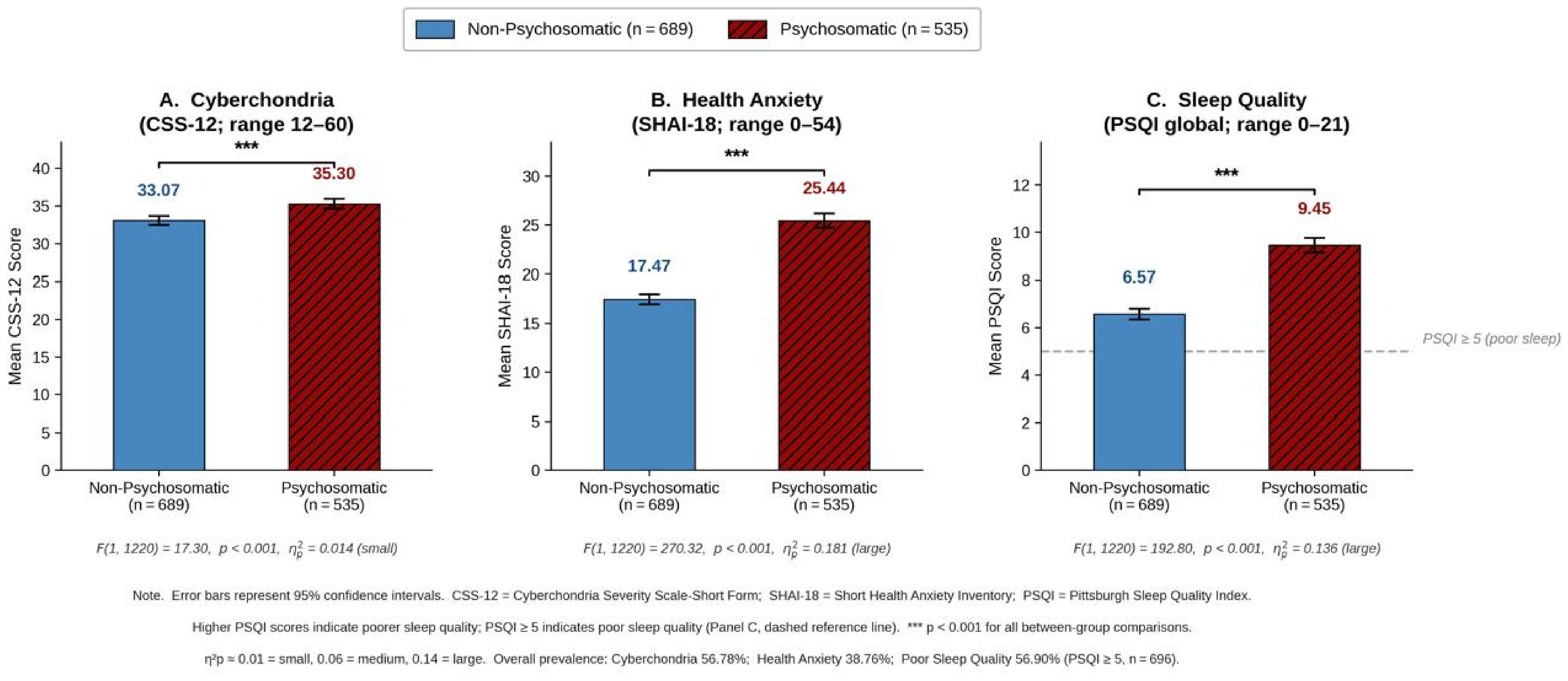
| Groups | 1282.532 | 1282.532 | 17.30 | <0.001 | 0.014 | |
| gender × Groups | 20.213 | 20.213 | 0.27 | 0.60 | <0.001 | |
| Health Anxiety | gender | 1244.856 | 1244.856 | 19.44 | <0.001 | 0.016 |
| Groups | 17,313.679 | 17,313.679 | 270.32 | <0.001 | 0.181 | |
| gender × Groups | 14.665 | 14.665 | 0.23 | 0.63 | <0.001 | |
| Sleep Quality | gender | 37.949 | 37.949 | 3.32 | 0.069 | 0.003 |
| Groups | 2203.356 | 2203.356 | 192.80 | <0.001 | 0.136 | |
| gender × Groups | 9.813 | 9.813 | 0.86 | 0.354 | 0.001 |
Disclaimer/Publisher’s Note: The statements, opinions and data contained in all publications are solely those of the individual author(s) and contributor(s) and not of MDPI and/or the editor(s). MDPI and/or the editor(s) disclaim responsibility for any injury to people or property resulting from any ideas, methods, instructions or products referred to in the content. |
© 2026 by the authors. Licensee MDPI, Basel, Switzerland. This article is an open access article distributed under the terms and conditions of the Creative Commons Attribution (CC BY) license.
Share and Cite
Elashram, R.E.M.; Bashshar, A.M.A.A.-B.; Abo-Bakr, A.S.S.; Al-Ghamdi, A.M. Cyberchondria, Health Anxiety, and Sleep Quality: An Observational Cross-Sectional Study of Adults with and Without Psychosomatic Disorders. Healthcare 2026, 14, 1356. https://doi.org/10.3390/healthcare14101356
Elashram REM, Bashshar AMAA-B, Abo-Bakr ASS, Al-Ghamdi AM. Cyberchondria, Health Anxiety, and Sleep Quality: An Observational Cross-Sectional Study of Adults with and Without Psychosomatic Disorders. Healthcare. 2026; 14(10):1356. https://doi.org/10.3390/healthcare14101356
Chicago/Turabian StyleElashram, Reda Ebrahim Mohamed, Ali Mohammed Ali Al-Basiouni Bashshar, Ahmed Samir Sedik Abo-Bakr, and Ali Marzouq Al-Ghamdi. 2026. "Cyberchondria, Health Anxiety, and Sleep Quality: An Observational Cross-Sectional Study of Adults with and Without Psychosomatic Disorders" Healthcare 14, no. 10: 1356. https://doi.org/10.3390/healthcare14101356
APA StyleElashram, R. E. M., Bashshar, A. M. A. A.-B., Abo-Bakr, A. S. S., & Al-Ghamdi, A. M. (2026). Cyberchondria, Health Anxiety, and Sleep Quality: An Observational Cross-Sectional Study of Adults with and Without Psychosomatic Disorders. Healthcare, 14(10), 1356. https://doi.org/10.3390/healthcare14101356