Article

Risk Factors, Clinical Outcomes, and Medical Costs of Pelvic Infection After Open Pelvic Fractures: A 7-Year Retrospective Observational Study at a Single Trauma Center


Division of Trauma Surgery, Department of Surgery, Ajou University School of Medicine, Suwon 16499, Republic of Korea
*
Author to whom correspondence should be addressed.
Healthcare 2026, 14(10), 1328; https://doi.org/10.3390/healthcare14101328
Submission received: 10 March 2026 / Revised: 11 May 2026 / Accepted: 11 May 2026 / Published: 13 May 2026
(This article belongs to the Special Issue New Tools and Technologies in Emergency Medicine and Critical Care)

Highlights

What are the main findings?
  • Pelvic infection occurred in 50% of open pelvic fractures and was independently associated with older age, elevated serum lactate, Gustilo–Anderson grade III injury, and anorectal injury.
  • Pelvic infection nearly tripled hospital stay, number of surgeries, and total medical costs compared with non-infected cases.
What are the implications of the main findings?
  • Early identification of high-risk patients may aid prevention strategies, including prompt wound management and optimized antibiotic therapy.
  • Preventing pelvic infection in open pelvic fractures may reduce healthcare resource utilization and overall treatment costs.

Abstract

Background/Objectives: Patients with unstable pelvic fractures typically die of hemorrhagic shock, whereas those with open pelvic fractures (OPF) more commonly die of pelvic infections (PIs) and pelvic sepsis (PS). We examined the clinical outcomes of PI in patients with OPFs. Methods: Patients with OPFs treated at our hospital between March 2016 and February 2023 were retrospectively reviewed. Factors associated with PI were identified using logistic regression analysis. Results: A total of 44 patients with OPFs were included, of whom 22 developed PIs. The number of patients with Gustilo–Anderson grade III was higher in the PI group than in the non-PI group (n = 18 vs. 8, p = 0.008). Similarly, anorectal injury was more frequent in the PI group than in the non-PI group (n = 15 vs. 3, p = 0.001). Multivariate logistic regression identified age (odds ratio 1.082 [95% confidence interval 1.020–1.148], p = 0.009), serum lactate level (1.319 [0.992–1.755], p = 0.018), presence of Gustilo–Anderson grade III (7.467 [0.987–56.517], p = 0.052), and anorectal injury (36.468 [3.107–427.991], p = 0.004) as independent risk factors for PI. Hospital length of stay, overall medical costs, and number of surgeries were 2.8 (84.0 vs. 30.5 days, p = 0.002), 2.9 (95,812 vs. 33,224 USD, p = 0.001), and 2.9 (13.0 vs. 4.5, p < 0.001) times higher in the PI group than in the non-PI group, respectively. Conclusions: Age and anorectal injury were significantly associated with pelvic infection. Serum lactate level and Gustilo–Anderson grade III injury showed possible associations, although statistical precision was limited. PIs were associated with high medical costs. Early wound management, precise antibiotic therapy, and multidisciplinary approaches are necessary to treat PIs.

1. Introduction

The mortality rate among patients with open pelvic fractures (OPFs) caused by high-energy trauma has been reported to range from 7% to 66.7% [1,2,3]. Unlike patients with unstable pelvic fractures, who typically die of hemorrhagic shock, patients with OPFs more commonly die of pelvic soft tissue infections and sepsis [4,5,6,7,8]. These patients often develop severe pelvic infections, including extensive soft tissue infections, necrotizing fasciitis, and pelvic sepsis [5,6,9,10,11].
Several studies have identified shock, advanced sepsis, intra-abdominal injury, and a low Glasgow Coma Scale score as risk factors for the development of pelvic infections and related mortality in patients with OPFs [2,7,8,12]. Early fecal diversion, repeated irrigation and debridement, negative pressure wound therapy, external fixation of the pelvis, and early multidisciplinary approaches have been recommended for treating pelvic infections associated with OPFs [6,8,10,11,13,14,15,16,17,18,19]. Despite these treatment strategies, OPFs are associated with a high incidence of complications, prolonged hospitalization, increased utilization of medical resources, and substantial medical costs [3,5,8,10,11].
This study aimed to examine the clinical characteristics and outcomes of pelvic infection in patients with OPFs and analyze the factors associated with increased medical costs. We hypothesized that advanced wound severity and injury increase the risk of pelvic infection and associated medical costs.

2. Materials and Methods

2.1. Compliance with Ethical Standards

This study was conducted in accordance with the Declaration of Helsinki and approved by the Institutional Review Board of Ajou University Hospital (AJOUIRB-DB-2023-331; 11 July 2023). The requirement for informed consent was waived for this study due to its retrospective design.

2.2. Patients

Patients with OPFs treated at our hospital between March 2016 and February 2023 were reviewed. Pediatric patients (aged <15 years) were excluded from the study. Data collected included patient demographics, associated injuries, surgical procedures, comorbidities, resuscitation methods, injury severity, and radiological and laboratory findings. Sex was recorded as a biological variable (female or male) based on medical records at admission.
Pelvic infection was defined as a broad soft-tissue infection of the pelvic perineum or infection of the deep pelvic organ space. Superficial surgical site infections were not classified as pelvic infections. If the same pathogen was identified in the pelvic wound and bloodstream of a patient diagnosed with sepsis, the condition was defined as pelvic sepsis. Pelvic infections were identified during the index hospitalization without a predefined post-discharge surveillance window; therefore, the reported rates should be interpreted as in-hospital events rather than standardized incidence measures.
Two orthopedic surgeons with more than 10 years of clinical experience analyzed the surgical records and radiological and clinical images. They independently evaluated the Arbeitsgemeinschaft für Osteosynthesefragen/Orthopedic Surgeon Orthopedic Trauma Association (AO/OTA), Young–Burgess, Gustilo–Anderson, and Jones–Powell classifications and the occurrence of pelvic infection. Interobserver agreement was assessed using Cohen’s κ statistics or weighted κ statistics for ordinal variables. Disagreements between reviewers were resolved through consensus discussion based on operative records, radiologic findings, and clinical course review.
The hospitalization period, intensive care unit (ICU) stay period, duration of mechanical ventilator, complications, in-hospital mortality, and medical costs were analyzed.

2.3. Statistical Analyses

Normality was assessed using the Kolmogorov–Smirnov test. Continuous variables were compared between the pelvic infection and non-pelvic infection groups using the Mann–Whitney U test or Student’s t-test, and the data were presented as medians and interquartile ranges. Categorical variations were analyzed using the chi-squared test or Fisher’s exact test. Logistic regression analysis was used to identify factors associated with pelvic infection. Results were expressed as odds ratios with 95% confidence intervals (CIs). Given the relatively high incidence of pelvic infection, additional analyses were performed to estimate risk ratios using a Poisson regression model with robust variance, which provides a more appropriate measure of association when the outcome is common. Variables with a p-value < 0.20 in univariate analysis were considered candidates for inclusion in the multivariable logistic regression model. Missing data were handled using complete-case analysis. The proportion of missing data for each variable was assessed, and variables with substantial missingness (>20%) were not included in the multivariable analysis. Given the small sample size and limited number of events, multiple imputation was not performed to avoid introducing additional model instability. A backward stepwise selection method was applied to identify independent predictors. Given the limited number of events, the number of variables included in the final model was restricted to avoid overfitting, and variables were selected based on both statistical significance and clinical relevance. A causal framework was prespecified to guide variable selection for multivariable analysis. Variables were classified as potential confounders or mediators based on clinical plausibility and prior literature. In particular, anorectal injury and injury severity were considered upstream exposures, whereas surgical interventions such as fecal diversion and laparotomy were considered potential mediators in the causal pathway to pelvic infection. Therefore, to avoid bias from adjustment for intermediates, these variables were not included in the final multivariable model. Multicollinearity among variables included in the regression analyses was assessed using variance inflation factors (VIFs) and condition indices. Model discrimination was assessed using the area under the receiver operating characteristic curve (AUC). All analyses were performed using SPSS (version 23.0; IBM Corp., Armonk, NY, USA) and the R (R Foundation for Statistical Computing, Vienna, Austria) packages GGally (version 2.1.2) and moonBook (version 0.3.1). A two-sided p value of <0.05 was considered statistically significant.

3. Results

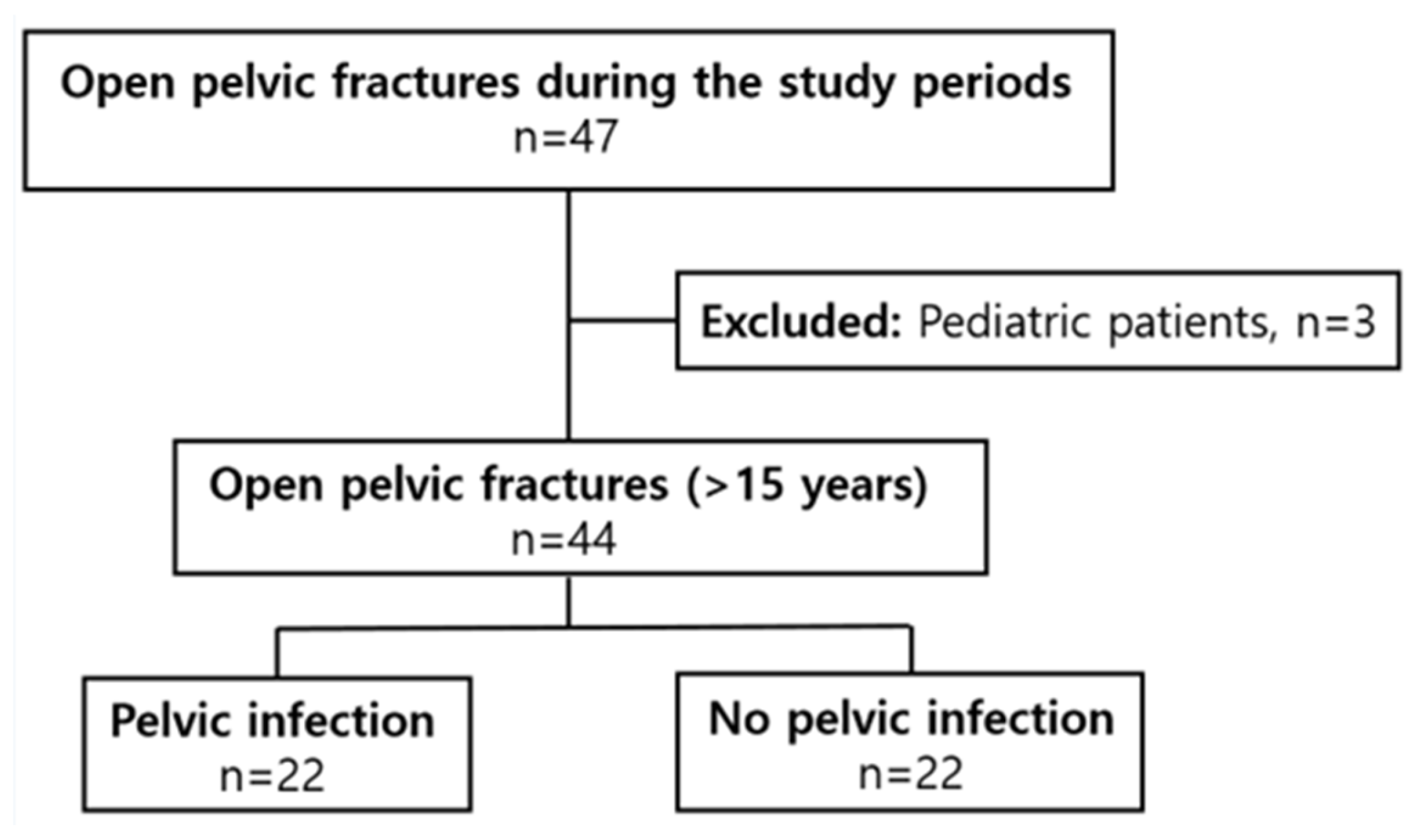
Between March 2016 and February 2023, 20,099 patients visited our hospital. Among them, 7249 had an Injury Severity Score (ISS) of ≥16. Of these, 675 had an Abbreviated Injury Scale (AIS) score of ≥4 points, and 47 had OPFs. After excluding three pediatric patients, 44 patients were included in the study (Figure 1). During treatment, 22 patients were identified as having pelvic infections. Interobserver agreement was excellent across all classification systems. Cohen’s κ for the AO/OTA classification was 1.000, while weighted κ values were 1.000 for the Young–Burgess classification, 0.941 for the Gustilo–Anderson classification, and 1.000 for the Jones–Powell classification, indicating almost perfect agreement.

3.1. Baseline Characteristics

Baseline characteristics are presented in Table 1. Of the 44 patients, 16 (36.4%) were female and 28 (63.6%) were male. There was no statistically significant difference in sex distribution between the pelvic and non-pelvic infection groups (p = 0.347). Patients in the pelvic infection group were older (55.5 [43–64] vs. 37.5 [22–56] years, p = 0.060) and had a higher ISS (41.5 [30–43] vs. 26.5 [22–43] years, p = 0.051). The pelvic infection group had higher blood lactate levels (8.02 [5.37–10.20] vs. 4.83 [2.93–7.90] mmol/L, p = 0.019). However, there were no statistically significant differences between the groups in vital signs or blood gas analysis. The injury mechanism and associated injury rate of AIS ≥ 3 did not differ between the groups. Missing data were minimal, with less than 20% missingness for all variables included in the primary analyses.

3.2. Analysis of Transfusion, Resuscitation, and Fecal Diversion

There were no statistically significant differences between the groups in the time required to start the transfusion or the amount of transfusion (Table 2). Laparotomy was performed more frequently in the pelvic infection group [n = 14 vs. 7, p = 0.070]. There were no statistically significant intergroup differences in the frequency of resuscitative endovascular balloon occlusion of the aorta, preperitoneal pelvic packing, angioembolization, external fixation, open reduction, or internal fixation. Repeat pelvic packing was performed only in the pelvic infection group (n = 5/10 vs. 0/9, p = 0.069). The rate of fecal diversion was higher in the pelvic infection group (n = 15 vs. 3, p = 0.001). There was no statistically significant difference between the groups in the time taken until fecal diversion or the percentage of fecal diversions performed within 48 h after arrival at the hospital.

3.3. Analysis of Pelvic Fracture Classification and Anorectal Injury

Eighteen patients in the pelvic infection group had Gustilo–Anderson grade III, which was more than twice as high as that in the non-pelvic infection group (n = 8) (p = 0.008) (Table 3). There were no differences between the groups in the AO/OTA classification or the Young–Burgess and Jones–Powell classes. Anorectal injury was more common in the pelvic infection group (n = 15 vs. 3, p = 0.001).

3.4. Logistic Regression for Pelvic Infection

In univariate logistic regression analysis, age, lactate level, ISS, presence of anorectal injury, need for laparotomy, and fecal diversion were statistically significant factors for pelvic infection. Although ISS, laparotomy, and fecal diversion were associated with pelvic infection in univariate analysis, laparotomy and fecal diversion were not included in the multivariable model because they were considered potential mediators rather than confounders; therefore, in the multivariable logistic regression analysis, age (odds ratio 1.02 [95% confidence interval 1.020–1.148], p = 0.009) and anorectal injury (36.468 [3.107–427.991], p = 0.004) were associated with pelvic infection, whereas serum lactate level (1.319 [0.992–1.755], p = 0.018) and Gustilo–Anderson grade III (7.467 [0.987–56.517], p = 0.052) showed suggestive but statistically imprecise associations (Table 4). In additional analyses using Poisson regression with robust variance estimation, age (RR 1.023, 95% CI 1.009–1.037), serum lactate level (RR 1.091, 95% CI 1.024–1.163), Gustilo–Anderson grade III injury (RR 2.253, 95% CI 1.089–4.662), and anorectal injury (RR 2.444, 95% CI 1.446–4.129) remained associated with pelvic infection (Supplementary Table S1). No significant multicollinearity was observed. The VIF values ranged from 1.10 to 2.45, and the maximum condition index was 3.33. The model demonstrated acceptable calibration, as indicated by the Hosmer–Lemeshow goodness-of-fit test (p = 0.342). The Nagelkerke R2 was 0.677, suggesting a moderate-to-substantial proportion of explained variance. Model discrimination was excellent, with an area under the receiver operating characteristic curve (AUC) of 0.926 (95% CI, 0.838–0.983).

3.5. Analysis of Complications and Clinical Outcomes

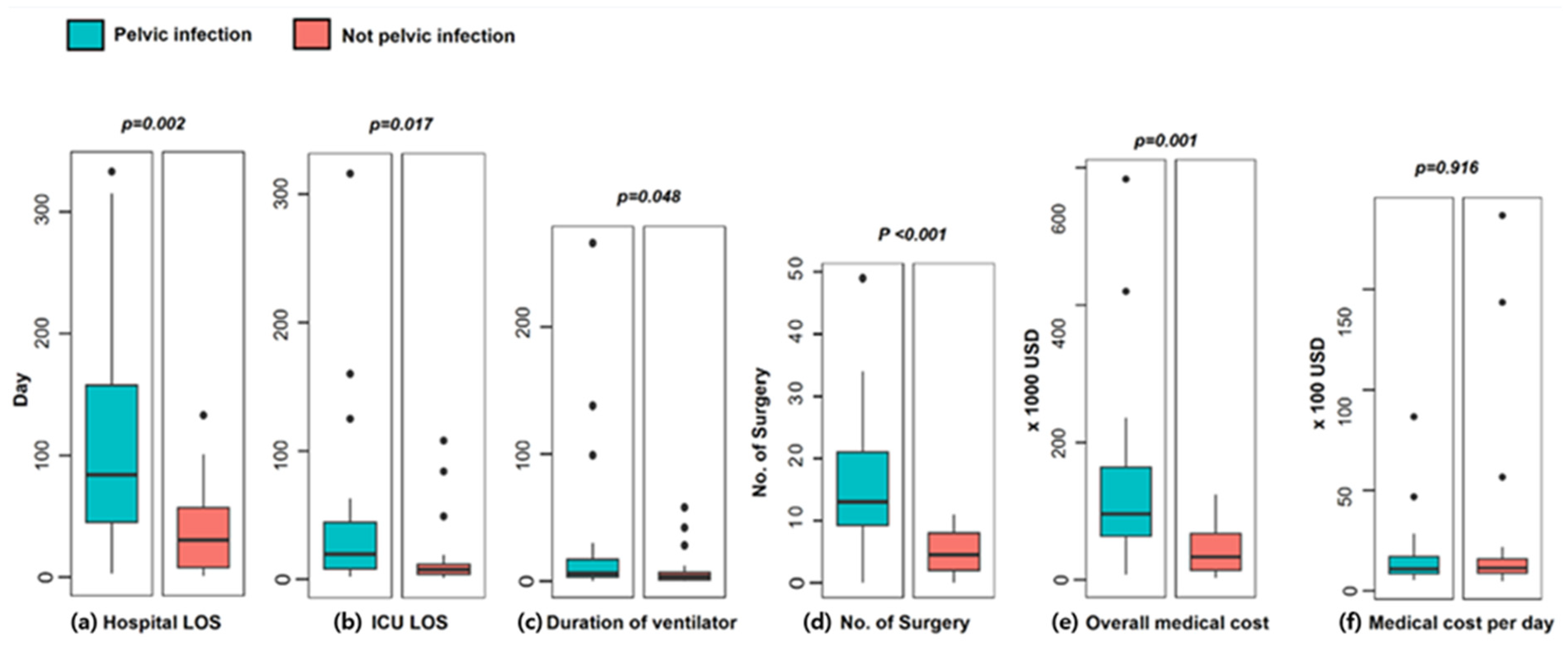
Sepsis, pneumonia, and acute kidney injury occurred more frequently in the pelvic infection group; however, the differences were not significant (Table 5). The pelvic infection group required approximately three times more surgeries during hospitalization than the non-pelvic infection group (13.0 [9–12] vs. 4.5 [2–8], p < 0.001) (Figure 2). The hospital length of stay (LOS, 84.0 vs. 30.5 days, p = 0.002), ICU stay (19.5 vs. 7.5 days, p = 0.017), and duration of mechanical ventilation (6.0 vs. 3.5 days, p = 0.048) were more than twice as long in the pelvic infection group as in the non-pelvic infection group. In-hospital mortality was lower in the pelvic infection group; however, the difference was not statistically significant (n = 3 vs. 4, p = 1.000). Deaths due to bleeding were encountered only in the non-pelvic infection group. Cases of death due to sepsis or multiorgan dysfunction syndrome (MODS) occurred only in the pelvic infection group.
The overall medical cost was three times higher in the pelvic infection group than in the non-pelvic infection group (95,812 vs. 33,224 USD, p = 0.001); however, there was no significant difference in the medical cost per day (1089 vs. 1142 USD, p = 1.000) (Figure 2).
The hospital LOS (median [interquartile range]) and number of surgeries for patients with OPFs were 55.5 (15–100) days and 9.0 (3–13), respectively.

3.6. Analysis of Microflora in Pelvic Infection of Open Pelvic Fractures

Enterococcus faecalis (n = 15) and coagulase-negative Staphylococcus (n = 13) were the most common microflora in the pelvic wounds of patients diagnosed with pelvic infections, followed by Escherichia coli (n = 11) (Table 6). E. coli and Staphylococcus aureus were the most common pathogens in the bloodstream (n = 4), followed by E. faecalis and Bacteroides (n = 3). Eight types of microflora were identified as the cause of pelvic sepsis, with E. coli being the most common pathogen (n = 4), followed by E. faecalis (n = 3).

4. Discussion

This study identified age, serum lactate level, Gustilo–Anderson grade III injury, and anorectal injury as independent risk factors for pelvic infection in patients with OPFs. Furthermore, pelvic infection was associated with high medical costs and resource utilization.
OPFs are life-threatening injuries with high morbidity and mortality [2,5,12,20,21]. Despite advances in damage-control techniques and radiological interventions, OPFs continue to require substantial medical resources [18]. Unlike pelvic fractures that often result in mortality from hemorrhagic shock in the early stages of trauma, OPFs are characterized by delayed morbidity and mortality [2,22]. Frane et al. [23] analyzed open pelvic ring fractures in 19,834 patients and reported that pneumonia, deep organ space surgical site infections, and sepsis were major complications. Dente et al. reported that 45% (n = 9) of the overall mortality in patients with OPFs was associated with late mortality [2]. In this study, pelvic infection was diagnosed in 22 patients with OPFs, and three patients with pelvic infection died of pelvic sepsis. In contrast, death due to hemorrhagic shock occurred only in two patients in the non-pelvic infection group, which was fewer than the deaths caused by sepsis or MODS.
Age is a major prognostic factor in trauma [24]. As the age of a patient increases, the development of comorbidities also increases [25]. Therefore, the Trauma and Injury Severity Score (TRISS), which is a combined scoring system that predicts the survival of trauma patients, adopts age as a major variable [26]. Frane et al. analyzed OPFs based on data from the National Trauma Data Bank and found that patient age was an independent risk factor for OPF complications [23]. A study by Tsugawa et al. reported that 37% of patients with OPFs aged ≥60 years with rectal injury died [14]; Tsugawa et al. suggested that fecal diversion should be considered as a treatment option for older patients with low physiological reserves. Dong et al. reported that among patients with OPFs, the overall mortality was higher in those aged >30 years [27]. Similarly to previous studies, age was found to be an independent risk factor for pelvic infections in our study.
The Faringer zone and Jones–Powell, Gustilo–Anderson, AO/OTA, and Young–Burgess classes were used to evaluate the severity of OPFs and predict their prognosis [2,5,8,20,27,28]. Dente et al. reported the vertical shearing type of Young–Burgess class, Faringer zone I or II, and Gustilo–Anderson grade III as predictive risk factors for overall mortality in OPFs [2]. However, the Young–Burgess class was excluded as a risk factor for late mortality, and Faringer zone I or II and Gustilo–Anderson grade III remained. Dong et al. reported the Gustilo–Anderson grade as a risk factor for late mortality [27], and Cannada et al. reported Jones–Powell class 3 and rectal injury as risk factors predicting mortality in OPFs [5]. Contrary to previous studies, our study did not identify an evaluation tool that could predict overall or late mortality; however, anorectal injury was consistently associated with pelvic infection, whereas serum lactate level and Gustilo–Anderson grade III demonstrated a possible association with substantial statistical uncertainty.
This study showed a relatively higher ISS and a lower revised trauma score than those reported in previous studies; however, the mortality rate was not high. This may reflect the implementation of an updated trauma management strategy, aggressive resuscitation, early wound management, and an early multidisciplinary approach for pelvic infection during the study period. Furthermore, Fitzgerald et al. [29] and Siada et al. [30] reported improved outcomes for OPFs following advances in damage-control surgery and the introduction of current management algorithms.
OPFs often result in high medical costs due to long-term hospitalization and repeated surgeries [3,23]. Chien et al. showed that the average hospitalization period and medical costs for patients with pelvic fracture were 9.3 days and 1475 USD, respectively [31]. Frane et al. [23] reported that the group with complications among patients with OPFs had 2.5 times longer hospitalization periods than the group without complications (17.2 vs. 6.9 days), and Fitzgerald et al. reported that patients with OPFs needed 2.3 times more surgeries than those with closed pelvic fractures [29]. Guo et al. analyzed 46 cases of OPFs and reported a mean hospital LOS of 53.0 ± 37.6 days and mean overall medical cost of 57,049 ± 41,975 USD [3]. The hospital LOS, overall medical cost, and number of surgeries in the pelvic infection group were 2.8 times (84.0 days vs. 30.5 days), 2.9 times (95,812 vs. 33,224 USD), and 2.9 times (13.0 vs. 4.5) higher than those in the non-pelvic infection group, respectively. Therefore, when establishing a treatment strategy for patients with OPFs, efforts to prevent the occurrence of pelvic infections are necessary to save on medical resources and costs.
OPFs are frequently exposed to various microorganisms [10]. Tsugawa et al. reported that E. coli and Bacteroides are the main pathogens causing infectious complications in OPFs [14]. Salášek et al., who reported surgical site infections in patients with pelvic ring injuries, found that coagulase-negative Staphylococcus, E. faecalis, Pseudomonas aeruginosa, and E. coli were the major pathogens [19]. In this study, the frequency of identification of major wound pathogens in pelvic infections was in the following order: E. faecalis, coagulase-negative Staphylococcus, E. coli, and S. aureus. However, the types of pathogens detected in the bloodstream of patients with sepsis differed. E. coli and S. aureus were the most commonly identified bacteria, followed by E. faecalis and Bacteroides. Coagulase-negative Staphylococcus was not cultured from patients with pelvic sepsis. The average number of pathogens identified by culture in the patients with pelvic infections was 5.2. Therefore, patients with OPFs and an increased frequency of mortality or morbidity due to pelvic sepsis or MODS should be administered broad-spectrum antibiotics at the earliest [12]. Furthermore, given the variability of bloodstream pathogens according to our findings, it is crucial to treat patients with severe pelvic infections with sepsis or MODS in consideration of changes in microorganisms.
The interpretation of our multivariable analysis should be considered within a causal framework. Variables such as anorectal injury and overall injury severity represent upstream factors, whereas surgical interventions including fecal diversion and laparotomy are likely to occur downstream in the clinical course and may lie on the causal pathway to pelvic infection. Adjusting for such intermediate variables may introduce bias, including collider stratification bias, and potentially attenuate or distort the true effects of upstream exposures. Therefore, these variables were not included in the final model.
This study has some limitations. First, selection bias may have occurred because this study retrospectively analyzed OPFs that occurred at a single center. However, the single-center design also ensures consistency in trauma management and decision-making, thereby reducing treatment heterogeneity. Second, the number of cases was small because the frequency of OPF is low. During the 7-year study period at this high-volume trauma center, approximately seven patients were diagnosed with OPFs annually. Therefore, a multicenter, large-scale study is required to generalize the results of this study. But despite the limited sample size, several variables demonstrated relatively large effect sizes and consistent associations with pelvic infection. Third, patients in this study had more severe and frequent pelvic infections than those in previous studies. A recent study reported selective fecal diversion in the management of OPFs [14]. However, fecal diversion was performed in most patients with anorectal injuries at our center. Therefore, selection bias may have occurred in relation to the treatment algorithm. Fourth, more detailed standardized criteria for pelvic infection were not applied, which may introduce some degree of diagnostic bias. However, in the context of open pelvic fractures, the distinction between superficial and deep infections is often clinically challenging due to complex anatomy, extensive soft tissue injury, and dynamic progression of infection. To minimize misclassification, infection status was independently assessed by two experienced orthopedic trauma surgeons based on comprehensive clinical, radiological, and operative findings. Fifth, the definition of pelvic sepsis in this study was based on microbiological concordance between pelvic wound and bloodstream isolates, which is a restrictive criterion. This approach likely underestimates the true incidence of pelvic sepsis, as a substantial proportion of clinically relevant infections may be culture-negative due to prior empirical antibiotic use, fastidious or anaerobic organisms, or limitations in culture techniques. Furthermore, this definition does not align with Sepsis-3 criteria, which are based on organ dysfunction rather than microbiological confirmation. Therefore, our reported incidence of pelvic sepsis should be interpreted as a conservative estimate reflecting microbiologically confirmed cases. Future studies should incorporate clinical criteria, including organ dysfunction and radiologic findings, to better capture the full spectrum of pelvic sepsis. Sixth, although sex distribution was reported and did not differ significantly between groups, sex-based subgroup analyses were not performed due to the small cohort size and restricted statistical power. Biological sex may influence trauma response, immune function, and infection risk. Therefore, future studies with larger populations should include adequately powered sex-disaggregated analyses. Seventh, because pelvic infection occurred in 50% of the study population, odds ratios may have overestimated the strength of association relative to risk ratios. Additional Poisson regression analyses with robust variance demonstrated attenuated but directionally consistent effect estimates. Eighth, there is the potential for model overfitting in the multivariable logistic regression analysis. With only 22 events (pelvic infection cases) and four variables included in the final model, the events-per-variable ratio was approximately 5.5, which is below the commonly recommended threshold of 10. This may result in unstable effect estimates and overly wide confidence intervals. Although the model demonstrated excellent discrimination (AUC 0.926, 95% CI 0.838–0.983), the relatively small sample size and limited number of outcome events may increase the risk of model optimism and overfitting. Therefore, the model should be interpreted as exploratory and hypothesis-generating rather than as a validated clinical prediction tool. Indeed, several variables demonstrated wide confidence intervals, reflecting substantial uncertainty in the estimated effects. Therefore, the results of the multivariable analysis should be interpreted with caution and regarded as exploratory and hypothesis-generating rather than confirmatory. This study has additional limitations related to missing data. As a retrospective analysis over a 7-year period, incomplete documentation of clinical variables was unavoidable. We used a complete-case analysis approach, which may introduce bias if the data were not missing completely at random. In particular, missingness related to injury severity or clinical status could potentially affect the observed associations. Therefore, the results should be interpreted with caution.

5. Conclusions

Age and anorectal injury were significantly associated with pelvic infection. Serum lactate level and Gustilo–Anderson grade III injury showed possible associations, although statistical precision was limited. Pelvic infections were associated with high medical costs and resource utilization. Aggressive resuscitation, early wound management, precise antibiotic therapy, and early multidisciplinary approaches are necessary for treating pelvic infections and preventing sepsis.

Supplementary Materials

The following supporting information can be downloaded at: https://www.mdpi.com/article/10.3390/healthcare14101328/s1, Supplementary Table S1. Comparison of effect estimates derived from Poisson regression with robust variance (risk ratios).

Author Contributions

Conceptualization, D.C., J.S., W.T.C., H.K.S. and K.J.; methodology, D.C., J.S., W.T.C., H.K.S. and K.J.; software, D.C. and J.S.; validation, D.C., J.S. and K.J.; formal analysis, D.C., J.S. and K.J.; investigation, D.C., J.S., W.T.C. and H.K.S.; resources, W.T.C. and H.K.S.; data curation, D.C., J.S. and K.J.; writing—original draft preparation, D.C., J.S. and K.J.; writing—review and editing, D.C., J.S. and K.J.; visualization, D.C. and J.S.; supervision, K.J.; project administration, D.C. and J.S. All authors have read and agreed to the published version of the manuscript.

Funding

This research received no external funding.

Institutional Review Board Statement

This study was conducted in accordance with the Declaration of Helsinki and approved by the Institutional Review Board of Ajou University Hospital (AJOUIRB-DB-2023-331; 11 July 2023).

Informed Consent Statement

The requirement for informed consent was waived for this study due to its retrospective design.

Data Availability Statement

The data supporting the conclusions of this article will be made available by the authors on request because the data may contain patients’ personal information.

Conflicts of Interest

The authors declare no conflicts of interest.

Abbreviations

The following abbreviations are used in this manuscript:
OPFOpen pelvic fracture
AO/OTAArbeitsgemeinschaft für Osteosynthesefragen/Orthopedic Surgeon Orthopedic Trauma Association
ICUIntensive care unit
CIConfidence interval
ISSInjury Severity Score
AISAbbreviated Injury Scale
IQRInterquartile range
DBPDiastolic blood pressure
GCSGlasgow Coma Scale
MCAMotorcycle accident
MVAMotor vehicle accident
PRPulse rate
RRRespiratory rate
RTSRevised trauma score
SBPSystolic blood pressure
TRISSTrauma and Injury Severity Score
APCAnteroposterior compression
LCLateral compression
VSVertical shearing
FFPFresh frozen plasma
ORIFOpen reduction and internal fixation
PPPPreperitoneal pelvic packing
PLTPlatelet
RBCRed blood cell
REBOAResuscitative endovascular balloon occlusion of the aorta
AKIAcute kidney injury
ARFAcute renal failure
LOSLength of stay
MODSMultiorgan dysfunction syndrome
DVTDeep vein thrombosis
PTEPulmonary thromboembolism

References

  1. Jones, A.L.; Powell, J.N.; Kellam, J.F.; McCormack, R.G.; Dust, W.; Wimmer, P. Open pelvic fractures. A multicenter retrospective analysis. Orthop. Clin. N. Am. 1997, 28, 345–350. [Google Scholar] [CrossRef]
  2. Dente, C.J.; Feliciano, D.V.; Rozycki, G.S.; Wyrzykowski, A.D.; Nicholas, J.M.; Salomone, J.P.; Ingram, W.L. The outcome of open pelvic fractures in the modern era. Am. J. Surg. 2005, 190, 830–835. [Google Scholar] [CrossRef]
  3. Guo, Q.; Zhang, L.; Zhou, S.; Zhang, Z.; Liu, H.; Zhang, L.; Talmy, T.; Li, Y. Clinical features and risk factors for mortality in patients with open pelvic fracture: A retrospective study of 46 cases. J. Orthop. Surg. 2020, 28, 2309499020939830. [Google Scholar] [CrossRef]
  4. Maull, K.I.; Sachatello, C.R.; Ernst, C.B. The deep perineal laceration-an injury frequently associated with open pelvic fractures: A need for aggressive surgical management. A report of 12 cases and review of the literature. J. Trauma 1977, 17, 685–696. [Google Scholar] [CrossRef]
  5. Cannada, L.K.; Taylor, R.M.; Reddix, R.; Mullis, B.; Moghadamian, E.; Erickson, M.; Southeastern Fracture Consortium. The Jones-Powell Classification of open pelvic fractures: A multicenter study evaluating mortality rates. J. Trauma Acute Care Surg. 2013, 74, 901–906. [Google Scholar] [CrossRef] [PubMed]
  6. Hasankhani, E.G.; Omidi-Kashani, F. Treatment outcomes of open pelvic fractures associated with extensive perineal injuries. Clin. Orthop. Surg. 2013, 5, 263–268. [Google Scholar] [CrossRef] [PubMed]
  7. Lalwani, S.; Rajkumari, N.; Mathur, P.; Sharma, V.; Trikha, V. Sepsis in fatal pelvic trauma patients: Report from a level-1 Indian Trauma Centre. Eur. J. Trauma Emerg. Surg. 2016, 42, 43–45. [Google Scholar] [CrossRef]
  8. Song, W.; Zhou, D.; Xu, W.; Zhang, G.; Wang, C.; Qiu, D.; Dong, J. Factors of pelvic infection and death in patients with open pelvic fractures and rectal injuries. Surg. Infect. 2017, 18, 711–715. [Google Scholar] [CrossRef]
  9. Wei, R.; Cao, X.; Tu, D. Clinical treatment of open pelvic fractures associated with perineal injury. Zhongguo Xiu Fu Chong Jian Wai Ke Za Zhi 2012, 26, 550–553. [Google Scholar] [PubMed]
  10. Kataoka, Y.; Minehara, H.; Shimada, K.; Nishimaki, H.; Soma, K.; Maekawa, K. Sepsis caused by peripelvic soft tissue infections in critically injured patients with multiple injuries and unstable pelvic fracture. J. Trauma 2009, 66, 1548–1554, discussion 54–55. [Google Scholar] [CrossRef]
  11. Labler, L.; Trentz, O. The use of vacuum assisted closure (VAC) in soft tissue injuries after high energy pelvic trauma. Langenbecks Arch. Surg. 2007, 392, 601–609. [Google Scholar] [CrossRef]
  12. Grotz, M.R.; Allami, M.K.; Harwood, P.; Pape, H.C.; Krettek, C.; Giannoudis, P.V. Open pelvic fractures: Epidemiology, current concepts of management and outcome. Injury 2005, 36, 1–13. [Google Scholar] [CrossRef]
  13. Woods, R.K.; O’Keefe, G.; Rhee, P.; Routt, M.L., Jr.; Maier, R.V. Open pelvic fracture and fecal diversion. Arch. Surg. 1998, 133, 281–286. [Google Scholar] [CrossRef]
  14. Tsugawa, K.; Koyanagi, N.; Hashizume, M.; Ayukawa, K.; Wada, H.; Tomikawa, M.; Sugimachi, K. New therapeutic strategy of open pelvic fracture associated with rectal injury in 43 patients over 60 years of age. Hepato-Gastroenterol. 2002, 49, 1275–1280. [Google Scholar]
  15. Lunsjo, K.; Abu-Zidan, F.M. Does colostomy prevent infection in open blunt pelvic fractures? A systematic review. J. Trauma 2006, 60, 1145–1148. [Google Scholar] [CrossRef]
  16. Govaert, G.; Siriwardhane, M.; Hatzifotis, M.; Malisano, L.; Schuetz, M. Prevention of pelvic sepsis in major open pelviperineal injury. Injury 2012, 43, 533–536. [Google Scholar] [CrossRef]
  17. Fitzgerald, C.A.; Moore, T.J., Jr.; Morse, B.C.; Subramanian, A.; Dente, C.J.; Patel, D.C.; Reisman, W.M.; Schenker, M.L.; Gelbard, R.B. The role of diverting colostomy in traumatic blunt open pelvic fractures. Am. Surg. 2017, 83, e280–282. [Google Scholar] [CrossRef] [PubMed]
  18. Roszman, A.D.; John, D.Q.; Patch, D.A.; Spitler, C.A.; Johnson, J.P. Management of open pelvic ring injuries. Injury 2023, 54, 1041–1046. [Google Scholar] [CrossRef]
  19. Salášek, M.; Český, R.; Whitley, A.; Šídlo, K.; Klézl, P.; Džupa, V. Surgical site infections after stabilization of pelvic ring injuries: A retrospective analysis of risk factors and a meta-analysis of similar studies. Int. Orthop. 2023, 47, 1331–1344. [Google Scholar] [CrossRef] [PubMed]
  20. Giordano, V.; Koch, H.A.; Gasparini, S.; Serrão de Souza, F.; Labronici, P.J.; do Amaral, N.P. Open pelvic fractures: Review of 30 cases. Open Orthop. J. 2016, 10, 772–778. [Google Scholar] [CrossRef] [PubMed]
  21. Watkins, R.J.; Hsu, J.M. The road to survival for haemodynamically unstable patients with open pelvic fractures. Front. Surg. 2020, 7, 58. [Google Scholar] [CrossRef]
  22. Wang, H.; Robinson, R.D.; Moore, B.; Kirk, A.J.; Phillips, J.L.; Umejiego, J.; Chukwuma, J.; Miller, T.; Hassani, D.; Zenarosa, N.R. Predictors of early versus late mortality in pelvic trauma patients. Scand. J. Trauma Resusc. Emerg. Med. 2016, 24, 27. [Google Scholar] [CrossRef] [PubMed]
  23. Frane, N.; Iturriaga, C.; Bub, C.; Regala, P.; Katsigiorgis, G.; Linn, M. Risk factors for complications and in-hospital mortality: An analysis of 19,834 open pelvic ring fractures. J. Clin. Orthop. Trauma 2020, 11, 1110–1116. [Google Scholar] [CrossRef]
  24. Meisler, R.; Thomsen, A.B.; Theilade, P.; Abildstrøm, H.; Borge, P.; Treschow, M.; Korsgaard, G.M.; Rasmussen, S.W.; Bødtker, S.; Sylvest, A.; et al. Age-related differences in mechanism, cause, and location of trauma deaths. Minerva Anestesiol. 2011, 77, 592–597. [Google Scholar] [PubMed]
  25. Bamvita, J.M.; Bergeron, E.; Lavoie, A.; Ratte, S.; Clas, D. The impact of premorbid conditions on temporal pattern and location of adult blunt trauma hospital deaths. J. Trauma 2007, 63, 135–141. [Google Scholar] [CrossRef]
  26. Bull, J.P.; Dickson, G.R. Injury scoring by TRISS and ISS/age. Injury 1991, 22, 127–131. [Google Scholar] [CrossRef] [PubMed]
  27. Dong, J.L.; Zhou, D.S. Management and outcome of open pelvic fractures: A retrospective study of 41 cases. Injury 2011, 42, 1003–1007. [Google Scholar] [CrossRef]
  28. Hermans, E.; Edwards, M.J.R.; Goslings, J.C.; Biert, J. Open pelvic fracture: The killing fracture? J. Orthop. Surg. Res. 2018, 13, 83. [Google Scholar] [CrossRef]
  29. Fitzgerald, C.A.; Morse, B.C.; Dente, C.J. Pelvic ring fractures: Has mortality improved following the implementation of damage control resuscitation? Am. J. Surg. 2014, 208, 1083–1090, discussion 9–90. [Google Scholar] [CrossRef]
  30. Siada, S.S.; Davis, J.W.; Kaups, K.L.; Dirks, R.C.; Grannis, K.A. Current outcomes of blunt open pelvic fractures: How modern advances in trauma care may decrease mortality. Trauma Surg. Acute Care Open 2017, 2, e000136. [Google Scholar] [CrossRef]
  31. Chien, L.C.; Cheng, H.M.; Chen, W.C.; Tsai, M.C. Pelvic fracture and risk factors for mortality: A population-based study in Taiwan. Eur. J. Trauma Emerg. Surg. 2010, 36, 131–137. [Google Scholar] [CrossRef]
Figure 1. Flow diagram of the study.
Healthcare 14 01328 g001
Figure 2. Clinical outcomes and medical costs of open pelvic fractures.
Healthcare 14 01328 g002
Table 1. Baseline demographics.
No Pelvic InfectionPelvic Infectionp Value
(n = 22)(n = 22)
Age (years), median [IQR]37.5 [22.0–56.0]55.5 [43.0–64.0]0.060
Sex, n 0.347
Female106
Male1216
Presence of diabetes240.660
Mechanism of injury 0.374
MVA23
MCA13
Pedestrian58
Fall from height114
Struck23
Penetrating11
Blunt vs. Penetrating 1.000
Blunt2121
Penetrating11
Time to hospital (h)0.9 [0.6–2.4]0.9 [0.6–1.4]0.832
Admission 1.000
Transfer87
Direct1415
ISS26.5 [22.0–43.0]41.5 [30.0–43.0]0.051
RTS7.329 [5.967–7.841]6.963 [5.967–7.550]0.479
TRISS0.925 [0.680–0.964]0.827 [0.505–0.936]0.185
AIS ≥ 3
Head and neck400.116
Thorax6110.216
Abdomen4100.106
Extremity21211.000
Vital signs and gas analysis on arrival
SBP (mmHg)120.0 [86.0–137.0]97.5 [74.0–121.0]0.133
DBP (mmHg)78.5 [65.0–100.0]67.0 [47.0–87.0]0.213
PR (min−1)98.5 [86.0–114.0]107.0 [91.0–131.0]0.240
RR (min−1)20.5 [18.0–25.0]24.0 [19.0–30.0]0.213
GCS14.0 [6.0–15.0]14.0 [12.0–15.0]0.748
Lactate (mmol/L)4.83 [2.93–7.90]8.02 [5.37–10.20]0.019
Base excess (mmol/L)−7.90 [−11.00 to −3.10]−9.75 [−13.20 to −7.10]0.173
Abbreviations: AIS, Abbreviated Injury Scale; DBP, diastolic blood pressure; GCS, Glasgow Coma Scale; IQR, interquartile range; ISS, Injury Severity Score; MCA, motorcycle accident; MVA, motor vehicle accident; PR, pulse rate; RR, respiratory rate; RTS, revised trauma score; SBP, systolic blood pressure; TRISS, Trauma and Injury Severity Score.
Table 2. Pelvic fracture classification and anorectal injury.
No Pelvic InfectionPelvic Infectionp Value
(n = 22)(n = 22)
Gustilo–Anderson grade 0.008
121
2123
3818
AO/OTA class 0.578
A76
B47
C119
Young–Burgess class 0.698
APC711
LC32
VS56
Jones–Powell class 0.212
151
267
31114
Anorectal injury2130.001
Abbreviations: AO/OTA, Arbeitsgemeinschaft für Osteosynthesefragen/Orthopedic Surgeon’s Orthopedic Trauma Association; APC, anteroposterior compression; LC, lateral compression; VS, vertical shearing.
Table 3. Transfusion, resuscitation, and fecal diversion.
No Pelvic InfectionPelvic Infectionp Value
(n = 22)(n = 22)
Transfusion
Time to transfusion (min−1)16.5 [9.0–43.5]13.0 [7.0–20.0]0.231
RBC for first 24 h18.0 [6.0–27.5]19.5 [9.0–33.0]0.929
FFP for first 24 h17.5 [6.0–28.0]19.0 [5.0–33.0]0.824
PLT for first 24 h4.5 [0.5–9.5]7.5 [2.0–16.0]0.355
Massive transfusion11160.216
Resuscitation and surgical procedures
REBOA530.696
PPP9101.000
Repeated packing050.069
Angioembolization891.000
Laparotomy7140.070
External fixation451.000
ORIF790.754
Fecal diversion3150.001
Time to fecal diversion
(h)
48.0 [38.0–71.0]46.0 [6.0–118.0]0.800
Fecal diversion < 48 h281.000
Abbreviations: FFP, fresh frozen plasma; ORIF, open reduction and internal fixation; PPP, preperitoneal pelvic packing; PLT, platelet; RBC, red blood cell; REBOA, resuscitative endovascular balloon occlusion of the aorta.
Table 4. Univariate and multivariate logistic regression for pelvic infection.
Univariate AnalysisMultivariate Analysis
Odds Ratio (95% CI)p ValueOdds Ratio (95% CI)p Value
Age1.031(0.997–1.066)0.0771.082(1.020–1.148)0.009
Serum lactate1.183(0.994–1.408)0.0581.319(0.992–1.755)0.018
Anorectal injury14.444(2.682–77.796)0.00236.468(3.107–427.991)0.004
Gustilo–Anderson grade III7.875(1.964–31.547)0.0047.467(0.987–56.517)0.052
ISS1.047(0.995–1.101)0.077
Laparotomy3.750(1.076–13.073)0.038
Fecal diversion13.571(2.991–61.586)0.001
Nagelkerke’s R2 = 0.677; Hosmer–Lemeshow’s goodness-of-fit test, p = 0.342, 84.1%; Abbreviations: CI, confidence interval; ISS, injury severity score.
Table 5. Complications and in-hospital mortality.
No Pelvic InfectionPelvic Infectionp Value
(n = 22)(n = 22)
Complications
DVT321.000
PTE101.000
Sepsis160.099
Pneumonia240.660
AKI.ARF150.188
In-hospital mortality431.000
Cause of death 0.072
Bleeding20
Sepsis/MODS03
Brain10
Others10
Time to death (h)57.5 [28.5–110.5]63.0 [54.5–222.5]0.857
Abbreviations: AKI, acute kidney injury; ARF, acute renal failure; DVT, deep vein thrombosis; MODS, multiorgan dysfunction syndrome; PTE, pulmonary thromboembolism.
Table 6. Pathogen analysis of patients with pelvic infection.
Pathogen/LocationPelvic Wound,
n
Blood Stream,
n
Pelvic Sepsis,
n
Enterococcus faecalis1533
Coagulase-negative Staphylococcus1300
Escherichia coli1144
Staphylococcus aureus842
Pseudomonas aeruginosa810
Acinetobacter baumannii811
Enterococcus faecium721
Enterococcus avium700
Corynebacterium striatum500
Klebsiella pneumoniae522
Candida422
Stenotrophomonas maltophilia200
Enterococcus hirae100
Enterobacter cloacae110
Bacillus species100
Streptococcus agalactiae111
Citrobacter braakii100
Proteus mirabi100
Staphylococcus epidermidis020
Streptococcus mitis group010
Bacteroides030
Haemophilus influenzae010
Staphylococcus lugdunensis010
Clostridium species010
Disclaimer/Publisher’s Note: The statements, opinions and data contained in all publications are solely those of the individual author(s) and contributor(s) and not of MDPI and/or the editor(s). MDPI and/or the editor(s) disclaim responsibility for any injury to people or property resulting from any ideas, methods, instructions or products referred to in the content.