AI Versus Human-Delivered Online Cognitive Behavioral Therapy for Anxiety Symptoms in Young Adults: A Randomized Controlled Trial
 ,
,
Abstract
1. Introduction
2. Methods
2.1. Study Design
2.2. Participants and Research Personnel
2.2.1. Participants and Sample Size
2.2.2. Research Team
2.2.3. Randomization and Blinding
2.3. Intervention
2.3.1. AI Group
2.3.2. Human Group
2.4. Instruments
2.4.1. Measures
2.4.2. Psychotherapy System Information Sheets
2.4.3. Pre-Intervention Interview
2.4.4. Post-Intervention Interview
2.5. Study Procedure
2.5.1. Pilot Study
2.5.2. Formal Study
2.5.3. Debriefing
2.6. Data Analysis
3. Results
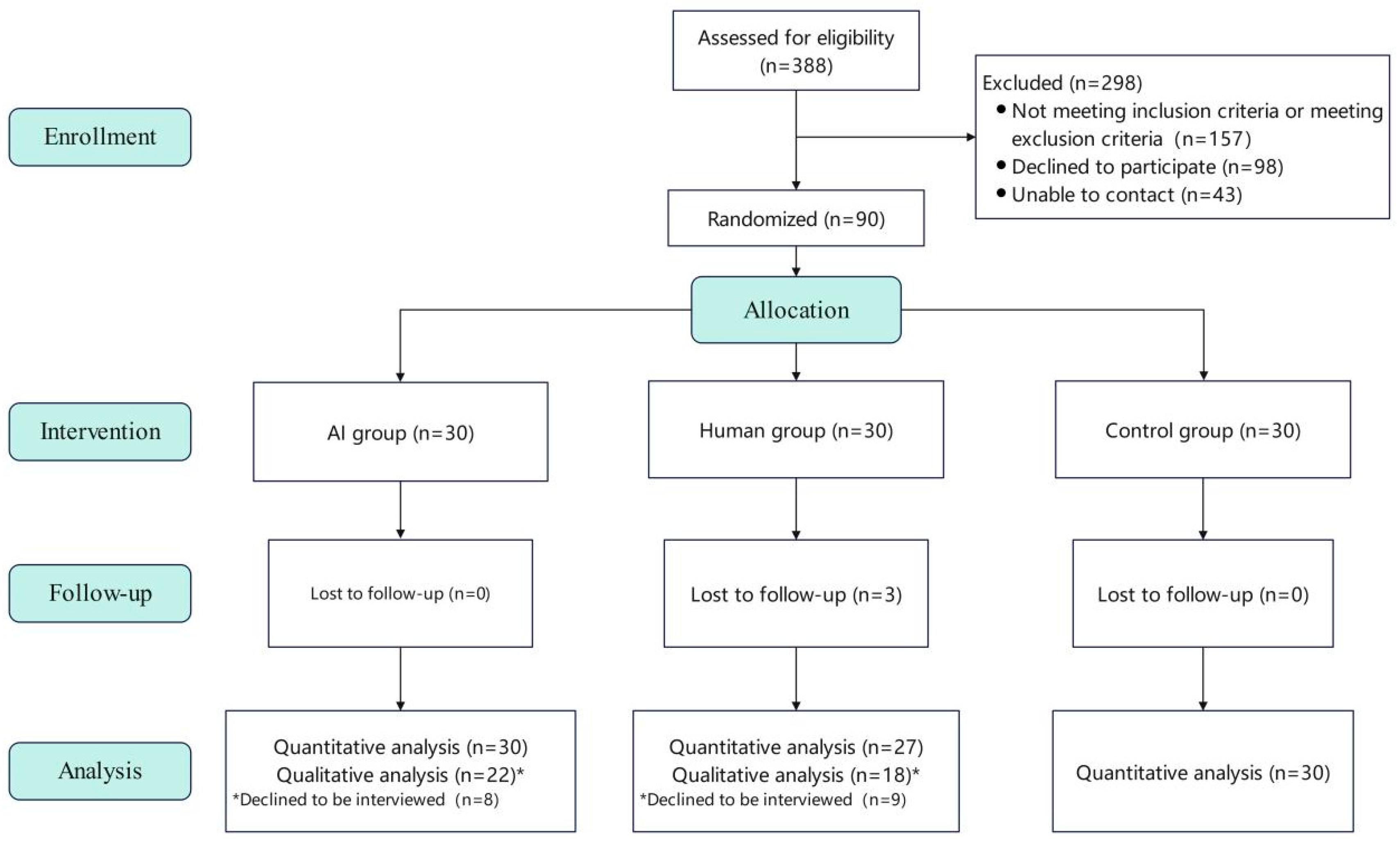
3.1. Participant Flow
3.2. Baseline Data
3.3. Quantitative Analysis
3.3.1. Changes in Anxiety Levels: Within-Group and Between-Group Comparisons
3.3.2. Changes in Self-Efficacy for Exercise and Sleep Quality
3.3.3. Differences in Perceived Psychotherapy Benefit
3.3.4. Qualitative Analysis
3.3.5. Intervention Process
3.3.6. Intervention Effectiveness
3.3.7. Future Perspectives
4. Discussion
4.1. Current Findings
4.2. Limitations
5. Conclusions
Supplementary Materials
Author Contributions
Funding
Institutional Review Board Statement
Informed Consent Statement
Data Availability Statement
Conflicts of Interest
References
- Santomauro, D.F.; Herrera, A.M.M.; Shadid, J.; Zheng, P.; Ashbaugh, C.; Pigott, D.M.; Abbafati, C.; Adolph, C.; Amlag, J.O.; Aravkin, A.Y.; et al. Global prevalence and burden of depressive and anxiety disorders in 204 countries and territories in 2020 due to the COVID-19 pandemic. Lancet 2021, 398, 1700–1712. [Google Scholar] [CrossRef]
- World Health Organization. Depression and Other Common Mental Disorders: Global Health Estimates. Available online: https://www.who.int/publications/i/item/depression-global-health-estimates (accessed on 7 May 2026).
- Chellappa, S.L.; Aeschbach, D. Sleep and anxiety: From mechanisms to interventions. Sleep Med. Rev. 2022, 61, 101583. [Google Scholar] [CrossRef]
- Kandola, A.; Stubbs, B. Exercise and Anxiety. In Advances in Experimental Medicine and Biology; Springer: Berlin/Heidelberg, Germany, 2020; Volume 1228, pp. 345–352. [Google Scholar] [CrossRef]
- Orgeta, V.; Leung, P.; Del-Pino-Casado, R.; Qazi, A.; Orrell, M.; Spector, A.E.; Methley, A.M. Psychological treatments for depression and anxiety in dementia and mild cognitive impairment. Cochrane Database Syst. Rev. 2022, 4, CD009125. [Google Scholar] [CrossRef]
- Rodebaugh, T.L.; Bielak, T.; Vidovic, V.; Moscovitch, D.A. The effects of social anxiety on interpersonal evaluations of warmth and dominance. J. Anxiety Disord. 2016, 38, 68–78. [Google Scholar] [CrossRef]
- Kariuki-Nyuthe, C.; Stein, D.J. Comorbidity of mental and physical disorders. In Anxiety and Related Disorders and Physical Illness; Sartorius, N., Holt, R.I.G., Maj, M., Eds.; Karger: Berlin, Germany, 2015; pp. 81–87. [Google Scholar]
- Li, J.; Cai, Z.; Li, X.; Du, R.; Shi, Z.; Hua, Q.; Zhang, M.; Zhu, C.; Zhang, L.; Zhan, X. Mindfulness-based therapy versus cognitive behavioral therapy for people with anxiety symptoms: A systematic review and meta-analysis of random controlled trials. Ann. Palliat. Med. 2021, 10, 7596–7612. [Google Scholar] [CrossRef] [PubMed]
- Gould, R.L.; Wetherell, J.L.; Kimona, K.; A Serfaty, M.; Jones, R.; Graham, C.D.; Lawrence, V.; Livingston, G.; Wilkinson, P.; Walters, K.; et al. Acceptance and commitment therapy for late-life treatment-resistant generalised anxiety disorder: A feasibility study. Age Ageing 2021, 50, 1751–1761. [Google Scholar] [CrossRef]
- Zhang, Q.; Yi, P.; Song, G.; Xu, K.; Wang, Y.; Liu, J.; Chen, Z.; Zhang, H.; Ma, L.; Liu, W.; et al. The efficacy of psychodynamic therapy for social anxiety disorder–A comprehensive meta-analysis. Psychiatry Res. 2022, 309, 114403. [Google Scholar] [CrossRef] [PubMed]
- Timulak, L.; Keogh, D.; Chigwedere, C.; Wilson, C.; Ward, F.; Hevey, D.; Griffin, P.; Jacobs, L.; Hughes, S.; Vaughan, C.; et al. A comparison of emotion-focused therapy and cognitive-behavioral therapy in the treatment of generalized anxiety disorder: Results of a feasibility randomized controlled trial. Psychotherapy 2022, 59, 84–95. [Google Scholar] [CrossRef]
- Afshari, B.; Jafarian Dehkordi, F.; Asgharnejad Farid, A.A.; Aramfar, B.; Balagabri, Z.; Mohebi, M.; Mardi, N.; Amiri, P. Study of the effects of cognitive behavioral therapy versus dialectical behavior therapy on executive function and reduction of symptoms in generalized anxiety disorder. Trends Psychiatry Psychother. 2022, 44, e20200156. [Google Scholar] [CrossRef] [PubMed]
- Lee, H.J.; Stein, M.B. Update on treatments for anxiety-related disorders. Curr. Opin. Psychiatry 2023, 36, 140–145. [Google Scholar] [CrossRef]
- Harvey, A. A cognitive model of insomnia. Behav. Res. Ther. 2002, 40, 869–893. [Google Scholar] [CrossRef]
- Kandola, A.; Vancampfort, D.; Herring, M.; Rebar, A.; Hallgren, M.; Firth, J.; Stubbs, B. Moving to Beat Anxiety: Epidemiology and Therapeutic Issues with Physical Activity for Anxiety. Curr. Psychiatry Rep. 2018, 20, 63. [Google Scholar] [CrossRef] [PubMed]
- Szuhany, K.L.; Simon, N.M. Anxiety Disorders: A Review. JAMA 2022, 328, 2431–2445. [Google Scholar] [CrossRef]
- Andrade, L.H.; Alonso, J.; Mneimneh, Z.; Wells, J.E.; Al-Hamzawi, A.; Borges, G.; Bromet, E.; Bruffaerts, R.; de Girolamo, G.; de Graaf, R.; et al. Barriers to mental health treatment: Results from the WHO World Mental Health surveys. Psychol. Med. 2013, 44, 1303–1317. [Google Scholar] [CrossRef]
- Wittchen, H.; Jacobi, F.; Rehm, J.; Gustavsson, A.; Svensson, M.; Jönsson, B.; Olesen, J.; Allgulander, C.; Alonso, J.; Faravelli, C.; et al. The size and burden of mental disorders and other disorders of the brain in Europe 2010. Eur. Neuropsychopharmacol. 2011, 21, 655–679. [Google Scholar] [CrossRef]
- Mack, S.; Jacobi, F.; Gerschler, A.; Strehle, J.; Höfler, M.; Busch, M.A.; Maske, U.E.; Hapke, U.; Seiffert, I.; Gaebel, W.; et al. Self-reported utilization of mental health services in the adult German population–evidence for unmet needs? Results of the DEGS1-Mental Health Module (DEGS1-MH). Int. J. Methods Psychiatr. Res. 2014, 23, 289–303. [Google Scholar] [CrossRef]
- Carlbring, P.; Andersson, G.; Cuijpers, P.; Riper, H.; Hedman-Lagerlöf, E. Internet-based vs. face-to-face cognitive behavior therapy for psychiatric and somatic disorders: An updated systematic review and meta-analysis. Cogn. Behav. Ther. 2017, 47, 1–18. [Google Scholar] [CrossRef]
- Richards, D.; Enrique, A.; Palacios, J. Internet-delivered Cognitive Behavioural Therapy. In The Handbook of Brief Therapies; Sage: Thousand Oaks, CA, USA, 2018; p. 173. [Google Scholar]
- Christensen, H.; Hickie, I.B. E-mental health: A new era in delivery of mental health services. Med. J. Aust. 2010, 192, S2–S3. [Google Scholar] [CrossRef] [PubMed]
- Duarte, A.; Walker, S.; Littlewood, E.; Brabyn, S.; Hewitt, C.; Gilbody, S.; Palmer, S. Cost-effectiveness of computerized cognitive–behavioural therapy for the treatment of depression in primary care: Findings from the Randomised Evaluation of the Effectiveness and Acceptability of Computerised Therapy (REEACT) trial. Psychol. Med. 2017, 47, 1825–1835. [Google Scholar] [CrossRef]
- Gilbody, S.; Brabyn, S.; Lovell, K.; Kessler, D.; Devlin, T.; Smith, L.; Araya, R.; Barkham, M.; Bower, P.; Cooper, C.; et al. Telephone-supported computerised cognitive–behavioural therapy: REEACT-2 large-scale pragmatic randomised controlled trial. Br. J. Psychiatry 2017, 210, 362–367. [Google Scholar] [CrossRef] [PubMed]
- Otter, D.W.; Medina, J.R.; Kalita, J.K. A Survey of the Usages of Deep Learning for Natural Language Processing. IEEE Trans. Neural Netw. Learn. Syst. 2020, 32, 604–624. [Google Scholar] [CrossRef]
- Aggarwal, A.; Tam, C.C.; Wu, D.; Li, X.; Qiao, S. Artificial Intelligence–Based Chatbots for Promoting Health Behavioral Changes: Systematic Review. J. Med. Internet Res. 2023, 25, e40789. [Google Scholar] [CrossRef]
- Sadeh-Sharvit, S.; Camp, T.D.; Horton, S.E.; Hefner, J.D.; Berry, J.M.; Grossman, E.; Hollon, S.D. Effects of an Artificial Intelligence Platform for Behavioral Interventions on Depression and Anxiety Symptoms: Randomized Clinical Trial. J. Med. Internet Res. 2023, 25, e46781. [Google Scholar] [CrossRef]
- He, Y.; Yang, L.; Zhu, X.; Wu, B.; Zhang, S.; Qian, C.; Tian, T. Mental Health Chatbot for Young Adults with Depressive Symptoms During the COVID-19 Pandemic: Single-Blind, Three-Arm Randomized Controlled Trial. J. Med. Internet Res. 2022, 24, e40719. [Google Scholar] [CrossRef]
- Prochaska, J.J.; A Vogel, E.; Chieng, A.; Kendra, M.; Baiocchi, M.; Pajarito, S.; Robinson, A. A Therapeutic Relational Agent for Reducing Problematic Substance Use (Woebot): Development and Usability Study. J. Med. Internet Res. 2021, 23, e24850. [Google Scholar] [CrossRef]
- Da Silva, J.G.G.; Kavanagh, D.J.; Belpaeme, T.; Taylor, L.; Beeson, K.; Andrade, J. Experiences of a Motivational Interview Delivered by a Robot: Qualitative Study. J. Med. Internet Res. 2018, 20, e116. [Google Scholar] [CrossRef] [PubMed]
- Schulz, K.F.; Altman, D.G.; Moher, D.; The CONSORT Group. CONSORT 2010 Statement: Updated guidelines for reporting parallel group randomised trials. BMJ 2010, 340, c332. [Google Scholar] [CrossRef]
- Liu, X.; Rivera, S.C.; Moher, D.; Calvert, M.J.; Denniston, A.K.; Ashrafian, H.; Beam, A.L.; Chan, A.W.; Collins, G.S.; Deeks, A.D.J.; et al. Reporting guidelines for clinical trial reports for interventions involving artificial intelligence: The CONSORT-AI extension. Lancet Digit. Health 2020, 2, e537–e548. [Google Scholar] [CrossRef] [PubMed]
- Zhong, W.; Luo, J.; Zhang, H. The therapeutic effectiveness of artificial intelligence-based chatbots in alleviation of depressive and anxiety symptoms in short-course treatments: A systematic review and meta-analysis. J. Affect. Disord. 2024, 356, 459–469. [Google Scholar] [CrossRef] [PubMed]
- Spitzer, R.L.; Kroenke, K.; Williams, J.B.; Löwe, B. A brief measure for assessing generalized anxiety disorder: The GAD-7. Arch. Intern. Med. 2006, 166, 1092–1097. [Google Scholar] [CrossRef]
- Guo, Z. The Introduction to Cognitive Behavioral Therapy; Posts and Telecommunications Press: Beijing, China, 2020. (In Chinese) [Google Scholar]
- Beck, J.S.; Beck, A.T. Cognitive Behavior Therapy: Basics and Beyond, 2nd ed.; The Guilford Press: New York, NY, USA, 2011; pp. 81–93. [Google Scholar]
- Ehly, S.W.; Vazquez, E.G. Peer counseling. In Peer-Assisted Learning; Routledge: Oxfordshire, UK, 1998; pp. 219–234. [Google Scholar]
- Shi, M.; Zhu, X. Clients’ Perception and Experience in “AI” Counseling. In Proceedings of the 21st National Academic Congress of Psychology, Chinese Psychological Society, Beijing, China, 2–4 November 2018. [Google Scholar]
- Buck, M.R. Peer counseling in an urban high school setting. J. Sch. Psychol. 1977, 15, 362–366. [Google Scholar] [CrossRef]
- Lee, L.L.; Perng, S.J.; Ho, C.C.; Hsu, H.M.; Lau, S.C.; Arthur, A. A preliminary reliability and validity study of the Chinese version of the self-efficacy for exercise scale for older adults. Int. J. Nurs. Stud. 2009, 46, 230–238. [Google Scholar] [CrossRef]
- Buysse, D.J.; Reynolds, C.F., III; Monk, T.H.; Berman, S.R.; Kupfer, D.J. The Pittsburgh Sleep Quality Index: A new instrument for psychiatric practice and research. Psychiatry Res. 1989, 28, 193–213. [Google Scholar] [CrossRef]
- Lambert, M.J.; Hawkins, E.J. Measuring Outcome in Professional Practice: Considerations in Selecting and Using Brief Outcome Instruments. Prof. Psychol. Res. Pract. 2004, 35, 492–499. [Google Scholar] [CrossRef]
- Cheng, T.A.; Williams, P. The design and development of a screening questionnaire (CHQ) for use in community studies of mental disorders in Taiwan. Psychol. Med. 1986, 16, 415–422. [Google Scholar] [CrossRef]
- Sheehan, D.V.; Lecrubier, Y.; Sheehan, K.H.; Amorim, P.; Janavs, J.; Weiller, E.; Hergueta, T.; Baker, R.; Dunbar, G.C. The Mini-International Neuropsychiatric Interview (M.I.N.I.): The development and validation of a structured diagnostic psychiatric interview for DSM-IV and ICD-10. J. Clin. Psychiatry 1998, 59, 22–33. [Google Scholar] [PubMed]
- Kagan, N.; Schauble, P.; Resnikoff, A.; Danish, S.J.; Krathwohl, D.R. Interpersonal process recall. J. Nerv. Ment. Dis. 1969, 148, 365–374. [Google Scholar] [CrossRef]
- Glaser, B.; Strauss, A. Discovery of Grounded Theory: Strategies for Qualitative Research; Routledge: New York, NY, USA, 2017. [Google Scholar]
- Toussaint, A.; Hüsing, P.; Gumz, A.; Wingenfeld, K.; Härter, M.; Schramm, E.; Löwe, B. Sensitivity to change and minimal clinically important difference of the 7-item Generalized Anxiety Disorder Questionnaire (GAD-7). J. Affect. Disord. 2020, 265, 395–401. [Google Scholar] [CrossRef] [PubMed]
- McCarney, R.; Warner, J.; Iliffe, S.; van Haselen, R.; Griffin, M.; Fisher, P. The Hawthorne Effect: A randomised, controlled trial. BMC Med. Res. Methodol. 2007, 7, 30. [Google Scholar] [CrossRef]
- Cox, R.C.; Ebesutani, C.; Olatunji, B.O. Linking Sleep Disturbance and Maladaptive Repetitive Thought: The Role of Executive Function. Cogn. Ther. Res. 2015, 40, 107–117. [Google Scholar] [CrossRef]
- Cox, R.C.; Olatunji, B.O. Sleep disturbance and obsessive-compulsive symptoms: Results from the national comorbidity survey replication. J. Psychiatr. Res. 2016, 75, 41–45. [Google Scholar] [CrossRef] [PubMed]
- Figueiredo, S.; Kulari, G. Sleep Preferences and Chronotype Traits Impact on Academic Performance Among University Students. Eur. J. Educ. Res. 2025, 14, 895–909. [Google Scholar] [CrossRef]
- Garabiles, M.R.; Lao, C.K.; Yip, P.; Chan, E.W.; Mordeno, I.; Hall, B.J. Psychometric Validation of PHQ-9 and GAD-7 in Filipino Migrant Domestic Workers in Macao (SAR), China. J. Pers. Assess. 2020, 102, 833–844. [Google Scholar] [CrossRef]
- Ip, H.; Suen, Y.N.; Hui, C.L.M.; Wong, S.M.Y.; Chan, S.K.W.; Lee, E.H.M.; Wong, M.T.H.; Chen, E.Y.H. Assessing anxiety among adolescents in Hong Kong: Psychometric properties and validity of the Generalised Anxiety Disorder-7 (GAD-7) in an epidemiological community sample. BMC Psychiatry 2022, 22, 703. [Google Scholar] [CrossRef] [PubMed]


| Variables | AI Group | Human Group | Control Group | F/χ2 | p |
|---|---|---|---|---|---|
| Age, mean (SD), years | 20.37 (1.83) | 20.23 (2.32) | 20.60 (1.63) | 0.271 | 0.763 |
| Gender, n (%) | |||||
| -Male | 8 (26.67) | 12 (40.00) | 6 (20.00) | 3.029 | 0.220 |
| -Female | 22 (73.33) | 18 (60.00) | 24 (80.00) | ||
| Employment, n (%) | |||||
| -Students | 27 | 27 | 28 | 4.824 | 0.306 |
| -Employed | 3 | 2 | 0 | ||
| -Others | 0 | 1 | 2 | ||
| Scale, mean (SD) | |||||
| -GAD-7 | 7.97 (2.77) | 9.17 (3.54) | 8.77 (3.70) | 0.990 | 0.376 |
| Anxiety level, n (%) | |||||
| -Mild | 21 (70.00) | 17 (62.96) | 20 (66.67) | 2.494 | 0.646 |
| -Moderate | 7 (23.33) | 11 (33.33) | 9 (30.00) | ||
| -Severe | 2 (6.67) | 2 (3.70) | 1 (3.33) |
| Group | Time Contrast | MD | SD | p |
|---|---|---|---|---|
| AI group | T0–T2 | 2.00 | 0.58 | 0.003 |
| T0–T4 | 1.93 | 0.64 | 0.010 | |
| T2–T4 | −0.07 | 0.61 | 1.000 | |
| Human group | T0–T2 | 1.40 | 0.58 | 0.056 |
| T0–T4 | 3.57 | 0.64 | <0.001 | |
| T2–T4 | 2.17 | 0.61 | 0.002 | |
| Control group | T0–T2 | 1.10 | 0.58 | 0.189 |
| T0–T4 | 0.80 | 0.64 | 0.639 | |
| T2–T4 | −0.30 | 0.61 | 1.000 |
| Variables | Parameter | β a | SE | p | 95% CI | |
|---|---|---|---|---|---|---|
| Lower | Upper | |||||
| Self-efficacy for exercise | Intercept | 34.71 | 4.30 | <0.001 | 26.28 | 43.14 |
| T4 | 7.92 | 1.53 | <0.001 | 1.53 | 4.93 | |
| T3 | 6.08 | 1.20 | <0.001 | 3.73 | 8.44 | |
| T2 | 0.10 | 1.01 | 0.918 | −1.87 | 2.08 | |
| T1 | 0 b | |||||
| AI group | −6.12 | 7.37 | 0.406 | −20.56 | 8.33 | |
| Human group | −0.78 | 6.71 | 0.908 | −13.94 | 12.38 | |
| Control group | 0 b | |||||
| Sleep quality | Intercept | 7.44 | 0.54 | <0.001 | 6.37 | 8.50 |
| T4 | −0.95 | 0.37 | 0.010 | −1.68 | −0.23 | |
| T3 | −0.91 | 0.34 | 0.008 | −1.58 | −0.23 | |
| T2 | −1.25 | 0.29 | <0.001 | −1.83 | −0.68 | |
| T1 | 0 b | |||||
| AI group | 0.54 | 0.71 | 0.448 | −0.86 | 1.94 | |
| Human group | −0.01 | 0.74 | 0.993 | −1.46 | 1.45 | |
| Control group | 0 b | |||||
| Theme | Subtheme | AI Group c | Human Group | Concept |
|---|---|---|---|---|
| Process (Advantages) | A1: Reduced time/location constraints | 8 | 7 | Cost-effective, saves time |
| A2: Reduced privacy concerns | 15 | 9 | Safe environment, increased self-disclosure | |
| A3: Reduced stigma | 14 | 10 | Reduced psychological burden | |
| A4: Sense of interaction | 11 | 16 | Provides an outlet for sharing or feeling heard | |
| A5: Broad information resources | 11 | 0 | Extensive information coverage | |
| A6: Comprehension ability | 15 | 14 | Flexible counseling direction (10/5) d captures semantics and key issues (5/9) | |
| (Disadvantages) | A7: Weak empathy | 17 | 16 | Limited ability to understand circumstances (3/11); identify emotional fluctuations, and provide emotional validation (14/5) |
| A8: Idealistic advice | 11 | 8 | Impractical suggestions | |
| A9: Weak recognition ability | 5 | 0 | Limited capacity to process language and perceive emotions | |
| A10: Mechanistic language | 15 | 21 | Inflexible and impersonal tone and response style | |
| A11: Weak sense of communication | 34 | 53 | Formulaic counseling style (34/0); slow response time (0/53) | |
| A12: Unproductive probing | 3 | 1 | Lack of direction in guidance | |
| Effectiveness | A13: Providing advice | 25 | 20 | Offers suggestions for practical problems |
| A14: Emotional support | 8 | 18 | Understands client’s perspective and improves mood | |
| A15: Thought-provoking | 18 | 30 | Identifies irrational beliefs and introduces new possibilities | |
| A16: Achieved desired outcomes | 21 | 20 | Met expectations for counseling outcomes | |
| A17: Partially helpful | 9 | 8 | Only addressed surface-level issues | |
| Future | A18: Preference for AI | 18 | 15 | Personalized matching, accessibility, stability |
| A19: Preference for human | 9 | 6 | Professionalism, emotional needs met, rich content exploration | |
| A20: Application and promotion | 4 | 9 | widespread adoption and dissemination | |
| A21: Scope of application | 18 | 30 | Suitable for mild to moderate problems, short-term interventions |
Disclaimer/Publisher’s Note: The statements, opinions and data contained in all publications are solely those of the individual author(s) and contributor(s) and not of MDPI and/or the editor(s). MDPI and/or the editor(s) disclaim responsibility for any injury to people or property resulting from any ideas, methods, instructions or products referred to in the content. |
© 2026 by the authors. Licensee MDPI, Basel, Switzerland. This article is an open access article distributed under the terms and conditions of the Creative Commons Attribution (CC BY) license.
Share and Cite
Huang, W.; Wu, Y.; Shen, Y.; Song, H.; Ye, C.; Lin, R.; Wang, Y.; Yang, X. AI Versus Human-Delivered Online Cognitive Behavioral Therapy for Anxiety Symptoms in Young Adults: A Randomized Controlled Trial. Healthcare 2026, 14, 1325. https://doi.org/10.3390/healthcare14101325
Huang W, Wu Y, Shen Y, Song H, Ye C, Lin R, Wang Y, Yang X. AI Versus Human-Delivered Online Cognitive Behavioral Therapy for Anxiety Symptoms in Young Adults: A Randomized Controlled Trial. Healthcare. 2026; 14(10):1325. https://doi.org/10.3390/healthcare14101325
Chicago/Turabian StyleHuang, Weihao, Yiyang Wu, Yujin Shen, Haoran Song, Chen Ye, Ruoyu Lin, You Wang, and Xueling Yang. 2026. "AI Versus Human-Delivered Online Cognitive Behavioral Therapy for Anxiety Symptoms in Young Adults: A Randomized Controlled Trial" Healthcare 14, no. 10: 1325. https://doi.org/10.3390/healthcare14101325
APA StyleHuang, W., Wu, Y., Shen, Y., Song, H., Ye, C., Lin, R., Wang, Y., & Yang, X. (2026). AI Versus Human-Delivered Online Cognitive Behavioral Therapy for Anxiety Symptoms in Young Adults: A Randomized Controlled Trial. Healthcare, 14(10), 1325. https://doi.org/10.3390/healthcare14101325