1. Introduction
Cardiovascular prevention has undergone a structural transformation over the past decade. Advances in lipid-lowering therapy have shifted management from daily oral pharmacotherapy toward long-acting injectable agents that substantially reduce treatment frequency and embed persistence within healthcare delivery systems. Proprotein convertase subtilisin/kexin type 9 (PCSK9) monoclonal antibodies demonstrated significant reductions in low-density lipoprotein cholesterol (LDL-C) and cardiovascular events in large randomized outcome trials, including FOURIER and ODYSSEY OUTCOMES [
1,
2]. These agents, administered biweekly or monthly, represented a departure from the behavioral demands of daily statin therapy.
Inclisiran further extends this trajectory through small interfering RNA (siRNA) technology that enables twice-yearly dosing following initial loading injections [
3,
4]. By dramatically reducing dosing frequency, inclisiran alters not only pharmacologic exposure but also the behavioral architecture of treatment adherence. Parallel developments in glucagon-like peptide-1 receptor agonists (GLP-1 RAs), such as once-weekly semaglutide [
5], reflect a broader movement toward long-acting, biologically targeted therapies in cardiometabolic disease.
Although glucagon-like peptide-1 receptor agonists (GLP-1 RAs) are not primarily lipid-lowering agents, they are included in this review because they share key structural characteristics with PCSK9-targeted therapies and inclisiran, namely long-acting injectable delivery, reduced dosing frequency, and application in cardiometabolic populations with elevated cardiovascular risk. For example, once-weekly semaglutide has demonstrated efficacy in high-risk populations while similarly reducing the need for continuous patient-driven adherence [
5]. From a behavioral economics perspective, these therapies collectively reduce the frequency of active patient engagement required for treatment persistence, thereby reshaping the incentive structure surrounding adherence and preventive effort [
6,
7]. As such, GLP-1 receptor agonists provide a relevant comparative context for examining how pharmacologic persistence and lifestyle engagement are measured across long-acting injectable therapies.
From a policy perspective, these innovations reflect intensified pharmacologic optimization of chronic disease management. Evaluations by the Institute for Clinical and Economic Review (ICER) underscore both the clinical effectiveness and substantial budgetary implications of these therapies [
8]. Beyond clinical efficacy and cost, however, long-acting injectables reconfigure the locus of preventive effort: treatment persistence becomes less dependent on daily patient behavior and increasingly embedded within system-delivered care.
Long-term statin non-adherence has been widely recognized as a major barrier to effective cardiovascular prevention. Adherence to chronic medications frequently declines to approximately 50% within one year [
6]. In cardiovascular populations, lower adherence is associated with significantly increased morbidity and mortality [
7].
The economic consequences of non-adherence are substantial. Systematic reviews estimate that medication non-adherence generates significant avoidable healthcare expenditures due to preventable hospitalizations and disease progression [
9]. Higher adherence has been associated with lower downstream healthcare utilization despite increased pharmaceutical spending [
10,
11].
In dyslipidemia, non-adherence reflects not only forgetfulness but the challenge of sustaining preventive effort when benefits are delayed and immediate costs, financial, behavioral, or cognitive, are present. Long-acting injectable therapies respond to this challenge by reducing the need for repeated daily action. In doing so, they restructure the incentive environment surrounding adherence. Persistence is less contingent on continuous patient engagement and more embedded within episodic clinical encounters.
The concept of moral hazard provides a useful analytical lens for examining such structural changes. In his foundational analysis, Pauly defined moral hazard as the predictable behavioral response that occurs when insurance coverage reduces the marginal cost of medical care [
12]. Cutler and Zeckhauser later emphasized that moral hazard reflects changes in behavior after protection is obtained, with welfare implications depending on whether additional behavior is efficient or excessive [
13].
While traditionally applied to utilization under insurance coverage, moral hazard can also be conceptualized behaviorally. When protection against adverse outcomes increases, through insurance, safety technologies, or biomedical innovation, individual incentives for preventive effort may shift. This form of behavioral moral hazard is closely related to the risk compensation literature, in which individuals adjust behavior in response to perceived reductions in risk.
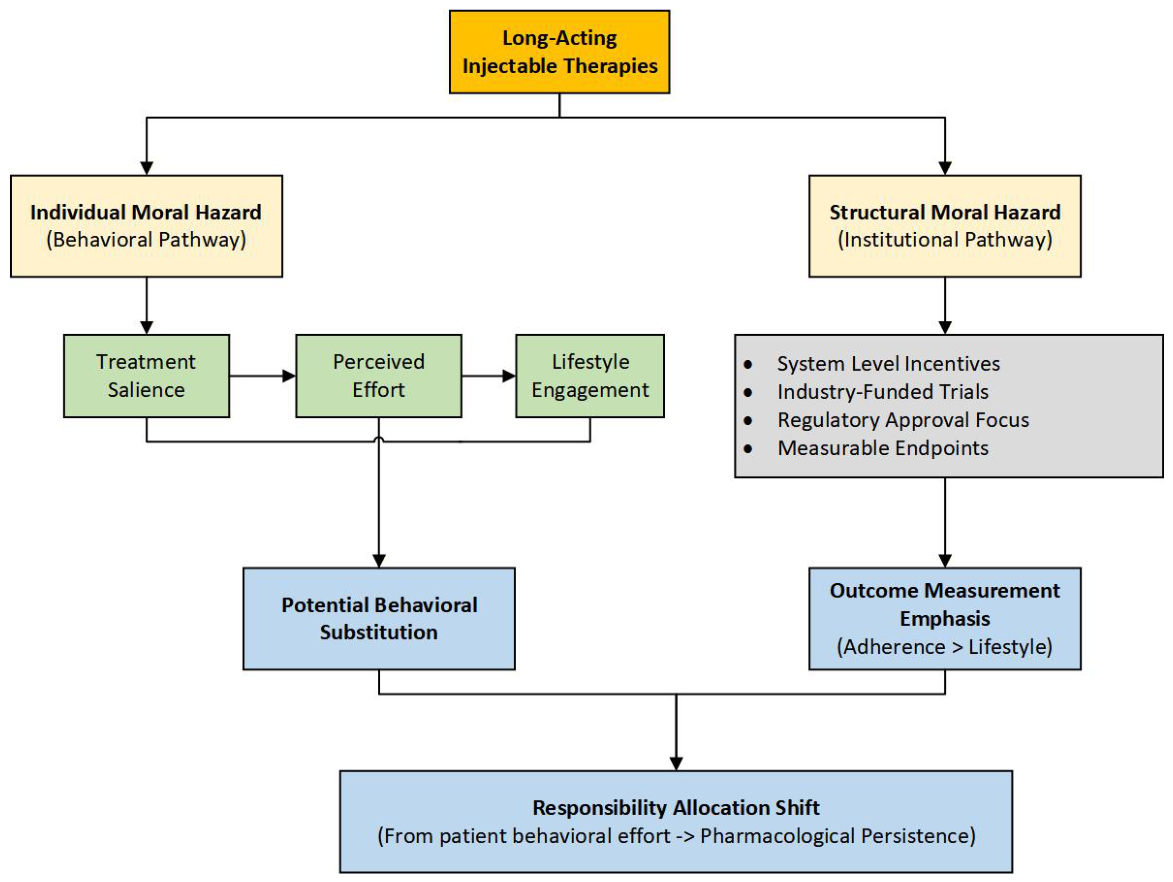
In the context of lipid-lowering therapy, long-acting injectables may create a technologically mediated form of protection that reduces the salience of daily preventive action. This does not imply that such therapies cause behavioral substitution. Rather, it raises a structural question: when pharmacologic protection becomes more durable and less behaviorally demanding, how might incentives for complementary lifestyle engagement change?
Contemporary guidelines from the European Society of Cardiology (ESC/EAS) and the U.S. Preventive Services Task Force (USPSTF) continue to position lifestyle modification, diet, physical activity, and weight management as foundational components of dyslipidemia management alongside pharmacologic therapy [
14,
15]. These recommendations reflect a normative framework in which responsibility for cardiovascular risk reduction is shared between patients and healthcare systems.
Policy scholarship emphasizes that responsibility for health is distributed rather than purely individual [
16,
17]. Within value-based healthcare frameworks, efficient prevention depends on alignment between pharmacologic innovation and sustained behavioral engagement [
18]. The emergence of long-acting injectable therapies raises the possibility that the locus of responsibility may be gradually shifting toward pharmacologic control.
This review focuses on patterns of outcome measurement rather than direct behavioral effects, using behavioral economic concepts as an interpretive framework.
Against this backdrop, the primary objective of this systematic review is to examine whether patterns of outcome measurement in studies of long-acting lipid-lowering therapies reflect such a shift. Specifically, we assess:
The extent to which pharmacologic adherence or persistence is measured in trials and real-world studies of PCSK9 monoclonal antibodies, inclisiran, and GLP-1 receptor agonists.
The extent to which lifestyle behaviors, diet, physical activity, or structured behavioral interventions are assessed.
Whether any studies explicitly evaluate behavioral substitution, risk compensation, or shifts in perceived patient responsibility.
The study does not assume the presence of behavioral moral hazard. Rather, it investigates whether a measurement asymmetry exists between pharmacologic persistence and lifestyle engagement. Such asymmetry does not only reflect differences in outcome prioritization; it also limits the capacity of the existing evidence base to detect behavioral moral hazard. In the absence of systematic lifestyle measurement, potential behavioral responses to long-acting pharmacologic protection remain empirically unobservable.
4. Methods
This systematic review was conducted in accordance with the Preferred Reporting Items for Systematic Reviews and Meta-Analyses (PRISMA 2020) guidelines. A review protocol was developed a priori to define the research question, eligibility criteria, search strategy, and analytical approach; however, it was not registered in a publicly accessible database.
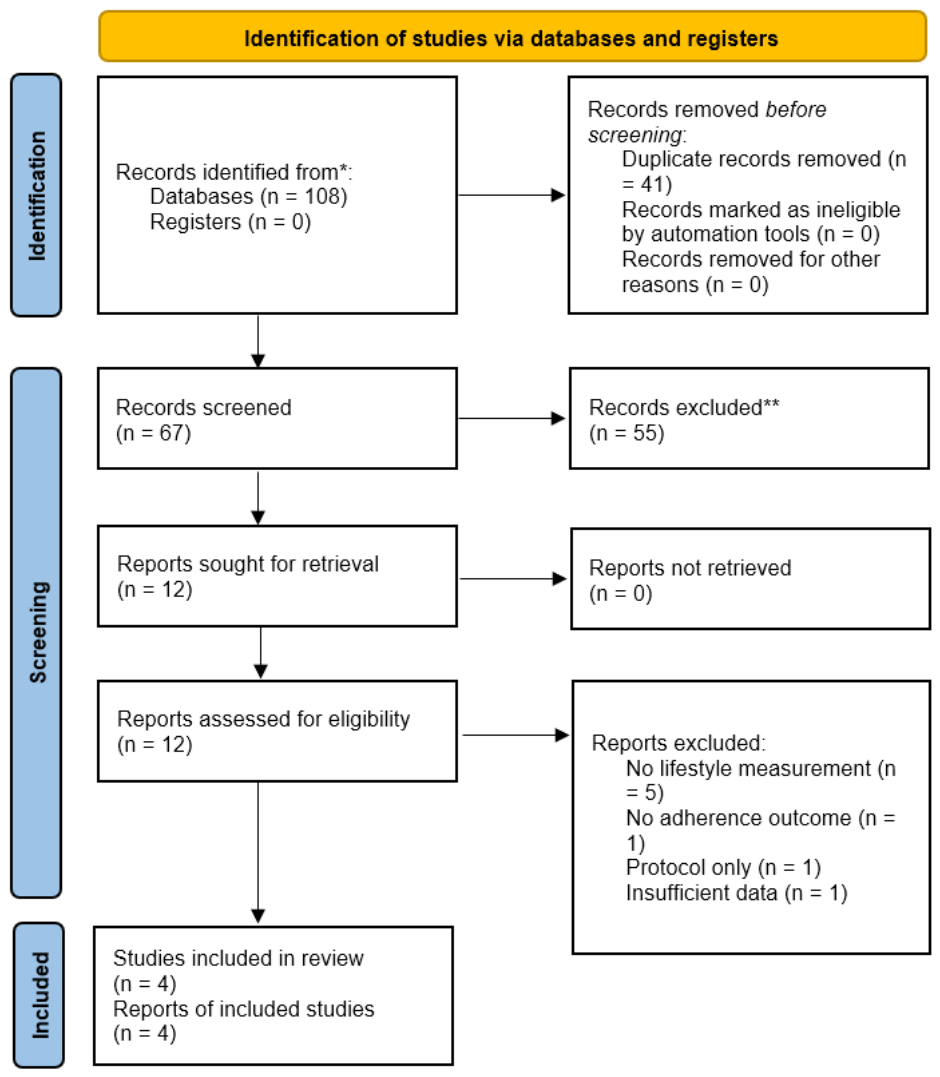
The protocol focused on long-acting lipid-lowering therapies and the assessment of pharmacologic adherence alongside lifestyle and behavioral outcomes. Any deviations from the protocol are described and justified within the Methods section. The study selection process is summarized in the PRISMA flow diagram (
Figure 2).
Eligibility criteria were established in advance to align with the objective of examining adherence, lifestyle engagement, and potential behavioral moral hazard in the context of long-acting lipid-lowering therapies.
Studies were included if they involved adults (≥18 years) with hypercholesterolemia, established atherosclerotic cardiovascular disease (ASCVD), or elevated cardiovascular risk requiring lipid-lowering treatment. Studies focusing exclusively on pediatric populations, animal models, or non-cardiovascular conditions were excluded.
Eligible interventions included the following long-acting lipid-lowering therapies:
PCSK9 monoclonal antibodies including evolocumab (Biosynth, Louisville, KY, USA), and alirocumab (Biosynth, Louisville, KY, USA).
Inclisiran (Novartis Pharma AG, Basel, Switzerland).
GLP-1 receptor agonists when used in populations with cardiometabolic or cardiovascular risk such as semaglutide (Novo Nordisk, Bagsværd, Denmark).
Studies were eligible if they reported at least one of the following: pharmacologic adherence or persistence, including measures such as medication possession ratio, proportion of days covered, treatment continuation, injection completion, or discontinuation rates or lifestyle or behavioral measures, including dietary assessment, physical activity, structured lifestyle interventions, self-management behaviors, or discussion of behavioral engagement or substitution.
Studies that reported adherence outcomes without measuring lifestyle behaviors were retained, as identifying this measurement imbalance was central to the review.
Studies were excluded if they: focused solely on mechanistic, pharmacokinetic, or short-term LDL-C reduction without patient-level adherence or behavioral data, reported biochemical outcomes only, without adherence or behavioral measures, included exclusively pediatric or non-human populations, and lacked accessible full text.
A systematic search was conducted in PubMed, Embase, Web of Science, and Scopus from database inception to the final search date. The final search was conducted on 15 January 2026. The search strategy combined terms related to lipid-lowering therapies (including PCSK9 inhibitors, evolocumab, alirocumab, inclisiran, and GLP-1 receptor agonists), adherence and persistence (such as medication adherence, persistence, proportion of days covered, and discontinuation), and lifestyle or behavioral outcomes (including diet, physical activity, self-management, behavioral change, risk compensation, and moral hazard).
Controlled vocabulary terms were used where appropriate, and search strings were adapted for each database. The full electronic search strategies for each database, including all keywords and controlled vocabulary terms, are provided in
Appendix A to ensure transparency and reproducibility. Reference lists of eligible articles, major clinical trials, and relevant guidelines were manually screened to identify additional studies.
The search was limited to English-language publications involving adult human populations. Duplicate records were removed prior to title and abstract screening. Study selection was performed independently by two reviewers. Titles and abstracts were screened for eligibility, followed by full-text assessment of potentially relevant studies. Discrepancies between reviewers were resolved through discussion and consensus.
Data were extracted using a standardized data extraction form developed for this review. Data extraction was conducted independently by two reviewers using the standardized form. Extracted variables were cross-checked for accuracy, and any discrepancies were resolved through discussion. The form captured study characteristics (authors, year, design, population, sample size, and follow-up duration), intervention details (drug class, dosing frequency, and administration mode), and outcome measures.
For each study, we extracted information on pharmacologic adherence or persistence, including measures such as medication possession ratio (MPR), proportion of days covered (PDC), continuation rates, injection completion, and discontinuation. We also recorded whether lifestyle or behavioral outcomes were assessed, including dietary behaviors, physical activity, structured lifestyle interventions, self-management measures, or discussion of behavioral engagement.
When lifestyle outcomes were not reported, this absence was explicitly coded, as identifying measurement asymmetry between pharmacologic adherence and lifestyle engagement was central to the review objective. Any explicit discussion of behavioral substitution, risk compensation, or patient responsibility was also documented.
The database search identified 108 records. After removal of 41 duplicates, 67 records were screened. Twelve full-text articles were assessed for eligibility, of which eight were excluded. Four studies met inclusion criteria.
4.1. Risk of Bias Assessment
The methodological quality of the included studies was assessed using the Cochrane Risk of Bias 2 (RoB 2) tool for randomized controlled trials. Each study was evaluated across the following domains: (1) bias arising from the randomization process, (2) bias due to deviations from intended interventions, (3) bias due to missing outcome data, (4) bias in measurement of outcomes, and (5) bias in selection of the reported result.
Risk of bias assessment was performed independently by two reviewers, with discrepancies resolved through discussion and consensus. The results of the assessment were summarized descriptively.
4.2. Analytical Approach
The analysis was designed to examine patterns of outcome measurement across long-acting lipid-lowering therapies and to assess potential asymmetry between pharmacologic adherence and lifestyle engagement. Given the heterogeneity of study designs and outcomes, a quantitative meta-analysis was not performed. Instead, a structured descriptive and comparative approach was used.
First, studies were classified by therapy type (PCSK9 monoclonal antibodies, PCSK9 siRNA, and GLP-1 receptor agonists). All included studies were randomized controlled trials. For each study, we identified whether pharmacologic adherence or persistence was measured, whether lifestyle behaviors (diet or physical activity) were assessed, and whether behavioral substitution or responsibility shift was explicitly evaluated.
Measurement prevalence was calculated as the proportion of studies reporting each outcome domain. A Measurement Asymmetry Index was defined as the difference between the prevalence of adherence measurement and the prevalence of lifestyle measurement within the included sample. This index was used descriptively as an exploratory indicator to illustrate differences in outcome prioritization across the included studies.
Comparisons were also made between therapy classes with respect to adherence and lifestyle outcome measurement. Findings were interpreted within a behavioral moral hazard framework, focusing on whether outcome reporting patterns may reflect differential emphasis on pharmacologic persistence versus lifestyle engagement. The analysis was descriptive and exploratory, and no causal inferences were drawn.
The analysis is descriptive and interpretive, and does not test behavioral hypotheses or causal relationships.
6. Discussion
This systematic review examined whether patterns of outcome measurement in studies of long-acting lipid-lowering injectable therapies reflect a redistribution of preventive responsibility. Across the included studies, pharmacologic adherence or persistence was consistently assessed, whereas lifestyle behaviors were rarely measured, and no study explicitly evaluated behavioral substitution or risk compensation. This imbalance suggests that pharmacologic persistence may serve as the primary operational indicator of preventive success within the current evidence base. As a result, an important epistemic limitation arises: without systematic assessment of lifestyle engagement, the literature cannot meaningfully evaluate the presence or absence of behavioral moral hazard. Given the limited number of included studies, these findings should be interpreted as exploratory and hypothesis-generating rather than definitive evidence of structural effects.
From the perspective of moral hazard theory, these findings may reflect a potential structural pattern, although this interpretation remains hypothesis-generating and requires further empirical validation. By reducing dosing burden, long-acting injectable therapies shift adherence from continuous patient-driven action to episodic clinical encounters, potentially diminishing the salience of preventive effort. This interpretation offers a theoretical lens through which the observed emphasis on pharmacologic outcomes can be understood.
Measurement Asymmetry as an Interpretive Framework
Building on the behavioral moral hazard perspective, this review uses the concept of measurement asymmetry to interpret how structural changes in dosing burden relate to outcome reporting patterns. The inclusion of GLP-1 receptor agonists reflects a conceptual grouping based on treatment structure rather than pharmacologic class, emphasizing shared features such as long-acting injectable delivery and reduced adherence burden. This broader framing enables comparison of how outcome measurement and preventive responsibility are defined across structurally similar, though clinically distinct, therapeutic approaches. In direct relation to the study objectives, the findings demonstrate that pharmacologic adherence or persistence is consistently measured across trials of PCSK9 monoclonal antibodies, inclisiran, and related therapies, whereas lifestyle behaviors, including diet, physical activity, and structured behavioral interventions, are assessed infrequently. Moreover, no included studies explicitly evaluate behavioral substitution, risk compensation, or shifts in perceived patient responsibility.
Reductions in dosing burden, achieved through biweekly, monthly, or biannual injectable therapies, reshape the behavioral structure of treatment adherence. Daily statin use requires repeated patient action [
6], whereas long-acting injectables embed persistence within episodic clinical encounters. As treatment becomes less integrated into everyday routines, the salience of cardiovascular risk management may diminish, with potential implications for engagement in complementary preventive behaviors. Treatment salience is not solely determined by dosing frequency but is shaped by clinical context, patient–provider interaction, and the symbolic meaning of therapy, which may either attenuate or reinforce engagement with preventive behaviors.
Within this context, pharmacologic adherence emerges as the dominant operational indicator of treatment success, while lifestyle engagement remains underrepresented in outcome measurement. Clinical guidelines consistently emphasize that pharmacologic therapy and lifestyle modification are complementary components of cardiovascular prevention [
14,
15]. However, when empirical evaluation prioritizes drug-attributable outcomes, the measurement of preventive effort becomes asymmetrically aligned with pharmacologic persistence. Such measurement asymmetry does not constitute evidence of behavioral substitution but reflects how preventive success is defined within the evidence base.
These findings are particularly relevant to the third objective of this review. The absence of explicit evaluation of behavioral substitution or risk compensation does not indicate that such effects are absent, but rather that they are not empirically observable within the current literature. If changes in lifestyle engagement were occurring, their detection would depend on systematic behavioral assessment. The lack of structured lifestyle measurement therefore limits the capacity of existing studies to assess potential shifts in patient behavior or perceived responsibility.
From a health systems perspective, this pattern may be understood within a framework of structural moral hazard. Regulatory approval and reimbursement decisions prioritize quantifiable, drug-attributable outcomes such as LDL-C reduction, cardiovascular events, and treatment persistence. In contrast, lifestyle behaviors are multidimensional, less standardized, and more difficult to attribute to specific interventions. Institutional incentives may therefore favor pharmacologic endpoints, narrowing the operational definition of prevention toward adherence-based metrics rather than sustained behavioral engagement.
At the same time, the clinical rationale for long-acting injectable therapies remains clear. Non-adherence to chronic cardiovascular medication is well-documented and associated with adverse outcomes [
6,
7]. Reducing dosing frequency may improve persistence and thereby enhance population-level cardiovascular risk reduction. In this sense, long-acting therapies address a genuine adherence challenge. The present findings should therefore be interpreted not as a critique of pharmacologic innovation, but as an indication that outcome measurement has not fully captured the broader scope of preventive care.
The alignment of findings across all three objectives highlights a structural imbalance in the evidence base: pharmacologic adherence is systematically measured, lifestyle engagement is inconsistently assessed, and behavioral responses are not directly evaluated. This imbalance suggests that the current literature is limited in its ability to fully characterize preventive behavior in the context of long-acting lipid-lowering therapies and underscores the importance of integrating behavioral metrics into future study designs.
7. Limitations
Several limitations should be considered when interpreting the findings of this review. First, the number of included studies was limited, reflecting the relatively recent introduction of long-acting lipid-lowering injectable therapies and the specificity of the eligibility criteria. The focus on studies that reported adherence or persistence outcomes constrained the pool of eligible trials. As a result, the sample size was modest and may not capture the full diversity of ongoing research in this rapidly evolving field. The small number of included studies limits the ability to draw definitive conclusions regarding structural moral hazard or shifts in preventive responsibility. The interpretations proposed in this review should therefore be viewed as hypothesis-generating and exploratory.
Second, heterogeneity in study design, populations, and outcome definitions limited the ability to conduct quantitative synthesis. Randomized cardiovascular outcome trials differed in follow-up duration, adherence assessment methods, and reporting practices. Adherence was typically measured using protocol-driven injection completion or treatment continuation rather than standardized metrics such as proportion of days covered (PDC) or medication possession ratio (MPR). This variability restricts cross-study comparability and limits the precision with which adherence patterns can be contrasted across therapeutic classes.
Third, the Measurement Asymmetry Index developed in this review is descriptive and exploratory rather than inferential. It reflects patterns within a small sample of studies and is intended as a heuristic indicator of outcome prioritization rather than a generalizable quantitative measure. The index captures the difference in reporting prevalence between pharmacologic adherence and lifestyle engagement outcomes. It does not establish that reduced dosing burden causes diminished lifestyle effort, nor does it demonstrate behavioral substitution at the patient level. Moral hazard theory, as articulated by Pauly and further refined by Cutler and Zeckhauser, describes incentive-based behavioral responses [
12,
13]. The present study examines outcome measurement architecture rather than observed patient behavior. Accordingly, conclusions pertain to structural patterns in reporting rather than to confirmed behavioral effects.
Fourth, absence of reported lifestyle measurement in trial publications does not necessarily imply absence of lifestyle counseling in clinical practice. Clinical guidelines from the ESC/EAS and USPSTF continue to emphasize lifestyle modification as foundational to dyslipidemia management [
14,
15]. Clinicians may provide behavioral counseling even if such engagement is not systematically captured in trial endpoints. Publication practices and reporting priorities may therefore underestimate the extent of behavioral reinforcement occurring in routine care.
Fifth, this review is limited to published literature and may be subject to reporting bias. Clinical trials are typically designed to meet regulatory and reimbursement requirements that prioritize measurable, drug-attributable outcomes. As a result, pharmacologic adherence and clinical endpoints are consistently reported, whereas lifestyle behaviors, being multifactorial and less directly attributable to specific interventions, may be underreported even when assessed. This structural tendency in outcome reporting complicates the interpretation of observed measurement asymmetry.
Finally, the conceptual perspectives used in this review are interpretive and not empirically tested within the included studies. Although informed by behavioral economic theory, including moral hazard and salience [
12,
13,
19], they are used to contextualize patterns of outcome measurement rather than to establish causal relationships. Future research incorporating standardized lifestyle metrics and longitudinal designs would be necessary to evaluate potential relationships between dosing frequency and preventive engagement.




 ,
,