1. Introduction
Hypertension (HT) remains one of the leading causes of cardiovascular morbidity and mortality worldwide [
1,
2]. Hypertension represents a major public health concern in Turkey, with prevalence rates reported to be comparable to or higher than global averages. National studies have highlighted the growing burden of hypertension and its associated cardiovascular complications, emphasizing the need for a more comprehensive understanding of both biomedical and psychosocial determinants. In this context, investigating the interplay between psychological factors and objective cardiovascular markers may provide valuable insights for improving patient management in the Turkish population. Although HT is primarily defined in clinical practice by blood pressure levels, current data indicate that this condition is not merely a hemodynamic disorder; it is a complex cardiovascular syndrome characterized by autonomic nervous system dysfunction, neurohumoral activation, endothelial dysfunction, and inflammatory processes [
3,
4]. In particular, chronic increase in sympathetic nervous system activity and decrease in parasympathetic (vagal) tone play a central role in the development and maintenance of hypertension [
5].
Heart rate variability (HRV) is widely used in clinical and research settings as a non-invasive, quantitative indicator of autonomic nervous system activity [
6]. Decreased HRV indicates a disruption of sympathovagal balance and a reduced adaptive capacity of the cardiovascular system to physiological stressors [
6,
7]. Low HRV in hypertensive individuals; Increased cardiovascular risk, target organ damage, and poor prognosis have been associated with it [
7,
8]. Therefore, HRV is considered not only an accompanying finding in hypertension but also an important marker of the disease’s pathophysiological depth. Autonomic instability in hypertension extends beyond heart rate variability and also affects cardiac electrical stability [
9]. Ventricular repolarization heterogeneity is an important component of the arrhythmogenic substrate and can be indirectly assessed by electrocardiographic (ECG) parameters. Parameters such as QT duration, Tp-e interval, and Tp-e/QT ratio have received increasing attention in recent years as practical indicators reflecting transmural repolarization dispersion [
10].
Prolongation in these parameters is associated with increased sympathetic activity, baroreflex impairment, and myocardial remodeling, and may predispose to an increased risk of arrhythmias in hypertensive individuals [
9,
10]. Psychosocial stress is a significant environmental factor known to influence the development and control of hypertension [
11]. Increased perceived stress alters autonomic balance towards sympathetic dominance by increasing cortisol and catecholamine levels via the hypothalamo-pituitary–adrenal axis and the sympathoadrenal system [
11,
12]. This process can result in decreased heart rate variability, increased heart rate, and impaired cardiac repolarization dynamics. Indeed, the adverse effects of stress on heart rate and its relationship with QT dynamics have been demonstrated in various clinical and experimental studies [
6,
10]. However, the cardiovascular effects of stress depend not only on the presence of the stressor but also on the individual’s capacity to cope with stress and their psychosocial resources. In this context, self-efficacy perception is an important psychosocial determinant reflecting an individual’s ability to cope with stressful situations and maintain health-related behaviors [
12]. Low self-efficacy perception can negatively affect treatment adherence and lifestyle changes in chronic diseases, indirectly impairing both blood pressure control and autonomic balance [
11,
12]. In recent years, the concepts of spiritual orientation and spirituality have received increasing attention among psychosocial factors associated with cardiovascular health [
13]. Spiritual orientation is closely related to an individual’s ability to attribute meaning to their life, feelings of hope and acceptance, perceptions of social support, and stress-coping strategies. An increasing number of studies suggest that spiritual or mental well-being can reduce perceived stress, increase psychological resilience, and, in some cases, improve cardiovascular outcomes [
13,
14]. Beyond autonomic regulation, psychosocial factors may also influence cardiac electrical stability through shared neurobiological pathways. Chronic stress and reduced psychological resilience can activate the hypothalamic–pituitary–adrenal axis and increase sympathetic tone, which not only suppresses vagal activity, as reflected in HRV, but also alters ventricular repolarization dynamics. Increased sympathetic activity and impaired baroreflex sensitivity have been associated with prolonged QT interval and increased Tp-e duration, reflecting greater repolarization heterogeneity. Conversely, spiritual orientation may act as a buffering factor by enhancing emotional regulation, reducing stress reactivity, and promoting parasympathetic dominance. Therefore, spirituality and stress-related constructs may simultaneously affect both HRV and ECG-based repolarization parameters through integrated psychophysiological mechanisms. However, the effects of spiritual orientation on autonomic nervous system function and cardiac electrical stability have been evaluated in only a limited number of studies, mostly using indirect measures. In the current literature, studies that comprehensively address psychosocial factors such as spiritual orientation, perceived stress, and self-efficacy in hypertensive individuals, along with heart rate variability and ventricular repolarization indicators, are limited [
14,
15]. In particular, elucidating the potential effects of spiritual orientation on objective cardiac physiological parameters can contribute to a better understanding of the biopsychosocial nature of hypertension.
This study aims to evaluate the relationship between spiritual orientation, perceived stress, and low self-efficacy levels with heart rate variability and electrocardiographic repolarization parameters in individuals diagnosed with hypertension, and to reveal the possible pathophysiological basis of these relationships.
2. Methods
2.1. Study Design and Population Characteristics
This study is a cross-sectional, observational study designed to evaluate the effects of spiritual orientation and perceived stress on heart rate variability (HRV) and ECG parameters in individuals diagnosed with hypertension. The study aims to examine the multidimensional relationships among psychosocial factors, cardiovascular autonomic regulation, and cardiac electrical stability. A total of 200 individuals were included in the study. 100 of the participants were patients diagnosed with HT, and 100 were healthy control group individuals matched for age and gender without a known history of HT or cardiovascular disease. The diagnosis of HT was confirmed based on previously established clinical diagnosis and/or regular use of antihypertensive treatment. Individuals in the control group did not have a history of hypertension, coronary artery disease, heart failure, clinically significant arrhythmias, or structural heart disease. Exclusion criteria for both groups were: known coronary artery disease, heart failure, significant valvular disease, persistent or paroxysmal arrhythmias, structural heart disease, chronic inflammatory or systemic diseases, history of malignancy, and use of drugs known to have a significant effect on the autonomic nervous system. Patients receiving antihypertensive treatment were not excluded from the study. 55.5% of the participants were female (
n = 111) and 44.5% were male (
n = 89). The mean age of the participants was 50.0 ± 8.9 years, and the mean BMI was 28.4 ± 3.4 kg/m
2. BMI classification was based on World Health Organization criteria [
16]. Participants were recruited using a consecutive sampling approach from the outpatient cardiology clinic of a tertiary care hospital. All eligible patients presenting during the study period were screened for inclusion according to predefined criteria. The recruitment was conducted over a defined period, and both hypertensive patients and control participants were enrolled in parallel. The control group consisted of individuals without known cardiovascular disease who were matched for age and sex. The recruitment process was designed to minimize selection bias; however, no formal record of refusal rate was maintained. Therefore, the possibility of selection bias cannot be entirely excluded and is acknowledged as a limitation of the study.
2.2. Electrocardiographic Evaluation
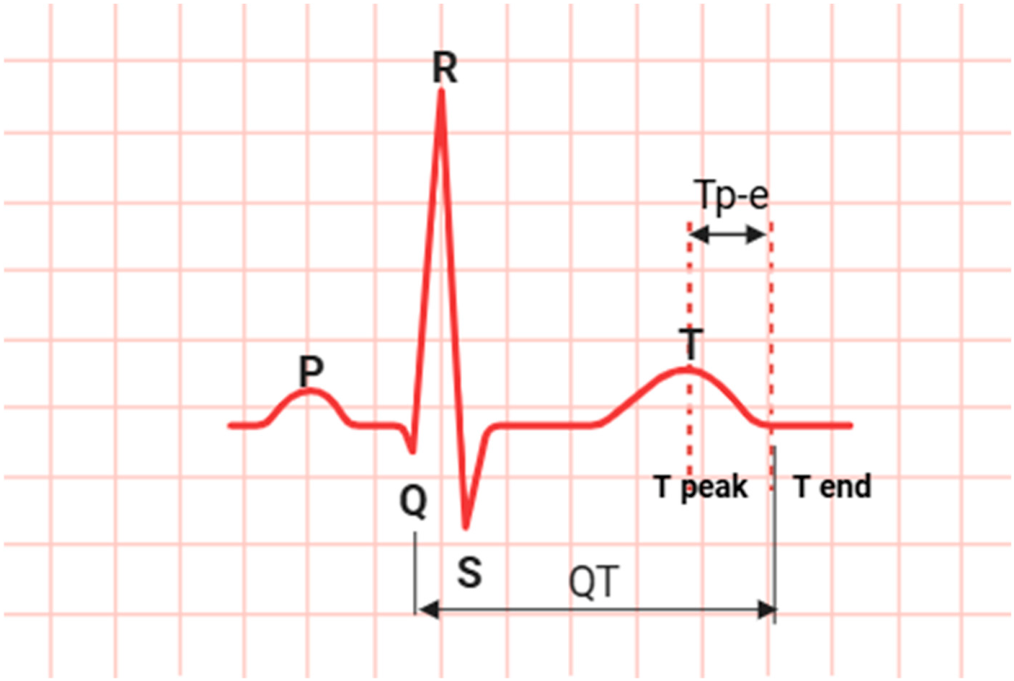
All participants underwent 12-lead surface ECG under standard conditions in a quiet, controlled environment after at least 5 min of rest. ECG recordings were digitized and analyzed at 300× magnification. Heart rate (beats/min), QRS duration (ms), QT interval (ms), Tp-e interval (ms), and Tp-e/QT ratio were measured from the ECG recordings. The QT interval was measured by averaging at least 3 consecutive complexes and corrected for heart rate. The Tp-e interval was defined as the time between the peak and end of the T wave and was considered an indicator of cardiac repolarization heterogeneity. The Tp-e/QT ratio was included in the analyses as a heart rate-independent indicator of repolarization (
Figure 1).
Heart rate variability analysis was performed using time-domain parameters from resting ECG recordings. SDNN (standard deviation normal–normal range), reflecting global autonomic activity, and RMSSD (root mean square of successive differences), an indicator of parasympathetic activity, were calculated. HRV parameters were evaluated as quantitative indicators of cardiac autonomic regulation.
2.3. Psychosocial Measurements
Participants’ spiritual orientation levels were assessed using a spiritual orientation scale for which Turkish validity and reliability studies have been previously conducted [
17]. The Spiritual Orientation Scale used in this study has been validated in the Turkish population, demonstrating good internal consistency (Cronbach’s alpha ≈ 0.85–0.90). The scale includes items reflecting meaning in life, connectedness, and inner peace (e.g., “I feel a sense of purpose in my life”). Perceived stress was assessed using the Perceived Stress Scale (PSS), which has been validated in Turkish populations with acceptable reliability (Cronbach’s alpha ≈ 0.80). The scale includes items such as “In the last month, how often have you felt unable to control important things in your life?” Self-efficacy was evaluated using a validated self-efficacy scale adapted for Turkish populations, with reported Cronbach’s alpha values typically above 0.80. Example items assess individuals’ confidence in coping with challenging situations. High scores on the scale indicate a strong spiritual orientation. Perceived stress level was assessed using a standard perceived stress scale that measures stress-related discomfort; higher scores indicated greater perceived stress. In addition, the perception of insufficient self-efficacy, which indirectly reflects individuals’ capacity to cope with stress, was measured through a validated scale.
2.4. Statistical Analysis
Statistical analyses were performed using JASP (version 0.19.0) and IBM SPSS Statistics software. Continuous variables were presented as mean ± standard deviation or median (interquartile range), while categorical variables were presented as number and percentage. Normality of the data distribution was assessed using the Shapiro–Wilk test, as well as skewness and kurtosis values. Variables showing normal distribution were analyzed using parametric tests, while non-normally distributed variables were analyzed using non-parametric methods. Specifically, independent-samples t-tests were used for normally distributed variables, and Mann–Whitney U tests were applied for non-normally distributed variables.
Correlation analyses were performed using Pearson’s correlation coefficient for normally distributed variables and Spearman’s rank correlation coefficient for non-normally distributed variables. Given the multiple comparisons performed in the study, the results were interpreted cautiously to reduce the risk of Type I error. Although formal correction methods (e.g., Bonferroni adjustment) were not applied due to the exploratory nature of the study, emphasis was placed on effect sizes and consistency of findings across related variables. To further strengthen the analytical framework, multivariate linear regression analyses were conducted to identify independent predictors of HRV and ECG parameters after adjusting for relevant covariates. Parametric tests were preferred for variables that met the standard distribution assumption, and nonparametric tests were preferred for variables that did not. The relationships among ECG parameters, HRV measures, spiritual orientation, perceived stress, and insufficient self-efficacy scores were examined using Pearson or Spearman correlation analyses, depending on the data distribution. Independent-samples t-test or Mann–Whitney U test was used for comparisons between two groups based on hypertension status; One-Way ANOVA or Kruskal–Wallis test was applied for comparisons based on age and BMI subgroups. In parametric analyses, the effect size was calculated as Cohen’s d; in nonparametric analyses, the biserial correlation coefficient was used. A statistical significance level of p < 0.05 was accepted for all analyses. Effect sizes were interpreted according to Cohen’s criteria, where d = 0.2 represents a small effect, d = 0.5 a medium effect, and d = 0.8 a large effect. A priori sample size calculation was not performed due to the observational and exploratory design of the study. However, a post hoc power analysis was conducted based on the observed differences in primary HRV parameters (SDNN and RMSSD) between groups. The analysis indicated that the study had >90% statistical power to detect medium-to-large effect sizes at an alpha level of 0.05. Therefore, the sample size of 200 participants was considered adequate for the primary analyses performed in this study. Potential confounding variables, including smoking status, caffeine intake, physical activity level, and comorbid conditions such as diabetes and psychological disorders, were recorded during participant assessment. Although these variables were not used as primary grouping factors, they were considered in the analytical framework and included as covariates in multivariate regression models where appropriate.
Heart rate variability (HRV) analysis in this study was based on time-domain parameters derived from resting ECG recordings. While frequency-domain and nonlinear HRV analyses provide additional insights into autonomic regulation, time-domain measures such as SDNN and RMSSD are widely accepted and clinically validated indicators of global and parasympathetic autonomic activity, particularly in observational clinical studies.
2.5. Ethical Approval
This study was approved by the Non-Interventional Clinical Research Ethics Committee of Bilecik Şeyh Edebali University Faculty of Medicine (approval date: 26 February 2025; decision number: 2025/2–10), in accordance with the principles of the Declaration of Helsinki and relevant national regulations. All participants were informed about the purpose and procedures of the study, and written informed consent was obtained prior to participation.
4. Discussion
In this cross-sectional study, the relationship between spiritual orientation, perceived stress, and insufficient self-efficacy levels with heart rate variability (HRV) and electrocardiographic repolarization indicators was evaluated in individuals diagnosed with hypertension. The findings suggest that HRV is significantly reduced in the presence of hypertension, parameters such as QT, Tp-e, and Tp-e/QT, which reflect repolarization heterogeneity, are increased, spiritual orientation is associated with higher HRV and a more favorable repolarization profile, while perceived stress and insufficient self-efficacy are correlated with autonomic imbalance and electrical instability indicators. These findings indicate that hypertension is not only a hemodynamic disorder but also a complex syndrome intertwined with autonomic dysfunction, baroreflex impairment, neurohumoral activation, and inflammatory processes [
3,
18].
In HT, autonomic nervous system dysfunction and sympathetic overactivation are key mechanisms in both maintaining blood pressure and causing target organ damage. Increased sympathetic nervous activity creates a vicious cycle that fuels hypertension through peripheral vasoconstriction, renal sodium retention, activation of the renin–angiotensin–aldosterone system (RAAS), and cardiac remodeling. In recent years, the association of sympathetic overactivity with endothelial dysfunction and vascular damage has been more strongly emphasized; these processes increase arterial stiffness, reduce baroreceptor sensitivity, and further disrupt autonomic balance [
19]. Therefore, decreased HRV in hypertension can be considered not merely an “accompanying finding” but an autonomic phenotype at the center of the pathophysiology.
Time-domain measures of heart rate variability (HRV), specifically SDNN and RMSSD, are commonly utilized in clinical research as indicators of global autonomic modulation and, more specifically, parasympathetic (vagal) activity. Decreased SDNN and RMSSD in hypertension suggest a shift in sympathovagal balance towards sympathetic activity, weakening of the vagal brake, and decreased physiological resilience of the cardiovascular system to environmental/psychological stressors. Compared with previous studies, the magnitude of HRV reduction observed in our hypertensive cohort appears to be clinically meaningful. For instance, prior research has reported moderate reductions in SDNN and RMSSD among hypertensive individuals; however, the effect sizes observed in our study were generally moderate to large, suggesting a more pronounced autonomic imbalance in our population. These differences may be attributable to variations in population characteristics, comorbidity burden, or measurement protocols.
Similarly, the observed increases in repolarization parameters, such as Tp-e and Tp-e/QT, are consistent with the existing literature; however, the strength of the associations in our study suggests a potentially stronger link between autonomic dysfunction and electrical instability. While some studies report weaker correlations between HRV and repolarization indices, our findings indicate a more integrated relationship between these domains. Importantly, discrepancies across studies may reflect differences in methodology, including short-term versus long-term HRV assessment, heterogeneity in antihypertensive treatment, and variability in psychosocial measurements. These factors should be considered when interpreting and comparing results across populations. In this context, current studies demonstrating hypertension-related autonomic impairment through HRV show that HRV can also be accompanied by chronic inflammation and disease burden [
20,
21]. Another noteworthy aspect of the study is the higher repolarization markers, such as QT, Tp-e, and Tp-e/QT, in the hypertension group. Ventricular repolarization heterogeneity is a significant component of the arrhythmogenic substrate, and the Tp-e interval and the Tp-e/QT ratio are suggested as practical ECG indicators reflecting transmural repolarization dispersion. Because the Tp-e/QT ratio is less variable than heart rate, it is considered a valuable index for capturing repolarization imbalance. The growing number of studies investigating the relationship between Tp-e and Tp-e/QT and prognosis across different clinical settings supports the potential of these indicators to reflect “electrical fragility” [
22,
23,
24].
The negative correlation of perceived stress with HRV and its positive correlation with repolarization parameters strengthen the importance of the psychobiological stress response in hypertension. Acute and chronic stress affect the cardiovascular system through mechanisms such as increased cortisol via the hypothalamo-pituitary–adrenal (HPA) axis, increased catecholamines via the sympathoadrenal system, enhanced inflammation, and impaired endothelial function [
11]. A broad literature supports the effect of stress on reducing HRV; meta-analytic data show that psychological stress may be associated with decreases in HRV parameters (especially in the RMSSD/SDNN axis) [
25].
The role of stress in repolarization parameters is explained by the hypothesis that it can trigger changes, such as QT/QTc prolongation, with a sudden shift in autonomic tone toward sympathetic dominance. Studies evaluating the effects of acute mental stress on QT dynamics have shown that different cardiac electrical responses may occur depending on the type and severity of the stress. It has been reported that QTc prolongation and changes in T wave morphology can be observed, especially with increased sympathetic activity [
26]. In this context, the correlation between stress and repolarization indicators in our study establishes a biologically consistent bridge between sympathetic dominance and repolarization heterogeneity in hypertension.
The increase in perceived inadequate self-efficacy, the decrease in HRV, and its positive relationship with stress are also clinically significant. Self-efficacy is a psychosocial determinant that affects an individual’s capacity to cope with stressors, maintain healthy behaviors, and adhere to treatment. In a chronic disease such as hypertension, low self-efficacy can negatively affect behavioral axes such as lifestyle adjustment, sleep patterns, physical activity, and medication adherence, indirectly disrupting both blood pressure control and autonomic balance [
27]. Therefore, self-efficacy can be considered not only a psychological outcome but also a marker that touches the behavioral and autonomic layers of the cardiovascular risk architecture. The positive relationship between spiritual orientation and SDNN/RMSSD and the negative relationship in the QT–Tp-e axis are among the most original findings of the study. Spirituality can increase psychological resilience by fostering meaning, hope, acceptance, social bonding, and stress-coping strategies. On the psychophysiological level, it is suggested that spiritual well-being can suppress the HPA axis activation by reducing stress reactivity, supporting vagal tone, and limiting sympathetic overactivity [
14]. This approach is consistent with current AHA-focused assessments discussing the relationship between religious/spiritual orientation and cardiovascular health [
28].
Current studies show that spiritual or mind–body-based practices can have measurable effects on autonomic function. For example, heart-focused meditation/breathing-based interventions have been reported to increase vagal activity and improve HRV measures [
29]. Furthermore, the increasing number of randomized studies reporting that “spirituality-based” interventions in hypertension can have positive effects on blood pressure and endothelial function supports the idea that spiritual orientation may be a physiological axis associated not only with subjective well-being but also with vascular function and autonomic balance [
30].
Regarding repolarization parameters, the growing evidence that Tp-e and the Tp-e/QT ratio may be associated with increased arrhythmia risk and poor prognosis across different clinical scenarios underscores their potential importance in hypertension [
23,
24]. These indicators may be a standard electrical output of processes such as sympathetic overactivity, baroreflex impairment, microvascular dysfunction, and hypertension-related myocardial remodeling. Baroreflex dysfunction is particularly noteworthy as a mechanism that fuels repolarization heterogeneity by increasing both autonomic balance and hemodynamic fluctuations in hypertension [
31]. The absence of significant differences in subgroup analyses according to gender, age, and BMI suggests that the observed relationship pattern may be independent of these demographic variables in our sample. An important consideration in interpreting the present findings is the potential influence of antihypertensive medications on autonomic and electrophysiological parameters. Beta-blockers, for instance, are known to increase vagal activity and reduce heart rate, potentially enhancing HRV indices, while certain calcium channel blockers and other agents may also influence ventricular repolarization dynamics. Therefore, part of the observed associations may be partially modulated by pharmacological effects.
Importantly, the multivariate regression analyses demonstrated that spiritual orientation and perceived stress remained independently associated with both HRV and repolarization parameters after adjustment for major clinical variables, suggesting that these relationships are not solely attributable to traditional confounders. However, residual confounding related to medication type and dosage cannot be completely excluded and should be addressed in future studies [
32]. Therefore, future studies must address the impact of potential confounders in more detail, either through sensitivity analyses by drug class or through multivariate models.
In conclusion, this study’s findings demonstrate that stress-coping resources (such as spiritual orientation and self-efficacy) in hypertensive individuals may be significantly associated with cardiac autonomic function and repolarization stability. In addition to biomedical risk factors, psychosocial assessment and stress-reducing interventions can provide a complementary strategy in hypertension management, particularly in patients with significant autonomic dysfunction. These findings suggest that psychosocial assessment may complement traditional cardiovascular risk evaluation and contribute to a more comprehensive management approach in hypertensive patients.