Exploring Innovative Strategies to Enhance Electronic Health Record Interoperability in U.S. Healthcare Settings



Abstract
1. Introduction
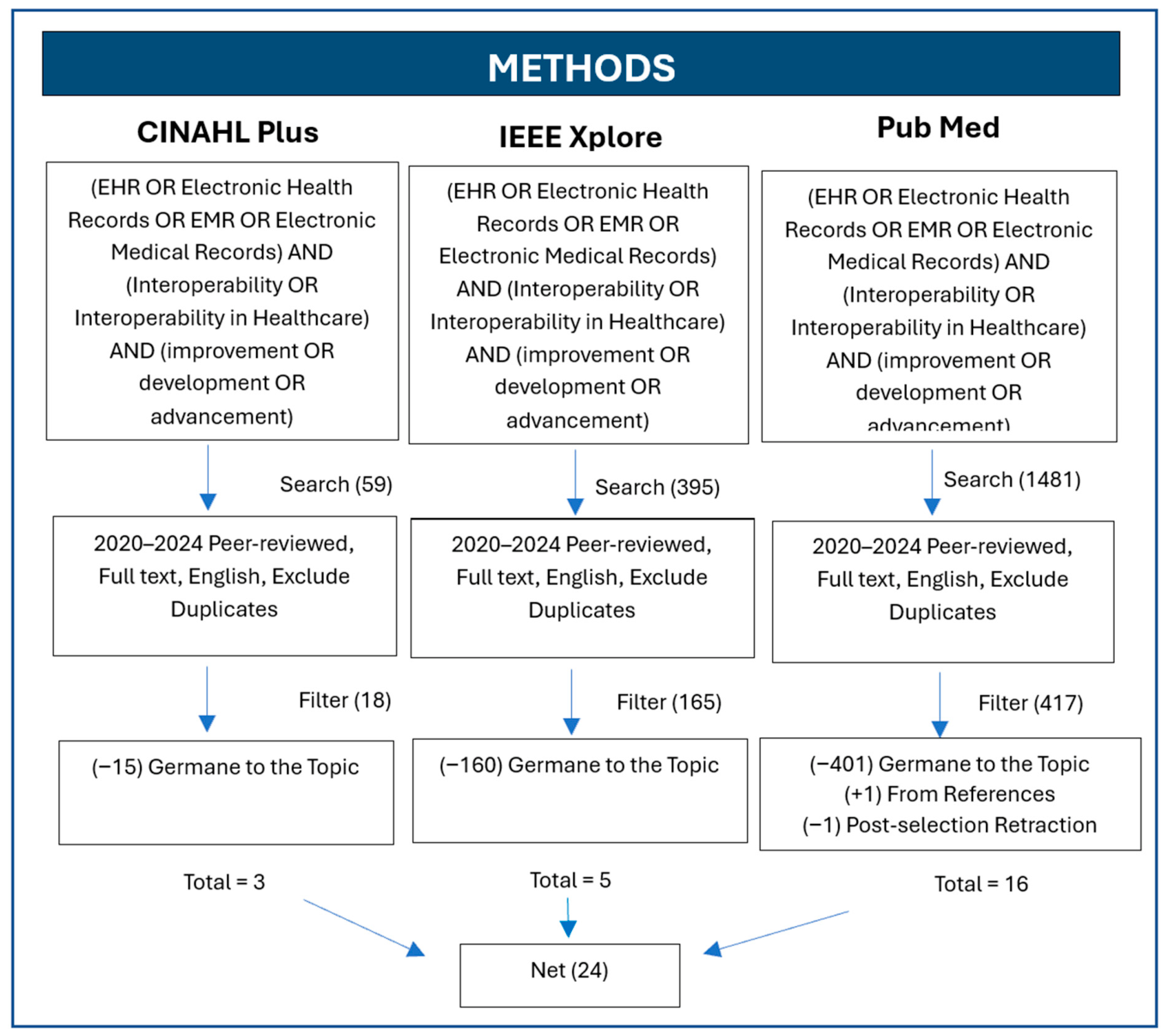
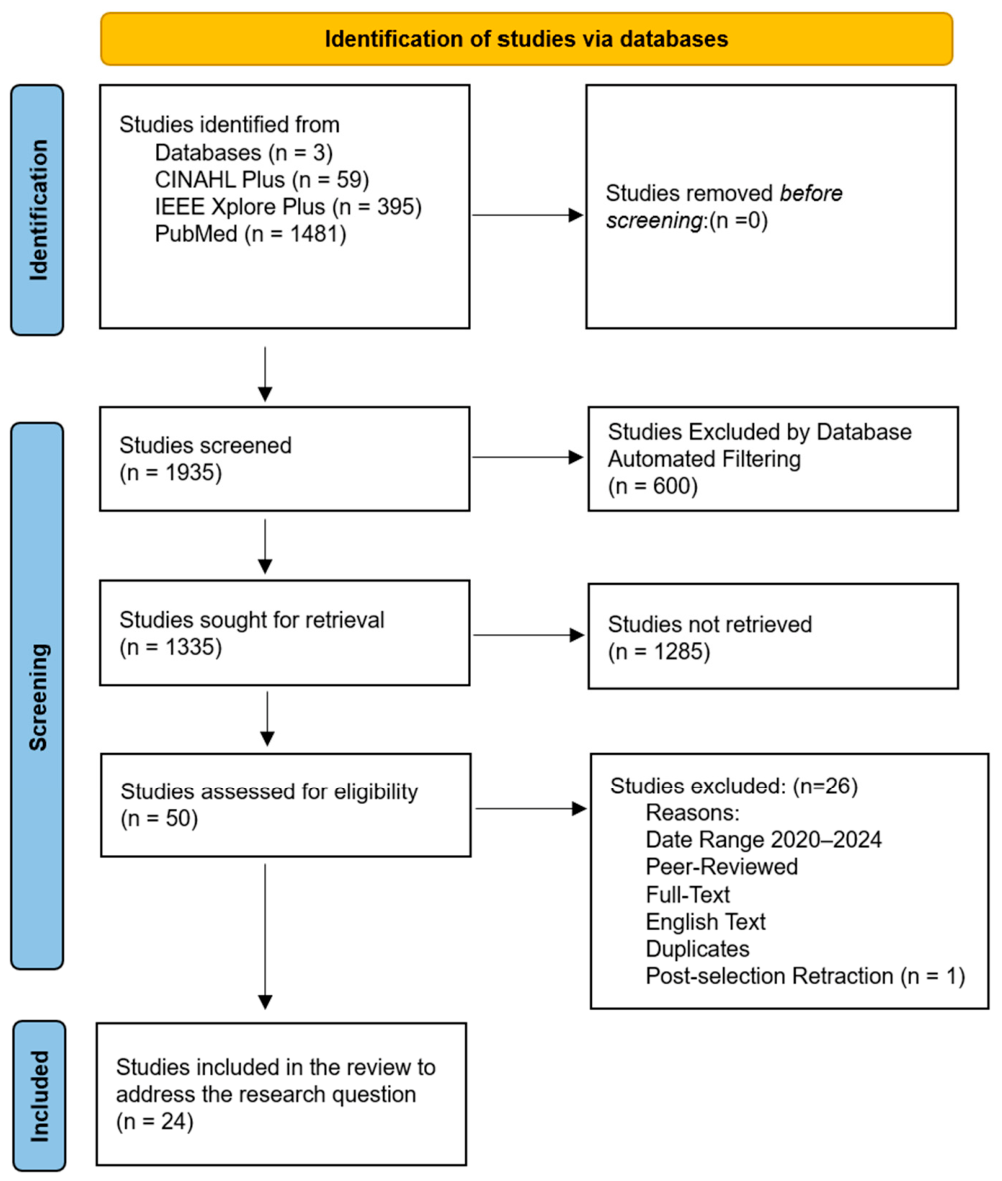
2. Methods
- Searching for relevant studies.
- Screening for inclusion and exclusion criteria.
- Extracting data based on the screening criteria.
- Synthesizing the data to identify key themes.
- Reporting and disseminating the findings [9].
- Publication between 2020 and 2024.
- English language.
- Peer-reviewed journal articles.
- Full-text availability.
- Related to the research question centered on strategies to improve interoperability of electronic health record communication between health information systems.
3. Results
4. Discussion
5. Conclusions
Author Contributions
Funding
Institutional Review Board Statement
Informed Consent Statement
Data Availability Statement
Conflicts of Interest
References
- Pant, K.; Bhatia, M.; Pant, R. Integrated care with digital health innovation: Pressing challenges. J. Integr. Care 2022, 30, 324–334. [Google Scholar] [CrossRef]
- Gaynor, M.; Yu, F.; Andrus, C.H.; Bradner, S.; Rawn, J. A general framework for interoperability with applications to healthcare. Health Policy Technol. 2014, 3, 3–12. [Google Scholar] [CrossRef]
- Naveed, A.; Sigwele, T.; Hu, Y.F.; Kamala, M.; Susanto, M. Addressing semantic interoperability, privacy and security concerns in electronic health records. J. Eng. Sci. Res. 2020, 2, 31–38. [Google Scholar] [CrossRef]
- Kumari, R.; Chander, S. Improving healthcare quality by unifying the American electronic medical report system: Time for change. Egypt. Heart J. 2024, 76, 32. [Google Scholar] [CrossRef]
- Cerchione, R.; Centobelli, P.; Riccio, E.; Abbate, S.; Oropallo, E. Blockchain’s coming to hospital to digitalize healthcare services: Designing a distributed electronic health record ecosystem. Technovation 2023, 120, 102480. [Google Scholar] [CrossRef]
- O’Malley, A.S.; Grossman, J.M.; Cohen, G.R.; Kemper, N.M.; Pham, H.H. Are electronic medical records helpful for care coordination? Experiences of physician practices. J. Gen. Intern. Med. 2010, 25, 177–185. [Google Scholar] [CrossRef]
- Joy, Z.H.; Rahman, M.M.; Uzzaman, A.; Maraj, M.A.A. Integrating machine learning and big data analytics for real-time disease detection in smart healthcare systems. Int. J. Health Med. 2024, 1, 16–27. [Google Scholar] [CrossRef]
- Moher, D.; Liberati, A.; Tetzlaff, J.; Altman, D.G. Preferred reporting items for systematic reviews and meta-analyses: The PRISMA statement. PLoS Med. 2009, 6, e1000097. [Google Scholar] [CrossRef]
- Page, M.J.; McKenzie, J.E.; Bossuyt, P.M.; Boutron, I.; Hoffmann, T.C.; Mulrow, C.D.; Shamseer, L.; Tetzlaff, J.M.; Akl, E.A.; Brennan, S.E.; et al. The PRISMA 2020 statement: An updated guideline for reporting systematic reviews. Rev. Esp. Cardiol. (Engl. Ed.) 2021, 74, 790–799. Available online: https://www.sciencedirect.com/science/article/pii/S1885585721002401?via%3Dihub (accessed on 10 July 2024). [CrossRef]
- Cohen, J. A coefficient of agreement for nominal scales. Educ. Psychol. Meas. 1960, 20, 37–46. [Google Scholar] [CrossRef]
- Fathima, K.L.; Rani, C.; Anuradha, M.P. Blockchain-based scalable IoT cloud for electronic health record using horizontal and vertical mining. J. Electr. Syst. 2024, 20, 1944–1956. [Google Scholar] [CrossRef]
- Samala, A.D.; Rawas, S. Transforming healthcare data management: A blockchain-based cloud EHR system for enhanced security and interoperability. Int. J. Online Biomed. Eng. 2024, 20, 46–60. [Google Scholar] [CrossRef]
- Abbas, A.; Alroobaea, R.; Krichen, M.; Rubaiee, S.; Vimal, S.; Almansour, F.M. Blockchain-assisted secured data management framework for health information analysis based on Internet of Medical Things. Pers. Ubiquitous Comput. 2024, 28, 59–72. [Google Scholar] [CrossRef]
- Ali, H.; Saeed, A.; Ahmed Khan, A.; Tin, T.T.; Assam, M.; Mohamed, H.G. Blockchain-powered healthcare systems: Enhancing scalability and security with hybrid deep learning. Sensors 2023, 23, 7740. [Google Scholar] [CrossRef]
- Schmeelk, S.; Kanabar, M.; Peterson, K.; Pathak, J. Electronic health records and blockchain interoperability requirements: A scoping review. JAMIA Open 2022, 5, ooac068. [Google Scholar] [CrossRef]
- Singh, Y.; Jabbar, M.A.; Kumar Shandilya, S.; Vovk, O.; Hnatiuk, Y. Exploring applications of blockchain in healthcare: Road map and future directions. Front. Public Health 2023, 11, 1229386. [Google Scholar] [CrossRef]
- Mehta, S.; Grant, K.; Ackery, A. Future of blockchain in healthcare: Potential to improve the accessibility, security and interoperability of electronic health records. BMJ Health Care Inform. 2020, 27, e100217. [Google Scholar] [CrossRef]
- Andersen, S.N.L.; Brandsborg, C.M.; Pape-Haugaard, L. Use of semantic interoperability to improve the urgent continuity of care in Danish ERs. In Public Health and Informatics; IOS Press: Amsterdam, The Netherlands, 2021; pp. 203–207. [Google Scholar] [CrossRef]
- Brown, J.; Bhatnagar, M.; Gordon, H.; Lutrick, K.; Goodner, J.; Blum, J.; Cobb, J.P. Clinical data extraction during public health emergencies: A blockchain technology assessment. Biomed. Instrum. Technol. 2021, 55, 103–111. [Google Scholar] [CrossRef]
- Hasselgren, A.; Kralevska, K.; Gligoroski, D.; Pedersen, S.A.; Faxvaag, A. Blockchain in healthcare and health sciences: A scoping review. Int. J. Med. Inform. 2020, 134, 104040. [Google Scholar] [CrossRef]
- Fatoum, H.; Hanna, S.; Halamka, J.D.; Sicker, D.C.; Spangenberg, P.; Hashmi, S.K. Blockchain integration with digital technology and the future of health care ecosystems: Systematic review. J. Med. Internet Res. 2021, 23, e19846. [Google Scholar] [CrossRef]
- Amar, F.; April, A.; Abran, A. Electronic health record and semantic issues using Fast Healthcare Interoperability Resources: Systematic mapping review. J. Med. Internet Res. 2024, 26, e45209. [Google Scholar] [CrossRef]
- Shukla, M.; Lin, J.; Seneviratne, O. BlockIoT: Blockchain-based health data integration using IoT devices. AMIA Annu. Symp. Proc. 2022, 2021, 1119. [Google Scholar]
- Satamraju, K.P. Proof of concept of scalable integration of Internet of Things and blockchain in healthcare. Sensors 2020, 20, 1389. [Google Scholar] [CrossRef]
- Zhuang, Y.; Zhang, L. Promoting TEFCA with blockchain technology: A decentralized approach to patient-centered healthcare data management. AMIA Annu. Symp. Proc. 2024, 2023, 824. [Google Scholar]
- Phelan, D.; Gottlieb, D.; Mandel, J.C.; Ignatov, V.; Jones, J.; Marquard, B.; Mandl, K.D. Beyond compliance with the 21st Century Cures Act rule: A patient-controlled electronic health information export application programming interface. J. Am. Med. Inform. Assoc. 2024, 31, 901–909. [Google Scholar] [CrossRef]
- Everson, J.; Healy, D.; Patel, V. Experiences with information blocking in the United States: A national survey of hospitals. J. Am. Med. Inform. Assoc. 2023, 30, 1150–1157. [Google Scholar] [CrossRef]
- Gordon, W.J.; Mandl, K.D. The 21st Century Cures Act: A competitive apps market and the risk of innovation blocking. J. Med. Internet Res. 2020, 22, e24824. [Google Scholar] [CrossRef]
- Zukaib, U.; Cui, X.; Hassan, M.; Harris, S.; Hadi, H.J.; Zheng, C. Blockchain and machine learning in EHR security: A systematic review. IEEE Access 2023, 11, 130230–130256. [Google Scholar] [CrossRef]
- Stafford, T.F.; Treiblmaier, H. Characteristics of a blockchain ecosystem for secure and shareable electronic medical records. IEEE Trans. Eng. Manag. 2020, 67, 1340–1362. [Google Scholar] [CrossRef]
- Koren, A.; Prasad, R. IoT health data in electronic health records: Security and privacy issues in era of 6G. J. ICT Stand. 2022, 10, 63–84. [Google Scholar] [CrossRef]
- Sonkamble, R.G.; Phansalkar, S.P.; Potdar, V.M.; Bongale, A.M. Survey of interoperability in electronic health records management and proposed blockchain-based framework: MyBlockEHR. IEEE Access 2021, 9, 158367–158401. [Google Scholar] [CrossRef]
- Katsaliaki, K.; Kumar, S. The past, present, and future of the healthcare delivery system through digitalization. IEEE Eng. Manag. Rev. 2022, 50, 21–33. [Google Scholar] [CrossRef]
- Choudhary, P.K.; Nagaraja, H.N. Measuring Agreement: Models, Methods, and Applications; John Wiley & Sons: Hoboken, NJ, USA, 2017. [Google Scholar] [CrossRef]
- McGinn, T.; Wyer, P.C.; Newman, T.B.; Keitz, S.; Leipzig, R. Tips for learners of evidence-based medicine: Measures of observer variability (kappa statistic). CMAJ 2004, 171, 1369–1373. [Google Scholar] [CrossRef]



| Reviewer 2 | Reviewer 2 | |||
|---|---|---|---|---|
| Yes | No | Total | ||
| Reviewer 1 | Yes | 25 | 0 | 25 |
| Reviewer 1 | No | 0 | 0 | 0 |
| Total | 25 | 0 | 25 |
| Title | Findings |
|---|---|
| (1) Blockchain-based scalable IoT cloud for electronic health records using horizontal and vertical mining [11] | By integrating with current healthcare systems, blockchain technology and mining techniques are utilized to build an IoT cloud ecosystem that is safe, scalable, and effective for managing electronic health records. |
| (2) Transforming healthcare data management: A blockchain-based cloud EHR system for enhanced security and interoperability [12] | To guarantee patient data confidentiality, integrity, and availability, this study examines the best blockchain technology, cloud infrastructure, and data management techniques. It also offers insightful analysis and helpful suggestions for healthcare organizations thinking about putting these systems into place. |
| (3) Blockchain-assisted secured data management framework for health information analysis based on Internet of Medical Things [13] | Decentralized handling of IoMT devices through blockchain integration is a fast-expanding practice. The traceability function of the blockchain ensures that the data used to create the predictive models are valid, resulting in an accurate diagnostic and decision support system in EHRs. |
| (4) Blockchain-Powered Healthcare Systems: Enhancing scalability and security with hybrid deep learning [14] | This article finds that data integrity, privacy, and interoperability can be guaranteed while doing away with the need for centralized authorities by incorporating blockchain technology into healthcare systems. |
| (5) Electronic health records and blockchain interoperability requirements: A scoping review [15] | This study indicates that integrating blockchain technology into EHR systems has potential. The acceptance is growing, but there are still a few implementation obstacles to overcome, including those related to standard viewpoints like patient matching issues, security concerns like legal requirements, and architectural perspectives like scalability and performance. |
| (6) Exploring applications of blockchain in healthcare: Road map and future directions [16] | Interoperability problems, security and privacy concerns, and fragmented data are some of the challenges facing the healthcare sector. By guaranteeing safe, unchangeable storage across several network nodes and enhancing interoperability and patient privacy, blockchain technology presents viable remedies. |
| (7) Future of blockchain in healthcare: potential to improve the accessibility, security and interoperability of electronic health records [17] | Blockchain technology has the potential to significantly increase data transparency, safety in patient care, healthcare efficiency, and the quality of medical research by enhancing the flow of health information. |
| (8) Use of semantic interoperability to improve the urgent continuity of care in Danish ERs [18] | The purpose of this pre-study was to create web services using emphasis framing to improve the interoperability of the emergency room’s EHR and the prehospital health record. Emphasis framing and requirements engineering were used in this investigation. To achieve the goal, an iterative linear requirement specification approach was selected as the framework. |
| (9) Clinical data extraction during public health emergencies: A blockchain technology assessment [19] | Despite the 21st Century Cures Act’s requirements, the readiness assessment for this study revealed advanced analytical competence in hospital institutions and emphasized inconsistent use of the Fast Healthcare Interoperability Resources format across institutions. It is advised to conduct additional testing at more institutions and yearly exercises that make use of the application of data exchange via a blockchain infrastructure to ascertain whether this approach is feasible in the event of a public health emergency and to increase knowledge of the technical specifications for multi-site data extraction. |
| (10) Blockchain in healthcare and health sciences—A scoping review [20] | The state of research, as this paper illustrates, indicates that a few EHR, PHR, and clinical trial system use cases are now investigating blockchain-based solutions. We discovered few, if any, publications on Knowledge infrastructures, Picture archiving and communications systems, Automated patient diagnostic services, Administrative systems, Population health management systems, and Pharma supply chains, indicating that several other health information system domains are under-explored. In addition to addressing these specific issues, the research agenda must be expanded to include the search for blockchain-based solutions that protect trust by reducing risks both inside and outside the healthcare industry. |
| (11) Blockchain integration with digital technology and the future of health care ecosystems: Systematic review [21] | The study concluded that blockchains have countless potential advantages, but actual evidence of long-term therapeutic results based on blockchains enhanced and powered by AI and IoT is still lacking. However, putting blockchains into practice as a cutting-edge method of integrating EHRs across the country and handling typical clinical issues algorithmically has the potential to enhance patient outcomes, healthcare experiences, and people’s general health and well-being. |
| (12) Electronic health record and semantic issues using fast healthcare interoperability resources: Systematic mapping review [22] | Interoperability problems have arisen at two levels because of the growing usage of electronic health records and the Internet of Things (structural and semantic). Standards are necessary for both correctly reading data and properly exchanging it (semantic interoperability). As a result, significant resources have been allocated to enhance the quality of shared clinical data by organizing and mapping it in accordance with the Fast Healthcare Interoperability Resources (FHIR) standard, to promote the semantic interoperability of data exchanged in the healthcare industry. |
| (13) BlockIoT: Blockchain-based health data integration using IoT devices [23] | The digitalization of patient information has been made possible by Internet of Things (IoT) devices, which have also significantly changed the way healthcare is delivered by enabling things like remote patient monitoring, healthcare decision-making, and medical research. The fragmentation of data across health infrastructures hinders medical data interoperability at the point of care. To bridge this gap, we provide BlockIoT, which leverages blockchain technology to move centralized and previously inaccessible data from medical equipment to EHR systems. This gives providers more information, enabling them to treat patients more effectively. |
| (14) Proof of concept of scalable integration of internet of things and blockchain in healthcare [24] | To handle potential privacy and security risks for data integrity, the article suggests a novel framework and a special model that combines IoT networks with a blockchain. Data management, device authentication, authorization, and access control are all handled via smart contracts, which play a key role in this integration process. Additionally shared was a new design model for interfaces that integrates both platforms and shows off its improved performance over the previous versions. |
| (15) Promoting TEFCA with blockchain technology: A decentralized approach to patient-centered healthcare data management [25] | The potential of blockchain technology to advance TEFCA design is explored in this article. Blockchain guarantees data integrity, transparency, and patient privacy by offering an unchangeable and transparent ledger. Given the circumstances, blockchain technology can assist in addressing the difficulties associated with putting TEFCA principles into practice, encourage patient empowerment and control over their health data, better data interoperability, and improve the standard of healthcare. |
| (16) Beyond compliance with the 21st Century Cures Act rule: A patient controlled electronic health information export application programming interface [26] | A patient’s complete collection of electronic health information (EHI) must be exportable from certified electronic health records (EHRs) according to the 21st Century Cures Act Final Rule. We develop a model to promote regulatory innovation that expands on the Cures Act Rule’s current requirements and moves toward an interoperable, scalable approach. This model facilitates clinical data sharing for better patient care and medical research, encourages the development of an ecosystem of third-party applications, and makes it easier for patients to access their own health information. |
| (17) Experiences with information blocking in the United States: A national survey of hospitals [27] | The information blocking provisions of the 21st Century Cures Act Final Rule, which outlawed actions likely to obstruct, hinder, or materially discourage the exchange, use, or access of electronic health information (EHI), went into effect for a small subset of data elements in April 2021 and for all EHI in October 2022. The purpose of the poll was to ascertain how frequently hospital administrators believed that certain activities amounted to information blockage. In all, 42% of hospitals reported seeing some activity that they thought was information blocking, and 36% of hospitals that responded said that medical professionals occasionally or frequently engaged in actions that could be considered information blocking. |
| (18) The 21st Century Cures Act: A competitive apps market and the risk of innovation blocking [28] | A “final rule” and the 21st Century Cures Act both specify standardized procedures for acquiring electronic copies of electronic health record (EHR) data via application programming interfaces. The goal of the regulation is to build an ecosystem of interchangeable, reusable apps that can be developed once and used “without special effort” in any medical system. The final rule has many restrictions pertaining to information blocking, but there is still worry that the commercial practices governing EHR providers and healthcare institutions in the US may impede innovation. |
| (19) Improving healthcare quality by unifying the American EMR system: Time for change [4] | A collaborative electronic medical record system is a viable way to improve interoperability in the US healthcare industry. The development of a more interconnected and easily accessible patient information network paves the way for a revolution in the provision of healthcare services. To fully realize the benefits of recent improvements in patient care and system efficiency, as well as to sustain the momentum of breakthroughs in healthcare technology, this transformation is essential. |
| (20) Blockchain and machine learning in EHR security: A systematic review [29]. | The study looks at the integration of blockchain (BC) technology and machine learning (ML) to enhance the security and interoperability of Electronic Health Records (EHRs) and highlights challenges in healthcare data management, including privacy, security, and scalability issues. Using a systematic literature review, the authors analyze existing research on BC-based frameworks, federated learning (FL), and deep learning (DL) to improve EHR security. The paper identifies key areas such as secure data storage, interoperability, and privacy-preserving mechanisms through cryptographic techniques and decentralized systems. |
| (21) Characteristics of a blockchain ecosystem for secure and shareable electronic medical records [30]. | The study reviews the potential of blockchain technology to enhance the security, interoperability, and accessibility of electronic medical records (EMRs). Using a grounded theory approach, the study analyzes industry perspectives on blockchain’s suitability for EMR management. It highlights blockchain’s advantages in secure data storage and sharing while addressing challenges such as governance and regulatory compliance. The findings suggest blockchain could revolutionize EMR systems but require further development for widespread adoption in healthcare. |
| (22) IoT health data in electronic health records (HER): Security and privacy issues in era of 6G [31]. | This study investigates the integration of wearable IoT health data into centralized medical systems, highlighting potential benefits for personalized healthcare. With the advent of 6G, increased data exchange rates and connectivity present both opportunities and challenges. It also identifies key security and privacy risks, including data integrity, confidentiality, and regulatory compliance. It also proposes solutions and guidelines for mitigating threats, ensuring secure and efficient handling of patient health data in future healthcare systems. |
| (23) Survey of interoperability in electronic health records management and proposed blockchain based framework: MyBlockEHR [32]. | This study systematically reviews existing literature to explore four key research questions. It evaluates the potential of a blockchain-based Electronic Health Record (EHR) management framework in ensuring privacy protection, access control, and efficient storage. Additionally, it examines the challenges associated with adopting blockchain for EHR management while assessing the current advancements in cross-chain interoperability solutions for securely sharing EHR across different blockchain platforms. |
| (24) The past, present, and future of the healthcare delivery system through digitalization [33]. | The increasing prevalence of chronic diseases and the global spread of infectious illnesses like COVID-19 have highlighted the need for adaptable healthcare solutions. Digitalization has played a crucial role in addressing both longstanding and emerging healthcare challenges. This study examines the evolution of healthcare delivery for cardiovascular and mental diseases, highlighting technological advancements in digital health. By exploring past, present, and future trends, the research presents a roadmap for digital healthcare transformation, emphasizing the importance of secure and accurate health data aggregation to enhance patient care and medical decision-making. |
| Theme | Occurrences | Instances of Attributes (n) | Percentage (%) |
|---|---|---|---|
| Theme 1: Blockchain-Based EHR Systems | 1, 2, 3, 4, 5, 6, 7, 9, 1, 11, 13, 14, 15, 20, 21, 23 | n = 16 | 67% |
| Theme 2: Cures Act | 9, 16, 17, 18 | n = 4 | 17% |
| Theme 3: Artificial Intelligence | 2, 4, 11, 13, 19, 20, 22, 24 | n = 8 | 33% |
| Theme 4: Internet of Things | 1, 3, 11, 13, 14, 20, 22, 24 | n = 8 | 33% |
| Theme 5: Value of Interoperability | 2, 4, 5, 6, 7, 8, 9, 10, 12, 13, 15, 16, 17, 18, 19, 20, 21, 23, 24 | n = 16 | 79% |
Disclaimer/Publisher’s Note: The statements, opinions and data contained in all publications are solely those of the individual author(s) and contributor(s) and not of MDPI and/or the editor(s). MDPI and/or the editor(s) disclaim responsibility for any injury to people or property resulting from any ideas, methods, instructions or products referred to in the content. |
© 2026 by the authors. Licensee MDPI, Basel, Switzerland. This article is an open access article distributed under the terms and conditions of the Creative Commons Attribution (CC BY) license.
Share and Cite
McPherson, C.; Davis, R.; Battu, M.; Lazar, B. Exploring Innovative Strategies to Enhance Electronic Health Record Interoperability in U.S. Healthcare Settings. Healthcare 2026, 14, 1285. https://doi.org/10.3390/healthcare14101285
McPherson C, Davis R, Battu M, Lazar B. Exploring Innovative Strategies to Enhance Electronic Health Record Interoperability in U.S. Healthcare Settings. Healthcare. 2026; 14(10):1285. https://doi.org/10.3390/healthcare14101285
Chicago/Turabian StyleMcPherson, Craig, Reece Davis, Manasa Battu, and Bruce Lazar. 2026. "Exploring Innovative Strategies to Enhance Electronic Health Record Interoperability in U.S. Healthcare Settings" Healthcare 14, no. 10: 1285. https://doi.org/10.3390/healthcare14101285
APA StyleMcPherson, C., Davis, R., Battu, M., & Lazar, B. (2026). Exploring Innovative Strategies to Enhance Electronic Health Record Interoperability in U.S. Healthcare Settings. Healthcare, 14(10), 1285. https://doi.org/10.3390/healthcare14101285