Article

Awareness of and Satisfaction with Governmental COVID-19 Support Among Foreign Residents in Japan: A Cross-Sectional Study


1
Faculty of Nursing and Rehabilitation, Konan Women’s University, Kobe 658-0001, Hyogo, Japan
2
Department of Global and Innovative Medicine, Graduate School of Medicine, The University of Osaka, Suita 565-0871, Osaka, Japan
3
Department of Post-Infectious Diseases Therapeutics, Graduate School of Medicine, The University of Osaka, Suita 565-0871, Osaka, Japan
*
Author to whom correspondence should be addressed.
Healthcare 2026, 14(10), 1279; https://doi.org/10.3390/healthcare14101279
Submission received: 31 March 2026 / Revised: 5 May 2026 / Accepted: 6 May 2026 / Published: 8 May 2026
(This article belongs to the Special Issue Healthcare for Migrants and Minorities)

Highlights

What are the main findings?
  • Awareness of government support was the strongest predictor of satisfaction among foreign residents.
  • Satisfaction was high even among non-users who were aware of support systems.
What is the implication of the main finding?
  • Length of residence influenced satisfaction patterns.
  • Tailored strategies are needed to improve access to government support.

Abstract

Background: Foreign residents in Japan faced various barriers that hindered their access to governmental COVID-19 (Coronavirus Disease 2019) support, which may have influenced their satisfaction with available services and overall well-being. However, limited evidence exists on how awareness of such support relates to satisfaction. This study examined the association between awareness of governmental COVID-19 support and satisfaction among foreign residents living in Japan. Methods: A cross-sectional online survey was conducted between September and November 2023 using a commercial online survey panel of foreign residents in Japan. Satisfaction with governmental support was assessed using a 10-point scale and dichotomized at the median. Signal detection analysis was applied to identify factors associated with higher satisfaction. Results: Among 427 respondents, 400 (93.7%) reported receiving COVID-19 vaccination. Satisfaction with government support was assessed using a 10-point scale, with a mean score of 5.8. Awareness of support was the strongest predictor of satisfaction, and length of residence was an additional determinant among those aware of support. Distinct demographic and socioeconomic patterns were observed across awareness and residence groups. Conclusions: Awareness of governmental COVID-19 support played a key role in shaping satisfaction among foreign residents, regardless of service use. Tailored, group-specific approaches considering length of residence and individual characteristics may improve access to support and enhance well-being.

1. Introduction

Japan is experiencing rapid population aging and a declining birth rate, which have resulted in a severe labor shortage. In response to this demographic challenge, the Japanese government has expanded the acceptance of foreign nationals.
In April 2019, the revised Immigration Control and Refugee Recognition Act came into effect, enabling the large-scale acceptance of foreign workers in addition to technical intern trainees and international students. Before and during the coronavirus disruptions, this demographic shift was already evident. The foreign resident population reached approximately 2.93 million in 2019 [1]. Among them, in 2019, Chinese nationals accounted for approximately 28%, followed by Korean nationals (17%) and Vietnamese nationals (13%). In terms of residence status, permanent residents and similar statuses constituted the largest group (52%), followed by technical intern trainees (27%), international students (25%), those with “Engineer/Specialist in Humanities/International Services” status (19%), dependents (14%), and so on. During the COVID-19 pandemic, however, strict border control measures and travel restrictions significantly affected international migration to Japan. As a result, the number of foreign residents temporarily declined during 2020 and 2021 after several consecutive years of increase, decreasing to about 2.76 million by the end of 2021. This decline reflected the immediate impact of entry restrictions and reduced international mobility during the pandemic.
The rapid increase in the foreign resident population has also generated new challenges related to access to government support. Some foreign residents face difficulties in accessing essential public services, leading to delayed medical consultations and unmet health needs. These challenges became particularly evident during the COVID-19 pandemic, when infection clusters occurred in dormitories and factories where foreign workers lived in group settings, highlighting the vulnerability of health and living conditions within foreign resident communities.
A systematic review identified several key facilitators, including accessible information provision, affordable language interpretation services, culturally appropriate healthcare, and the presence of social networks [2]. Nevertheless, disparities in access to government support persist. While information provision is essential for reducing these disparities, differences in age, Japanese language proficiency, internet access, and the methods used by administrative agencies to disseminate information contribute to unequal levels of information reception and comprehension. Mastering the Japanese language poses a substantial challenge for many foreign residents, representing a major barrier to accessing support information. Although local municipalities and volunteer groups across Japan offer community-based Japanese language courses to support integration, access to these opportunities is often limited by scheduling conflicts with work commitments, geographical constraints, and a shortage of certified language instructors. Consequently, the significant time and effort required to achieve language proficiency leave many foreign residents struggling to independently comprehend complex administrative procedures and public health announcements, thereby heightening their need for multilingual support [2,3].
To address these challenges, researchers and practitioners have explored practical approaches that leverage community networks and foreign resident support personnel. Foreign community organizations and local networks play an important role in disseminating government support information. These networks help mitigate barriers related to language and digital access. In addition, foreign peer supporters and navigators assist in providing information and guiding residents through administrative procedures. Ikeda [4] reported cases in which navigators supported foreign residents in obtaining COVID-19 vaccination vouchers, highlighting the importance of coordinated administrative support. Furthermore, case studies of foreign resident support during the COVID-19 pandemic demonstrated that collaboration among public health centers, medical institutions, and foreign resident consultation centers enabled access to PCR testing [5].
During the COVID-19 pandemic, the Japanese government and local municipalities implemented various public support measures to mitigate the social and health impacts of the pandemic. These measures included financial assistance programs such as the Special Cash Payments, livelihood support, and public health services [6,7]. Vaccination programs were widely implemented as a major healthcare-related public support measure to prevent severe illness and reduce the spread of infection. COVID-19 vaccines were provided free of charge to residents, including foreign residents, and local governments played an important role in disseminating information and facilitating access to vaccination services through multilingual communication and community outreach.
Although knowledge has accumulated regarding the relationship between community network involvement and access to government support among foreign residents, gaps remain. Differences in satisfaction with government support and the factors underlying these differences—such as individual attributes and living environments—have not been fully elucidated. Therefore, this study focuses on awareness of government support as a key determinant of satisfaction among foreign residents. The study aims to examine the associations between service awareness, length of residence, and social attributes. By doing so, this research seeks to identify effective strategies for information dissemination and support for populations with limited access to governmental support, ultimately contributing to the improvement of well-being among foreign residents.

2. Materials and Methods

2.1. Definition of Terms

In this study, the term foreign residents refers to non-Japanese nationals categorized as “mid- to longer-term residents” and “special permanent residents” in the statistics published by the Immigration Services Agency of Japan [1]. In these statistics, “mid- to longer-term residents” exclude, for example, persons granted a period of stay of three months or less, those with “Temporary Visitor” status, and those with “Diplomat” or “Official” status [1].
In Japan, foreign residents who legally stay for more than three months and have an address in a municipality are required to complete resident registration and are recorded in the municipal Basic Resident Register (i.e., a resident record, jūminhyō, is created). As registered residents, they are subject to local taxation (e.g., individual inhabitant tax) and are covered by social security programs, including public health insurance. Foreign residents who are not covered by employment-based health insurance are generally required to enroll in the municipal National Health Insurance.

2.2. Survey Method

Data were collected between September and November 2023. Participants were recruited using the “foreign residents in Japan” panel managed by a private research company (Asmark Inc.). Eligible participants were defined as foreign nationals aged 20 years or older who were registered as mid- to longer-term residents or special permanent residents in Japan. Individuals staying for less than three months (e.g., temporary visitors) were explicitly excluded at the recruitment stage. The online survey system was configured to prevent duplicate entries from the same user. Eligible participants received an invitation to participate in the study through the panel system. Researchers distributed a study invitation document to eligible participants. The document described the purpose of the study and included a QR code linking to an online questionnaire. The invitation document was prepared in six languages: Japanese, English, Chinese, Spanish, Portuguese, and Vietnamese. The online questionnaire allowed respondents to select their preferred language from these six options. An informed consent item was presented at the beginning of the online questionnaire. Participants were provided with an explanation of the study, and only those who indicated their consent electronically were allowed to proceed to the survey.

2.3. Survey Items

The survey collected information on the following variables: gender, age group, current nationality, current place of residence, length of residence in Japan, Japanese language proficiency, employment status, history of COVID-19 infection, COVID-19 vaccination status, use of government support and satisfaction with government support for foreign residents.

2.4. Analysis Method

Satisfaction with government support was measured using a 10-point scale. The median satisfaction score was calculated and found to be 7 points. Based on this value, satisfaction was dichotomized into two categories: high satisfaction (≥7 points) and low satisfaction (<7 points). Signal Detection Analysis (SDA) was conducted to identify the branching structure of explanatory variables that predicted levels of satisfaction. SDA is a decision-tree–based analytical method that clarifies conditional structures associated with outcome classification. In this study, branching conditions and classification accuracy were examined to explore the factor structure influencing satisfaction with government support. Furthermore, only fully completed questionnaires were included in the final dataset. For non-mandatory variables, missing data were handled by analyzing valid responses only, and cases with missing values were excluded from the specific computations. All statistical analyses were performed using IBM SPSS Statistics version 29.

2.5. Ethical Considerations

This study was approved by the Research Ethics Committee of Kyosei Studies, Graduate School of Human Sciences, The University of Osaka, on 17 September 2021 (Approval No. OUKS2124). All procedures were conducted in accordance with the ethical standards of the institutional research committee and the Declaration of Helsinki.

3. Results

3.1. Characteristics of Foreign Residents and COVID-19 Infection (Table 1)

This study analyzed the demographic characteristics of foreign residents. A total of 427 participants were included. Among them, 238 were female (55.7%) and 176 were male (41.2%). The largest age group was individuals in their 30s (46.4%), followed by those in their 40s (21.5%). The most common nationalities were the United States (15.3%), China (12.2%), and Brazil (11.3%). Most participants resided in Tokyo (38.6%), followed by Kanagawa (12.4%) and Chiba (8.7%). The most common length of residence was 10–19 years (30.2%), followed by 4–6 years (24.8%). Mean Japanese language proficiency scores were 6.4 for speaking, 5.5 for reading, 4.7 for writing, and 6.9 for listening. Full-time employment was the most common (57.3%). A total of 247 participants (57.8%) reported a history of COVID-19 infection.
Table 1. Characteristics of Foreign Residents (n = 427).
n
Mean
%
SD
Sex/GenderFemale 23855.7
Male17641.2
Other10.2
Prefer not to answer122.8
Age group20s8419.7
30s19846.4
40s9221.5
50s409.4
60s133.0
NationalityUnited States6515.3
China5212.2
Brazil4811.3
Vietnam327.5
UK276.3
Other20247.4
Current prefecture of residenceTokyo16538.6
Kanagawa5312.4
Chiba378.7
Saitama317.3
Osaka266.1
Other11526.9
Length of residence in JapanLess than 1 year30.7
1–3 years4310.1
4–6 years10624.8
7–9 years8720.4
10–19 years12930.2
20 years or more5913.8
Self-rated Japanese language proficiency Speaking6.42.3
Reading5.52.4
Writing4.72.5
Listening6.92.2
Current employment statusFull-time job24357.3
Part-time job5212.3
Freelance429.9
Student429.9
Not working184.2
Self-owned business153.5
Dependent102.4
Technical intern trainee10.2
Prefer not to answer10.2
History of COVID-19 infectionYes24757.8
No18042.2
Note: Percentages were calculated based on valid responses only; missing values included non-response and not applicable. 10 pts: As good as my first language, 0 pt: No skill at all.

3.2. COVID-19 Vaccination Status Among Foreign Residents (Table 2)

COVID-19 vaccination was reported by 400 participants (93.7%). Three times vaccine doses were received by 205 participants (51.2%), and more than three times doses by 112 participants (28.0%). The most common vaccination sites were municipal vaccination sites (137 participants, 37.6%) and workplaces (e.g., factories or companies) (120 participants, 33.0%). A total of 44 participants (11.0%) reported problems regarding COVID-19 vaccination. The most common concerns were concerns about side effects (9 participants, 33.3%), concerns about infection risk at the vaccination venue (5 participants, 18.5%), and delay in receiving the vaccination voucher (4 participants, 14.8%). Twenty-seven participants (6.3%) were unvaccinated. The most common reasons for non-vaccination were reluctance to receive the COVID-19 vaccination (5 participants, 38.5%) and concerns about side effects (4 participants, 30.8%).
Table 2. COVID-19 Vaccination Status among Foreign Residents (n = 427).
n%
Vaccination statusYes40093.7
No276.3
Number of doses administered 1 time30.8
2 times8020.0
3 times20551.2
More than three times11228.0
Place of COVID-19 vaccination Municipal mass vaccination site13737.6
Workplace12033.0
Primary care clinic10027.5
Overseas71.9
Problems regarding COVID-19 vaccination Yes4411.0
No35689.0
Types of problems regarding COVID-19 vaccination Concerns about side effects933.3
Concerns about infection risk at the vaccination venue518.5
Delay in receiving the vaccination voucher414.8
Uncertainty about where to get vaccinated311.1
Difficulty making a reservation311.1
Difficulty understanding explanations and instructions in Japanese27.4
Uncertainty about how to obtain the vaccination voucher13.7
Reasons for not receiving vaccinated §Reluctance to receive COVID-19 vaccination538.5
Concerns about side effects430.8
Constitution/pregnancy215.4
Doubts about vaccine effectiveness17.7
Financial constraints17.7
Note: Percentages were calculated based on valid responses only; missing values included non-response and not applicable. Only participants who had been vaccinated against COVID-19. Only participants who experienced problems related to COVID-19 vaccination. § Only participants who had not been vaccinated against COVID-19.

3.3. Awareness, Utilization, and Satisfaction with Government Support (Non-Healthcare-Related)

3.3.1. Awareness, Utilization, and Satisfaction with Government Support (Table 3)

A total of 213 participants (49.9%) reported being aware of and having used government support related to COVID-19. In contrast, 130 participants (30.4%) were aware of such government support but had not used it, and 84 participants (19.7%) were neither aware of nor had used these services. Among service users, the most common type of support received was financial assistance (115 participants, 79.9%), followed by material support (27 participants, 18.8%) and psychological support (2 participants, 1.4%). Among non-users, the most frequently cited reasons for not using government support were lack of necessity (59 participants, 56.7%), lack of knowledge regarding application procedures (19 participants, 18.3%), and the belief that they were not eligible for the services (17 participants, 16.3%). Satisfaction with government support was assessed using a 10-point scale. The mean satisfaction score was 5.8.
Table 3. Awareness, Utilization, and Satisfaction with Government Support (n = 427).
n
Mean
%
SD
Use of government COVID-19 support measuresUsed/currently using the measures21349.9
Aware of the measures but not used13030.4
Not aware of the measures8419.7
Types of government COVID-19 support used Financial support11579.9
Material support2718.8
Mental health support21.4
Reasons for not using government COVID-19 support Did not need the support5956.7
Lack of knowledge about the application procedure1918.3
Lack of awareness of eligibility1716.3
Unsuccessful application65.8
Emotional reluctance to use the support32.9
Satisfaction with government COVID-19 support measures § 5.82.6
Note: Percentages were calculated based on valid responses only; missing values included non-response and not applicable. Only participants who reported having received government COVID-19 support. Only participants who were aware of government COVID-19 support measures had not used them. § 10-point scale: Higher satisfaction yields a higher score.

3.3.2. Determinants of Satisfaction with Government Support Identified by SDA (Figure 1)

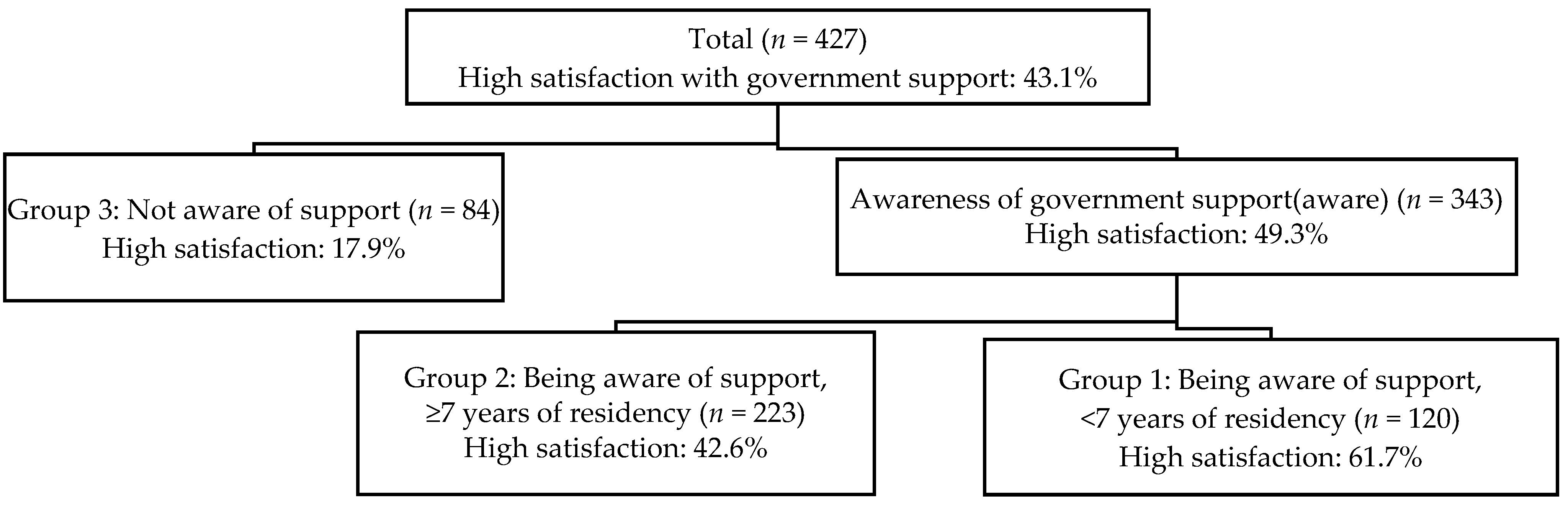
Satisfaction scores were dichotomized using the median value of 7 points. Participants scoring 7 points or higher were classified into the high satisfaction group. Overall, 43.1% of participants belonged to the high satisfaction group. SDA identified awareness of government support as the primary splitting variable. Among participants who were aware of government support—regardless of actual use—the proportion of the high satisfaction group was 49.3%. In contrast, among participants who were neither aware of nor had used government support, the proportion of the high satisfaction group was 17.9%. The second splitting variable was the length of residence in Japan. Among participants with six years or less of residence, 61.7% belonged to the high satisfaction group. Among those with seven years or more of residence, 42.6% belonged to the high satisfaction group. Participants were classified into three groups: Group 1, those aware of government support services with six years or less of residence (n = 120); Group 2, those aware of government support with seven years or more of residence (n = 223); and Group 3, those not aware of government support services (n = 84).
Figure 1. Determinants of Satisfaction with Government Support Identified by SDA (n = 427).
Healthcare 14 01279 g001

3.3.3. Characteristics by Awareness of Government Support and Length of Residence (Table 4)

Participants in Group 1 were more likely to be in their 20s, whereas participants in Group 2 were predominantly in their 40s to 60s. Participants in Group 3 were most frequently in their 30s. Group 1 included a higher proportion of individuals from Southeast Asia and Africa. Group 2 included more individuals from North America and Latin America. Group 3 included more individuals from Western Europe. Japanese language proficiency was lower in Group 1 and higher in Group 2. Group 1 included more students and part-time workers, whereas Group 2 included more full-time employees and freelancers. Group 3 included more unemployed individuals and dependents.
Table 4. Characteristics by Awareness of Government Support and Length of Residence (n = 427).
Group 1 (n = 120)Group 2 (n = 223)Group 3 (n = 84)
n
Mean
%
SD
n
Mean
%
SD
n
Mean
%
SD
p
Sex/gender Female6859.112356.44758.00.888
Male4740.99543.63442.0
Age group 20s5949.2146.31113.1<0.001
30s4940.810748.04250.0
40s86.76328.32125.0
50s21.73013.589.5
60s21.794.022.4
Nationality East Asia2117.64018.02125.30.308
Southeast Asia3428.63515.8910.80.002
South Asia75.962.767.20.161
Middle East and West Asia00.010.511.20.469
Western Europe1310.93214.42024.10.033
Northern Europe00.020.911.20.533
Central and Eastern Europe21.783.622.40.575
North America1411.85223.41416.90.028
Latin America1613.43817.156.00.044
Africa97.641.822.40.019
Oceania32.541.822.40.890
Language proficiency Speaking5.42.36.92.16.32.1<0.001
Reading4.82.35.92.45.32.5<0.001
Writing4.22.35.12.64.62.60.015
Listening5.82.37.42.07.12.1<0.001
Employment status Not working32.583.678.30.106
Full-time job5546.613962.94958.30.015
Part-time job1714.42310.41214.30.466
Freelance10.83214.5910.7<0.001
Student3731.431.422.4<0.001
Self-owned business00.0135.922.40.017
Technical intern trainee10.800.000.00.274
Dependent43.431.433.60.361
Note: Percentages were calculated based on valid responses only; missing values included non-response and not applicable. χ2 test One-way ANOVA.

4. Discussion

4.1. COVID-19 Vaccination Uptake and Access to Vaccination Support Among Foreign Residents

In this study, the COVID-19 vaccination rate among foreign residents was higher than the national average vaccination rate in Japan (approximately 80%) [8]. Although vaccination was not legally mandatory in Japan, practical circumstances—such as quarantine requirements upon re-entry into Japan for unvaccinated individuals—may have made vaccination effectively close to mandatory for many foreign residents. The survey results also suggest that administrative support related to vaccination was widely recognized. Only one respondent reported difficulty understanding how to receive the vaccination voucher, indicating that vaccination support was broadly disseminated among foreign residents. However, several barriers were still reported, including delays in receiving vaccination vouchers, uncertainty about where to get vaccinated, difficulty making reservations, and difficulty understanding explanations and instructions in Japanese. Because vaccination is a critical public health intervention during infectious disease outbreaks, it is essential to ensure that no residents—including foreign residents—are left behind. These findings suggest the need for improved multilingual communication and accessible reservation systems in preparation for future pandemics. Furthermore, it is important to highlight the critical role of the healthcare system in operationalizing governmental support. Our findings show that 27.5% of the respondents received their vaccinations at primary care clinics. This indicates that local medical institutions and public health centers function as the primary access points where governmental public health policies are delivered to foreign residents. The effective delivery of public support measures, such as the vaccination program, heavily relies on the robust collaboration between administrative bodies and the community healthcare system. Moreover, it is important to acknowledge that the reasons for non-vaccination among foreign residents often extend beyond logistical or language barriers. As highlighted by recent literature, religious, cultural, and moral values can significantly influence individuals’ vaccination choices and their perception of public health interventions [9]. In our study, a subset of unvaccinated respondents cited reluctance or doubts about vaccine effectiveness. These attitudes may be deeply intertwined with cultural or religious backgrounds that shape health behaviors. Recognizing these additional factors is crucial, as culturally and religiously sensitive communication, often mediated through community leaders, may be necessary to address vaccine hesitancy and improve the equitable reach of government support.

4.2. Pathways Through Which Awareness of Government Support Services and Length of Residence Shape Satisfaction

This study identified awareness of government support as a primary determinant of satisfaction. Higher awareness was associated with greater satisfaction regardless of whether participants used the services. Prior evidence suggests that access and availability are important factors influencing satisfaction with healthcare [10] and that perceived service quality is associated with healthcare utilization and may also influence satisfaction [11]. When individuals are aware of and use government support services, direct experiences of support may enhance their recognition of its contribution to daily life, thereby increasing satisfaction.
Previous research has demonstrated that the perceived availability of support plays a critical role in promoting psychological well-being and life satisfaction [12,13]. Building on this, it could be hypothesized that the mere awareness of available administrative support might function as a psychological reassurance or a perceived social safety net. Although trust and reassurance were not directly measured in our survey, recognizing that assistance is available if needed may provide a sense of security and control, fostering trust in local administrations. Our findings suggest that administrative support, like health insurance coverage, functions not only as an instrumental resource but also as a perceived safety net. This awareness may enhance a sense of security and reassurance, thereby increasing satisfaction even in the absence of direct service utilization—a mechanism also implied by recent literature [14].
These findings are consistent with previous studies on public responses during the COVID-19 pandemic, which suggest that satisfaction is influenced not only by policy effectiveness but also by perceptions of accessibility and government performance [15,16]. This implies that perceived availability and accessibility of support programs may enhance satisfaction by reinforcing the perception that authorities are responsive to citizens’ needs.
Awareness of government support services may also reflect exposure to government communication. Transparent communication and the provision of reliable information have been shown to strengthen trust in government during crises. Mansoor (2021) demonstrated that high-quality information provided through government communication channels contributes to strengthening citizens’ trust in government during the COVID-19 pandemic [17]. Thus, awareness may reflect not only the existence of support systems but also the effectiveness of communication, which may foster reassurance and institutional trust.
Furthermore, effective dissemination of information is essential. In addition to the existence of support systems, clear information regarding eligibility criteria and application procedures is necessary to ensure that support reaches those in need. Previous research has shown that awareness and utilization of services are influenced by individual and contextual factors, including access to information and personal conditions [18]. Without accessible and understandable information, even well-designed systems may fail to reach potential beneficiaries. Limited awareness may therefore act as a barrier to service utilization and influence individuals’ evaluations of support [19].
This study also showed that the length of residence influenced satisfaction. Differences in satisfaction may reflect changes in social integration, stability, and perceived need for support over time. Participants with <7 years of residence may still be establishing their living foundations, and government support may provide direct and immediate benefits, thereby increasing satisfaction. In contrast, those with ≥7 years of residence may experience more stable conditions and reduced dependence on support, leading to lower perceived benefits and satisfaction. Previous research has similarly reported that the determinants of residential satisfaction among foreign residents differ according to the length of residence and stage of settlement [20].

4.3. Characteristics of the Three Groups Determining Satisfaction (The <7 Years of Residency, ≥7 Years of Residency, and Those Unaware of Services)

This study identified distinct profiles across three groups defined by length of residence and awareness of government support. The group with <7 years of residence included a higher proportion of individuals in their 20s, as well as students and part-time workers, suggesting relatively unstable living foundations. This group also included more individuals from Southeast Asia and Africa, many of whom had limited Japanese language proficiency. Despite these vulnerabilities, it is plausible that individuals in this group may perceive a higher need for governmental support, which could hypothetically increase their motivation to seek information and engage with available services. Previous research suggests that immigrants’ subjective well-being is shaped by economic conditions, social networks, and information environments, all of which evolve over time [21]. In this context, individuals in earlier stages of settlement may be more actively engaged in seeking resources necessary for daily life. As a result, awareness of government support may be more easily developed, and once recognized, such services may function as concrete and immediate support, thereby increasing satisfaction.
The group with ≥7 years of residence included a higher proportion of individuals aged 40–60 years and those engaged in stable employment (e.g., full-time work and freelance work). This group also included relatively more individuals from North America and Latin America. These characteristics may reflect more stable living conditions and greater familiarity with Japanese society. Previous research has shown that limited social support and barriers to healthcare access are associated with poorer mental health and reduced well-being among immigrants in Japan [22]. Conversely, individuals with more stable socioeconomic conditions and established social networks may experience fewer immediate challenges in daily life. While such conditions may facilitate access to and understanding of government support information, the perceived need for support may be lower. As a result, although awareness may be maintained, the perceived benefits of support may be less salient, leading to relatively lower satisfaction compared with the <7 years of residence group.
The group that was unaware of government support included a higher proportion of individuals in their 30s. Individuals in this life stage may prioritize family responsibilities and childcare, which can constrain employment opportunities and increase the likelihood of being unemployed or categorized as dependents. This group also included more individuals from Western Europe. We hypothesize that differences in socioeconomic status, educational background, and social capital could influence patterns of information-seeking behavior and reliance on governmental support. Individuals with relatively higher levels of social capital might depend less on public support systems and therefore could be less attentive to available services. In addition, previous research suggests that awareness of services is influenced by individual and contextual factors, including access to information and personal circumstances [18]. A lack of awareness may limit opportunities to obtain reassurance from existing support systems and to benefit from available services, which may ultimately contribute to lower satisfaction.

4.4. Implications for Government Support Approaches by Awareness and Length of Residence

This study suggests that support strategies should differ according to awareness status and length of residence. The group with <7 years of residency who were aware of services included many individuals in their 20s, students and part-time workers, participants from Southeast Asia and Africa, and those with limited Japanese proficiency. For this group, multilingual information provision through immigrant community organizations and educational institutions may be effective. Practical formats include leaflets, videos, and audio materials. This is consistent with previous evidence suggesting that the use of patients’ native languages improves satisfaction, treatment adherence, and health outcomes [23]. In addition, training and deploying foreign peer supporters or navigators, as well as strengthening face-to-face assistance, may enhance awareness and translate service knowledge into tangible benefits in daily life. This aligns with previous evidence demonstrating that navigation interventions delivered by community health workers are effective in chronic disease management in primary care settings [24]. Together, these approaches may support immediate improvements in daily life and increase satisfaction.
For the group with ≥7 years of residence who were aware of services, many were aged 40–60 years, originated from North America or Latin America, had higher Japanese proficiency, and were engaged in stable employment (e.g., full-time work or freelancing). For this group, strengthening information dissemination through workplace networks and organizations may be effective. Additionally, providing detailed information about services, simplifying procedures, and improving usability may help maintain awareness while increasing the likelihood of utilization. Although this group may perceive less need for support, ensuring transparency and fairness in information provision may prevent declines in satisfaction and strengthen trust in government support systems. This is consistent with previous research indicating that culturally responsive care enhances trust in healthcare systems and improves patient satisfaction [25], and a similar principle may be applicable to government support delivery.
Several factors may contribute to limited awareness of government support among this group, including differences in educational background, personal social networks, and opportunities to encounter information in daily life. This is consistent with previous research showing that immigrants tend to rely on informal interpersonal information channels, such as family members, friends, and community organizations, when seeking information about services in host societies [26].
Studies have also highlighted the important role of community-based institutions as accessible information hubs for migrant populations. Local community centers, consultation services, and settlement support organizations serve as key access points through which migrants obtain information about public services and local resources [27]. These community-based venues allow individuals to encounter information naturally in the course of everyday life, which may reduce barriers to accessing administrative services.
From a policy perspective, strengthening community-based information channels may therefore be an effective strategy to improve awareness of government support services among foreign residents. Providing information through multicultural community hubs, consultation counters, and peer-support networks may help ensure that administrative support systems reach individuals who might otherwise remain unaware of available services.
For the group unaware of services, which included many individuals in their 30s, participants from Western Europe, and individuals who were unemployed or dependents, face-to-face informational sessions in everyday community settings may be particularly important. Potential venues include multicultural community hubs and local salons, where individuals can encounter information as part of their daily routines. Given the lower reliance on government support in this group, framing information as a source of reassurance and an opportunity for social participation may increase awareness and prevent further declines in satisfaction. This is consistent with a systematic review demonstrating that community navigators are effective in improving health outcomes among immigrants [28]. Disseminating information via peer supporters and community networks may reduce psychological distance from administrative systems and encourage willingness to use available services. In addition to administrative efforts, the healthcare system plays an indispensable role as an information hub. Healthcare professionals, including doctors, nurses, and community health workers in primary care settings, are often the most trusted and accessible point of contact for foreign residents. Therefore, the healthcare system serves not merely as a provider of medical treatment but as a critical bridge connecting vulnerable populations to broader governmental support. As previous evidence suggests, integrating culturally responsive care and utilizing community health workers as navigators within the healthcare system not only improves clinical health outcomes but also strengthens trust in public institutions. Enhancing the synergy between government policies and the healthcare delivery system is essential for maximizing the reach and satisfaction of public support for foreign residents [24,27,28].
Beyond the domestic context in Japan, our findings resonate with international evidence regarding the psychological and socioeconomic vulnerabilities of migrant populations and international students during the COVID-19 pandemic. Research across multiple countries has highlighted that foreign populations experienced significantly elevated stress and anxiety levels. For instance, a cross-sectional study of international medical students in Serbia found that a majority experienced higher-than-usual stress levels, primarily driven by concerns over their finances, academic future, and the health of loved ones in their home countries [29]. Similarly, global scoping reviews and studies from host countries such as Canada have demonstrated that migrant workers and international students faced disproportionate mental health burdens due to social isolation, job insecurity, and exclusion from national emergency financial relief programs [30,31]. Furthermore, structural barriers and the lack of culturally tailored support often exacerbated their difficulties in accessing crucial public health information and administrative services [32]. To cope with these unprecedented challenges, accessible institutional support, transparent communication, and community networks emerged as critical protective factors that mitigate psychological distress. Comparing our local findings with these international results underscores a universal trend: awareness of the availability of support provides a vital psychological safety net. Ensuring equitable access to information and structural support is therefore not only a localized issue in Japan but a shared global challenge essential for safeguarding the well-being of foreign residents during public health crises.
Several limitations should be considered when interpreting these findings. First, participants were recruited through a commercial online panel managed by an online survey company. Web-based surveys and opt-in online panels are subject to potential coverage errors and self-selection bias, which can limit the representativeness of the sample and the generalizability of estimates to the broader foreign resident population. In addition, participation required internet access and sufficient digital literacy, which may have resulted in the underrepresentation of individuals with limited internet access or those facing greater time and resource constraints, potentially introducing selection bias [33]. Second, the recruitment approach may have disproportionately captured foreign residents with relatively stable living conditions (e.g., registered residents with more stable residence situations). Consequently, foreign residents in more vulnerable circumstances—such as those with unstable residence status—may not have been adequately represented. Prior research in Japan indicates that some migrant groups experience barriers to healthcare access, including gaps in insurance coverage and other structural barriers, suggesting that determinants of awareness, utilization, and satisfaction may differ among harder-to-reach and more vulnerable populations who are often underrepresented in survey-based studies [34,35,36]. Future studies should consider complementary recruitment strategies (e.g., community organizations, multilingual outreach, and mixed-mode surveys) to better include these populations and to evaluate whether the observed associations hold across varying levels of vulnerability.

5. Conclusions

This study demonstrated that awareness of government support was strongly associated with higher satisfaction in this sample. Individuals who used government support reported higher satisfaction, likely through direct support effects. Even among those who did not use the services, satisfaction was higher, which may reflect reassurance derived from the existence of available systems and trust in government support institutions. In contrast, individuals who were unaware of government support tended to report lower levels of satisfaction.
The study also showed that the length of residence was an additional factor associated with satisfaction with government support, potentially by shaping perceived need and perceived benefits. The <7-year residence group tended to have less stable living foundations and experienced stronger perceived benefits from government support, which might have contributed to higher satisfaction. Conversely, the ≥7 years of residence group generally had more stable living conditions and showed reduced dependence on government support, which may relate to relatively lower satisfaction.
Furthermore, this study identified distinct characteristics among the <7 years residence group, the ≥7 years residence group, and individuals who were unaware of government support. These groups differed in age distribution, region of origin, Japanese language proficiency, and employment status. Based on these findings, the study suggests that tailored policy measures are required for each group. Such measures include multilingual support, the deployment of foreign peer supporters, simplification of government support procedures, and information dissemination through community-based interaction hubs. Implementing these strategies in a stratified manner according to population characteristics is essential to improve satisfaction with government support.
As post-pandemic international mobility resumes, the number of foreign residents in Japan has rapidly rebounded, reaching approximately 3.76 million by the end of December 2024. This population reflects increasing diversity in nationalities and residence statuses, with significant concentrations in major metropolitan areas where employment opportunities are abundant [1]. At a time when Japan is introducing new policies to reshape its foreign labor system, including the planned transition from the Technical Intern Training Program to the Developmental Employment system, it is particularly important to reflect on the experiences of foreign residents during the COVID-19 pandemic [37]. The lessons learned from administrative support during this period should be carefully examined and incorporated into future policy development to build more inclusive and responsive support systems for this growing and diverse population.

Author Contributions

Conceptualization, R.O.; methodology, R.O.; software, S.A. and D.O.; validation, S.A. and D.O.; formal analysis, S.A. and D.O.; investigation, R.O.; resources, R.O.; data curation, S.A.; writing—original draft preparation, S.A.; writing—review and editing, S.A., R.O. and D.O.; visualization, S.A.; supervision, D.O.; project administration, R.O. All authors have read and agreed to the published version of the manuscript.

Funding

This study was supported by a Grant-in-Aid for Scientific Research from the Japan Society for the Promotion of Science (JSPS KAKENHI; Grant Number 21K18457).

Institutional Review Board Statement

This study was approved by the Research Ethics Committee of Kyosei Studies, Graduate School of Human Sciences, The University of Osaka, on 17 September 2021 (Approval No. OUKS2124).

Informed Consent Statement

Informed consent was obtained electronically from all participants involved in the study. Before answering the online questionnaire, all participants were provided with an explanation of the study and indicated their consent to participate.

Data Availability Statement

The data presented in this study are not publicly available due to ethical restrictions and the protection of participants’ privacy.

Acknowledgments

The authors would like to thank all participants and the cooperating institutions for their support of this study. The authors report on the use of generative AI (ChatGPT-5-series and NotebookLM) to support language editing, clarity, and structural refinement during the preparation of this manuscript. All substantive arguments, interpretations and analyses were developed by the authors, however, who take full responsibility for the originality, accuracy, and integrity of the work and the data reported.

Conflicts of Interest

The authors declare no conflicts of interest.

References

  1. Immigration Services Agency of Japan. Statistics on Foreign Residents. Available online: https://www.moj.go.jp/isa/publications/press/13_00052.html (accessed on 17 September 2025).
  2. Khin, Y.P.; Owusu, F.M.; Nawa, N.; Surkan, P.J.; Fujiwara, T. Barriers and facilitators for healthcare access among immigrants in Japan: A mixed methods systematic review and meta-synthesis. Lancet Reg. Health West. Pac. 2025, 54, 101276. [Google Scholar] [CrossRef]
  3. Piller, I.; Zhang, J.; Li, J. Linguistic diversity in a time of crisis: Language challenges of the COVID-19 pandemic. Multilingua 2020, 39, 503–515. [Google Scholar] [CrossRef]
  4. Ikeda, S.; Sudo, K.; Iwamoto, A.; Kanda, M.; Aoyagi, R.; Ota, S.; Shakya, M.; Nii, M.; Sawada, T.; Nakasa, T.; et al. A critical role of navigator for vulnerable migrants in health emergency: Overcoming administrative barriers to COVID-19 vaccination in Japan. J. Migr. Health 2025, 11, 100332. [Google Scholar] [CrossRef]
  5. Center for Global Citizenship Activities (CINGA). COVIC Report: How COVID-19 Vaccination Was Promoted Among Foreign Residents, Including Those Without Legal Status. Available online: https://www.cinga.or.jp/cinga/wp-content/uploads/2023/04/COVIC-report-web-1.pdf (accessed on 16 September 2023).
  6. Ministry of Health, Labour and Welfare. To Foreign Nationals: Support for Work and Daily Life. Available online: https://www.mhlw.go.jp/stf/seisakunitsuite/bunya/koyou_roudou/koyou/jigyounushi/page11_00001.html (accessed on 9 March 2026).
  7. Working Group on Strengthening Global Response Capacity of Public Health Centers. Guidelines for Foreign Resident Support at Public Health Administration Counters. Available online: http://www.phcd.jp/02/t_gaikoku/pdf/file01.pdf (accessed on 16 September 2023).
  8. Ministry of Health, Labour and Welfare. Regarding the Number of COVID-19 Vaccine Doses During the Special Temporary Vaccination Period. Available online: https://www.mhlw.go.jp/stf/seisakunitsuite/bunya/kenkou_iryou/kenkou/kekkaku-kansenshou/yobou-sesshu/syukeihou_00002.html (accessed on 16 March 2026).
  9. Petrović, J.R.; Šuvaković, U.V.; Nikolić, I.A. Religiosity and University Students’ Attitudes About Vaccination Against COVID-19. Religions 2025, 16, 58. [Google Scholar] [CrossRef]
  10. Ferreira, D.C.; Vieira, I.; Pedro, M.I.; Caldas, P.; Varela, M. Patient satisfaction with healthcare services and the techniques used for its assessment: A systematic literature review and a bibliometric analysis. Healthcare 2023, 11, 639. [Google Scholar] [CrossRef]
  11. Hussien, M. The role of perceived quality of care on outpatient visits to health centers in two rural districts of northeast Ethiopia: A community-based, cross-sectional study. BMC Health Serv. Res. 2024, 24, 614. [Google Scholar] [CrossRef] [PubMed]
  12. Cohen, S.; Wills, T.A. Stress, social support, and the buffering hypothesis. Psychol. Bull. 1985, 98, 310–357. [Google Scholar] [CrossRef] [PubMed]
  13. Yeo, G.; Lansford, J.E.; Rudolph, K.D. How does perceived social support relate to human thriving? A systematic review with meta-analyses. Psychol. Bull. 2025, 151, 1089–1124. [Google Scholar] [CrossRef]
  14. Markowitz, W.; Kausar, K.; Coffield, E. Relationship between Patient Experience Scores and Health Insurance. Healthcare 2022, 10, 2128. [Google Scholar] [CrossRef]
  15. Jannati, N.; Zandian, H.; Naghibzadeh Tahami, A.; Yazdi-Feyzabadi, V. Public satisfaction with COVID-19 policy responses and their implementation: A cross-sectional study. Health Res. Policy Syst. 2025, 23, 118. [Google Scholar] [CrossRef]
  16. Kim, S.; Rho, E.; Teo, Y.X.J. Citizen satisfaction research in public administration: A systematic literature review and future research agenda. Am. Rev. Public Adm. 2024, 54, 5. [Google Scholar] [CrossRef]
  17. Mansoor, M. Citizens’ trust in government as a function of good governance and government agency’s provision of quality information on social media during COVID-19. Gov. Inf. Q. 2021, 38, 4. [Google Scholar] [CrossRef]
  18. Kim, H.J.; Jang, S.N.; Lim, J.Y. Service demand for and awareness of a primary healthcare pilot project for people with disabilities. J. Korean Med. Sci. 2022, 37, e241. [Google Scholar] [CrossRef]
  19. Tanner, E.C.; Vann, R.J.; Kizilova, E. Consumer-level perceived access to health services and its effects on vulnerability and health outcomes. J. Public Policy Mark. 2020, 39, 2. [Google Scholar] [CrossRef]
  20. Lim, H.; Niwa, Y.; Sunaga, A. Factors enhancing residential satisfaction of foreign residents toward settlement: A case study of Toshima City, Tokyo, Japan. J. Hous. Built Environ. 2025, 40, 181–213. [Google Scholar] [CrossRef]
  21. Ainsaar, M. Life Satisfaction of Immigrants and Length of Stay in the New Country. Soc. Sci. 2023, 12, 655. [Google Scholar] [CrossRef]
  22. Ando, H.; Nishino, Y.; Aizawa, N.; Takahashi, K.; Itagaki, A. Health problems and lifestyles of uninsured immigrants: A report from a free health check-up at a hospital in Japan. BMC Res. Notes 2025, 18, 252. [Google Scholar] [CrossRef]
  23. Babalola, A.E.; Johnson, V.; Oromakinde, A.; Azeez, O.; Aderinto, N.; Onasanya, O.; Akinloye, S. The role of local languages in effective health service delivery. Discov. Public Health 2025, 22, 59. [Google Scholar] [CrossRef]
  24. Mistry, S.K.; Harris, E.; Harris, M. Community health workers as healthcare navigators in primary care chronic disease management: A systematic review. J. Gen. Intern. Med. 2021, 36, 2755–2771. [Google Scholar] [CrossRef] [PubMed]
  25. Theodosopoulos, L.; Fradelos, E.C.; Panagiotou, A.; Dreliozi, A.; Tzavella, F. Delivering culturally competent care to migrants by healthcare personnel: A crucial aspect of delivering culturally sensitive care. Soc. Sci. 2024, 13, 530. [Google Scholar] [CrossRef]
  26. Caidi, N.; Allard, D.; Quirke, L. Information practices of immigrants. Annu. Rev. Inf. Sci. Technol. 2010, 44, 491–531. [Google Scholar] [CrossRef]
  27. Goodall, K.; Ward, P.; Newman, L. Use of information and communication technology to provide health information: What do older migrants know, and what do they need to know? Qual. Prim. Care 2010, 18, 27. [Google Scholar]
  28. Shommu, N.S.; Ahmed, S.; Rumana, N.; Barron, G.R.S.; McBrien, K.A.; Turin, T.C. What is the scope of improving immigrant and ethnic minority healthcare using community navigators: A systematic scoping review. Int. J. Equity Health 2016, 15, 6. [Google Scholar] [CrossRef]
  29. Milanović, M.; Mijatović, E.; Đokić, M.; Stanisavljevic, T.; Đokić, A.; Milić, N.; Ćirković, A.; Rajović, N. Stress among international medical students during COVID-19 pandemic: A cross-sectional study. Med. Podml. 2022, 73, 36–42. [Google Scholar] [CrossRef]
  30. Oliva-Arocas, A.; Benavente, P.; Ronda, E.; Diaz, E. Health of International Migrant Workers During the COVID-19 Pandemic: A Scoping Review. Front. Public Health 2022, 10, 816597. [Google Scholar] [CrossRef] [PubMed]
  31. Firang, D.; Mensah, J. Exploring the Effects of the COVID-19 Pandemic on International Students and Universities in Canada. J. Int. Stud. 2021, 12, 1–18. [Google Scholar] [CrossRef]
  32. Du, L.J. The crisis of international education students and responsive service in and after COVID-19 pandemic. Front. Psychol. 2022, 13, 1053512. [Google Scholar] [CrossRef]
  33. Bethlehem, J. Selection bias in web surveys. Int. Stat. Rev. 2010, 78, 161–188. [Google Scholar] [CrossRef]
  34. Suguimoto, S.P.; Ono-Kihara, M.; Feldman, M.D.; Kihara, M. Latin American immigrants have limited access to health insurance in Japan: A cross-sectional study. BMC Public Health 2012, 12, 238. [Google Scholar] [CrossRef]
  35. Shakya, P.; Tanaka, M.; Shibanuma, A.; Jimba, M. Nepalese migrants in Japan: What is holding them back in getting access to healthcare? PLoS ONE 2018, 13, e0203645. [Google Scholar] [CrossRef]
  36. Higuchi, M.; Endo, M.; Yoshino, A. Factors associated with access to health care among foreign residents living in Aichi Prefecture, Japan: Secondary data analysis. Int. J. Equity Health 2021, 20, 135. [Google Scholar] [CrossRef]
  37. Immigration Services Agency of Japan. Employment for Skill Development. Available online: https://www.moj.go.jp/isa/applications/index_00005.html (accessed on 9 March 2026).
Disclaimer/Publisher’s Note: The statements, opinions and data contained in all publications are solely those of the individual author(s) and contributor(s) and not of MDPI and/or the editor(s). MDPI and/or the editor(s) disclaim responsibility for any injury to people or property resulting from any ideas, methods, instructions or products referred to in the content.