The codes used in the analysis are illustrated by textual quotations from the participants (verbatims). Participants verbatims were identified by their code, age, sex (M = Men/W = Woman), and whether they had participated in the INCOPAL project (yes/no).
3.1. Palliative Needs
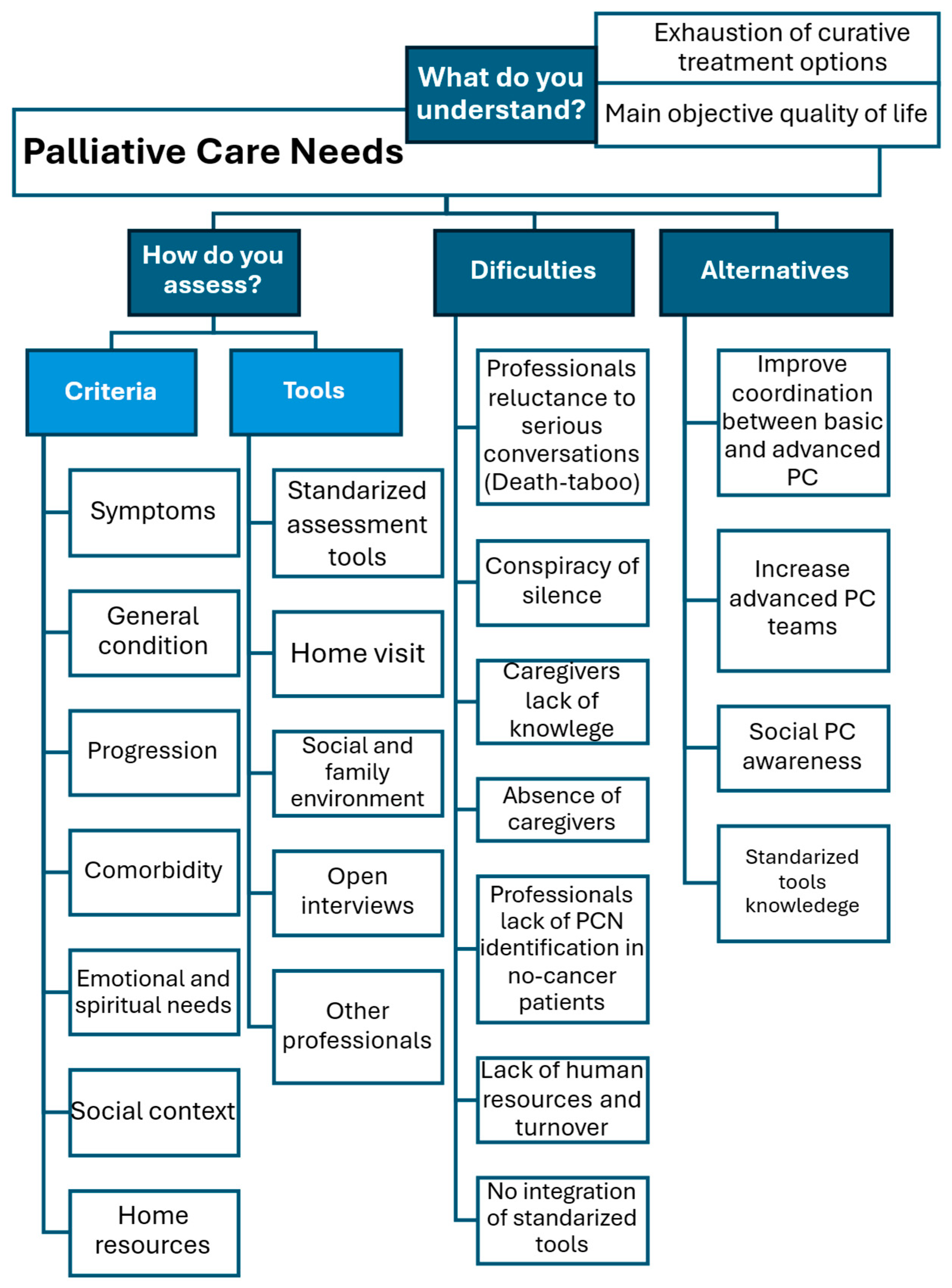
The codes, themes and sub-themes related to PCNs are shown in
Figure 1.
3.1.1. What Do You Understand by PCNs?
Although none of the participants clearly defined what they understood by PCN, most agreed that patients with PCN are those with cancer or non-cancer diseases who have exhausted all curative treatment options. At this point, the main objective becomes the quality of life of both the patient and their family. One interviewee emphasized that PC should begin as soon as an incurable disease is diagnosed, without waiting for the patient to reach the terminal stage.
“You are going to focus on comfort care, on care that does not go beyond simply making the patient feel as comfortable as possible.” (19, 49 y, W, No INCOPAL)
“Above all, you have to provide care, comfort measures aimed more at their well-being, more at the intention of caring than at curing those diseases.” (4, 48 y, W, No)
“Patients with complex chronic conditions that progress to the end and patients who have cancer, where the progression is much faster and more aggressive, and who may come to me at much more complex stages.” (16, 55 y, W, No)
“Palliative care should be provided from the moment I am diagnosed with an incurable disease.” (2, 30 y, M, No)
3.1.2. How Do You Assess PCNs?
The assessment of PCN involves a comprehensive evaluation of different criteria: clinical symptoms, the patient’s general condition, their progression, and the presence of comorbidities. In this assessment, the emotional and spiritual needs of patients also become relevant.
“Assessing not only clinical and care aspects, but also emotional and spiritual aspects is essential because, at the end of the day, is what moves us, and what perhaps enables us to face these difficult moments.” (10, 57 y, W, yes)
“Above all, addressing those spiritual needs of how they are coping with the process, what strengths they have as internal resources when working through moments of crisis in their daily lives.” (16, 55 y, W, No)
Regarding PCNs assessment tools, some interviewees use standardized assessment tools that are integrated into the computer system in their daily practice. The NCMs participating in the INCOPAL project mention that they use different instruments to identify PCN and the IDC-pal to determine the degree of complexity of the patient.
“At the clinical level, I assess palliative needs first according to clinical symptoms, clinical pathology, progression, patient dependence, and the complexity of that care.” (1, 46 y, W, yes)
“Through the IDC-pal and the Barthel, Pfeiffer, social, and Gijón questionnaires. And if I see that the patient is in the final stage, the Karnofsky as well” (17, 50 y, W, No)
Some interviewees highlighted the importance of assessing not only the patient, but also their social and family environment, especially caregivers burden and the availability of resources in the home.
“Knowing what the family environment is like, what problems they have, what that patient means to the family, well, that’s very important in order to care both, the patient and the family.” (8, 57 y, W, yes)
“I don’t just focus on the person. I also focus on the caregiver, the family surrounding the palliative patient, and what I do is an assessment of basic needs.” (18, 56 y, W, No)
In this sense, home visits are essential for assessing PCN. Open interviews with the patient allow them to express their concerns and needs more freely, obtaining information that is not always revealed in a standard consultation with a structured interview.
“I usually try to listen a lot, listen carefully to what they tell me because sometimes it gives me much more information than when you are interrogating them.” (7, 61 y, W, yes)
“I like it that way, directly with the patient and in a natural way, which is good. Which is part of the process, of course.” (2, 30 y, M, No)
On the other hand, some interviewees point out that they do not have the opportunity to directly evaluate PCNs, as these are assessed in advance by other healthcare professionals before their intervention.
“They usually come already defined by the internist.” (12, 54 y, W, No)
“I access palliative care patients through hospital NCMs and through my colleagues, so they practically come to me already assessed.” (2, 30 y, M, No)
3.1.3. Difficulties in Assessing PCNs
Among the difficulties in assessing PCN, all participants highlighted the conspiracy of silence, which limits open communication about the reality of the disease and hinders informed decision-making. Healthcare professionals themselves contribute to this situation by avoiding difficult conversations about prognosis and limited treatment options.
“I try to make the family understand that I know that they want to protect their relative (…) But I also try to make them see that the patient has rights and we cannot deny them; Patients have the right to know or not to know.” (18, 56 y, W, No)
“Often, this conspiracy of silence comes from professionals who do not dare to communicate the few therapeutic options available and show a difficult reality.” (10, 57 y, M, yes)
Some interviewees acknowledge that caregivers do not have the adequate knowledge to take on the task of caregiving. One participant mentions the progressive decline in informal caregivers or absence of caregivers due to changes in family structure.
“Sometimes what I find is that you have to inform the family on how to use all the resources they may have.” (12, 54 y, W, No)
“There are not as many caregivers available anymore. Caregivers are older, they are also very advanced in age.” (10, 57 y, M, yes)
Almost all interviewees agree that death remains a taboo in society, which makes it difficult to accept PC. There is still professionals’ reluctance to address this type of care, perceiving it as synonymous with failure. Family members and patients also share this perception.
“The society we live turns its back on death. It is a society that only seeks to extent life at any price.” (16, 55 y, W, No)
“Culturally, when you reach palliative care, it is a failure. In fact, patients and family members experience it that way at first.” (15, 60 y, W, yes)
On the other hand, the lack of training in PC is another significant barrier that hinders the identification and addressing of patients’ needs. This lack of training particularly impacts professionals’ ability to address patients’ emotional and spiritual needs. In addition, there is a notable lack of training in identifying PCN in non-oncology patients, which contributes to many patients having delayed access to PC, limiting the interventions and support they can receive.
“There are areas that we tend to neglect, which, in the context of the end of life, need to be worked on, such as the emotional and spiritual spheres, which are difficult to work on with patients and which we find a little difficult to address.” (4, 48 y, M, No)
“We all understand that when we cannot cure a cancer patient, they are palliative, but what about those frail elderly people, those with heart failure, those with COPD...” (6, 34 y, W, No)
“I see that these patients continue to attend consultations, follow-ups, and appointments with specialists, and no one makes the decision to say that at this point the patient is in a palliative situation.” (19, 49 y, W, yes)
Participants also pointed out the lack of healthcare personnel and the continuous turnover of staff, especially nurses. Short-term contracts create instability in teams, which affects continuity of care and hinders specialization in PC. In addition, they cite a lack of time to perform a comprehensive assessment of patients, which leads them to prioritize the most obvious cases. All of this generates frustration and helplessness among professionals.
“The fundamental problem is the mobility we have had lately with professionals” (19, 49 y, W, yes)
“I don’t know if in primary care, healthcare professionals are able to devote time, and perhaps that is what is failing us in identifying those patients who are not affiliated with palliative care.” (6, 34 y, W, No)
The NCMs participating in the INCOPAL project indicated that essential tools, such as the IDC-Pal or NECPAL, are not integrated into the computer system, which makes it difficult to apply and record them in the medical record. Furthermore, the medical record is not always completed properly, and information regarding previous interventions, referrals, and home visits is not clearly reflected.
“The computer tool is used here in Andalusia, but it doesn’t have many tools that facilitate that assessment.” (4, 48 y, M, No)
“It’s true that we have the IDC-Pal scale, but that scale, for example, is not registered in (the computer system). Since we don’t have it registered, it’s more complicated to register it.” (11, 60 y, W, No)
3.1.4. Alternatives to Actual PCNs Assessment
As alternatives for assessing PCN, some interviewees highlighted the need to improve coordination basic and advanced level of PC, that might enhance continuity of care. Others, however, propose increasing the number of specialized PC nurses and doctors. One participant suggests implementing a “red button” in the computer system that would allow for early identification of patients with PCN, even before they are referred to specific resources.
“We should all work together so that the patient really benefits from my timely intervention, but also from the continuity of care provided by the palliative care unit and primary care.” (6, 34 y, W, No)
“Provide palliative care with more staff so that they can care for patients entering the palliative process, regardless of the level of complexity.” (17, 50 y, W, No)
“That you can really identify it in (computer system), medicine, and nursing, even if you can’t refer it to the teams.” (8, 57 y, W, yes)
Several interviewees highlighted the need to raise awareness among both professionals and society about the importance of PC. This involves ensuring access to PC training for all professionals. Some suggested that training should be mandatory during working hours. Interviewees who did not participate in the INCOPAL project emphasized the need to know scales and instruments for assessing PCNs, while those who collaborated in the project highlighted that it has allowed them to learn about and become familiar with many of these tools.
“End of life is part of the life cycle and that professionals have to be prepared to respond to that situation and also adapt and establish strategies for action.” (6, 34 y, W, No)
“Perhaps offering some kind of more advanced course that people could take at a more affordable price and that would also be easier to attend in terms of work.” (7, 61 y, W, yes)
3.2. Referral to PC
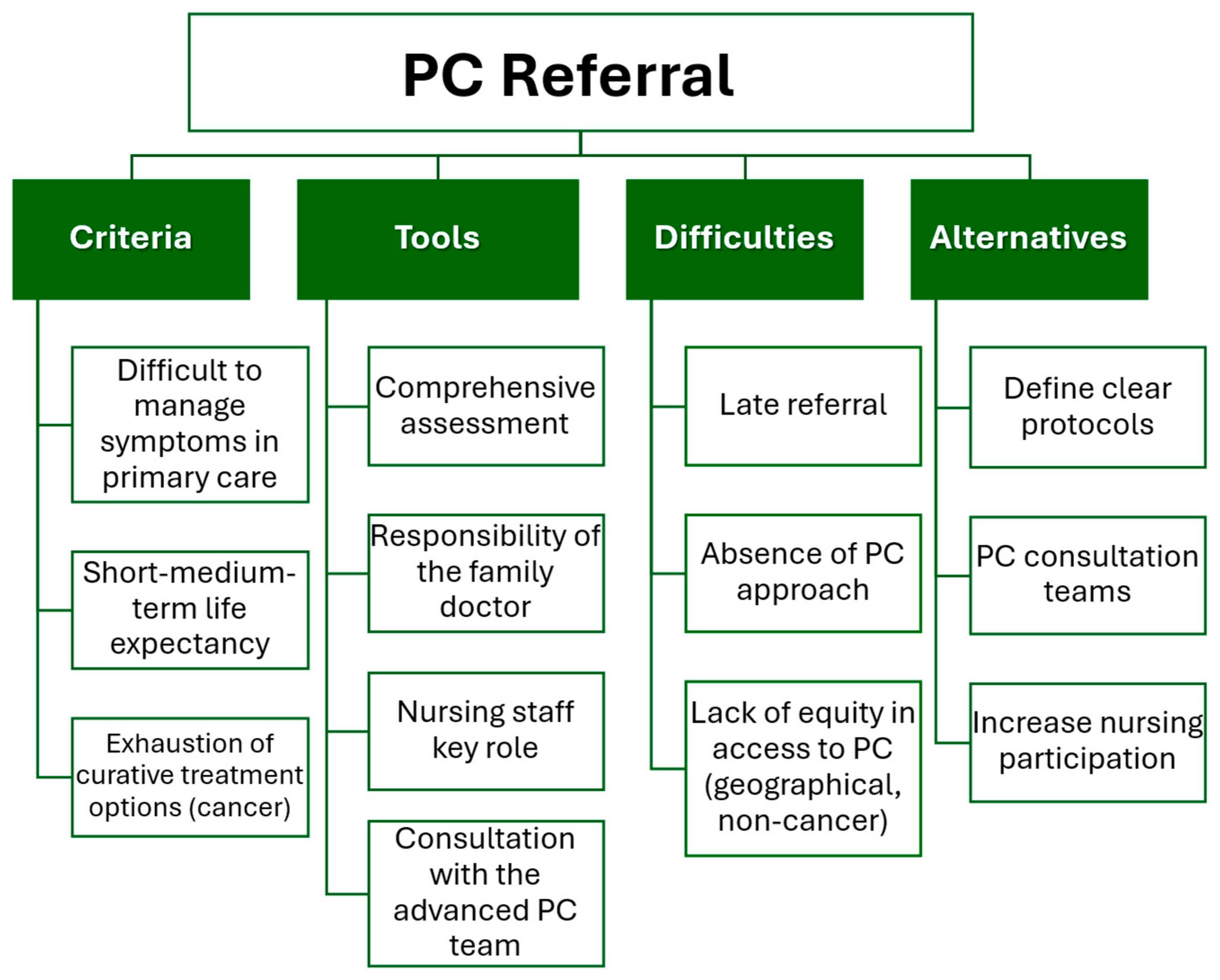
The themes and sub-themes related to referral to advanced PC resources are shown in
Figure 2.
3.2.1. Criteria for Specialized PC Referral
One of the criteria for referral to PC most frequently mentioned by participants is the presence of symptoms that are difficult to manage in primary care setting. Participants emphasized that these patients require specialized management due to the complexity of their needs.
“When I make that assessment and find that the patient is highly complex and beyond the response we can give in primary care, that’s when I refer them.” (18, 56 y, W, No)
“Those complex chronic patients who are basically immobilized with almost 24-h home care. That’s when I understand that it’s time to move the person into the palliative care process.” (10, 57 y, M, yes)
Other interviewees point out that referral to PC is considered when the patient is estimated to have a short- or medium-term life expectancy. Likewise, other interviewees state that, in their experience, referral to PC is usually made for cancer patients who cannot tolerate treatment and have exhausted all therapeutic options.
“If the person is in a palliative situation, undergoing palliative treatment, with no cure, and it is a matter of time and a short- to medium-term prognosis, then palliative care should be initiated.” (9, 57 y, W, No)
“When I see that the situation is more complex and when the patient requires, let’s say, a short-term prognosis.” (11, 60 y, W, No)
“When the signs and symptoms treated by their family doctor do not resolve the situation or improve the patient’s condition, we have exhausted all resources in terms of treatment, tests, and so on. Then we need more advanced resources.” (13, 61 y, W, yes)
3.2.2. Tools for Specialized PC Referral
In relation to the referral process, the first step is to perform a comprehensive assessment. Half of the participants agreed that this assessment is the responsibility of the family doctor, although nursing staff play a key role. Several interviewees emphasized that this process requires close coordination with the multidisciplinary team.
“ The doctor performs a physical examination and so on. While we make our assessment based on needs and also perform a physical examination.” (18, 56 y, W, No)
“Talking to the care team: family doctor, family nurses, social worker at the healthcare centre, in order to communicate the situation of reversibility, worsening, poor prognosis, increased intensity of interventions and visits...” (10, 57 y, M, yes)
Many of the participants highlighted the consultation with the specialized PC team, emphasizing the need for fluid communication. Other NCMs stated that, in some cases, it is the family who requests PC when they perceive a deterioration in the patient’s condition.
“If a patient is referred who is in a much more advanced stage and I want them to be seen soon, I speak to them (specialized PC team) directly and maybe they will see them the next day.” (14, 60 y, W, yes)
“Often it is the family who contacts you, because sometimes you don’t get to see all the patients, they are being seen by specialists.” (20, 56 y, W, yes)
3.2.3. Difficulties for Specialized PC Referral
Among the difficulties in referral to PC, some interviewees pointed out that referral often occurs too late, when the patient is already in the last days of life. They mentioned that, in practice, it is difficult to refer patients in the early or intermediate stages of the process, due to the reluctance of certain health professionals to adopt a palliative care approach.
“They act when the patient is already in a very advanced or final stage, when it is time to sedate, while all the literature tells you is that these teams have to work intensively at the beginning of the process.” (8, 57 y, W, yes)
“They want to be too clear when sending patients to palliative care. It has to be too obvious from the beginning to send them.” (15, 60 y, W, yes)
On the other hand, participants highlighted the lack of equity in access to PC, depending on geographical factors. Some patients from rural areas die without receiving adequate PC, far from their families or without the possibility of staying at home, as they would wish. Several interviewees emphasized that non-cancer patients have more difficult access to PC.
“It is very sad that, depending on where you live, you may die with more or less dignity because if you want to die at home, if you don’t have a home support and palliative care team, you may not be able to consider it.” (14, 60 y, W, yes)
“I mean that it (PC) depends on the professional you get, it depends on which hospital you are in, it depends on which service, it depends on which health centre your home is in, it depends on whether you get the morning shift, the afternoon shift, the night shift...” (18, 56 y, W, No)
Some participants suggested the need to define clear protocols for referring patients to the hospital, avoiding unnecessary steps, and optimizing coordination between PC and hospital services. Other NCM suggested the creation of PC consultation teams within districts or hospital centres, to offer advice and continuous updating on the management of PC patients. Several interviewees recommended that referral to PC should not depend exclusively on the physician, but that the nursing team should actively participate in the referral and decision-making process. One interviewee proposed the creation of a specialized team for non-oncological diseases, and another the creation of a specific form in the computer system.
“Establishing this formal, well-known, and clear circuit, especially in the event that a patient needs to be referred to a hospital. Above all to avoid that initial hassle at the emergency room door.” (4, 48 y, M, No)
“It would be great to have a unit or a team of highly trained people in the district or hospital or somewhere where we can ask for information or where we can always be up to date.” (2, 30 y, M, No)
“There should also be an advanced support team to help us primary care professionals carry out this follow-up and approach work for non-cancer patients.” (10, 57 y, M, yes)
“Nurses are the ones who are actually doing the work at home, and follow-up care for patients at home is mainly carried out by nurses, which means that nurses are the first to realize when a patient needs palliative care.” (16, 55 y, W, No)
“If there was a questionnaire or form in the computer program that could be filled out and sent to palliative care at to be viewed, it would be much faster” (17, 50 y, W, No)
3.3. Evaluation of the INCOPAL Project
3.3.1. Changes in Participants’ Understanding of PC
The INCOPAL project has generated changes in the perception and approach to PC by the participating NCMs. It has allowed them to understand that the approach to PC transcends physical symptoms, and they have adopted a more holistic view in their professional practice. One of the participants stated that his perception of which patients require PC has changed, now including non-oncology patients. Another interviewee mentioned that the project has helped to highlight the importance of early detection of PCN, allowing for better care planning.
“What really needs to be identified is not just the symptoms, but much more than that, namely the families, the team, how to approach that patient with the entire team.” (1, 46 y, W, yes)
“We always have the concept of palliative care for cancer patients, and really, with this participation, I have seen that this is not the case. Palliative patients involve many more pathologies than just cancer.” (1, 46 y, W, yes)
“The project helps you to appreciate more or make more visible the palliative care needs at an earlier stage.” (15, 60 y, W, yes)
Some NCM stated that the project has made them more aware of the difficulties in PC, such as the lack of resources or the difficulty of accessing the services. Others highlighted the importance of scales and questionnaires to assess patients in a more accurate and structured way.
3.3.2. Criticism of INCOPAL Project
In this regard, some of the participants recommended reducing the number of questionnaires, eliminating those that are redundant or irrelevant, or combining the questionnaires into one. On the other hand, one participant pointed out that he has missed specific instruments to assess the situation of the primary caregiver.
“It really reflects the gap between palliative needs and the response we provide.” (8, 57 y, W, yes)
“Knowing some questionnaires and assessment scales that we could incorporate into that assessment to make it more complete.” (13, 61 y, W, yes)
“There are questionnaires that I would remove because an assessment, an evaluation of the patient with all these questionnaires is practically impossible, so I would reduce them.” (1, 46 y, W, yes)
“There are no scales aimed at assessing the caregiver’s situation, the caregiver’s emotions, the difficulty the caregiver has had or is having in caring for that complex chronic person in palliative care. I have missed them.” (10, 57 y, M, yes)





 ,
,