Taiwan’s Smart Healthcare Value Chain: AI Innovation from R&D to Industry Deployment


Abstract
1. Introduction
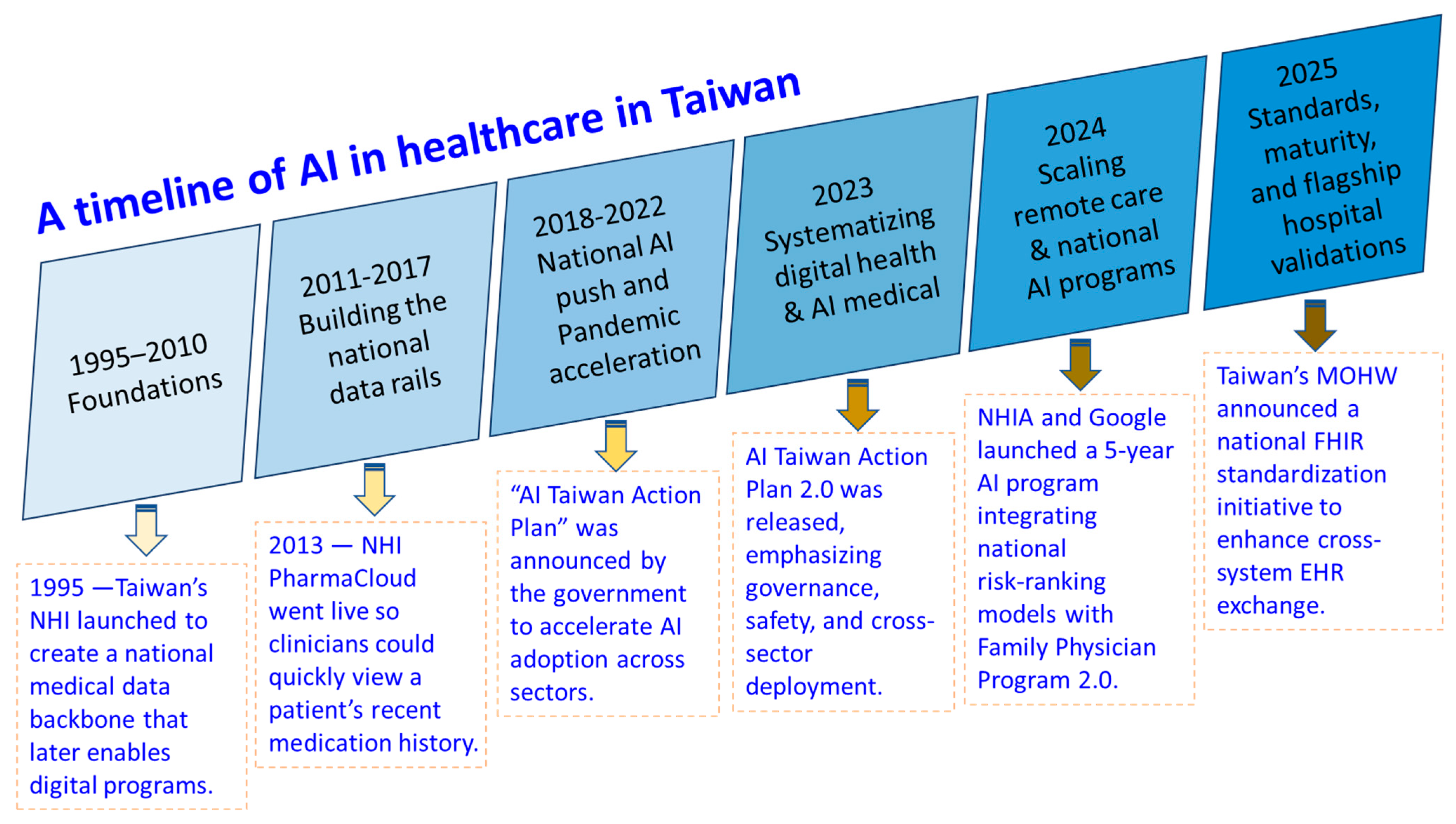
2. Timeline of the Development of Smart Healthcare in Taiwan
3. Comparative Synthesis of Major National Programs
3.1. Major Programs Driving Smart Healthcare Development in Taiwan Since 2019
3.2. Integrated Comparison of the National Programs
4. The University-Led Achievements Driving Taiwan’s Smart Healthcare Industry
5. Key Taiwan’s ICT Players in the Smart Healthcare Industry
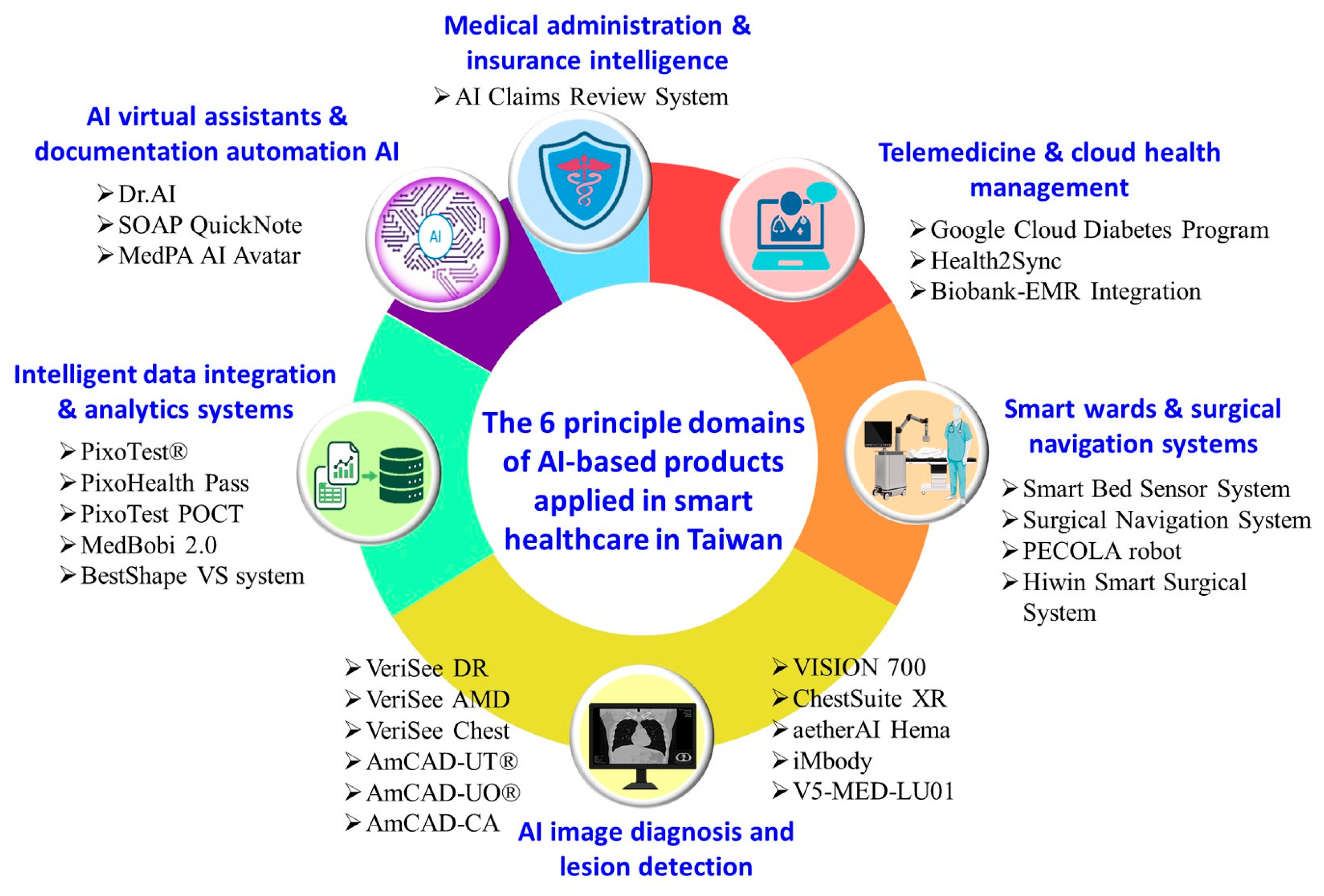
6. AI-Assisted Products in Taiwan’s Smart Healthcare Industry
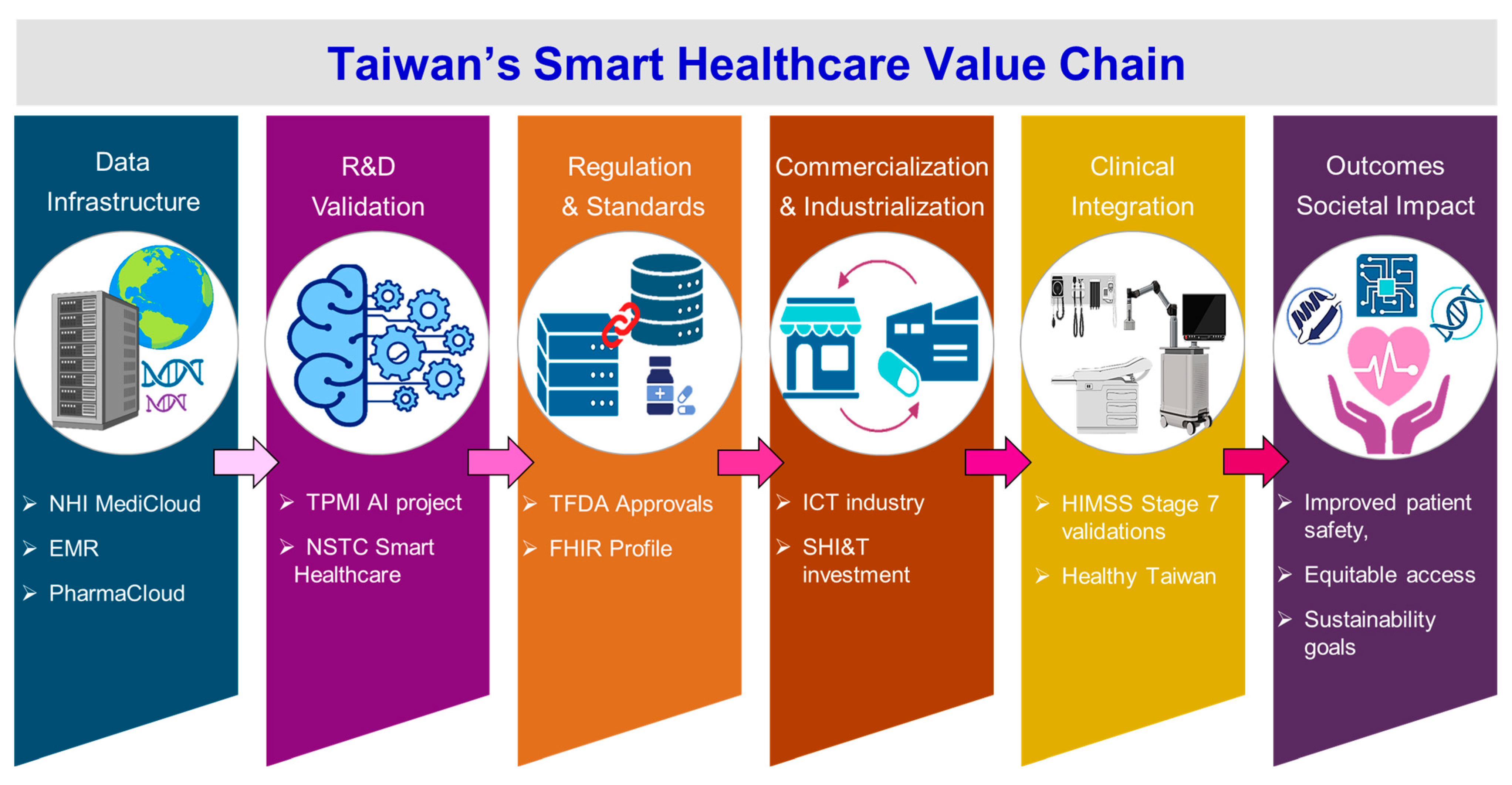
7. Taiwan’s Smart Healthcare Development Pathway
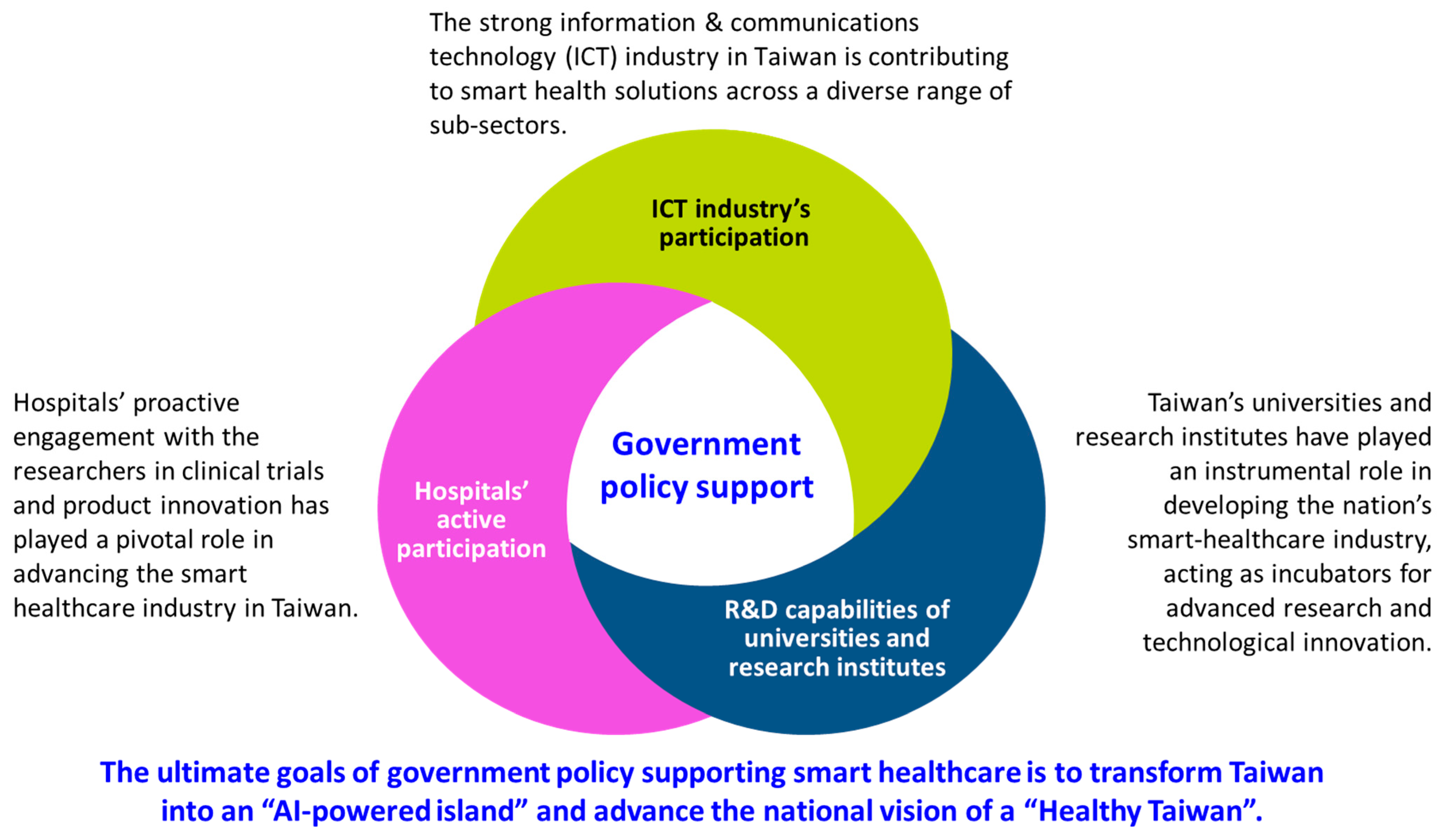
8. Taiwan’s Smart Healthcare Ecosystem: Drivers, Infrastructure, and Applications
9. Limitations and Future Directions
10. Conclusions
Author Contributions
Funding
Informed Consent Statement
Data Availability Statement
Conflicts of Interest
Abbreviations
| AI | Artificial Intelligence |
| AI/ML | AI/Machine Learning |
| AMAM | Analytics Maturity Adoption Model |
| CGU | Chang Gung University |
| CGUH | Chang Gung University Hospital |
| CMU | China Medical University |
| CMUH | China Medical University Hospital |
| CT | Computed Tomography |
| DHP | Digital Health Platform |
| DIAM | Dynamic Interspinous Assisted Motion |
| EMR | Electronic Medical Record |
| EMRAM | Electronic Medical Record Adoption Model |
| FDA | U.S. Food and Drug Administration |
| FHIR | Fast Healthcare Interoperability Resources |
| HIMSS | Healthcare Information and Management Systems Society |
| ICT | Information and Communications Technology |
| IoT | Internet of Things |
| ITRI | Industrial Technology Research Institute |
| KMU | Kaohsiung Medical University |
| KMUH | Kaohsiung Medical University Chung-Ho Memorial Hospital |
| MOHW | Ministry of Health and Welfare, Taiwan |
| MOU | Memorandum of Understanding |
| NCKU | National Cheng Kung University |
| NCKUH | National Cheng Kung University Hospital |
| NHI | National Health Insurance |
| NHIA | National Health Insurance Administration |
| NSTC | National Science and Technology Council, Taiwan |
| NTU | National Taiwan University |
| NTUH | National Taiwan University Hospital |
| NYCU | National Yang Ming Chiao Tung University |
| TCVGH | Taichung Veterans General Hospital |
| TFDA | Taiwan Food and Drug Administration |
| TMU | Taipei Medical University |
| TMUH | Taipei Medical University Hospital |
| TPMI | Taiwan Precision Medicine Initiative |
| TSHA | Smart Healthcare Industry-Academia Alliance |
| QMS | Quality Management System |
References
- Everington, K. Taiwan’s Healthcare Ranked No. 1 Globally by Numbeo. 5 February 2025. Available online: https://www.taiwannews.com.tw/news/6029934 (accessed on 12 November 2025).
- Yang, Y.; Lin, G.T.R. Analyzing the shortcomings in smart healthcare for remote home care—A case study of the Taiwan market. Int. J. Environ. Res. Public Health 2024, 21, 838. [Google Scholar] [CrossRef] [PubMed]
- Wengelin, F.; Vercouter, M. Taiwan’s healthcare tale: Navigating Accessibility, Affordability, and Quality in an Ageing Society. 2 December 2024. Available online: https://www.business-sweden.com/insights/articles/taiwans-healthcare-tale-navigating-accessibility-affordability-and-quality-in-an-ageing-society/ (accessed on 12 November 2025).
- Industrial Technology Research Institute (ITRI). Current Status and Trends in Taiwan’s Digital Healthcare Industry. 25 April 2025. Available online: https://investtaiwan.nat.gov.tw/intelNewsPage202504250001eng?lang=eng&search=202504250001 (accessed on 12 November 2025).
- Hsieh, C.Y.; Su, C.C.; Shao, S.C.; Sung, S.F.; Lin, S.J.; Kao Yang, Y.H.; Lai, E.C.C. Taiwan’s National Health Insurance Research Database: Past and future. Clin. Epidemiol. 2019, 11, 349–358. [Google Scholar] [CrossRef] [PubMed]
- Lee, T.L.; Lee, Y.L. Maintaining the right to health: A democratic process in Taiwan. Health Hum. Rights 2025, 27, 125–128. Available online: https://pubmed.ncbi.nlm.nih.gov/40703588/ (accessed on 12 November 2025). [PubMed]
- Lu, J.R.; Liang, L.L. The role of digital health under Taiwan’s National Health Insurance System: Progress and challenges. Health Syst. Reform. 2024, 10, 2375433. [Google Scholar] [CrossRef]
- Bruynseels, K.; de Sio, F.S.; van den Hoven, J. Digital twins in health care: Ethical implications of an emerging engineering paradigm. Front. Genet. 2018, 9, 31. [Google Scholar] [CrossRef]
- Shen, M.d.; Chen, S.-b.; Ding, X.-d. The effectiveness of digital twins in promoting precision health across the entire population: A systematic review. npj Digit. Med. 2024, 7, 45. [Google Scholar] [CrossRef]
- Tasmurzayev, N.; Amangeldy, B.; Imanbek, B.; Baigarayeva, Z.; Imankulov, T.; Dikhanbayeva, G.; Amangeldi, I.; Sharipova, S. Digital Cardiovascular Twins, AI Agents, and Sensor Data: A Narrative Review from System Architecture to Proactive Heart Health. Sensor 2025, 25, 5272. [Google Scholar] [CrossRef]
- Kritzinger, W.; Karner, M.; Traar, G.; Henjes, J.; Sihn, W. Digital twin in manufacturing and healthcare: A state of the art review. Comput. Ind. 2018, 98, 90–99. [Google Scholar] [CrossRef]
- Ministry of Health and Welfare (MOHW). Applications of Digital Twin Technology in Taiwan’s Smart Hospitals; Ministry of Health and Welfare: Taipei, Taiwan, 2024; Available online: https://www.taiwantoday.tw/Society/Top-News/259863/MOHW-unveils-plan-to-establish-AI-centers-in-hospitals (accessed on 4 December 2025).
- HIMSS. Conference Proceedings: Smart Healthcare and Digital Transformation in Asia; HIMSS: Chicago, IL, USA, 2023; Available online: https://dig.watch/event/himss-2023 (accessed on 4 December 2025).
- Taiwan Food and Drug Administration (TFDA). AI/ML Medical Device Approval List (109–113 Years); Ministry of Health and Welfare: Taipei, Taiwan, 2025. Available online: https://www.fda.gov.tw/TC/siteListContent.aspx?sid=310&id=42528 (accessed on 4 December 2025).
- Ministry of Health and Welfare (MOHW). 2024 Taiwan Health and Welfare. Available online: https://service.mohw.gov.tw/ebook/dopl/113/02/files/downloads/ebooke.pdf (accessed on 12 November 2025).
- Deloitte Insights. Global Healthcare Outlook 2024: Smart Healthcare and AI Industry Trends; Deloitte: London, UK, 2024; Available online: https://www2.deloitte.com (accessed on 4 December 2025).
- National Health Insurance Administration (NHIA). Digital Health Care in Taiwan: Innovations of National Health Insurance. 15 August 2022. Available online: https://www.nhi.gov.tw/en/cp-1111-156fd-200-2.html (accessed on 12 November 2025).
- European Commission. Proposal for a Regulation Laying Down Harmonised Rules on Artificial Intelligence (Artificial Intelligence Act); European Commission: Brussels, Belgium, 2021; Available online: https://eur-lex.europa.eu/legal-content/EN/TXT/?uri=CELEX:52021PC0206 (accessed on 4 December 2025).
- Wu, T.Y.; Shih, C.Y.; Jan, C.F.; Cheng, S.Y. Taiwan’s community health care evolution: Navigating pandemic challenges and shaping the future. J. Formos. Med. Assoc. 2024, 123, S188–S193. [Google Scholar] [CrossRef]
- Industrial Technology Research Institute (ITRI). Innovations & Applications: Quality Health. 2025. Available online: https://www.itri.org.tw/english/ListStyle.aspx?DisplayStyle=01&SiteID=1&MmmID=1037333532423704272 (accessed on 12 November 2025).
- Chen, S.H.; Chi, W.H. Modelling the dynamic emergence of AI-enabled biomedical innovation systems. Systems 2025, 13, 648. [Google Scholar] [CrossRef]
- Lin, C.S.; Lin, Y.J.; Li, Y.H. Advances in cardiovascular medicine in Taiwan: Artificial intelligence has come to the real world. Eur. Heart J. 2025, 46, 2616–2617. [Google Scholar] [CrossRef] [PubMed]
- Groeneveld, S.W.M.; van Os-Medendorp, H.; van Gemert-Pijnen, J.E.W.C.; Verdaasdonk, R.M.; van Houwelingen, T.; Dekkers, T.; den Ouden, M.E.M. Essential competencies of nurses working with AI-driven lifestyle monitoring in long-term care: A modified Delphi study. Nurse Educ. Today 2025, 149, 106659. [Google Scholar] [CrossRef] [PubMed]
- Smart Taiwan. AI Taiwan Action Plan 2.0. Executive Yuan of Taiwan 2023. Available online: https://digi.nstc.gov.tw/File/7C71629D702E2D89 (accessed on 12 November 2025).
- Chiang, T.L. Health Care Policy in East Asia: A World Scientific Reference; World Scientific Publishing: Singapore, 2020; pp. 1–12. Available online: https://www.worldscientific.com/doi/abs/10.1142/9789813236165_0001 (accessed on 12 November 2025).
- Cheng, T.M. Reflections on the 20th anniversary of Taiwan’s single-payer National Health Insurance System. Health Aff. 2015, 34, 502–510. [Google Scholar] [CrossRef] [PubMed]
- Lee, P.C.; Wang, J.T.H.; Chen, T.Y.; Peng, C.H. Digital Health Care in Taiwan: Innovations of National Health Insurance; Springer International Publishing AG: Cham, Switzerland, 2022; ISBN 9783031051623. [Google Scholar] [CrossRef]
- Liu, T.J.; Lee, H.T.; Wu, F. Building an electronic medical record system exchanged in FHIR format and its visual presentation. Healthcare 2023, 11, 2410. [Google Scholar] [CrossRef]
- National Health Insurance Administration (NHIA). Physicians Taking Advantage of the NHI PharmaCloud System to Reduce Inappropriate Waste of Resources. 2 December 2015. Available online: https://www.nhi.gov.tw/en/cp-247-7267a-8-2.html (accessed on 12 November 2025).
- National Science and Technology Council (NSTC). Biomedical Industry Innovation Program: Building Taiwan into a World-Class Center of Innovative Biomedical Research and Development. 28 October 2020. Available online: https://english.ey.gov.tw/News3/9E5540D592A5FECD/2e752915-7149-48e0-ae33-06fcb2e33bc3 (accessed on 12 November 2025).
- National Science and Technology Council (NSTC). AI Taiwan Action Plan. 7 August 2019. Available online: https://english.ey.gov.tw/News3/9E5540D592A5FECD/1dec0902-e02a-49c6-870d-e77208481667 (accessed on 12 November 2025).
- Lin, Y.Y. AI-Assisted Medical System of Acer Medical Obtains TFDA Approval, Accelerating Entry into Smart Healthcare Market. CIO Taiwan. 31 March 2021. Available online: https://www.cio.com.tw/stepping-into-a-smart-doctor-acer-gets-a-tfda-license/ (accessed on 12 November 2025).
- Taipei Times. Executive Yuan Announces Artificial Intelligence Plan. 4 June 2023. Available online: https://stp.nstc.gov.tw/staben/440C143786470B9E/356a2273-bc1d-4980-931b-11376a58f5a4 (accessed on 12 November 2025).
- National Health Insurance Administration (NHIA). MOU signed between NHIA and HIMSS of the US marks new milestones in digital transformation. In NHIA; 29 November 2023. Available online: https://www.nhi.gov.tw/en/cp-13000-21b9d-8-2.html (accessed on 12 November 2025).
- National Health Insurance Administration (NHIA). Innovative Payments and Digital Enhancement. National Health Insurance Annual Report 2024–2025; NHIA: Taipei, Taiwan, 2025; ISBN 978-626-7461-44-0. [Google Scholar]
- National Health Insurance Administration (NHIA). NHIA Collaborates with Google to Usher in a New Era of AI-Powered Healthcare in Taiwan. 24 June 2024. Available online: https://www.nhi.gov.tw/en/cp-15274-e2281-8-2.html (accessed on 12 November 2025).
- China Medical University Hospital (CMUH). Taiwan’s First Hospital to Achieve AMAM Stage 7 Certification! China Medical University Hospital Sets a New Benchmark in AI-powered Smart Healthcare. 4 March 2025. Available online: https://www.cmuh.cmu.edu.tw/NewsInfo/NewsArticle?no=9308 (accessed on 12 November 2025).
- Ministry of Health and Welfare (MOHW). The Ministry of Health and Welfare (MOHW) Convenes the Launch Conference for Taiwan’s Healthcare Information Standards Mega Platform. 12 March 2025. Available online: https://www.mohw.gov.tw/cp-7180-81833-1.html (accessed on 12 November 2025).
- Taiwan-Healthcare. 2024 Taiwan Healthcare Expo: NCKU Hospital Showcases Strength in Artificial Intelligence and Precision Medicine. 7 December 2024. Available online: https://www.taiwan-healthcare.org/en/news-detail?id=0so3n0nn6mzzxgtf (accessed on 12 November 2025).
- Department of Industrial Development. Promoting the ten AI initiatives—Implementing the policy vision of making Taiwan a smart technology island nation. Taiwan Econ. Forum 2025, 23, 12–16. Available online: https://ws.ndc.gov.tw/Download.ashx?u=LzAwMS9hZG1pbmlzdHJhdG9yLzEwL3JlbGZpbGUvMC8xNjIwMC9lOTdlYTViNC1jMTBjLTQ4NDAtYWViNi00M2RkNWFhMTA0NzYucGRm&n=MjAyNee2k%2Ba%2Fn%2BirluihoV%2Fnp4vlraPomZ9fMi0yLuaUv%2BetlueEpum7nl9Qcm9tb3RpbmcgdGhlIFRlbiBBSSBJbml0aWF0aXZlc%2BKAlEltcGxlbWVudGluZyB0aGUgcG9saWN5IHZpc2lvbiBvZiBtYWtpbmcgVGFpd2FuIGEgc21hcnQgdGVjaG5vbG9neSBpc2xhbmQgbmF0aW9uLnBkZg%3D%3D&icon=.pdf (accessed on 12 November 2025).
- Focus Taiwan. BioMed Taiwan: Taiwan Eyes More Collaboration Between High Tech, Health Care Sectors. 26 August 2024. Available online: https://biomed.pdis.tw/news/taiwan-eyes-more-collaboration-between-high-tech-health-care-sectors/ (accessed on 12 November 2025).
- Yen, I.W.; Chen, S.C.; Lin, C.H.; Fan, K.C.; Yang, C.Y.; Hsu, C.Y.; Kuo, C.H.; Lin, M.S.; Lyu, Y.P.; Juan, H.C.; et al. Precision medicine in diabetes prediction: Exploring a subgroup-specific biomarker strategy for risk stratification. J. Diabetes Investig. 2025, 16, 43–50. [Google Scholar] [CrossRef]
- Aronson, S.J.; Rehm, H.L. Building the foundation for genomics in precision medicine. Nature 2015, 526, 336–342. [Google Scholar] [CrossRef]
- Borrebaeck, C.A. Precision diagnostics: Moving towards protein biomarker signatures of clinical utility in cancer. Nat. Rev. Cancer 2017, 17, 199–204. [Google Scholar] [CrossRef]
- Institute of Biomedical Sciences (IBMS). Notes for the TPMI Press Conference. 18 August 2022. Available online: https://www.ibms.sinica.edu.tw/en/news/2022-441.html (accessed on 12 November 2025).
- Chen, H.H.; Chen, C.H.; Hou, M.C.; Fu, Y.C.; Li, L.H.; Chou, C.Y.; Yeh, E.C.; Tsai, M.F.; Chen, C.H.; Yang, H.C.; et al. Population-specific polygenic risk scores for people of Han Chinese ancestry. Nature 2025, 648, 128–137. [Google Scholar] [CrossRef]
- Wei, C.Y.; Wen, M.S.; Cheng, C.K.; Sheen, Y.J.; Yao, T.C.; Lee, S.L.; Wu, J.Y.; Tsai, M.F.; Li, L.H.; Chen, C.H.; et al. Clinical impact of pharmacogenetic risk variants in a large Chinese cohort. Nat. Commun. 2025, 16, 6344. [Google Scholar] [CrossRef]
- Yang, H.C.; Kwok, P.Y.; Li, L.H.; Liu, Y.M.; Jong, Y.J.; Lee, K.Y.; Wang, D.W.; Tsai, M.F.; Yang, J.H.; Chen, C.H.; et al. The Taiwan Precision Medicine Initiative provides a cohort for large-scale studies. Nature 2025, 648, 117–127. [Google Scholar] [CrossRef] [PubMed]
- National Science and Technology Council (NSTC). The Interdisciplinary Development and Technology Project Using AI and Clinical Database. 4 July 2022. Available online: https://www.nstc.gov.tw/folksonomy/detail/5878bbd2-4dde-4d0f-adf7-2fd8b0780e0d?l=en (accessed on 12 November 2025).
- Wang, C.Y.; Zhou, F.L.; Gandhi, A.B.; Lee, T.Y.; Cui, N.; Mao, J.S.; Chen, J.F. Real-world effectiveness of the Gla-300 + Cap + App program in adult users living with type 2 diabetes in Taiwan. Diabetes Ther. 2024, 15, 1389–1401. [Google Scholar] [CrossRef] [PubMed]
- Huang, C.T.; Wang, T.J.; Kuo, L.K.; Tsai, M.J.; Cia, C.T.; Chiang, D.H.; Chang, P.J.; Chong, I.W.; Tsai, Y.S.; Chu, Y.C.; et al. Federated machine learning for predicting acute kidney injury in critically ill patients: A multicenter study in Taiwan. Health Inf. Sci. Syst. 2023, 11, 48. [Google Scholar] [CrossRef] [PubMed]
- Wang, R.P. The National Science and Technology Council (NSTC) has Announced the Strategic Direction for Phase II of Smart Healthcare Program, Focusing on Two Major Themes and Nine System Modules. 21 May 2025. Available online: https://www.ithome.com.tw/news/169083 (accessed on 12 November 2025).
- Chung, P.F. Taiwan’s Smart Healthcare Alliance Has Established a Nationwide AI Task Force Composed of Leading Medical Centers. 5 May 2024. Available online: https://www.hst.org.tw/tw/story/content/4583 (accessed on 12 November 2025).
- Hou, J.L. Taiwan’s National Medical AI Task Force is Driving Rapid Progress in Smart Healthcare Development. 28 October 2024. Available online: https://www.epochtimes.com/b5/24/10/28/n14359485.htm (accessed on 12 November 2025).
- Candido, R. Ask the Expert: The Role of Mobile Computing Workstations in the HIMSS EMRAM Levels. 2025. Available online: https://www.capsahealthcare.com/blog/ask-the-expert/ask-the-expert-the-role-of-mobile-computing-workstations-in-himsss-emram-levels/#:~:text=As%20outlined%20by%20the%20Healthcare%20Information%20and,for%20enhancing%20patient%20care%20and%20operational%20efficiency (accessed on 12 November 2025).
- Taiwan Food and Drug Administration (TFDA). Taiwan FDA Updates AI Medical Device Technical Guidelines. 17 September 2025. Available online: https://cisema.com/en/taiwan-fda-updates-ai-medical-device-technical-guidelines/ (accessed on 5 December 2025).
- Ministry of Health and Welfare (MOHW). Healthy Taiwan Deepening Project. 2025. Available online: https://www.ey.gov.tw/Page/5A8A0CB5B41DA11E/f1618406-1ed7-4e72-bd4f-d1b6faaf8381 (accessed on 12 November 2025).
- Foxconn. AI Robotics, Digital Twins, and MONAI Contributions Highlight Hon Hai Foxconn’s Smart Healthcare Vision at GTC Taipei 2025. 21 May 2025. Available online: https://www.foxconn.com/en-us/press-center/press-releases/latest-news/1605 (accessed on 12 November 2025).
- Ministry of Health and Welfare (MOHW). National Health Insurance big Data Applications; Ministry of Health and Welfare (MOHW): Taipei, Taiwan, 2023. Available online: https://www.nhi.gov.tw (accessed on 4 December 2025).
- U.S. Food and Drug Administration (FDA). Artificial Intelligence/Machine Learning (AI/ML)-Based Software as a Medical Device (SaMD) Action Plan; FDA: Silver Spring, MD, USA, 2021. Available online: https://www.fda.gov/medical-devices/software-medical-device-samd/artificial-intelligence-and-machine-learning-software-medical-device (accessed on 4 December 2025).
- World Health Organization (WHO). Global Benchmarking Tool (GBT) for Evaluation of National Regulatory Systems; WHO: Geneva, Switzerland, 2021; Available online: https://www.who.int/publications/i/item/9789240020245 (accessed on 4 December 2025).
- National Yang Ming Chiao Tung University (NYCU). NYCU Opens Platform for University–Industry Co-Creation of Global Smart Medicine. 12 March 2024. Available online: https://sdgs.nycu.edu.tw/22487/?lang=en (accessed on 12 November 2025).
- National Taiwan University (NTU). Artificial Intelligence in Biomedical Imaging. 25 October 2025. Available online: https://med.nyu.edu/departments-institutes/radiology/research/ai-biomedical-imaging (accessed on 12 November 2025).
- Onyx Healthcare. ONYX Partners with NVIDIA to Advance AI-Powered Smart Healthcare. 20 May 2025. Available online: https://www.onyx-healthcare.com/en-US (accessed on 12 November 2025).
- National Taiwan University Hospital (NTUH). National Taiwan University Hospital Develops Smart Healthcare: Participated in the Taiwan Specific Disease Clinical trial Cooperation Alliance Project and Published the Results. 20 June 2024. Available online: https://www.ntuh.gov.tw/News.action?l=en_US&q_type=-1&q_itemCode=15097 (accessed on 12 November 2025).
- Fulco, M. Deploying AI in the Battle Against Cancer. 25 November 2024. Available online: https://topics.amcham.com.tw/2024/11/ai-battle-against-cancer/ (accessed on 12 November 2025).
- Lai, C. NYCU Demonstrates Research Excellence in 2024 with Breakthrough Medical Imaging Technologies. 15 January 2025. Available online: https://www.nycu.edu.tw/nycu/en/app/news/view?id=552&module=headnews&serno=f705012a-6c4d-4853-a647-2432dc7c4e3e (accessed on 12 November 2025).
- National Yang Ming Chiao Tung University (NYCU). NYCU and Partners Win “2024 Presidential Hackathon” Excellence Award for Revolutionizing Elderly Healthcare in Taiwan. 31 December 2024. Available online: https://sdgs.nycu.edu.tw/nycu-and-partners-win-2024-presidential-hackathon-excellence-award-for-revolutionizing-elderly-healthcare-in-taiwan/?lang=en (accessed on 12 November 2025).
- Tu, C.C. Technology-Assisted Rehabilitation: Empowering Active Participation in Training and Early Recovery of Ambulatory Function. 3 December 2025. Available online: https://www.nstc.gov.tw/folksonomy/detail/be4ba26b-3d1a-474a-9b40-c703e0acabcd?l=en (accessed on 8 December 2025).
- Taipei Medical University (TMU). AI for all, all with AI—Taipei Medical University Celebrates Its 64th Anniversary, Advancing Towards a Smart University. 1 November 2024. Available online: https://oge.tmu.edu.tw/ai-for-all-all-with-ai-taipei-medical-university-celebrates-its-64th-anniversary-advancing-towards-a-smart-university/ (accessed on 12 November 2025).
- Taipei Medical University (TMU). Taipei Medical University Highlights Digital Innovation and Regional Engagement at 2025 Japan–Taiwan University Presidents’ Forum. 8 August 2025. Available online: https://oge.tmu.edu.tw/taipei-medical-university-highlights-digital-innovation-and-regional-engagement-at-2025-japan-taiwan-university-presidents-forum/ (accessed on 12 November 2025).
- China Medical University Hospital (CMUH). China Medical University Hospital Honored with Dual Accolades at 2025 Healthcare Asia Awards. Available online: https://www.cmuh.cmu.edu.tw/NewsInfo/NewsArticle?no=9391 (accessed on 12 November 2025).
- Ho, L.C.; Yu Chi, C.; You, Y.S.; Hsieh, Y.W.; Hou, Y.C.; Lin, T.C.; Chen, M.T.; Chou, C.H.; Chen, Y.C.; Hsu, K.C.; et al. Impact of the implementation of the Intelligent Antimicrobial System (iAMS) on clinical outcomes among patients with bacteraemia caused by methicillin-resistant Staphylococcus aureus. Int. J. Antimicrob. Agents 2024, 63, 107142. [Google Scholar] [CrossRef]
- Healthcare EXPO Taiwan. KMUH Achieves HIMSS EMRAM Stage 7 Certification. 31 July 2025. Available online: https://www.taiwan-healthcare.org/en/news-detail?id=0t08ov7v0rurwkjn (accessed on 12 November 2025).
- Kaohsiung Medical University and Chung-Ho Memorial Hospital (KMUH). Resilient Healthcare System and AI Innovation Summit: Government, Industry, and Academia Gather to Discuss Smart Healthcare Development and Trends. 12 July 2024. Available online: https://www.kmuh.org.tw/web/actboard/data/20241042524-02.pdf (accessed on 12 November 2025).
- PR Newswire. From AI to Precision Medicine: Taiwan’s Smart Healthcare Innovations Shine at Taiwan Expo USA 2025. PR Newswire. 5 August 2025. Available online: https://www.prnewswire.com/news-releases/from-ai-to-precision-medicine-taiwans-smart-healthcare-innovations-shine-at-taiwan-expo-usa-2025-302522775.html (accessed on 12 November 2025).
- Chang Gung University (CGU). CGU Artificial Intelligence Research Center. 21 June 2024. Available online: https://www.cgu.edu.tw/aic-en (accessed on 12 November 2025).
- Hsiao, W.W.; Lin, J.C.; Fan, C.T.; Chen, S.S. Precision health in Taiwan: A data-driven diagnostic platform for the future of disease prevention. Comput. Struct. Biotechnol. J. 2022, 20, 1593–1602. [Google Scholar] [CrossRef]
- Metal Industries Research and Development Centre (MIRDC). Opportunities and Challenges of Taiwan’s Smart Healthcare Industry. 30 April 2024. Available online: https://investtaiwan.nat.gov.tw/intelNewsPage202406060002eng?lang=eng&search=202406060002 (accessed on 12 November 2025).
- Healthcare Asia. Taiwan Excellence: Empowering the Future of Healthcare with Advanced Medical Technologies. Medical Fair Asia. 2024. Available online: https://healthcareasiamagazine.com/co-written-partner/sponsored-articles/taiwan-excellence-empowering-future-healthcare-advanced-medical-technologies (accessed on 12 November 2025).
- Techsauce Team. Taiwan Shapes the Future of Health Tech: A Call for Global Innovation and Collaboration. 18 June 2025. Available online: https://techsauce.co/en/news/taiwan-health-tech-global-innovation-collaboration (accessed on 12 November 2025).
- Chang, Y.L.; Lin, C.Y.; Hsu, J.; Liao, S.L.; Yu, C.T.; Peng, H.C.; Chen, C.Y.; Ma, M.H.; Hwang, J.J. Leveraging Smart Telemedicine Technology to Enhance Nursing Care Satisfaction and Revolutionize COVID-19 Care: Prospective Cohort Study. JMIR Hum. Factors 2025, 12, e53456. [Google Scholar] [CrossRef]
- Liu, Y.H.; Chen, L.C.; Guo, Y.S.; Lin, H.J. Validation of blood pressure measurement using a smartwatch in patients with acute ischemic stroke. Medicine 2025, 104, e42899. [Google Scholar] [CrossRef]
- Hsu, T.K.; Lai, I.P.; Tsai, M.J.; Lee, P.J.; Hung, K.C.; Yang, S.; Chan, L.W.; Lin, I.C.; Chang, W.H.; Huang, Y.J.; et al. A deep learning approach for the screening of referable age-related macular degeneration—Model development and external validation. J. Formos. Med. Assoc. 2024. [Google Scholar] [CrossRef]
- Tsai, M.J.; Hsieh, Y.T.; Tsai, C.H.; Chen, M.; Hsieh, A.T.; Tsai, C.W.; Chen, M.L. Cross-camera external validation for artificial intelligence software in diagnosis of diabetic retinopathy. J. Diabetes Res. 2022, 2022, 5779276. [Google Scholar] [CrossRef]
- BenQ Medical Technology. All BenQ Medical Technology Catalogs and Technical Brochures. 2025. Available online: https://pdf.medicalexpo.com/pdf/benq-medical-technology-70369.html (accessed on 12 November 2025).
- Wistron Medical. Wistron Medical Taps into AI-Powered Contactless Healthcare. 25 March 2025. Available online: https://www.taiwan-healthcare.org/en/news-detail?id=0stnnzk5ozu9xpdo (accessed on 12 November 2025).
- Lee, K.T.; Liu, W.T.; Lin, Y.C.; Chen, Z.; Ho, Y.H.; Huang, Y.W.; Tsai, Z.L.; Hsu, C.W.; Yeh, S.M.; Lin, H.Y.; et al. Utilizing a wireless radar framework in combination with deep learning approaches to evaluate obstructive sleep apnea severity in home-setting environments. J. Multidiscip. Healthc. 2025, 18, 381–393. [Google Scholar] [CrossRef]
- Scanlan, S. Taiwan’s Compal Diversifies Into Smart Healthcare: OEM PC Maker Leverages Hardware and Software Expertise for AI Healthcare Products. 21 August 2025. Available online: https://www.taiwannews.com.tw/news/6184005 (accessed on 12 November 2025).
- Tang, K.T.; Shih, J.Y.; Hsu, P.C.; Liao, C.T.; Chiu, I.M.; Chen, Z.C.; Huang, H.L.; Yang, L.O.; Liu, C.F.; Wang, J.J.; et al. Artificial intelligence powered real-time coronary stenosis recognition and quantification in angiography. J. Imaging Inform. Med. 2025, Epub ahead of print. [Google Scholar] [CrossRef] [PubMed]
- Tu, N.; Hsiao, J. Taiwan EMS Giants Deepen Smart Healthcare Push with AI. 9 June 2025. Available online: https://www.digitimes.com/news/a20250606PD210/smart-healthcare-worldwide-healthcare-technology-foxconn.html (accessed on 12 November 2025).
- Inventec. Inventec Showcases Intelligent Mobile OR System and Collaborative Healthcare Innovations at the Healthcare Expo Taiwan. 4 December 2025. Available online: https://nabd.inventec.com/en/news/7/30.
- Lee, C.S.; Lien, J.J.; Chain, K.; Huang, L.C.; Hsu, Z.W. Federated learning-based CT liver tumor detection using a teacher–student SANet with semisupervised learning. BMC Med. Imaging 2025, 25, 250. [Google Scholar] [CrossRef] [PubMed]
- Tsai, M.Y.; Wang, Y.W.; Lu, Y.J.; Lu, T.M.; Chung, S.T. Measurements and modelling of thermally induced warpages of DIMM socket server PCB assembly after solder reflow processes. Materials 2023, 16, 3233. [Google Scholar] [CrossRef] [PubMed]
- Taiwan Startupterrace. StarFab Accelerator Integrates Big Companies’ Transformation Needs to Create an Innovative Ecosystem. 26 August 2020. Available online: https://www.startupterrace.tw/en/News_Content.aspx?n=1678&s=12630 (accessed on 12 November 2025).
- Liang, Y.W.; Fang, Y.T.; Lin, T.C.; Yang, C.R.; Chang, C.C.; Chang, H.K.; Ko, C.C.; Tu, T.H.; Fay, L.Y.; Wu, J.C.; et al. The quantitative evaluation of automatic segmentation in lumbar magnetic resonance images. Neurospine 2024, 21, 665–675. [Google Scholar] [CrossRef]
- Tsai, Y.C.; Huang, Y.Y.; Liu, C.; Chen, H.Y. Non-contact electromyography measurement based on coupling sensing technology for smart healthcare applications. Stud. Health Technol. Inform. 2025, 329, 1760–1761. [Google Scholar] [CrossRef]
- ENSUN. 41 Companies for Healthcare AI in Taiwan. 12 October 2025. Available online: https://ensun.io/search/healthcare-ai/taiwan (accessed on 12 November 2025).
- Cheo, H.M.; Ong, C.Y.G.; Ting, Y. A systematic review of AI performance in lung cancer detection on CT thorax. Healthcare 2025, 13, 1510. [Google Scholar] [CrossRef]
- Shih, B.H.; Yeh, C.C. Advancements in artificial intelligence in emergency medicine in Taiwan: A narrative review. J. Acute Med. 2024, 14, 9–19. [Google Scholar] [CrossRef]
- Huang, W.C.; Chen, I.S.; Yu, H.C.; Chen, C.S.; Wu, F.Z.; Hsu, C.L.; Wu, P.C. A simple and user-friendly machine learning model to detect osteoporosis in health examination populations in Southern Taiwan. Bone Rep. 2025, 24, 101826. [Google Scholar] [CrossRef]
- Tai, H.C.; Chen, K.Y.; Wu, M.H.; Chang, K.J.; Chen, C.N.; Chen, A. Assessing detection accuracy of computerized sonographic features and computer-assisted reading performance in differentiating thyroid cancers. Biomedicines 2022, 10, 1513. [Google Scholar] [CrossRef]
- Xie, F.; Luo, Y.K.; Lan, Y.; Tian, X.Q.; Zhu, Y.Q.; Jin, Z.; Zhang, Y.; Zhang, M.B.; Song, Q.; Zhang, Y. Differential diagnosis and feature visualization for thyroid nodules using computer-aided ultrasonic diagnosis system: Initial clinical assessment. BMC Med. Imaging 2022, 22, 153. [Google Scholar] [CrossRef]
- Hays, P. Artificial intelligence in cytopathological applications for cancer: A review of accuracy and analytic validity. Eur. J. Med. Res. 2024, 29, 553. [Google Scholar] [CrossRef]
- National Taiwan University Hospital (NTUH). Approved by Taiwan’s Ministry of Health and Welfare and the European Union, the AI-Based Bone Marrow Smear Classification and Counting System Developed by NTU Hospital and Yunxiang Technology Sets a New Benchmark in the Medical Industry, Advancing the Commercialization of Innovative Medical Devices. 2020. Available online: https://epaper.ntuh.gov.tw/health/202204/special_3_1.html (accessed on 12 November 2025). (In Chinese)
- Lin, W.L.; Chen, J.J.; Wu, L.M.; Huang, W.T.; Guo, H.R.; Nguyen, T.H. A sarcopenia screening test predicts mortality among hospitalized cancer patients. Physiol. Rep. 2024, 12, e16173. [Google Scholar] [CrossRef]
- Gandhi, Z.; Gurram, P.; Amgai, B.; Lekkala, S.P.; Lokhandwala, A.; Manne, S.; Mohammed, A.; Koshiya, H.; Dewaswala, N.; Desai, R.; et al. Artificial intelligence and lung cancer: Impact on improving patient outcomes. Cancers 2023, 15, 5236. [Google Scholar] [CrossRef]
- Liao, G. Taiwan’s ITRI Wins Two CES Innovation Awards. 2019. Available online: https://www.taiwannews.com.tw/news/3814810 (accessed on 12 November 2025).
- Lan, W.; Liao, H.; Chen, Q.; Zhu, L.; Pan, Y.; Chen, Y.P. DeepKEGG: A multi-omics data integration framework with biological insights for cancer recurrence prediction and biomarker discovery. Brief Bioinform. 2024, 25, bbae185. [Google Scholar] [CrossRef]
- Ministry of Health and Welfare (MOHW). Center for External AI Validation in Healthcare. 2 June 2025. Available online: https://aicenter.mohw.gov.tw/AC/cp-7294-82667-208.html (accessed on 12 November 2025).
- Beardsley, S.C.; Enriquez, L.; Bonini, S.; Sandoval, S.; Brun, M. Fostering the Economic and Social Benefits of ICT. In The Global Information Technology Report 2009–2010; Dutta, S., Mia, I., Eds.; World Economic Forum: Geneva, Switzerland, 2010; pp. 61–70. Available online: https://www.darden.virginia.edu/sites/default/files/inline-files/Chap%205_Fostering%20the%20Economic%20and%20Social%20Benefits%20of%20ICT.pdf (accessed on 3 December 2025).
- Taiwan News. Taiwan on Track to Be Super-Aged Society by Next Year. 18 October 2024. Available online: https://www.taiwannews.com.tw/news/5954295 (accessed on 4 December 2025).
- Central News Agency. Taiwan Population Projections Show Elderly Share to Exceed 30% by 2039. 17 October 2024. Available online: https://www.cna.com.tw/news/ahel/202410170246.aspx (accessed on 4 December 2025).
- Taiwan Business TOPICS. Taiwan Charts a New Course for Chronic Disease Care with T-CaReMe Declaration. 11 June 2025. Available online: https://topics.amcham.com.tw/2025/06/taiwan-charts-a-new-course-for-chronic-disease-care (accessed on 4 December 2025).
- Taipei Times. Cabinet Boosts Healthcare for Heart, Diabetes Patients. 18 April 2025. Available online: https://www.taipeitimes.com/News/taiwan/archives/2025/04/18/2003835393 (accessed on 4 December 2025).
- National Development Fund. Smart Healthcare Innovation and Entrepreneurship Investment Program. 6 September 2024. Available online: https://www.df.gov.tw/Content_List.aspx?n=FE9D31DC2999CE61 (accessed on 12 November 2025).
- Wang, R.P. The NHIA Has Disclosed Progress in Four Key Areas of Smart Healthcare and is Actively Promoting its Next-Generation Digital Health Platform Initiative. 29 August 2024. Available online: https://www.ithome.com.tw/news/164759 (accessed on 12 November 2025).
- Hsieh, L.H. The Ministry of Health and Welfare (MOHW) is Proposing a Five-Year Plan with a Total Budget of NT$48.9 Billion to Comprehensively Strengthen Taiwan’s Healthcare Infrastructure. 27 March 2025. Available online: https://newtalk.tw/news/view/2025-03-27/962687 (accessed on 12 November 2025).
- Jin, J.; Wu, M.; Ouyang, A.; Li, K.; Chen, C. A novel dynamic Hill cipher and its applications on medical IoT. IEEE Internet Things J. 2025, 12, 14297–14308. [Google Scholar] [CrossRef]
- Zhu, L.; Zhang, J.; Zhang, Y.; Lang, J.; Xiang, J.; Bai, X.; Yan, N.; Tian, G.; Zhang, H.; Yang, J. NAIGO: An improved method to align PPI networks based on gene ontology and graphlets. Front. Bioeng. Biotechnol. 2020, 8, 547. [Google Scholar] [CrossRef] [PubMed]
- Wang, S.; Zhang, K.; Liu, A. Flat-Lattice-CNN: A model for Chinese medical-named-entity recognition. PLoS ONE 2025, 20, e0331464. [Google Scholar] [CrossRef] [PubMed]



| Category | Stages (Duration) | Key Implementation Highlights | Reference |
|---|---|---|---|
| Data Infrastructure | Foundations (1995–2010) | 1995—Taiwan’s NHI was launched to create a single-payer system and national data backbone that later enabled digital/AI programs. | [25] |
| 2001—To support future AI model development and big data analytics in healthcare, NHIA initiated efforts to integrate ERC with hospital information systems. | [26] | ||
| 2005—In alignment with the WHO’s eHealth framework, Taiwan progressively integrated ICT into healthcare services and commenced strategic planning for digital health policies. | [27] | ||
| Building the national data rails (2011–2017) | 2011—MOHW set up the ERC Exchange Center to let hospitals exchange EMRs nationwide (initially using HL7 CDA R2). | [28] | |
| 2013—NHI PharmaCloud went live so clinicians could quickly view a patient’s recent medication history. | [29] | ||
| 2015—NHI MediCloud expanded PharmaCloud into a multi-registry clinical data hub (labs, imaging, surgeries, allergies, discharge summaries, etc.). | [7] | ||
| 2017—Precision medicine has been featured as one of the key industries in the Biomedical Industry Innovation Program launched, focusing on pharmaceuticals, medical devices, applied biotechnology, and health and well-being. | [30] | ||
| Regulation | First national AI push, pandemic acceleration, and early telemedicine easing (2018–2022) | “AI Taiwan Action Plan” was announced by the Executive Yuan of Taiwan to accelerate AI adoption across sectors, including healthcare. | [31] |
| 2020—TFDA approved the first AI-assisted diagnostic system for diabetic retinopathy interpretation, marking the official entry of AI-based medical devices into clinical application. | [32] | ||
| 2022—MOHW relaxed telemedicine interpretation during COVID-19, catalyzing virtual-care pilots. | [19] | ||
| Systematizing digital health and AI medical (2023) | Apr. 2023—AI Taiwan Action Plan 2.0 was released, emphasizing governance, safety, and cross-sector deployment (healthcare included). | [33] | |
| Nov. 2023—NHIA ↔ HIMSS Memorandum of understanding (MOU) aligned with global standards, cybersecurity, and workforce upskilling for digital health. | [34] | ||
| Hospital milestones | Scaling remote care and national AI programs (2024) | 2024—Telehealth regulations revised to ease e-prescriptions and allow teleconsultation in more circumstances. | [35] |
| Jun. 2024—NHIA ↔ Google Cloud/Google Health 5-year AI program (diabetes first): national risk-ranking models were integrated with Family Physician Program 2.0. | [36] | ||
| Standards, maturity, and flagship hospital validations (2025) | Mar. 2025—The hospital achieved HIMSS Analytics Maturity Adoption Model (AMAM) Stage 7. CMUH previously scored # 1 globally on the HIMSS Digital Health Indicator 2023. | [37] | |
| Mar. 2025—MOHW signaled a national FHIR standardization drive, aiming for smoother cross-system EHR exchange (FHIR-based Taiwan profiles). | [38] | ||
| Jul. 2025—The hospital validated at the HIMSS Electronic Medical Record Adoption Model (EMRAM) Stage 7, underscoring hospital-level digital maturity momentum. | [39] |
| Title of Program | Project Duration & Funding | Distinctive Features | Measurable Outcomes to Date |
|---|---|---|---|
| The Taiwan Precision Medicine Initiative (TPMI) | 2019–present NSTC; Academia Sinica, in collaboration with 16 major medical centers around Taiwan | As of the end of December 2023, 565,390 participants have been recruited for DNA profiling and EMR access |
|
| Phase I of the NSTC Smart Healthcare Program—“The interdisciplinary development and technology project using AI and clinical database” | 2020–2023 NSTC | Cross-sector AI projects, collaboration among medical, academic, and industrial partners to advance multiple cross-hospital AI and smart healthcare projects |
|
| Phase II of the NSTC Smart Healthcare Program—“Taiwan Smart Healthcare Innovation and Value-added Promotion Program” | 2024–2027 NSTC | Focus on “Smart Clinical Decision Support” and “GenAI-powered Smart Hospital Management” |
|
| Taiwan Smart Healthcare Alliance (TSHA) | 2022–present NSTC |
|
|
| Smart Healthcare Innovation and Entrepreneurship Investment Program | 2024–2027 National Development Fund, Executive Yuan of Taiwan USD 330 million |
|
|
| Next-Generation Digital Health Platform (DHP) | 2024–2027 MOHW |
| Creating three AI-based centers for smart healthcare: the Responsible AI Implementation Center, the AI Validation and Certification Center, and the AI Impact Research Center. |
| Healthy Taiwan Deepening Project | 2025–2029 MOHW USD 1.63 billion |
|
|
| Program/Framework | Goals | Funding/Resources | Current Status | Outcomes/Benchmarks |
|---|---|---|---|---|
| Taiwan—smart healthcare Promotion Program (MOHW, 2018–2025) [58] | Digital transformation of hospitals; integration of AI in clinical workflows | National MOHW budget allocations; ICT industry partnerships | Ongoing; multiple hospitals achieving HIMSS EMRAM/AMAM Stage 7 | Improved hospital digital maturity; pilot AI deployments in imaging and chronic disease management |
| Taiwan—TFDA AI/Machine Learning (AI/ML) Medical Device Approval Initiative (2020–2025) [14] | Regulatory pathway for AI/ML medical devices | TFDA regulatory resources; collaboration with academic R&D | Approved >30 AI/ML devices (diagnostics, imaging, ophthalmology) | National approvals; limited international recognition; need for FDA/CE alignment |
| Taiwan—NHI Big Data Applications [59] | Use of NHI datasets for AI model training and real-world evidence | Government-maintained NHI database; academic access | Active; multiple AI studies published | Strong domestic dataset utility; reproducibility challenges internationally |
| U.S.—FDA SaMD AI/ML Action Plan (2023) [60] | Lifecycle regulation of AI/ML medical devices; PCCP for adaptive algorithms | Federal regulatory resources; industry compliance | Implemented; ongoing stakeholder consultations | Transparent lifecycle monitoring; global reference for adaptive AI regulation |
| EU—Artificial Intelligence Act (2021) [18] | Risk-based classification of AI systems; emphasis on safety and transparency | EU-wide legislative framework; member state enforcement | Adopted; implementation phase | Global benchmark for AI governance; healthcare AI classified as high-risk |
| WHO—Global Benchmarking Tool (GBT) [61] | Strengthening national regulatory systems for medical products | WHO technical assistance; country participation | Active; applied in >70 countries | Provides comparative regulatory maturity scores; situates Taiwan’s TFDA globally |
| University | Achievements |
|---|---|
| National Taiwan University (NTU) and NTU Hospital (NTUH) |
|
| National Yang Ming Chiao Tung University (NYCU) |
|
| National Cheng Kung University (NCKU) and NCKU Hospital | |
| Taipei Medical University (TMU) and TMU Hospital (TMUH) | |
| China Medical University (CMU) and CMU Hospital (CMUH) |
|
| Kaohsiung Medical University (KMU) and KMU Hospital (KMUH) |
|
| Chang Gung University (CGU) and Chang Gung Memorial Hospital (CGMH, Linkou) |
| ICT Company/ Institution | Annual Revenue (USD, Last Year) | Role in Smart Healthcare Industry |
|---|---|---|
| Quanta | 23.67 billion (2024) | Developed QOCA telemedicine platform, which plays a critical role in enabling remote healthcare services in smart hospitals [82]. |
| ASUS | 17.52 billion (2024) | Offers AICS smart healthcare solutions, integrating AI and Internet of Things (IoT) to support clinical environments [83]. |
| Acer Medical (a branch of Acer) | 7.77 billion (2023) | Created AI diagnostic tools such as VeriSee DR (for diabetic retinopathy) and VeriSee AMD, along with the TeleMed telemedicine app, enabling remote patient consultation and monitoring [84,85]. |
| BenQ Medical Technology (via Qisda) | 6.51 billion (2024) | Advanced the development of medical hardware essential to smart hospital systems [86]. |
| Leadtek | 4.29 billion (2024) | Expanded into healthcare products, including Alvital-brand oximeters, wearable sleep monitoring services, and home health devices. |
| Wistron Medical Technology (via Wistron) | 33.83 billion (2024) | Produced the BestShape VS system, a non-contact vital signs sensor that continuously detects respiration, heart rate, and bed presence in elderly patients, providing 24 h real-time monitoring and data display [87,88]. |
| Compal Electronics | 29.36 billion (2024) | Introduced the Compal iCare System and BoostFix. The iCare platform supports over 3000 long-term and residential care institutions across Taiwan, streamlining administrative tasks such as uploading data to the NHI Bureau [89,90]. |
| Foxconn (Hon Hai) | 212.92 billion (2024) | Leading EMS firms (e.g., Foxconn, Quanta, Inventec, etc.) are deepening investments in smart healthcare, recognizing strong synergies between ICT advancements and healthcare innovation [91]. |
| Inventec | 21.60 billion (2024) | Actively engaged in AI-driven smart healthcare partnerships [92,93]. |
| StarFab of ITRI | Not available | While not a commercial ICT company, ITRI plays a pivotal role in fostering smart medical innovation and startups through its StarFab accelerator, providing cross-industry R&D, infrastructure, and incubation resources for ICT-healthcare integration [94,95,96]. |
| Catalog | Developer (Approval) | Product | Key Features |
|---|---|---|---|
| AI- assisted Medical Imaging Diagnostics | Acer Medical (TFDA) | VeriSee DR | AI-powered diabetic retinopathy screening tool approved by Taiwan’s TFDA [32]. |
| VeriSee AMD | A TeleMed telemedicine app, enabling remote patient consultation and monitoring (https://www.acer-medical.com/solutions/verisee-amd/ (accessed on 12 November 2025) [84]. | ||
| VeriSee Chest | AI-based chest radiograph analysis platform. | ||
| AmCad BioMed (TFDA; FDA) | AmCAD-UT® | AI ultrasound analysis for thyroid cancer risk stratification [102,103]. | |
| AmCAD-UO® | AI-based sleep apnea diagnostic platform. | ||
| AmCAD-CA | Digital cytopathology analysis system [104]. | ||
| Crystalvue (TFDA; FDA; CE) | VISION 700 | Ophthalmic diagnostic imaging devices (such as fundus cameras) (https://www.crystalvue.com.tw/en/product.php?act=view&id=35 (accessed on 12 November 2025). | |
| EverFortune AI (TFDA; FDA) | ChestSuite XR Assessment System | AI Performance in Lung Cancer Detection on CT Thorax. | |
| aetherAI (TFDA) | aetherAI Hema | Uses digital morphology analysis software for bone marrow smear evaluation. An AI colonoscopy with clinical performance reported at 96% accuracy (https://www.aetherai.com/zh/our-service (accessed on 12 November 2025) [105]. | |
| NCKU Megapro biomedical | iMbody | A sarcopenia screening test predicts mortality among hospitalized cancer patients [106]. | |
| V5med (TFDA; FDA) | V5-MED-LU01 | An AI-assisted lung cancer diagnosis module was developed by V5med Inc. and AstraZeneca Taiwan. Starting with low-dose CT image interpretation, the module supports early lesion detection of solitary pulmonary nodules [107]. | |
| Data Integration and Analytics Systems | iXensor (TFDA; FDA) | PixoTest® | Smartphone-integrated blood glucose monitoring platform (http://www.primemedix.com.ph/products/pixotest-blood-glucose-monitoring-system/ (accessed on 12 November 2025). |
| PixoHealth Pass | Digital Health Passport System. | ||
| PixoTest POCT System | Multi-modal point-of-care testing system (including blood glucose, COVID-19 rapid test, smartphone-enabled diagnostics) | ||
| ITRI | MedBobi 2.0 | Voice-to-text system for clinical documentation improves efficiency by 10× (https://event.itri.org/CES2025/tech_detail/7/ (accessed on 12 November 2025). | |
| Wistron Medical Technology (TFDA; FDA) | BestShape VS system | A non-contact vital signs sensor to detect the elderly’s respiration, heart rate, and not-in-bed status without touching them [87]. | |
| AI-Powered Virtual Assistants and Intake Avatars | IntoWell Biomedical Technology (collaboration with Meiyo Medical Technology, Samoa) (TFDA) | Dr. AI | Multilingual virtual assistant that captures symptoms and generates SOAP notes (https://www.draiai.com/ (accessed on 12 November 2025). |
| SOAP QuickNote | Auto-generates clinical notes, reduces physician documentation workload (https://www.draiai.com/tw/soap-quicknote (accessed on 12 November 2025). | ||
| MedPA AI Avatar | Pre-consultation AI agent that prepares clinical documentation before patient entry. | ||
| Smart ward and surgical navigation systems | ITRI (collaborated with hospital partners and various Taiwanese medtech firms) | Smart Bed Sensor System | Monitors pressure distribution, prevents falls and bedsores. |
| Surgical Navigation System | Combines AI and imaging for precision and safety in surgery. | ||
| PECOLA robot | Assists elderly adults living alone by combining ambient intelligence with computer vision [108]. | ||
| HIWIN Technologies (collaboration with CMUH) | Hiwin Smart Surgical System | Combines robotic arms with AI imaging for precision surgery. | |
| Telemedicine and Cloud-based Systems | NHIA (collaborates with Google) | Google Cloud Diabetes Program | AI analytics for managing 2 million diabetic patients (AI-Powered Healthcare in Taiwan) [36]. |
| Health2Sync (TFDA) | App and cloud analytics platforms | Diabetes management platform integrated with blood glucose data in collaboration with the NHIA [50]. | |
| Chang Gung Memorial Hospital | Biobank-EMR Integration | AI models for cancer recurrence prediction. [109] | |
| Fubon Financial Administrative automation and insurance intelligence | NHIA | AI Claims Review System | Smart algorithms for billing review and fraud detection (https://www.fubon.com/financialholdings/citizenship/downloadlist/downloadlist_report/Fubon_ESGreport_2021_EN.pdf (accessed on 12 November 2025). |
Disclaimer/Publisher’s Note: The statements, opinions and data contained in all publications are solely those of the individual author(s) and contributor(s) and not of MDPI and/or the editor(s). MDPI and/or the editor(s) disclaim responsibility for any injury to people or property resulting from any ideas, methods, instructions or products referred to in the content. |
© 2025 by the authors. Licensee MDPI, Basel, Switzerland. This article is an open access article distributed under the terms and conditions of the Creative Commons Attribution (CC BY) license.
Share and Cite
Lin, T.-M.; Yang, H.-W.; Han, C.-C.; Lin, C.-S. Taiwan’s Smart Healthcare Value Chain: AI Innovation from R&D to Industry Deployment. Healthcare 2026, 14, 23. https://doi.org/10.3390/healthcare14010023
Lin T-M, Yang H-W, Han C-C, Lin C-S. Taiwan’s Smart Healthcare Value Chain: AI Innovation from R&D to Industry Deployment. Healthcare. 2026; 14(1):23. https://doi.org/10.3390/healthcare14010023
Chicago/Turabian StyleLin, Tzu-Min, Hui-Wen Yang, Ching-Cheng Han, and Chih-Sheng Lin. 2026. "Taiwan’s Smart Healthcare Value Chain: AI Innovation from R&D to Industry Deployment" Healthcare 14, no. 1: 23. https://doi.org/10.3390/healthcare14010023
APA StyleLin, T.-M., Yang, H.-W., Han, C.-C., & Lin, C.-S. (2026). Taiwan’s Smart Healthcare Value Chain: AI Innovation from R&D to Industry Deployment. Healthcare, 14(1), 23. https://doi.org/10.3390/healthcare14010023