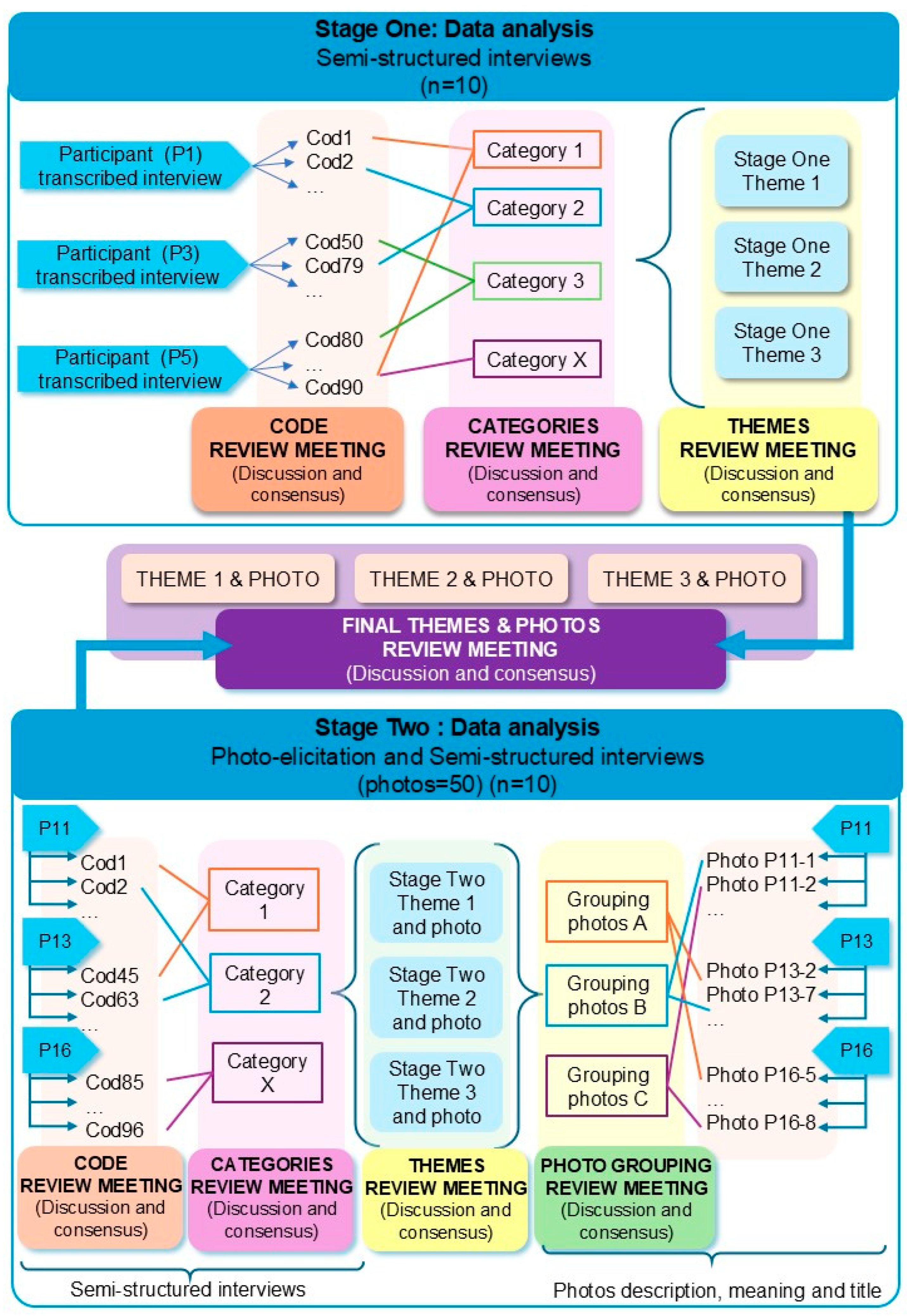

Parental Concerns and Active Participation in Home-Based Vojta Therapy for Children with Global Developmental Delay: A Qualitative Study Using Interviews and Photo-Elicitation

 ,
,  ,
,  , and
, and
Highlights
- Parents reported that home-based Vojta therapy facilitated parent–child affiliative bonding.
- Parents in this study indicated that adherence to HBP-delivered VT was perceived as beneficial and sustainable despite their initial concerns.
- Given appropriate information and resources, more parents of GDD children would choose to administer home-based Vojta therapy.
Abstract
1. Introduction
2. Materials and Methods
2.1. Design
2.2. Participants, Sampling Strategies, and Recruitment Process
2.3. Data Collection
2.4. Data Analysis
2.5. Rigor
2.6. Ethics
3. Results
3.1. Parents’ Active Participation in VT
3.1.1. Desire to Become an Active Agent
3.1.2. Implication of Undertaking VT at Home
3.1.3. Adherence and Continuity

| Category: Desire to become an active agent |
 Title: “Here are our hands to work as a family” EP1-Photo 6 “This image conveys that to me, like a balance, like a strength, right? (…) of being there and of offering, here are our hands to work for whatever you need.” (EP1) “I think it is a positive thing because, in the end, you get involved. Only once a week with the physiotherapist…., with this, being part of it, well, you force yourself to participate throughout the week as well, right? It also makes him improve a lot faster because instead of doing it once a week, maybe he is doing it 3 or 4 times a week, and you feel part of the improvement.” (P6) “(my son) He could be better…then, if there is anything I can do something, so he is even better, I do it. So, she (the therapist) taught me how to do it right, it took me time to learn it. When I learned how to do it right, I felt confident, and my baby got the greatest improvement; he moved much better.” (P2) “I felt responsible for my son’s improvement.” (P5) “As you see, it’s working for him, you feel responsible when you don’t do it., right? “It’s a little bit of how poorly I organized myself today that I didn’t manage to do it.” I feel a little bit of frustration.” (EP4) |
| Category: Implication of performing VT at home |
 Title: “Conciliation” EP5-Photo 1 “I chose this photo because it represents how much I need to block out time from my work, umm… to invest in Vojta therapy and in (child name), in my son.” (EP5) “It is much more extensive, it enslaves you, so to speak, it requires much more time, but well, Vojta is for me a method and a way of stimulating my baby that gives very good results and very quickly.” (P2) “Well, for me it involves me, a lot of patience, (…) “I have to do this, I have to do it right.” First, be calm, include in your daily life, at least… it is almost 3 h or 45 min multiplicated by 3 to dedicate… THAT TIME TO THAT GIRL, that time to that girl, because it is important… for her.” (P14) “To me, it means work, perseverance, dedication, effort, discipline, perseverance, it’s ultimately the working tool with which I can apply Vojta therapy to (child name).” (EP15) “For me, the job is to organize it and then do it, but I also see that (child name), the more you work with him, the better he is.” (P1) |
| Category: Adherence and continuity |
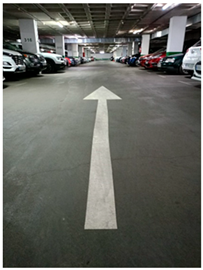 Title: “Knowledge and information” EP11-Photo 2 “Look for some way of moving forward, of representing… the way of expressing what you have in your head (…) Well, that’s what it is for me, that “I am capable of moving forward”, with Vojta…Yes, really, eh::: going little by little, achieving, achieving new things each time, reaching goals, little by little and, advancing more (…), taking steps towards recovery.” (EP11) “It worked for us. That…it’s a pain because you know? She cries a lot. But… that… that’s it, It’s worth it. And that’s it” (P7). “If we hadn’t seen improvement in a few weeks, we would have stopped, but when we started to see it after a while, at first it was a very small improvement, (…) and then we saw a very clear evolution.” (P8) “It means continuing the benefit you get from Monday sessions and being able to continue until the following Monday.” (P1) “I would never define myself as my son’s physical therapist! I’m more like Berta’s (physiotherapist) hands when Berta’s not around, right? We’re more of a remote physical therapist. She does the thinking, and we do the hands a little.” (P4) |
3.2. Participants’ Perception of Results
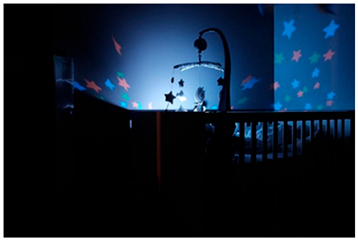 Title: “Peace of mind that everything is working” EP13-Photo 5 “So, when I finally took her to Vojta Physio for the first session. We arrived at night, everything was normal, everything was the same, and suddenly the girl…uh… falls asleep and doesn’t wake up until the next morning at 8:00 a.m., or on top of that, 12 h of sleep, which we’ve never seen before. “What?” My husband expressed it like this, “Just for this session… it was worth it,”… “if we go back to normal tomorrow, he says, I don’t care, but it was worth it.” (EP13) “Know that until you have applied the therapy for a while, you will not see any results. It’s a long-distance race.” (P5) “It’s also true that he used to eat better and sleep better after Vojta’s therapy, as he gets tired a lot, so that was a plus for us, (…) Well, the truth is that was also a plus, wasn’t it? He continues sleeping, continues sleeping better. And eating even better.” (P3) “Well, for me it was one of the first milestones we achieved, and it made me feel like we were making important progress (…) for me the fact that I was starting to open my hands and that I was starting to manipulate objects quite well, well, that was the sensation… That, happiness too.” (EP3) “Every time we do the… therapy afterwards, we try to put him over on his tummy to see if that time spent like that was actually worth it, right? Then the child just lifts his chest more.” (EP16) “But if you invest in your child doing the therapy, then you’ll see results that perhaps you wouldn’t see otherwise. I’m not sure that…that it wouldn’t have worked without Vojta, but I do think that when we don’t do Vojta, she’s weaker, I mean, I do see a difference. In fact, when she’s sick, which has happened to us twice now, and we can’t do Vojta, you can tell she’s weaker.” (P9) “We, well, now I’m telling you that it’s starting, we’re starting to see changes that we understand are due to development, but the child wasn’t holding his head up until a month ago. And… And yes, we believe it’s because of Vojta, well. Very clearly, right? Because we’ve been seeing improvement in the exercises. On the sides we’ve…. It’s something that can be seen.” (P4) “Ah, well the work that we do in therapy when we go to the sessions or the… and the homework that they give us to take home and what you work on with… with the child, well you see that, Uh, he’s achieving things that… that were difficult for him, it’s a little bit more, well he’s moving his neck better, he’s making more movements with… with the part, it was the upper part, especially the one that he had the most problems with and… And you see him, well little by little he’s achieving certain… certain milestones and certain moments that… that of course maybe without therapy, well we wouldn’t have achieved them.” (EP11) |
3.3. Parents’ Initial Concerns
3.3.1. Initial Concerns, Implementation, and Evidence
3.3.2. Emotional Bond Concerns
| Category: Initial concerns, implementation, and evidence |
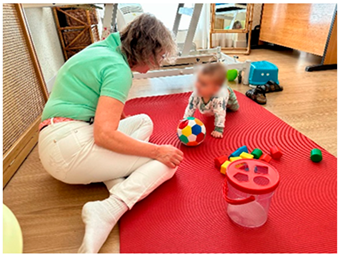 Title: “Seeing you” EP5-Photo 5 “Vojta therapy, too, it must be said, is, in my case, tough. My baby cries, cries a lot, and… and that increases my anxiety, increases my anguish, increases my doubts about, like, “Uh? Whether it’s the right thing to do or not?” Or what other therapy might work for him?” (P2) “At that moment, you think: “Am I doing it right? Am I doing it right? Are you breaking it?” In that state, you are like this, like nervous, but…, but no, she (the therapist) did reassure us, “Look, you are doing this right, put it a little more like this, a little more like that”, it is like in that moment you are more concentrated and::::and:::: listening to her and her advice” (P8) “Well, on the one hand, amazed, right? You ask yourself, “How, how did Mr. Vojta come up with this?” Of course, because he has a learning curve, a learning curve that I don’t have behind me. Right? “But how did he manage to press these keys and see what produced this?” But I’m surprised that the hospitals don’t… Don’t move it (VT) anymore. Because it’s not like they don’t have Vojta people, I mean, no. It’s not like they didn’t put Vojta in ours because they think he’s very good, it’s just that no, there aren’t people who do Vojta in general. So we were surprised.” (P4) “Well, hey, it takes time, first to learn it, then to gain a little confidence.” (P14) “(At home) we have doubts, so, hey, is he crying because I’m taking away her movements? Or is he crying because I’m not doing something right? And on top of that, could I end up hurting her? Right? Because no, because I don’t know how to do it right.” (EP16) “This is (name child) in the clinic, before starting Vojta exercises with Berta (physiotherapist). He’s on all fours, crawling, playing some games for (name child), but we also, well (…) it’s good for us to appreciate (name child) ‘s crawling. Berta tells us certain aspects that (name child) can improve, (…) she tells us, “look at this and see how (name child) is crawling now,” but it also helps (Child name) play a little, to warm up a little before the session, and also to appreciate each other, right? So also, to improve that bond with Berta, since they both get along well, (…) I always really like this little bit of time before starting the exercises. (EP5) |
| Category: Emotional bond concerns |
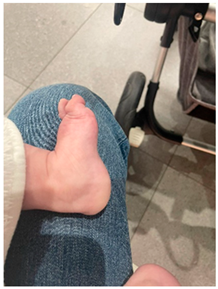 Title: “Tiny Feet” EP17-Photo 7 “Well, initially, a lot of doubts. I’m a high school teacher, so, uh, I’m not much of a psychology teacher, but I did have some basic knowledge, and I remember that the first few days, I became obsessed with the subject of attachments and bonds. “Oh, my goodness, how is this going to affect the attachments that I myself am causing her at the moment of annoyance?” (P4) “I don’t know how that could affect him. Whether she’ll be left with some trauma or not, or whether she’ll forget.” (P9) “A concern I might have is that she’ll be traumatized by the image of “When I was little, my father was on top of me, you know? Squeezing me with his thumbs.” (P7) “In therapy, you have to squeeze (the foot), learn to squeeze it well, the points, (…) for us it is a learning process, because we are not physiotherapists, (…) to do it well, so that it does not cause more damage or more pain than perhaps, well, unconsciously we can do it. Look, it is supposed that the normal thing is that it does not hurt; he must feel uncomfortable to achieve the result, but it does not have to hurt.” (EP17) “Myself as the mother, whoever does the Vojta therapy made me feel very special, very connected to my baby.” (P2) “I really appreciate it a lot, having been able to know…This therapy because…because you get so involved.” (P1) “Well, that’s it, in the end, I am his father, right? And I want the best for him…, I have seen the difficulties he had when he was born, so contributing to this whole process of improvement, etc., It is important to me, because that way I feel more…part of the whole process and…and as I say, it’s not like I sit and watch a specialist do X exercises and nothing more, but I get involved…, I am part of the process. it also makes me create more of a bond with… with (Child name), I spend more time with him…, etc. So that’s why it’s important to me, yes.” (P5) “But I think it’s because of the relationship that’s created, right? With your son, because in the end, you’re helping him. He notices that you’re helping him. And right? Well, a moment you have alone with him, then, I don’t know exactly if only a professional would do it, you’d have the same ties, but having to participate, and right? To be a co-participant in all this therapy, well, obviously, you have a greater bond than with another person, I mean, more than if you just take him to the doctor. (P6) “And so, well, I’m always surprised by the amount of sweat he produces, and you can see the effort it takes to do the exercises, right?” (EP5) |
4. Discussion
Limitations
5. Conclusions
Supplementary Materials
Author Contributions
Funding
Institutional Review Board Statement
Informed Consent Statement
Data Availability Statement
Acknowledgments
Conflicts of Interest
Abbreviations
| EIC | Early Intervention Centers |
| GDD | Global developmental delay |
| HBP | Home-based program |
| VT | Vojta therapy |
| PE | Photo-elicitation |
References
- American Psychiatric Association. Diagnostic and Statistical Manual of Mental Disorders; American Psychiatric Association Publishing: Washington, DC, USA, 2022. [Google Scholar]
- Armstrong, J.; Pieterse, B.; Elliott, C.; Wray, J.; Davidson, E.; Mizen, J.; Girdler, S. The Development and Feasibility of a Manualised Therapeutic Playgroup for Children with Developmental Delay. J. Child. Fam. Stud. 2021, 30, 1–16. [Google Scholar] [CrossRef]
- Taboada, E.; Iglesias, P.; López, S.; Rivas, R. Neurodevelopmental difficulties as a comprehensive construct of learning disabilities in children with developmental delay: A systematic review. Ann. Psychol. 2020, 36, 271–282. [Google Scholar]
- Hsu, C.; Kang, Y.; Tseng, S. Effects of Therapeutic Exercise Intensity on Cerebral Palsy Outcomes: A Systematic Review With Meta-Regression of Randomized Clinical Trials. Front. Neurol. 2019, 10, 657. [Google Scholar] [CrossRef] [PubMed]
- Tinderholt Myrhaug, H.; Østensjø, S.; Larun, L.; Odgaard-Jensen, J.; Jahnsen, R. Intensive training of motor function and functional skills among young children with cerebral palsy: A systematic review and meta-analysis. BMC Pediatr. 2014, 14, 292. [Google Scholar] [CrossRef]
- Maier, M.; Ballester, B.R.; Verschure, P.F.M.J. Principles of Neurorehabilitation After Stroke Based on Motor Learning and Brain Plasticity Mechanisms. Front. Syst. Neurosci. 2019, 13, 74. [Google Scholar] [CrossRef]
- Aaron, C.; Chiarello, L.A.; Palisano, R.J.; Gracely, E.; O’Neil, M.; Kolobe, T. Relationships Among Family Participation, Team Support, and Intensity of Early Intervention Services. Phys. Occup. Ther. Pediatr. 2014, 34, 343–355. [Google Scholar] [CrossRef]
- Bernabe-Zuñiga, J.E.; Rodriguez-Lucenilla, M.I.; Alias-Castillo, A.J.; Rueda-Ruzafa, L.; Roman, P.; del Mar Sanchez-Joya, M. Early interventions with parental participation and their implications on the neurodevelopment of premature children: A systematic review and meta-analysis. Eur. Child Adolesc. Psychiatry 2025, 34, 853–865. [Google Scholar] [CrossRef]
- Novak, I.; Berry, J. Home Program Intervention Effectiveness Evidence. Phys. Occup. Ther. Pediatr. 2014, 34, 384–389. [Google Scholar] [CrossRef]
- Sakzewski, L.; Ziviani, J.; Boyd, R.N. Delivering Evidence-Based Upper Limb Rehabilitation for Children with Cerebral Palsy: Barriers and Enablers Identified by Three Pediatric Teams. Phys. Occup. Ther. Pediatr. 2014, 34, 368–383. [Google Scholar] [CrossRef]
- Novak, I.; Cusick, A. Home programmes in paediatric occupational therapy for children with cerebral palsy: Where to start? Aust. Occup. Ther. J. 2006, 53, 251–264. [Google Scholar] [CrossRef]
- Qian, G.; Perzanowska, E.; Wilczyńska, D.; Kozakiewicz, M.; Yu, H.; Hejła, M.; Ossowski, Z. Exploring the impact of home-based Vojta therapy on gait performance in individuals with Down syndrome: A preliminary feasibility study. Front. Neurol. 2025, 16, 1537635. [Google Scholar] [CrossRef] [PubMed]
- Juárez-Albuixech, M.L.; Redondo-González, O.; Tello-Díaz-Maroto, I.; Torres de la Guía, J.L.; Villafañe, J.H.; Jiménez-Antona, C. Feasibility and efficacy of the Vojta therapy in subacromial impingement syndrome: A randomized controlled trial. J. Exerc. Rehabil. 2021, 17, 256–264. [Google Scholar] [CrossRef] [PubMed]
- Sanz-Esteban, I.; Cano-de-la-Cuerda, R.; San-Martin-Gomez, A.; Jimenez-Antona, C.; Monge-Pereira, E.; Estrada-Barranco, C.; Garcia-Sanchez, P.C.; Serrano, J.I. Innate Muscle Patterns Reproduction During Afferent Somatosensory Input With Vojta Therapy in Healthy Adults. A Randomized Controlled Trial. IEEE Trans. Neural Syst. Rehabil. Eng. 2021, 29, 2232–2241. [Google Scholar] [CrossRef] [PubMed]
- Trafalska, A.; Paprocka-Borowicz, M. The Role of the Vojta Method in Diagnosing and Enhancing Motor Skills in Preterm Infants: A Prospective Open-Label Controlled Study. Med. Sci. Monit. 2025, 31, e945495. [Google Scholar] [CrossRef]
- Ptak, A.; Dębiec-Bąk, A.; Stefańska, M. Assessment of Viscoelastic Parameters of Muscles in Children Aged 4–9 Months with Minor Qualitative Impairment of the Motor Pattern after Vojta Therapy Implementation. Int. J. Environ. Res. Public Health 2022, 19, 10448. [Google Scholar] [CrossRef]
- Sánchez-González, J.L.; Sanz-Esteban, I.; Menéndez-Pardiñas, M.; Navarro-López, V.; Sanz-Mengíbar, J.M. Critical Review of the Evidence for Vojta Therapy: A Systematic Review and Meta-Analysis. Front. Neurol. 2024, 15, 1391448. [Google Scholar] [CrossRef]
- Ungureanu, A.; Rusu, L.; Rusu, M.R.; Marin, M.I. Balance Rehabilitation Approach by Bobath and Vojta Methods in Cerebral Palsy: A Pilot Study. Children 2022, 9, 1481. [Google Scholar] [CrossRef]
- Jung, M.W.; Landenberger, M.; Jung, T.; Lindenthal, T.; Philippi, H. Vojta therapy and neurodevelopmental treatment in children with infantile postural asymmetry: A randomised controlled trial. J. Phys. Ther. Sci. 2016, 29, 301–306. [Google Scholar] [CrossRef]
- Vojta, V. The basic elements of treatment according to Vojta. In Management of the Motor Disorders of Children with Cerebral Palsy; Blackwell Scientific: Oxford, UK, 1984; pp. 128–160. [Google Scholar]
- Øberg, G.K.; Sørvoll, M.; Labori, C.; Girolami, G.L.; Håkstad, R.B. A systematic synthesis of qualitative studies on parents’ experiences of participating in early intervention programs with their infant born preterm. Front. Psychol. 2023, 14, 1172578. [Google Scholar] [CrossRef]
- Ochandorena-Acha, M.; Noell-Boix, R.; Yildirim, M.; Cazorla-Sánchez, M.; Iriondo-Sanz, M.; Troyano-Martos, M.J.; Casas-Baroy, J.C. Experiences and coping strategies of preterm infants’ parents and parental competences after early physiotherapy intervention: Qualitative study. Physiother. Theory Pract. 2020, 38, 1174–1187. [Google Scholar] [CrossRef]
- Demeke, Z.D.; Assefa, Y.A.; Abich, Y.; Chala, M.B. Home-based therapy and its determinants for children with cerebral palsy, exploration of parents’ and physiotherapists’ perspective, a qualitative study, Ethiopia. PLoS ONE 2023, 18, e0282328. [Google Scholar] [CrossRef] [PubMed]
- Verhaegh, A.P.; Nuijen, N.B.; Aarts, P.B.; Nijhuis-Van Der Sanden, M.W.G.; Willemsen, M.A.; Groen, B.E.; Vriezekolk, J.E. Parents’ experiences with a home-based upper limb training program using a video coaching approach for infants and toddlers with unilateral cerebral palsy: A qualitative interview study. BMC Pediatr. 2022, 22, 380. [Google Scholar] [CrossRef] [PubMed]
- Fàbregues, S.; Fetters, M.D. Fundamentals of case study research in family medicine and community health. Fam. Med. Community Healt. 2019, 7, e000074. [Google Scholar] [CrossRef] [PubMed]
- Fraser, A.; Mays, N. Case Studies; Qualitative Research in Health Care; John Wiley & Sons, Ltd.: Chichester, UK, 2020; pp. 181–191. [Google Scholar]
- Jack, S.M.; Phoenix, M. Qualitative health research in the fields of developmental medicine and child neurology. Dev. Med. Child Neurol. 2022, 64, 830–839. [Google Scholar] [CrossRef]
- Moser, A.; Korstjens, I. Series: Practical guidance to qualitative research. Part 3: Sampling, data collection and analysis. Eur. J. Gen. Pract. 2018, 24, 9–18. [Google Scholar] [CrossRef]
- Ha, S.; Sung, Y.; Ha, S.Y.; Sung, Y.H. Changes of neural pathways after vojta approach in a child with developmental delay. Children 2021, 8, 918. [Google Scholar] [CrossRef]
- Vasileiou, K.; Barnett, J.; Thorpe, S.; Young, T. Characterising and justifying sample size sufficiency in interview-based studies: Systematic analysis of qualitative health research over a 15-year period. BMC Med. Res. Methodol. 2018, 18, 148. [Google Scholar] [CrossRef]
- Braun, V.; Clarke, V. Conceptual and Design Thinking for Thematic Analysis. Qual. Psychol. 2022, 9, 3–26. [Google Scholar] [CrossRef]
- Hennink, M.; Kaiser, B.N. Sample sizes for saturation in qualitative research: A systematic review of empirical tests. Soc. Sci. Med. 2021, 292, 114523. [Google Scholar] [CrossRef]
- Bogetz, J.; Oslin, E.; Meissner, E.; Trowbridge, A.; Anderson, J.; Morris, L.; Barton, K.S.; Yi-Frazier, J.; Watson, R.S.; Rosenberg, A.R. A photo-narrative intervention for children with severe neurological impairment in the PICU. J. Pain Symptom Manag. 2025, 69, 319–330.e10. [Google Scholar] [CrossRef]
- Hepperlen, R.A.; Rabaey, P.; Ament-Lemke, A.; Manley, H. Caring for a child with a disability in a Zambian community: A study using photo-elicitation. Child Care Health Dev. 2021, 47, 422–434. [Google Scholar] [CrossRef] [PubMed]
- Eisen, I.; Cunningham, B.J.; Campbell, W. Conducting participatory photography with children with disabilities: A literature review. Disabil. Rehabil. 2019, 41, 1943–1954. [Google Scholar] [CrossRef] [PubMed]
- Frith, H.; Harcourt, D. Using Photographs to Capture Women’s Experiences of Chemotherapy: Reflecting on the Method. Qual. Health Res. 2007, 17, 1340–1350. [Google Scholar] [CrossRef] [PubMed]
- Gill, S.L. About Research—Qualitative Data Collection: Photo Elicitation. J. Hum. Lact. 2024, 40, 503–505. [Google Scholar] [CrossRef]
- Oliffe, J.L.; Bottorff, J.L. Further Than the Eye Can See? Photo Elicitation and Research With Men. Qual. Health Res. 2007, 17, 850. [Google Scholar] [CrossRef]
- Padgett, D.K.; Smith, B.T.; Derejko, K.; Henwood, B.F.; Tiderington, E. A Picture Is Worth...? Photo Elicitation Interviewing With Formerly Homeless Adults. Qual. Health Res. 2013, 23, 1435–1444. [Google Scholar] [CrossRef]
- Church, S.; Quilter, J. Consideration of Methodological Issues When Using Photo-Elicitation in Qualitative Research. Nurse Res. 2021, 29, 25–32. [Google Scholar]
- Miles, M.B.; Huberman, A.M.; Saldaña, J. Qualitative Data Analysis: A Methods Sourcebook; Sage Publications: Los Angeles, CA, USA, 2014. [Google Scholar]
- Korstjens, I.; Moser, A. Series: Practical guidance to qualitative research. Part 4: Trustworthiness and publishing. Eur. J. Gen. Pract. 2017, 24, 120. [Google Scholar] [CrossRef]
- O’brien, B.C.; Harris, I.B.; Beckman, T.J.; Reed, D.A.; Cook, D.A. Standards for Reporting Qualitative Research. Acad. Med. 2014, 89, 1245. [Google Scholar] [CrossRef]
- Tong, A.; Sainsbury, P.; Craig, J. Consolidated criteria for reporting qualitative research (COREQ): A 32-item checklist for interviews and focus groups. Int. J. Qual. Health Care 2007, 19, 349. [Google Scholar] [CrossRef]
- Gmmash, A.S.; Effgen, S.K.; Skubik-Peplaski, C.; Lane, J.D. Parental Adherence to Home Activities in Early Intervention for Young Children With Delayed Motor Development. Phys. Ther. 2021, 101, 1. [Google Scholar] [CrossRef] [PubMed]
- Kim, G.Y.; Tuck, K.N.; Eddy, M.M.; Bhattashali, A.; Bigelow, K.M. Caregivers’perceptions on caregiver-implemented intervention and coaching. Early Child. Res. Q. 2025, 70, 264–273. [Google Scholar] [CrossRef]
- Lee, M.; Lee, T.; Lee, Y. Experiences of Family Resource Utilization Among Taiwanese Parents of Children with Developmental Delay. J. Pediatr. Nurs. 2020, 53, e204. [Google Scholar] [CrossRef] [PubMed]
- Lillo-Navarro, C.; Medina-Mirapeix, F.; Escolar-Reina, P.; Montilla-Herrador, J.; Gomez-Arnaldos, F.; Oliveira-Sousa, S.L. Parents of children with physical disabilities perceive that characteristics of home exercise programs and physiotherapists’ teaching styles influence adherence: A qualitative study. J. Physiother. 2015, 61, 81–86. [Google Scholar] [CrossRef]
- Lillo-Navarro, C.; Montilla-Herrador, J.; Escolar-Reina, P.; Oliveira-Sousa, S.L.; García-Vidal, J.A.; Medina-Mirapeix, F. Factors Associated with Parents’ Adherence to Different Types of Exercises in Home Programs for Children with Disabilities. J. Clin. Med. 2019, 8, 456. [Google Scholar] [CrossRef]
- Pérez-De La Cruz, S.; Ramírez, I. Parents’ Perceptions Regarding the Implementation of a Physical Therapy Stimulation Program for Children with Disabilities in Bolivia: A Qualitative Study. Int. J. Environ. Res. Public Health 2020, 17, 6409. [Google Scholar] [CrossRef]
- Buckley, L.; Harford, K.; Gibson, L.; Cornally, N.; Curtin, M. Parent perspectives of engaging with a community paediatric clinic with linked child development supports in a disadvantaged area of Ireland. J. Child Health Care 2025, 29, 424–443. [Google Scholar] [CrossRef]
- Strojek, K.; Wójtowicz, D.; Kowalska, J. Assessment of the Emotional State of Parents of Children Starting the Vojta Therapy in the Context of the Physical Activity—A Pilot Study. Int. J. Environ. Res. Public Health 2022, 19, 10691. [Google Scholar] [CrossRef]
- King, G.; Pozniak, K.; Teplicky, R.; Earl, S. The experiences of parents of children with disabilities receiving healthcare services: Negative emotions and associated situations. Res. Dev. Disabil. 2024, 156, 104896. [Google Scholar] [CrossRef]
- Medina-Mirapeix, F.; Lillo-Navarro, C.; Montilla-Herrador, J.; Gacto-Sánchez, M.; Franco-Sierra, M.Á.; Escolar-Reina, P. Predictors of parents’ adherence to home exercise programs for children with developmental disabilities, regarding both exercise frequency and duration: A survey design. Eur. J. Phys. Rehabil. Med. 2017, 53, 545. [Google Scholar] [CrossRef]
- Ha, S.; Sung, Y. Vojta Therapy Affects Trunk Control and Postural Sway in Children with Central Hypotonia: A Randomized Controlled Trial. Children 2022, 9, 1470. [Google Scholar] [CrossRef] [PubMed]
- De-La-Barrera-Aranda, E.; Gonzalez-Gerez, J.J.; Saavedra-Hernandez, M.; Fernandez-Bueno, L.; Rodriguez-Blanco, C.; Bernal-Utrera, C. Vojta Therapy in Neuromotor Development of Pediatrics Patients with Periventricular Leukomalacia: Case Series. Medicina 2021, 57, 1149. [Google Scholar] [CrossRef] [PubMed]
- Martínez-Fuentes, M.T.; Pérez-López, J.; Brito de la Nuez, A.; Díaz-Herrero, Á.; Vojta, T.; Desarrollo psicológico, Y. Apego Infantil En Poblaciones De Riesgo biológico. Acción Psicol. 2012, 8, 87–97. [Google Scholar] [CrossRef]
- Czajkowska, M.; Fonfara, A.; Królak-Olejnik, B.; Michnikowski, M.; Gólczewski, T. The impact of early therapeutic intervention on the central pattern generator in premature newborns—A preliminary study and literature review. J. Mother Child 2021, 23, 178–183. [Google Scholar]
- Bragelien, R.; Røkke, W.; Markestad, T. Stimulation of sucking and swallowing to promote oral feeding in premature infants. Acta Paediatr. 2007, 96, 1430. [Google Scholar] [CrossRef]
- Igual Blasco, A.; Piñero Peñalver, J.; Fernández-Rego, F.J.; Torró-Ferrero, G.; Pérez-López, J. Effects of Chest Physiotherapy in Preterm Infants with Respiratory Distress Syndrome: A Systematic Review. Healthcare 2023, 11, 1091. [Google Scholar] [CrossRef]
- Kaundal, N.; Mittal, S.; Bajaj, A.; Thapar, B.; Mahajan, K. To Compare the Effect of Chest Physiotherapy and Chest Physiotherapy along with Reflex Rolling on Saturation of Peripheral Oxygen and Respiratory Rate in Preterm with Respiratory Distress Syndrome. Indian J. Physiother. Occup. Ther. 2016, 10, 137. [Google Scholar] [CrossRef]
- Kole, J.; Metgud, D. Effect of lung squeeze technique and reflex rolling on oxygenation in preterm neonates with respiratory problems: A randomized controlled trial. Indian J. Health Sci. Biomed. Res. 2014, 7, 15. [Google Scholar] [CrossRef]
- Giannantonio, C.; Papacci, P.; Ciarniello, R.; Ghennet Tesfagabir, M.; Purcaro, V.; Cota, F.; Semeraro, C.M.; Romagnoli, C. Chest physiotherapy in preterm infants with lung diseases. Ital. J. Pediatr. 2010, 36, 65. [Google Scholar] [CrossRef]
- Hagaman, A.; Rhodes, E.C.; Aloe, C.F.; Hennein, R.; Peng, M.L.; Deyling, M.; Georgescu, M.; Nyhan, K.; Schwartz, A.; Zhou, K.; et al. How Are Qualitative Methods Used in Implementation Science Research? Results From a Systematic Scoping Review. Implement. Res. Pract. 2025, 6, 26334895251367470. [Google Scholar] [CrossRef]
- Meuleman, Y.; Schade van Westrum, E.; Bos, W.J.W.; Mooijaart, S.P.; van Buren, M.; Tripepi, G.; Stel, V.S.; Jager, K.J.; Zoccali, C.; Dekker, F.W. Designing qualitative research with value in the clinical and epidemiological context: What, why and how. Clin. Kidney J. 2024, 18, sfae422. [Google Scholar] [CrossRef] [PubMed]
- Cohen, D.; Crabtree, B.F.; Damschroder, L.; Hamilton, A.B.; Heurtin-Roberts, S.; Leeman, J.; Padgett, D.K.; Palinkas, L.; Rabin, B.; Reisinger, H.S.; et al. Qualitative Methods in Implementation Science; National Cancer Institute: Bethesda, MD, USA; National Institutes of Health: Bethesda, MD, USA; U.S. Department of Health and Human Services: Washington, DC, USA, 2015. Available online: https://cancercontrol.cancer.gov/sites/default/files/2020-09/nci-dccps-implementationscience-whitepaper.pdf (accessed on 17 December 2025).
- Hamilton, A.B.; Finley, E.P. Qualitative methods in implementation research: An introduction. Psychiatry Res. 2019, 280, 112516. [Google Scholar] [CrossRef] [PubMed]
- Paleg, G.; Pool, D.; Hidalgo-Robles, Á.; Frumberg, D.; Livingstone, R.; Damiano, D. Where’s the Evidence? Challenging Therapists to Stop Legitimizing Dynamic Movement Intervention and Cuevas Medek Exercises. Pediatr. Phys. Ther. 2025, 38, 138–143. [Google Scholar] [CrossRef] [PubMed]
- Sim, J.; Saunders, B.; Waterfield, J.; Kingstone, T. Can sample size in qualitative research be determined a priori? Int. J. Soc. Res. Methodol. 2018, 21, 619. [Google Scholar] [CrossRef]
- Sebele-Mpofu, F.Y. Saturation controversy in qualitative research: Complexities and underlying assumptions. A literature review. Cogent Soc. Sci. 2020, 6, 1838706. [Google Scholar] [CrossRef]
- Jimenez-Gomez, A.; Standridge, S.M. A refined approach to evaluating global developmental delay for the international medical community. Pediatr. Neurol. 2014, 51, 198–206. [Google Scholar] [CrossRef]
- García Cruz, J.M.; García Pérez, M.A. Guía de Algoritmos en Pediatría de Atención Primaria. In Retraso Psicomotor; Algoritmos AEPap: Madrid, Spain, 2018. [Google Scholar]
- Insuga, V.S.; Alguacil, E.G.; Peñas, J.G. Detección y manejo del retraso psicomotor en la infancia. Pediatr. Integral 2020, XXIV, 303–315. [Google Scholar]
- Juneja, M.; Gupta, A.; Sairam, S.; Jain, R.; Sharma, M.; Thadani, A.; Srinivasan, R.; Lingappa, L.; Ahmed, S.; Multani, K.S.; et al. Diagnosis and Management of Global Development Delay: Consensus Guidelines of Growth, Development and Behavioral Pediatrics Chapter, Neurology Chapter and Neurodevelopment Pediatrics Chapter of the Indian Academy of Pediatrics. Indian Pediatr. 2022, 59, 401–415. [Google Scholar] [CrossRef]
- Zahle, J. Bias and Debiasing Strategies in Qualitative Data Collection. Philos. Sci. 2025, 92, 606–623. [Google Scholar] [CrossRef]
- Lim, W.M. What Is Qualitative Research? An Overview and Guidelines. Australas. Mark. J. 2024, 33, 199–229. [Google Scholar] [CrossRef]

| Criteria | Techniques Performed |
|---|---|
| Credibility | Researcher triangulation: Each interview was analyzed by two researchers. Subsequently, team meetings were held in which the analyses were compared, and themes were identified. |
| Triangulation of data collection methods: Semi-structured interviews were conducted, participant-driven photographs were taken, and the researchers made field notes. | |
| Member checking: This consisted of asking participants to confirm the data obtained during data collection. All participants were offered the opportunity to review the audio and/or video recordings to confirm their experience. None of the participants made any additional comments. | |
| Transferability | In-depth descriptions of the study were made, detailing the characteristics of the investigators, participants, sampling strategies, and data collection and analysis procedures. |
| Dependability | Audit by an external researcher: An external researcher evaluated the study’s research protocol, focusing on aspects related to the methods applied and the study design. |
| Confirmability | Researcher and data collection triangulation. Researcher reflexivity was encouraged through reflective reporting. |
| Participants | 17 participants (6 fathers, 11 mothers) |
| Age, years (parents) | Mean: 38.47 years (SD 4.58) |
| Work situation | Work active: n = 11 Leave of absence: n = 4 Parental leave: n = 2 |
| Number of children | Only child: n = 8 More than one child: n = 9 |
| Educational status | College education: n = 17 |
| Time within Vojta therapy (in months) | Between 2 and 3 months: n = 9 Between 3 months and 1 year: n = 8. |
| GDD child’s age. | Less than 6 months old: n = 5 More than 6 months and less than a year old: n = 9 Older than a year: n = 3 |
Disclaimer/Publisher’s Note: The statements, opinions and data contained in all publications are solely those of the individual author(s) and contributor(s) and not of MDPI and/or the editor(s). MDPI and/or the editor(s) disclaim responsibility for any injury to people or property resulting from any ideas, methods, instructions or products referred to in the content. |
© 2026 by the authors. Licensee MDPI, Basel, Switzerland. This article is an open access article distributed under the terms and conditions of the Creative Commons Attribution (CC BY) license.
Share and Cite
San-Martín-Gómez, A.; Jiménez-Antona, C.; Salcedo-Perez-Juana, M.; Viana-Meireles, L.G.; Palacios-Ceña, D. Parental Concerns and Active Participation in Home-Based Vojta Therapy for Children with Global Developmental Delay: A Qualitative Study Using Interviews and Photo-Elicitation. Healthcare 2026, 14, 104. https://doi.org/10.3390/healthcare14010104
San-Martín-Gómez A, Jiménez-Antona C, Salcedo-Perez-Juana M, Viana-Meireles LG, Palacios-Ceña D. Parental Concerns and Active Participation in Home-Based Vojta Therapy for Children with Global Developmental Delay: A Qualitative Study Using Interviews and Photo-Elicitation. Healthcare. 2026; 14(1):104. https://doi.org/10.3390/healthcare14010104
Chicago/Turabian StyleSan-Martín-Gómez, Ana, Carmen Jiménez-Antona, María Salcedo-Perez-Juana, Livia Gomes Viana-Meireles, and Domingo Palacios-Ceña. 2026. "Parental Concerns and Active Participation in Home-Based Vojta Therapy for Children with Global Developmental Delay: A Qualitative Study Using Interviews and Photo-Elicitation" Healthcare 14, no. 1: 104. https://doi.org/10.3390/healthcare14010104
APA StyleSan-Martín-Gómez, A., Jiménez-Antona, C., Salcedo-Perez-Juana, M., Viana-Meireles, L. G., & Palacios-Ceña, D. (2026). Parental Concerns and Active Participation in Home-Based Vojta Therapy for Children with Global Developmental Delay: A Qualitative Study Using Interviews and Photo-Elicitation. Healthcare, 14(1), 104. https://doi.org/10.3390/healthcare14010104