


The HIT-6 Questionnaire Corresponds to the PedMIDAS for Assessment of Pediatric Headaches

 ,
, 
Abstract
1. Introduction
2. Patients and Methods
3. Results
4. Discussion
5. Limitations
6. Conclusions
Supplementary Materials
Author Contributions
Funding
Data Availability Statement
Conflicts of Interest
Clinical Implications
References
- Abu-Arefeh, I.; Russell, G. Prevalence of headache and migraine in schoolchildren. BMJ 1994, 309, 765–769. [Google Scholar] [CrossRef] [PubMed]
- Genizi, J.; Lahoud, D.; Cohen, R. Migraine abortive treatment in children and adolescents in Israel. Sci. Rep. 2022, 12, 7418. [Google Scholar] [CrossRef] [PubMed]
- GBD 2016 Neurology Collaborators. Global, regional, and national burden of neurological disorders, 1990–2016: A systematic analysis for the Global Burden of Disease Study 2016. Lancet Neurol. 2019, 18, 459–480. [Google Scholar] [CrossRef]
- GBD 2023 Headache Collaborators. Global, regional, and national burden of headache disorders, 1990-2023: A systematic analysis for the Global Burden of Disease Study 2023. Lancet Neurol. 2025, 24, 1005–1015. [Google Scholar] [CrossRef]
- Wang, Q.; Luo, R.; Wen, Q. Rising trends in the burden of migraine among children and adolescents: A comprehensive analysis from 1990 to 2021 with future predictions. Front. Public Health 2025, 23, 1634098. [Google Scholar] [CrossRef]
- Genizi, J.; Khourieh Matar, A.; Schertz, M.; Zelnik, N.; Srugo, I. Pediatric mixed headache—The relationship between migraine, tension-type headache and learning disabilities in a clinic-based sample. J. Headache Pain 2016, 17, 42. [Google Scholar] [CrossRef]
- Adachi, K.; Sakai, N.; Kimpara, K.; Arizono, S. The effect of physical therapy integrated with pharmacotherapy on tension-type headache and migraine in children and adolescents. BMC Neurol. 2024, 24, 316. [Google Scholar] [CrossRef]
- Abu-Arafeh, I. Predicting quality of life outcomes in children with migraine. Expert Rev. Neurother. 2022, 22, 291–299. [Google Scholar] [CrossRef]
- Hershey, A.D.; Powers, S.W.; Vockell, A.L.; LeCates, S.; Kabbouche, M.A.; Maynard, M.K. PedMIDAS: Development of a questionnaire to assess disability of migraines in children. Neurology 2001, 57, 2034–2039. [Google Scholar] [CrossRef]
- Heyer, G.L.; Merison, K.; Rose, S.C.; Perkins, S.Q.; Lee, J.M.; Stewart, W.C. PedMIDAS-based scoring underestimates migraine disability on non-school days. Headache 2014, 54, 1048–1053. [Google Scholar] [CrossRef]
- Stewart, W.F.; Lipton, R.B.; Kolodner, K.B.; Sawyer, J.; Lee, C.; Liberman, J.N. Validity of the Migraine Disability Assessment (MIDAS) score in comparison to a diary-based measure in a population sample of migraine sufferers. Pain 2000, 88, 41–52. [Google Scholar] [CrossRef]
- Stewart, W.F.; Lipton, R.B.; Dowson, A.J.; Sawyer, J. Development and testing of the Migraine Disability Assessment (MIDAS) Questionnaire to assess headache-related disability. Neurology 2001, 56 (Suppl. S1), S20–S28. [Google Scholar] [CrossRef]
- Bayliss, M.S.; Dewey, J.E.; Dunlap, I.; Batenhorst, A.S.; Cady, R.; Diamond, M.L.; Sheftell, F. A study of the feasibility of Internet administration of a computerized health survey: The headache impact test (HIT). Qual. Life Res. 2003, 12, 953–961. [Google Scholar] [CrossRef]
- Houts, C.R.; Wirth, R.J.; McGinley, J.S.; Gwaltney, C.; Kassel, E.; Snapinn, S.; Cady, R. Content validity of HIT-6 as a measure of headache impact in people with migraine: A narrative review. Headache 2020, 60, 28. [Google Scholar] [CrossRef]
- Piebes, S.K.; Snyder, A.R.; Bay, R.C.; Valovich McLeod, T.C. Measurement properties of headache-specific outcomes scales in adolescent athletes. J. Sport Rehabil. 2011, 20, 129–142. [Google Scholar] [CrossRef] [PubMed]
- Headache Classification Committee of the International Headache Society (IHS). The International Classification of Headache Disorders, 3rd edition. Cephalalgia 2018, 38, 1–211. [Google Scholar] [CrossRef] [PubMed]
- Ozge, A.; Sasmaz, T.; Cakmak, S.E.; Kaleagasi, H.; Siva, A. Epidemiological-based childhood headache natural history study: After an interval of six years. Cephalalgia 2010, 30, 703–712. [Google Scholar] [CrossRef] [PubMed]
- Kröner-Herwig, B.; Heinrich, M.; Vath, N. The assessment of disability in children and adolescents with headache: Adopting PedMIDAS in an epidemiological study. Eur. J. Pain 2010, 14, 951–958. [Google Scholar] [CrossRef]
- Thomsen, A.V.; Ashina, H.; Al-Khazali, H.M.; Rose, K.; Christensen, R.H.; Amin, F.M.; Ashina, M. Clinical features of migraine with aura: A REFORM study. J. Headache Pain 2024, 25, 22. [Google Scholar] [CrossRef]
- Genizi, J.; Khourieh Matar, A.; Zelnik, N.; Schertz, M.; Srugo, I. Frequency of pediatric migraine with aura in a clinic-based sample. Headache 2016, 56, 113–117. [Google Scholar] [CrossRef]
- Heyer, G.L.; Perkins, S.Q.; Rose, S.C.; Aylward, S.C.; Lee, J.M. Comparing patient and parent recall of 90-day and 30-day migraine disability using elements of the PedMIDAS and an Internet headache diary. Cephalalgia 2014, 34, 298–306. [Google Scholar] [CrossRef]
- Al Jumah, M.; Al Khathaami, A.M.; Kojan, S.; Husøy, A.; Steiner, T.J. The burden of headache disorders in the adult general population of the Kingdom of Saudi Arabia: Estimates from a cross-sectional population-based study including a health-care needs assessment. J. Headache Pain 2024, 25, 66. [Google Scholar] [CrossRef]
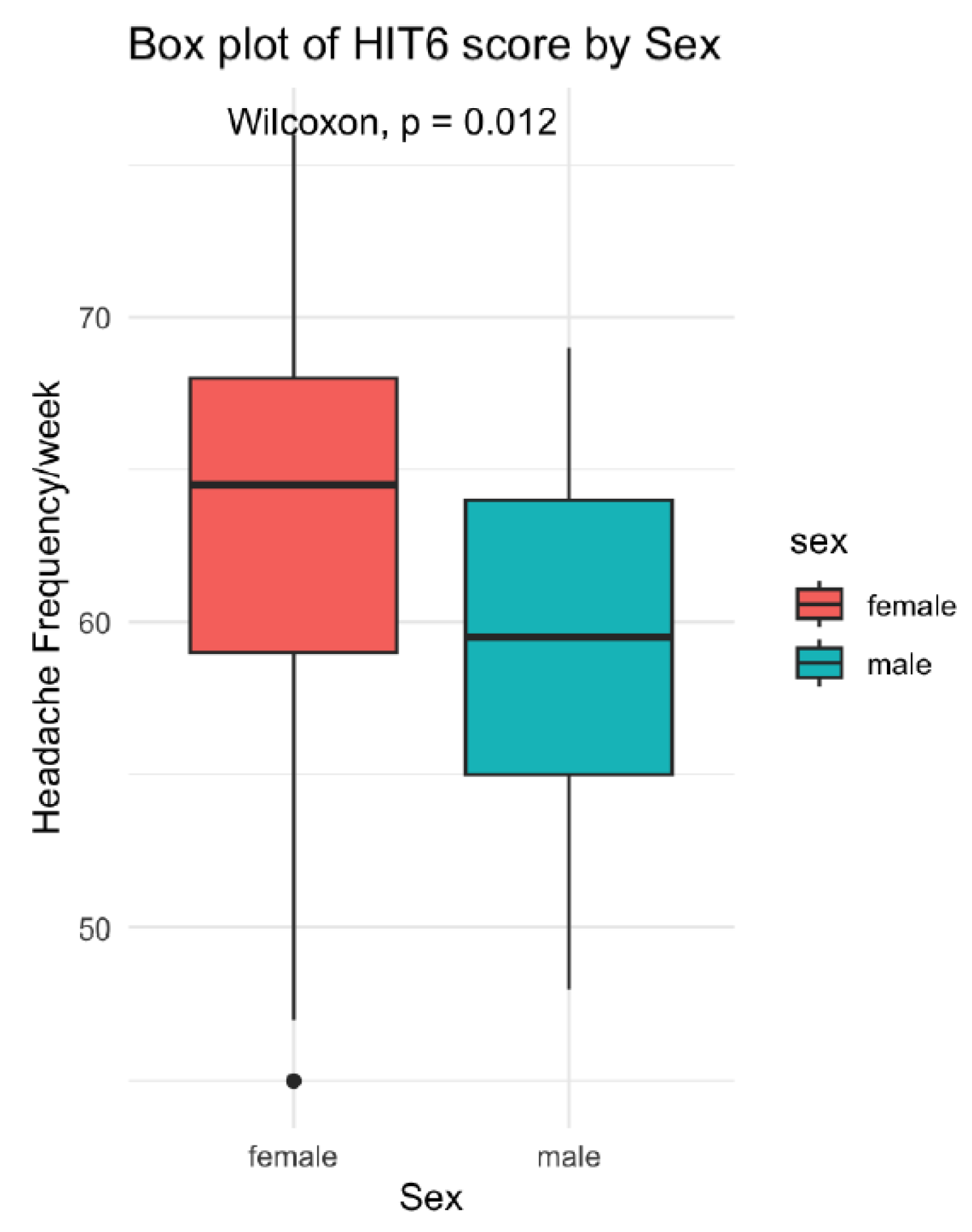
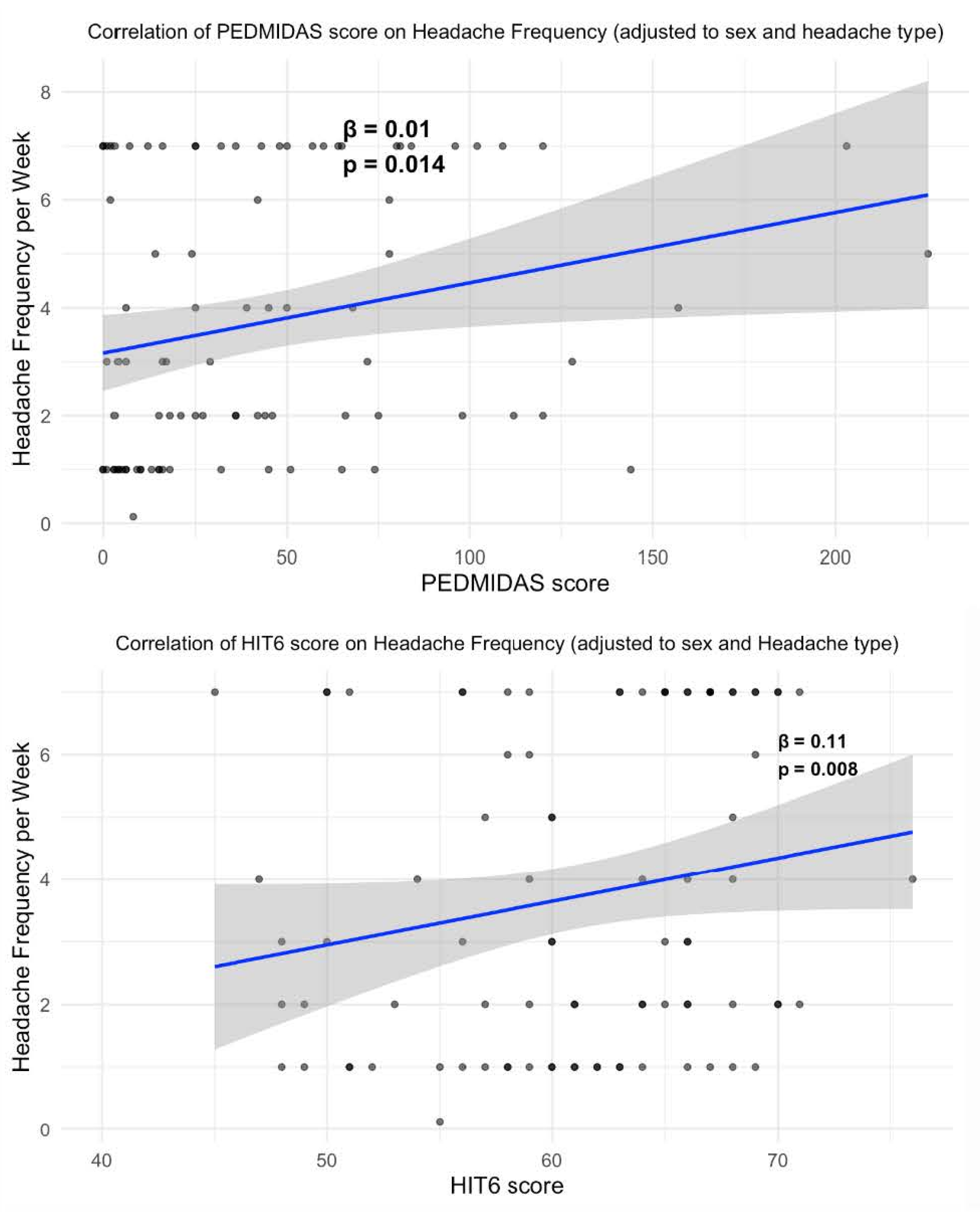

| Characteristic | N = 96 |
|---|---|
| Age | 14.0 (±3.3) |
| Sex | |
| Female | 63 (66%) |
| Male | 33 (34%) |
| Headache type | |
| Migraine with aura | 10 (10%) |
| Migraine without aura | 50 (52%) |
| TTH | 17 (18%) |
| Combined | 14 (15%) |
| Other | 5 (5.2%) |
| Family history of migraine | |
| Negative | 32 (34%) |
| Positive | 61 (66%) |
| Disease duration (months) | 11.0 (9.0, 15.0) |
| Headache frequency (per week) | 3.00 (1.00, 7.00) |
| Headache intensity | 7.00 (5.00, 8.00) |
| Characteristic | Migraine with Aura, N = 10 1 | Migraine Without Aura, N = 50 1 | TTH, N = 17 1 | Combined, N = 14 1 | Other, N = 5 1 | p Value |
|---|---|---|---|---|---|---|
| Age | 14.9 (2.8) | 13.0 (3.3) | 11.7 (3.3) | 14.8 (2.9) | 12.8 (2.6) | 0.048 |
| Sex | 0.12 | |||||
| Female | 6/10 (60%) | 32/50 (64%) | 10/17 (59%) | 13/14 (93%) | 2/5 (40%) | |
| Male | 4/10 (40%) | 18/50 (36%) | 7/17 (41%) | 1/14 (7.1%) | 3/5 (60%) | |
| Family history of migraine | 0.7 | |||||
| Negative | 4/9 (44%) | 16/50 (32%) | 7/17 (41%) | 3/13 (23%) | 2/4 (50%) | |
| Positive | 5/9 (56%) | 34/50 (68%) | 10/17 (59%) | 10/13 (77%) | 2/4 (50%) | |
| Disease duration (months) | 15.4 (4.9) | 10.8 (4.3) | 8.1 (5.0) | 12.0 (5.0) | 11.0 (3.9) | 0.004 |
| Headache frequency (per week) | 3.00 (2.56) | 3.04 (2.27) | 4.75 (2.52) | 5.43 (2.10) | 3.38 (3.45) | 0.006 |
| Headache intensity | 7.67 (0.87) | 6.71 (1.50) | 5.53 (1.19) | 6.62 (1.45) | 6.00 (1.00) | 0.005 |
| Migraine with Aura | Migraine Without Aura | TTH | Combined | Other | p Value | |
|---|---|---|---|---|---|---|
| PedMIDAS score | 69 (69) | 44 (47) | 19 (26) | 59 (36) | 48 (83) | 0.006 |
| PedMIDAS level | 2.80 (1.40) | 2.56 (1.21) | 1.71 (0.99) | 3.21 (0.80) | 2.00 (1.41) | 0.008 |
| HIT-6 score | 65 (4) | 62 (7) | 55 (6) | 63 (5) | 54 (10) | <0.001 |
| HIT-6 level | 3.90 (0.32) | 3.44 (0.95) | 2.47 (1.18) | 3.64 (0.50) | 2.40 (1.14) | <0.001 |
| ID | Age (Years) | Disease Duration (Months) | Headache Frequency (per Week) | Headache Intensity | PedMIDAS Score | PedMIDAS Level | HIT-6 Score | |
|---|---|---|---|---|---|---|---|---|
| ID | ||||||||
| Age (years) | −0.317 ** | |||||||
| Disease duration (months) | 0.011 | 0.182 | ||||||
| Headache frequency (per week) | −0.196 | 0.150 | −0.142 | |||||
| Headache intensity | 0.107 | 0.219 * | 0.269 * | −0.188 | ||||
| PedMIDAS score | −0.245 * | 0.326 ** | 0.150 | 0.275 * | 0.075 | |||
| PedMIDAS level | −0.280 ** | 0.335 ** | 0.094 | 0.299 ** | 0.059 | 0.964 *** | ||
| HIT-6 score | −0.031 | 0.244 * | 0.225 * | 0.203 | 0.255 * | 0.594 *** | 0.601 *** | |
| HIT-6 level | −0.076 | 0.228 * | 0.168 | 0.121 | 0.236 * | 0.478 *** | 0.498 *** | 0.874 *** |
Disclaimer/Publisher’s Note: The statements, opinions and data contained in all publications are solely those of the individual author(s) and contributor(s) and not of MDPI and/or the editor(s). MDPI and/or the editor(s) disclaim responsibility for any injury to people or property resulting from any ideas, methods, instructions or products referred to in the content. |
© 2025 by the authors. Licensee MDPI, Basel, Switzerland. This article is an open access article distributed under the terms and conditions of the Creative Commons Attribution (CC BY) license (https://creativecommons.org/licenses/by/4.0/).
Share and Cite
Genizi, J.; Mansour, R.; Burbara, M.; Gal, S.; Nathan, K.; Kaly, L.; Yaniv, L. The HIT-6 Questionnaire Corresponds to the PedMIDAS for Assessment of Pediatric Headaches. Healthcare 2025, 13, 3158. https://doi.org/10.3390/healthcare13233158
Genizi J, Mansour R, Burbara M, Gal S, Nathan K, Kaly L, Yaniv L. The HIT-6 Questionnaire Corresponds to the PedMIDAS for Assessment of Pediatric Headaches. Healthcare. 2025; 13(23):3158. https://doi.org/10.3390/healthcare13233158
Chicago/Turabian StyleGenizi, Jacob, Raneen Mansour, Malak Burbara, Shoshana Gal, Keren Nathan, Lisa Kaly, and Liat Yaniv. 2025. "The HIT-6 Questionnaire Corresponds to the PedMIDAS for Assessment of Pediatric Headaches" Healthcare 13, no. 23: 3158. https://doi.org/10.3390/healthcare13233158
APA StyleGenizi, J., Mansour, R., Burbara, M., Gal, S., Nathan, K., Kaly, L., & Yaniv, L. (2025). The HIT-6 Questionnaire Corresponds to the PedMIDAS for Assessment of Pediatric Headaches. Healthcare, 13(23), 3158. https://doi.org/10.3390/healthcare13233158

