Bridging Distance, Delivering Care: Pediatric Tele-Nutrition in the Digital Health Era—A Narrative Review



Abstract
1. Introduction
1.1. The Critical Importance of Pediatric Nutrition
1.2. Barriers to Accessing Pediatric Nutrition Services
1.3. The Evolution and Promise of Telehealth
1.4. The COVID-19 Pandemic as Catalyst
1.5. Unique Considerations for Pediatric Tele-Nutrition
1.6. Scope and Objectives of This Review
2. Methods
2.1. Search Strategy
2.2. Inclusion and Exclusion Criteria
- Studies involving children and adolescents (birth through 18 years of age)
- Interventions involving tele-nutrition, telehealth nutrition services, virtual nutrition care, remote nutrition counseling, or digital nutrition platforms
- Studies reporting clinical outcomes, implementation experiences, feasibility, acceptability, satisfaction, cost-effectiveness, or barriers and facilitators
- Published in English
- Published between 2010–2025
- Evidence types included: primary research studies (randomized controlled trials, quasi-experimental studies, observational cohort studies, qualitative studies, mixed-methods studies), systematic reviews and meta-analyses, implementation studies, evidence-based clinical guidelines, and policy documents
- Adult-only populations (>18 years of age)
- Studies not involving nutrition or dietary interventions as a primary or significant component
- Case reports or case series with fewer than 5 participants
- Abstracts without full-text availability
- Studies published in languages other than English
- Studies conducted prior to 2010
2.3. Study Selection and Data Extraction
2.4. Quality Assessment
2.5. Data Synthesis
2.6. Methodological Considerations and Limitations
3. Results
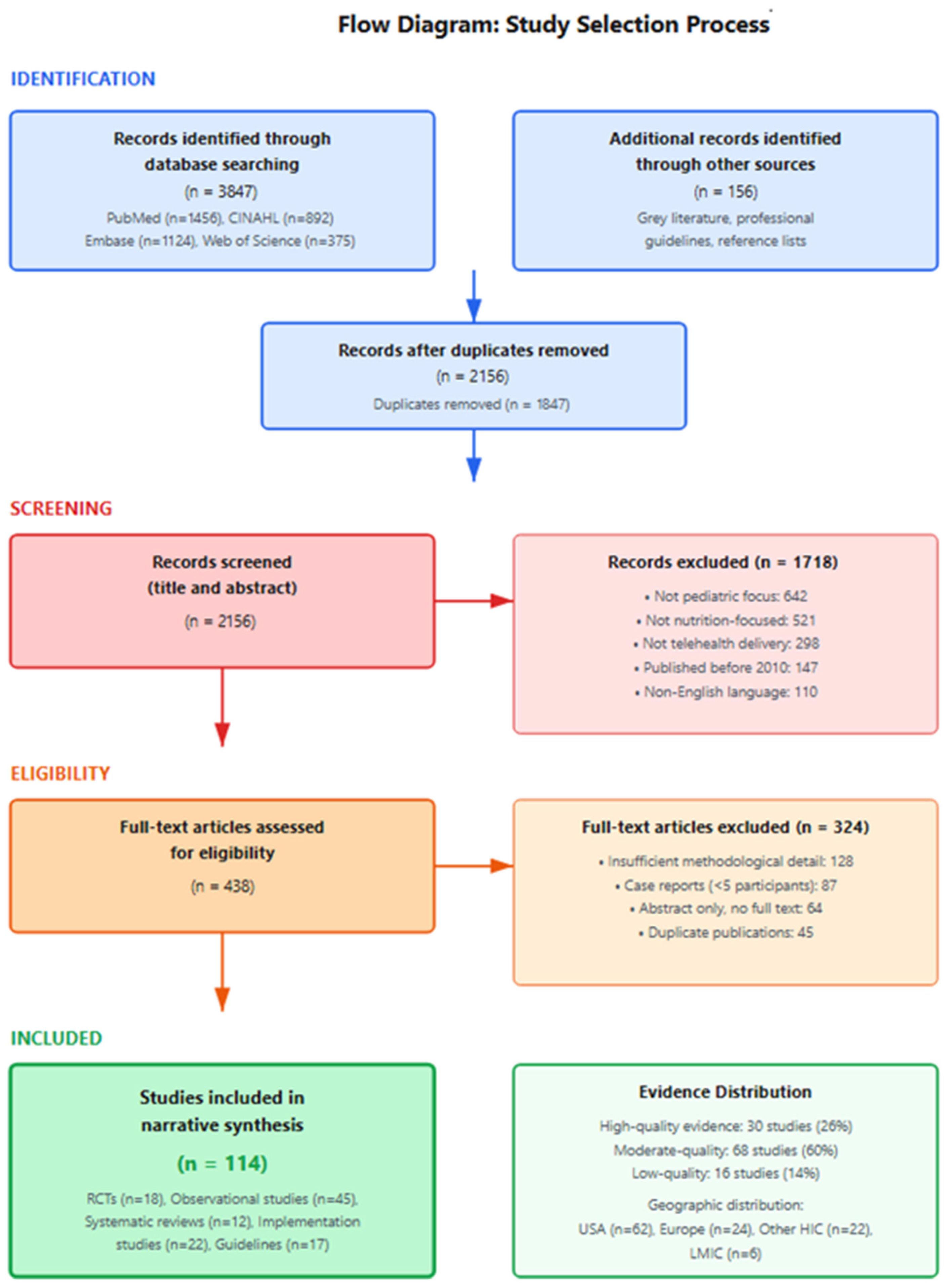
3.1. Search Results and Literature Overview
3.2. Technology Platforms and Delivery Modalities
3.2.1. Synchronous Video Consultations
3.2.2. Asynchronous Communication
3.2.3. Mobile Health Applications
- Enabling Factors for App Effectiveness
- Limitations and Barriers
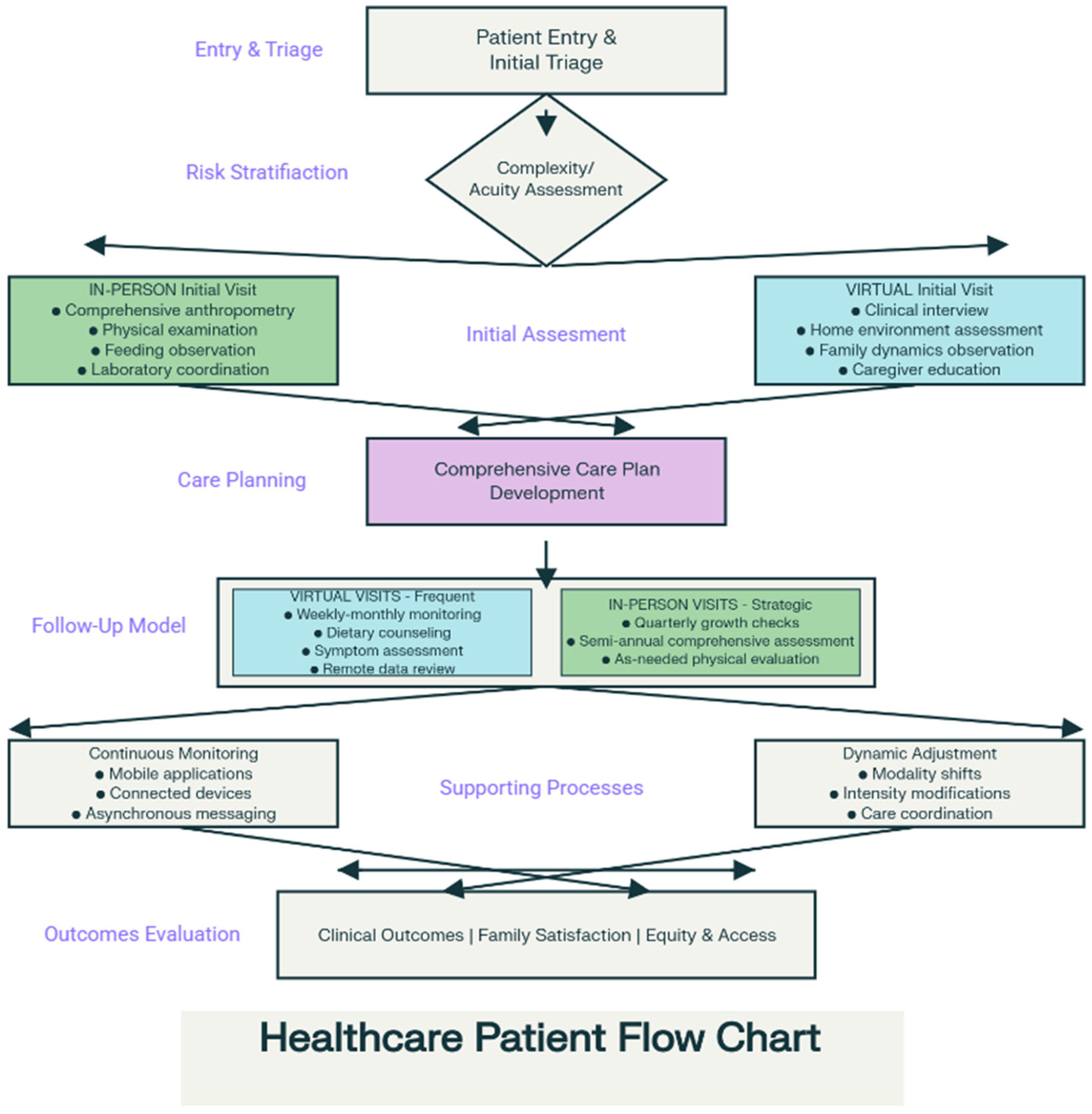
3.2.4. Hybrid Models
3.3. Clinical Applications and Outcomes Across Pediatric Populations
3.3.1. Obesity Management
3.3.2. Diabetes Management
3.3.3. Gastrointestinal Disorders
3.3.4. Feeding Disorders and Selective Eating
3.3.5. Food Allergies and Celiac Disease
3.3.6. Failure to Thrive and Malnutrition
3.3.7. Metabolic Disorders
3.3.8. Chronic Kidney Disease
3.3.9. Cystic Fibrosis
3.3.10. Preventive Nutrition and Health Promotion

| Condition [References] | Key Clinical Outcomes | Family Satisfaction | Comparison to In-Person Care | Evidence Level and Quality |
|---|---|---|---|---|
| Obesity [17,28,54,55,57] | • Meta-analysis findings (Margetin et al. 2022 [54], n = 1847, 12 RCTs): • BMI z-score reduction: −0.21 (95% CI: −0.29 to −0.13) • Dietary quality scores im-proved • Fruit/vegetable intake in-creased • Sugar-sweetened beverage consumption decreased Additional findings: • Group attendance: 89% (vir-tual) vs. 67% (in-person) • Home environment observation valued by families • Increased contact frequency associated with better adherence | 82–89% Sources: Davis 2013 [53] (n = 58): 85% Poulsen 2022 [17] (n = 112): 89% Moorman 2021 [28] review: 82–88% range | Comparable outcomes (meta-analysis conclusion) • Non-inferiority established in Margetin meta-analysis • Individual RCTs show similar BMI trajectories • Virtual groups: better attendance, comparable weight outcomes | HIGH Based on: • Multiple RCTs (n = 12) • Meta-analysis with 1847 participants • Low heterogeneity (I2 = 23%) • Low risk of bias • Consistent findings across studies |
| Type 1 Diabetes [4,58,59,60] | Non-inferiority RCT (Zhang et al. 2024 [58], n = 1704): • Telemedicine interventions, which typically include nutrition counseling as a component, were associated with reductions in hemoglobin A1c levels of 0.22% (95% CI: −0.33 to −0.10; p < 0.001; I2 = 35%) compared to usual care • Dietary adherence: Superior in tele-nutrition group (78% vs. 68%, p = 0.03) • Time in target glucose range: improved with CGM integration Additional findings: • CGM data integration enables pattern-based counseling • Carbohydrate counting accuracy improved • Hypoglycemia episodes: comparable • Quality of life scores: similar both groups | 85–92% Sources: Zhang 2024 (n = 142): 91% Crossen 2022 review: 85–90% range Adolescents: 73% prefer virtual visits (privacy, convenience) | Comparable glycemic control Superior adherence in virtual group • Formal non-inferiority design confirmed equivalence • More frequent contact possible virtually • Adolescent engagement higher with virtual option | HIGH Based on: • Formal non-inferiority RCT • Systematic review (Zhang 2024 [58]) of multiple studies • Low risk of bias • Validated outcomes (HbA1c) • Consistent findings |
| Gastrointestinal Disorders (IBD, EoE) [5,61,62,63,64] | Eosinophilic Esophagitis: • Studies in adult populations show elimination diet remission: 70–72% • Elemental diet remission: >90% • Telehealth enables complex diet management Inflammatory Bowel Disease: • Nutritional status maintained in 95% of patients • Growth velocity: comparable to in-person • Dietary adherence with frequent monitoring improved Both conditions: • No-show rates: lower with telehealth (8% vs. 18% in-person) • Travel burden reduced substantially • Frequent dietitian contact associated with better outcomes | 87–94% Sources: Venkatesh 2025 [63] (EoE, n = 247): 94% Miele 2018 [61] (IBD): 87–91% range Valued: Time savings, adequate provider time, reduced clinic visit burden | Comparable nutritional outcomes Reduced burden: • Lower no-show rates • More frequent monitoring feasible • Better treatment adherence reported • Complex elimination diets manageable virtually with frequent support | MODERATE Based on: • Large observational cohorts • Implementation studies • Position papers from professional societies (ESPGHAN) • Limited RCTs specific to telehealth • Consistent positive findings |
| Feeding Disorders/ARFID [9,65,66,83] | Behavioral feeding outcomes: • Food variety acceptance: increased (mean +7.3 new foods) • Bite acceptance rate: improved • Parental stress: reduced (measured by standardized scales) • Maladaptive mealtime behaviors: decreased Comparative study (Peterson et al. 2021 [66], n = 24): • Equivalent outcomes: in-clinic vs. telehealth-exclusive follow-up • Better long-term maintenance with telehealth (home generalization) • Caregiver coaching effective via video platform | 79–96% Sources: Davidson 2024 [83] (n = 127): High satisfaction with telehealth services Peterson 2021 [66] (n = 24): 79% Bloomfield 2019 [65]: case study positive | Equivalent outcomes to in-clinic for follow-up Potential advantages: • Home setting facilitates skill generalization • Real mealtime observation • Family dynamics visible • Long-term maintenance may be better | MODERATE Based on: • Case studies and case series • One comparative study (n = 24) • Pilot trials • No large RCTs yet • Promising preliminary evidence • More research needed |
| Food Allergies [7,67,68] | Children with food allergies are at risk for nutritional deficiencies and growth impairment [67], necessitating expert dietary guidance. Tele-nutrition delivery: • Label reading skills: improved with real-time virtual guidance • Appropriate allergen avoidance: achieved • Nutritional adequacy of elimination diets: maintained • Real-time shopping guidance via mobile device • Timely access to specialist dietitians | 87–91% Sources: Schultz 2024 [68] review: 88–91% range Valued: Real-time label review, shopping guidance, timely access to specialist care | Superior for timely access to specialist dietitians Advantages of virtual care: • Real-time label reading during video consultations • Shopping guidance via mobile device • Earlier intervention than typical clinic wait times • Comparable education quality | MODERATE Based on: • Implementation reports • Expert guidance • Clinical experience • No RCTs comparing virtual vs. in-person • Limited pediatric-specific research |
| Celiac Disease [69] | Virtual care feasibility: • Gluten-free diet adherence monitoring: feasible • Phone consultations: deemed appropriate by patients • Virtual dietary counseling: high acceptability • Nutritional adequacy assessments: conducted effectively COVID-19 experience: • Rapid telehealth adoption successful • Patients maintained dietary adherence • Access to specialized dietitian services improved | 85–90% Sources: Haimi & Lerner 2024 [69] review: 85–90% Patient beliefs: Phone consultations appropriate and beneficial for celiac follow-up | Comparable for dietary follow-up • Ongoing monitoring effective • Education delivery successful • Troubleshooting inadvertent exposure manageable • Initial diagnosis may benefit from in-person | LOW-MODERATE Based on: • Survey data • Narrative reviews • COVID-19 implementation reports • Limited controlled studies • Mostly adult data, pediatric extrapolated |
| Failure to Thrive [70,71,72] | Remote monitoring technology: • Connected scales can wirelessly transmit weight data [72] • Automated alerts when measurements fall outside parameters [72] • Weekly weight assessments feasible with home monitoring Integration with telehealth visits: • Weight progress review • Barrier identification • Nutritional intervention adjustments • Behavioral change support Note: Research on effectiveness of home monitoring combined with telehealth in pediatric FTT is emerging | 83–88% Sources: Implementation studies: 83–88% range Valued: Frequent monitoring without travel, convenience for stressed families | Technology may facilitate intensive monitoring Potential advantages: • More frequent weight tracking possible • Earlier intervention when growth falters • Reduced family burden during monitoring phase Limitation: Cannot assess clinical signs of malnutrition remotely | MODERATE Based on: • Implementation studies • Clinical guidelines adapted for telehealth • Case series • Technology capabilities described • Effectiveness research needed |
| Metabolic Disorders (PKU) [8,73,74,75] | Italian multicenter study (Rovelli et al. 2021 [74], n = 755): • 98% found video consulting useful • High satisfaction with telehealth services • Metabolic control (Phe levels): comparable to in-person • Blood sample submission: improved (geographic barrier reduced) UK patient perspectives (McBride et al. 2024 [73], n = 156): • Geographic barriers significantly reduced • >100 miles travel eliminated for many • Adolescent engagement: improved (often lost to follow-up) • Diet adherence: maintained or improved | 84–98% Sources: Rovelli 2021 [74] (n = 755): 98% found useful McBride 2024 [73] (n = 156): 84% satisfied Zubarioglu 2022 [75] (n = 89): 89% | Comparable metabolic control Superior engagement and accessibility: • Geographic barriers eliminated • Adolescent retention improved • More frequent contact possible • Blood sample submission increased | MODERATE Based on: • Large cohort studies (n = 755) • Survey research • Implementation studies • No RCTs • Consistent positive findings • Real-world effectiveness data |
| Chronic Kidney Disease [76,77,78] | Complex dietary management needs: • Sodium, potassium, phosphorus monitoring • Protein management guidance • Fluid restriction counseling Renal tele-nutrition potential benefits [77,78]: • Increased access to specialized renal dietitians • More frequent monitoring feasible • Remote dietary counseling capability Note: Dietary adherence in CKD remains challenging; research on whether tele-mutrition improves adherence is limited | 81–87% Sources: Limited pediatric data Adult extrapolations: 81–87% Valued: Access to renal dietitians, frequent monitoring capability | Promising for improving access to specialized care [77,78] • Access barriers reduced • Frequent monitoring feasible • Evidence base for effectiveness limited • Comparative pediatric data lacking | LOW Based on: • Limited pediatric-specific data • Extrapolation from adult studies • Expert opinion/commentaries • Implementation descriptions • Controlled effectiveness studies needed |
| Cystic Fibrosis [6,79,80] | CF nutritional needs [6,80]: • Dramatically increased energy requirements • Pancreatic enzyme supplementation Telehealth acceptability [79]: • Reduced infection exposure: highly valued by families • Pancreatic enzyme optimization: feasible virtually • High-calorie diet counseling: effective • Growth monitoring: requires periodic in-person assessment Limitations: • Rigorous outcome data for tele-nutrition effectiveness limited • Complex nutritional needs may require hybrid approach | 86–93% Sources: Gifford 2021 [79] (n = 245 programs): 86–93% range Highest value: Infection risk reduction (CF patients’ susceptibility to respiratory infections) | Accepted modality but outcomes data limited [79] • Infection prevention major advantage • Complex needs may require hybrid approach • Further research needed for optimal delivery models | LOW-MODERATE Based on: • Survey data from CF programs • Implementation reports • Limited rigorous outcome studies • Expert guidelines • More research needed |
| Preventive Nutrition [35,81,82] | Well-child nutrition services: • Lactation support: high utilization and satisfaction [35] • Infant feeding consultations: effective delivery Complementary feeding education: • Evidence supports early allergenic food introduction [81] • Tele-nutrition offers a modality for delivering this education to families WIC virtual services: • Implementation in Arizona WIC program showed participant satisfaction >85% [82] • Convenience highly valued • Educational content delivery: effective • Nutrition screening: feasible | >85% Sources: Arizona WIC program [82]: >85% Lactation support: 88–94% Infant feeding: 85–90% Strong preference for convenience of virtual visits | Effective for health promotion and education • Scalable for population health • Group classes: efficient delivery • Timely access for new parents • Early intervention possible | MODERATE Based on: • Program evaluations (WIC) • Implementation studies • Satisfaction surveys • Evidence-based guidelines on feeding practices [81] • Limited controlled trials on tele-nutrition delivery |
3.4. Patient and Family Experience
3.4.1. Satisfaction and Acceptability
3.4.2. Technology Experience and Barriers
3.4.3. Child and Adolescent Perspectives
3.5. Implementation Factors
3.5.1. Provider Perspectives and Training
3.5.2. Organizational and System Factors
3.5.3. Reimbursement and Policy
3.6. Barriers and Facilitators
3.6.1. Access and Equity
3.6.2. Language and Cultural Considerations
3.6.3. Physical Assessment Limitations
3.7. International Implementation: The Israeli Experience
| Domain [References] | Barriers | Facilitators | Strategies to Address Barriers | Geographic/Context Notes |
|---|---|---|---|---|
| Technology and Infrastructure [16,84,85,104] | • Poor internet connectivity • Lack of appropriate devices • Platform technical difficulties during sessions • Low digital literacy among caregivers • Technology fatigue, especially in children • Multiple platform requirements across providers | • High-speed broadband access • User-friendly, intuitive platforms • EHR integration reducing duplicate data entry • Technical support availability 24/7 • Multiple device compatibility (phone, tablet, computer) • Experience reduces technical difficulties over time | • Device lending programs for low-income families • Internet hotspots or connectivity subsidies • Audio-only visit options when video fails • Community technology hubs (libraries, clinics) • Comprehensive platform training with practice sessions • Prior experience improves comfort and reduces difficulties | Universal barrier but severity varies: • Rural areas face greater connectivity challenges than urban areas • LMIC settings: May require mobile-first, SMS-based platforms • HIC settings: Generally better infrastructure but disparities persist |
| Clinical Assessment [22,39,106,107,108,109,110] | • Cannot perform direct anthropometry (accuracy concerns with parent measurements) • Limited physical examination (cannot palpate edema, assess muscle/fat stores) • Cannot assess oral motor function for feeding disorders • Missing non-verbal cues in child behavior • No body composition assessment (skinfolds, bioimpedance) • Difficulty visualizing subtle signs of malnutrition | • Home environment observation provides contextual insights • Real-time feeding behavior observation in natural setting • Photo/video documentation between visits • Connected digital scales for objective weight data • Parent measurement training improves accuracy vs. estimation • Screen sharing enables real-time label review | • Hybrid models with periodic in-person visits for comprehensive assessment • Structured measurement training for parents (video demonstrations) • Clear protocols defining when in-person evaluation mandatory • Parents measuring (not estimating) improves accuracy: sensitivity 73% vs. 47% • Low threshold for transitioning to in-person when concerns arise • Validated assessment checklists for virtual encounters | Universal challenge across all settings • Protocols for hybrid care needed regardless of country • Connected devices more available in HIC but emerging in LMIC • Assessment limitations consistent globally |
| Equity and Access [13,31,32,86,94,101] | • Income-based disparities: 38.1% video use (income <$25 K) vs. 68.8% (≥ $100 K) • Race/ethnicity gaps: Latino 50.7%, Asian 51.3%, Black 53.6% vs. White populations • Education gaps: 38.1% (no HS diploma) • Language barriers without interpretation • Cultural preferences for in-person care • Digital literacy gaps across age/education • Privacy concerns in shared living spaces • Rural connectivity challenges | • Eliminates geographic travel barriers • Flexible scheduling accommodates work schedules • Reduced time burden (no commute, parking) • Access to distant specialists previously unavailable • Multiple family members can participate across locations • Reduced stigma for some conditions • Lower indirect costs (childcare, transportation) | • Professional interpretation services available via phone or video • Multilingual platform interfaces • Cultural adaptation of virtual care delivery • Proactive outreach to underserved populations • Subsidized technology access programs • Community partnerships for support • Monitor utilization by demographics to identify gaps • Maintain robust in-person options without creating two-tier system | Barrier severity varies by setting: • U.S.: Documented racial/ethnic/income disparities in utilization • Universal healthcare systems: May have different equity patterns • LMIC: Equity concerns more severe; require targeted interventions • Rural vs. urban: Greater connectivity gaps in rural areas |
| Provider Factors [20,89,90,91] | • Initial discomfort with virtual assessment techniques • Reimbursement uncertainty creating hesitancy • Technology difficulties and troubleshooting stress • Documentation uncertainty for virtual visits • Perceived limitations in building therapeutic relationship • Concerns about liability and quality of care • Training time requirements | • Increased scheduling flexibility • Reduced/eliminated commute for providers • Wider geographic reach to underserved areas • Home-based practice options • Confidence increased: 61% pre-pandemic to 76.6% during pandemic • Younger providers (20–39 yrs) adapt more readily • Peer learning and mentorship opportunities | • Comprehensive telehealth training programs (assessment techniques, communication) • Mentorship pairing experienced/novice providers • Clear documentation guidelines and templates • Ongoing technical support for providers • Quality metrics and feedback • Experience improves confidence: 78% RDN adoption rate during pandemic • Protected time for training and practice sessions | Relatively universal across settings • Training needs consistent globally • Younger providers adapt faster (universal finding) • Documentation requirements vary by country/system |
| Organizational and System [27,93,94,96,97] | • Variable reimbursement policies across payers • Interstate licensure restrictions (U.S.-specific) • Lack of institutional leadership support • Inadequate EHR integration with telehealth platforms • Workflow disruption during implementation • Start-up costs (technology, training) • Quality metrics not established for virtual care | • Strong leadership support and vision • Organizational prior telehealth experience • Robust IT infrastructure already in place • EHR-integrated telehealth platforms • COVID-19 policy changes enabled rapid scaling • Value-based payment models support telehealth • Champions within organization | • Advocacy for permanent telehealth reimbursement parity • Interstate licensure compacts (Dietitian Compact now available for state adoption) • Investment in digital infrastructure and support staff • Workflow optimization and process mapping • Quality metric development and tracking • Implementation science frameworks (CFIR) • Phased rollout with evaluation | Highly context-dependent: • U.S.: Interstate licensure major barrier; state-by-state reimbursement variation • Universal systems (Israel, Europe): Different regulatory structures; HMO coordination • LMIC: Infrastructure barriers more severe; different organizational models • COVID policy changes primarily HIC phenomenon |
| Family Factors [21,28,83,84,87,88] | • Initial preference for in-person care, especially first visits • Privacy concerns with virtual visits at home • Household disruptions (siblings, noise) • Young children difficulty maintaining focus (ages 0–5 lowest satisfaction) • Work schedule conflicts for live video • Caregiver stress operating technology • Preference for “hands-on” clinical experience | • Convenience and time savings highly valued • Reduced travel burden (cost, time, stress) • Home comfort reduces child anxiety • Ability to include working parents remotely • Adolescents value privacy and autonomy (73% prefer virtual) • High satisfaction reported after telehealth implementation • Observation of real home environment | • Hybrid models honoring family preferences • Flexible visit options (scheduled video, asynchronous, phone) • Clear privacy protocols and recommendations • Brief, focused virtual visits for young children (15–20 min) • Asynchronous options for busy families • Age-appropriate engagement strategies • Technical “dry runs” before first visit | Preferences vary culturally: • Some cultures stronger preference for in-person • Family structure affects participation (multi-generational homes) • Privacy concerns greater in crowded housing • Work flexibility varies by country/labor laws |
| Reimbursement and Policy [11,19,26,27,96,97,98,99] | • Inconsistent payer coverage for nutrition services • State-by-state variation in telehealth laws (U.S.) • Uncertainty of COVID-19 policy permanence • Nutrition services historically under-covered • Prior authorization requirements • Time limits on visits • Audio-only visits often not covered | • Temporary COVID-19 telehealth parity policies (U.S.) • Growing recognition of telehealth value • Value-based care models support prevention • Prevention focus in some policies • Cost-effectiveness potential (family savings documented) • Bipartisan policy support in some jurisdictions | • Advocacy for permanent parity policies • Documentation of cost-effectiveness and clinical outcomes • Demonstration projects showing value • Multi-stakeholder policy engagement • Professional organization lobbying (Academy of Nutrition and Dietetics) • Interstate compacts for licensure (7 states needed for activation) • Economic evaluation research | Highly country/system specific: • U.S.: Complex payer landscape; state laws vary; interstate practice restricted • Israel: Universal coverage via 4 HMOs; different barriers • Europe: Varies by country; many have universal systems • LMIC: Payment models completely different; may rely on government/NGO funding |
| Measurement and Data Quality [39,107,108] | • Parent-reported anthropometrics less accurate than professional • BMI from parent data: poor concordance • Growth velocity calculations may be inaccurate • Variability in home measurement technique • Delayed recognition of growth problems • Cannot obtain detailed body composition • Dietary recall accuracy concerns | • Connected digital scales can transmit weight data automatically • Photo food diaries provide visual documentation • Parents measuring vs. estimating: 73% vs. 47% sensitivity for obesity • Frequent home monitoring enables trend detection • Real-time data sharing with providers • Automated alerts for concerning values | • Detailed parent training in measurement technique (video demonstration + return demo) • Provide standardized measuring tools (tapes, stadiometers) • Connected scale programs for high-risk patients • Periodic in-person verification measurements • Heightened suspicion when measurements inconsistent with clinical picture • Clear protocols: when to require in-person assessment | Technology availability varies: • Connected scales more available/affordable in HIC • LMIC may rely on simple techniques • Training approaches adaptable globally • Verification frequency depends on resources |
4. Discussion
4.1. Principal Findings
4.2. Technology as Enabler of Care Transformation
Mechanisms of Effectiveness
4.3. Optimal Care Delivery Models
4.4. Equity and Access Considerations
4.5. Economic and Policy Considerations
4.6. Future Directions
4.7. Limitations and Research Priorities
- Long-term outcome studies examining sustained effects over multiple years, including growth trajectories, disease progression, and quality of life
- Comparative effectiveness research comparing different tele-nutrition modalities (synchronous video vs. asynchronous vs. hybrid) and implementation strategies
- Implementation science investigating effective integration strategies, organizational factors supporting adoption, and sustainment over time
- Health equity research examining barriers and facilitators across diverse populations, with outcomes stratified by socioeconomic status, race/ethnicity, language, geography, and other relevant characteristics
- Economic evaluations including comprehensive cost-effectiveness analyses from multiple perspectives (family, payer, healthcare system, societal)
- Child and adolescent perspectives through age-appropriate qualitative research understanding preferences, experiences, and developmental considerations
- Provider competency development studying optimal training approaches, assessment techniques adapted for virtual environments, and quality metrics
- LMIC adaptation studies examining feasibility, acceptability, and effectiveness of tele-nutrition models in resource-limited settings
4.8. Risks and Safeguards
4.9. Implications for Practice and Policy
5. Conclusions
Supplementary Materials
Author Contributions
Funding
Institutional Review Board Statement
Informed Consent Statement
Data Availability Statement
Acknowledgments
Conflicts of Interest
Abbreviations
| ARFID | Avoidant/Restrictive Food Intake Disorder |
| BMI | Body Mass Index |
| CGM | Continuous Glucose Monitor |
| CKD | Chronic Kidney Disease |
| EHR | Electronic Health Record |
| EoE | Eosinophilic Esophagitis |
| HbA1c | Hemoglobin A1c |
| HIC | High-Income Country |
| HMO | Health Maintenance Organization |
| IBD | Inflammatory Bowel Disease |
| LMIC | Low- and Middle-Income Country |
| PKU | Phenylketonuria |
| PTN | Pediatric Tele-Nutrition |
| RCT | Randomized Controlled Trial |
| RDN | Registered Dietitian Nutritionist |
| WIC | Women, Infants, and Children (nutrition program) |
References
- Black, R.e.; Victora, C.g.; Walker, S.P.; Bhutta, Z.A.; Christian, P.; de Onis, M.; Ezzati, M.; Grantham-McGregor, S.; Katz, J.; Martorell, R.; et al. Maternal and child undernutrition and overweight in low-income and middle-income countries. Lancet 2013, 382, 427–451. [Google Scholar] [CrossRef] [Scilit]
- Schwarzenberg, S.J.; Georgieff, M.K.; Committee on Nutrition. Advocacy for improving nutrition in the first 1000 days to support childhood development and adult health. Pediatrics 2018, 141, e20173716. [Google Scholar] [CrossRef] [Scilit] [PubMed]
- UNICEF; WHO; World Bank Group. Levels and Trends in Child Malnutrition: Key Findings of the 2021 Edition; World Health Organization: Geneva, Switzerland, 2021; Available online: https://www.who.int/publications/i/item/9789240025257 (accessed on 2 November 2025).
- Chiang, J.L.; Kirkman, M.S.; Laffel, L.M.; Peters, A.L. Type 1 diabetes through the life span: A position statement of the American Diabetes Association. Diabetes Care 2014, 37, 2034–2054. [Google Scholar] [CrossRef] [Scilit] [PubMed]
- Bousvaros, A.; Sylvester, F.; Kugathasan, S.; Szigethy, E.; Fiocchi, C.; Colletti, R.; Otley, A.; Amre, D.; Ferry, G.; Czinn, S.J. Challenges in pediatric inflammatory bowel disease. Inflamm. Bowel Dis. 2006, 12, 885–913. [Google Scholar] [CrossRef] [Scilit] [PubMed]
- Borowitz, D.; Robinson, K.A.; Rosenfeld, M.; Davis, S.D.; Sabadosa, K.A.; Spear, S.L.; Michel, S.H.; Parad, R.B.; White, T.B.; Farrell, P.M.; et al. Cystic Fibrosis Foundation evidence-based guidelines for management of infants with cystic fibrosis. J. Pediatr. 2009, 155, S73–S93. [Google Scholar] [CrossRef] [Scilit]
- Sicherer, S.H.; Sampson, H.A. Food allergy: A review and update on epidemiology, pathogenesis, diagnosis, prevention, and management. J. Allergy Clin. Immunol. 2018, 141, 41–58. [Google Scholar] [CrossRef] [Scilit]
- Zschocke, J.; Hoffmann, G.F. Vademecum Metabolicum: Diagnosis and Treatment of Inborn Errors of Metabolism, 4th ed.; Schattauer: Wagrain, Austria, 2011; Available online: https://content.e-bookshelf.de/media/reading/L-224480-ee2af85de9.pdf (accessed on 2 November 2025).
- Sharp, W.G.; Volkert, V.M.; Scahill, L.; McCracken, C.E.; McElhanon, B. A systematic review and meta-analysis of intensive multidisciplinary intervention for pediatric feeding disorders: How standard is the standard of care? J. Pediatr. 2017, 181, 116–124.e4. [Google Scholar] [CrossRef] [Scilit]
- Wilks-Gallo, L.; Aron, C.Z.; Messina, C.R. Integrating Registered Dietitian Nutritionists Into Primary Care Practices to Work With Children With Overweight. Clin. Pediatr. 2018, 57, 605–612. [Google Scholar] [CrossRef] [Scilit] [PubMed] [PubMed Central]
- Kohn, J.B.; Schofield, M. Is Medical Nutrition Therapy Considered a Form of Preventive Care and Is It Reimbursable? J. Acad. Nutr. Diet. 2015, 115, 1746–1749. [Google Scholar] [CrossRef] [Scilit] [PubMed]
- Henderson, C.; Knapp, M.; Fernández, J.L.; Beecham, J.; Hirani, S.P.; Cartwright, M.; Rixon, L.; Beynon, M.; Rogers, A.; Bower, P.; et al. Cost effectiveness of telehealth for patients with long term conditions. BMJ 2013, 346, f1035. [Google Scholar]
- Beaunoyer, E.; Dupéré, S.; Guitton, M.J. COVID-19 and digital inequalities: Reciprocal impacts and mitigation strategies. Comput. Human Behav. 2020, 111, 106424. [Google Scholar] [CrossRef] [Scilit] [PubMed]
- Kelly, J.T.; Reidlinger, D.P.; Hoffmann, T.C.; Campbell, K.L. Telehealth methods to deliver dietary interventions in adults with chronic disease: A systematic review and meta-analysis. Am. J. Clin. Nutr. 2016, 104, 1693–1702. [Google Scholar] [CrossRef] [Scilit] [PubMed]
- Masab, M.A.; Ibrahim, A.F. Telemedicine Beyond the Pandemic: Innovations, Challenges, and the Future of Digital Healthcare; IntechOpen: London, UK, 2025; Available online: https://www.intechopen.com/online-first/1222152 (accessed on 2 November 2025).
- Almathami, H.K.Y.; Win, K.T.; Vlahu-Gjorgievska, E. Barriers and facilitators that influence telemedicine-based, real-time, online consultation at patients’ homes: Systematic literature review. J. Med. Internet Res. 2020, 22, e16407. [Google Scholar] [CrossRef] [Scilit] [PubMed]
- Poulsen, M.N.; Hosterman, J.F.; Wood, G.C.; Cook, A.; Wright, L.; Jamieson, S.T.; Naylor, A.; Lutcher, S.; Mowery, J.; Seiler, C.J.; et al. Family-Based Telehealth Initiative to Improve Nutrition and Physical Activity for Children With Obesity and Its Utility During COVID-19: A Mixed Methods Evaluation. Front. Nutr. 2022, 9, 932514. [Google Scholar] [CrossRef] [Scilit] [PubMed] [PubMed Central]
- Shaikh, U.; Cole, S.L.; Marcin, J.P.; Nesbitt, T.S. Clinical management and patient outcomes among children and adolescents receiving telemedicine consultations for obesity. Telemed. J. E Health 2008, 14, 434–440. [Google Scholar] [CrossRef] [Scilit]
- American Bar Association Telehealth Legal Issues 2022. Available online: https://www.americanbar.org/groups/business_law/resources/business-law-today/2022-april/telehealth-the-legal-and-regulatory-issues/ (accessed on 2 November 2025).
- Garber, K.; Gustin, T. Telehealth Education: Impact on Provider Experience and Adoption. Nurse Educ. 2022, 47, 75–80. [Google Scholar] [CrossRef] [Scilit] [PubMed] [PubMed Central]
- Moulaei, K.; Sheikhtaheri, A.; Fatehi, F.; Shanbehzadeh, M.; Bahaadinbeigy, K. Patients’ perspectives and preferences toward telemedicine versus in-person visits: A mixed-methods study on 1226 patients. BMC Med. Inform. Decis. Mak. 2023, 23, 261. [Google Scholar] [CrossRef] [Scilit] [PubMed] [PubMed Central]
- Wagner, R.; Lima, T.C.; Silva, M.R.T.D.; Rabha, A.C.P.; Ricieri, M.C.; Fachi, M.M.; Afonso, R.C.; Motta, F.A. Assessment of Pediatric Telemedicine Using Remote Physical Examinations With a Mobile Medical Device: A Nonrandomized Controlled Trial. JAMA Netw. Open 2023, 6, e2252570. [Google Scholar] [CrossRef] [Scilit] [PubMed] [PubMed Central]
- Haynes, S.C.; Marcin, J.P. Pediatric Telemedicine: Lessons Learned During the Coronavirus Disease 2019 Pandemic and Opportunities for Growth. Adv. Pediatr. 2022, 69, 1–11. [Google Scholar] [CrossRef] [Scilit] [PubMed] [PubMed Central]
- Fishman, G.D.; Elkins, J. COVID-19 Lessons From The Field: Toward A Pediatric Physical Therapy Telehealth Framework. Int. J. Telerehabil. 2022, 14, e6448. [Google Scholar] [CrossRef] [Scilit] [PubMed] [PubMed Central]
- Centers for Medicare & Medicaid Services. Medicare Telemedicine Health Care Provider Fact Sheet. 2020. Available online: https://www.cms.gov/newsroom/fact-sheets/medicare-telemedicine-health-care-provider-fact-sheet (accessed on 2 November 2025).
- Greenhalgh, T.; Wherton, J.; Shaw, S.; Morrison, C. Video consultations for covid-19. BMJ 2020, 368, m998. [Google Scholar] [CrossRef] [Scilit]
- Theis, R.P.; Dorbu, J.I.; Mavrodieva, M.E.; Guerrero, R.A.; Wright, S.E.; Donahoo, W.T.; Modave, F.; Carrasquillo, O.; Shenkman, E.A. Telehealth Implementation Response to COVID-19 in the OneFlorida + Clinical Research Network: Perspectives of Clinicians and Health Systems Leaders. Telemed. J. E Health 2024, 30, 268–277. [Google Scholar] [CrossRef] [Scilit] [PubMed] [PubMed Central]
- Moorman, E.L.; Koskela-Staples, N.C.; Mathai, B.B.; Fedele, D.A.; Janicke, D.M. Pediatric Obesity Treatment via Telehealth: Current Evidence and Future Directions. Curr. Obes. Rep. 2021, 10, 371–384. [Google Scholar] [CrossRef] [Scilit] [PubMed]
- Bouabida, K.; Lebouché, B.; Pomey, M.P. Telehealth and COVID-19 Pandemic: An Overview of the Telehealth Use, Advantages, Challenges, and Opportunities during COVID-19 Pandemic. Healthcare 2022, 10, 2293. [Google Scholar] [CrossRef] [Scilit] [PubMed] [PubMed Central]
- Ramsetty, A.; Adams, C. Impact of the digital divide in the age of COVID-19. J. Am. Med. Inform. Assoc. 2020, 27, 1147–1148. [Google Scholar] [CrossRef] [Scilit] [PubMed]
- Sieck, C.J.; Sheon, A.; Ancker, J.S.; Castek, J.; Callahan, B.; Siefer, A. Digital inclusion as a social determinant of health. npj Digit. Med. 2021, 4, 52. [Google Scholar] [CrossRef] [Scilit] [PubMed] [PubMed Central]
- Calcaterra, V.; Verduci, E.; Vandoni, M.; Rossi, V.; Di Profio, E.; Carnevale Pellino, V.; Tranfaglia, V.; Pascuzzi, M.C.; Borsani, B.; Bosetti, A.; et al. Telehealth: A Useful Tool for the Management of Nutrition and Exercise Programs in Pediatric Obesity in the COVID-19 Era. Nutrients 2021, 13, 3689. [Google Scholar] [CrossRef] [Scilit] [PubMed] [PubMed Central]
- Stackpole, K.M.W.; Kharofa, R.Y.; Tucker, J.M.; Novick, M.B.; Fals, A.M.; Bernier, A.V.; Tammi, E.M.; Khoury, P.R.; Siegel, R.; Paul, S.; et al. Telehealth Use in a National Pediatric Weight Management Sample During the COVID-19 Pandemic. Child. Obes. 2024, 20, 309–320. [Google Scholar] [CrossRef] [Scilit] [PubMed] [PubMed Central]
- Hagan, J.F.; Shaw, J.S.; Duncan, P.M. Bright Futures: Guidelines for Health Supervision of Infants, Children, and Adolescents, 4th ed.; American Academy of Pediatrics: Itasca, IL, USA, 2017; Available online: https://fhop.ucsf.edu/sites/g/files/tkssra4481/f/Bright_Futures_4th_Edition_POCKETGUIDE.pdf (accessed on 2 November 2025).
- Uscher-Pines, L.; Lawrence, R.; Waymouth, M. Telehealth for Breastfeeding Support and Lessons for Digital Equity. JAMA Health Forum. 2023, 4, e225464. [Google Scholar] [CrossRef] [Scilit] [PubMed] [PubMed Central]
- Potthoff, L.M. Telemedicine and Integrated Multidisciplinary Care for Pediatric IBD Patients: A Review. Children 2021, 8, 347. [Google Scholar] [CrossRef] [Scilit]
- Ray, K.N.; Krull, D. Telehealth and pediatric care: Policy to optimize access, outcomes, and equity. Pediatr. Res. 2022, 92, 306–311. [Google Scholar] [CrossRef] [Scilit]
- Mahmood, L.; Flores-Barrantes, P.; Moreno, L.A.; Manios, Y.; Gonzalez-Gil, E.M. The Influence of Parental Dietary Behaviors and Practices on Children’s Eating Habits. Nutrients 2021, 13, 1138. [Google Scholar] [CrossRef] [Scilit] [PubMed] [PubMed Central]
- Casadei, K.; Kiel, J. Anthropometric Measurement. In StatPearls; StatPearls: Treasure Island, FL, USA, 2025. Available online: https://www.ncbi.nlm.nih.gov/books/NBK537315/ (accessed on 2 November 2025).
- Martin, H.; Schofield, M.; Yakes Jimenez, E. Tenets for Increasing Access to Nutrition Care Delivered Via Telehealth: Recommendations from the Academy of Nutrition and Dietetics Telehealth Task Force. J. Acad. Nutr. Diet. 2025, 125, 256–268. [Google Scholar] [CrossRef] [Scilit] [PubMed]
- Limketkai, B.N.; Mauldin, K.; Manitius, N.; Jalilian, L.; Salonen, B.R. The Age of Artificial Intelligence: Use of Digital Technology in Clinical Nutrition. Curr. Surg. Rep. 2021, 9, 20. [Google Scholar] [CrossRef] [Scilit]
- Theodore Armand, T.P.; Nfor, K.A.; Kim, J.I.; Kim, H.C. Applications of Artificial Intelligence, Machine Learning, and Deep Learning in Nutrition: A Systematic Review. Nutrients 2024, 16, 1073. [Google Scholar] [CrossRef] [Scilit] [PubMed] [PubMed Central]
- Sauers-Ford, H.S.; Hamline, M.Y.; Gosdin, M.M.; Kair, L.R.; Weinberg, G.M.; Marcin, J.P.; Rosenthal, J.L. Acceptability, usability, and effectiveness: A qualitative study evaluating a pediatric telemedicine program. Acad. Emerg. Med. 2019, 26, 1022–1033. [Google Scholar] [CrossRef] [Scilit] [PubMed]
- Curfman, A.; McSwain, S.D.; Chuo, J.; Yeager-McSwain, B.; Schinasi, D.A.; Marcin, J.; Herendeen, N.; Chung, S.L.; Rheuban, K.; Olson, C.A. Pediatric telehealth in the COVID-19 pandemic era and beyond. Pediatrics 2021, 148, e2021051772. [Google Scholar] [CrossRef] [Scilit]
- Flodgren, G.; Rachas, A.; Farmer, A.J.; Inzitari, M.; Shepperd, S. Interactive telemedicine: Effects on professional practice and health care outcomes. Cochrane Database Syst. Rev. 2015, 2015, CD002098. [Google Scholar] [CrossRef] [Scilit]
- Smith, A.C.; Thomas, E.; Snoswell, C.L.; Haydon, H.; Mehrotra, A.; Clemensen, J.; Caffery, L.J. Telehealth for global emergencies: Implications for coronavirus disease 2019 (COVID-19). J. Telemed. Telecare 2020, 26, 309–313. [Google Scholar] [CrossRef] [Scilit]
- Chen, J.; Cade, J.E.; Allman-Farinelli, M. The most popular smartphone apps for weight loss: A quality assessment. JMIR mHealth uHealth 2015, 3, e104. [Google Scholar] [CrossRef] [Scilit]
- Turner, T.; Spruijt-Metz, D.; Wen, C.K.; Hingle, M.D. Prevention and treatment of pediatric obesity using mobile and wireless technologies: A systematic review. Pediatr. Obes. 2015, 10, 403–409. [Google Scholar] [CrossRef] [Scilit]
- Li, X.; Yin, A.; Choi, H.Y.; Chan, V.; Allman-Farinelli, M.; Chen, J. Evaluating the Quality and Comparative Validity of Manual Food Logging and Artificial Intelligence-Enabled Food Image Recognition in Apps for Nutrition Care. Nutrients 2024, 16, 2573. [Google Scholar] [CrossRef] [Scilit]
- Zahedani, A.D.; McLaughlin, T.; Veluvali, A.; Aghaeepour, N.; Hosseinian, A.; Agarwal, S.; Ruan, J.; Tripathi, S.; Woodward, M.; Hashemi, N.; et al. Digital health application integrating wearable data and behavioral patterns improves metabolic health. npj Digit. Med. 2023, 6, 216. [Google Scholar] [CrossRef] [Scilit]
- Martinez, K.A.; Rood, M.; Jhangiani, N.; Kou, L.; Rose, S.; Boissy, A.; Rothberg, M.B. Patterns of use and correlates of patient satisfaction with a large nationwide direct to consumer telemedicine service. J. Gen. Intern. Med. 2018, 33, 1768–1773. [Google Scholar] [CrossRef] [Scilit] [PubMed]
- Krasovsky, T.; Weiss, P.L.; Gafni-Lachter, L.; Kizony, R.; Gefen, N. Hybrid approaches to allied health services for children and young people: A scoping review. J. Neuroeng. Rehabil. 2024, 21, 122, Erratum in J. Neuroeng. Rehabil. 2024, 21, 139. https://doi.org/10.1186/s12984-024-01434-6. [Google Scholar] [CrossRef] [Scilit] [PubMed] [PubMed Central]
- Davis, A.M.; Sampilo, M.; Gallagher, K.S.; Landrum, Y.; Malone, B. Treating rural pediatric obesity through telemedicine: Outcomes from a small randomized controlled trial. J. Pediatr. Psychol. 2013, 38, 932–943. [Google Scholar] [CrossRef] [Scilit] [PubMed]
- Margetin, C.A.; Radler, D.R.; Thompson, K.; Ziegler, J.; Dreker, M.; Byham-Gray, L.; Chung, M. Anthropometric Outcomes of Children and Adolescents Using Telehealth with Weight Management Interventions Compared to Usual Care: A Systematic Review and Meta-analysis. J. Am. Nutr. Assoc. 2021, 41, 207–229. [Google Scholar] [CrossRef] [Scilit]
- Talens, C.; da Quinta, N.; Adebayo, F.A.; Erkkola, M.; Heikkilä, M.; Bargiel-Matusiewicz, K.; Ziółkowska, N.; Rioja, P.; Łyś, A.E.; Cruz, E.S.; et al. Mobile- and Web-Based Interventions for Promoting Healthy Diets, Preventing Obesity, and Improving Health Behaviors in Children and Adolescents: Systematic Review of Randomized Controlled Trials. J. Med. Internet Res. 2025, 27, e60602. Available online: https://www.jmir.org/2025/1/e60602 (accessed on 2 November 2025). [CrossRef] [Scilit]
- Brunton, C.; Arensberg, M.B.; Drawert, S.; Badaracco, C.; Everett, W.; McCauley, S.M. Perspectives of Registered Dietitian Nutritionists on Adoption of Telehealth for Nutrition Care during the COVID-19 Pandemic. Healthcare 2021, 9, 235. [Google Scholar] [CrossRef] [Scilit] [PubMed] [PubMed Central]
- Zhu, D.; Dordevic, A.L.; Gibson, S.; Davidson, Z.E. The effectiveness of a 10-week family-focused e-Health healthy lifestyle program for school-aged children with overweight or obesity: A randomised control trial. BMC Public Health 2025, 25, 59. [Google Scholar] [CrossRef] [Scilit]
- Zhang, K.; Huang, Q.; Wang, Q.; Li, C.; Zheng, Q.; Li, Z.; Xu, D.; Xie, C.; Zhang, M.; Lin, R. Telemedicine in Improving Glycemic Control Among Children and Adolescents With Type 1 Diabetes Mellitus: Systematic Review and Meta-Analysis. J. Med. Internet Res. 2024, 26, e51538. [Google Scholar] [CrossRef] [Scilit] [PubMed] [PubMed Central]
- Jackson, M.A.; Ahmann, A.; Shah, V.N. Type 2 Diabetes and the Use of Real-Time Continuous Glucose Monitoring. Diabetes Technol. Ther. 2021, 23, S27–S34. [Google Scholar] [CrossRef] [Scilit] [PubMed] [PubMed Central]
- Crossen, S.S.; Bruggeman, B.S.; Haller, M.J.; Raymond, J.K. Challenges and Opportunities in Using Telehealth for Diabetes Care. Diabetes Spectr. 2022, 35, 33–42. [Google Scholar] [CrossRef] [Scilit] [PubMed] [PubMed Central]
- Miele, E.; Shamir, R.; Aloi, M.; Assa, A.; Braegger, C.; Bronsky, J.; de Ridder, L.; Escher, J.C.; Hojsak, I.; Kolaček, S.; et al. Nutrition in Pediatric Inflammatory Bowel Disease: A Position Paper on Behalf of the Porto Inflammatory Bowel Disease Group of the European Society of Pediatric Gastroenterology, Hepatology and Nutrition. J. Pediatr. Gastroenterol. Nutr. 2018, 66, 687–708. [Google Scholar] [CrossRef] [Scilit] [PubMed]
- Lucendo, A.J.; Arias, Á.; González-Cervera, J.; Yagüe-Compadre, J.L.; Guagnozzi, D.; Angueira, T.; Jiménez-Contreras, S.; González-Castillo, S.; Rodríguez-Domíngez, B.; De Rezende, L.C.; et al. Empiric 6-food elimination diet induced and maintained prolonged remission in patients with adult eosinophilic esophagitis: A prospective study on the food cause of the disease. J. Allergy Clin. Immunol. 2013, 131, 797–804. [Google Scholar] [CrossRef] [Scilit] [PubMed]
- Venkatesh, R.D.; Hiremath, G.; Dai, X.; Anderson, C.; Kodroff, E.; Strobel, M.J.; Zicarelli, A.; Gray, S.; Cordell, A.; Dellon, E.S.; et al. Lessons learned: Telehealth for patients with eosinophilic gastrointestinal diseases. Dis. Esophagus 2025, 38, doaf059. [Google Scholar] [CrossRef] [Scilit] [PubMed] [PubMed Central]
- Stoner, N.L.; Schwartz, S.; Dieterle, M. How Nutrition Can Support Children with IBD; Children’s Hospital of Philadelphia: Philadelphia, PA, USA, 2020; Available online: https://www.chop.edu/news/how-nutrition-can-support-children-ibd (accessed on 2 November 2025).
- Bloomfield, B.S.; Fischer, A.J.; Clark, R.R.; Dove, M.B. Treatment of food selectivity in a child with avoidant/restrictive food intake disorder through parent teleconsultation. Behav. Anal. Pract. 2018, 12, 33–43. [Google Scholar] [CrossRef] [Scilit]
- Peterson, K.M.; Ibañez, V.F.; Volkert, V.M.; Zeleny, J.R.; Engler, C.W.; Piazza, C.C. Using telehealth to provide outpatient follow-up to children with avoidant/restrictive food intake disorder. J. Appl. Behav. Anal. 2020, 54, 6–24. [Google Scholar] [CrossRef] [Scilit]
- Christie, L.; Hine, R.J.; Parker, J.G.; Burks, W. Food allergies in children affect nutrient intake and growth. J. Am. Diet. Assoc. 2002, 102, 1648–1651. [Google Scholar] [CrossRef] [Scilit]
- Schultz, M. Telehealth for food allergy management. In The Doctor Is…Online: The Emerging Role of Telehealth; Allergy & Asthma Network: Vienna, VA, USA, 2024. [Google Scholar]
- Haimi, M.; Lerner, A. Utilizing telemedicine applications in celiac disease and other gluten-free-diet-dependent conditions: Insights from the COVID-19 pandemic. Healthcare 2024, 12, 1132. [Google Scholar] [CrossRef] [Scilit]
- Jeong, S.J. Nutritional approach to failure to thrive. Korean J. Pediatr. 2011, 54, 277–281. [Google Scholar] [CrossRef] [Scilit] [PubMed] [PubMed Central]
- Goodwin, E.T.; Buel, K.L.; Cantrell, L.D. Growth Faltering and Failure to Thrive in Children. Am. Fam. Physician 2023, 107, 597–603, Erratum in Am. Fam. Physician 2024, 109, 105–106. [Google Scholar] [PubMed]
- Tenovi. Step-by-Step Guide: How to Use a Remote Patient Monitoring Scale for Accurate Weight Monitoring. Updated 8 April 2025. Available online: https://www.tenovi.com/remote-patient-monitoring-scale/ (accessed on 2 November 2025).
- McBride, H.; Evans, S.; Pinto, A.; Daly, A.; Ashmore, C.; Ilgaz, F.; Ford, S.; Buckley, S.; MacDonald, A. Patient and carer perceptions of video, telephone and in-person clinics for Phenylketonuria (PKU). Orphanet J. Rare Dis. 2024, 19, 303. [Google Scholar] [CrossRef] [Scilit] [PubMed]
- Rovelli, V.; Zuvadelli, J.; Paci, S.; Ercoli, V.; Dionigi, A.R.; Selmi, R.; Salvatici, E.; Cefalo, G.; Banderali, G. Telehealth and COVID-19: Empowering Standards of Management for Patients Affected by Phenylketonuria and Hyperphenylalaninemia. Healthcare 2021, 9, 1407. [Google Scholar] [CrossRef] [Scilit] [PubMed]
- Zubarioglu, T.; Hopurcuoglu, D.; Uygur, E.; Ahmadzada, S.; Oge-Enver, E.; Isat, E.; Cansever, M.S.; Kiykim, E.; Aktuglu-Zeybek, C. The Impact of Telemedicine for Monitoring and Treatment of Phenylketonuria Patients on Metabolic Outcome During Coronavirus Disease-19 Outbreak. Telemed. J. E Health 2022, 28, 258–265. [Google Scholar] [CrossRef] [Scilit] [PubMed]
- Nguyen, L.; Levitt, R.; Mak, R.H. Practical Nutrition Management of Children with Chronic Kidney Disease. Clin. Med. Insights Urol. 2016, 9, CMU.S13180. [Google Scholar] [CrossRef] [Scilit]
- Kalantar-Zadeh, K.; Moore, L.W. Renal Telenutrition for Kidney Health: Leveraging Telehealth and Telemedicine for Nutritional Assessment and Dietary Management of Patients With Kidney Disorders. J. Ren. Nutr. 2020, 30, 471–474. [Google Scholar] [CrossRef] [Scilit] [PubMed]
- Raina, R.; Nair, N.; Sharma, A.; Chakraborty, R.; Rush, S.; Panelists, D. Telemedicine for Pediatric Nephrology: Perspectives on COVID-19, Future Practices, and Work Flow Changes. Kidney Med. 2021, 3, 412–425. [Google Scholar] [CrossRef] [Scilit] [PubMed] [PubMed Central]
- Gifford, A.H.; Ong, T.; Dowd, C.; Van Citters, A.D.; Scalia, P.; Sabadosa, K.A.; Sawicki, G.S. Evaluating barriers to and promoters of telehealth during the COVID-19 pandemic at U.S. cystic fibrosis programs. J. Cyst. Fibros. 2021, 20, 9–13. [Google Scholar] [CrossRef] [Scilit] [PubMed] [PubMed Central]
- Stallings, V.A.; Stark, L.J.; Robinson, K.A.; Feranchak, A.P.; Quinton, H. Evidence-based practice recommendations for nutrition-related management of children and adults with cystic fibrosis. J. Am. Diet. Assoc. 2008, 108, 832–839. [Google Scholar] [CrossRef] [Scilit]
- Obbagy, J.E.; English, L.K.; Wong, Y.P.; Butte, N.F.; Dewey, K.G.; Fleischer, D.M.; Fox, M.K.; Greer, F.R.; Krebs, N.F.; Scanlon, K.S.; et al. Complementary feeding and food allergy, atopic dermatitis/eczema, asthma, and allergic rhinitis: A systematic review. Am. J. Clin. Nutr. 2019, 109, 890S–934S. [Google Scholar] [CrossRef] [Scilit]
- Arizona Department of Health Services, WIC Program 2019. WIC Online 2.0: WIC Online with eWIC-Final Report. USDA Food and Nutrition Service. Available online: https://wicworks.fns.usda.gov/resources/wic-online-ewic (accessed on 2 November 2025).
- Davidson, R.D.; Kramer, R.; Fleet, S.E. Satisfaction of telehealth implementation in a pediatric feeding clinic. AIMS Med. Sci. 2024, 11, 124–136. [Google Scholar] [CrossRef] [Scilit]
- Kodjebacheva, G.D.; Culinski, T.; Kawser, B.; Coffer, K. Satisfaction With Telehealth Services Compared With Nontelehealth Services Among Pediatric Patients and Their Caregivers: Systematic Review of the Literature. JMIR Pediatr. Parent. 2023, 6, e41554. [Google Scholar] [CrossRef] [Scilit] [PubMed]
- Kaufman-Shriqui, V.; Sherf-Dagan, S.; Boaz, M.; Birk, R. Virtual nutrition consultation: What can we learn from the COVID-19 pandemic? Public Health Nutr. 2021, 24, 1166–1173. [Google Scholar] [CrossRef] [Scilit] [PubMed] [PubMed Central]
- Tong, L.; George, B.; Crotty, B.H.; Somai, M.; Taylor, B.W.; Osinski, K.; Luo, J. Telemedicine and health disparities: Association between patient characteristics and telemedicine, in-person, telephone and message-based care during the COVID-19 pandemic. IPEM Transl. 2022, 3, 100010. [Google Scholar] [CrossRef] [Scilit] [PubMed] [PubMed Central]
- Jones, E.; Kurman, J.; Delia, E.; Crockett, J.; Peterson, R.; Thames, J.; Salorio, C.; Kalb, L.; Jacobson, L.; Stone, J.; et al. Parent Satisfaction With Outpatient Telemedicine Services During the COVID-19 Pandemic: A Repeated Cross-Sectional Study. Front. Pediatr. 2022, 10, 908337. [Google Scholar] [CrossRef] [Scilit]
- Kodjebacheva, G.D.; Culinski, T.; Kawser, B.; Amin, S. Satisfaction with pediatric telehealth according to the opinions of children and adolescents during the COVID-19 pandemic: A literature review. Front. Public Health 2023, 11, 1145486. [Google Scholar] [CrossRef] [Scilit]
- Rozga, M.; Handu, D.; Kelley, K.; Jimenez, E.Y.; Martin, H.; Schofield, M.; Steiber, A. Telehealth During the COVID-19 Pandemic: A Cross-Sectional Survey of Registered Dietitian Nutritionists. J. Acad. Nutr. Diet. 2021, 121, 2524–2535. [Google Scholar] [CrossRef] [Scilit] [PubMed] [PubMed Central]
- Bookari, K.; Arrish, J.; Alkhalaf, M.M.; Alharbi, M.H.; Zaher, S.; Alotaibi, H.M.; Tayyem, R.; Al-Awwad, N.; Qasrawi, R.; Allehdan, S.; et al. Perspectives and practices of dietitians with regards to social/mass media use during the transitions from face-to-face to telenutrition in the time of COVID-19: A cross-sectional survey in 10 Arab countries. Front. Public Health 2023, 11, 1151648. [Google Scholar] [CrossRef] [Scilit] [PubMed] [PubMed Central]
- Gnagnarella, P.; Ferro, Y.; Monge, T.; Troiano, E.; Montalcini, T.; Pujia, A.; Mazza, E. Telenutrition: Changes in Professional Practice and in the Nutritional Assessments of Italian Dietitian Nutritionists in the COVID-19 Era. Nutrients 2022, 14, 1359. [Google Scholar] [CrossRef] [Scilit] [PubMed] [PubMed Central]
- Alomar, D.; Almashmoum, M.; Eleftheriou, I.; Whelan, P.; Ainsworth, J. The Impact of Patient Access to Electronic Health Records on Health Care Engagement: Systematic Review. J. Med. Internet Res. 2024, 26, e56473. [Google Scholar] [CrossRef] [Scilit] [PubMed] [PubMed Central]
- Gustavson, A.M.; Lewinski, A.A.; Fitzsimmons-Craft, E.E.; Coronado, G.D.; Linke, S.E.; O’Malley, D.M.; Adams, A.S.; Glasgow, R.E.; Klesges, L.M. Strategies to Bridge Equitable Implementation of Telehealth. Interact J. Med. Res. 2023, 12, e40358. [Google Scholar] [CrossRef] [Scilit] [PubMed] [PubMed Central]
- Uscher-Pines, L.; Sousa, J.; Mehrotra, A.; Schwamm, L.H.; Zachrison, K.S. Rising to the challenges of the pandemic: Telehealth innovations in U.S. emergency departments. J. Am. Med. Inform. Assoc. 2021, 28, 1910–1918. [Google Scholar] [CrossRef] [Scilit] [PubMed] [PubMed Central]
- Mehta, P.; Stahl, M.G.; Germone, M.M.; Nagle, S.; Guigli, R.; Thomas, J.; Shull, M.; Liu, E. Telehealth and Nutrition Support During the COVID-19 Pandemic. J. Acad. Nutr. Diet. 2020, 120, 1953–1957. [Google Scholar] [CrossRef] [Scilit] [PubMed] [PubMed Central]
- Shachar, C.; Engel, J.; Elwyn, G. Implications for Telehealth in a Postpandemic Future: Regulatory and Privacy Issues. JAMA 2020, 323, 2375–2376. [Google Scholar] [CrossRef] [Scilit] [PubMed]
- Zhang, Z.; Bundorf, M.K.; Gong, Q.; Shea, C.M.; Gilleskie, D.; Sylvia, S.Y. Telehealth payment parity and outpatient service utilization: Evidence from privately insured workers. Health Aff. Sch. 2025, 3, qxaf068. [Google Scholar] [CrossRef] [Scilit] [PubMed] [PubMed Central]
- Council of State Governments National Center for Interstate Compacts. Dietitian Licensure Compact. Available online: https://compacts.csg.org/compact-updates/the-interstate-compact-for-dietitians/ (accessed on 2 November 2025).
- Saeed, S.A.; Masters, R.M. Disparities in Health Care and the Digital Divide. Curr. Psychiatry Rep. 2021, 23, 61. [Google Scholar] [CrossRef] [Scilit] [PubMed] [PubMed Central]
- Price, J.C.; Simpson, D.C. Telemedicine and Health Disparities. Clin. Liver Dis. 2022, 19, 144–147. [Google Scholar] [CrossRef] [Scilit] [PubMed] [PubMed Central]
- National Survey Trends in Telehealth Use in 2021: Disparities in Utilization and Audio vs. Video Services. Available online: https://aspe.hhs.gov/sites/default/files/documents/4e1853c0b4885112b2994680a58af9ed/telehealth-hps-ib.pdf (accessed on 2 November 2025).
- Rural Health Information Hub Data on Broadband Access. Available online: https://www.ruralhealthinfo.org/toolkits/telehealth/1/barriers (accessed on 2 November 2025).
- Joshi, A.U. Bridging the Language Divide in Telehealth: Understanding the Impact on Patient Experience. Available online: https://telehealth.org/blog/bridging-the-language-divide-in-telehealth-understanding-the-impact-on-patient-experience/ (accessed on 2 November 2025).
- Pullyblank, K.; Scribani, M.; Krupa, N.; Chapman, A.; Kern, M.; Brunner, W. Exploring Multiple Dimensions of Access to and Preferences for Telehealth Use. Telemed. Rep. 2023, 4, 348–358. [Google Scholar] [CrossRef] [Scilit] [PubMed] [PubMed Central]
- Kruse, C.S.; Krowski, N.; Rodriguez, B.; Tran, L.; Vela, J.; Brooks, M. Telehealth and patient satisfaction: A systematic review and narrative analysis. BMJ Open 2017, 7, e016242. [Google Scholar] [CrossRef] [Scilit] [PubMed] [PubMed Central]
- Cueto, V.; Sanders, L.M. Telehealth Opportunities and Challenges for Managing Pediatric Obesity. Pediatr Clin N. Am. 2020, 67, 647–654. [Google Scholar] [CrossRef] [Scilit]
- Chai, L.K.; Collins, C.E.; May, C.; Holder, C.; Burrows, T.L. Accuracy of Parent-Reported Child Height and Weight and Calculated Body Mass Index Compared With Objectively Measured Anthropometrics: Secondary Analysis of a Randomized Controlled Trial. J. Med. Internet Res. 2019, 21, e12532. [Google Scholar] [CrossRef] [Scilit] [PubMed] [PubMed Central]
- Huybrechts, I.; Himes, J.H.; Ottevaere, C.; De Vriendt, T.; De Keyzer, W.; Cox, B.; Van Trimpont, I.; De Bacquer, D.; De Henauw, S. Validity of parent-reported weight and height of preschool children measured at home or estimated without home measurement: A validation study. BMC Pediatr. 2011, 11, 63. [Google Scholar] [CrossRef] [Scilit]
- Einarsson, S.; Thoresen, L.; Tobberup, R.; Paur, I. Dietitians’ experiences of nutrition assessment via TeleNutrition: “Video-calls are better than phone-calls, but it’s probably difficult for patients to show their ankles on the screen” . Clin. Nutr. Open Sci. 2024, 56, 11–25. Available online: https://www.sciencedirect.com/science/article/pii/S2667268524000457 (accessed on 2 November 2025). [CrossRef] [Scilit]
- Kesari, A.; Noel, J.Y. Nutritional Assessment. In StatPearls; StatPearls: Treasure Island, FL, USA, 2025. Available online: https://www.ncbi.nlm.nih.gov/books/NBK580496/ (accessed on 2 November 2025).
- Sheba Medical Center. Sheba BEYOND: Israel’s First Virtual Hospital; Tel Hashomer: Ramat Gan, Israel, 2020; Available online: https://beyond-en.sheba.co.il/145697 (accessed on 2 November 2025).
- Penn, N.; Laron, M. Use and barriers to the use of telehealth services in the Arab population in Israel: A cross sectional survey. Isr. J. Health Policy Res. 2023, 12, 21. [Google Scholar] [CrossRef] [Scilit]
- Levi, B.; Davidovitch, N. The Healthcare System in Israel: An Overview. In State of the Nation Report: Society, Economy and Policy in Israel 2022; Taub Center for Social Policy Studies: Jerusalem, Israel, 2022. [Google Scholar]
- Grossman, Z.; Chodick, G.; Reingold, S.M.; Chapnick, G.; Ashkenazi, S. The future of telemedicine visits after COVID-19: Perceptions of primary care pediatricians. Isr. J. Health Policy Res. 2020, 9, 53. [Google Scholar] [CrossRef] [Scilit]


| Platform Type | Adoption Prevalence | Key Advantages | Primary Limitations | Best Applications |
|---|---|---|---|---|
| Synchronous Video | 85–95% of programs | • Real-time interaction • Visual assessment of feeding • Home environment observation • Immediate feedback • Screen sharing for education | • Requires scheduled time • Technology/bandwidth dependent • Less flexible for busy families • Digital literacy needed | • Initial assessments • Feeding disorder observation • Parent education • Complex diet counseling • Family engagement |
| Asynchronous Communication | 30–45% of programs | • High scheduling flexibility • Reduced time burden • Ongoing monitoring between visits • Photo/video documentation • Convenient for families | • Delayed responses • Limited interaction depth • May miss urgent issues • Less personal connection | • Diet diary review • Label reading questions • Symptom tracking • Follow-up clarifications • Routine monitoring |
| Mobile Applications | 45–65% of programs | • Continuous tracking • Automated reminders • Growth chart integration • Gamification for children • AI-enabled food recognition | • Requires digital literacy • Adherence varies • Data privacy concerns • Platform fragmentation • Cost barriers | • Diabetes management (CGM integration) • Food allergy tracking • PKU diet monitoring • Obesity self-monitoring • Medication reminders |
| Remote Monitoring Devices | 20–35% of programs | • Objective data collection • Early problem detection • Reduced reporting burden • Real-time data sharing • Automated alerts | • Device cost • Technical setup required • Accuracy variability • Limited parameters • Requires broadband connectivity | • Failure to thrive (connected scales) • Growth monitoring • Diabetes (CGM) • Weight tracking • Early intervention |
| Hybrid Models | 40–55% of programs | • Combines strengths of each modality • Flexibility based on clinical needs • Comprehensive assessment capability • Optimized resource use • Patient preference accommodation | • Complex coordination • Variable insurance coverage • Requires clear protocols • Higher organizational demands | • Most chronic conditions • Complex medical needs • Initial in-person + virtual follow-up • Periodic growth assessments |
Disclaimer/Publisher’s Note: The statements, opinions and data contained in all publications are solely those of the individual author(s) and contributor(s) and not of MDPI and/or the editor(s). MDPI and/or the editor(s) disclaim responsibility for any injury to people or property resulting from any ideas, methods, instructions or products referred to in the content. |
© 2025 by the authors. Licensee MDPI, Basel, Switzerland. This article is an open access article distributed under the terms and conditions of the Creative Commons Attribution (CC BY) license (https://creativecommons.org/licenses/by/4.0/).
Share and Cite
Haimi, M.; Inchi, L. Bridging Distance, Delivering Care: Pediatric Tele-Nutrition in the Digital Health Era—A Narrative Review. Healthcare 2025, 13, 3107. https://doi.org/10.3390/healthcare13233107
Haimi M, Inchi L. Bridging Distance, Delivering Care: Pediatric Tele-Nutrition in the Digital Health Era—A Narrative Review. Healthcare. 2025; 13(23):3107. https://doi.org/10.3390/healthcare13233107
Chicago/Turabian StyleHaimi, Motti, and Liron Inchi. 2025. "Bridging Distance, Delivering Care: Pediatric Tele-Nutrition in the Digital Health Era—A Narrative Review" Healthcare 13, no. 23: 3107. https://doi.org/10.3390/healthcare13233107
APA StyleHaimi, M., & Inchi, L. (2025). Bridging Distance, Delivering Care: Pediatric Tele-Nutrition in the Digital Health Era—A Narrative Review. Healthcare, 13(23), 3107. https://doi.org/10.3390/healthcare13233107