

Associations Between Personal Views of Aging and Quality of Life in Midlife and Older Age: The Mediating Role of Psychological Resilience



Abstract
1. Introduction
2. Materials and Methods
2.1. Participants
2.2. Materials
2.2.1. Quality of Life
2.2.2. Personal Views of Aging
2.2.3. Psychological Resilience
2.3. Procedure
2.4. Statistical Analysis
3. Results
3.1. Regression Analyses
3.1.1. Overall QoL
3.1.2. QoL Domains
3.2. Path Analyses
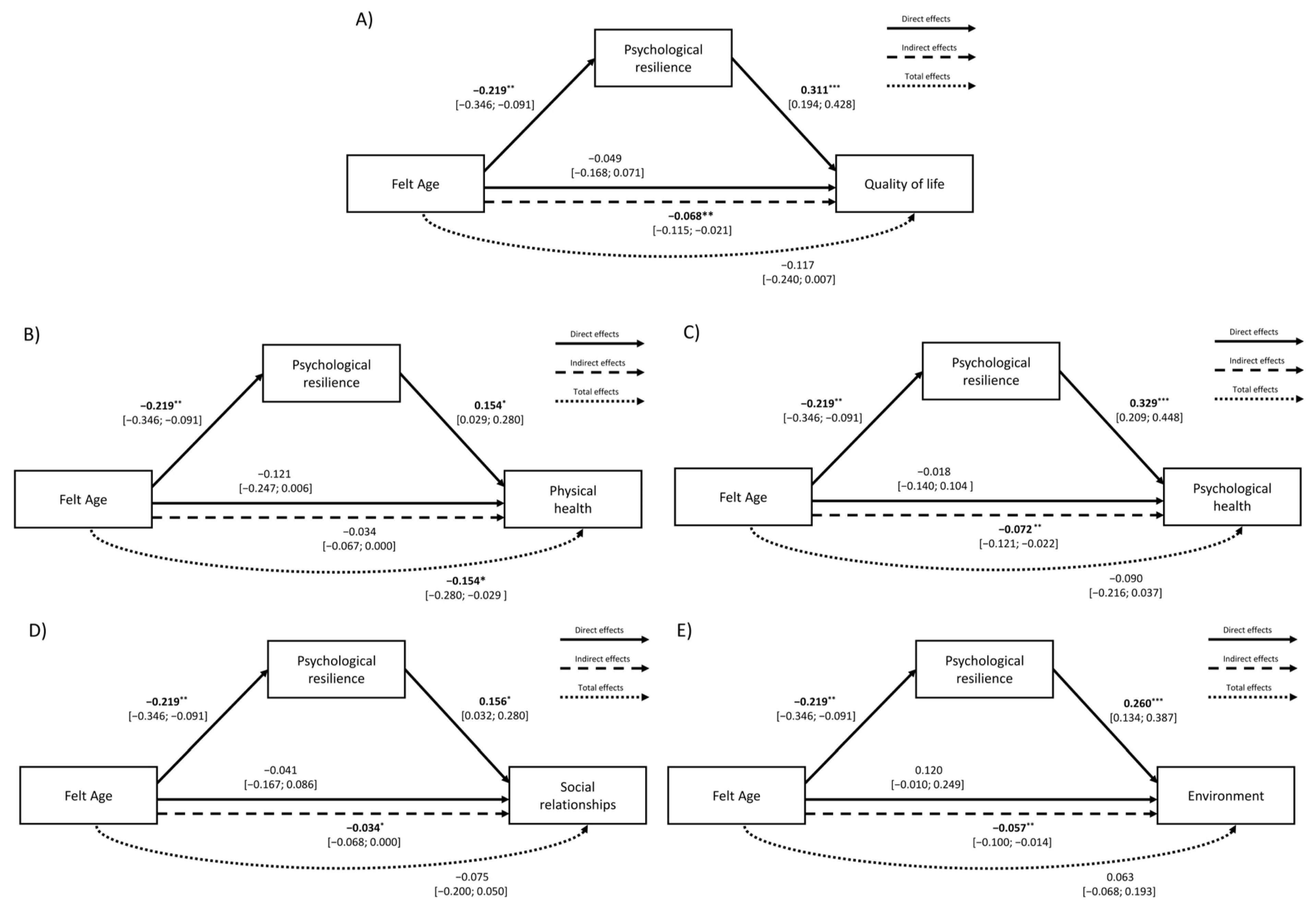
3.2.1. FA and Psychological Resilience on Overall QoL
3.2.2. FA and Psychological Resilience on QoL Domains
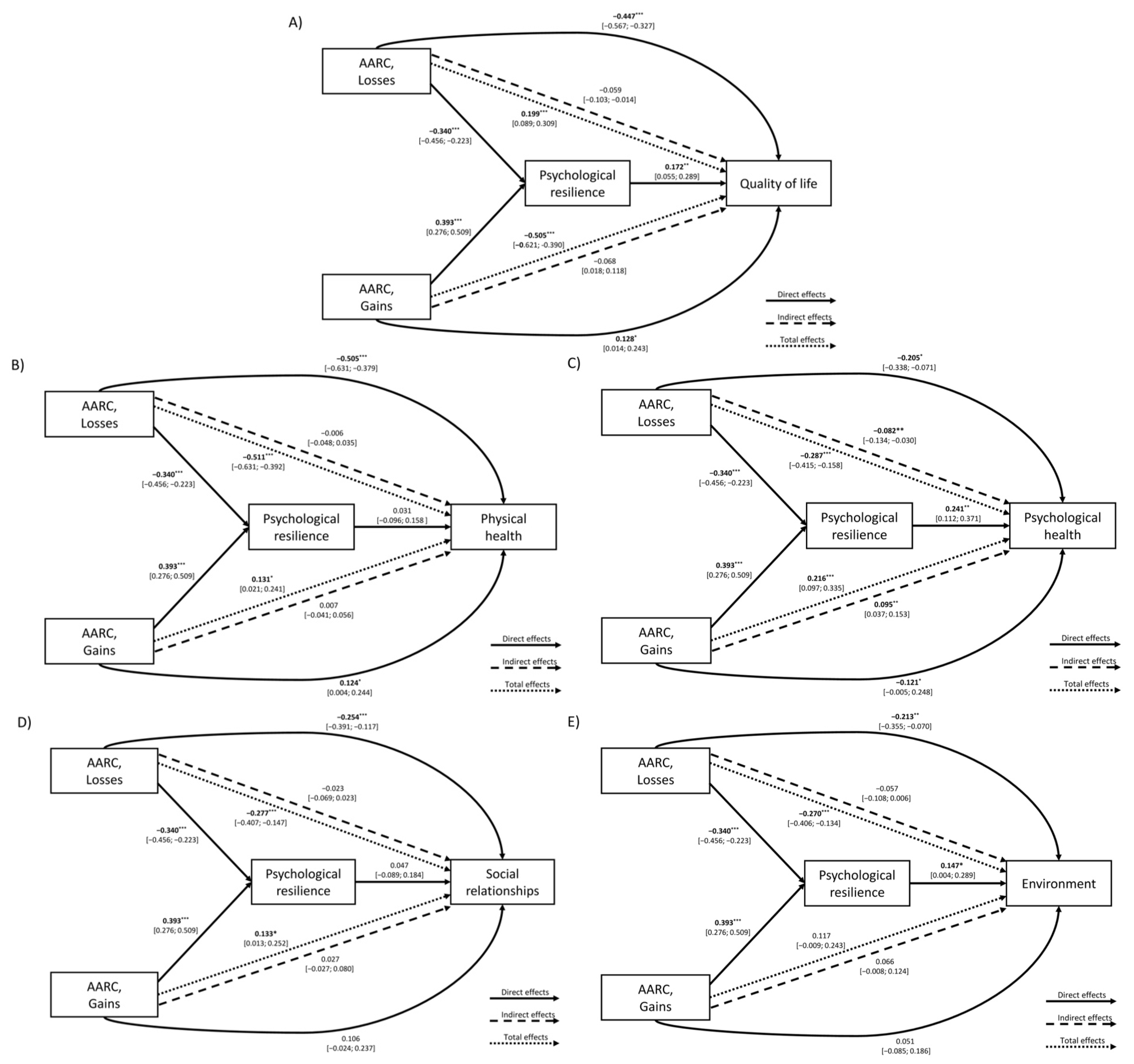
3.2.3. AARC and Psychological Resilience on Overall QoL
3.2.4. AARC and Psychological Resilience on QoL Domains
4. Discussion
5. Conclusions
Supplementary Materials
Author Contributions
Funding
Institutional Review Board Statement
Informed Consent Statement
Data Availability Statement
Acknowledgments
Conflicts of Interest
References
- Palgi, Y.; Shrira, A.; Diehl, M. (Eds.) Subjective Views of Aging: Theory, Research, and Practice; Springer International Publishing: Berlin, Germany, 2022. [Google Scholar]
- Levy, B.R.; Slade, M.D.; Kunkel, S.R.; Kasl, S.V. Longevity increased by positive self-perceptions of aging. J. Personal. Soc. Psychol. 2002, 83, 261. [Google Scholar] [CrossRef]
- Westerhof, G.J.; Nehrkorn-Bailey, A.M.; Tseng, H.-Y.; Brothers, A.; Siebert, J.S.; Wurm, S.; Wahl, H.-W.; Diehl, M. Longitudinal effects of subjective aging on health and longevity: An updated meta-analysis. Psychol. Aging 2023, 38, 147–166. [Google Scholar] [CrossRef]
- Sabatini, S.; Silarova, B.; Martyr, A.; Collins, R.; Ballard, C.; Anstey, K.J.; Kim, S.; Clare, L. Associations of awareness of age-related change with emotional and physical well-being: A systematic review and meta-analysis. Gerontologist 2020, 60, e477–e490. [Google Scholar] [CrossRef]
- World Health Organization. Decade of Healthy Ageing: Baseline Report; WHO: Geneva, Switzerland, 2020. [Google Scholar]
- Beard, J.R.; Officer, A.; de Carvalho, I.A.; Sadana, R.; Pot, A.M.; Michel, J.P.; Chatterji, S. The World report on ageing and health: A policy framework for healthy ageing. Lancet 2016, 387, 2145–2154. [Google Scholar] [CrossRef]
- Livingston, G.; Huntley, J.; Liu, K.Y.; Costafreda, S.G.; Selbæk, G.; Alladi, S.; Mukadam, N. Dementia prevention, intervention, and care: 2024 report of the Lancet Standing Commission. Lancet 2024, 404, 572–628. [Google Scholar] [CrossRef] [PubMed]
- Skevington, S.M.; Lotfy, M.; O’Connell, K.A. The World Health Organization’s WHOQOL-BREF quality of life assessment: Psychometric properties and results of the international field trial. A report from the WHOQOL group. Qual. Life Res. 2004, 13, 299–310. [Google Scholar] [CrossRef] [PubMed]
- World Health Organization. The World Health Report 2002: Reducing Risks, Promoting Healthy Life; World Health Organization: Geneva, Switzerland, 2002. [Google Scholar]
- Noto, S. Perspectives on Aging and Quality of Life. Healthcare 2023, 11, 2131. [Google Scholar] [CrossRef] [PubMed]
- Zaninotto, P.; Falaschetti, E.; Sacker, A. Age trajectories of quality of life among older adults: Results from the English Longitudinal Study of Ageing. Qual. Life Res. 2009, 18, 1301–1309. [Google Scholar] [CrossRef]
- Waddell, C.; Van Doorn, G.; Power, G.; Statham, D. From successful ageing to ageing well: A narrative review. Gerontologist 2025, 65, gnae109. [Google Scholar] [CrossRef]
- Marzo, R.R.; Khanal, P.; Shrestha, S.; Mohan, D.; Myint, P.K.; Su, T.T. Determinants of active aging and quality of life among older adults: Systematic review. Front. Public Health 2023, 11, 1193789. [Google Scholar] [CrossRef]
- Xiaopeng, Z.; Jing, Y.; Xia, L.; Xingsheng, W.; Juan, D.; Yan, L.; Baoshan, L. Global burden of Alzheimer’s disease and other dementias in adults aged 65 years and older, 1991–2021: Population-based study. Front. Public Health 2025, 13, 1585711. [Google Scholar] [CrossRef]
- Velaithan, V.; Tan, M.M.; Yu, T.F.; Liem, A.; Teh, P.L.; Su, T.T. The association of self-perception of aging and quality of life in older adults: A systematic review. Gerontologist 2024, 64, gnad041. [Google Scholar] [CrossRef]
- Barrett, A.E. Socioeconomic status and age identity: The role of dimensions of health in the subjective construction of age. J. Gerontol. Ser. B Psychol. Sci. Soc. Sci. 2003, 58, S101–S109. [Google Scholar] [CrossRef]
- Kotter-Grühn, D.; Kornadt, A.E.; Stephan, Y. Looking beyond chronological age: Current knowledge and future directions in the study of subjective age. Gerontology 2015, 62, 86–93. [Google Scholar] [CrossRef] [PubMed]
- Diehl, M.K.; Wahl, H.W. Awareness of age-related change: Examination of a (mostly) unexplored concept. J. Gerontol. Ser. B Psychol. Sci. Soc. Sci. 2010, 65, 340–350. [Google Scholar] [CrossRef] [PubMed]
- Brothers, A.; Gabrian, M.; Wahl, H.W.; Diehl, M. Future time perspective and awareness of age-related change: Examining their role in predicting psychological well-being. Psychol. Aging 2016, 31, 605. [Google Scholar] [CrossRef] [PubMed]
- Kaspar, R.; Gabrian, M.; Brothers, A.; Wahl, H.W.; Diehl, M. Measuring awareness of age-related change: Development of a 10-item short form for use in large-scale surveys. Gerontologist 2019, 59, e130–e140. [Google Scholar] [CrossRef]
- Sabatini, S.; Rupprecht, F.; Kaspar, R.; Klusmann, V.; Kornadt, A.; Nikitin, J.; Wahl, H.W. Successful Aging and Subjective Aging: Toward a Framework to Research a Neglected Connection. Gerontologist 2024, 64, gnae051. [Google Scholar] [CrossRef]
- Windle, G. What is resilience? A review and concept analysis. Rev. Clin. Gerontol. 2011, 21, 152–169. [Google Scholar] [CrossRef]
- Górska, S.; Singh Roy, A.; Whitehall, L.; Irvine Fitzpatrick, L.; Duffy, N.; Forsyth, K. A systematic review and correlational meta-analysis of factors associated with resilience of normally aging, community-living older adults. Gerontologist 2022, 62, e520–e533. [Google Scholar] [CrossRef]
- Trică, A.; Golu, F.; Sava, N.I.; Licu, M.; Zanfirescu, Ș.A.; Adam, R.; David, I. Resilience and successful aging: A systematic review and meta-analysis. Acta Psychol. 2024, 248, 104357. [Google Scholar] [CrossRef] [PubMed]
- Ribeiro-Gonçalves, J.A.; Costa, P.A.; Leal, I. Loneliness, ageism, and mental health: The buffering role of resilience in seniors. Int. J. Clin. Health Psychol. 2023, 23, 100339. [Google Scholar] [CrossRef]
- Chen, J.J.; Liu, L.F.; Shea, J.L. The impact of positive self-perceptions of aging on subjective well-being through the mediation of psychological resilience among community-dwelling older adults during COVID-19 in Taiwan. Health Soc. Care Community 2024, 2024, 4755146. [Google Scholar] [CrossRef]
- Li, H.W.; Lee, W.J.; Lin, M.H.; Peng, L.N.; Loh, C.H.; Chen, L.K.; Lu, C.C. Quality of life among community-dwelling middle-aged and older adults: Function matters more than multimorbidity. Arch. Gerontol. Geriatr. 2021, 95, 104423. [Google Scholar] [CrossRef]
- Kanesarajah, J.; Waller, M.; Whitty, J.A.; Mishra, G.D. Multimorbidity and quality of life at mid-life: A systematic review of general population studies. Maturitas 2018, 109, 53–62. [Google Scholar] [CrossRef] [PubMed]
- Hopper, S.; Best, J.R.; Wister, A.V.; Cosco, T.D. Contributors to mental health resilience in middle-aged and older adults: An analysis of the Canadian Longitudinal Study on Aging. Int. Psychogeriatr. 2024, 36, 929–938. [Google Scholar] [CrossRef]
- McGinnis, D. Resilience, life events, and well-being during midlife: Examining resilience subgroups. J. Adult Dev. 2018, 25, 198–221. [Google Scholar] [CrossRef] [PubMed]
- Alonso Debreczeni, F.; Bailey, P.E. A systematic review and meta-analysis of subjective age and the association with cognition, subjective well-being, and depression. J. Gerontol. Ser. B 2021, 76, 471–482. [Google Scholar] [CrossRef]
- Brothers, A.; Gabrian, M.; Wahl, H.W.; Diehl, M. A new multidimensional questionnaire to assess awareness of age-related change (AARC). Gerontologist 2019, 59, e141–e151. [Google Scholar] [CrossRef]
- Campbell-Sills, L.; Stein, M.B. Psychometric analysis and refinement of the Connor–Davidson Resilience Scale (CD-RISC): Validation of a 10-item measure of resilience. J. Trauma. Stress 2007, 20, 1019–1028. [Google Scholar] [CrossRef]
- Brothers, A.; Miche, M.; Wahl, H.-W.; Diehl, M. Examination of associations among three distinct subjective aging constructs and their relevance for predicting developmental correlates. J. Gerontol. Ser. B 2017, 72, 547–560. [Google Scholar] [CrossRef]
- Brothers, A.; Kornadt, A.E.; Nehrkorn-Bailey, A.; Wahl, H.-W.; Diehl, M. The effects of age stereotypes on physical and mental health are mediated by self-perceptions of aging. J. Gerontol. Ser. B 2020, 76, 845–857. [Google Scholar] [CrossRef]
- Wettstein, M.; Kornadt, A.E.; Wahl, H.W. Awareness of age-related changes among middle-aged and older adults: Longitudinal trajectories, and the role of age stereotypes and personality traits. Front. Psychiatry 2022, 13, 902909. [Google Scholar] [CrossRef]
- Pinquart, M.; Wahl, H.W. Subjective age from childhood to advanced old age: A meta-analysis. Psychol. Aging 2021, 36, 394–406. [Google Scholar] [CrossRef] [PubMed]
- Gerino, E.; Rollè, L.; Sechi, C.; Brustia, P. Loneliness, resilience, mental health, and quality of life in old age: A structural equation model. Front. Psychol. 2017, 8, 2003. [Google Scholar] [CrossRef] [PubMed]
- Ratanasiripong, P.; Ratanasiripong, N.; Khamwong, M.; Jingmark, S.; Thaniwattananon, P.; Pisaipan, P.; Sanseeha, L.; Rungnoei, N.; Songprakun, W.; Tonkuriman, A.; et al. The impact of resiliency on mental health and quality of life among older adults in Thailand. J. Health Res. 2022, 36, 908–918. [Google Scholar] [CrossRef]
- Pruchno, R.; Heid, A.R.; Genderson, M.W. Resilience and successful aging: Aligning complementary constructs using a life course approach. Psychol. Inq. 2015, 26, 200–207. [Google Scholar] [CrossRef]
- Carmel, S. Health and well-being in late life: Gender differences worldwide. Front. Med. 2019, 6, 218. [Google Scholar] [CrossRef] [PubMed]
- Carbone, E.; Sella, E.; Signori, D.; Borella, E. Personal views of aging in midlife and older age: The role of personality. Front. Psychol. 2024, 15, 1437232. [Google Scholar] [CrossRef]
- De Beni, R.; Borella, E.; Carretti, B.; Marigo, C.; Nava, L.A. BAC. Portfolio per la Valutazione del Benessere e Delle Abilità Cognitive Nell’età Adulta e Avanzata [The Assessment of Well-Being and Cognitive Abilities in Adulthood and Aging]; Giunti OS: Firenze, Italy, 2008. [Google Scholar]
- Wittich, W.; Phillips, N.; Nasreddine, Z.S.; Chertkow, H. Sensitivity and specificity of the Montreal Cognitive Assessment modified for individuals who are visually impaired. J. Vis. Impair. Blind. 2010, 104, 360–368. [Google Scholar] [CrossRef]
- Sheikh, J.I.; Yesavage, J.A. Geriatric Depression Scale (GDS): Recent evidence and development of a shorter version. In Clinical Gerontology; Routledge: London, UK, 2014; pp. 165–173. [Google Scholar]
- WHOQOL Group. Development of the World Health Organization WHOQOL-BREF quality of life assessment. Psychol. Med. 1998, 28, 551–558. [Google Scholar] [CrossRef]
- Jöreskog, K.G.; Sörbom, D. LISREL 8: Structural Equation Modeling with the SIMPLIS Command Language; Scientific Software International: Beltsville, MD, USA, 1993. [Google Scholar]
- R Core Team. R: A Language and Environment for Statistical Computing, Version 4.3.2 (2023-10-31); R Foundation for Statistical Computing: Vienna, Austria, 2023; Available online: http://www.r-project.org/ (accessed on 11 November 2025).
- Diehl, M.; Wahl, H.W.; Barrett, A.E.; Brothers, A.F.; Miche, M.; Montepare, J.M.; Westerhof, G.J.; Wurm, S. Awareness of aging: Theoretical considerations on an emerging concept. Dev. Rev. 2014, 34, 93–113. [Google Scholar] [CrossRef]
- Westerhof, G.J.; Miche, M.; Brothers, A.F.; Barrett, A.E.; Diehl, M.; Montepare, J.M.; Wahl, H.-W.; Wurm, S. The influence of subjective aging on health and longevity: A meta-analysis of longitudinal data. Psychol. Aging 2014, 29, 793. [Google Scholar] [CrossRef] [PubMed]
- Stephan, Y.; Chalabaev, A.; Kotter-Grühn, D.; Jaconelli, A. “Feeling younger, being stronger”: An experimental study of subjective age and physical functioning among older adults. J. Gerontol. Ser. B Psychol. Sci. Soc. Sci. 2013, 68, 1–7. [Google Scholar] [CrossRef]
- Rippon, I.; Steptoe, A. Feeling old vs being old: Associations between self-perceived age and mortality. JAMA Intern. Med. 2015, 175, 307–309. [Google Scholar] [CrossRef] [PubMed]
- Stephan, Y.; Sutin, A.R.; Terracciano, A. “Feeling younger, walking faster”: Subjective age and walking speed in older adults. Age 2015, 37, 86. [Google Scholar] [CrossRef]
- Aliakbarzadeh Arani, Z.; Zanjari, N.; Delbari, A.; Foroughan, M.; Ghaedamini Harouni, G. Place attachment and aging: A scoping review. J. Hum. Behav. Soc. Environ. 2022, 32, 91–108. [Google Scholar] [CrossRef]
- Dutt, A.J.; Gabrian, M.; Wahl, H.W. Developmental regulation and awareness of age-related change: A (mostly) unexplored connection. J. Gerontol. Ser. B 2018, 73, 934–943. [Google Scholar] [CrossRef]
- Levy, B. Stereotype embodiment: A psychosocial approach to aging. Curr. Dir. Psychol. Sci. 2009, 18, 332–336. [Google Scholar] [CrossRef]
- Wurm, S.; Diehl, M.; Kornadt, A.E.; Westerhof, G.J.; Wahl, H.W. How do views on aging affect health outcomes in adulthood and late life? Explanations for an established connection. Dev. Rev. 2017, 46, 27–43. [Google Scholar] [CrossRef]
- Keyes, C.L.M.; Ryff, C.D. Psychological well-being in midlife. In Life in the Middle; Academic Press: Oxford, UK, 1999; pp. 161–180. [Google Scholar] [CrossRef]
- Yazdi-Ravandi, S.; Taslimi, Z.; Saberi, H.; Shams, J.; Osanlo, S.; Nori, G.; Haghparast, A. The role of resilience and age on quality of life in patients with pain disorders. Basic Clin. Neurosci. 2013, 4, 24. [Google Scholar]
- Friborg, O.; Hjemdal, O.; Rosenvinge, J.H.; Martinussen, M. A new rating scale for adult resilience: What are the central protective resources behind healthy adjustment? Int. J. Methods Psychiatr. Res. 2003, 12, 65–76. [Google Scholar] [CrossRef]
- Ong, A.D.; Bergeman, C.S.; Bisconti, T.L.; Wallace, K.A. Psychological resilience, positive emotions, and successful adaptation to stress in later life. J. Personal. Soc. Psychol. 2006, 91, 730. [Google Scholar] [CrossRef] [PubMed]
- Carstensen, L.L. Socioemotional selectivity theory: The role of perceived endings in human motivation. Gerontologist 2021, 61, 1188–1196. [Google Scholar] [CrossRef] [PubMed]
- Borella, E.; Ghisletta, P.; Carbone, E.; Aichele, S. The Current and Retrospective Cognitive Reserve (2CR) survey and its relationship with cognitive and mood measures. Eur. J. Ageing 2023, 20, 23. [Google Scholar] [CrossRef] [PubMed]
- Brinkhof, L.P.; Huth, K.B.; Murre, J.M.; de Wit, S.; Krugers, H.J.; Ridderinkhof, K.R. The interplay between quality of life and resilience factors in later life: A network analysis. Front. Psychol. 2021, 12, 752564. [Google Scholar] [CrossRef]
- Liao, Z.; Zhou, H.; He, Z. The mediating role of psychological resilience between social participation and life satisfaction among older adults in China. BMC Geriatr. 2022, 22, 948. [Google Scholar] [CrossRef]
- Henriques, A.; Silva, S.; Severo, M.; Fraga, S.; Barros, H. Socioeconomic position and quality of life among older people: The mediating role of social support. Prev. Med. 2020, 135, 106073. [Google Scholar] [CrossRef]
- Sella, E.; Carbone, E.; Domenicucci, R.; Tanturri, M.L.; Paoli, A.; Borella, E. Examining subjective views of the aging process in older adults: A systematic review following the COSMIN methodology. BMC Geriatr. 2025, 25, 897. [Google Scholar] [CrossRef]


| M | SD | |
|---|---|---|
| Chronological age (years) | 61.54 | 9.87 |
| Education (years) | 11.87 | 3.86 |
| Gender (%) | 75 | - |
| MOCA-BLIND | 19.41 | 1.54 |
| GDS−15 | 1.92 | 1.57 |
| Personal VoA | ||
| FA | −0.13 | 0.13 |
| AARC-Gains | 84.81 | 15.19 |
| AARC-Losses | 54.22 | 14.71 |
| Resilience | ||
| CD-RISC-10 | 35.90 | 6.23 |
| QoL | ||
| WHOQOL-BREF, Total score | 96.33 | 9.75 |
| WHOQOL-BREF, Physical health | 72.83 | 13.28 |
| WHOQOL-BREF, Psychological health | 59.65 | 10.61 |
| WHOQOL-BREF, Social relationships | 67.67 | 14.46 |
| WHOQOL-BREF, Environment | 64.01 | 10.77 |
| β | 95% CI | p | |
|---|---|---|---|
| Chronological Age | −0.009 | [−0.128; 0.111] | 0.889 |
| Gender | 0.107 | [−0.033; 4.872] | 0.053 |
| Education | 0.151 | [0.084; 0.677] | 0.012 |
| FA | 0.025 | [−6.630; 1.358] | 0.666 |
| AARC-Gains | 0.131 | [0.008; 0.159] | 0.030 |
| AARC-Losses | −0.452 | [−0.382; −0.217] | <0.001 |
| CD-RISC-10 | 0.176 | [0.085; 0.465] | 0.005 |
| R2/R2 adjusted | 0.364/0.384 | ||
| WHOQOL-BREF, Physical Health | WHOQOL-BREF, Psychological Heath | WHOQOL-BREF, Social Relationships | WHOQOL-BREF, Environment | |||||||||
|---|---|---|---|---|---|---|---|---|---|---|---|---|
| β | 95% CI | p | β | 95% CI | p | β | 95% CI | p | β | 95% CI | p | |
| Chronological Age | −0.064 | [−0.257; 0.084] | 0.319 | −0.099 | [−0.250; 0.038 | 0.147 | −0.198 | [−0.492; −0.088] | 0.005 | 0.199 | [0.063; 0.371] | 0.006 |
| Gender | 0.066 | [−1.487; 5.525] | 0.258 | 0.078 | [−1.032; 4.878 | 0.201 | 0.082 | [−1.396; 6.916] | 0.192 | 0.018 | [−2.738; 3.613] | 0.786 |
| Education | 0.068 | [−0.191; 0.658] | 0.279 | 0.145 | [0.041; 0.756] | 0.029 | 0.081 | [−0.200; 0.806] | 0.237 | 0.170 | [0.091; 0.859] | 0.016 |
| FA | −0.041 | [−16.385; 7.903] | 0.492 | 0.019 | [−8.704; 11.762 | 0.769 | 0.002 | [−14.179; 14.609] | 0.977 | 0.159 | [2.326; 24.323] | 0.018 |
| AARC-Gains | 0.120 | [−0.003; 0.213] | 0.056 | 0.123 | [−0.005; 0.177] | 0.064 | 0.106 | [−0.027; 0.229] | 0.121 | 0.065 | [−0.052; 0.144] | 0.356 |
| AARC-Losses | −0.497 | [−0.566; −0.331] | <0.001 | −0.208 | [−0.249; −0.051] | 0.003 | −0.254 | [−0.390; −0.111] | <0.001 | −0.244 | [−0.285; −0.072] | 0.001 |
| CD-RISC-10 | 0.013 | [−0.244; 00.300] | 0.839 | 0.244 | [0.186; 0.644] | <0.001 | 0.068 | [−0.165; 0.480] | 0.337 | 0.189 | [0.081; 0.574] | 0.009 |
| R2/R2 adjusted | 0.324/0.295 | 0.245/0.220 | 0.197/0.171 | 0.155/0.127 | ||||||||
| Model Pathways | β [95% CI] | SE | z | p |
|---|---|---|---|---|
| Direct effect | ||||
| a1 * FA→CD-RISC-10 | −0.219 [−0.346; −0.091] | 0.065 | −3.354 | 0.001 |
| b1 * FA→WHOQOL-BREF, tot | −0.049 [−0.168; 0.071] | 0.061 | −0.798 | 0.425 |
| b2 * CD-RISC-10→WHOQOL-BREF, tot | 0.311 [0.194; 0.428] | 0.060 | 5.205 | <0.001 |
| Age→WHOQOL-BREF, tot | −0.123 [−0.250; 0.003] | 0.064 | −1.917 | 0.055 |
| Education→WHOQOL-BREF, tot | 0.199 [0.074; 0.324] | 0.064 | 3.125 | 0.002 |
| Gender→WHOQOL-BREF, tot | 0.405 [0.138; 0.671] | 0.136 | 2.975 | 0.003 |
| Indirect effect | ||||
| a1 * b2 FA→CD-RISC-10→WHOQOL-BREF, tot | −0.068 [−0.115; −0.021] | 0.024 | −2.819 | 0.005 |
| Total effect | ||||
| b1 + (a1 * b2) | −0.117 [−0.240; 0.007] | 0.063 | −1.854 | 0.064 |
| Model Pathways | β [95% CI] | SE | z | p |
|---|---|---|---|---|
| Direct effect | ||||
| a1 * AARC-Losses→CD-RISC-10 | −0.340 [−0.456; −0.223] | 0.059 | −5.715 | <0.001 |
| a2 * AARC-Gains→CD-RISC-10 | 0.393 [0.276; 0.509] | 0.059 | 6.605 | <0.001 |
| b1 * AARC-Losses→WHOQOL-BREF, tot | −0.447 [−0.567; −0.327] | 0.061 | −7.284 | <0.001 |
| b2 * AARC-Gains→WHOQOL-BREF, tot | 0.128 [0.014; 0.243] | 0.058 | 2.205 | 0.027 |
| b3 * CD-RISC-10→WHOQOL-BREF, tot | 0.172 [0.055; 0.289] | 0.060 | 2.888 | 0.004 |
| Age→WHOQOL-BREF, tot | −0.014 [−0.129; 0.101] | 0.059 | −0.244 | 0.807 |
| Education→WHOQOL-BREF, tot | 0.149 [0.035; 0.263] | 0.058 | 2.558 | 0.011 |
| Gender→WHOQOL-BREF, tot | 0.246 [0.001; 0.491] | 0.125 | 1.969 | 0.049 |
| Indirect effect | ||||
| a1 * b3 AARC-Losses→CD-RISC-10→WHOQOL-BREF, tot | −0.059 [−0.103; −0.014] | 0.023 | −2.577 | 0.010 |
| a2 * b3 AARC-Gains→CD-RISC-10→WHOQOL-BREF, tot | 0.068 [0.018; 0.118] | 0.026 | 2.646 | 0.008 |
| Total effect | ||||
| b1 + (a1 * b3) | −0.505 [−0.621; −0.390] | 0.059 | −8.596 | <0.001 |
| b2 + (a2 * b3) | 0.196 [0.090; 0.302] | 0.054 | 3.612 | <0.001 |
Disclaimer/Publisher’s Note: The statements, opinions and data contained in all publications are solely those of the individual author(s) and contributor(s) and not of MDPI and/or the editor(s). MDPI and/or the editor(s) disclaim responsibility for any injury to people or property resulting from any ideas, methods, instructions or products referred to in the content. |
© 2025 by the authors. Licensee MDPI, Basel, Switzerland. This article is an open access article distributed under the terms and conditions of the Creative Commons Attribution (CC BY) license (https://creativecommons.org/licenses/by/4.0/).
Share and Cite
Sella, E.; Carbone, E.; Borella, E. Associations Between Personal Views of Aging and Quality of Life in Midlife and Older Age: The Mediating Role of Psychological Resilience. Healthcare 2025, 13, 2906. https://doi.org/10.3390/healthcare13222906
Sella E, Carbone E, Borella E. Associations Between Personal Views of Aging and Quality of Life in Midlife and Older Age: The Mediating Role of Psychological Resilience. Healthcare. 2025; 13(22):2906. https://doi.org/10.3390/healthcare13222906
Chicago/Turabian StyleSella, Enrico, Elena Carbone, and Erika Borella. 2025. "Associations Between Personal Views of Aging and Quality of Life in Midlife and Older Age: The Mediating Role of Psychological Resilience" Healthcare 13, no. 22: 2906. https://doi.org/10.3390/healthcare13222906
APA StyleSella, E., Carbone, E., & Borella, E. (2025). Associations Between Personal Views of Aging and Quality of Life in Midlife and Older Age: The Mediating Role of Psychological Resilience. Healthcare, 13(22), 2906. https://doi.org/10.3390/healthcare13222906