


Exploring the Conditions and Strategies That Lead Nurses to Advocate for Elderly Cancer Patients in the Perioperative Intensive Care Unit: A Qualitative Study


Abstract
1. Introduction
2. Materials and Methods
2.1. Study Design
2.2. Researcher Positioning
2.3. Recruitment
2.4. Data Collection
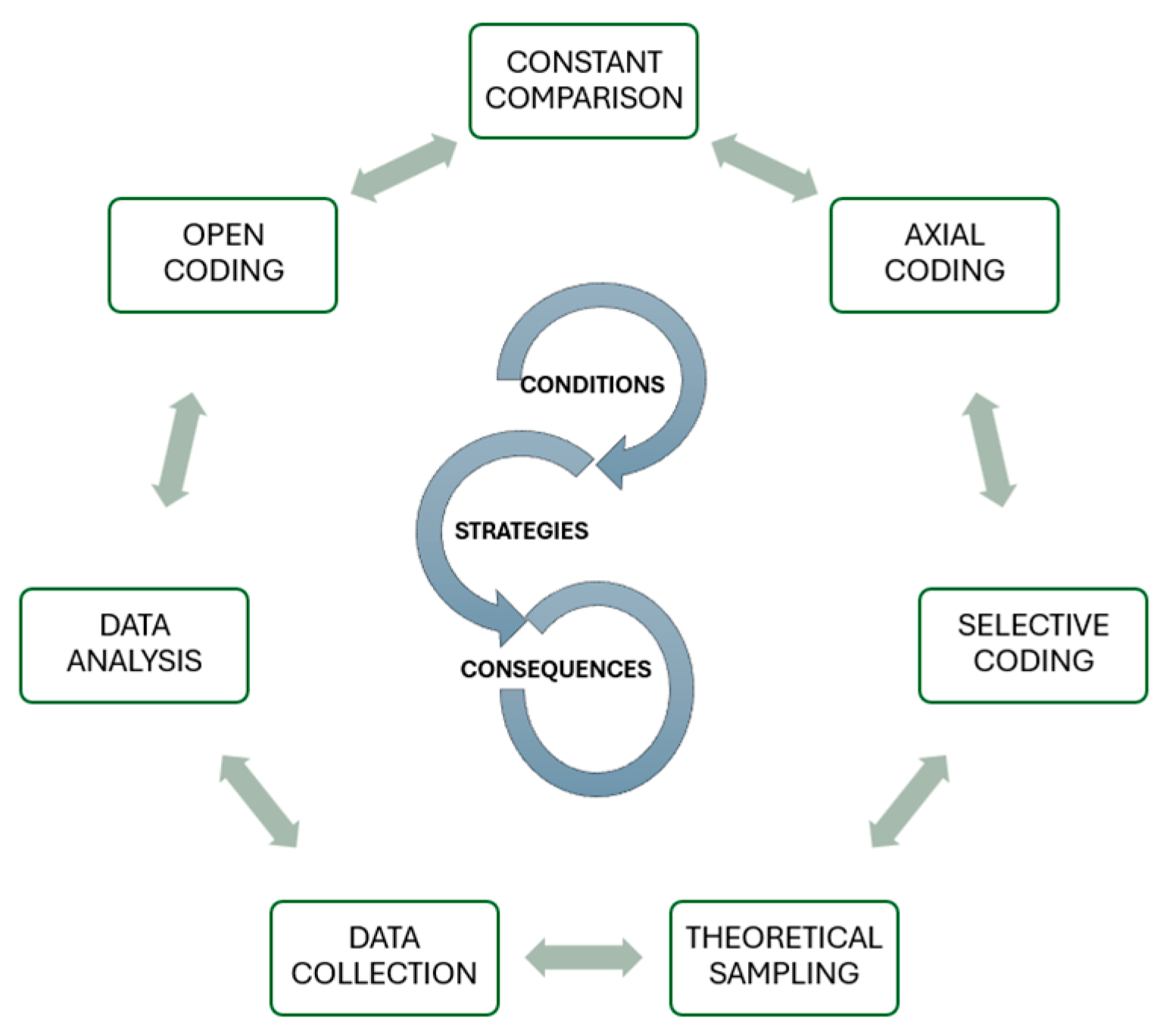
2.5. Data Analysis
2.6. Rigor
2.7. Ethical Considerations
3. Results
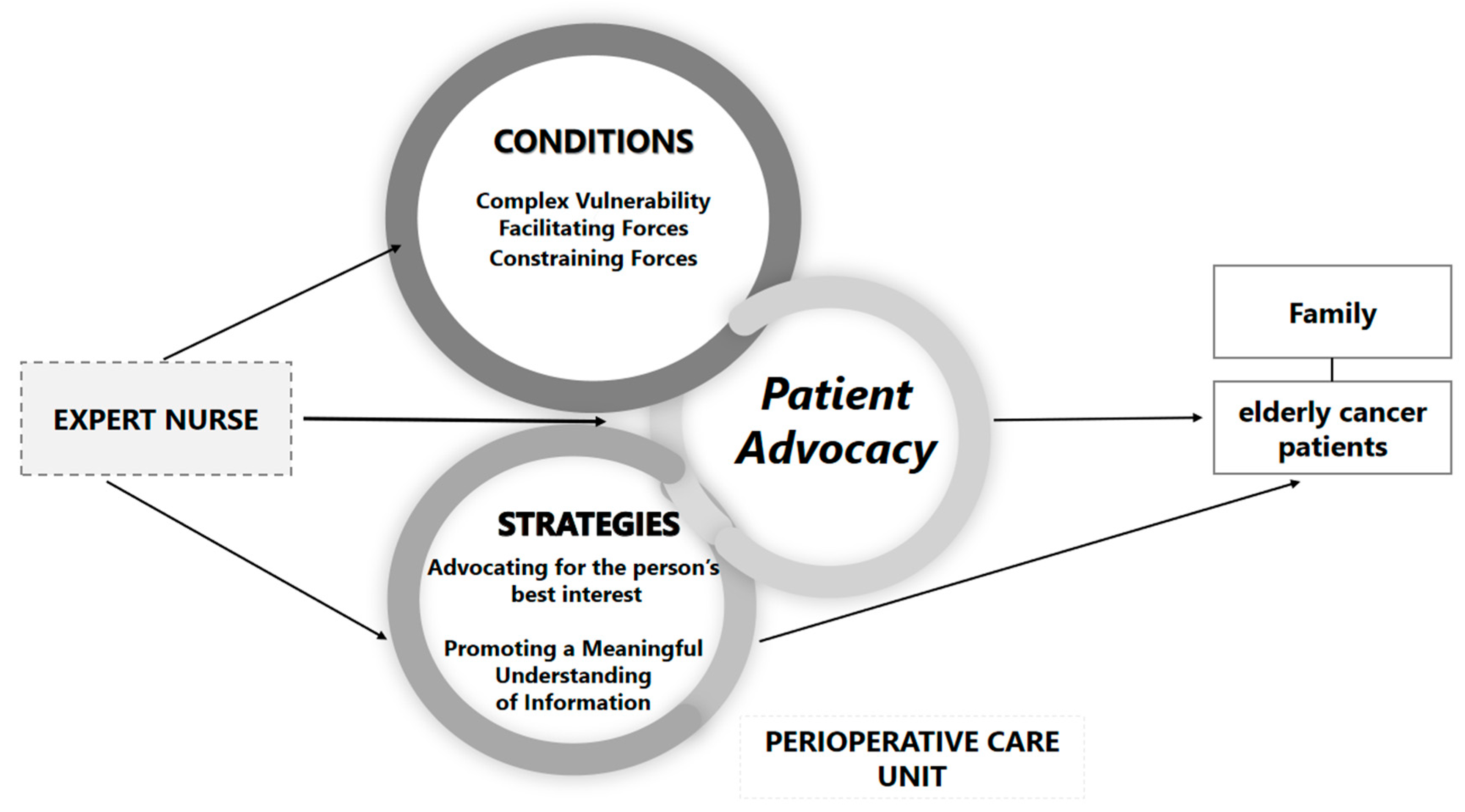
3.1. Conditions
- ➢
- Complex Vulnerability
“…the most specific oncology and perioperative care is a vulnerability in extremis… it is, and I think that is what makes the biggest difference, because we know that these are extremely vulnerable and sensitive people with low energy levels, autonomy, and ability to perform their daily activities, take care of themselves, and be comfortable…”(H1, Participant Nurse 1, ICU)
“The post-operative status of these patients always involves a very weak pain control… I don’t think it is very well controlled. It is poorly managed pain.”(H1, Participant Nurse 3, ICU)
“…situations of greater vulnerability, of deficiency, whether emotional or otherwise, it is multidimensional, they are situations of greater fragility, they are situations where we have to be more alert to advocate for that person.”(H1, Participant Nurse 4, ICU)
“…it would not be extreme to say that it is an attack on human dignity, but it places people in a situation of vulnerability and fragility, and we must protect their dignity as much as possible”(H1, Participant Nurse 4, ICU)
- ➢
- Facilitating Forces and Constraining Forces
“Here, the family has a lot of influence.”(H1, Participant Nurse 3, ICU)
“The family holds significant weight here. Visiting hours are very extended, they spend many hours here, and therefore, yes, the family holds significant weight here.”(H1, Participant Nurse 3, ICU)
“The clinical team speaks with the family member first; the family member then enters and stands beside the person, and often information is provided to them, that is, to the patien, and that information is validated with the family member.”(H1, Participant Nurse 4, ICU)
“…it interferes with their family dynamics, which is that some took care of their grandchildren and then no longer…”(H1, Participant Nurse 2, ICU)
“That was a failure to advocate, because I wanted to advocate, but I couldn’t! I didn’t have it… well, I just didn’t… going against it is very difficult, you know? When I say this, that we nurses do this, I know it’s difficult, attention…”(H1, Participant Nurse 1, ICU)
“…When we finish the course, our attention is very focused on technique, and advocating implies having effective management of technique, but also having this entire relational component and specific skills in communication, emotional management, and cognitive management; therefore, I think it is something complex.”(H1, Participant Nurse 4, ICU)
3.2. Strategies
- ➢
- Advocating for the person’s best interest
“I think that today, more than empowerment, I would say that advocacy in current times, they are two married concepts, has even more force! Because today’s patient is not the patient of 20 years ago; I think they are a much more empowered and much more autonomous patient, that is beyond any doubt.”(H1, Participant Nurse 1, ICU)
“To advocate is to defend that person’s best interest, or to try to understand whether that person is informed, whether they can make an informed decision, how they are emotionally, to understand their beliefs, to understand their values—that is, to try to look at that person from a more multidimensional perspective and in all their complexity.”(H1, Participant Nurse 1, ICU)
- ➢
- Promoting a Meaningful Understanding of Information
“…you have to read between the lines, there are some patients who completely delegate to their family!”(H1, Participant Nurse 2, ICU)
“…it is much easier to explain what might happen and for them to understand what will happen next, and for them to be much less frightened, and for the family to be much less frightened.”(H1, Participant Nurse 3, ICU)
“…but I felt it was a job well done.”(H1, Participant Nurse 2, ICU)
4. Discussion
5. Strengths and Limitations
6. Conclusions
Author Contributions
Funding
Institutional Review Board Statement
Informed Consent Statement
Data Availability Statement
Acknowledgments
Conflicts of Interest
Abbreviations
| GT | Grounded Theory |
| ICU | Intensive Care Unit |
References
- Pallis, A.G.; Fortpied, C.; Wedding, U.; Van Nes, M.C.; Penninckx, B.; Ring, A.; Lacombe, D.; Monfardini, S.; Scalliet, P.; Wildiers, H. EORTC elderly task force position paper: Approach to the older cancer patient. Eur. J. Cancer 2010, 46, 1502–1513. [Google Scholar] [CrossRef]
- Ramos, A.; Fonseca, C.; Pinho, L.; Lopes, M.; Brites, R.; Henriques, A. Assessment of Functioning in Older Adults Hospitalized in Long-Term Care in Portugal: Analysis of a Big Data. Front. Med. 2022, 9, 780364. [Google Scholar] [CrossRef]
- Fonseca, C.; Ramos, A.; Pinho, L.G.; Morgado, B.; Oliveira, H.; Lopes, M. Functional Profile of Older Adults Hospitalized in Rehabilitation Units of the National Network of Integrated Continuous Care of Portugal: A Longitudinal Study. J. Pers. Med. 2022, 12, 1937. [Google Scholar] [CrossRef]
- Fonseca, C.; Ramos, A.; Morgado, B.; Quaresma, P.; Garcia-Alonso, J.; Coelho, A.; Lopes, M. Long-term care units: A Portuguese study about the functional profile. Front. Aging 2023, 4, 1192718. [Google Scholar] [CrossRef]
- Sav, A.; McMillan, S.S.; Akosile, A. Burden of Treatment among Elderly Patients with Cancer: A Scoping Review. Healthcare 2021, 9, 612. [Google Scholar] [CrossRef]
- Pires, S.M.; Ramos, A.; Gomes, I. Exploring the emergent concept of patient advocacy in acute and perioperative settings: A scoping review. J. Caring Sci. 2025, 14, 93–101. [Google Scholar] [CrossRef]
- Sundqvist, A.S.; Nilsson, U.; Holmefur, M.; Anderzén-Carlsson, A. Promoting person-centred care in the perioperative setting through patient advocacy: An observational study. J. Clin. Nurs. 2018, 27, 2403–2415. [Google Scholar] [CrossRef]
- Abbasinia, M.; Ahmadi, F.; Kazemnejad, A. Patient advocacy in nursing: A concept analysis. Nurs. Ethics 2020, 27, 141–151. [Google Scholar] [CrossRef] [PubMed]
- Uçar, Ö.; Çelik, S.; Karahan, E.; Altıntaş, S.; Yücel, M. Exploring the relationship between spiritual care and patient advocacy of nurses from generations X, Y and Z working in intensive care clinics: A cross-sectional study. Intensive Crit. Care Nurs. 2024, 84, 103754. [Google Scholar] [CrossRef] [PubMed]
- Lam, A.B.; Sorensen, L.; Moore, V.A.; Bouvette, M.J.; Diaz Barba, A.; Clifton, S.; Wismann, A.; Keyser, K.; Shinall, M.C., Jr.; Nipp, R.D. Perioperative Supportive Care Interventions to Enhance Surgical Outcomes for Older Adults with Cancer: A Systematic Review. JCO Oncol. Pract. 2025, 21, 1106–1117. [Google Scholar] [CrossRef] [PubMed]
- Komatsu, H.; Komatsu, Y. The Role of Nurse on the Treatment Decision Support for Older People with Cancer: A Systematic Review. Healthcare 2023, 11, 546. [Google Scholar] [CrossRef]
- Nsiah, C.; Ninnoni, J.P.K.-A.; Siakwa, M.; Nsiah, F. Exploring the Implications of Patient Advocacy Outcomes among Practicing Nurses within the Hospital Context: A Qualitative Research. Open J. Nurs. 2023, 13, 855–874. [Google Scholar] [CrossRef]
- Alanezi, F.Z. Nurses’ attitude towards patient advocacy in a single tertiary care hospital. Nurs. Open 2022, 9, 2602–2607. [Google Scholar] [CrossRef] [PubMed]
- Tomaschewski-Barlem, J.G.; Lunardi, V.L.; Barlem, E.L.; da Silveira, R.S.; Ramos, A.M.; dos Santos, J.M. Actions of nurses in the exercise of patient advocacy: An integrative review. Texto Contexto Enferm. 2018, 27, e0730014. [Google Scholar] [CrossRef]
- Tíscar-González, V.; Gea-Sánchez, M.; Blanco-Blanco, J.; Moreno-Casbas, M.T.; Peter, E. The advocacy role of nurses in cardiopulmonary resuscitation. Nurs. Ethics 2020, 27, 333–347. [Google Scholar] [CrossRef]
- Vargas, C.P.; de Oliveira Vargas, M.A.; Tomaschewski-Barlem, J.G.; Ramos, F.R.; Schneider, D.G.; Camponogara, S. Patient advocacy actions by intensivist nurses. Rev. Esc. Enferm. USP 2019, 53, e03490. [Google Scholar] [CrossRef]
- Adjei, M.D.; Diji, A.K.; Oduro, E.; Bam, V.B.; Dzomeku, V.M.; Budu, I.H.; Lomotey, A.Y.; Sakyi, R.; Kyerew, A.A. Experiences of patient advocacy among nurses working in a resource constrained emergency department in Ghana. Int. Emerg. Nurs. 2023, 67, 101252. [Google Scholar] [CrossRef] [PubMed]
- Kurt, D.; Gurdogan, E.P. Professional autonomy and patient advocacy in nurses. Collegian 2023, 30, 327–334. [Google Scholar] [CrossRef]
- Guba, E.G.; Lincoln, Y.S. Competing paradigms in qualitative research. In Handbook of Qualitative Research; Denzin, N.K., Lincoln, Y.S., Eds.; Sage Publications: Thousand Oaks, CA, USA, 1994; pp. 105–117. [Google Scholar]
- Creswell, J.W.; Poth, C.N. Qualitative Inquiry and Research Design: Choosing Among Five Approaches, 4th ed.; Sage Publications: Thousand Oaks, CA, USA, 2018. [Google Scholar]
- Polit, D.F.; Beck, C.T. Nursing Research: Generating and Assessing Evidence for Nursing Practice, 11th ed.; Wolters Kluwer: Philadelphia, PA, USA, 2020. [Google Scholar]
- Denzin, N.K.; Lincoln, Y.S. The SAGE Handbook of Qualitative Research, 5th ed.; SAGE Publications: Thousand Oaks, CA, USA, 2018. [Google Scholar]
- Merriam, S.B.; Tisdell, E.J. Qualitative Research: A Guide to Design and Implementation, 4th ed.; Jossey-Bass: San Francisco, CA, USA, 2016. [Google Scholar]
- Charmaz, K. Constructing Grounded Theory: A Practical Guide Through Qualitative Analysis; SAGE Publications: Thousand Oaks, CA, USA, 2006. [Google Scholar]
- Strauss, A.; Corbin, J. Basics of Qualitative Research: Techniques and Procedures for Developing Grounded Theory, 4th ed.; SAGE Publications: Thousand Oaks, CA, USA, 2015. [Google Scholar]
- Alexis, O.; Cooke, J.; Shimumbi, L.; Worsley, A. The role of the nurse advocate in health and social care. Mediterr. Nurs. Midwifery 2022, 2, 140–146. [Google Scholar] [CrossRef]
- Ramos, A.; Pires, S.; Sá, E.; Gomes, I.; Alves, E.; Fonseca, C.; Coelho, A. A Cross-Sectional Study of the Perception of Individualized Nursing Care Among Nurses in Acute Medical and Perioperative Settings. Nurs. Rep. 2024, 14, 3191–3205. [Google Scholar] [CrossRef]
- Manoel, M.S.; da Rosa, F.S.; Peter, E.; da Silva Caram, C.; da Luz, K.R.; de Oliveira Vargas, M.A. Patient advocacy in valuing social and family being in times of COVID-19. Esc. Anna Nery 2023, 27, e20220373. [Google Scholar] [CrossRef]
- Aghaie, B.; Norouzadeh, R.; Sharifipour, E.; Koohpaei, A.; Negarandeh, R.; Abbasinia, M. The experiences of intensive care nurses in advocacy of COVID-19 patients. J. Patient Exp. 2021, 8, 23743735211056534. [Google Scholar] [CrossRef]
- Hanks, R.G.; Eloi, H.; Stafford, L. Understanding how advanced practice registered nurses function as patient advocates. Nurs Forum 2019, 54, 213–219. [Google Scholar] [CrossRef] [PubMed]
- Nsiah, C.; Siakwa, M.; Ninnoni, J.P.K. Registered Nurses’ description of patient advocacy in the clinical setting. Nurs. Open 2019, 6, 1124–1132. [Google Scholar] [CrossRef] [PubMed]
- Pitcher, C.; Slemon, A.; Danda, M. Reconceptualizing Advocacy: A Novel Model for Nursing Theory and Practice. Nurs. Inq. 2025, 32, e70036. [Google Scholar] [CrossRef]
- Çerçi, S.; Sevinç, E.; Uyurdağ, N.; Kasap, E.U. The effect of patient advocacy on professional values in nurses: A correlational study. BMC Nurs. 2025, 24, 838. [Google Scholar] [CrossRef] [PubMed]
- Ibrahim, A.M. Nurses’ ethical responsibilities: Whistleblowing and advocacy in patient safety. Nurs. Ethics 2024, 31, 1289–1314. [Google Scholar] [CrossRef]
- Alireza Arman, A.; Ghiyasvandian, S.; Dolatabadi, Z.A.; Khoshavi, M.; Yavari, A.; Zakerimoghadam, M. Preserving patient dignity in critical care units: A qualitative content analysis. Nurs. Pract. Today 2025, 12, 316–326. [Google Scholar] [CrossRef]

| Gender | Clinical Nurses (n = 6) |
|---|---|
| Male Female | 2 4 |
| Age | |
| 25–30 31–40 41–50 | 0 2 4 |
| Years of Professional Experience | |
| 1–10 11–20 21–30 | 0 3 3 |
| Professional Experience in the Field | |
| 6–10 11–22 | 5 1 |
| Postgraduate Education | |
| Master | 3 |
| Nursing Specialization | 4 |
| CONDITIONS | ||
| Open Coding | Axial Coding | Selective Coding |
| Vulnerability of the elderly Emotional burden of the disease Violation of human dignity Management of pain/suffering Polymedicated patients Memory/cognitive deficits Family support Family at the forefront of decision-making Flexible visiting hours Devaluation of the nurse’s opinion Surgeon’s opinion prevails Lack of communication Postgraduate specialization Team support | Physical, Emotional, and Cognitive Frailty Family as Anchor Family at the forefront Barriers of Professional Practice Facilitators of Professional Practice | Complex Vulnerability Facilitating Forces and Constraining Forces |
| STRATEGIES | ||
| Open Coding | Axial Coding | Selective Coding |
| Advocating for the person’s best interest Understanding the patient’s wishes Empowerment Informed decision-making Deconstructing complex information validating information link between classes information transmission maximizing protection drafting advance directives understanding drug metabolism | Knowing and Empowerment Deconstructing and Transmitting Information | Advocating for the person’s best interest Promoting a Meaningful Understanding of Information |
Disclaimer/Publisher’s Note: The statements, opinions and data contained in all publications are solely those of the individual author(s) and contributor(s) and not of MDPI and/or the editor(s). MDPI and/or the editor(s) disclaim responsibility for any injury to people or property resulting from any ideas, methods, instructions or products referred to in the content. |
© 2025 by the authors. Licensee MDPI, Basel, Switzerland. This article is an open access article distributed under the terms and conditions of the Creative Commons Attribution (CC BY) license (https://creativecommons.org/licenses/by/4.0/).
Share and Cite
Pires, S.M.; Gomes, I. Exploring the Conditions and Strategies That Lead Nurses to Advocate for Elderly Cancer Patients in the Perioperative Intensive Care Unit: A Qualitative Study. Healthcare 2025, 13, 2848. https://doi.org/10.3390/healthcare13222848
Pires SM, Gomes I. Exploring the Conditions and Strategies That Lead Nurses to Advocate for Elderly Cancer Patients in the Perioperative Intensive Care Unit: A Qualitative Study. Healthcare. 2025; 13(22):2848. https://doi.org/10.3390/healthcare13222848
Chicago/Turabian StylePires, Sara Morais, and Idalina Gomes. 2025. "Exploring the Conditions and Strategies That Lead Nurses to Advocate for Elderly Cancer Patients in the Perioperative Intensive Care Unit: A Qualitative Study" Healthcare 13, no. 22: 2848. https://doi.org/10.3390/healthcare13222848
APA StylePires, S. M., & Gomes, I. (2025). Exploring the Conditions and Strategies That Lead Nurses to Advocate for Elderly Cancer Patients in the Perioperative Intensive Care Unit: A Qualitative Study. Healthcare, 13(22), 2848. https://doi.org/10.3390/healthcare13222848


