Development of a Tool to Assess the Implementation and Perception of the Value-Based Healthcare Model: Our Results

 , , and
Abstract
1. Introduction
- (1)
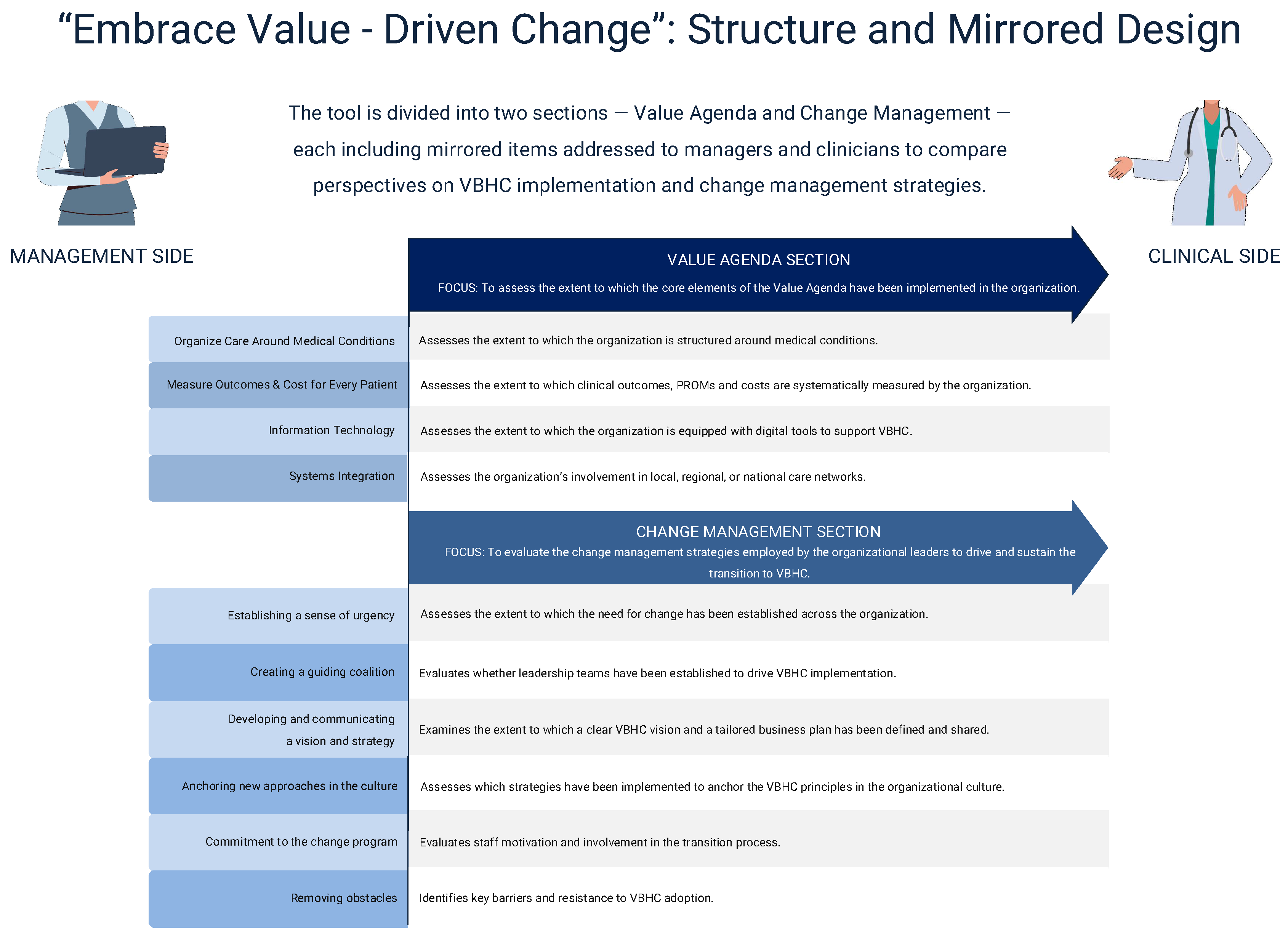
- To assess the extent to which the Value Agenda elements have been implemented within an organization, and
- (2)
- To evaluate the change management strategies employed by organizational leaders to drive and sustain the transition to VBHC.
2. Materials and Methods
2.1. Phase 1: Tool Development
2.2. Phase 2: Tool Validation
2.2.1. The Panel Members
2.2.2. Data Analysis and Definition of Consensus
- Central tendency and dispersion analysis;
- Consensus evaluation between rounds: To gauge agreement, we relied on the IQR, a non-parametric measure in which smaller values reflect tighter convergence of ratings and thus greater consensus. We complemented this with the Relative Interquartile Range (RIR), which expresses how dispersed the responses are in relation to the central tendency; it is computed as (IQR/Median) × 100, so lower RIR values indicate that judgments cluster more closely around the median. To assess how stable the panel’s views remained across rounds, we examined the Variation in the Coefficient of Variation (VCV), defined as the percentage change in the coefficient of variation (CV) from Round 1 to Round 2. The CV is calculated as (Standard Deviation/Mean) × 100, and VCV as ((CV_Round2 − CV_Round1)/CV_Round1) × 100. In this framework, smaller—and especially negative—VCV values signal that variability decreased over time, consistent with increasing stability of expert judgments across successive Delphi rounds.
- Reliability assessment using Cronbach’s alpha;
- Stability analysis of group responses through the median test and U test.
3. Results
3.1. Tool Development
3.2. Tool Validation
- Panel Participation
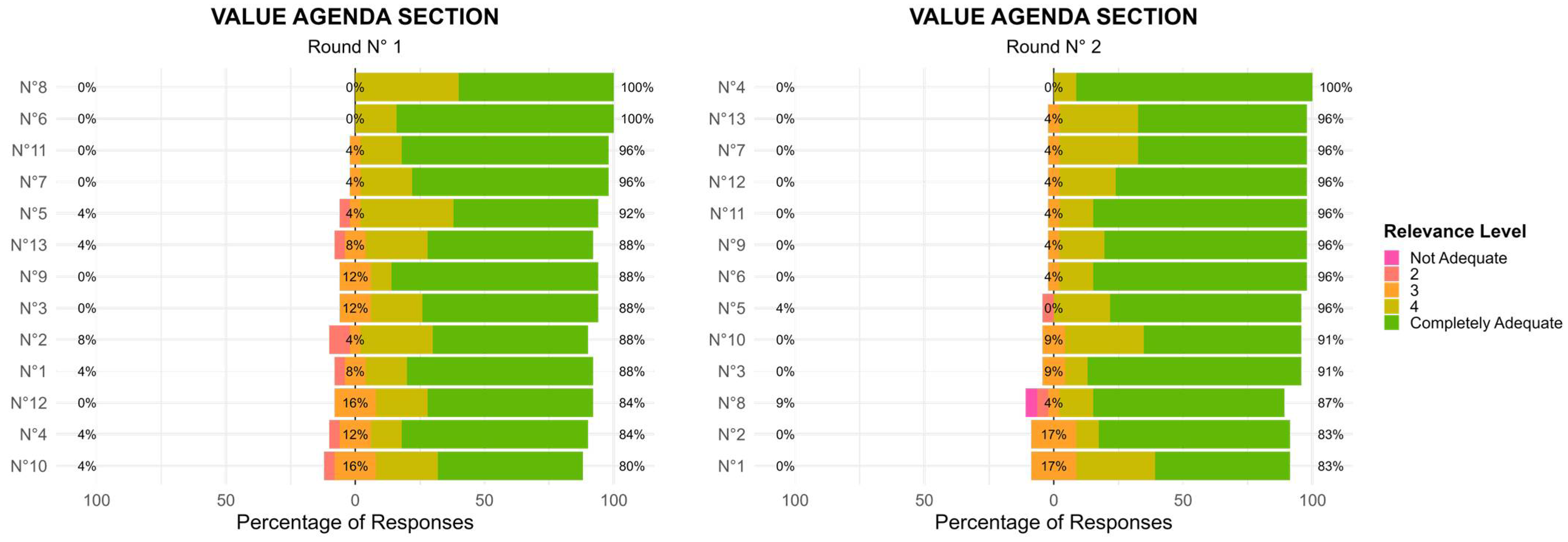
- Value Agenda Section
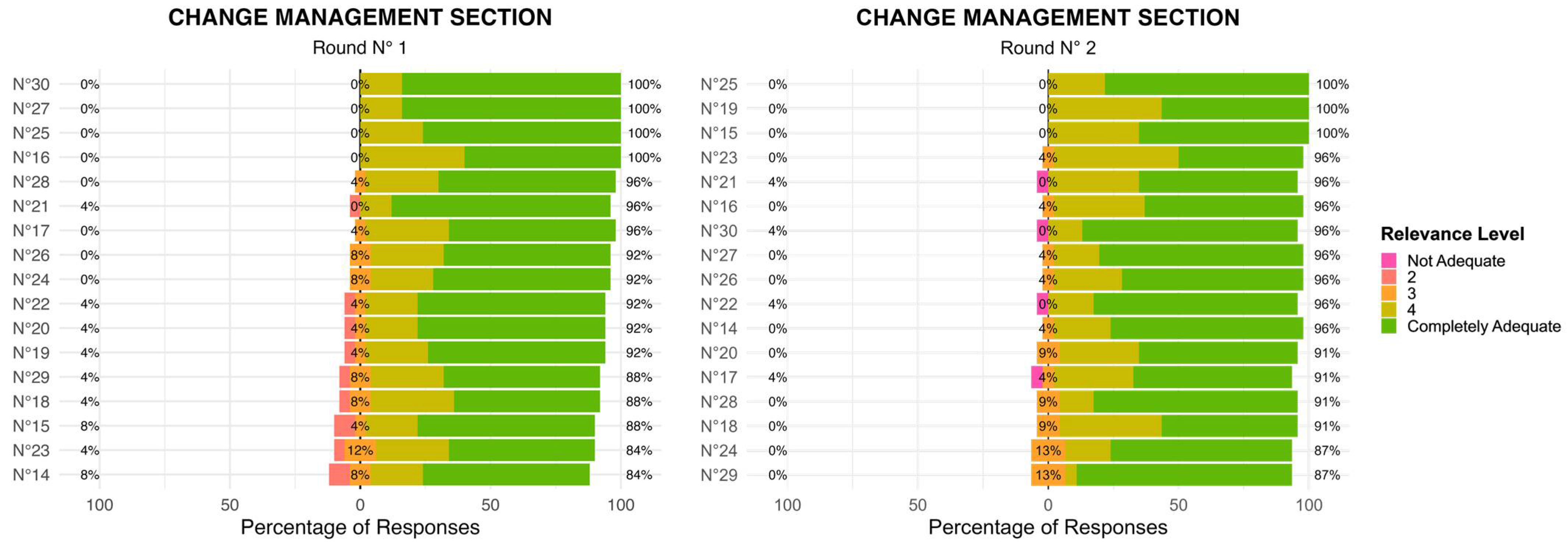
- Change Management Section
- Data Analysis
- ○
- Analysis of Consensus Level and Group Stability in Answers
- ○
- Questionnaire Validity and Reliability Analysis
- ○
- Independent Samples t-Test
4. Discussion
Limitations
5. Conclusions
Supplementary Materials
Author Contributions
Funding
Institutional Review Board Statement
Informed Consent Statement
Data Availability Statement
Conflicts of Interest
References
- Porter, M.E. What Is Value in Health Care? N. Engl. J. Med. 2010, 363, 2477–2481. [Google Scholar] [CrossRef]
- Porter, M.E.; Teisberg, E.O. Redefining Health Care: Creating Value-Based Competition on Results; Harvard Business School Press: Boston, MA, USA, 2006. [Google Scholar]
- Porter, M.E. Value-Based Health Care Delivery. Ann. Surg. 2008, 248, 503–509. [Google Scholar] [CrossRef] [PubMed]
- Plsek, P.E. Systematic Design of Healthcare Processes. Qual. Health Care 1997, 6, 40–48. [Google Scholar] [CrossRef] [PubMed]
- Gabutti, I.; Mascia, D.; Cicchetti, A. Exploring “Patient-Centered” Hospitals: A Systematic Review to Understand Change. BMC Health Serv. Res. 2017, 17, 364. [Google Scholar] [CrossRef]
- Coulson-Thomas, C. Re-Engineering Hospital and Healthcare Processes. Health Estate J. 1997, 51, 14–15. [Google Scholar] [PubMed]
- Porter, M.E.; Lee, T.H. Integrated Practice Units: A Playbook for Health Care Leaders. NEJM Catal. Innov. Care Deliv. 2021, 2. [Google Scholar] [CrossRef]
- Conrad, D.; Grembowski, D.; Gibbons, C.; Marcus-Smith, M.; Hernandez, S.; Chang, J.; Renz, A.; Lau, B.; dela Cruz, E. A Report On Eight Early-Stage State And Regional Projects Testing Value-Based Payment. Health Aff. 2013, 32, 998–1006. [Google Scholar] [CrossRef]
- De Mattia, E.; Angioletti, C.; D’Agostino, M.; Paoletti, F.; de Belvis, A.G. Moving from Principles to Practice: A Scoping Review of Value-Based Healthcare (VBHC) Implementation Strategies. Healthcare 2024, 12, 2457. [Google Scholar] [CrossRef]
- Porter, M.; Lee, T. The Strategy That Will Fix Health Care. Harv. Bus. Rev. 2013, 91, 50–70. [Google Scholar]
- Gallani, S.; Witkowski, M.; Corsi, E.; Jonsson, N. Transforming Healthcare Delivery at Karolinska University Hospital. Available online: https://www.hbs.edu/faculty/Pages/item.aspx?num=65111 (accessed on 5 November 2025).
- EIT Health. Implementing Value-Based Health Care in Europe: Handbook for Pioneers; EIT Health: Munich, Germany, 2020. [Google Scholar]
- Ramos, P.; Savage, C.; Thor, J.; Atun, R.; Carlsson, K.S.; Makdisse, M.; Neto, M.C.; Klajner, S.; Parini, P.; Mazzocato, P. It Takes Two to Dance the VBHC Tango: A Multiple Case Study of the Adoption of Value-Based Strategies in Sweden and Brazil. Soc. Sci. Med. 2021, 282, 114145. [Google Scholar] [CrossRef]
- Van Staalduinen, D.J.; Van Den Bekerom, P.; Groeneveld, S.; Kidanemariam, M.; Stiggelbout, A.M.; Van Den Akker-van Marle, M.E. The Implementation of Value-Based Healthcare: A Scoping Review. BMC Health Serv. Res. 2022, 22, 270. [Google Scholar] [CrossRef] [PubMed]
- Van der Nat, P.B. The New Strategic Agenda for Value Transformation. Health Serv. Manag. Res. 2022, 35, 189–193. [Google Scholar] [CrossRef]
- Kotter, J.P. Leading Change; Harvard Business Review Press: Brighton, MA, USA, 2012. [Google Scholar]
- Coetsee, L. From Resistance to Commitment. Public. Adm. Q. 1999, 23, 204–222. [Google Scholar]
- Weiner, B.J.; Amick, H.; Lee, S.-Y.D. Conceptualization and Measurement of Organizational Readiness for Change: A Review of the Literature in Health Services Research and Other Fields. Med. Care Res. Rev. 2008, 65, 379–436. [Google Scholar] [CrossRef] [PubMed]
- Kotter, J.P. Leading Change; Harvard Business Press: Boston, MA, USA, 1996. [Google Scholar]
- Ramos, P. The Adoption, Adaptation, and Abandonment of Value-Based Health Care. Ph.D. Thesis, Karolinska Institutet, Stockholm, Sweden, 2023. [Google Scholar]
- Mengual-Andrés, S.; Roig-Vila, R.; Mira, J.B. Delphi Study for the Design and Validation of a Questionnaire about Digital Competences in Higher Education. Int. J. Educ. Technol. High. Educ. 2016, 13, 12. [Google Scholar] [CrossRef]
- Keswani, A.; Koenig, K.; Bozic, K. Value-Based Healthcare: Part 1-Designing and Implementing Integrated Practice Units for the Management of Musculoskeletal Disease. Clin. Orthop. Relat. Res. 2016, 474, 2100–2103. [Google Scholar] [CrossRef]
- Conrad, D.; Vaughn, M.; Grembowski, D.; Marcus-Smith, M. Implementing Value-Based Payment Reform: A Conceptual Framework and Case Examples. Med. Care Res. Rev. 2016, 73, 437–457. [Google Scholar] [CrossRef]
- Steinmann, G.; Daniels, K.; Mieris, F.; Delnoij, D.; van de Bovenkamp, H.; van Der Nat, P. Redesigning Value-Based Hospital Structures: A Qualitative Study on Value-Based Health Care in the Netherlands. BMC Health Serv. Res. 2022, 22, 1193. [Google Scholar] [CrossRef]
- Van Veghel, D.; Soliman-Hamad, M.; Schulz, D.; Cost, B.; Simmers, T.; Dekker, L. Improving Clinical Outcomes and Patient Satisfaction among Patients with Coronary Artery Disease: An Example of Enhancing Regional Integration between a Cardiac Centre and a Referring Hospital. BMC Health Serv. Res. 2020, 20, 494. [Google Scholar] [CrossRef]
- Goretti, G.; Marinari, G.; Vanni, E.; Ferrari, C. Value-Based Healthcare and Enhanced Recovery After Surgery Implementation in a High-Volume Bariatric Center in Italy. Obes. Surg. 2020, 30, 2519–2527. [Google Scholar] [CrossRef]
- Phillips, R.; Cyr, J.; Keaney, J.; Messina, L.; Meyer, T.; Tam, S.; Korenda, K.; Darrigo, M.; Kumar, P.; Challapalli, S. Creating and Maintaining a Successful Service Line in an Academic Medical Center at the Dawn of Value-Based Care: Lessons Learned From the Heart and Vascular Service Line at UMass Memorial Health Care. Acad. Med. 2015, 90, 1340–1346. [Google Scholar] [CrossRef]
- Zipfel, N.; Van Der Nat, P.B.; Rensing, B.J.W.M.; Daeter, E.J.; Westert, G.P.; Groenewoud, A.S. The Implementation of Change Model Adds Value to Value-Based Healthcare: A Qualitative Study. BMC Health Serv. Res. 2019, 19, 643. [Google Scholar] [CrossRef] [PubMed]
- Nilsson, K.; Baathe, F.; Andersson, A.; Sandoff, M. Value-Based Healthcare as a Trigger for Improvement Initiatives. Leadersh. Health Serv. 2017, 30, 364–377. [Google Scholar] [CrossRef] [PubMed]
- Angioletti, C.; de Mattia, E.; Carloni, L.M.; Morsella, A.; Fabi, A.; Orlandi, A.; Tortora, G.; de Belvis, A.G. Definition of a Tool to Assess Shared Decision-Making (SDM) on Women with Breast Cancer: A Value-Based Approach. Health Sci. Rep. 2022, 5, e817. [Google Scholar] [CrossRef] [PubMed]
- Randazzo, G.; Brown, Z. Transitioning from Volume to Value: A Strategic Approach to Design and Implementation. Nurs. Adm. Q. 2016, 40, 130–136. [Google Scholar] [CrossRef]
- Nilsson, K.; Baathe, F.; Andersson, A.; Sandoff, M. The Need to Succeed—Learning Experiences Resulting from the Implementation of Value-Based Healthcare. Leadersh. Health Serv. 2018, 31, 2–16. [Google Scholar] [CrossRef]
- Daniels, K.; van der Voort, M.; Biesma, D.; van der Nat, P. Five Years’ Experience with Value-Based Quality Improvement Teams: The Key Factors to a Successful Implementation in Hospital Care. BMC Health Serv. Res. 2022, 22, 1271. [Google Scholar] [CrossRef]
- Gray, C.F.; Parvataneni, H.K.; Bozic, K.J. Value-Based Healthcare: “Physician Activation”: Healthcare Transformation Requires Physician Engagement and Leadership. Clin. Orthop. Relat. Res. 2020, 478, 954–957. [Google Scholar] [CrossRef]
- Nilsson, K.; Baathe, F.; Andersson, A.; Wikstrom, E.; Sandoff, M. Experiences from Implementing Value-Based Healthcare at a Swedish University Hospital—A Longitudinal Interview Study. BMC Health Serv. Res. 2017, 17, 169. [Google Scholar] [CrossRef]
- Van der Nat, P.; van Veghel, D.; Daeter, E.; Crijns, H.; Koolen, J.; Houterman, S.; Soliman, M.; de Mol, B. Meetbaar Beter Study Grp Insights on Value-Based Healthcare Implementation from Dutch Heart Care. Int. J. Healthc. Manag. 2020, 13, 189–192. [Google Scholar] [CrossRef]
- Van Veghel, H.; Dekker, L.; Theunissen, L.; Janssen, J.; Burg, M.; Huijbers, P.; Voermans, P.; van der Wees, P.; Cremers, H. Introducing a Method for Implementing Value Based Health Care Principles in the Full Cycle of Care: Using Atrial Fibrillation as a Proof of Concept. Int. J. Healthc. Manag. 2022, 15, e009054. [Google Scholar] [CrossRef]
- Lansdaal, D.; van Nassau, F.; van der Steen, M.; de Bruijne, M.; Smeulers, M. Lessons Learned on the Experienced Facilitators and Barriers of Implementing a Tailored VBHC Model in a Dutch University Hospital from a Perspective of Physicians and Nurses. BMJ Open 2022, 12, e051764. [Google Scholar] [CrossRef]
- Van Veghel, D.; Daeter, E.; Bax, M.; Amoroso, G.; Blaauw, Y.; Camaro, C.; Cummins, P.; Halfwerk, F.; Hamer, I.; de Jong, J.; et al. Organization of Outcome-Based Quality Improvement in Dutch Heart Centres. Eur. Heart J. Qual. CARE Clin. Outcomes 2020, 6, 49–54. [Google Scholar] [CrossRef]
- Chatfield, J.; Longenecker, C.; Fink, L.; Gold, J. Ten CEO Imperatives for Healthcare Transformation: Lessons from Top-Performing Academic Medical Centers. J. Healthc. Manag. 2017, 62, 371–383. [Google Scholar] [CrossRef] [PubMed]
- Collden, C.; Hellstrom, A. Value-Based Healthcare Translated: A Complementary View of Implementation. BMC Health Serv. Res. 2018, 18, 681. [Google Scholar] [CrossRef]
- Kaplan, R.S. Improving Value with TDABC. Healthc. Financ. Manag. 2014, 68, 76–83. [Google Scholar]
- Hurh, J.; Ko, Y.; Lee, S. Value-Based Healthcare: Prerequisites and Suggestions for Full-Fledged Implementation in the Republic of Korea. J. Korean Med. Assoc. 2017, 60, 826–840. [Google Scholar] [CrossRef]
- De Vries, E.; Drewes, H.; Struijs, J.; Heijink, R.; Baan, C. Barriers to Payment Reform: Experiences from Nine Dutch Population Health Management Sites. Health Policy 2019, 123, 1100–1107. [Google Scholar] [CrossRef] [PubMed]
- Griffiths, E.; Odelade, O.; Gostkorzewicz, J.; Cordero, L. Demonstrating Proof of Concept for Value-Based Agreements in Europe: Two Real-World Cases. Int. J. Technol. Assess. Health Care 2023, 39, e30. [Google Scholar] [CrossRef]
- Conrad, D.; Grembowski, D.; Hernandez, S.; Lau, B.; Marcus-Smith, M. Emerging Lessons from Regional and State Innovation in Value-Based Payment Reform: Balancing Collaboration and Disruptive Innovation. Milbank Q. 2014, 92, 568–623. [Google Scholar] [CrossRef]
- Kissam, S.; Beil, H.; Cousart, C.; Greenwald, L.; Lloyd, J. States Encouraging Value-Based Payment: Lessons from CMS’s State Innovation Models Initiative. Milbank Q. 2019, 97, 506–542. [Google Scholar] [CrossRef]
- Leao, D.L.L.; Cremers, H.-P.; Van Veghel, D.; Pavlova, M.; Hafkamp, F.J.; Groot, W.N.J. Facilitating and Inhibiting Factors in the Design, Implementation, and Applicability of Value-Based Payment Models: A Systematic Literature Review. Med. Care Res. Rev. 2023, 80, 467–483. [Google Scholar] [CrossRef] [PubMed]
- Ng, S. A Qualitative Study on Relationships and Perceptions between Managers and Clinicians and Its Effect on Value-Based Healthcare within the National Health Service in the UK. Health Serv. Manag. Res. 2022, 35, 251–258. [Google Scholar] [CrossRef] [PubMed]
- Theunissen, L.; Cremers, H.-P.; Dekker, L.; Janssen, H.; Burg, M.; Huijbers, E.; Voermans, P.; Kemps, H.; Van Veghel, D. Implementing Value-Based Health Care Principles in the Full Cycle of Care: The Pragmatic Evolution of the Netherlands Heart Network. Circ. Cardiovasc. Qual. Outcomes 2023, 16, e009054. [Google Scholar] [CrossRef]
- Stefánsdóttir, N.T.; Nilsen, P.; Lindstroem, M.B.; Andersen, O.; Powell, B.J.; Tjørnhøj-Thomsen, T.; Kirk, J.W. Implementing a New Emergency Department: A Qualitative Study of Health Professionals’ Change Responses and Perceptions. BMC Health Serv. Res. 2022, 22, 447. [Google Scholar] [CrossRef]
- Shea, C.M.; Jacobs, S.R.; Esserman, D.A.; Bruce, K.; Weiner, B.J. Organizational Readiness for Implementing Change: A Psychometric Assessment of a New Measure. Implement. Sci. 2014, 9, 7. [Google Scholar] [CrossRef]
- Chaganty, S.S.; Walter, H.; Smith, F.; Sharma, H. Evaluating Patient and Neurosurgeon Perspectives on Virtualisation of Neurosurgery Clinics in the COVID-19 Era: A Prospective Mirror Survey Study. Br. J. Neurosurg. 2023, 37, 142–147. [Google Scholar] [CrossRef]
- De Mattia, E.; Angioletti, C.; Perilli, A.; Guajardo Rios, L.S.; Garganese, G.; Tagliaferri, L.; Scambia, G.; Fragomeni, S.M.; de Belvis, A.G. Gov➔Value: How to Combine Reported Quality Experiences and Patient-Reported Outcome Measures. First Results on Vulvar Cancer Patients in an Italian Research Hospital. Front. Public Health 2022, 10, 1014651. [Google Scholar] [CrossRef]
- Gimenez, L.; Kelly-Irving, M.; Delpierre, C.; Rougé-Bugat, M.-E.; Lepage, B.; Lang, T. Interaction between Patient and General Practitioner According to the Patient Body Weight: A Cross-Sectional Survey. Fam. Pract. 2023, 40, 218–225. [Google Scholar] [CrossRef]
- Kirren, Q.; Daste, C.; Foissac, F.; Abdoul, H.; Alami, S.; Carrier, M.-E.; Kwakkenbos, L.; Lefèvre-Colau, M.-M.; Rannou, F.; Papelard, A.; et al. Differences in Disability Perception in Systemic Sclerosis: A Mirror Survey of Patients and Health Care Providers. J. Clin. Med. 2023, 12, 1359. [Google Scholar] [CrossRef] [PubMed]
- Westerink, H.J.; Steinmann, G.; Koomans, M.; van der Kemp, M.H.; van der Nat, P.B. Value-Based Healthcare Implementation in the Netherlands: A Quantitative Analysis of Multidisciplinary Team Performance. BMC Health Serv. Res. 2024, 24, 224. [Google Scholar] [CrossRef] [PubMed]
- Sirkin, H.; Keenan, P.; Jackson, A. The Hard Side of Change Management. Harv. Bus. Rev. 2005, 83, 108–118, 158. [Google Scholar] [CrossRef] [PubMed]
- Donohoe, H.M.; Needham, R.D. Moving Best Practice Forward: Delphi Characteristics, Advantages, Potential Problems, and Solutions. Int. J. Tour. Res. 2009, 11, 415–437. [Google Scholar] [CrossRef]



| Round 1 | Round 2 | |||
|---|---|---|---|---|
| Gender | n | % | n | % |
| Female | 14 | 56% | 12 | 52% |
| Male | 11 | 44% | 11 | 48% |
| Country or region | n | % | n | % |
| Italy | 18 | 72% | 17 | 74% |
| The Netherlands | 2 | 8% | 2 | 9% |
| Brazil | 2 | 8% | 1 | 4% |
| Belgium | 1 | 4% | 1 | 4% |
| UK | 1 | 4% | 1 | 4% |
| Saudi Alaskar | 1 | 4% | 1 | 4% |
| Job title | n | % | n | % |
| Researcher | 8 | 32% | 6 | 26% |
| Medical Doctor | 9 | 36% | 9 | 39% |
| Manager | 5 | 20% | 5 | 22% |
| Professor | 3 | 12% | 3 | 13% |
| Sub Area | Items | Prospective | Prospective | Answers | Sources |
|---|---|---|---|---|---|
| Value agenda section Evidence highlights that many organizations do not adopt the VBHC model as an integrated strategy; instead, they implement only selected elements that best align with their organizational structure. This partial approach hinders the model’s effectiveness, preventing the creation of a care system that maximizes value for the patient. Therefore, this section aims to explore which structural VBHC elements have been adopted by the organization and to what extent. | |||||
| Organize Care Around Medical Conditions | 1 | To what extent is care delivery in your hospital organized around medical conditions? | To what extent is care delivery in your hospital organized around medical conditions? |
| [10,15,22,23,24,25,26,27,28,29] |
| 2 | To what extent does the hospital structurally involve patients and/or caregivers in the condition-based teams? | To what extent does the hospital structurally involve patients and/or caregivers in the condition-based teams? |
| [15,30] | |
| 3 | To what extent is the hospital equipped with support staff to assist condition-based teams in delivering care and continuously improving their quality of care delivery? (e.g., Data Analysts, Project Leaders, Care/case Managers, Clinical Coordinators, Quality Improvement Specialists, Patient Navigators) | To what extent is the hospital equipped with support staff to assist you and your team in delivering care and continuously improving quality of care delivery? (e.g., Data Analysts, Project Leaders, Care/case Managers, Clinical Coordinators, Quality Improvement Specialists, Patient Navigators) |
| [15,24,29,31,32,33] | |
| Measure Outcomes & Cost for Every Patient | 4 | To what extent does the hospital systematically measure clinical and patient reported outcomes? | To what extent does the hospital systematically measure clinical and patient reported outcomes? |
| [10,15,23,24,25,26,31,32,33,34,35,36,37,38,39,40,41] |
| 5 | If so, which of the following measures are used? (Select all that apply) | If so, which of the following measures are used? (Select all that apply) |
| [10,15] | |
| 6 | If so, to what extent does this clinical performance measurement system integrated in mechanisms for Audit & Feedback? | If so, To what extent does this clinical performance measurement system integrated in mechanisms for Audit & Feedback? |
| [15,25,37] | |
| 7 | If so, at the end each audit meeting, to what extent are these improvement actions defined and shared, along with their respective responsible actors/figures and implementation timelines? | If so, at the end of each audit meeting, to what extent are these improvement actions defined and shared, along with their respective responsible actors/figures and implementation timelines? |
| [25,37] | |
| 8 | To what extent are the results of these analyses (PREMS, PROMs and clinical outcomes) shared with the patients and/or caregivers? | To what extent are the results of these analyses (PREMS, PROMs and clinical outcomes) shared with the patients and/or caregivers? |
| [15] | |
| 9 | To what extent does the hospital have a planning and control system capable of monitoring the costs of care delivery in condition-based teams? | To what extent does the hospital have a planning and control system capable of monitoring the costs of care delivery in condition-based teams? |
| [42] | |
| 10 | If so, what type of cost accounting is used? (Select all that apply) | If so, what type of cost accounting is used? (Select all that apply) |
| [42] | |
| Information Technology | 11 | To what extent does the hospital have an Electronic Medical Record (EMR) system? | To what extent does the hospital have an Electronic Medical Record (EMR) system? |
| [8,10,23,31,32,33,35,43,44,45,46] |
| 12 | To what extent is the hospital equipped with digital platforms (dashboard/app, etc.) that support clinicians by collecting outcome data in real time? | To what extent is the hospital equipped with digital platforms (dashboard/app, etc.) that support clinicians by collecting outcomes outcome data in real time? |
| [30,45,47] | |
| Systems Integration | 13 | To what extent is the hospital actively involved in local, regional or national networks aimed at developing condition-based care models across a network of facilities? | To what extent is the hospital actively involved in local, regional or national networks aimed at developing integrated care models across a network of facilities? |
| [10,23,24,25,37] |
| Change management section Implementing VBHC principles within hospital dynamics require structural changes and, more importantly, cultural transformations. Indeed, for the principles of this theory to become more than just another innovation proposed within the healthcare sector and truly take root within hospital dynamics, it is essential that healthcare professionals understand and support them, and become the leading actors in this transition process. Therefore, this section aims to answer the following questions: what change management strategies did top management employ to facilitate the transition to the VBHC model? | |||||
| Establishing a sense of urgency | 14 | To what extent did your organization establish a sense of urgency to implement the principles of VBHC? | To what extent did your organization establish a sense of urgency to implement the principles of VBHC? |
| [16,23,43,44,46,48] |
| 15 | If so, which of the following factors push up the urgency level? (Select all that apply) | If so, which of the following factors push up the urgency level? (Select all that apply) |
| [16,23,43,45,46,48] | |
| Creating a guiding coalition | 16 | To what extent was a formal group of people—representatives from clinical and managerial teams—brought together to drive the implementation of VBHC? | To what extent was a formal group of people—representatives from clinical and managerial teams—brought together to drive the implementation of VBHC? |
| [14,16,25,27,28,32,33,37,38,39,40,41,49,50] |
| Developing and communicating a vision and strategy | 17 | To what extent has an official vision for VBHC (“a future-oriented perspective that emphasizes the reasons why you should strive to create that future”) been established within the hospital? | To what extent has an official vision for VBHC (“a future-oriented perspective that emphasizes the reasons why you should strive to create that future”) been established within the hospital? |
| [16,27,29,32,40,41] |
| 18 | If so, which of the following activities have been conducted to promote and disseminate the VBHC vision within the hospital? (Select all that apply) | If so, which of the following activities have been conducted to promote and disseminate the VBHC vision within the hospital? (Select all that apply) |
| [16,27,29,32,40,41] | |
| 19 | To what extent has a tailored business plan (“a detailed document that outlines your hospital’s goals on VBHC, the strategy for achieving them, and the resources required”) been developed to provide a clear, structured, goal-oriented process? | To what extent has a tailored business plan (“a detailed document that outlines your hospital’s goals on VBHC, the strategy for achieving them, and the resources required”) been developed to provide a clear, structured, and goal-oriented process? |
| [16,24,28,33,40,41] | |
| 20 | To what extent are members of the organization regularly updated on the progress of the VBHC plan over time? | To what extent are you informed about the progress of such VBHC plan over time? |
| [14,16,26,31,32,37,40,50] | |
| Anchoring new approaches in the culture | 21 | To what extent have educational initiatives been organized for employees of the organization on the VBHC principles? | To what extent have educational initiatives been organized for you on the VBHC principles? |
| [14,16,24,27,31,32,33,34,39,40] |
| 22 | If so, which of the following educational initiatives have been used? (Select all that apply) | If so, which of the following educational initiatives have been used? (Select all that apply) |
| [14,16,24,27,31,32,33,39,40] | |
| 23 | To what extent has the organization involved the key internal stakeholders (e.g., employees, management teams, clinical staff) in the change process? | To what extent do you feel involved in the change process? |
| [16,24,26,31,32,35,40,50] | |
| 24 | To what extent do employees have the time to work on VBHC activities and anchor changes into their daily work? | To what extent do you have the time to work on VBHC activities and anchor changes into your daily work? |
| [16,28,32,33,37,38] | |
| Commitment to the change program | 25 | To what extent do you believe that the changes introduced by the VBHC model will be your way of delivering care in the long term? | To what extent do you believe that the changes introduced by the VBHC model will be your way of delivering care in the long term? |
| [16,29,32,38] |
| 26 | Which of the following strategies was utilized to support the commitment toward VBHC of the employees within the hospital? (Select all that apply) | Which of the following strategies have been utilized to support your commitment toward VBHC? (Select all that apply) |
| [16,17,51] | |
| 27 | How would you describe the current level of commitment of the employees of the organization? | How would you describe your current level of commitment? |
| [8,14,16,24,25,27,28,32,33,35,37,38,39,40,41,49,50,51,52] | |
| 28 | To what extent have initial successes or challenges/failures, during the change process toward VBHC, impact the level of commitment among the members of the organization? | To what extent have initial successes or challenges/failures, during the change process toward VBHC, impact your level of commitment? |
| [16,29,32,38] | |
| 29 | Which strategies have been implemented to maintain engagement and motivation of the employees of the organization after facing challenges, failures, or initial successes in implementing VBHC? (Select all that apply) | Which strategies have helped maintain your engagement and motivation after facing challenges, failures, or initial successes in implementing VBHC? (Select all that apply) |
| [16,29,32,38] | |
| Removing obstacles | 30 | Which were the main obstacles you encountered during the implementation of VBHC? (Select all that apply) | Which were the main obstacles you encountered during the implementation of VBHC? (Select all that apply) |
| [16] |
Disclaimer/Publisher’s Note: The statements, opinions and data contained in all publications are solely those of the individual author(s) and contributor(s) and not of MDPI and/or the editor(s). MDPI and/or the editor(s) disclaim responsibility for any injury to people or property resulting from any ideas, methods, instructions or products referred to in the content. |
© 2025 by the authors. Licensee MDPI, Basel, Switzerland. This article is an open access article distributed under the terms and conditions of the Creative Commons Attribution (CC BY) license (https://creativecommons.org/licenses/by/4.0/).
Share and Cite
de Mattia, E.; van Staalduinen, D.; Valentini, I.; van der Nat, P.B.; de Belvis, A.G. Development of a Tool to Assess the Implementation and Perception of the Value-Based Healthcare Model: Our Results. Healthcare 2025, 13, 2849. https://doi.org/10.3390/healthcare13222849
de Mattia E, van Staalduinen D, Valentini I, van der Nat PB, de Belvis AG. Development of a Tool to Assess the Implementation and Perception of the Value-Based Healthcare Model: Our Results. Healthcare. 2025; 13(22):2849. https://doi.org/10.3390/healthcare13222849
Chicago/Turabian Stylede Mattia, Egidio, Dorine van Staalduinen, Ilaria Valentini, Paul B van der Nat, and Antonio Giulio de Belvis. 2025. "Development of a Tool to Assess the Implementation and Perception of the Value-Based Healthcare Model: Our Results" Healthcare 13, no. 22: 2849. https://doi.org/10.3390/healthcare13222849
APA Stylede Mattia, E., van Staalduinen, D., Valentini, I., van der Nat, P. B., & de Belvis, A. G. (2025). Development of a Tool to Assess the Implementation and Perception of the Value-Based Healthcare Model: Our Results. Healthcare, 13(22), 2849. https://doi.org/10.3390/healthcare13222849