Indicators for Intellectual Disability Where No Formal Diagnosis Exists but Nursing Knowledge Demonstrates Grounds for a Formal Assessment: A Scoping Review
 , , , and
Abstract
1. Introduction
2. Materials and Methods
2.1. Identifying the Research Question
2.2. Identifying Relevant Studies
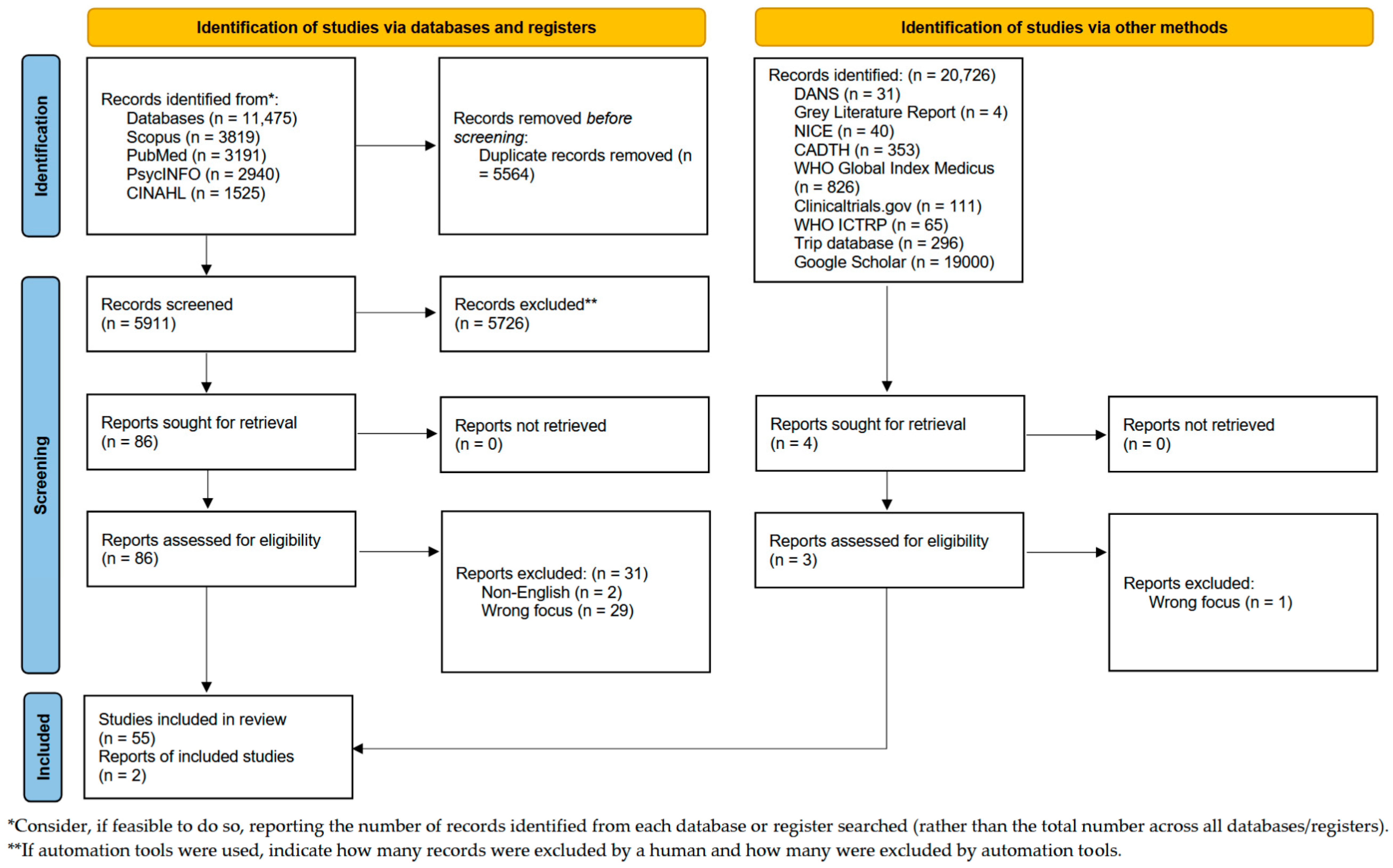
2.3. Selecting Studies
2.4. Charting the Data
2.5. Collating, Summarising, and Reporting the Results
2.6. Consulting with Stakeholders

| Author, Year, Country | Methodology | Aim/Objectives | Key Findings | Indicators Identified |
|---|---|---|---|---|
| [25] Ali and Galloway (2016) UK | Literature review. | To outline and report on the initial development of a screening tool for offenders with suspected intellectual disability (ID) known as the rapid assessment of potential intellectual disability (RAPID). | All indicated the tool to be an effective way of identifying ID and vulnerability and allowed professionals to think about mental health and ID pathology in ways that they had not previously. The authors recognised that the inclusion of a short training package about its use in addition to general ID awareness would be advantageous in promoting good practice and consistency. | Difficulty with academic work at school. Previously had a classroom assistant in school. Attended a special needs school. Attended a special needs class. Received extra help with reading, writing, and doing maths. Help now in form filling. Help with household tasks, managing money, using public transport. Previously identified or diagnosed with ID. Previously identified with learning difficulties, dyslexia, ADHD, or autism. |
| [26] Alramamneh and Al-Sabayleh (2024) Jordan | Cross-sectional study. | To explore and articulate the indicators of learning disabilities among kindergarden students in Amman as identified and experienced by teachers. | Of the teachers, 70% agreed with “difficulty following instructions”, 71% agreed with poor academic performance, 68.3% agreed with behavioural issues, and 59.6% with social interaction problems. | Difficulty following instructions. Poor academic performance. Behavioural issues and social interaction problems. |
| [27] Bhandari et al. (2015) Australia | Randomized controlled trial. | To describe social circumstances and patterns of substance use and substance-related harm in soon-to-be-released prisoners with ID compared with those without ID to understand the health-related needs of the ID group compared with the mainstream prison population. | A total of 316 participants (24%) scored below 85. Overall, 115 participants (9%) were identified as having an ID; of these participants, 108 (93%) reported attending a special school and 56 (49%) reported having been diagnosed with ID. | Having attended a special school. Having received a diagnosis of ID from a healthcare professional. |
| [28] Billstedt et al. (2017) Sweden | Prevalence study. | To map prevalence and clinical characteristics of neurodevelopment disorders (NDDs) among young adult male violent offenders in prison and compare young violent offenders with and without NDDs regarding childhood adversities, school age adjustment, and criminal history. | Out of 265 participants, 55 (22%, missing data in 4) had a General Ability Index score between 71 and 84, indicating borderline intellectual functioning, and 3 participants received a score at or below IQ 70 and a Global Assessment of Functioning (GAF) score < 70, indicating ID. | Difficulties in planning future tasks, judging appropriate social behaviour, learning a new skill. |
| [29] Board et al. (2015) UK | Retrospective audit. | To evaluate a new ID screening service within a women’s prison in England. | Of 23 women referred for secondary assessment, only 4 underwent the Hayes Ability Screening Index (HASI); others released. | Difficulty with academic work at school. Attend special needs school/class. Extra help with reading, writing, learning. Requires help with filling in forms, shopping, handling money, using public transport. Been diagnosed with learning disabilities, learning difficulties, dyslexia, attention-deficit/hyperactivity disorder (ADHD), dyspraxia. |
| [30] Braatveit et al. (2018) Norway | Cross-sectional study. | To validate the HASI as a screening instrument for identifying intellectual disabilities in a population of inpatients with substance use disorder (SUD) using all three ICD-10/DSM5 criteria in classifying ID as the validation criterion. | It is important to stress that the HASI is not a diagnostic instrument but is a screening tool used to detect individuals who should receive further assessment. Based on this, having a strong sensitivity and a weaker specificity is less of a problem than if the opposite were true, and the HASI is a timesaving instrument for detecting further assessment needs when considering ID, borderline intellectual disability, and borderline intellectual functioning in the SUD population. | Increased support needs, mental health problems. |
| [31] Braatveit et al. (2022) Norway | Cross-sectional study. | To investigate the convergent, predictive, and discriminant validity of the HASI subtest background information in identifying in-patients with SUD, mild to borderline intellectual disability (MBID) or non MBID. | Among the HASI subtests, background information was the strongest predictor and has acceptable validity for screening MBID among in-patients with SUD. To have an early indication of MBID can be of clinical value for patients with MBID because they are known to have higher treatment dropout rates and more negative treatment experiences than the general SUD in-patient group. A HASI background information cut between 6 and 7 showed a sensitivity of 78% and a specificity of 72%. | Showed greater involvement with public support systems during childhood. Reported more childhood learning difficulties. Had higher relapse rates during treatment. Were more likely to have developmental and conduct disorders. |
| [32] Cashin et al. (2006) Australia | Cross-sectional study. | To determine the prevalence of intellectual disability in the New South Wales inmate population. | Prevalence of ID lower than community prevalence. Positive correlations at a significance level of 0.01 between the HASI score and the overall full scaled score and the scaled scores in the verbal and performance scales. | Difficulty processing information. Learning disorders. |
| [33] Catalano et al. (2020a) Australia | Literature review. | Targeted review of the literature on screening tools for cognitive impairment and adaptive functioning in prisons. | From 115 journal articles, 26 tools were identified. | Educational background. Availability of social support and difficulties with arithmetic (calculation), reading and writing (spelling exercise), language comprehension and behaviour tasks. |
| [34] Catalano et al. (2020b) Australia | Literature review. | Targeted literature review to identify screening tools and diagnostic assessment instruments with proven or potential application in prison populations. | In total, 135 peer-reviewed articles were identified in relation to diagnostic instruments. In total, 15 assessment instruments indicated were suited to forensic settings. The use of threshold questions at prison reception is applied in several jurisdictions and can be useful. Through such a staged process, prisons reduce the number of diagnostic assessments required and, concomitantly, lessen the demands upon clinical staff. | Difficulties with schoolwork. Previously assessed at school as needing additional help. Attended a special school or a special needs class. Needed extra help with writing, reading, learning. Previously diagnosed as having a disability. Requires help now with filling in forms, shopping, handling money, using public transport. Received a disability pension, disability support services. Matches words with pictures, reasoning skills and abstract problem-solving ability. |
| [35] Chaplin et al. (2017) UK | Cross-sectional study. | To identify prisoners with ID and compare their characteristics with prisoners without NNDs regarding demographic profile, mental health, suicide risk, and offences. | Following screening, 18 male prisoners were identified with ID. | Being single. Homeless. Unemployed. Not having any qualifications before coming into prison. Left school before the age of 16. Problems with reading and writing. |
| [36] Delahunty et al. (2022) UK | Cross-sectional study. | To identify clinical features and characteristics of children with ID in a population of 6–18-year-olds in mainstream school attending paediatric developmental clinics. | The number of children that met the criteria for ID was 28 (22%). The majority of children meeting the criteria for ID were male (64.3%). Children in the ID group were more likely to have had contact with all services. | Concerns about development in early years. Learning and developmental delay. Multiple health problems in past. Undergone testing for genetic abnormalities. Mother who smoked during pregnancy. Speech and language concerns in the early years. Family history of confirmed or suspected ID. History of health problems likely to impact on development. Having a lower height centile. Parental unemployment. |
| [37] Dias et al. (2013) Australia | Cross-sectional study. | To estimate the prevalence of co-occurring mental disorders among prisoners with ID and explore the association between ID and mental disorder. | The positive association between ID and lifetime psychiatric diagnosis was consistent with previous studies. There is an association between prisoners with ID having higher co-occurring mental disorders at (52.5%) current (37.2%). | Attended a special school. Diagnosis of ID. Education of less than 10 years. Unemployment in last 6 months. Unstable accommodation. Previous juvenile and adult imprisonment. Social disadvantage. Psychological distress. Mental illness. Use of psychotropic medication. |
| [38] Donohue et al. (2014) USA | Correlational study. | To examine the utility of a brief test of intelligence (PROFOKS) in inpatients in a forensic psychiatric unit. | The PROFOKS appears to be a useful screening tool in identifying intellectual disability in a forensic psychiatric population and correlated with the Wechsler Adult Intelligence Scale (WAIS). | Low score on tool. |
| [39] Douglas and Cuskelly (2012) Australia | Qualitative focus group study. | To extend the understanding of police in Queensland, Australia to identify an individual as having ID. | Police officers reflected that they could identify ID by appearance and behaviours. Failure to identify people with ID resulted in lack of appropriate services. HASI screening tool was recommended. | Appearance. Language difficulties. Problems with comprehension. Inappropriate behaviour for age. Problem behaviour. |
| [40] Durbin et al. (2018) Canada | Cross-sectional observational study. | To assess the prevalence of borderline or lower intellectual functioning among homeless adults with mental illness and determine whether lower intellectual functioning is associated with longer lifetime duration of homelessness. | Lifetime homelessness duration was approximately three years longer, or almost twice as long, for individuals with borderline or lower intellectual functioning. Findings support existing calls to consider screening for intellectual functioning in programs that serve homeless individuals and to tailor interventions to better support this disadvantaged population. | Immigrants. Completed some high school. Receipt of disability income support. Lifetime duration of homelessness. Difficulty with routine tasks, understanding information. |
| [41] Fischer et al. (2014) Brazil | Literature review. | To identify the tools for identification of children with developmental disabilities and assess the psychometric properties and feasibility of the tools used in low- and middle-income countries (LMICs). | Fourteen tools used in LMICs, with three reporting adequate psychometric properties and meeting most of the feasibility criteria. Three tools appear promising for use in identifying and monitoring young children with disabilities at primary healthcare level. They varied significantly in their psychometric performance and feasibility. None of the tools fully met all the criteria established by the experts. Four tools had good psychometric properties (over 80%). However, only three met most items of feasibility listed by the experts. | Difficulties in communication, gross motor development, fine motor development, problem solving, personal social skill, daily living skills, socialisation, cognitive, personal, social, expressive language, receptive language. Seizures. Socioemotional difficulties. Difficulties in vision and hearing, eye–hand coordination and locomotor skills, self-help skills, play, language and concept development, learning, development and behaviour, primitive reflexes, and social-personal aspects skills. |
| [42] Ford et al., 2008 UK | Cross-sectional study. | To gain data from a representative sample of the young offending population in the northeast UK and to determine whether the HASI is an effective means of identifying those young people within youth justice services for ID. | The HASI was too over-inclusive; it reported a positive result (i.e., recommendation to refer for further assessment) for a considerable number of individuals who did not meet the criteria for ID when assessed using diagnostic measures commonly used in clinical practice. A screening tool is not expected to demonstrate perfect performance when compared with diagnostic criteria, as it is not a substitute for full assessment. The HASI is designed to be over-inclusive; however, the HASI appears to be excessively sensitive, resulting in an unacceptably low specificity to ID. | School exclusion. Behavioural disturbance in mainstream school. Reading difficulties. Needing special help. |
| [43] García-Largo et al., 2020 Spain | Literature review. | To provide a global overview of the available evidence regarding ID rates in prisons. | The prevalence of ID among prison inmates is high and is much higher than in the general population. | Low scores. Less capable of understanding their rights. Problems in understanding information. More likely to suffer harassment and segregation, to have more depressive and anxiety symptomatology, higher risk of social isolation and exclusion from activities. |
| [44] Gendle and Woodhams, 2005 UK | Qualitative interviews. | To explore police officers’ perceptions of suspects with ID, their knowledge and understanding of ID, how well they apply procedures (e.g., use of appropriate adults) when interacting with such individuals, the adequacy of training received on ID-related issues. | Officers often confused ID with mental illness. Officers expressed concern over failing to recognise ID, especially in suspects who do not display visible indicators. Officers recognised difficulty in applying the law fairly when suspects did not understand cautions or procedures. Officers noted problems communicating with suspects with ID. Many were unsure of how to phrase questions without leading or coercing. Training was often theoretical, lacking practical, experiential components. Officers wanted more hands-on training and clearer guidance on identifying and supporting people with ID. Officers generally expressed empathy and a desire to do the right thing but felt underprepared and unsupported by existing systems. | Easily influenced by people with a bit more common sense. Engaging in minor crime, robbery, assault. Cannot read. Difficult to understand. |
| [45] Grigorenko et al., 2015 USA | Cross-sectional observational study. | To assess the academic skills (reading and math) of juvenile detainees in Connecticut, identify the prevalence of learning disabilities using performance-based screeners, identify academic deficiencies that could relate to learning or intellectual disabilities, provide baseline data. | Estimate that at least 10% to 15% of juveniles in detention (i.e., at least twice the rate in the general population) have various forms of severe learning disabilities, often comorbid with other developmental and neuropsychiatric conditions, particularly ADHD. Yet these estimations have not been substantiated in large-scale studies. | Difficulties in academic skills of reading, spelling, math. |
| [46] Hayes et al., 2007 UK | Cross-sectional, observational prevalence study. | To determine the prevalence of ID among inmates in a major UK prison using both standardized intelligence and adaptive behaviour assessments. | The results indicate that the prevalence of ID is higher than previous research in the UK has indicated. | Communication difficulties. Receive poor healthcare. |
| [47] Hayes, 2002 Australia | Cross-sectional study. | To compare the Kaufman Brief Intelligence Test (KBIT) and the Vineland Adaptive Behavior Scale (VABS) with the HASI. | The HASI was effective in identifying those prisoners who need full-scale diagnostic assessment. The HASI is designed to be administered by non-psychologists. The index does not diagnose the presence of ID, but rather, identifies those people who either need to be referred for further diagnostic assessment or, in a police setting, need to have implemented the protections offered to vulnerable suspects. | Low score on tool. |
| [48] Kaal et al., 2015 Netherlands | Mixed-method pilot implementation study. | To pilot the Screener for Intelligence and Learning disabilities (SCIL) in detention settings to determine the feasibility of screening for ID in prisons, the added value for staff of knowing whether a detainee has ID, the prevalence and characteristics of ID. | The SCIL can be successfully implemented within the criminal justice system (CJS), especially when prison workers determine their own ways in which they fit the screening in their daily routines and when they receive adequate instructions on how to administer the instrument. | Difficulties with calculations, writing a simple line without errors, reading, drawing time on a clock, elementary skills needed in daily life. |
| [49] Leung et al., 2013 China | Psychometric validation study. | To evaluate the reliability and validity of the cognitive subtest of the Preschool Developmental Assessment Scale (PDAS) for Chinese children. | The cognitive subtest of the PDAS was found to be a promising screening tool for the identification of preschool children with developmental disabilities. | Low scores on areas within tool. |
| [50] Mahmood, et al., 2021 USA | Cross-sectional observational study. | To examine rates of cognitive and functional impairment and the association between cognitive performance and functional capacity of sheltered adults experiencing homelessness. | A total of 65% scored in the cognitively impaired range on a brief cognitive screening test, 30% had impaired processing speed, and 11% met cognitive criteria for ID. | Homelessness. Reading, language, math deficiencies. |
| [51] Mason and Murphy, 2002 UK | Psychometric development and validation study. | To develop a screening tool to detect those who may have ID or borderline ID (BID) in the CJS and create a tool that probation officers can easily administer without clinical training. | The screening measure has a good level of sensitivity but somewhat lower specificity (as for most screening tools). The assessment of cognitive functioning requires careful consideration of cultural, ethnic, and socioeconomic factors. Almost by definition, screening tools ignore these. | Had a learning disability. Been to special school. Received help for a mental health problem. Live with relatives. Problems with everyday coping skills. Difficulties with verbal functioning. Ability to keep appointments, follow rules, control feelings. |
| [52] McCarthy et al., 2016 UK | Cross-sectional descriptive study. | To identify prisoners with NDD, including ADHD, autism spectrum disorder (ASD), and ID, and to compare characteristics (sociodemographic, educational, criminal history) of prisoners with and without NDD. | The study identified 87 prisoners who screened positive for one or more types of NDD. Participants with NDD were significantly younger and more likely to be single [(odds ratio) OR = 2.1], homeless (OR = 3.4) or unemployed (OR = 2.6) before they came into prison. They also had poorer educational achievements than those without NDD. Over 80% of those with NDD had a previous conviction or imprisonment. | Single. Homeless. Unemployed. Poorer educational achievements. Self-reported difficulties with attention, impulsivity, hyperactivity, social communication, behaviour, literacy, functioning. |
| [53] McCarthy et al., 2015 UK | Cross-sectional screening and diagnostic assessment study. | To identify prisoners with NDDs to determine the best approach to the recognition and assessment of individuals with NDDs within the UK prison system. | The study identified 24 participants who met the criteria for mild/borderline ID, 3 with an estimated IQ of less than 70, and 21 with borderline intellectual functioning (IQ of 70–84); 87 prisoners with NDD, 79 screened and 8 self-reported a diagnosis; 65 screened positive for ADHD, 46 screened positive for ASD, and 33 screened positive for ID. Most of those with NDD (51 percent) had previously gone unrecognised. Providing access to skilled, standardised assessment can result in increased recognition and identification of NDD. | An existing diagnosis or previously suspected. Low scores. Less likely to read, write. Experienced homelessness. |
| [54] McKenzie et al., 2012a UK | Psychometric validation study. | To assess the validity of an intellectual disability screening tool, the Learning Disability Screening Questionnaire (LDSQ). | Using the LDSQ cut-off score obtained from the original community standardisation sample gave sensitivity of 82.3% and specificity of 87.5%. This compares with 91.2% and 87%, respectively, for the LDSQ as used with the original community sample. | LDSQ cut-off score. |
| [55] McKenzie et al., 2012b UK | Pilot psychometric validation study. | To evaluate aspects of the validity of the Child and Adolescent Intellectual Disability Screening Questionnaire (CAIDS-Q) as a screening tool for young offenders with ID. | Good internal consistency was indicated by a Cronbach’s alpha value of 0.723. A significant difference was found between the CAIDS-Q scores of those with (mean ¼ 37.9, SD ¼ 18.1) and without ID (mean ¼ 84.7, SD ¼ 12.8), using an independent t-test. | Low scores on tool. |
| [56] McKenzie et al., 2019 UK | Pilot feasibility and validation study. | To evaluate the use of the LDSQ in a homeless service. | Three people were indicated by LDSQ scores as likely to have ID. Two subsequently had this status confirmed, but the third did not attend for further assessment. All but two items on the LDSQ showed complete agreement. High and significant agreement was found between raters for LDSQ total and percentage scores. | Help needed with spelling. Could use only digital clock to tell time. Prior special school attendance. Difficulties with telling time, writing, and reading. Co-occurring issues: mental health problems, substance misuse, previous offending, and physical health concerns. |
| [17] McKenzie et al., 2023 UK | Correlational validation study. | To examine the concordance between the LDSQ and assessments of ID (intellectual and adaptive functioning and developmental history) and inter-rater reliability. | The LDSQ was found to have good inter-rater reliability, with significant agreement between total percentage LDSQ scores for staff-completed and self-completed questionnaires. Some discrepancy in LDSQ scores for some people who were indicated as likely to meet the criteria for ID. The LDSQ, when completed by staff, had levels of accuracy that are consistent with those found in other settings. | Low score on tool. |
| [57] McKinnon et al., 2015 UK | Multi-part prospective descriptive study. | To ascertain the efficacy of current police reception screening to detect detainees with ID. | The rate of detainees with suspected ID was 2–3 percent. The standard police screen detected 25 percent of these detainees in part 1. When the new screen was introduced in part 2, the sensitivity for ID increased to 83 percent. | Learning or educational problems. Ability to read. Low scores. |
| [58] Murphy et al., 2017 UK | Prospective observational feasibility study. | To assess the feasibility and the utility of screening for ID using the LDSQ. | Of the total 2429 who were screened, 169 were identified as being more likely to have ID on the LDSQ (7%), and the remainder were considered unlikely to have ID. | Dyslexia. Low score on tool. |
| [59] Nieuwenhuis et al., 2022a Netherlands | Cross-sectional observational study. | To establish the association between aggressive behaviour and mild ID (MID)/borderline intellectual functioning (BIF) among psychiatric patients. | A total of 239 (20.4%) showed a SCIL score of 15 and lower. | Low score on tool. Poor impulse control. Difficulty coping with complex social environments. Higher prevalence of psychiatric comorbidities. |
| [60] Nieuwenhuis et al., 2022b Netherlands | Observational within-subject longitudinal study. | To examine the influence of the severity of psychiatric symptoms on the SCIL scores. | A total of 86% of patients received the same SCIL classification in terms of screening positive/negative for MID/BIF, regardless of the administration time. BIF was classified in 76% as the same, while MID was the same in 86%. No BIF or MID was the same in 86% of cases. | Involuntary admission. Subject to coercion. More aggression, physical aggression. Experience of sexual abuse. PTSD not recognised (person unaware). |
| [61] Nieuwenhuis et al., 2021 Netherlands | Cross-sectional observational study. | To establish the prevalence of ID in different mental healthcare settings and estimate the percentage of cognitive decline. | From screening 1213 persons, 502 (41.4%) were identified as borderline ID. | Low score on tool. Long history of psychiatric care. Social functioning problems for at least two years. Lower quality of life. Poorer functioning. Low intellectual functioning. |
| [62] Nieuwenhuis et al., 2017 Netherlands | Prospective dynamic cohort study. | To determine the percentage of MID/BIF among admitted psychiatric patients according to the SCIL. | Of the 208 patients who were screened with the SCIL, 91 (43.8%) were found to be SCIL positive. | Conduct problems. Social withdrawal. Substance abuse. Reduced coping skills. Easily react with verbal aggression. Refusal behaviour. |
| [63] Nijman et al., 2018 Netherlands | Psychometric validation study. | To develop and validate a brief, reliable, and valid screening tool (SCIL) for identifying MBID. | The validity of using the SCIL for the youngest respondents of 12 and 13 years, also for detecting an IQ of below 70, turned out to be lower when compared with the results with the older juveniles or adults. This underlines that it is not advisable to use the SCIL in minors under the age of 14 years. T-tests revealed no significant differences in SCIL scores between boys and girls. | Poor cognitive ability. Poor mathematical skills, writing skills. Poor social and adoptive functioning. |
| [64] Pratt, 2015 USA | Meta-analytic review (dissertation). | To examine intellectual deficits in persons who are homeless. | Estimated prevalence among the homeless population: ID (IQ < 70): 8.9%, BID (IQ 70–85): 23.2%. | Homelessness. Increased risk of exploitation. Having a higher likelihood of being denied rights and opportunities. Prevalence of at least one comorbid mental disorder. Difficulty securing and maintaining employment. |
| [65] Ramsay, et al., 2020 UK | Qualitative exploratory study. | Examine staff views of the usefulness of the Learning Screening Tool (LST) and Adaptive Functioning Checklist—Revised (AFC-R) on offending behaviour programme selection. | The application of clinical judgement was a strong theme, with a clear view that the screening tools are most effective when clinical judgement and interpretation is applied alongside the screening tools. A cut-off of three was used to identify people who may be more likely to have ID and/or learning challenges. | Issues with social functioning, communication, social participation, personal independence, functioning in activities, work skills, education. No fixed abode. |
| [66] Ross et al., 2020 UK | Psychometric validation study. | To investigate the psychometric properties of the Adaptive Functioning Assessment Tool (AFAT). | The AFAT is both a reliable and valid measure of adaptive functioning (AF) in a prison environment. | Issues with communication, socialisation, independence, functioning at work, functioning at education. Poor hygiene or daily living skills. Inability to manage money. Limited participation in education or work programmes. |
| [67] Simonoff et al., 2006 UK | Population-based cross-sectional study. | To estimate the prevalence of mild ID in a UK urban population and examine the factors that relate to educational identification. | Only 15% of those with IQ < 70 had a statement of special educational needs or attended a school for moderate learning difficulties. | Low score on tool. Low academic performance. Social communication difficulties. |
| [68] Søndenaa et al., 2010 Norway | Cross-sectional validation study. | To explore methods for better identification of ID at an early stage during criminal proceedings. | A total of 10.8% (n = 15) of the participants showed an IQ below 70, and an additional 12.2% (n = 17) had scores in the borderline range (IQ 70–79). A total of 23.0% had considerable intellectual impairments, defined by an IQ below 80 as measured by the Wechsler Abbreviated Scale of Intelligence (WASI). Out of the 46 cases referred for neuropsychological examination, 15 scored below IQ 70 on the WASI, 14 scored between IQ 70–79, and 18 scored above IQ 80. HASI scores below 85 also require further assessments. | Low score on tool. |
| [69] Søndenaa et al., 2008 Norway | Cross-sectional observational study. | To calculate the prevalence of inmates with ID and identify historical, medical, and criminological characteristics. | Two-thirds (10 of 15) of the individuals with ID were identified, and only 16 of the 124 individuals without ID were wrongly identified. | History of truancy. Need help in school. Dyslexia. ADHD. Having a learning disability. History of special educational needs. Repeated incarcerations. |
| [70] Stewart et al., 2016 Canada | Cross-sectional observational study. | To estimate the prevalence of cognitive deficits among a sample of incoming male federal offenders. | Education level and the presence of a potential learning disability were significantly related to cognitive deficits. Lower educational achievement was associated with having either moderate or severe cognitive deficits. Offenders with cognitive deficits were three times more likely to have a learning disability than offenders with no deficits. | Education level. Lower educational achievement. Unstable employment history. Alcohol dependence. |
| [71] To et al., 2015 Netherlands | Validation study. | To assess the validity of the Dutch version of the HASI in persons with a substance abuse problem residing in mental health services. | A significant positive relationship was found between the full-scale IQ of the WAIS-III and the HASI score, indicating that the higher the IQ score of a person, the higher the HASI score will be. This finding is congruent with results from previous studies. | Substance abuse. Mental health problems. |
| [72] Tort et al., 2016 Spain | Cross-sectional descriptive epidemiological study. | To determine the prevalence of ID and BIF in the Spanish prison population and the prevalence of ID in prison psychiatric units and hospitals. | Prevalence of 3.77% for IQ under 70 among inmates to whom the TONI-2 test was administered. | Behavioural disorder. Difficulty understanding prison rules. Poor impulse control. |
| [73] Tzouriadou et al., 2021 Greece | Cross-sectional observational validation study. | To investigate if teachers’ judgements with the use of an appropriate screening tool can detect Roma students at risk for developmental disabilities and predict their actual language achievement. | A total of 23 students with low scores were seen as at risk of ID. A high proportion of both Roma and non-Roma students were at risk for developmental disabilities based on teacher screening. | Score low on tool. |
| [74] Uzieblo et al., 2012 Belgium | Theoretical and critical review. | To discuss the incorporation and possible implications of using the Cattell–Horn–Carroll (CHC) model of intelligence in the CJS. | The prevalence of intellectual disability is not overrepresented in the criminal justice system but higher rates in mental health. | Low intelligence. Adaptive functioning. |
| [75] van Esch et al., 2020 Netherlands | Cross-sectional psychometric validation study. | To investigate the psychometric properties of the SCIL in a population of mentally ill Dutch detainees. | The SCIL gives a quick and accurate indication of whether a person is at risk for ID. Although both the reliability and validity of the SCIL are lower in the study population than in regular prison populations, all psychometric properties could be classified as acceptable for the SCIL. | Limited social network. Experience problems in maintaining contact with their family. |
| [76] Vella, 2014 USA | Cross-sectional observational study. | To examine the level of cognitive and functional impairment in a sheltered homeless population and the effects of impairment on service utilisation. | Significant cognitive and functional impairment was observed. Most participants performed in the average range for IQ and general cognition, but many showed low average or below average performance in key functional areas. No significant link was found between cognitive/functional scores and housing or service outcomes. Important to routinely conduct cognitive screening in shelters. | Low score on tool. Issues with reading, vocabulary, reasoning, functional capacity. |
| [77] Verheijen et al., 2022 Netherlands | Cross-sectional observational study. | To investigate MBID prevalence and its relationship with psychopathology and self-sufficiency problems among young adult violent repeat offenders. | A total of 240 participants (55.6%) were assessed using the SCIL. The prevalence of MBID in a group of young adult violent repeat offenders, obtained with a screening instrument for MBID, was 51.1%. | Low scores on tool. Poor adaptive functioning |
| [78] Wakeling and Ramsay, 2020 UK | Validation study. | To validate the LST and the AFC-R. | Regardless of the administration time, 86% of patients received the same SCIL classification (in terms of screening positive/negative for MID/BIF). Need for better adherence to guidance and training for staff in tool administration and interpretation. | Poorer adaptive functioning. Challenges in social participation and daily activities. Socio-environmental risk factors (e.g., homelessness, lack of education). |
| [79] Young et al., 2018 UK | Cross-sectional observational study. | To identify the prevalence of NDDs, specifically ADHD, ASD and ID, in a prison population and explore their comorbidity with psychiatric symptoms. | Nine percent (n = 35) identified with ID. Inmates with ID had significantly higher scores on both DBSP subscales compared with those without ID. Forty percent of the ID group met criteria for ADHD. | Low score on the tool. Destructive behaviour. Social problems. Sought attention from staff. |
| [80] Young et al., 2013 UK | Cross-sectional observational screening and diagnostic study. | To assess the prevalence of ID and ADHD among individuals detained by police and assess the effectiveness of current police risk assessment procedures in identifying these vulnerabilities and prompting use of appropriate adults during interviews. | Of these individuals, the current study identified that 7 people screened positive for ID and 24 screened positive for current ADHD. However, only two (28.6%) and one (4.2%) had an appropriate adult, respectively. | Self-harm. Mental health problems. Substance use. Need help with reading, writing. |
3. Results
3.1. Study Characteristics
3.2. What Indicators Currently Exist for Intellectual Disability When No Formal Diagnosis Is Present?
3.3. What Screening Tools Are Currently in Use to Screen for Intellectual Disability When No Formal Diagnosis Is Present?
3.4. Who Administers These Tools
3.5. Particular Marginalised Groups Identified as Being at Risk
4. Discussion
Limitations
5. Conclusions
Author Contributions
Funding
Institutional Review Board Statement
Informed Consent Statement
Data Availability Statement
Acknowledgments
Conflicts of Interest
References
- Patel, D.R.; Cabral, M.D.; Ho, A.; Merrick, J. A clinical primer on intellectual disability. Transl. Pediatr. 2020, 9 (Suppl. S1), S23–S35. [Google Scholar] [CrossRef]
- Hatton, C.; Emerson, E.; Glover, G.; Robertson, J.; Baines, S.; Christie, A. People with Learning Disabilities in England 2013; Public Health England: London, UK, 2014. [Google Scholar]
- McKenzie, K.; Murray, G.; Metcalfe, D.; Shirley, A.; Kaczmar, M. Exploring the short-term impact of using the Learning Disability Screening Questionnaire in a service for people experiencing homelessness. Learn. Disabil. Pract. 2024, 27, 18–25. [Google Scholar] [CrossRef]
- Gulati, G.; Cusack, A.; Kelly, B.D.; Kilcommins, S.; Dunne, C.P. Experiences of people with intellectual disabilities encountering law enforcement officials as the suspects of crime—A narrative systematic review. Int. J. Law Psychiatry 2020, 71, 101609. [Google Scholar] [CrossRef] [PubMed]
- Beer, A.; Baker, E.; Lester, L.; Daniel, L. The relative risk of homelessness among persons with a disability: New methods and policy insights. Int. J. Environ. Res. Public Health 2019, 16, 4304. [Google Scholar] [CrossRef]
- Ingram, C.; Buggy, C.; Elabbasy, D.; Perrotta, C. Homelessness and health-related outcomes in the Republic of Ireland: A systematic review, meta-analysis and evidence map. J. Public Health 2024, 32, 1855–1876. [Google Scholar] [CrossRef]
- Casey, C.; Fanagan, S.; O’Sullivan, M.; Caffrey, N.; Lynn, E. National Ability Supports System (NASS): Overview of People Engaging with Disability Services, 2022. 2023. Available online: https://www.lenus.ie/handle/10147/640540 (accessed on 30 April 2024).
- Central Statistics Office. Census of Population 2022-Profile 4 Health, Disability and Carers. Central Statistics Office: Dublin, Ireland, 2023. Available online: https://www.cso.ie/en/releasesandpublications/ep/p-cpp4/census2022profile4-disabilityhealthandcarers/#:~:text=Census%202022%20Disability%2C%20Health%20and,great%20extent%20or%20a%20lot (accessed on 30 April 2024).
- Marshall-Tate, K.; Chaplin, E.; McCarthy, J.; Grealish, A. A literature review about the prevalence and identification of people with an intellectual disability within Court Liaison and Diversion Services. J. Intellect. Disabil. Offending Behav. 2020, 11, 159–169. [Google Scholar] [CrossRef]
- Linhorst, D.M.; Loux, T.M.; Dirks-Linhorst, P.A.; Riley, S.E. Characteristics and outcomes of people with intellectual and developmental disabilities participating in a mental health court. Am. J. Intellect. Dev. Disabil. 2018, 123, 359–370. [Google Scholar] [CrossRef]
- Jones, J. Persons with intellectual disabilities in the criminal justice system: Review of issues. Int. J. Offender Ther. Comp. Criminol. 2007, 51, 723–733. [Google Scholar] [CrossRef]
- Emerson, E.; Hatton, C. Poverty, socio-economic position, social capital and the health of children and adolescents with intellectual disabilities in Britain: A replication. J. Intellect. Disabil. Res. 2010, 51, 866–874. [Google Scholar] [CrossRef]
- McKenzie, K.; Milton, M.; Smith, G.; Ouellette-Kuntz, H. Systematic review of the prevalence and incidence of intellectual disabilities: Current trends and issues. Curr. Dev. Disord. Rep. 2016, 3, 104–115. [Google Scholar] [CrossRef]
- Brown, M.; McCann, E. Homelessness and people with intellectual disabilities: A systematic review of the international research evidence. J. Appl. Res. Intellect. Disabil. 2021, 34, 390–401. [Google Scholar] [CrossRef] [PubMed]
- Royal College of Psychiatrists. Mental Health Services for Adults with Mild Intellectual Disability. Royal College of Psychiatrists: Dublin, Ireland, 2020. Available online: https://www.rcpsych.ac.uk/improving-care/campaigning-for-better-mental-health-policy/college-reports/2020-college-reports/cr226 (accessed on 30 April 2024).
- Zarotti, N.; Hudson, C.; Human, H.; Muratori, G.; Fisher, P. ‘It’s working together with what you’ve got’: Healthcare professionals’ experiences of working with people with combined intellectual disability and personality disorder diagnoses. J. Appl. Res. Intellect. Disabil. 2022, 35, 1317–1326. [Google Scholar] [CrossRef] [PubMed]
- McKenzie, K.; Murray, G.; Metcalfe, D.; Robson, R.; Kaczmar, M.; Shirley, A. Using the learning disability screening questionnaire to help identify people with an intellectual disability in homeless services. J. Appl. Res. Intellect. Disabil. 2023, 36, 1319–1325. [Google Scholar] [CrossRef] [PubMed]
- Geijsen, K.; Kop, N.; de Ruiter, C. Screening for intellectual disability in Dutch police suspects. J. Investig. Psychol. Offender Profiling 2018, 15, 200–214. [Google Scholar] [CrossRef]
- Arksey, H.; O’Malley, L. Scoping studies: Towards a methodological framework. Int. J. Soc. Res. Methodol. 2005, 8, 19–32. [Google Scholar] [CrossRef]
- Levac, D.; Colquhoun, H.; O’Brien, K.K. Scoping studies: Advancing the methodology. Implement. Sci. 2010, 5, 69. [Google Scholar] [CrossRef]
- Page, M.J.; McKenzie, J.E.; Bossuyt, P.M.; Boutron, I.; Hoffmann, T.C.; Mulrow, C.D.; Shamseer, L.; Tetzlaff, J.M.; Akl, E.A.; Brennan, S.E.; et al. The PRISMA 2020 statement: An updated guideline for reporting systematic reviews. BMJ 2021, 372, 71. [Google Scholar] [CrossRef]
- Tricco, A.C.; Lillie, E.; Zarin, W.; O’Brien, K.K.; Colquhoun, H.; Levac, D.; Moher, D.; Peters, M.D.J.; Horsley, T.; Weeks, L.; et al. PRISMA extension for scoping reviews (PRISMA-ScR): Checklist and explanation. Ann. Intern. Med. 2018, 169, 467–473. [Google Scholar] [CrossRef]
- Colorafi, K.J.; Evans, B. Qualitative descriptive methods in health science research. HERD Health Environ. Res. Des. J. 2016, 9, 16–25. [Google Scholar] [CrossRef]
- Westphaln, K.K.; Regoeczi, W.; Masotya, M.; Vazquez-Westphaln, B.; Lounsbury, K.; McDavid, L.; Lee, H.; Johnson, J.; Ronis, S.D. From Arksey and O’Malley and Beyond: Customizations to enhance a team-based, mixed approach to scoping review methodology. MethodsX 2021, 8, 101375. [Google Scholar] [CrossRef]
- Ali, S.; Galloway, S. Developing a screening tool for offenders with intellectual disabilities–the RAPID. J. Intellect. Disabil. Offending Behav. 2016, 7, 161–170. [Google Scholar] [CrossRef]
- Alramamneh, A.K.; Al-Sabayleh, O.A. Indicators of learning disabilities among kindergarten students from the perspective of their teachers. Perspect. Sci. Educ. 2024, 67, 285–299. [Google Scholar] [CrossRef]
- Bhandari, A.; van Dooren, K.; Eastgate, G.; Lennox, N.; Kinner, S.A. Comparison of social circumstances, substance use and substance-related harm in soon-to-be-released prisoners with and without intellectual disability. J. Intellect. Disabil. Res. 2015, 59, 571–579. [Google Scholar] [CrossRef]
- Billstedt, E.; Anckarsäter, H.; Wallinius, M.; Hofvander, B. Neurodevelopmental disorders in young violent offenders: Overlap and background characteristics. Psychiatry Res. 2017, 252, 234–241. [Google Scholar] [CrossRef] [PubMed]
- Board, T.; Ali, S.; Bartlett, A. Intellectual disability screening in women prisoners: Preliminary evaluation. Int. J. Prison. Health 2015, 11, 243–254. [Google Scholar] [CrossRef]
- Braatveit, K.J.; Torsheim, T.; Hove, O. Screening for intellectual disabilities: A validation of the Hayes Ability Screening Index for in-patients with substance use disorder. Nord. J. Psychiatry 2018, 72, 387–392. [Google Scholar] [CrossRef]
- Braatveit, K.J.; Assmus, J.; Hove, O. Exploring the predictive properties of the Hayes Ability Screening Index subtest background information in identifying individuals with MBID among in-patients with SUD. Front. Psychiatry 2022, 13, 1051946. [Google Scholar] [CrossRef]
- Cashin, A.; Butler, T.; Levy, M.; Potter, E. Intellectual disability in the New South Wales inmate population. Int. J. Prison. Health 2006, 2, 115–120. [Google Scholar] [CrossRef]
- Catalano, G.; Mason, J.; Brolan, C.E.; Loughnan, S.; Harley, D. Screening prisoners for cognitive impairment–literature review. J. Intellect. Disabil. Offending Behav. 2020, 11, 201–210. [Google Scholar] [CrossRef]
- Catalano, G.; Mason, J.; Brolan, C.E.; Loughnan, S.; Harley, D. Diagnosing cognitive impairment in prisoners–a literature review. J. Intellect. Disabil. Offending Behav. 2020, 11, 221–232. [Google Scholar] [CrossRef]
- Chaplin, E.; McCarthy, J.; Underwood, L.; Forrester, A.; Hayward, H.; Sabet, J.; Mills, R.; Young, S.; Asherson, P.; Murphy, D. Characteristics of prisoners with intellectual disabilities. J. Intellect. Disabil. Res. 2017, 61, 1185–1195. [Google Scholar] [CrossRef]
- Delahunty, L.; O’Hare, A.; Marryat, L.; Stewart, T.M.; McKenzie, K.; Murray, G.; Kaza, N. Exploring the extent to which Intellectual Disability is undiagnosed within children attending developmental paediatric clinics. Res. Dev. Disabil. 2022, 131, 104359. [Google Scholar] [CrossRef] [PubMed]
- Dias, S.; Ware, R.S.; A Kinner, S.; Lennox, N.G. Co-occurring mental disorder and intellectual disability in a large sample of Australian prisoners. Aust. N. Z. J. Psychiatry 2013, 47, 938–944. [Google Scholar] [CrossRef] [PubMed]
- Donohue, A.; Samuels, J.; Thompson, R.; Watson, C.; Gallucci, G. Use of a Brief Screening Tool to Assess Intellectual Functioning in a Forensic Population. J. Intellect. Disabil.-Diagn. Treat. 2014, 2, 54–58. [Google Scholar] [CrossRef]
- Douglas, L.; Cuskelly, M. A focus group study of police officers’ recognition of individuals with intellectual disability. Psychiatry Psychol. Law 2012, 19, 35–44. [Google Scholar] [CrossRef]
- Durbin, A.; Lunsky, Y.; Wang, R.; Nisenbaum, R.; Hwang, S.W.; O’Campo, P.; Stergiopoulos, V. Borderline intellectual functioning and lifetime duration of homelessness among homeless adults with mental illness. Healthc. Policy 2018, 14, 40–46. [Google Scholar] [CrossRef]
- Fischer, V.J.; Morris, J.; Martines, J. Developmental screening tools: Feasibility of use at primary healthcare level in low-and middle-income settings. J. Health Popul. Nutr. 2014, 32, 314–326. [Google Scholar] [CrossRef]
- Ford, G.; Andrews, R.; Booth, A.; Dibdin, J.; Hardingham, S.; Kelly, T.P. Screening for learning disability in an adolescent forensic population. J. Forensic Psychiatry Psychol. 2008, 19, 371–381. [Google Scholar] [CrossRef]
- García-Largo, L.M.; Martí-Agustí, G.; Martin-Fumadó, C.; Gómez-Durán, E.L. Intellectual disability rates among male prison inmates. Int. J. Law Psychiatry 2020, 70, 101566. [Google Scholar] [CrossRef]
- Gendle, K.; Woodhams, J. Suspects who have a learning disability: Police perceptions toward the client group and their knowledge about learning disabilities. J. Intellect. Disabil. 2005, 9, 70–81. [Google Scholar] [CrossRef]
- Grigorenko, E.L.; Macomber, D.; Hart, L.; Naples, A.; Chapman, J.; Geib, C.F.; Chart, H.; Tan, M.; Wolhendler, B.; Wagner, R. Academic achievement among juvenile detainees. J. Learn. Disabil. 2015, 48, 359–368. [Google Scholar] [CrossRef] [PubMed]
- Hayes, S.; Shackell, P.; Mottram, P.; Lancaster, R. The prevalence of intellectual disability in a major UK prison. Br. J. Learn. Disabil. 2007, 35, 162–167. [Google Scholar] [CrossRef]
- Hayes, S.C. Early intervention or early incarceration? Using a screening test for intellectual disability in the criminal justice system. J. Appl. Res. Intellect. Disabil. 2002, 15, 120–128. [Google Scholar] [CrossRef]
- Kaal, H.L.; Nijman, H.L.; Moonen, X.M.; Saunders, A.K.A.L. Identifying offenders with an intellectual disability in detention in The Netherlands. J. Intellect. Disabil. Offending Behav. 2015, 6, 94–101. [Google Scholar] [CrossRef]
- Leung, C.; Mak, R.; Lau, V.; Cheung, J.; Lam, C. The validation of a scale to measure cognitive development in Chinese preschool children. Res. Dev. Disabil. 2013, 34, 2257–2267. [Google Scholar] [CrossRef] [PubMed]
- Mahmood, Z.; Vella, L.; Maye, J.E.; Keller, A.V.; Van Patten, R.; Clark, J.M.R.; Twamley, E.W. Rates of cognitive and functional impairments among sheltered adults experiencing homelessness. Psychiatr. Serv. 2021, 72, 333–337. [Google Scholar] [CrossRef]
- Mason, J.; Murphy, G. People with an intellectual disability in the criminal justice system: Developing an assessment tool for measuring prevalence. Br. J. Clin. Psychol. 2002, 41, 315–320. [Google Scholar] [CrossRef]
- McCarthy, J.; Chaplin, E.; Underwood, L.; Forrester, A.; Hayward, H.; Sabet, J.; Young, S.; Asherson, P.; Mills, R.; Murphy, D. Characteristics of prisoners with neurodevelopmental disorders and difficulties. J. Intellect. Disabil. Res. 2016, 60, 201–206. [Google Scholar] [CrossRef]
- McCarthy, J.; Chaplin, E.; Underwood, L.; Forrester, A.; Hayward, H.; Sabet, J.; Young, S.; Asherson, P.; Mills, R.; Murphy, D.; et al. Screening and diagnostic assessment of neurodevelopmental disorders in a male prison. J. Intellect. Disabil. Offending Behav. 2015, 6, 102–111. [Google Scholar] [CrossRef]
- McKenzie, K.; Michie, A.; Murray, A.; Hales, C. Screening for offenders with an intellectual disability: The validity of the Learning Disability Screening Questionnaire. Res. Dev. Disabil. 2012, 33, 791–795. [Google Scholar] [CrossRef]
- McKenzie, K.; Paxton, D.; Michie, A.; Murray, G.; Murray, A.; Curtis, J. Screening with young offenders with an intellectual disability. J. Forensic Psychiatry Psychol. 2012, 23, 676–688. [Google Scholar] [CrossRef]
- McKenzie, K.; Murray, G.; Wilson, H.; Delahuntly, L. A tool to help identify learning disabilities in homeless people. Nurs. Times 2019, 115, 26–28. [Google Scholar]
- McKinnon, I.; Thorp, J.; Grubin, D.; Devapriam, J.M.a.D.J. Improving the detection of detainees with suspected intellectual disability in police custody. Adv. Ment. Health Intellect. Disabil. 2015, 9, 174–185. [Google Scholar] [CrossRef]
- Murphy, G.H.; Gardner, J.; Freeman, M.J. Screening prisoners for intellectual disabilities in three English prisons. J. Appl. Res. Intellect. Disabil. 2017, 30, 198–204. [Google Scholar] [CrossRef] [PubMed]
- Nieuwenhuis, J.G.; Lepping, P.; Mulder, C.L.; Nijman, H.L.I.; Noorthoorn, E.O.; Didden, R. Aggressive behaviour of psychiatric patients with mild and borderline intellectual disabilities in general mental health care. PLoS ONE 2022, 17, e0272502. [Google Scholar] [CrossRef] [PubMed]
- Nieuwenhuis, J.; Noorthoorn, E.; Lepping, P.; Mulder, N.; Nijman, H. Psychiatric symptoms influence the performance on the Screener Intelligence and Learning Disabilities in general mental health care in The Netherlands. Adv. Ment. Health Intellect. Disabil. 2022, 16, 211–215. [Google Scholar] [CrossRef]
- Nieuwenhuis, J.G.; Lepping, P.; Mulder, N.L.; Nijman, H.L.I.; Veereschild, M.; Noorthoorn, E.O. Increased prevalence of intellectual disabilities in higher-intensity mental healthcare settings. BJPsych Open 2021, 7, e83. [Google Scholar] [CrossRef]
- Nieuwenhuis, J.G.; Noorthoorn, E.O.; Nijman, H.L.I.; Naarding, P.; Mulder, C.L.; van Amelsvoort, T. A blind spot? Screening for mild intellectual disability and borderline intellectual functioning in admitted psychiatric patients: Prevalence and associations with coercive measures. PLoS ONE 2017, 12, e0168847. [Google Scholar] [CrossRef]
- Nijman, H.; Kaal, H.; van Scheppingen, L.; Moonen, X. Development and testing of a screener for intelligence and learning disabilities (SCIL). J. Appl. Res. Intellect. Disabil. 2018, 31, e59–e67. [Google Scholar] [CrossRef]
- Pratt, D.A. A Quantitative Review of Intellectual Functioning in the Ranges of Intellectual Disability and Borderline Intelligence for Adults Who Are Homeless: Implications for Identification, Service, and Prevention. Ph.D. Thesis, Wheaton College Graduate School, Wheaton, IL, USA, 2014. [Google Scholar]
- Ramsay, L.; Wakeling, H.; De Lucchi, R.; Gilbert, H. Learning disability screening: Impact on prison programmes. J. Intellect. Disabil. Offending Behav. 2020, 11, 145–158. [Google Scholar] [CrossRef]
- E Ross, G.; Hocken, K.; Auty, J.M. The reliability and validity of the Adaptive Functioning Assessment Tool in UK custodial settings. J. Intellect. Disabil. 2020, 24, 35–49. [Google Scholar] [CrossRef] [PubMed]
- Simonoff, E.; Pickles, A.; Chadwick, O.; Gringras, P.; Wood, N.; Higgins, S.; Maney, J.; Karia, N.; Iqbal, H.; Moore, A. The Croydon Assessment of Learning Study: Prevalence and educational identification of mild mental retardation. J. Child Psychol. Psychiatry 2006, 47, 828–839. [Google Scholar] [CrossRef] [PubMed]
- Søndenaa, E.; Palmstierna, T.; Iversen, V.C. A stepwise approach to identify intellectual disabilities in the Criminal Justice System. Eur. J. Psychol. Appl. Leg. Context 2010, 2, 183–198. [Google Scholar]
- Søndenaa, E.; Rasmussen, K.; Palmstierna, T.; Nøttestad, J. The prevalence and nature of intellectual disability in Norwegian prisons. J. Intellect. Disabil. Res. 2008, 52, 1129–1137. [Google Scholar] [CrossRef]
- Stewart, L.A.; Wilton, G.; Sapers, J. Offenders with cognitive deficits in a Canadian prison population: Prevalence, profile, and outcomes. Int. J. Law Psychiatry 2016, 44, 7–14. [Google Scholar] [CrossRef] [PubMed]
- To, W.T.; Vanheule, S.; Vanderplasschen, W.; Audenaert, K.; Vandevelde, S. Screening for intellectual disability in persons with a substance abuse problem: Exploring the validity of the Hayes Ability Screening Index in a Dutch-speaking sample. Res. Dev. Disabil. 2015, 36, 498–504. [Google Scholar] [CrossRef] [PubMed]
- Tort, V.; Dueñas, R.; Vicens, E.; Zabala, C.; Martínez, M.; Romero, D. Intellectual disability and the prison setting. Rev. Española Sanid. Penit. 2016, 18, 25–32. [Google Scholar] [CrossRef]
- Tzouriadou, M.; Vouyoukas, C.; Anagnostopoulou, E.; Filiou, A. Teachers’ screening accuracy and language achievement for Roma students at risk for developmental disabilities: A Greek study. Int. J. Biling. Educ. Biling. 2021, 24, 1405–1413. [Google Scholar] [CrossRef]
- Uzieblo, K.; Winter, J.; Vanderfaeillie, J.; Rossi, G.; Magez, W. Intelligent diagnosing of intellectual disabilities in offenders: Food for thought. Behav. Sci. Law 2012, 30, 28–48. [Google Scholar] [CrossRef]
- van Esch, A.Y.M.; de Vries, J.; Masthoff, E.D.M. Screening for intellectual disability in Dutch psychiatrically disturbed detainees: Assessing the psychometric properties of the Screener for Intelligence and Learning Disability (SCIL). J. Appl. Res. Intellect. Disabil. 2020, 33, 1418–1427. [Google Scholar] [CrossRef]
- Vella, L. Cognitive Assessment of the Sheltered Homeless. Ph.D. Thesis, University of California, San Diego, CA, USA, 2014. Available online: https://escholarship.org/content/qt495478qj/qt495478qj.pdf (accessed on 30 April 2024).
- Verheijen, V.B.M.; Segeren, M.W.; Fassaert, T.; Grimbergen, C. Intellectual disability among violent repeat offenders and its relation with psychopathology and self-sufficiency. Int. J. Forensic Ment. Health 2022, 21, 54–67. [Google Scholar] [CrossRef]
- Wakeling, H.; Ramsay, L. Learning disability and challenges in male prisons: Programme screening evaluation. J. Intellect. Disabil. Offending Behav. 2019, 11, 49–59. [Google Scholar] [CrossRef]
- Young, S.; González, R.A.; Mullens, H.; Mutch, L.; Malet-Lambert, I.; Gudjonsson, G.H. Neurodevelopmental disorders in prison inmates: Comorbidity and combined associations with psychiatric symptoms and behavioural disturbance. Psychiatry Res. 2018, 261, 109–115. [Google Scholar] [CrossRef] [PubMed]
- Young, S.; Goodwin, E.J.; Sedgwick, O.; Gudjonsson, G.H. The effectiveness of police custody assessments in identifying suspects with intellectual disabilities and attention deficit hyperactivity disorder. BMC Med. 2013, 11, 248. [Google Scholar] [CrossRef]
- Donaldson, S.I.; Cabrera, V.; Gaffaney, J. Following the science to generate well-being: Using the highest-quality experimental evidence to design interventions. Front. Psychol. 2021, 12, 739352. [Google Scholar] [CrossRef]
- Bacherini, A.; Pierluigi, I.; Balboni, G. Healthcare for people with intellectual and developmental disabilities in Italy. J. Policy Pract. Intellect. Disabil. 2024, 21, e12490. [Google Scholar] [CrossRef]
- Desroches, M.L.; Sethares, K.A.; Curtin, C.; Chung, J. Nurses’ attitudes and emotions toward caring for adults with intellectual disabilities: Results of a cross-sectional, correlational-predictive research study. J. Appl. Res. Intellect. Disabil. 2019, 32, 1501–1513. [Google Scholar] [CrossRef]
- Lamb, A.E.; Biesecker, B.B.; Umstead, K.L.; Muratori, M.; Biesecker, L.G.; Erby, L.H. Family functioning mediates adaptation in caregivers of individuals with Rett syndrome. Patient Educ. Couns. 2016, 99, 1873–1879. [Google Scholar] [CrossRef]
- Peay, H.L.; Meiser, B.; Kinnett, K.; Furlong, P.; Porter, K.; Tibben, A. Mothers’ psychological adaptation to Duchenne/Becker muscular dystrophy. Eur. J. Hum. Genet. 2016, 24, 633–637. [Google Scholar] [CrossRef]
- Perera, B.; Audi, S.; Solomou, S.; Courtenay, K.; Ramsay, H. Mental and physical health conditions in people with intellectual disabilities: Comparing local and national data. Br. J. Learn. Disabil. 2020, 48, 19–27. [Google Scholar] [CrossRef]
- Logeswaran, S.; Hollett, M.; Zala, S.; Richardson, L.; Scior, K. How do people with intellectual disabilities construct their social identity? A review. J. Appl. Res. Intellect. Disabil. 2019, 32, 533–542. [Google Scholar] [CrossRef] [PubMed]
- Werner, S.; Abergel, M. What’s in a label? The stigmatizing effect of intellectual disability by any other name. Stigma Health 2018, 3, 385–394. [Google Scholar] [CrossRef]
- Emerson, E.; Hatton, C.; Baines, S.; Robertson, J. The physical health of british adults with intellectual disability: Cross sectional study. Int. J. Equity Health 2016, 15, 11. [Google Scholar] [CrossRef]
- Bravo, J.; Buta, F.L.; Talina, M.; Silva-Dos-Santos, A. Avoiding revolving door and homelessness: The need to improve care transition interventions in psychiatry and mental health. Front. Psychiatry 2022, 13, 1021926. [Google Scholar] [CrossRef]
- Maltais, J.; Morin, D.; Tassé, M.J. Healthcare services utilization among people with intellectual disability and comparison with the general population. J. Appl. Res. Intellect. Disabil. 2020, 33, 552–564. [Google Scholar] [CrossRef]
- Krahn, G.L.; Fox, M.H. Health disparities of adults with intellectual disabilities: What do we know? What do we do? J. Appl. Res. Intellect. Disabil. 2014, 27, 431–446. [Google Scholar] [CrossRef] [PubMed]
- Walker, A.R.; Trollor, J.N.; Florio, T.; Srasuebkul, P.; Alam Mahumud, R. Predictors and outcomes of recognition of intellectual disability for adults during hospital admissions: A retrospective data linkage study in NSW, Australia. PLoS ONE 2022, 17, e0266051. [Google Scholar] [CrossRef]
- Whitaker, S. Hidden learning disability. Br. J. Learn. Disabil. 2004, 32, 139–143. [Google Scholar] [CrossRef]
- Acton, D.J.; Jaydeokar, S.; Jones, S. Caregivers experiences of caring for people with intellectual disability and dementia: A qualitative evidence synthesis. Adv. Ment. Health Intellect. Disabil. 2023, 17, 10–25. [Google Scholar] [CrossRef]
- Doody, O.; Bailey, M.E. Pain and pain assessment in people with intellectual disability: Issues and challenges in practice. Br. J. Learn. Disabil. 2017, 45, 157–165. [Google Scholar] [CrossRef]
- United Nations. Convention on the Rights of Persons with Disabilities; United Nations: Geneva, Switzerland, 2006; Available online: https://www.ohchr.org/en/hrbodies/crpd/pages/conventionrightspersonswithdisabilities.aspx (accessed on 30 April 2024).
- Doody, O.; Hennessy, T.; Moloney, M.; Lyons, R.; Bright, A. The value and contribution of intellectual disability nurses/nurses caring for people with intellectual disability in intellectual disability settings: A scoping review. J. Clin. Nurs. 2022, 32, 1993–2040. [Google Scholar] [CrossRef] [PubMed]
- Oner, B.; Zengul, F.D.; Oner, N.; Ivankova, N.V.; Karadag, A.; Patrician, P.A. Nursing-sensitive indicators for nursing care: A systematic review (1997–2017). Nurs. Open 2021, 8, 1005–1022. [Google Scholar] [CrossRef]
- Doherty, A.J.; Atherton, H.; Boland, P.; Hastings, R.; Hives, L.; Hood, K.; James-Jenkinson, L.; Leavey, R.; Randell, E.; Reed, J.; et al. Barriers and facilitators to primary health care for people with intellectual disabilities and/or autism: An integrative review. BJGP Open 2020, 4, bjgpopen20X101030. [Google Scholar] [CrossRef]
- Stone, E.M.; Jopson, A.D.; German, D.; McCourt, A.D.; McGinty, E.E. Interagency coordination to manage co-occurring intellectual and developmental disabilities and mental health conditions. Psychiatr. Serv. 2024, 75, 770–777. [Google Scholar] [CrossRef]
- Chuang, E.; Wells, R. The role of inter-agency collaboration in facilitating receipt of behavioral health services for youth involved with child welfare and juvenile justice. Child. Youth Serv. Rev. 2010, 32, 1814–1822. [Google Scholar] [CrossRef] [PubMed]
- Bertelli, M.O.; Salerno, L.; Rondini, E.; Salvador-Carulla, L. Integrated Care for People with Intellectual Disability. In Handbook Integrated Care; Amelung, V., Stein, V., Suter, E., Goodwin, N., Nolte, E., Balicer, R., Eds.; Springer: Cham, Switzerland, 2021. [Google Scholar] [CrossRef]
- Knapp, M.; Romeo, R.; Beecham, J. The Economic Consequences of Autism in the UK. Foundation for People with Learning Disabilities: London, UK, 2007. Available online: https://eprints.lse.ac.uk/3462/1/Economic_consequences_of_autism.pdf (accessed on 30 April 2024).
- Turns, B.; Goff, B.S.N.; Masterson, M.; Cless, J.D.; Cless, A.W. Intellectual and developmental disabilities: An Introduction and Overview. In Intellectual and Developmental Disabilities: A Roadmap for Families and Professionals; Routledge: England, UK, 2017; pp. 3–16. [Google Scholar] [CrossRef]
- Heckman, J.J. Skill formation and the economics of investing in disadvantaged children. Science 2006, 312, 1900–1902. [Google Scholar] [CrossRef] [PubMed]
- Magaña, S.; Vanegas, S.B. Culture, race, and ethnicity and intellectual and developmental disabilities. In APA Handbook of Intellectual and Developmental Disabilities: Foundations; Glidden, L.M., Abbeduto, L., McIntyre, L.L., Tassé, M.J., Eds.; American Psychological Association: Washington, DC, USA, 2021; pp. 355–382. [Google Scholar] [CrossRef]
- Emerson, E.; Hatton, C. Health Inequalities and People with Intellectual Disabilities; Cambridge University Press: Cambridge, UK, 2014. [Google Scholar]
- Ryan, J.M.; Norris, M.; Walsh, A.; Breen, A.; Hensey, O.; Kerr, C.; Koppe, S.; Lavelle, G.; Owens, M.; Walsh, M.; et al. Transition from child to adult health services for young people with cerebral palsy in Ireland; implications from a mixed-methods study. HRB Open Res. 2025, 7, 47. [Google Scholar] [CrossRef]
- McLeroy, K.R.; Bibeau, D.; Steckler, A.; Glanz, K. An ecological perspective on health promotion programs. Health Educ. Q. 1988, 15, 351–377. [Google Scholar] [CrossRef] [PubMed]
- Bronfenbrenner, U. The Ecology of Human Development: Experiments by Nature and Design; Harvard University Press: Cambridge, MA, USA, 1979. [Google Scholar]
- Cicchetti, D.; Rogosch, F.A. A developmental psychopathology perspective on adolescence. J. Consult. Clin. Psychol. 2002, 70, 6–20. [Google Scholar] [CrossRef]
- Rapley, M. The Social Construction of Intellectual Disability; Cambridge University Press: Cambridge, UK, 2004. [Google Scholar]
- Goffman, E. Stigma: Notes on the Management of Spoiled Identity; Simon and Schuster: New York, NY, USA, 1963. [Google Scholar]
- Link, B.G.; Phelan, J.C. Conceptualizing stigma. Annu. Rev. Sociol. 2001, 27, 363–385. [Google Scholar] [CrossRef]

| S1 | “intellectual disabilit*” OR “learning disabilit*” OR “developmental disabilit*” OR “mental retardation” OR “intellectual and developmental disabilit*” OR “mental* Disabled Person*” or “mental* disab*” or retard* or “mental retard*” or “intellectual* impair*” or subnormal* or “sub-normal*” or “feeble-mind*” or “learning disorder*” OR “intellectual developmental disorder” OR neurodivers* OR “borderline” OR “cognitive impairment*” OR “cognitive disabilit*” OR “adaptive behavio#r*” OR “developmental disorder*” |
| S2 | “Screen*” OR “Tool*” OR “Assessment*” OR “indicator*” OR “nursing indicator*” OR “clinical presentation*” OR “Screening Questionnaire” OR “screening index” OR “undiagnosed” OR “intelligent quotient” OR “skills test*” OR “screening measur*” Or “adaptive functioning” Or “nursing metric*” OR “nursing scale*” |
| S3 | “educational difficulties” OR “Learning difficulties” OR “academic performance” OR “communication difficulties” OR “unemployment” OR “poverty” OR “mental health” OR “behavio#rs that challenge” OR “behavio#rs of concern” OR “behavio#ral patterns” OR “substance abuse” OR “homelessness” OR “prison” OR “offending behavio#r*” OR “unplanned pregnancy” OR “parenting difficulties” OR “exploitation” OR “offender*” OR “detention” OR “addiction” OR “drug abuse” |
| S4 | S1 AND S2 AND S3 |
| Inclusion |
|
| Exclusion |
|
| Experiences as potentially indicative of intellectual disability | |
| Developmental delay in early years | Health problems in childhood |
| Delay in developing fine and motor skills in early years | Socially disadvantaged or excluded |
| Learning challenges during childhood | Mental health problems |
| A learning difficulty such as dyslexia, ADHD, or autism | Personal care and daily functioning challenges |
| Attended “special school” or had an assistant in mainstream school | Low scores in previous screening tools |
| Behaviours as potentially indicative of intellectual disability | |
| Poor academic outputs | Displays maladaptive behaviours |
| Social skills deficits | Inappropriate relationships |
| Demeanour [overly friendly or age inappropriate] | Inappropriate behaviours |
| Executive functioning problems | Substance abuse |
| Aggression and conduct problems | Criminal behaviours [minor robbery and assault] |
| Difficulties as potentially indicative of intellectual disability | |
| Completing school | Daily functioning tasks |
| Communicating | Financial matters |
| Comprehension | Coping skills |
| Routine tasks [e.g., household/transport] | Securing and maintaining employment |
| Planning future tasks | Making positive and respectful relationships |
| Observations as potentially indicative of intellectual disability | |
| Abnormal movements or postures | Unexpected responses |
| Requires “additional time” for activities | Accommodation challenges |
| Extra support needs | Poor support network |
| Increased risk for involuntary admission, exploitation/abuse | Likelihood of being denied rights and opportunities |
| Screening Tool | Description | Studies | Psychometric Properties |
|---|---|---|---|
| Hayes Ability Screening Index, HASI | This three-item self-report questionnaire takes 5–10 min to complete for an age range of 13 years to adulthood. Can be administered by professionals with no specialist training. Developed in Australia by Susan Hayes in 2000. Widely used in the UK, Canada, Norway, and The Netherlands. | [27,29,30,31,32,33,34,37,39,42,43,47,68,71] | Sensitivity: 82%, specificity: 70%, validated in prison and forensic settings; quick to administer. |
| Learning Disability Screening Questionnaire, LDSQ | A seven-item screening tool taking 5–10 min to complete. Can be completed independently, with support, or by someone who knows the person well. Developed in the UK by Karen McKenzie and Donna Paxton in 2006. | [17,33,34,35,43,52,53,54,56,58,79,80] | Sensitivity: 82.3%, specificity: 87.5%; strong internal consistency and inter-rater reliability. |
| Screener for intelligence and learning disability, SCIL | This 14-item screening tool takes less than 15 min to complete and can be administered by prison staff members without special training. Developed and validated in The Netherlands (2016) by Henk Nijman and colleagues to screen large groups of patients in the CJS. | [34,48,59,60,61,62,63,75,77] | Sensitivity: 76–86%, specificity: 72–83%; validated in criminal justice and psychiatric settings; suitable for use by non-specialists. |
| Rapid assessment of potential intellectual disability, RAPID | This 15-item self-report questionnaire is quick and simple. Can be administered by staff with little training. Developed in the UK in 2016 by Salma Ali and Scott Galloway. | [25,34] | Initial validation suggests acceptable utility; more research needed on reliability and specificity. |
| Learning Screening Tool, LST | This seven-item screening tool is quick and efficient to administer and does not require specialist psychological input or staff training. Developed in the UK by Helen Wakeling in 2018. | [65,78] | Early data supports practical utility in correctional settings; limited published psychometric validation. |
| Knowledge of proverbs, fund of knowledge and similarities. PROFOKS | This three-item brief test of intelligence is quick and easy to administer. Does not require specialised psychological testing expertise. Developed in the USA by Gerard Gallucci and colleagues in 2007. | [38] | Correlates with WAIS; useful in forensic settings; limited published data on broader psychometric performance. |
| Child and Adolescent Intellectual Disability Screening Questionnaire. CAIDS-Q | This seven-item questionnaire takes 5–10 min to complete. Does not require specialised training or qualifications to use. Developed in the UK by McKenzie, Paxton, Murray, and Milanesi in 2012. | [55] | Cronbach’s alpha: 0.723; statistically significant differences between ID and non-ID groups; good internal validity. |
Disclaimer/Publisher’s Note: The statements, opinions and data contained in all publications are solely those of the individual author(s) and contributor(s) and not of MDPI and/or the editor(s). MDPI and/or the editor(s) disclaim responsibility for any injury to people or property resulting from any ideas, methods, instructions or products referred to in the content. |
© 2025 by the authors. Licensee MDPI, Basel, Switzerland. This article is an open access article distributed under the terms and conditions of the Creative Commons Attribution (CC BY) license (https://creativecommons.org/licenses/by/4.0/).
Share and Cite
Doody, O.; Cithambaram, K.; Ryan, J.; Ryan, R.; Conway, M.; Corby, D. Indicators for Intellectual Disability Where No Formal Diagnosis Exists but Nursing Knowledge Demonstrates Grounds for a Formal Assessment: A Scoping Review. Healthcare 2025, 13, 1489. https://doi.org/10.3390/healthcare13131489
Doody O, Cithambaram K, Ryan J, Ryan R, Conway M, Corby D. Indicators for Intellectual Disability Where No Formal Diagnosis Exists but Nursing Knowledge Demonstrates Grounds for a Formal Assessment: A Scoping Review. Healthcare. 2025; 13(13):1489. https://doi.org/10.3390/healthcare13131489
Chicago/Turabian StyleDoody, Owen, Kumaresan Cithambaram, Judy Ryan, Ruth Ryan, Martina Conway, and Deirdre Corby. 2025. "Indicators for Intellectual Disability Where No Formal Diagnosis Exists but Nursing Knowledge Demonstrates Grounds for a Formal Assessment: A Scoping Review" Healthcare 13, no. 13: 1489. https://doi.org/10.3390/healthcare13131489
APA StyleDoody, O., Cithambaram, K., Ryan, J., Ryan, R., Conway, M., & Corby, D. (2025). Indicators for Intellectual Disability Where No Formal Diagnosis Exists but Nursing Knowledge Demonstrates Grounds for a Formal Assessment: A Scoping Review. Healthcare, 13(13), 1489. https://doi.org/10.3390/healthcare13131489