Article

Emotional Health of Immigrant Adolescents by a Cross-Lagged Panel Network Analysis: Self-Esteem and Depression


1
Department of Social and Behavioral Sciences, City University of Hong Kong, Kowloon, Hong Kong, China
2
Graduate School of Human Sciences, Osaka University, Osaka 565-0871, Japan
*
Author to whom correspondence should be addressed.
Healthcare 2024, 12(24), 2563; https://doi.org/10.3390/healthcare12242563

Submission received: 15 November 2024 / Revised: 15 December 2024 / Accepted: 17 December 2024 / Published: 19 December 2024
(This article belongs to the Special Issue Family Influences on Child and Adolescent Health)

Abstract

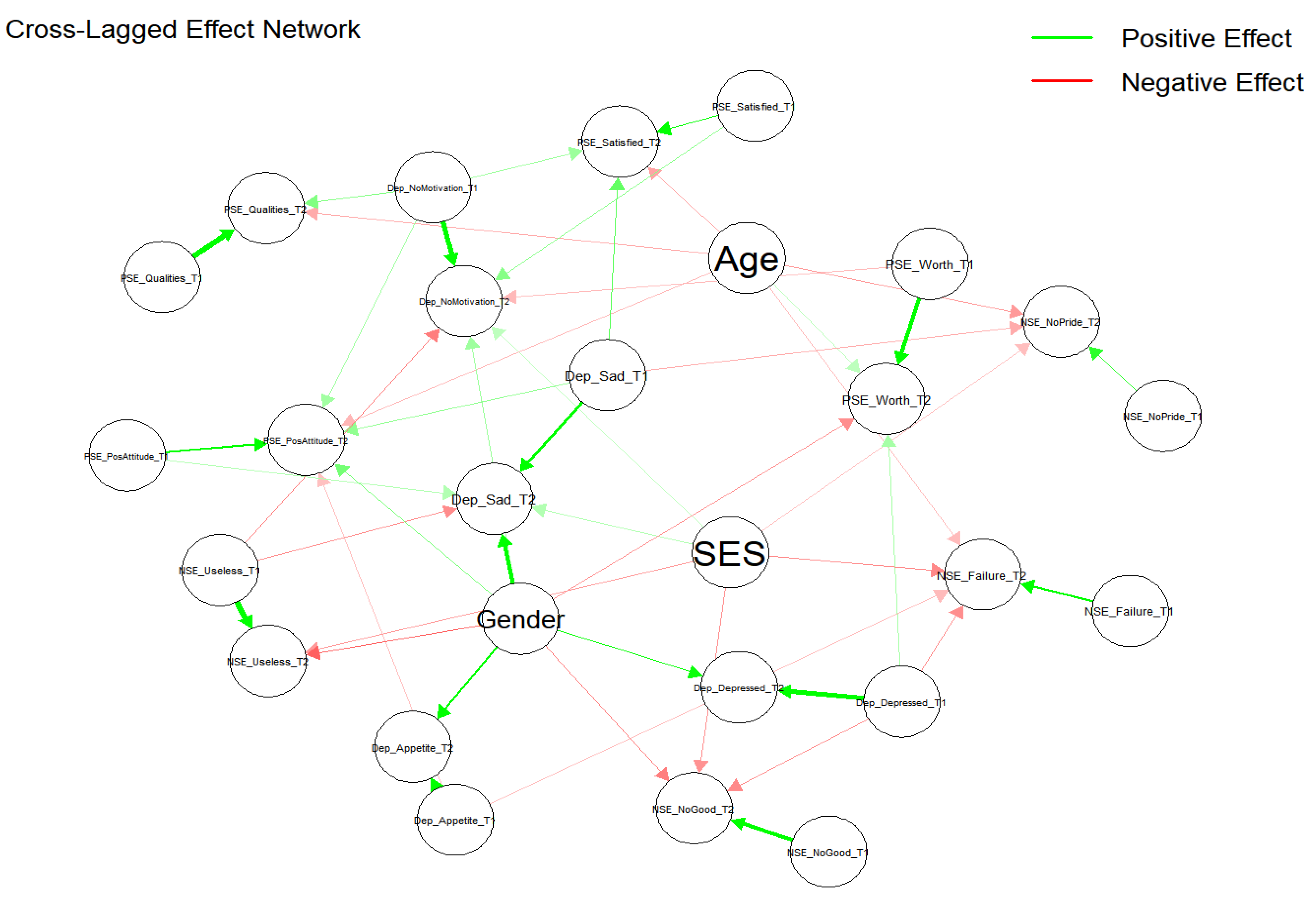
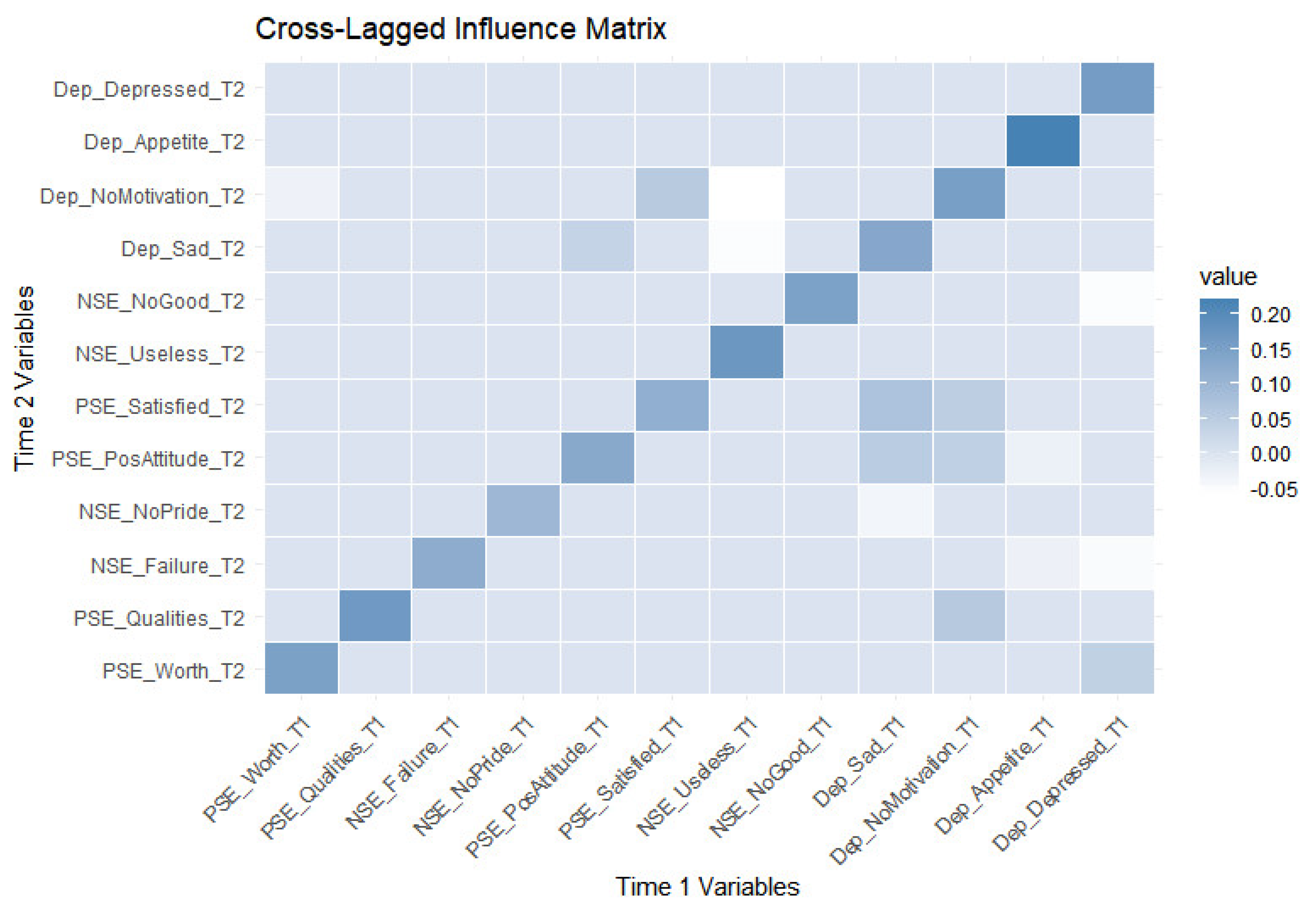
Background/Objectives: The study investigated the dynamic interrelations of both positive and negative self-esteem with depression among immigrant adolescents. Methods: Longitudinal data from the Children of Immigrants Longitudinal Study (CILS) were analyzed using a Cross-Lagged Panel Network (CLPN) model. Results: The results showed strong autoregressive effects; both the positive and negative dimensions of self-esteem and symptoms of depression were fairly stable across the two measurement times. Cross-lagged effects indicated that higher levels of positive self-esteem predicted reduced depressive symptoms; for example, higher self-worth at Time 1 was associated with a lower lack of motivation at Time 2. However, some components, for instance, positive self-attitude, predicted in greater sadness from Time 1 to Time 2. On the other hand, certain dimensions of negative self-esteem, such as feeling useless at Time 1, were related to decreases in depressive symptoms at Time 2, which points to complex and bidirectional effects that challenge traditional hypotheses on how self-esteem may affect mental health. Conclusions: The current study teases apart sub-components of self-esteem and, in doing so, demonstrates how different facets uniquely predict depression over time and inform nuanced mental health trajectories among immigrant youth. The findings indicate that selective self-esteem interventions should be carried out to enhance resilience and mental well-being in adolescents from diverse backgrounds.
Keywords: self-esteem; depression; immigrant adolescents; cross-lagged panel network (CLPN); mental health care self-esteem; depression; immigrant adolescents; cross-lagged panel network (CLPN); mental health care