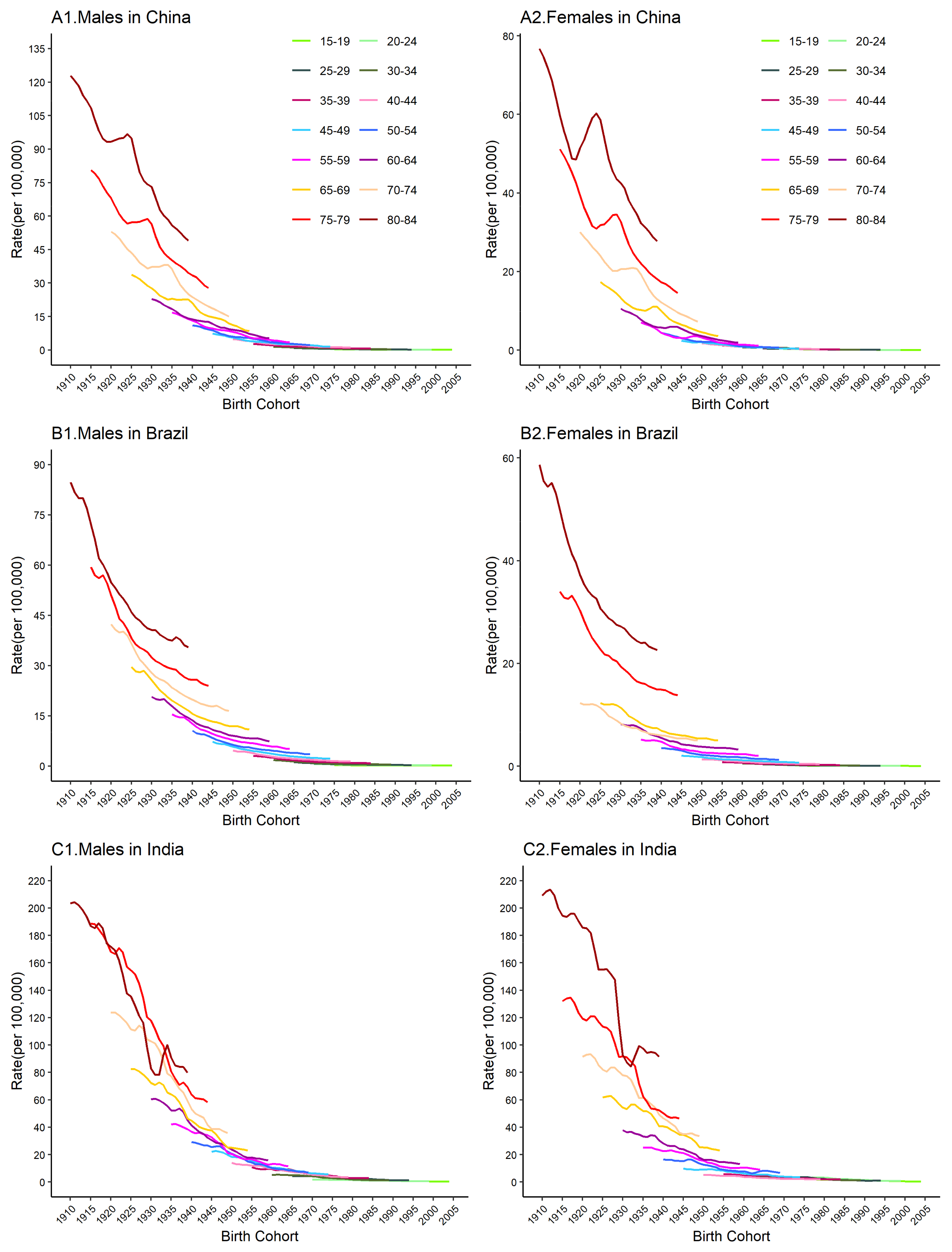
Comparison of Secular Trends in Peptic Ulcer Diseases Mortality in China, Brazil and India during 1990–2019: An Age-Period-Cohort Analysis
 , and
, and Abstract
Share and Cite
Sun, J.; Huang, L.; Li, R.; Wang, T.; Wang, S.; Yu, C.; Gong, J. Comparison of Secular Trends in Peptic Ulcer Diseases Mortality in China, Brazil and India during 1990–2019: An Age-Period-Cohort Analysis. Healthcare 2023, 11, 1085. https://doi.org/10.3390/healthcare11081085
Sun J, Huang L, Li R, Wang T, Wang S, Yu C, Gong J. Comparison of Secular Trends in Peptic Ulcer Diseases Mortality in China, Brazil and India during 1990–2019: An Age-Period-Cohort Analysis. Healthcare. 2023; 11(8):1085. https://doi.org/10.3390/healthcare11081085
Chicago/Turabian StyleSun, Jinyi, Lihong Huang, Ruiqing Li, Tong Wang, Shuwen Wang, Chuanhua Yu, and Jie Gong. 2023. "Comparison of Secular Trends in Peptic Ulcer Diseases Mortality in China, Brazil and India during 1990–2019: An Age-Period-Cohort Analysis" Healthcare 11, no. 8: 1085. https://doi.org/10.3390/healthcare11081085
APA StyleSun, J., Huang, L., Li, R., Wang, T., Wang, S., Yu, C., & Gong, J. (2023). Comparison of Secular Trends in Peptic Ulcer Diseases Mortality in China, Brazil and India during 1990–2019: An Age-Period-Cohort Analysis. Healthcare, 11(8), 1085. https://doi.org/10.3390/healthcare11081085