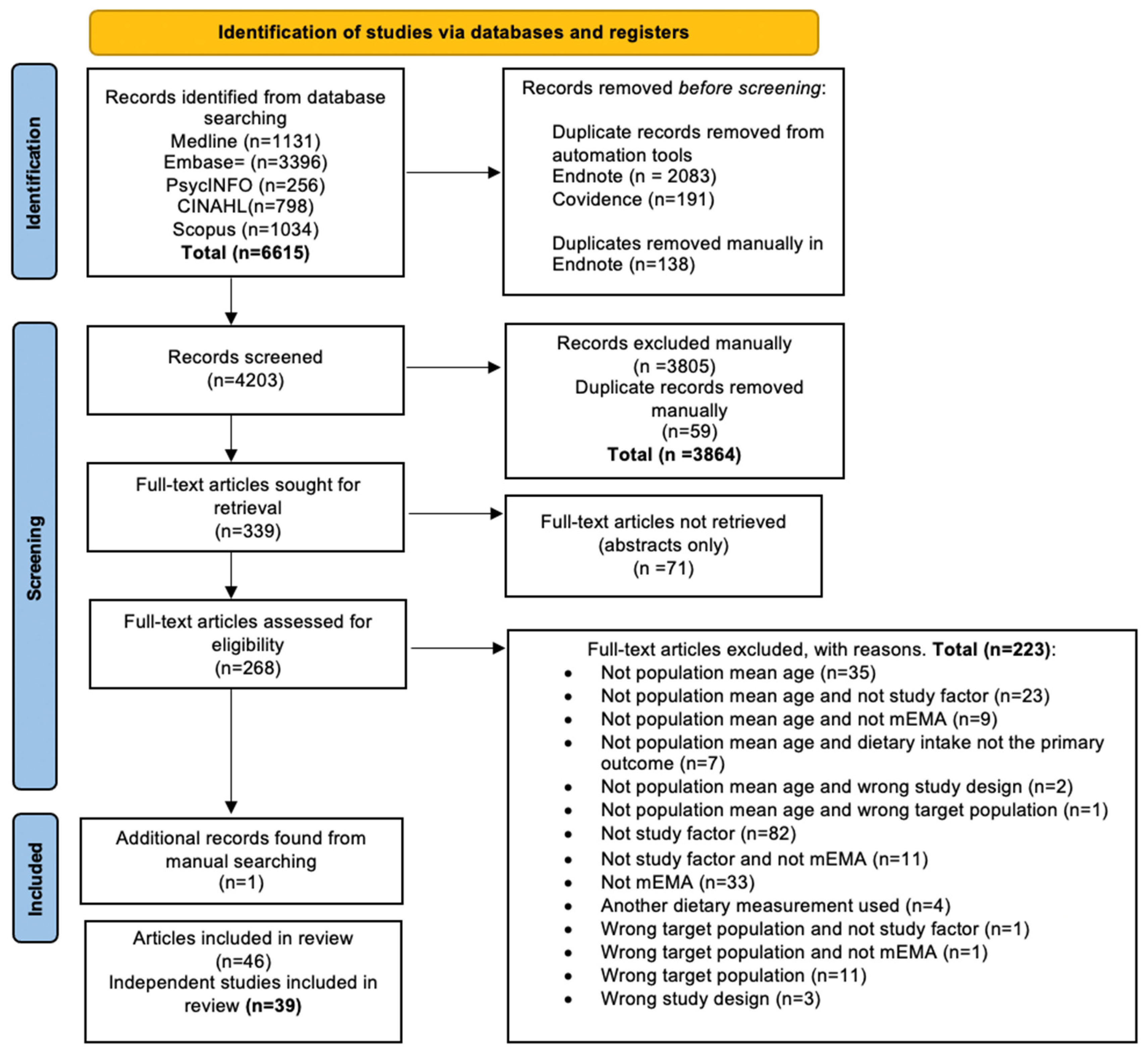
The Use of Mobile-Based Ecological Momentary Assessment (mEMA) Methodology to Assess Dietary Intake, Food Consumption Behaviours and Context in Young People: A Systematic Review
 , and
, and 
Abstract
Share and Cite
Battaglia, B.; Lee, L.; Jia, S.S.; Partridge, S.R.; Allman-Farinelli, M. The Use of Mobile-Based Ecological Momentary Assessment (mEMA) Methodology to Assess Dietary Intake, Food Consumption Behaviours and Context in Young People: A Systematic Review. Healthcare 2022, 10, 1329. https://doi.org/10.3390/healthcare10071329
Battaglia B, Lee L, Jia SS, Partridge SR, Allman-Farinelli M. The Use of Mobile-Based Ecological Momentary Assessment (mEMA) Methodology to Assess Dietary Intake, Food Consumption Behaviours and Context in Young People: A Systematic Review. Healthcare. 2022; 10(7):1329. https://doi.org/10.3390/healthcare10071329
Chicago/Turabian StyleBattaglia, Brigitte, Lydia Lee, Si Si Jia, Stephanie Ruth Partridge, and Margaret Allman-Farinelli. 2022. "The Use of Mobile-Based Ecological Momentary Assessment (mEMA) Methodology to Assess Dietary Intake, Food Consumption Behaviours and Context in Young People: A Systematic Review" Healthcare 10, no. 7: 1329. https://doi.org/10.3390/healthcare10071329
APA StyleBattaglia, B., Lee, L., Jia, S. S., Partridge, S. R., & Allman-Farinelli, M. (2022). The Use of Mobile-Based Ecological Momentary Assessment (mEMA) Methodology to Assess Dietary Intake, Food Consumption Behaviours and Context in Young People: A Systematic Review. Healthcare, 10(7), 1329. https://doi.org/10.3390/healthcare10071329